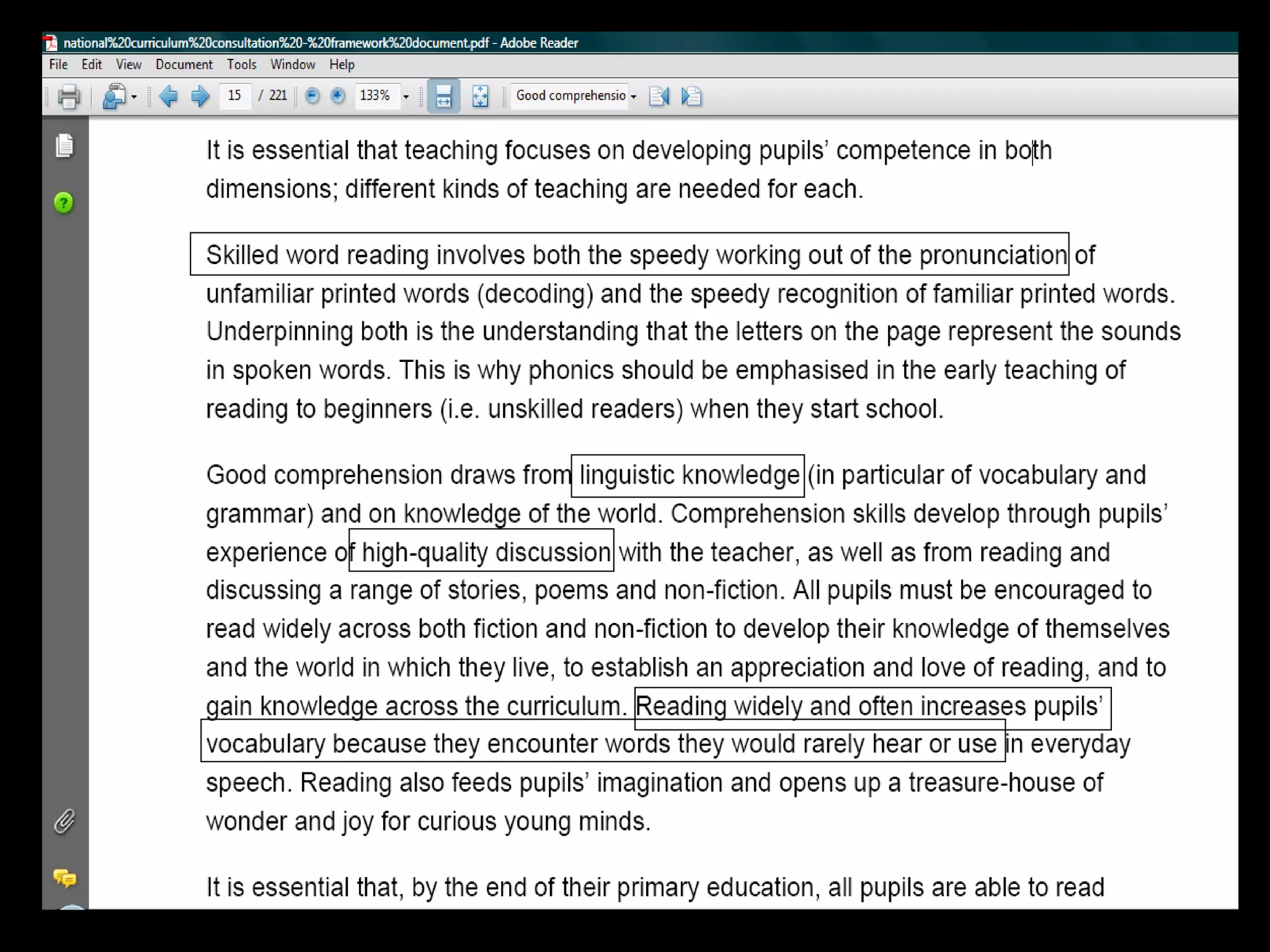
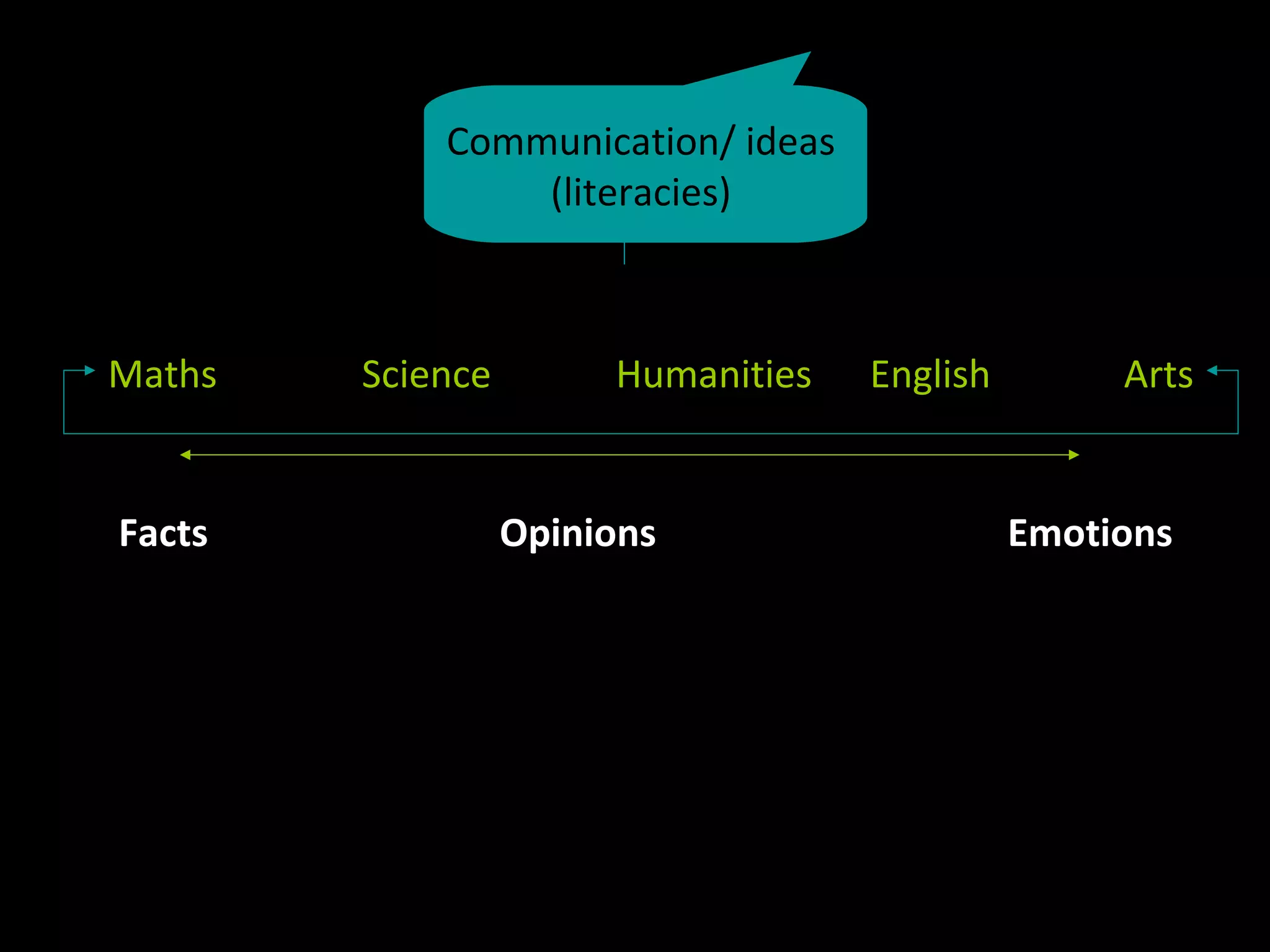
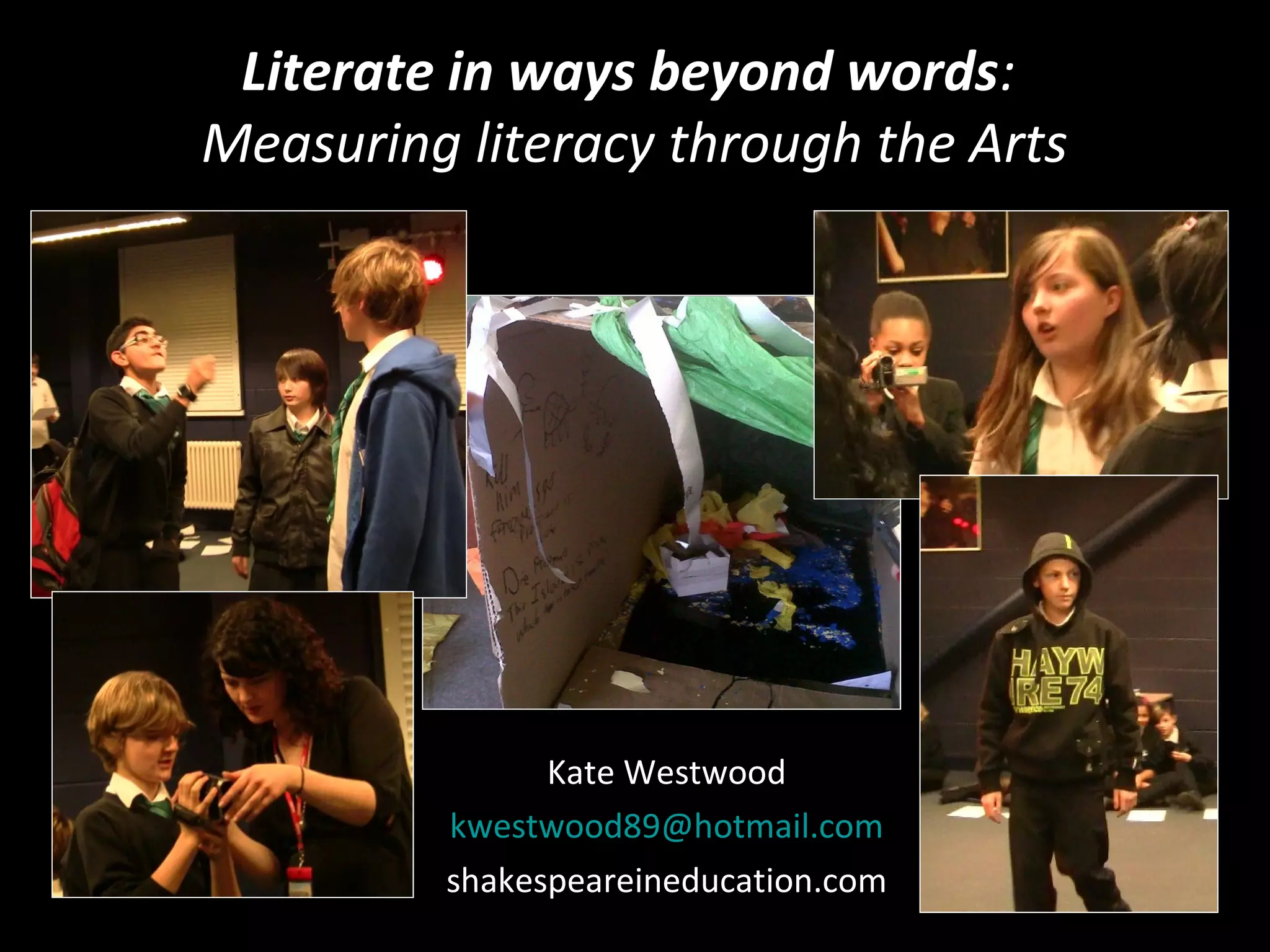
This document discusses measuring literacy through the arts and beyond traditional written words. It provides quotes from students who felt that arts-integrated lessons in English class helped improve their understanding of Shakespeare and engagement with the material compared to traditional lessons. The document also discusses how the internet may make creators more similar to Shakespeare in blending various ideas and media, as well as making people less categorical in their thinking.
![education in the twenty-first century needs to
focus more sharply on the ability to
communicate, to work in teams, to think
critically, to adapt to change, [and] to be more
innovative, creative and familiar with new
technologies.[1]
Cynthia Guttman, ‘Education in and for the Information Society’, UNESCO, (2003)
[1]
http://unesdoc.unesco.org/images/0013/001355/135528e.pdf [accessed 16/2/2012], p. 17.](https://image.slidesharecdn.com/trinity-130222042531-phpapp01/75/Literate-in-ways-beyond-words-2-2048.jpg)
![‘What students have picked up from their intellectual
environment is the message that the professionally
praiseworthy attitude to literature is one that demonstrates
that it has not come under its spell. Disenchantment,
disengagement, is the thing. […] the student who
begins a course of literary study precisely because they have
found themselves enchanted and engaged, often rapidly
discovers that they must put away such childlike responses’](https://image.slidesharecdn.com/trinity-130222042531-phpapp01/75/Literate-in-ways-beyond-words-3-2048.jpg)
![‘as well as […] English, we also need to make sure our
children are fluent in the most important languages of the
twenty-first century - maths and science. We urgently need
to ensure our children study rigorous disciplines instead of
pseudo-subjects. Otherwise we will be left behind [the rest
of the world in education].’
(Gove, 2010)](https://image.slidesharecdn.com/trinity-130222042531-phpapp01/75/Literate-in-ways-beyond-words-4-2048.jpg)
![‘I liked the fact that we didn’t do much writing because
we normally do loads of writing in normal English lessons’
‘I liked doing drama […] because it was a nice change from
normal lessons.’
‘[…] I love drama. I liked that instead of just writing the
modern version we got to perform it.’
‘It got more people involved and was more interesting
than normal English lessons.’
‘I liked the practical things we [did] it was better than
normal lessons because we didn’t write as much’](https://image.slidesharecdn.com/trinity-130222042531-phpapp01/75/Literate-in-ways-beyond-words-5-2048.jpg)
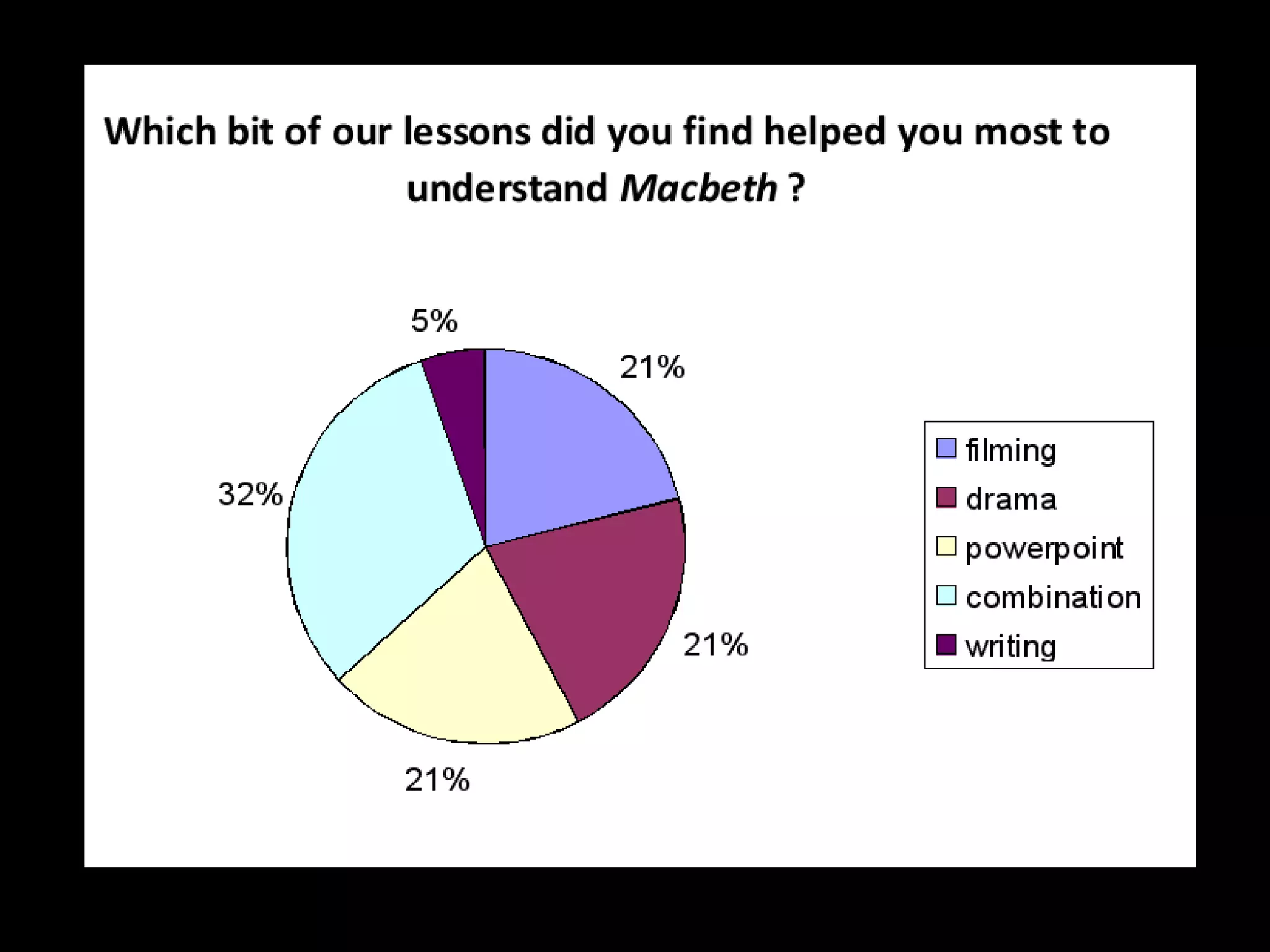
![‘it was a better approach to teach us’
‘working in groups encouraged me to do better’
‘our lessons are fun and interesting’
81% of this class felt more confident with Shakespeare after these lessons
‘No, [there was nothing I would have preferred to have done differently] because
[the classes] were all interactive and full of things to do.’
59% felt more confident with Shakespeare’s language
after using it in their adaptation
71% felt confident about future study and assessment in English
‘I understand the words more’](https://image.slidesharecdn.com/trinity-130222042531-phpapp01/75/Literate-in-ways-beyond-words-8-2048.jpg)
![‘How is the internet changing the way you create? […]
The Gutenberg Parenthesis answer would be “it’s
making me a bit more like Shakespeare”’
‘The internet will make us less categorical in the way
we perceive the world’
1440s 1980s](https://image.slidesharecdn.com/trinity-130222042531-phpapp01/75/Literate-in-ways-beyond-words-9-2048.jpg)