Download to read offline

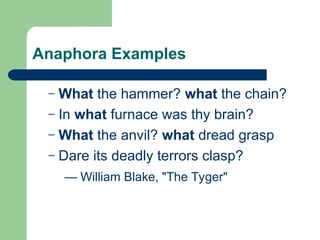
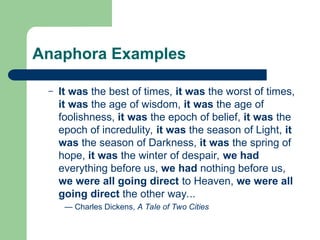

Anaphora is a rhetorical device involving the repetition of words at the beginning of neighboring clauses for emphasis. Examples are provided from works by William Blake and Charles Dickens, which illustrate how anaphora draws attention to specific details. An exercise is included for identifying anaphora in 'Frederick Douglass' by Robert Hayden, focusing on its contribution to the poem’s meaning.


