Click on the book to go to the table
                 of contents


Comprehension Texts

RESOURCES TO HELP TEACHERS HELP
           STUDENTS
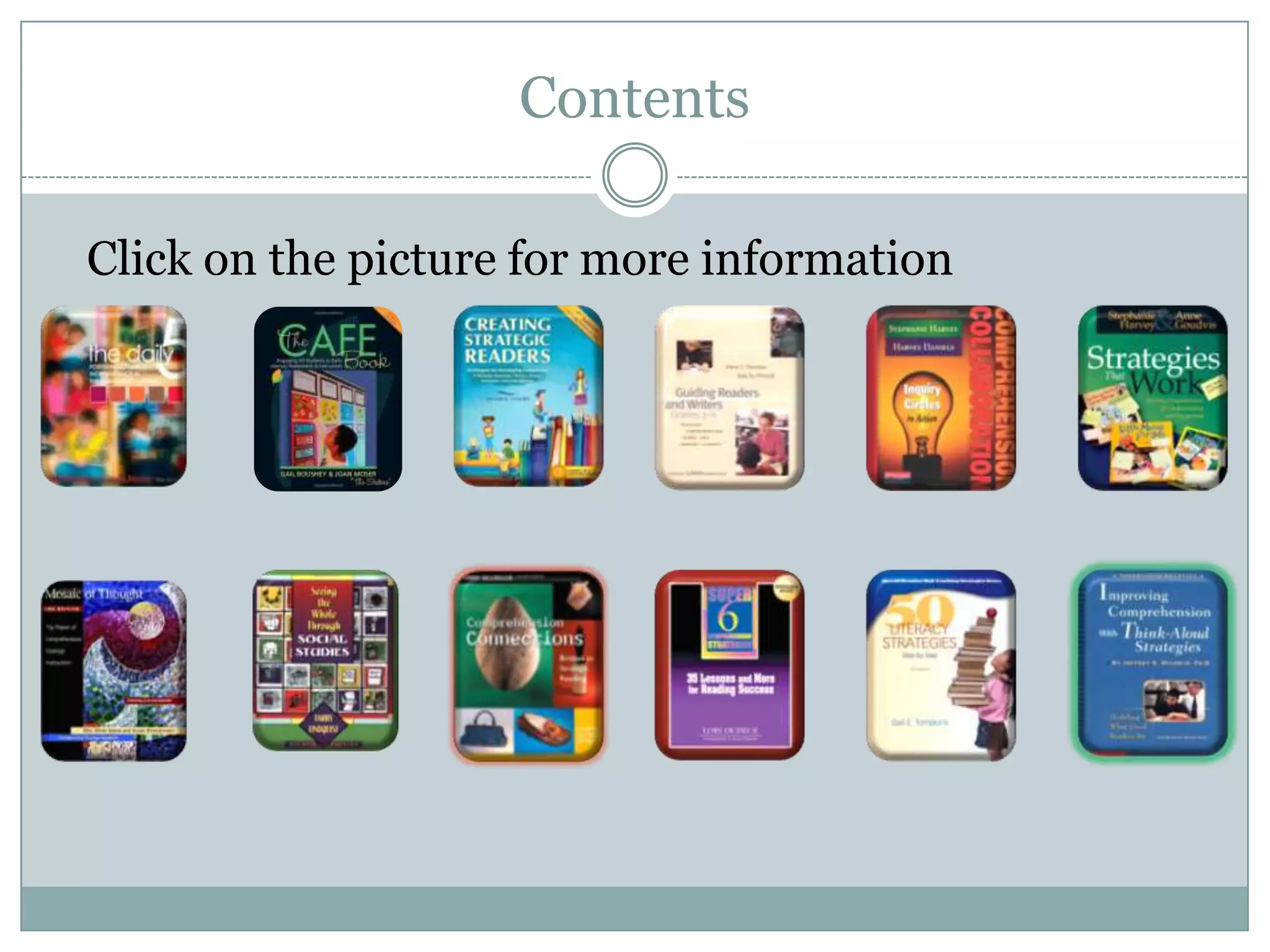
Contents

Click on the picture for more information
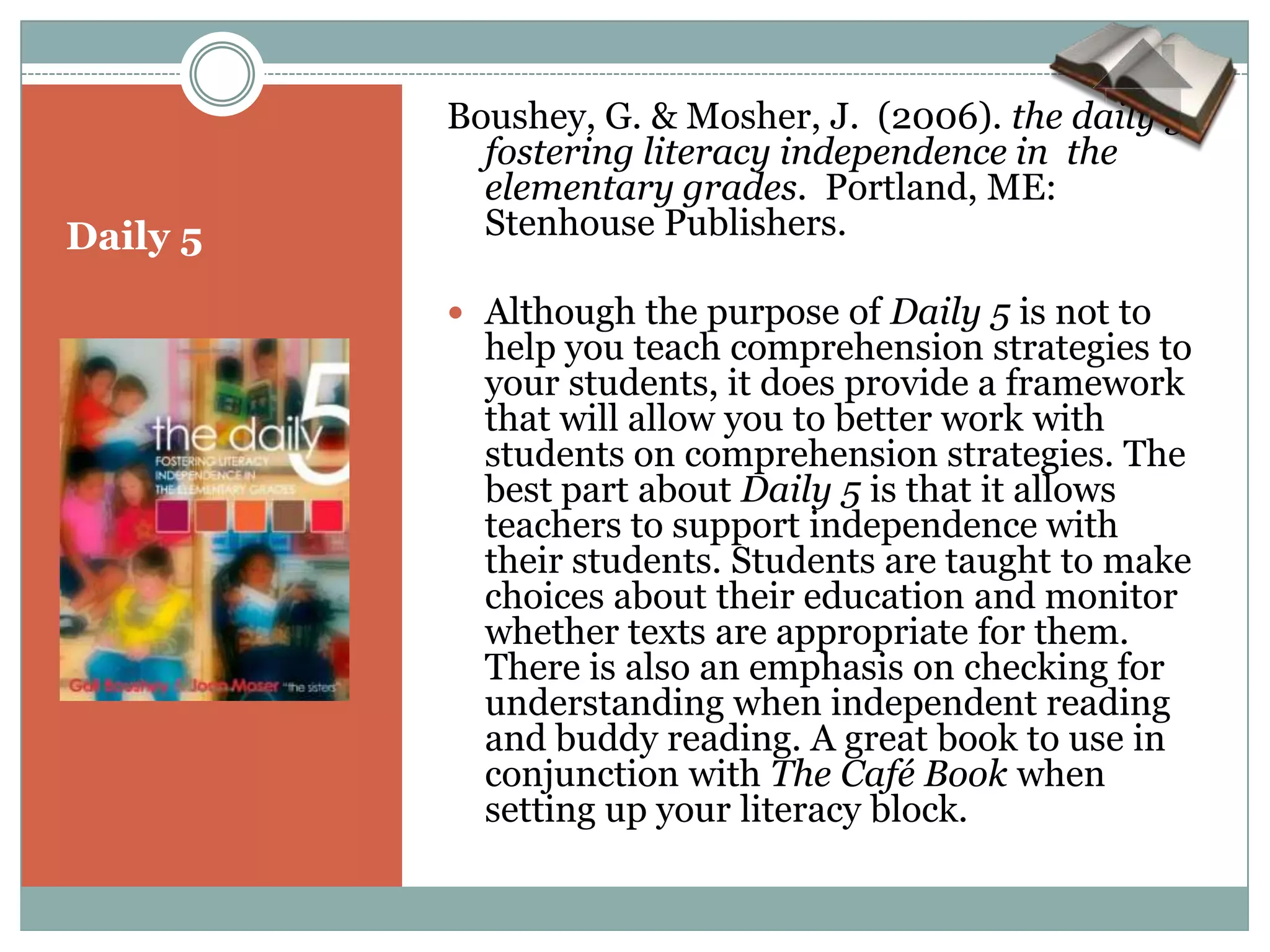
Boushey, G. & Mosher, J. (2006). the daily 5:
            fostering literacy independence in the
            elementary grades. Portland, ME:
Daily 5     Stenhouse Publishers.

           Although the purpose of Daily 5 is not to
            help you teach comprehension strategies to
            your students, it does provide a framework
            that will allow you to better work with
            students on comprehension strategies. The
            best part about Daily 5 is that it allows
            teachers to support independence with
            their students. Students are taught to make
            choices about their education and monitor
            whether texts are appropriate for them.
            There is also an emphasis on checking for
            understanding when independent reading
            and buddy reading. A great book to use in
            conjunction with The Café Book when
            setting up your literacy block.
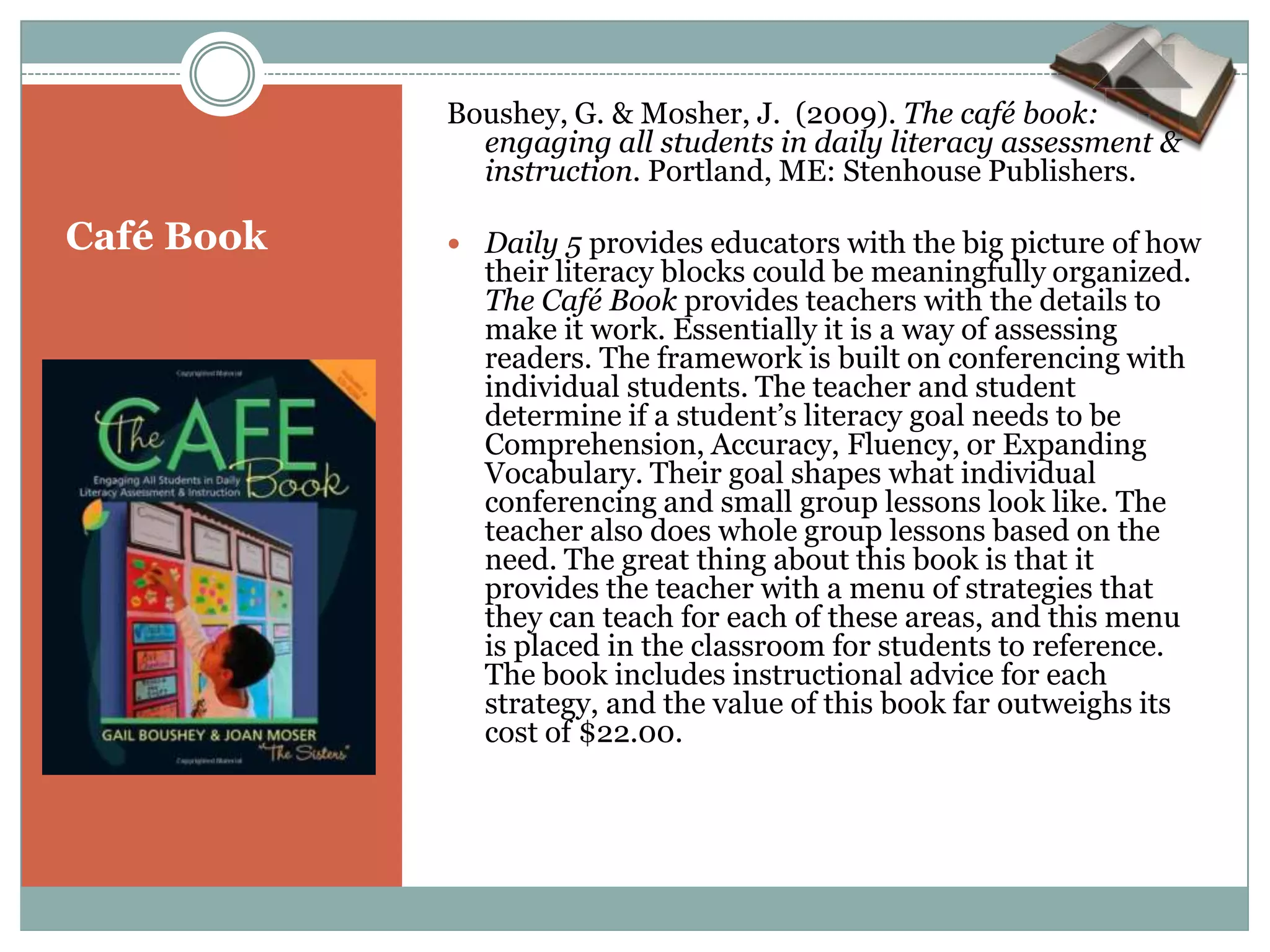
Boushey, G. & Mosher, J. (2009). The café book:
              engaging all students in daily literacy assessment &
              instruction. Portland, ME: Stenhouse Publishers.

Café Book    Daily 5 provides educators with the big picture of how
              their literacy blocks could be meaningfully organized.
              The Café Book provides teachers with the details to
              make it work. Essentially it is a way of assessing
              readers. The framework is built on conferencing with
              individual students. The teacher and student
              determine if a student’s literacy goal needs to be
              Comprehension, Accuracy, Fluency, or Expanding
              Vocabulary. Their goal shapes what individual
              conferencing and small group lessons look like. The
              teacher also does whole group lessons based on the
              need. The great thing about this book is that it
              provides the teacher with a menu of strategies that
              they can teach for each of these areas, and this menu
              is placed in the classroom for students to reference.
              The book includes instructional advice for each
              strategy, and the value of this book far outweighs its
              cost of $22.00.
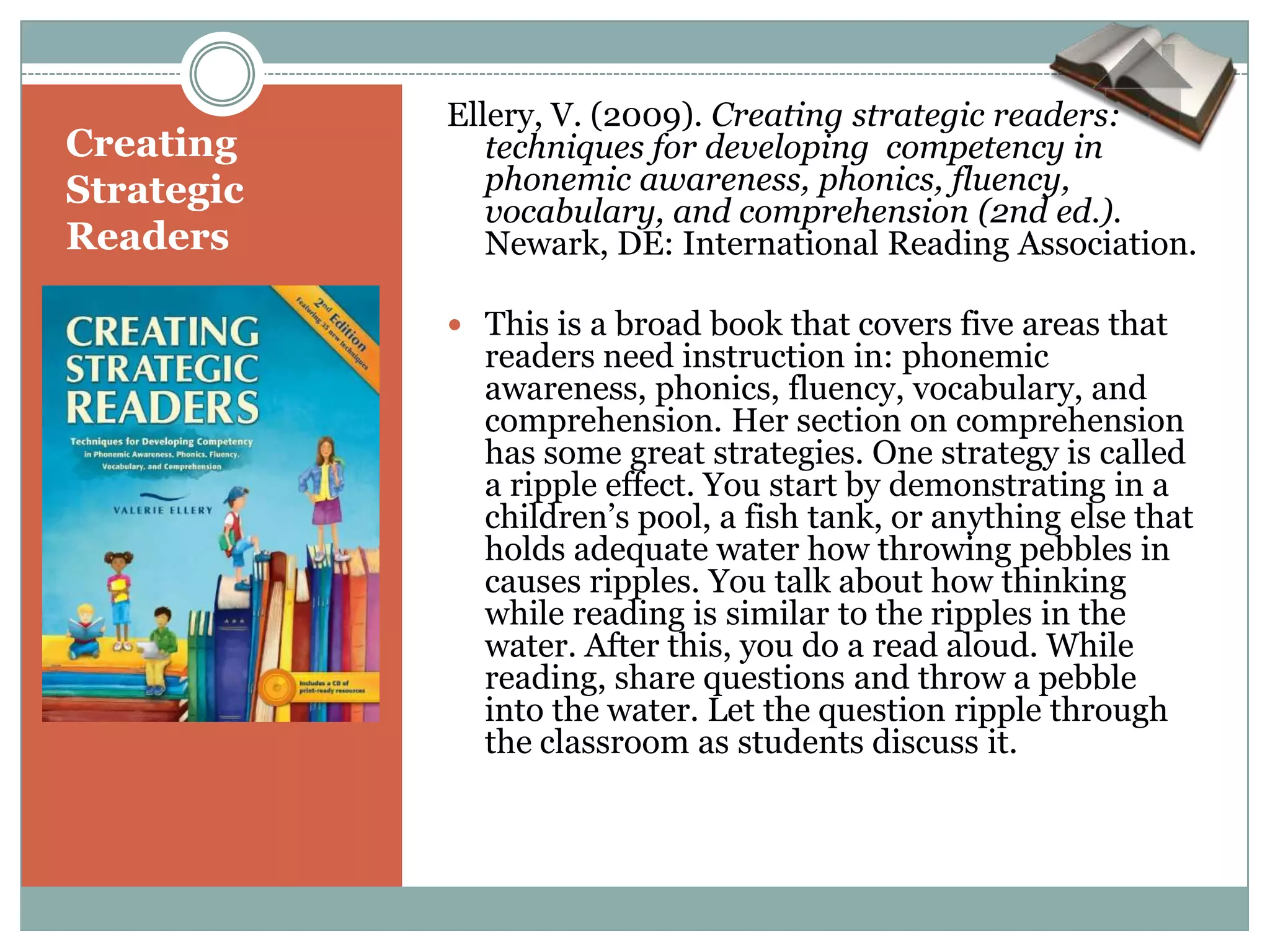
Ellery, V. (2009). Creating strategic readers:
Creating       techniques for developing competency in
Strategic      phonemic awareness, phonics, fluency,
               vocabulary, and comprehension (2nd ed.).
Readers        Newark, DE: International Reading Association.

             This is a broad book that covers five areas that
              readers need instruction in: phonemic
              awareness, phonics, fluency, vocabulary, and
              comprehension. Her section on comprehension
              has some great strategies. One strategy is called
              a ripple effect. You start by demonstrating in a
              children’s pool, a fish tank, or anything else that
              holds adequate water how throwing pebbles in
              causes ripples. You talk about how thinking
              while reading is similar to the ripples in the
              water. After this, you do a read aloud. While
              reading, share questions and throw a pebble
              into the water. Let the question ripple through
              the classroom as students discuss it.
Fountas, I.C. & Pinell, G.S. (2001).
Guiding         Guiding readers and writers grades 3-
Readers and     6: teaching comprehension, genre, and
Writers         content literacy. Portsmouth, NH:
                Heinemann.

               This book is the bible of literacy
                instruction. It contains information
                about almost every area of literacy
                (excluding digital literacy) you can
                think of. It is a treasure trove of
                resources, and it is an essential read if
                you are setting up a reading, writing, or
                word study workshop. It also is a great
                book to look up information about
                teaching comprehension or any other
                questions you might have.
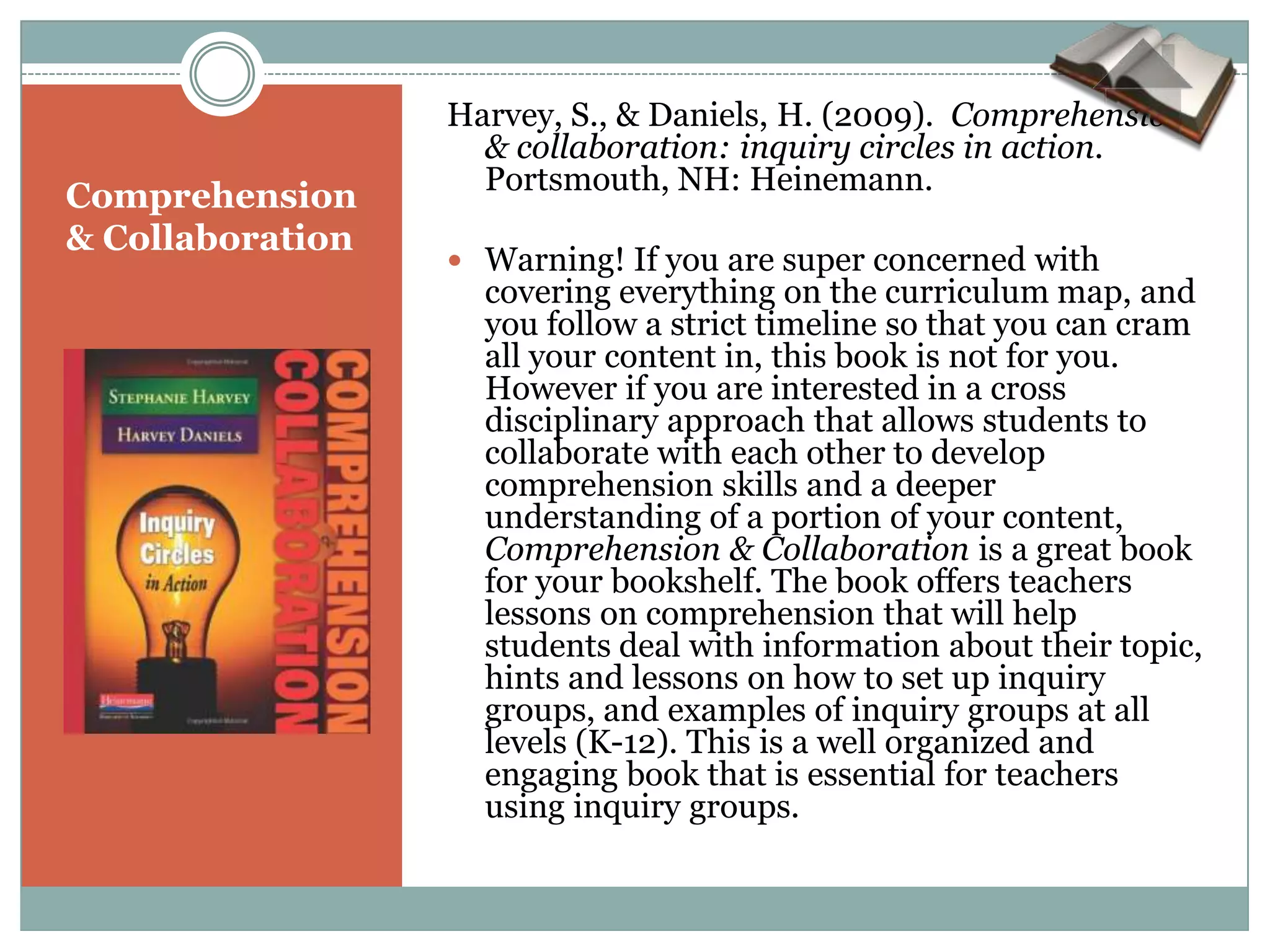
Harvey, S., & Daniels, H. (2009). Comprehension
                    & collaboration: inquiry circles in action.
                    Portsmouth, NH: Heinemann.
Comprehension
& Collaboration
                   Warning! If you are super concerned with
                    covering everything on the curriculum map, and
                    you follow a strict timeline so that you can cram
                    all your content in, this book is not for you.
                    However if you are interested in a cross
                    disciplinary approach that allows students to
                    collaborate with each other to develop
                    comprehension skills and a deeper
                    understanding of a portion of your content,
                    Comprehension & Collaboration is a great book
                    for your bookshelf. The book offers teachers
                    lessons on comprehension that will help
                    students deal with information about their topic,
                    hints and lessons on how to set up inquiry
                    groups, and examples of inquiry groups at all
                    levels (K-12). This is a well organized and
                    engaging book that is essential for teachers
                    using inquiry groups.
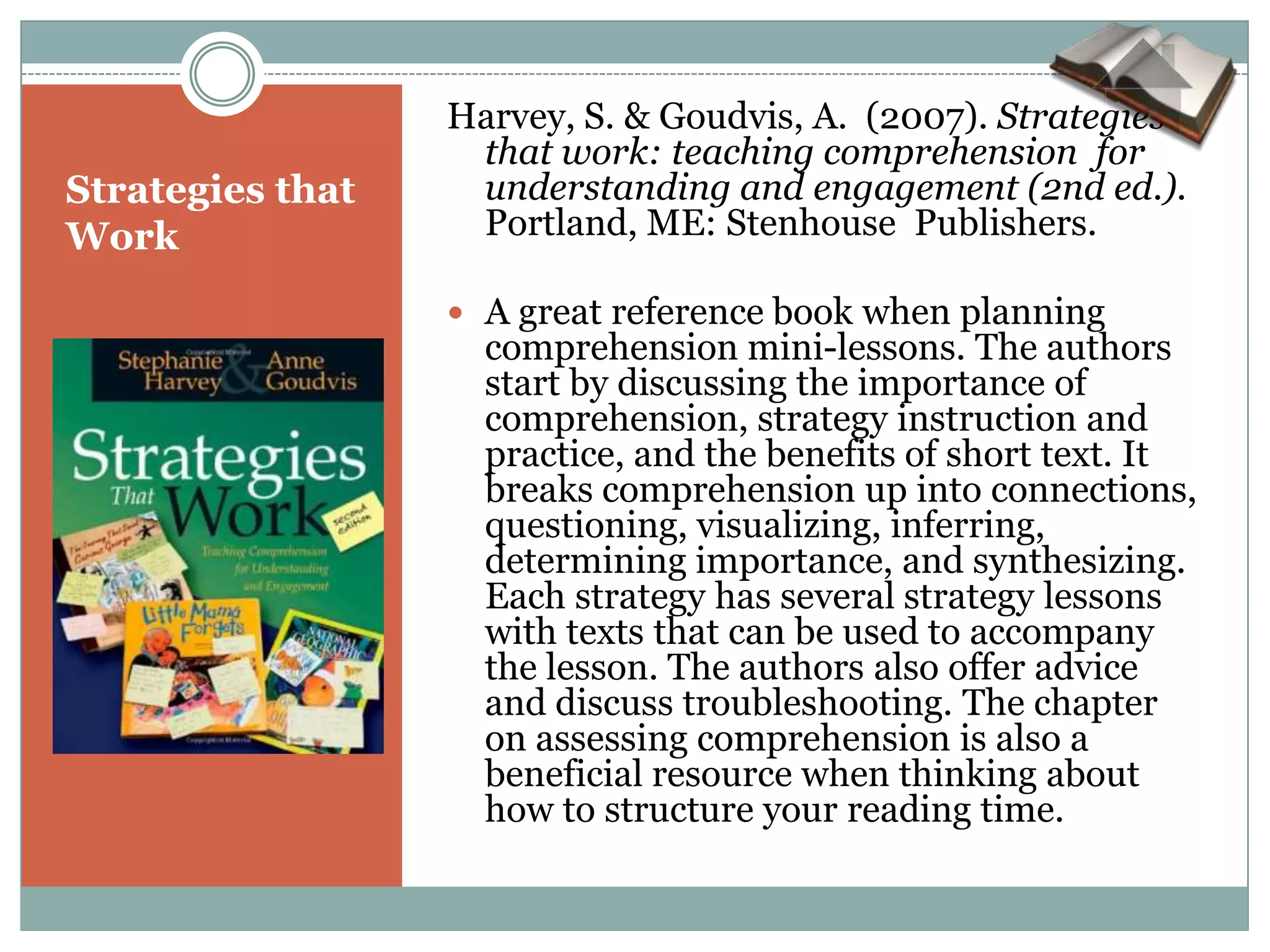
Harvey, S. & Goudvis, A. (2007). Strategies
                   that work: teaching comprehension for
Strategies that    understanding and engagement (2nd ed.).
Work               Portland, ME: Stenhouse Publishers.

                   A great reference book when planning
                    comprehension mini-lessons. The authors
                    start by discussing the importance of
                    comprehension, strategy instruction and
                    practice, and the benefits of short text. It
                    breaks comprehension up into connections,
                    questioning, visualizing, inferring,
                    determining importance, and synthesizing.
                    Each strategy has several strategy lessons
                    with texts that can be used to accompany
                    the lesson. The authors also offer advice
                    and discuss troubleshooting. The chapter
                    on assessing comprehension is also a
                    beneficial resource when thinking about
                    how to structure your reading time.
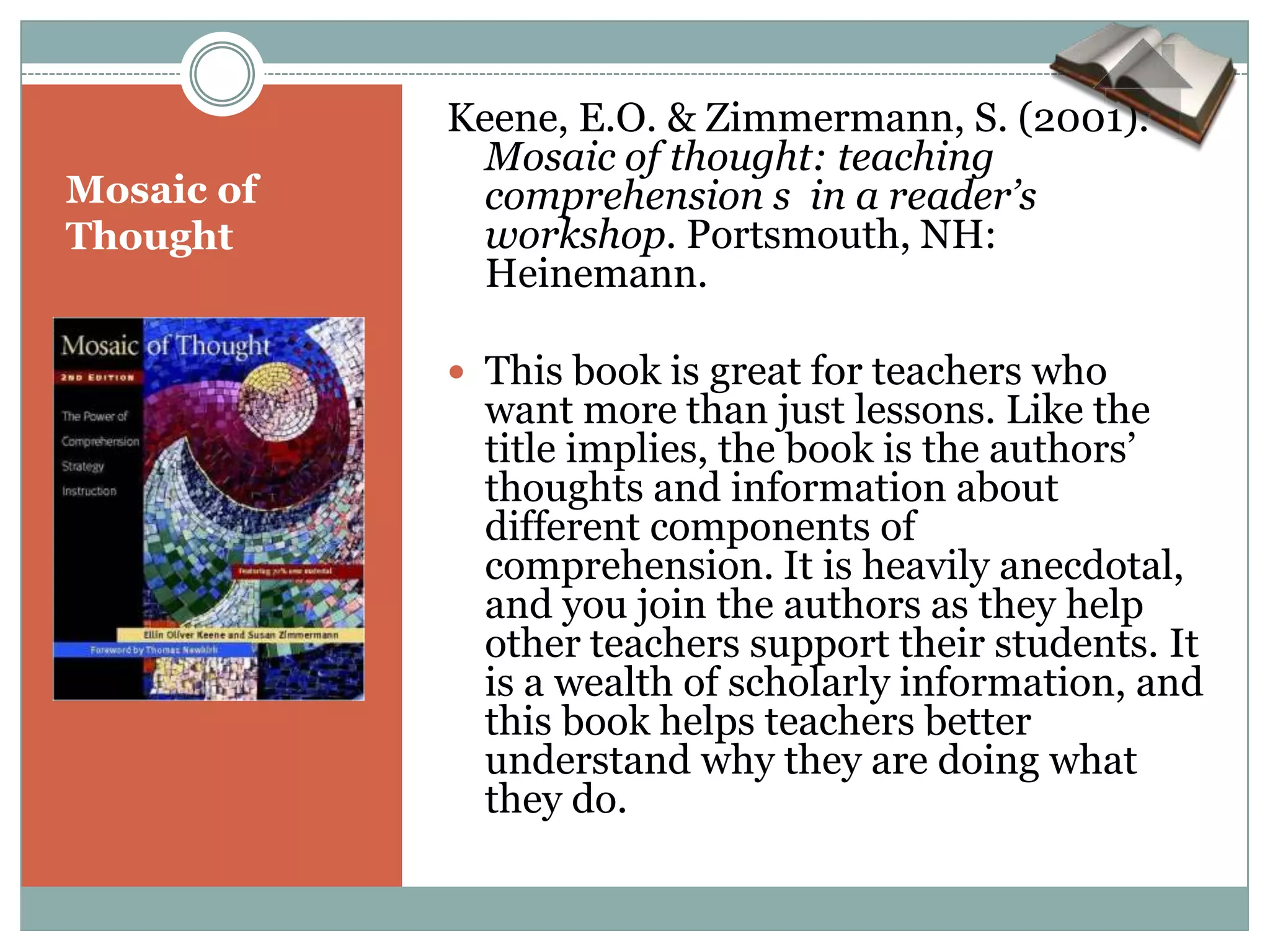
Keene, E.O. & Zimmermann, S. (2001).
              Mosaic of thought: teaching
Mosaic of     comprehension s in a reader’s
Thought       workshop. Portsmouth, NH:
              Heinemann.

             This book is great for teachers who
              want more than just lessons. Like the
              title implies, the book is the authors’
              thoughts and information about
              different components of
              comprehension. It is heavily anecdotal,
              and you join the authors as they help
              other teachers support their students. It
              is a wealth of scholarly information, and
              this book helps teachers better
              understand why they are doing what
              they do.
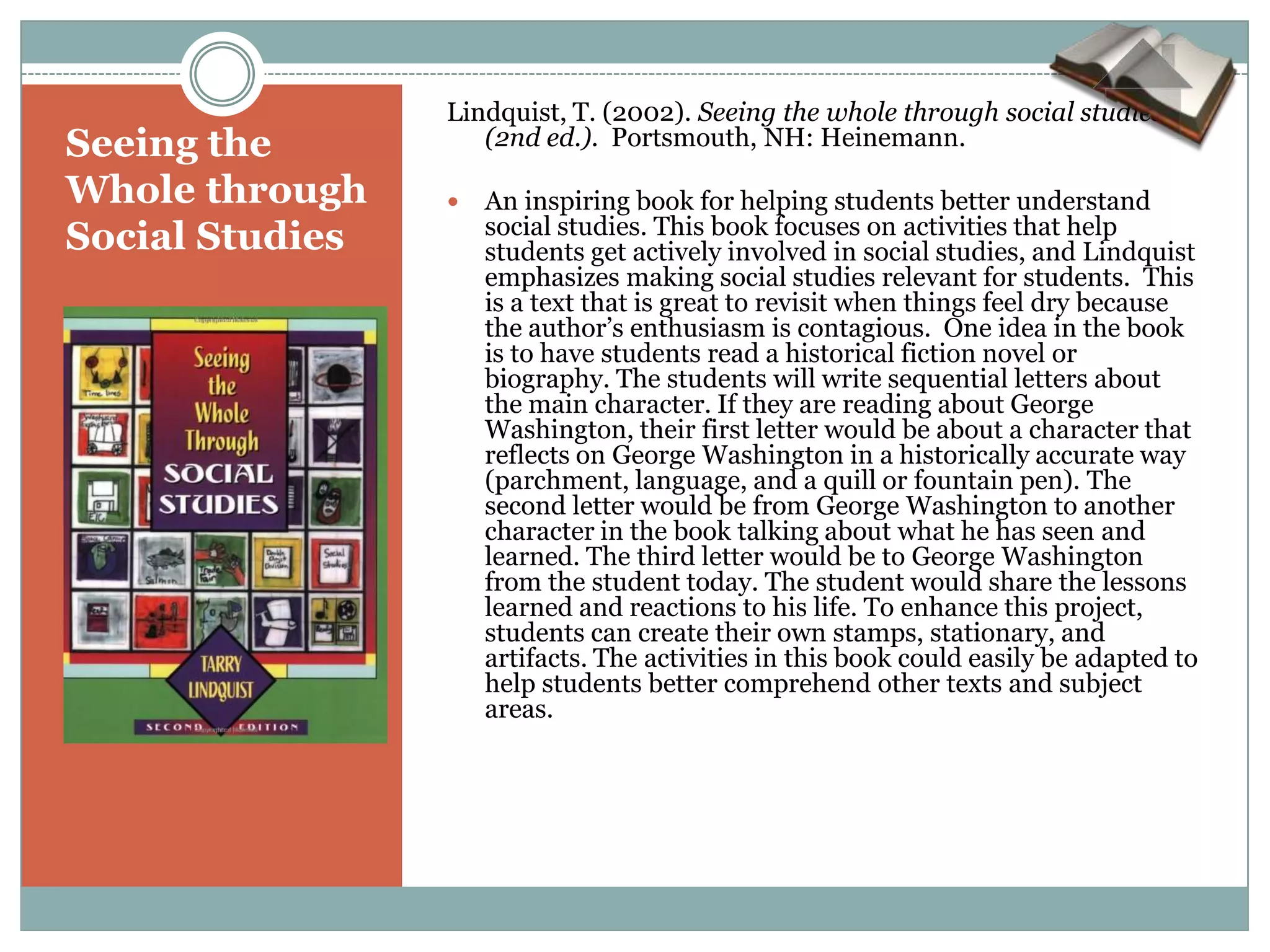
Lindquist, T. (2002). Seeing the whole through social studies
Seeing the          (2nd ed.). Portsmouth, NH: Heinemann.

Whole through       An inspiring book for helping students better understand
                     social studies. This book focuses on activities that help
Social Studies       students get actively involved in social studies, and Lindquist
                     emphasizes making social studies relevant for students. This
                     is a text that is great to revisit when things feel dry because
                     the author’s enthusiasm is contagious. One idea in the book
                     is to have students read a historical fiction novel or
                     biography. The students will write sequential letters about
                     the main character. If they are reading about George
                     Washington, their first letter would be about a character that
                     reflects on George Washington in a historically accurate way
                     (parchment, language, and a quill or fountain pen). The
                     second letter would be from George Washington to another
                     character in the book talking about what he has seen and
                     learned. The third letter would be to George Washington
                     from the student today. The student would share the lessons
                     learned and reactions to his life. To enhance this project,
                     students can create their own stamps, stationary, and
                     artifacts. The activities in this book could easily be adapted to
                     help students better comprehend other texts and subject
                     areas.
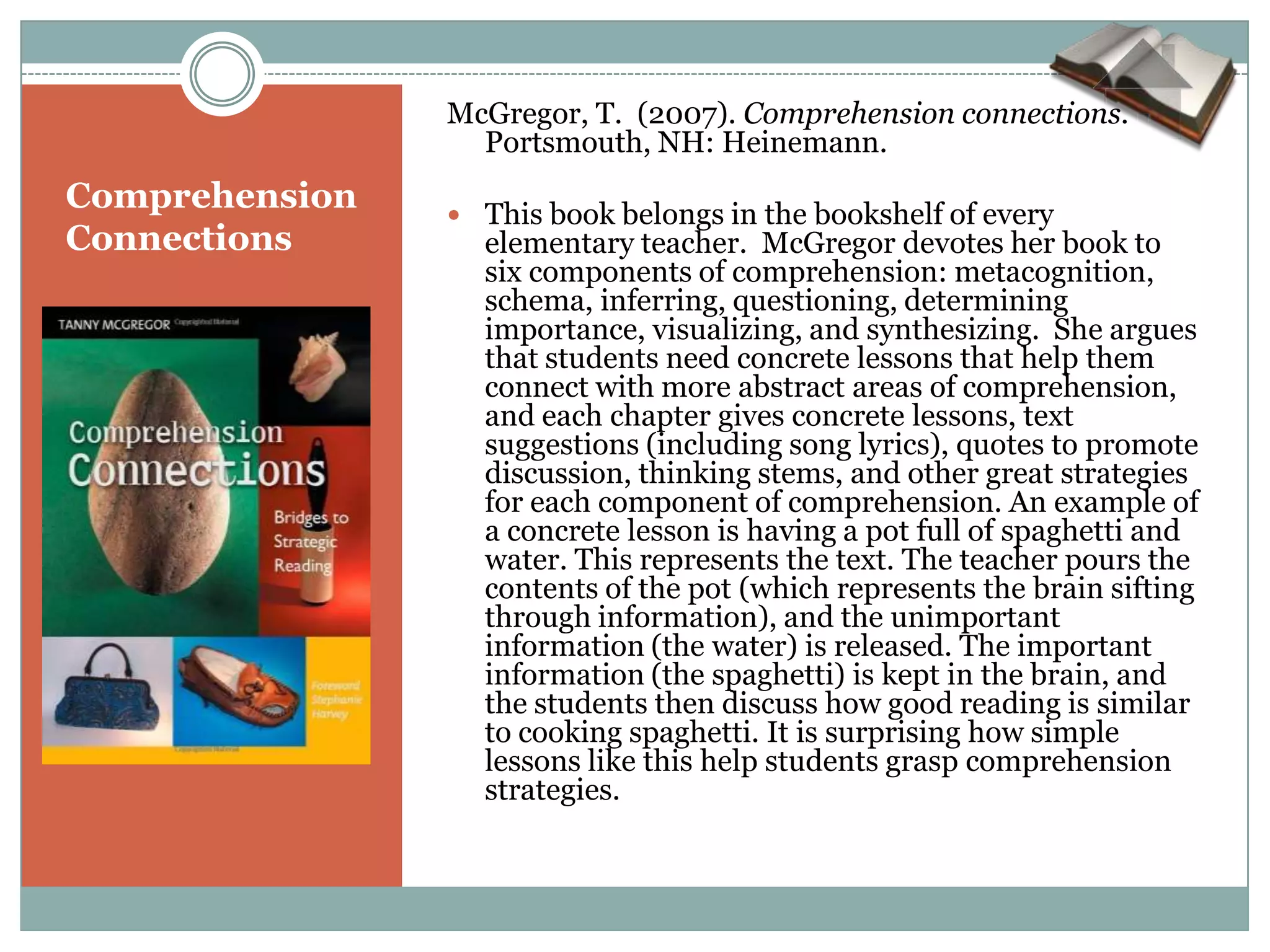
McGregor, T. (2007). Comprehension connections.
                  Portsmouth, NH: Heinemann.
Comprehension    This book belongs in the bookshelf of every
Connections       elementary teacher. McGregor devotes her book to
                  six components of comprehension: metacognition,
                  schema, inferring, questioning, determining
                  importance, visualizing, and synthesizing. She argues
                  that students need concrete lessons that help them
                  connect with more abstract areas of comprehension,
                  and each chapter gives concrete lessons, text
                  suggestions (including song lyrics), quotes to promote
                  discussion, thinking stems, and other great strategies
                  for each component of comprehension. An example of
                  a concrete lesson is having a pot full of spaghetti and
                  water. This represents the text. The teacher pours the
                  contents of the pot (which represents the brain sifting
                  through information), and the unimportant
                  information (the water) is released. The important
                  information (the spaghetti) is kept in the brain, and
                  the students then discuss how good reading is similar
                  to cooking spaghetti. It is surprising how simple
                  lessons like this help students grasp comprehension
                  strategies.
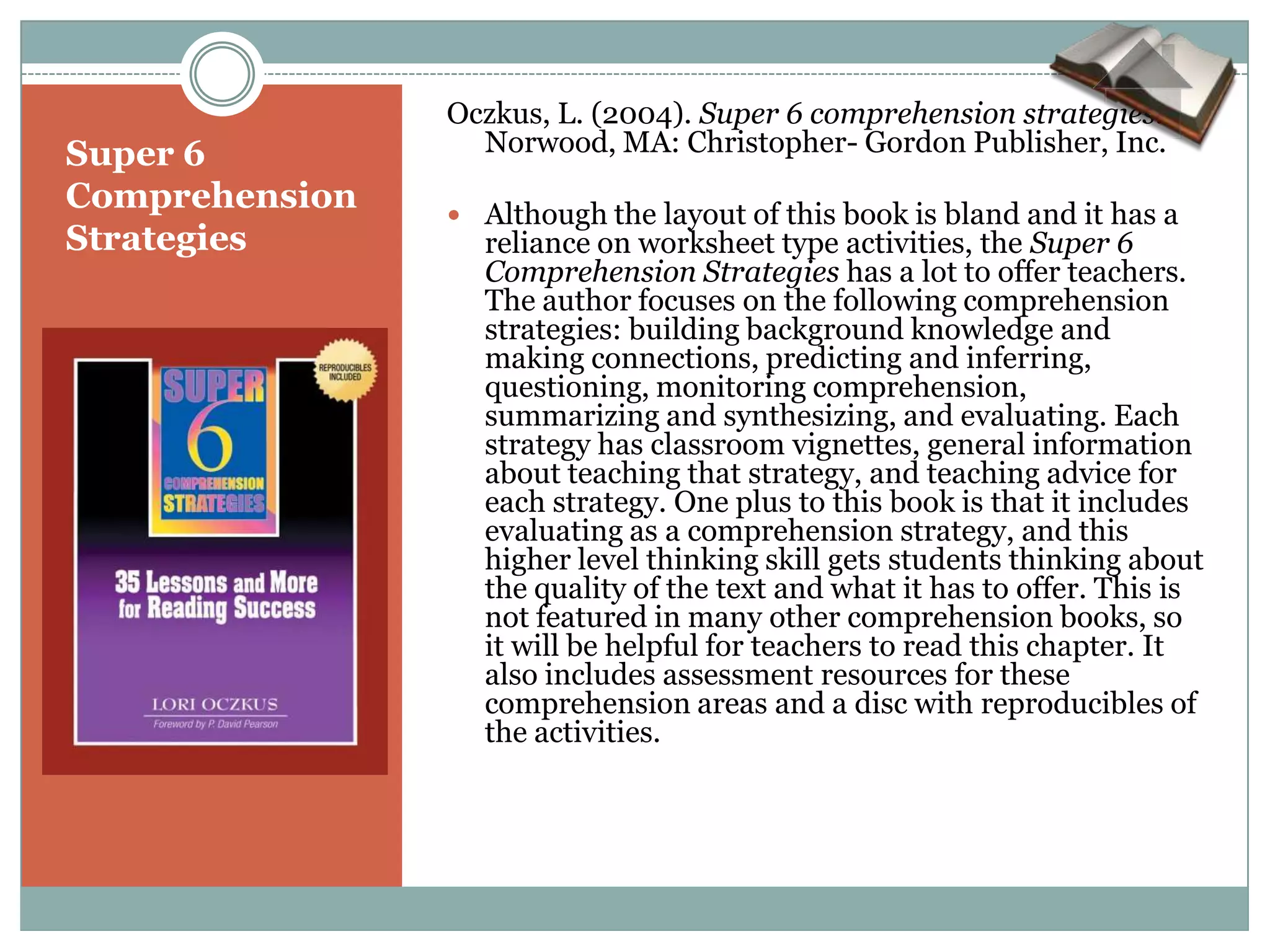
Oczkus, L. (2004). Super 6 comprehension strategies.
Super 6           Norwood, MA: Christopher- Gordon Publisher, Inc.
Comprehension    Although the layout of this book is bland and it has a
Strategies        reliance on worksheet type activities, the Super 6
                  Comprehension Strategies has a lot to offer teachers.
                  The author focuses on the following comprehension
                  strategies: building background knowledge and
                  making connections, predicting and inferring,
                  questioning, monitoring comprehension,
                  summarizing and synthesizing, and evaluating. Each
                  strategy has classroom vignettes, general information
                  about teaching that strategy, and teaching advice for
                  each strategy. One plus to this book is that it includes
                  evaluating as a comprehension strategy, and this
                  higher level thinking skill gets students thinking about
                  the quality of the text and what it has to offer. This is
                  not featured in many other comprehension books, so
                  it will be helpful for teachers to read this chapter. It
                  also includes assessment resources for these
                  comprehension areas and a disc with reproducibles of
                  the activities.
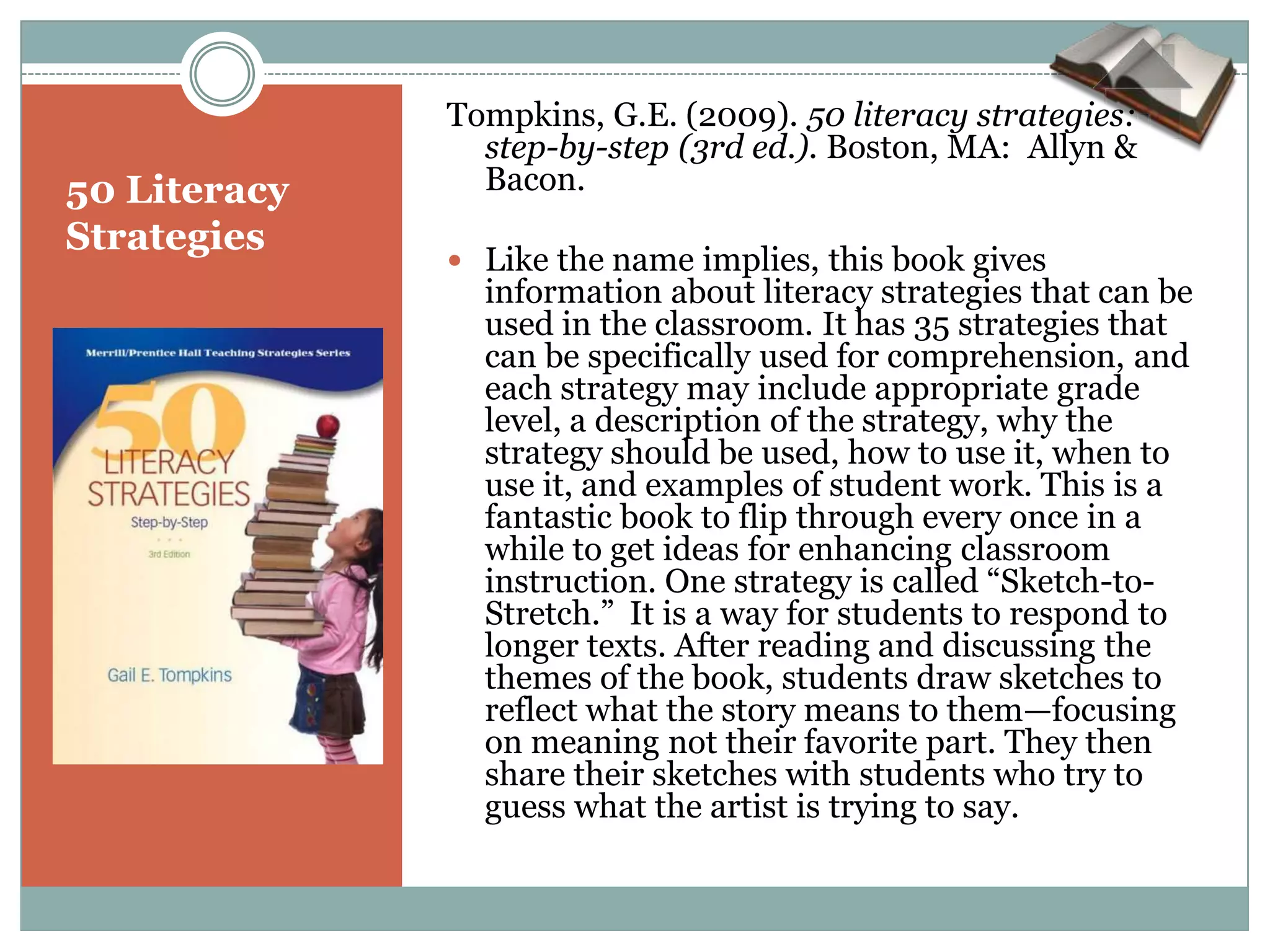
Tompkins, G.E. (2009). 50 literacy strategies:
                step-by-step (3rd ed.). Boston, MA: Allyn &
50 Literacy     Bacon.
Strategies
               Like the name implies, this book gives
                information about literacy strategies that can be
                used in the classroom. It has 35 strategies that
                can be specifically used for comprehension, and
                each strategy may include appropriate grade
                level, a description of the strategy, why the
                strategy should be used, how to use it, when to
                use it, and examples of student work. This is a
                fantastic book to flip through every once in a
                while to get ideas for enhancing classroom
                instruction. One strategy is called “Sketch-to-
                Stretch.” It is a way for students to respond to
                longer texts. After reading and discussing the
                themes of the book, students draw sketches to
                reflect what the story means to them—focusing
                on meaning not their favorite part. They then
                share their sketches with students who try to
                guess what the artist is trying to say.
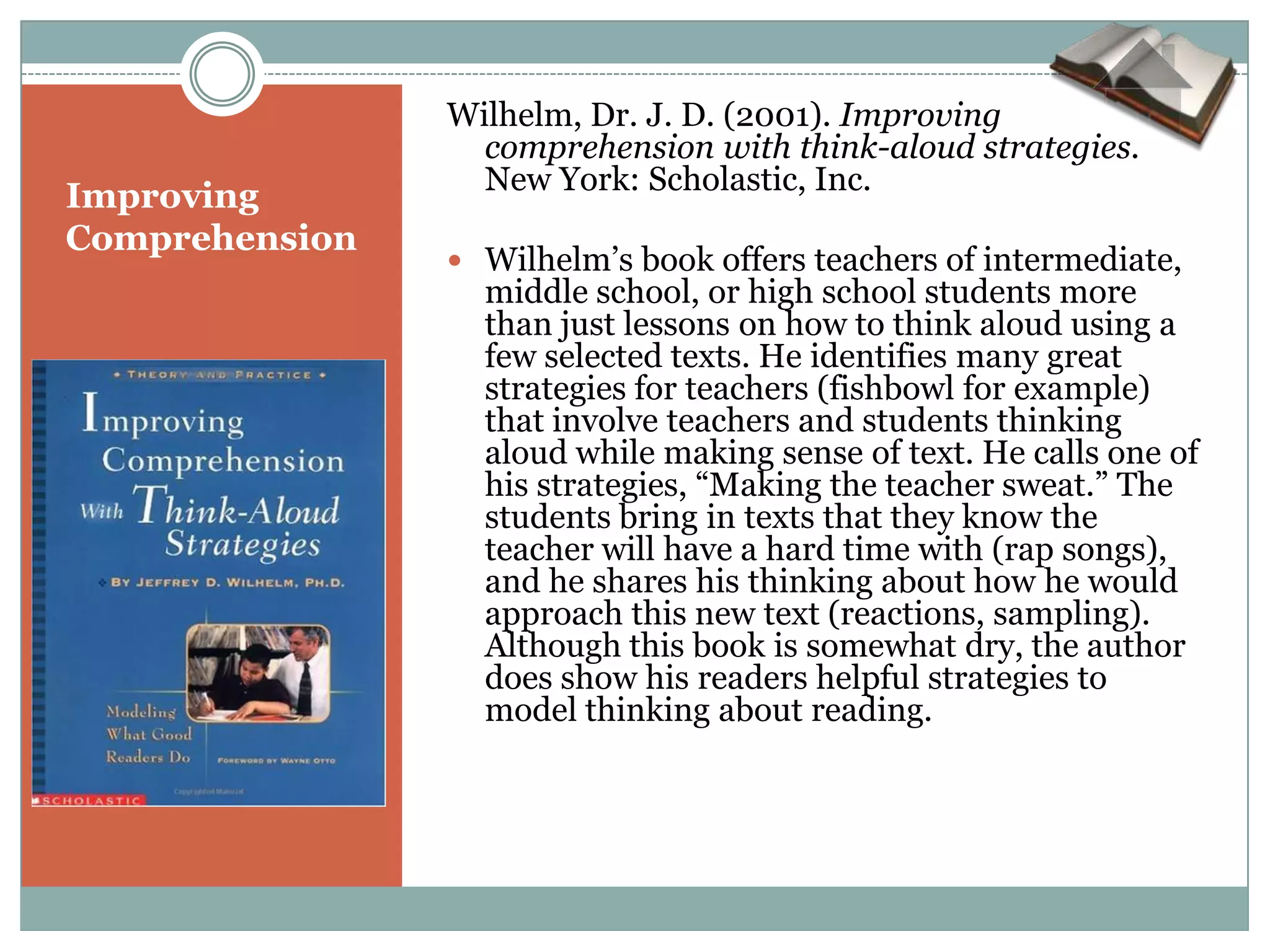
Wilhelm, Dr. J. D. (2001). Improving
                  comprehension with think-aloud strategies.
                  New York: Scholastic, Inc.
Improving
Comprehension
                 Wilhelm’s book offers teachers of intermediate,
                  middle school, or high school students more
                  than just lessons on how to think aloud using a
                  few selected texts. He identifies many great
                  strategies for teachers (fishbowl for example)
                  that involve teachers and students thinking
                  aloud while making sense of text. He calls one of
                  his strategies, “Making the teacher sweat.” The
                  students bring in texts that they know the
                  teacher will have a hard time with (rap songs),
                  and he shares his thinking about how he would
                  approach this new text (reactions, sampling).
                  Although this book is somewhat dry, the author
                  does show his readers helpful strategies to
                  model thinking about reading.

Comprehension texts

  • 1.
    Click on thebook to go to the table of contents Comprehension Texts RESOURCES TO HELP TEACHERS HELP STUDENTS
  • 2.
    Contents Click on thepicture for more information
  • 3.
    Boushey, G. &Mosher, J. (2006). the daily 5: fostering literacy independence in the elementary grades. Portland, ME: Daily 5 Stenhouse Publishers.  Although the purpose of Daily 5 is not to help you teach comprehension strategies to your students, it does provide a framework that will allow you to better work with students on comprehension strategies. The best part about Daily 5 is that it allows teachers to support independence with their students. Students are taught to make choices about their education and monitor whether texts are appropriate for them. There is also an emphasis on checking for understanding when independent reading and buddy reading. A great book to use in conjunction with The Café Book when setting up your literacy block.
  • 4.
    Boushey, G. &Mosher, J. (2009). The café book: engaging all students in daily literacy assessment & instruction. Portland, ME: Stenhouse Publishers. Café Book  Daily 5 provides educators with the big picture of how their literacy blocks could be meaningfully organized. The Café Book provides teachers with the details to make it work. Essentially it is a way of assessing readers. The framework is built on conferencing with individual students. The teacher and student determine if a student’s literacy goal needs to be Comprehension, Accuracy, Fluency, or Expanding Vocabulary. Their goal shapes what individual conferencing and small group lessons look like. The teacher also does whole group lessons based on the need. The great thing about this book is that it provides the teacher with a menu of strategies that they can teach for each of these areas, and this menu is placed in the classroom for students to reference. The book includes instructional advice for each strategy, and the value of this book far outweighs its cost of $22.00.
  • 5.
    Ellery, V. (2009).Creating strategic readers: Creating techniques for developing competency in Strategic phonemic awareness, phonics, fluency, vocabulary, and comprehension (2nd ed.). Readers Newark, DE: International Reading Association.  This is a broad book that covers five areas that readers need instruction in: phonemic awareness, phonics, fluency, vocabulary, and comprehension. Her section on comprehension has some great strategies. One strategy is called a ripple effect. You start by demonstrating in a children’s pool, a fish tank, or anything else that holds adequate water how throwing pebbles in causes ripples. You talk about how thinking while reading is similar to the ripples in the water. After this, you do a read aloud. While reading, share questions and throw a pebble into the water. Let the question ripple through the classroom as students discuss it.
  • 6.
    Fountas, I.C. &Pinell, G.S. (2001). Guiding Guiding readers and writers grades 3- Readers and 6: teaching comprehension, genre, and Writers content literacy. Portsmouth, NH: Heinemann.  This book is the bible of literacy instruction. It contains information about almost every area of literacy (excluding digital literacy) you can think of. It is a treasure trove of resources, and it is an essential read if you are setting up a reading, writing, or word study workshop. It also is a great book to look up information about teaching comprehension or any other questions you might have.
  • 7.
    Harvey, S., &Daniels, H. (2009). Comprehension & collaboration: inquiry circles in action. Portsmouth, NH: Heinemann. Comprehension & Collaboration  Warning! If you are super concerned with covering everything on the curriculum map, and you follow a strict timeline so that you can cram all your content in, this book is not for you. However if you are interested in a cross disciplinary approach that allows students to collaborate with each other to develop comprehension skills and a deeper understanding of a portion of your content, Comprehension & Collaboration is a great book for your bookshelf. The book offers teachers lessons on comprehension that will help students deal with information about their topic, hints and lessons on how to set up inquiry groups, and examples of inquiry groups at all levels (K-12). This is a well organized and engaging book that is essential for teachers using inquiry groups.
  • 8.
    Harvey, S. &Goudvis, A. (2007). Strategies that work: teaching comprehension for Strategies that understanding and engagement (2nd ed.). Work Portland, ME: Stenhouse Publishers.  A great reference book when planning comprehension mini-lessons. The authors start by discussing the importance of comprehension, strategy instruction and practice, and the benefits of short text. It breaks comprehension up into connections, questioning, visualizing, inferring, determining importance, and synthesizing. Each strategy has several strategy lessons with texts that can be used to accompany the lesson. The authors also offer advice and discuss troubleshooting. The chapter on assessing comprehension is also a beneficial resource when thinking about how to structure your reading time.
  • 9.
    Keene, E.O. &Zimmermann, S. (2001). Mosaic of thought: teaching Mosaic of comprehension s in a reader’s Thought workshop. Portsmouth, NH: Heinemann.  This book is great for teachers who want more than just lessons. Like the title implies, the book is the authors’ thoughts and information about different components of comprehension. It is heavily anecdotal, and you join the authors as they help other teachers support their students. It is a wealth of scholarly information, and this book helps teachers better understand why they are doing what they do.
  • 10.
    Lindquist, T. (2002).Seeing the whole through social studies Seeing the (2nd ed.). Portsmouth, NH: Heinemann. Whole through  An inspiring book for helping students better understand social studies. This book focuses on activities that help Social Studies students get actively involved in social studies, and Lindquist emphasizes making social studies relevant for students. This is a text that is great to revisit when things feel dry because the author’s enthusiasm is contagious. One idea in the book is to have students read a historical fiction novel or biography. The students will write sequential letters about the main character. If they are reading about George Washington, their first letter would be about a character that reflects on George Washington in a historically accurate way (parchment, language, and a quill or fountain pen). The second letter would be from George Washington to another character in the book talking about what he has seen and learned. The third letter would be to George Washington from the student today. The student would share the lessons learned and reactions to his life. To enhance this project, students can create their own stamps, stationary, and artifacts. The activities in this book could easily be adapted to help students better comprehend other texts and subject areas.
  • 11.
    McGregor, T. (2007).Comprehension connections. Portsmouth, NH: Heinemann. Comprehension  This book belongs in the bookshelf of every Connections elementary teacher. McGregor devotes her book to six components of comprehension: metacognition, schema, inferring, questioning, determining importance, visualizing, and synthesizing. She argues that students need concrete lessons that help them connect with more abstract areas of comprehension, and each chapter gives concrete lessons, text suggestions (including song lyrics), quotes to promote discussion, thinking stems, and other great strategies for each component of comprehension. An example of a concrete lesson is having a pot full of spaghetti and water. This represents the text. The teacher pours the contents of the pot (which represents the brain sifting through information), and the unimportant information (the water) is released. The important information (the spaghetti) is kept in the brain, and the students then discuss how good reading is similar to cooking spaghetti. It is surprising how simple lessons like this help students grasp comprehension strategies.
  • 12.
    Oczkus, L. (2004).Super 6 comprehension strategies. Super 6 Norwood, MA: Christopher- Gordon Publisher, Inc. Comprehension  Although the layout of this book is bland and it has a Strategies reliance on worksheet type activities, the Super 6 Comprehension Strategies has a lot to offer teachers. The author focuses on the following comprehension strategies: building background knowledge and making connections, predicting and inferring, questioning, monitoring comprehension, summarizing and synthesizing, and evaluating. Each strategy has classroom vignettes, general information about teaching that strategy, and teaching advice for each strategy. One plus to this book is that it includes evaluating as a comprehension strategy, and this higher level thinking skill gets students thinking about the quality of the text and what it has to offer. This is not featured in many other comprehension books, so it will be helpful for teachers to read this chapter. It also includes assessment resources for these comprehension areas and a disc with reproducibles of the activities.
  • 13.
    Tompkins, G.E. (2009).50 literacy strategies: step-by-step (3rd ed.). Boston, MA: Allyn & 50 Literacy Bacon. Strategies  Like the name implies, this book gives information about literacy strategies that can be used in the classroom. It has 35 strategies that can be specifically used for comprehension, and each strategy may include appropriate grade level, a description of the strategy, why the strategy should be used, how to use it, when to use it, and examples of student work. This is a fantastic book to flip through every once in a while to get ideas for enhancing classroom instruction. One strategy is called “Sketch-to- Stretch.” It is a way for students to respond to longer texts. After reading and discussing the themes of the book, students draw sketches to reflect what the story means to them—focusing on meaning not their favorite part. They then share their sketches with students who try to guess what the artist is trying to say.
  • 14.
    Wilhelm, Dr. J.D. (2001). Improving comprehension with think-aloud strategies. New York: Scholastic, Inc. Improving Comprehension  Wilhelm’s book offers teachers of intermediate, middle school, or high school students more than just lessons on how to think aloud using a few selected texts. He identifies many great strategies for teachers (fishbowl for example) that involve teachers and students thinking aloud while making sense of text. He calls one of his strategies, “Making the teacher sweat.” The students bring in texts that they know the teacher will have a hard time with (rap songs), and he shares his thinking about how he would approach this new text (reactions, sampling). Although this book is somewhat dry, the author does show his readers helpful strategies to model thinking about reading.