
+ 
Database Change Management* as a service 
* Also known as ‘patching’ or ‘refactoring’
+ 
About me 
(Andrew Solomon) 
Was … 
an academic teaching Perl 
Am now doing … 
 Perl Web Development at Net-A-Porter 
 (learning) Devops at Net-A-Porter 
 Teaching at Geekuni
+ 
Motivation 
Data is inconvenient 
 Next app release coming 
 App has new features 
 Needs different DB structure 
 Can’t just trash and install DB like an app
+ 
Principles 
For safe refactoring 
 Backward compatibility 
 Old and new app versions are ok with the refactored DB 
 DB is versioned 
 You can quickly determine which patches have been applied 
 App won’t be run if the DB is not compatible 
 Write a rollback for every DB change 
http://www.amazon.co.uk/Continuous-Delivery-Deployment- 
Automation-Addison-Wesley/dp/0321601912
+ 
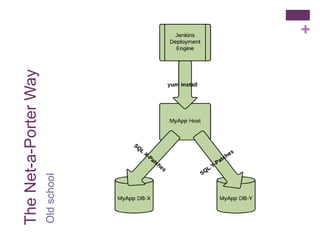
The Net-a-Porter Way 
Old school
+ 
The Net-a-Porter Way 
Old school 
 Put refactor code into My-App’s code base 
 Approach A: Run when installing the My-App RPM 
 Approach B: Run when starting My-App 
 Log the patches run in the database
+ 
The Net-a-Porter Way 
Old school 
 Put refactor.pl into My-App’s code base 
 PROBLEM: A slightly different refactor.pl for each app 
 PROBLEM: refactor.pl has extra CPAN dependencies 
 Approach A: Run when installing the My-App RPM 
 Approach B: Run when starting My-App 
 Log the patches run in the database
+ 
The Net-a-Porter Way 
Old school 
 Put refactor.pl into My-App’s code base 
 PROBLEM: A slightly different refactor.pl for each app 
 PROBLEM: refactor.pl has extra CPAN dependencies 
 Approach A: Run when installing the My-App RPM 
 Approach B: Run when starting My-App 
 PROBLEM: Multiple My-App servers per DB 
 Log the patches run in the database
+ 
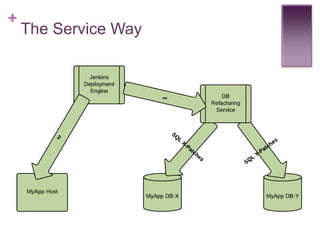
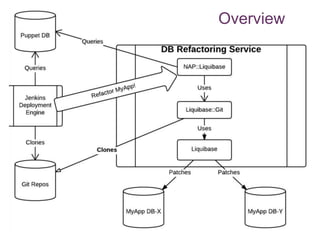
The Service Way
+ 
Available Refactoring Tools 
Flyway 
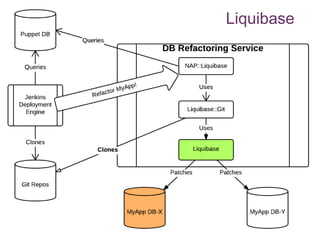
Liquibase 
DB Deploy
+ 
Winner: Liquibase 
Big user base 
Bought by Datical 
Has branching and 
More features than Flyway 
DB Deploy uses Apache ANT
Overview
Liquibase
+ 
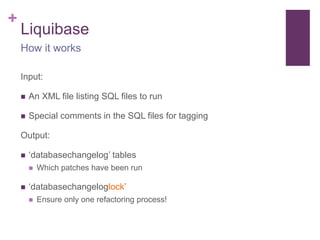
Liquibase 
How it works 
Input: 
 An XML file listing SQL files to run 
 Special comments in the SQL files for tagging 
Output: 
 ‘databasechangelog’ tables 
 Which patches have been run 
 ‘databasechangeloglock’ 
 Ensure only one refactoring process!
+ 
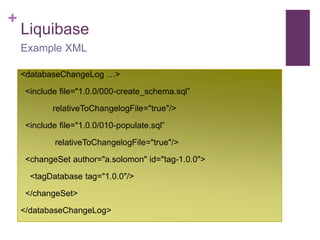
Liquibase 
Example XML 
<databaseChangeLog …> 
<include file="1.0.0/000-create_schema.sql” 
relativeToChangelogFile="true"/> 
<include file="1.0.0/010-populate.sql” 
relativeToChangelogFile="true"/> 
<changeSet author="a.solomon" id="tag-1.0.0"> 
<tagDatabase tag="1.0.0"/> 
</changeSet> 
</databaseChangeLog>
+ 
Liquibase 
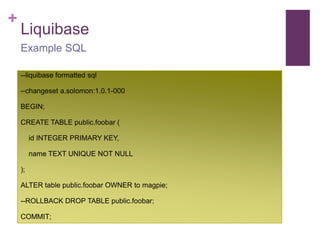
Example SQL 
--liquibase formatted sql 
--changeset a.solomon:1.0.1-000 
BEGIN; 
CREATE TABLE public.foobar ( 
id INTEGER PRIMARY KEY, 
name TEXT UNIQUE NOT NULL 
); 
ALTER table public.foobar OWNER to magpie; 
--ROLLBACK DROP TABLE public.foobar; 
COMMIT;
+ 
Liquibase 
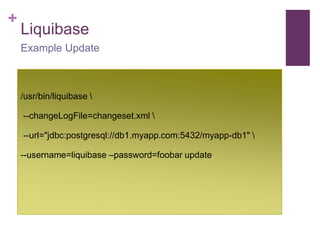
Example Update 
/usr/bin/liquibase  
--changeLogFile=changeset.xml  
--url="jdbc:postgresql://db1.myapp.com:5432/myapp-db1"  
--username=liquibase –password=foobar update
+ 
Liquibase 
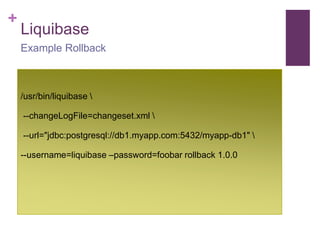
Example Rollback 
/usr/bin/liquibase  
--changeLogFile=changeset.xml  
--url="jdbc:postgresql://db1.myapp.com:5432/myapp-db1"  
--username=liquibase –password=foobar rollback 1.0.0
+ 
Liquibase 
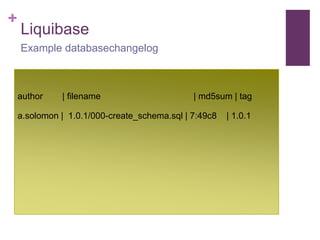
Example databasechangelog 
author | filename | md5sum | tag 
a.solomon | 1.0.1/000-create_schema.sql | 7:49c8 | 1.0.1
+ 
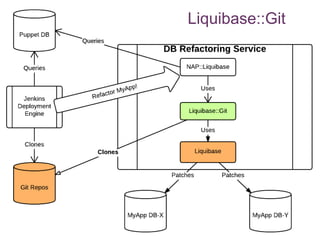
Liquibase::Git 
What is it? 
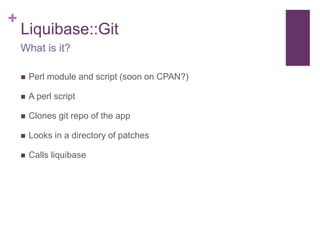
 Perl module and script (soon on CPAN?) 
 A perl script 
 Clones git repo of the app 
 Looks in a directory of patches 
 Calls liquibase
Liquibase::Git
+ 
Liquibase::Git 
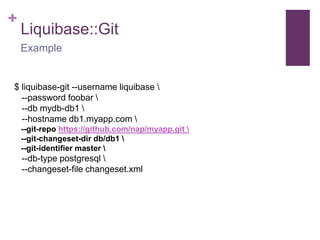
Example 
$ liquibase-git --username liquibase  
--password foobar  
--db mydb-db1  
--hostname db1.myapp.com  
--git-repo https://github.com/nap/myapp.git  
--git-changeset-dir db/db1  
--git-identifier master  
--db-type postgresql  
--changeset-file changeset.xml
+ 
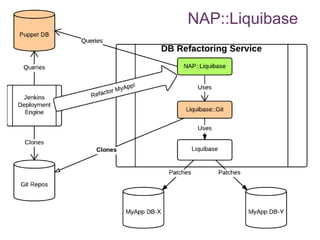
NAP::Liquibase 
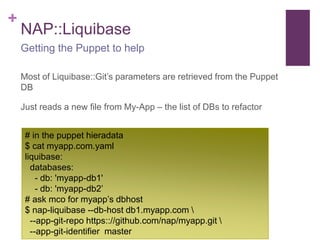
Getting the Puppet to help 
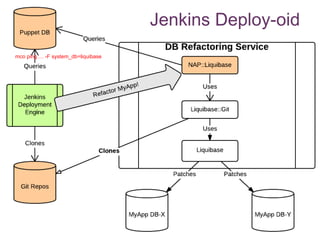
Most of Liquibase::Git’s parameters are retrieved from the Puppet 
DB 
Just reads a new file from My-App – the list of DBs to refactor 
# in the puppet hieradata 
$ cat myapp.com.yaml 
liquibase: 
databases: 
- db: 'myapp-db1' 
- db: 'myapp-db2’ 
# ask mco for myapp’s dbhost 
$ nap-liquibase --db-host db1.myapp.com  
--app-git-repo https:://github.com/nap/myapp.git  
--app-git-identifier master
NAP::Liquibase
Jenkins Deploy-oid 
mco ping … -F system_db=liquibase
+ 
Appendix 
… managing DBs outside the Puppet estate 
Cases where the box is being managed differently with puppet… 
Jenkins Continuous Integration Test Server 
Developer’s Box 
 Option 1: Emulate Liquibase on an empty DB – 5 lines 
 Option 2: Call liquibase-git to update a DB dump
+ 
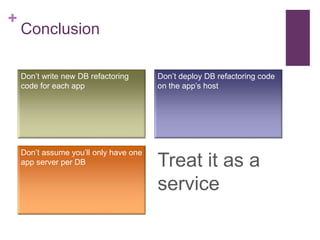
Conclusion 
Don’t write new DB refactoring 
code for each app 
Don’t assume you’ll only have one 
app server per DB 
Don’t deploy DB refactoring code 
on the app’s host 
Treat it as a 
service
+ 
But wait!!! There’s more… 
 Ilmari told me about it 
 It’s a Perl project of David E. 
Wheeler / theory 
 Based on sane principles: 
http://sqitch.org/ 
Sqitch is to Liquibase 
Is what 
Git is to CVS 
 The switch to sqitch will be almost 
invisible at the architecture level 
 Only difference is that the developers 
get LOCAL application of the patches 
on the dev box with a simple 
command-line interface
+ 
Questions? 
… or grab me at the pub.

Database Change Management as a Service

  • 1.
    + Database ChangeManagement* as a service * Also known as ‘patching’ or ‘refactoring’
  • 2.
    + About me (Andrew Solomon) Was … an academic teaching Perl Am now doing …  Perl Web Development at Net-A-Porter  (learning) Devops at Net-A-Porter  Teaching at Geekuni
  • 3.
    + Motivation Datais inconvenient  Next app release coming  App has new features  Needs different DB structure  Can’t just trash and install DB like an app
  • 4.
    + Principles Forsafe refactoring  Backward compatibility  Old and new app versions are ok with the refactored DB  DB is versioned  You can quickly determine which patches have been applied  App won’t be run if the DB is not compatible  Write a rollback for every DB change http://www.amazon.co.uk/Continuous-Delivery-Deployment- Automation-Addison-Wesley/dp/0321601912
  • 5.
    + The Net-a-PorterWay Old school
  • 6.
    + The Net-a-PorterWay Old school  Put refactor code into My-App’s code base  Approach A: Run when installing the My-App RPM  Approach B: Run when starting My-App  Log the patches run in the database
  • 7.
    + The Net-a-PorterWay Old school  Put refactor.pl into My-App’s code base  PROBLEM: A slightly different refactor.pl for each app  PROBLEM: refactor.pl has extra CPAN dependencies  Approach A: Run when installing the My-App RPM  Approach B: Run when starting My-App  Log the patches run in the database
  • 8.
    + The Net-a-PorterWay Old school  Put refactor.pl into My-App’s code base  PROBLEM: A slightly different refactor.pl for each app  PROBLEM: refactor.pl has extra CPAN dependencies  Approach A: Run when installing the My-App RPM  Approach B: Run when starting My-App  PROBLEM: Multiple My-App servers per DB  Log the patches run in the database
  • 9.
  • 10.
    + Available RefactoringTools Flyway Liquibase DB Deploy
  • 11.
    + Winner: Liquibase Big user base Bought by Datical Has branching and More features than Flyway DB Deploy uses Apache ANT
  • 12.
  • 13.
  • 14.
    + Liquibase Howit works Input:  An XML file listing SQL files to run  Special comments in the SQL files for tagging Output:  ‘databasechangelog’ tables  Which patches have been run  ‘databasechangeloglock’  Ensure only one refactoring process!
  • 15.
    + Liquibase ExampleXML <databaseChangeLog …> <include file="1.0.0/000-create_schema.sql” relativeToChangelogFile="true"/> <include file="1.0.0/010-populate.sql” relativeToChangelogFile="true"/> <changeSet author="a.solomon" id="tag-1.0.0"> <tagDatabase tag="1.0.0"/> </changeSet> </databaseChangeLog>
  • 16.
    + Liquibase ExampleSQL --liquibase formatted sql --changeset a.solomon:1.0.1-000 BEGIN; CREATE TABLE public.foobar ( id INTEGER PRIMARY KEY, name TEXT UNIQUE NOT NULL ); ALTER table public.foobar OWNER to magpie; --ROLLBACK DROP TABLE public.foobar; COMMIT;
  • 17.
    + Liquibase ExampleUpdate /usr/bin/liquibase --changeLogFile=changeset.xml --url="jdbc:postgresql://db1.myapp.com:5432/myapp-db1" --username=liquibase –password=foobar update
  • 18.
    + Liquibase ExampleRollback /usr/bin/liquibase --changeLogFile=changeset.xml --url="jdbc:postgresql://db1.myapp.com:5432/myapp-db1" --username=liquibase –password=foobar rollback 1.0.0
  • 19.
    + Liquibase Exampledatabasechangelog author | filename | md5sum | tag a.solomon | 1.0.1/000-create_schema.sql | 7:49c8 | 1.0.1
  • 20.
    + Liquibase::Git Whatis it?  Perl module and script (soon on CPAN?)  A perl script  Clones git repo of the app  Looks in a directory of patches  Calls liquibase
  • 21.
  • 22.
    + Liquibase::Git Example $ liquibase-git --username liquibase --password foobar --db mydb-db1 --hostname db1.myapp.com --git-repo https://github.com/nap/myapp.git --git-changeset-dir db/db1 --git-identifier master --db-type postgresql --changeset-file changeset.xml
  • 23.
    + NAP::Liquibase Gettingthe Puppet to help Most of Liquibase::Git’s parameters are retrieved from the Puppet DB Just reads a new file from My-App – the list of DBs to refactor # in the puppet hieradata $ cat myapp.com.yaml liquibase: databases: - db: 'myapp-db1' - db: 'myapp-db2’ # ask mco for myapp’s dbhost $ nap-liquibase --db-host db1.myapp.com --app-git-repo https:://github.com/nap/myapp.git --app-git-identifier master
  • 24.
  • 25.
    Jenkins Deploy-oid mcoping … -F system_db=liquibase
  • 26.
    + Appendix …managing DBs outside the Puppet estate Cases where the box is being managed differently with puppet… Jenkins Continuous Integration Test Server Developer’s Box  Option 1: Emulate Liquibase on an empty DB – 5 lines  Option 2: Call liquibase-git to update a DB dump
  • 27.
    + Conclusion Don’twrite new DB refactoring code for each app Don’t assume you’ll only have one app server per DB Don’t deploy DB refactoring code on the app’s host Treat it as a service
  • 28.
    + But wait!!!There’s more…  Ilmari told me about it  It’s a Perl project of David E. Wheeler / theory  Based on sane principles: http://sqitch.org/ Sqitch is to Liquibase Is what Git is to CVS  The switch to sqitch will be almost invisible at the architecture level  Only difference is that the developers get LOCAL application of the patches on the dev box with a simple command-line interface
  • 29.
    + Questions? …or grab me at the pub.