PROBLEM-BASED
TASK
NUR SAFFIYAH ADANI (10DDT22F1122)
SREETHARAN A/L THIAGARAJAN (10DDT22F2037)
Question 1
Explain what is the definition of Free Software Foundations (FSF)?
The Free Software Foundation (FSF) defines free
software as software that respects users' freedom and
community. This means that users have the freedom to
run, copy, distribute, study, change, and improve the
software. The FSF promotes the development and use
of free software to ensure that users maintain control
over their computing.
Question 2
Justify what is the difference between GNU General Public Licenses (GPL) and
Mozilla PublicLicense.
The main difference between the GNU General Public License
(GPL) and the Mozilla Public License (MPL) lies in their
approach to copyleft and compatibility with other licenses.
GPL is a copyleft license, meaning that derivative works must
also be distributed under the same license terms, ensuring
that the software remains free. MPL is a weak copyleft license,
allowing the combination of MPL-licensed code with code
under other licenses, including proprietary licenses, without
requiring the entire work to be open source.
Question 3
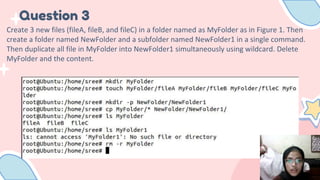
Create 3 new files (fileA, fileB, and fileC) in a folder named as MyFolder as in Figure 1.
Then create a folder named NewFolder and a subfolder named NewFolder1 in a single
command. Then duplicate all file in MyFolder into NewFolder1 simultaneously using
wildcard. Delete MyFolder and the content.
Question 3
Create 3 new files (fileA, fileB, and fileC) in a folder named as MyFolder as in Figure 1. Then
create a folder named NewFolder and a subfolder named NewFolder1 in a single command.
Then duplicate all file in MyFolder into NewFolder1 simultaneously using wildcard. Delete
MyFolder and the content.
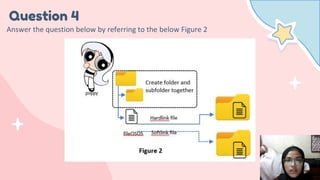
Question 4
Answer the question below by referring to the below Figure 2
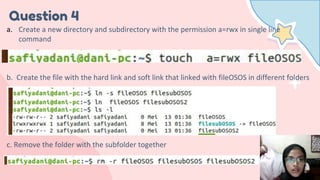
Question 4
a. Create a new directory and subdirectory with the permission a=rwx in single line
command
b. Create the file with the hard link and soft link that linked with fileOSOS in different folders
c. Remove the folder with the subfolder together
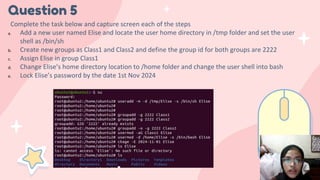
Question 5
Complete the task below and capture screen each of the steps
a. Add a new user named Elise and locate the user home directory in /tmp folder and set the user
shell as /bin/sh
b. Create new groups as Class1 and Class2 and define the group id for both groups are 2222
c. Assign Elise in group Class1
d. Change Elise’s home directory location to /home folder and change the user shell into bash
e. Lock Elise’s password by the date 1st Nov 2024
Question 6
USER wanted to create files with limited access for certain users. Help the USER to create
a file and directory with the permission below [user the numerical method | Default
value file: 644 | Default value directory: 755]. Group and user for this question must be
referred to the table below
Question 7
Using Linux command
a. Show firewall settings on Ubuntu Linux
b. Show the IP address for www.psp.edu.my
Question 7
Using Linux command
c. Show list a of partitions on your system.
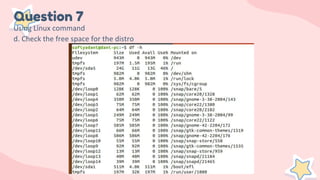
Question 7
Using Linux command
d. Check the free space for the distro
Question 8
State the function of the umask command and check the current umask setting.
The set default permission for a newly created file named as myFiles
a. to have read, and write permissions for the user and read for the group and write for others.
b. to have read, and write permissions for the user and write for the group and no permissions for
others.
Question 8
State the function of the umask command and check the current umask setting.
The set default permission for a newly created file named as myFiles
c. to have read, and write permissions for the user, group, and others
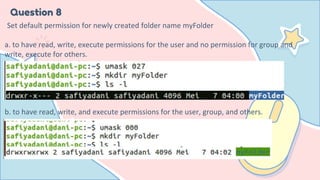
Question 8
Set default permission for newly created folder name myFolder
a. to have read, write, execute permissions for the user and no permission for group and
write, execute for others.
b. to have read, write, and execute permissions for the user, group, and others.
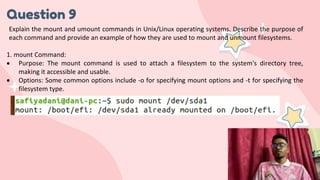
Question 9
Explain the mount and umount commands in Unix/Linux operating systems. Describe the purpose of
each command and provide an example of how they are used to mount and unmount filesystems.
1. mount Command:
 Purpose: The mount command is used to attach a filesystem to the system's directory tree,
making it accessible and usable.
 Options: Some common options include -o for specifying mount options and -t for specifying the
filesystem type.
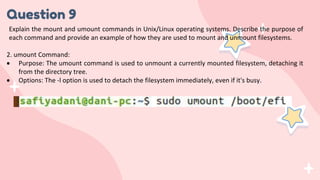
Question 9
Explain the mount and umount commands in Unix/Linux operating systems. Describe the purpose of
each command and provide an example of how they are used to mount and unmount filesystems.
2. umount Command:
 Purpose: The umount command is used to unmount a currently mounted filesystem, detaching it
from the directory tree.
 Options: The -l option is used to detach the filesystem immediately, even if it's busy.
A sales company named Save Cost Sdn. Bhd. Operates with an owner, a business
manager, an administrator, and six staff members connected via a network. Each
member of the company has a computer, but these computers are located in different
places, distant from the administrator. When staff encounter computer issues, the
administrator must physically go to their location to troubleshoot. Recently, issues have
arisen, prompting the company owner to request an efficient solution utilizing the latest
technology.
As a junior network engineer in the company, you are required to planning the remote
administration. Your tasks are:
a. Installation OpenSSH
b. Configuration OpenSSH
c. Remote Access Ubuntu from Windows PC
Question 10
Question 10
Question 11
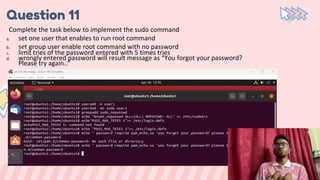
Complete the task below to implement the sudo command
a. set one user that enables to run root command
b. set group user enable root command with no password
c. limit tries of the password entered with 5 times tries
d. wrongly entered password will result message as “You forgot your password?
Please try again..”
CREDITS: This presentation template was created by Slidesgo, including icons by
Flaticon, and infographics & images by Freepik
Thanks!
Cmd
Ctrl
A
Z
C
+

Linux Ubuntu OpenSource Operating System

  • 1.
    PROBLEM-BASED TASK NUR SAFFIYAH ADANI(10DDT22F1122) SREETHARAN A/L THIAGARAJAN (10DDT22F2037)
  • 2.
    Question 1 Explain whatis the definition of Free Software Foundations (FSF)? The Free Software Foundation (FSF) defines free software as software that respects users' freedom and community. This means that users have the freedom to run, copy, distribute, study, change, and improve the software. The FSF promotes the development and use of free software to ensure that users maintain control over their computing.
  • 3.
    Question 2 Justify whatis the difference between GNU General Public Licenses (GPL) and Mozilla PublicLicense. The main difference between the GNU General Public License (GPL) and the Mozilla Public License (MPL) lies in their approach to copyleft and compatibility with other licenses. GPL is a copyleft license, meaning that derivative works must also be distributed under the same license terms, ensuring that the software remains free. MPL is a weak copyleft license, allowing the combination of MPL-licensed code with code under other licenses, including proprietary licenses, without requiring the entire work to be open source.
  • 4.
    Question 3 Create 3new files (fileA, fileB, and fileC) in a folder named as MyFolder as in Figure 1. Then create a folder named NewFolder and a subfolder named NewFolder1 in a single command. Then duplicate all file in MyFolder into NewFolder1 simultaneously using wildcard. Delete MyFolder and the content.
  • 5.
    Question 3 Create 3new files (fileA, fileB, and fileC) in a folder named as MyFolder as in Figure 1. Then create a folder named NewFolder and a subfolder named NewFolder1 in a single command. Then duplicate all file in MyFolder into NewFolder1 simultaneously using wildcard. Delete MyFolder and the content.
  • 6.
    Question 4 Answer thequestion below by referring to the below Figure 2
  • 7.
    Question 4 a. Createa new directory and subdirectory with the permission a=rwx in single line command b. Create the file with the hard link and soft link that linked with fileOSOS in different folders c. Remove the folder with the subfolder together
  • 8.
    Question 5 Complete thetask below and capture screen each of the steps a. Add a new user named Elise and locate the user home directory in /tmp folder and set the user shell as /bin/sh b. Create new groups as Class1 and Class2 and define the group id for both groups are 2222 c. Assign Elise in group Class1 d. Change Elise’s home directory location to /home folder and change the user shell into bash e. Lock Elise’s password by the date 1st Nov 2024
  • 9.
    Question 6 USER wantedto create files with limited access for certain users. Help the USER to create a file and directory with the permission below [user the numerical method | Default value file: 644 | Default value directory: 755]. Group and user for this question must be referred to the table below
  • 10.
    Question 7 Using Linuxcommand a. Show firewall settings on Ubuntu Linux b. Show the IP address for www.psp.edu.my
  • 11.
    Question 7 Using Linuxcommand c. Show list a of partitions on your system.
  • 12.
    Question 7 Using Linuxcommand d. Check the free space for the distro
  • 13.
    Question 8 State thefunction of the umask command and check the current umask setting. The set default permission for a newly created file named as myFiles a. to have read, and write permissions for the user and read for the group and write for others. b. to have read, and write permissions for the user and write for the group and no permissions for others.
  • 14.
    Question 8 State thefunction of the umask command and check the current umask setting. The set default permission for a newly created file named as myFiles c. to have read, and write permissions for the user, group, and others
  • 15.
    Question 8 Set defaultpermission for newly created folder name myFolder a. to have read, write, execute permissions for the user and no permission for group and write, execute for others. b. to have read, write, and execute permissions for the user, group, and others.
  • 16.
    Question 9 Explain themount and umount commands in Unix/Linux operating systems. Describe the purpose of each command and provide an example of how they are used to mount and unmount filesystems. 1. mount Command:  Purpose: The mount command is used to attach a filesystem to the system's directory tree, making it accessible and usable.  Options: Some common options include -o for specifying mount options and -t for specifying the filesystem type.
  • 17.
    Question 9 Explain themount and umount commands in Unix/Linux operating systems. Describe the purpose of each command and provide an example of how they are used to mount and unmount filesystems. 2. umount Command:  Purpose: The umount command is used to unmount a currently mounted filesystem, detaching it from the directory tree.  Options: The -l option is used to detach the filesystem immediately, even if it's busy.
  • 18.
    A sales companynamed Save Cost Sdn. Bhd. Operates with an owner, a business manager, an administrator, and six staff members connected via a network. Each member of the company has a computer, but these computers are located in different places, distant from the administrator. When staff encounter computer issues, the administrator must physically go to their location to troubleshoot. Recently, issues have arisen, prompting the company owner to request an efficient solution utilizing the latest technology. As a junior network engineer in the company, you are required to planning the remote administration. Your tasks are: a. Installation OpenSSH b. Configuration OpenSSH c. Remote Access Ubuntu from Windows PC Question 10
  • 19.
  • 20.
    Question 11 Complete thetask below to implement the sudo command a. set one user that enables to run root command b. set group user enable root command with no password c. limit tries of the password entered with 5 times tries d. wrongly entered password will result message as “You forgot your password? Please try again..”
  • 21.
    CREDITS: This presentationtemplate was created by Slidesgo, including icons by Flaticon, and infographics & images by Freepik Thanks! Cmd Ctrl A Z C +