Kernel HTTPS/TCP/IP stack
for HTTP DDoS mitigation
Alexander Krizhanovsky
Tempesta Technologies, Inc.
ak@tempesta-tech.com
Who am I?
CEO & CTO at Tempesta Technologies
Developing Tempesta FW – open source Linux
Application Delivery Controller (ADC)
Custom software development in:
● high performance network traffic processing
● Databases
e.g. MariaDB SQL System Versioning
https://github.com/tempesta-tech/mariadb
https://m17.mariadb.com/session/technical-preview-temporal-queryi
ng-asof
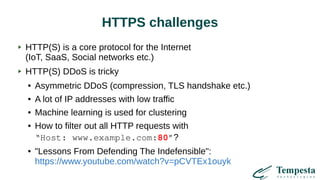
HTTPS challenges
HTTP(S) is a core protocol for the Internet
(IoT, SaaS, Social networks etc.)
HTTP(S) DDoS is tricky
● Asymmetric DDoS (compression, TLS handshake etc.)
● A lot of IP addresses with low traffic
● Machine learning is used for clustering
● How to filter out all HTTP requests with
“Host: www.example.com:80”?
● "Lessons From Defending The Indefensible":
https://www.youtube.com/watch?v=pCVTEx1ouyk
TCP stream filter
IPtables strings, BPF, XDP, NIC filters
● HTTP headers can cross packet bounds
● Scan large URI or Cookie for Host value?
Web accelerator
● aren’t designed (suitable) for HTTP filtering
IPS vs HTTP DDoS
e.g. Suricata, has powerful rules syntax at L3-L7
Not a TCP end point => evasions are possible
SSL/TLS
SSL terminator is required => many data copies & context switches
or double SSL processing (at IDS & at Web server)
Double HTTP parsing
Doesn’t improve Web server peroformance (mitigation != prevention)
Interbreed an HTTP accelerator and a firewall
TCP & TLS end point
Very fast HTTP parser to process HTTP floods
Network I/O optimized for massive ingress traffic
Advanced filtering abilities at all network layers
Very fast Web cache to mitigate DDoS which we can’t filter out
● ML takes some time for bots clusterization
● False negatives are unavoidable
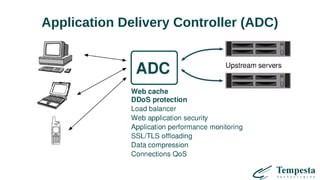
Application Delivery Controller (ADC)
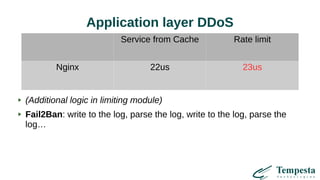
Application layer DDoS
Service from Cache Rate limit
Nginx 22us 23us
(Additional logic in limiting module)
Fail2Ban: write to the log, parse the log, write to the log, parse the
log…
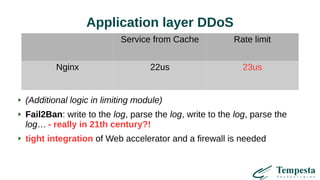
Application layer DDoS
Service from Cache Rate limit
Nginx 22us 23us
(Additional logic in limiting module)
Fail2Ban: write to the log, parse the log, write to the log, parse the
log… - really in 21th century?!
tight integration of Web accelerator and a firewall is needed
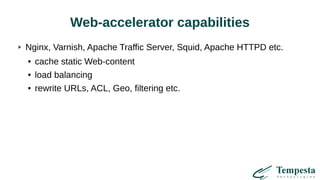
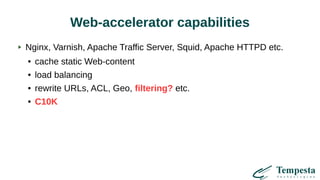
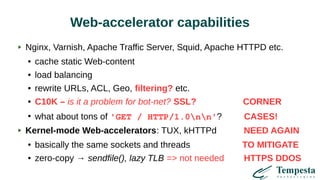
Web-accelerator capabilities
Nginx, Varnish, Apache Traffic Server, Squid, Apache HTTPD etc.
● cache static Web-content
● load balancing
● rewrite URLs, ACL, Geo, filtering etc.
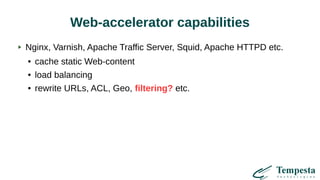
Web-accelerator capabilities
Nginx, Varnish, Apache Traffic Server, Squid, Apache HTTPD etc.
● cache static Web-content
● load balancing
● rewrite URLs, ACL, Geo, filtering? etc.
Web-accelerator capabilities
Nginx, Varnish, Apache Traffic Server, Squid, Apache HTTPD etc.
● cache static Web-content
● load balancing
● rewrite URLs, ACL, Geo, filtering? etc.
● C10K
Web-accelerator capabilities
Nginx, Varnish, Apache Traffic Server, Squid, Apache HTTPD etc.
● cache static Web-content
● load balancing
● rewrite URLs, ACL, Geo, filtering? etc.
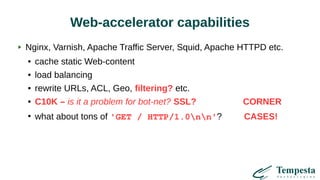
● C10K – is it a problem for bot-net? SSL? CORNER
●
what about tons of 'GET / HTTP/1.0nn'? CASES!
Web-accelerator capabilities
Nginx, Varnish, Apache Traffic Server, Squid, Apache HTTPD etc.
● cache static Web-content
● load balancing
● rewrite URLs, ACL, Geo, filtering? etc.
● C10K – is it a problem for bot-net? SSL? CORNER
●
what about tons of 'GET / HTTP/1.0nn'? CASES!
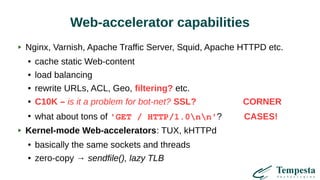
Kernel-mode Web-accelerators: TUX, kHTTPd
● basically the same sockets and threads
● zero-copy → sendfile(), lazy TLB
Web-accelerator capabilities
Nginx, Varnish, Apache Traffic Server, Squid, Apache HTTPD etc.
● cache static Web-content
● load balancing
● rewrite URLs, ACL, Geo, filtering? etc.
● C10K – is it a problem for bot-net? SSL? CORNER
●
what about tons of 'GET / HTTP/1.0nn'? CASES!
Kernel-mode Web-accelerators: TUX, kHTTPd
● basically the same sockets and threads
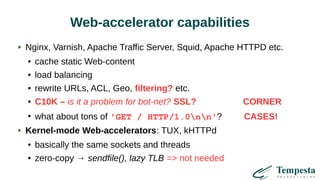
● zero-copy → sendfile(), lazy TLB => not needed
Web-accelerator capabilities
Nginx, Varnish, Apache Traffic Server, Squid, Apache HTTPD etc.
● cache static Web-content
● load balancing
● rewrite URLs, ACL, Geo, filtering? etc.
● C10K – is it a problem for bot-net? SSL? CORNER
●
what about tons of 'GET / HTTP/1.0nn'? CASES!
Kernel-mode Web-accelerators: TUX, kHTTPd NEED AGAIN
● basically the same sockets and threads TO MITIGATE
● zero-copy → sendfile(), lazy TLB => not needed HTTPS DDOS
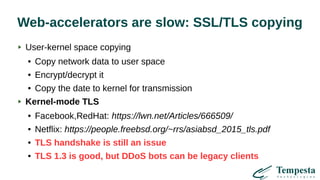
Web-accelerators are slow: SSL/TLS copying
User-kernel space copying
● Copy network data to user space
● Encrypt/decrypt it
● Copy the date to kernel for transmission
Kernel-mode TLS
● Facebook,RedHat: https://lwn.net/Articles/666509/
● Netflix: https://people.freebsd.org/~rrs/asiabsd_2015_tls.pdf
● TLS handshake is still an issue
● TLS 1.3 is good, but DDoS bots can be legacy clients
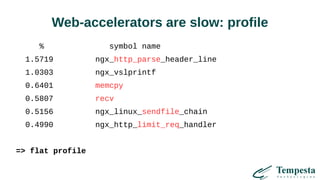
Web-accelerators are slow: profile
% symbol name
1.5719 ngx_http_parse_header_line
1.0303 ngx_vslprintf
0.6401 memcpy
0.5807 recv
0.5156 ngx_linux_sendfile_chain
0.4990 ngx_http_limit_req_handler
=> flat profile
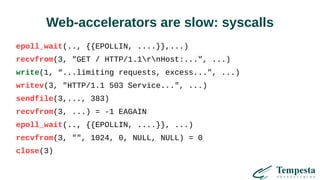
Web-accelerators are slow: syscalls
epoll_wait(.., {{EPOLLIN, ....}},...)
recvfrom(3, "GET / HTTP/1.1rnHost:...", ...)
write(1, “...limiting requests, excess...", ...)
writev(3, "HTTP/1.1 503 Service...", ...)
sendfile(3,..., 383)
recvfrom(3, ...) = -1 EAGAIN
epoll_wait(.., {{EPOLLIN, ....}}, ...)
recvfrom(3, "", 1024, 0, NULL, NULL) = 0
close(3)
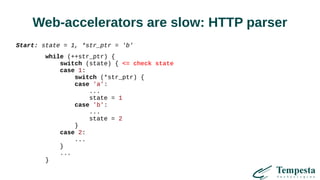
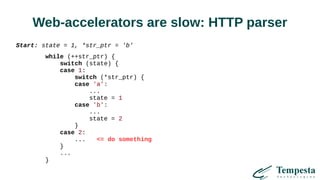
Web-accelerators are slow: HTTP parser
Start: state = 1, *str_ptr = 'b'
while (++str_ptr) {
switch (state) { <= check state
case 1:
switch (*str_ptr) {
case 'a':
...
state = 1
case 'b':
...
state = 2
}
case 2:
...
}
...
}
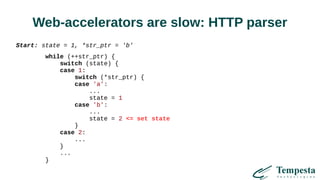
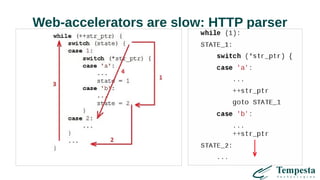
Web-accelerators are slow: HTTP parser
Start: state = 1, *str_ptr = 'b'
while (++str_ptr) {
switch (state) {
case 1:
switch (*str_ptr) {
case 'a':
...
state = 1
case 'b':
...
state = 2 <= set state
}
case 2:
...
}
...
}
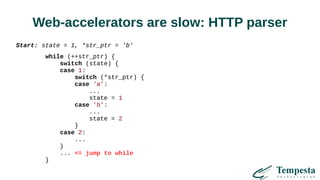
Web-accelerators are slow: HTTP parser
Start: state = 1, *str_ptr = 'b'
while (++str_ptr) {
switch (state) {
case 1:
switch (*str_ptr) {
case 'a':
...
state = 1
case 'b':
...
state = 2
}
case 2:
...
}
... <= jump to while
}
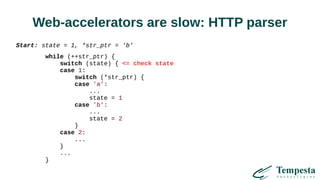
Web-accelerators are slow: HTTP parser
Start: state = 1, *str_ptr = 'b'
while (++str_ptr) {
switch (state) { <= check state
case 1:
switch (*str_ptr) {
case 'a':
...
state = 1
case 'b':
...
state = 2
}
case 2:
...
}
...
}
Web-accelerators are slow: HTTP parser
Start: state = 1, *str_ptr = 'b'
while (++str_ptr) {
switch (state) {
case 1:
switch (*str_ptr) {
case 'a':
...
state = 1
case 'b':
...
state = 2
}
case 2:
... <= do something
}
...
}
Web-accelerators are slow: HTTP parser
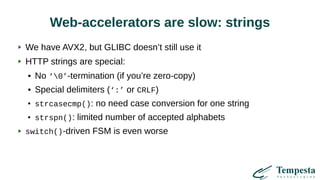
Web-accelerators are slow: strings
We have AVX2, but GLIBC doesn’t still use it
HTTP strings are special:
● No ‘0’-termination (if you’re zero-copy)
● Special delimiters (‘:’ or CRLF)
●
strcasecmp(): no need case conversion for one string
●
strspn(): limited number of accepted alphabets
switch()-driven FSM is even worse
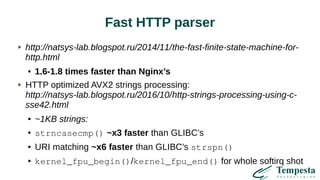
Fast HTTP parser
http://natsys-lab.blogspot.ru/2014/11/the-fast-finite-state-machine-for-
http.html
● 1.6-1.8 times faster than Nginx’s
HTTP optimized AVX2 strings processing:
http://natsys-lab.blogspot.ru/2016/10/http-strings-processing-using-c-
sse42.html
● ~1KB strings:
● strncasecmp() ~x3 faster than GLIBC’s
● URI matching ~x6 faster than GLIBC’s strspn()
● kernel_fpu_begin()/kernel_fpu_end() for whole softirq shot
HTTP strong validation
TODO: https://github.com/tempesta-tech/tempesta/issues/628
Injections: specify allowed URI characters for a Web app
Resistant to large HTTP fields
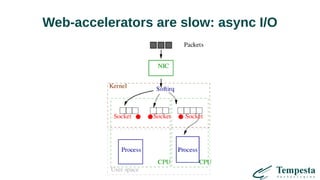
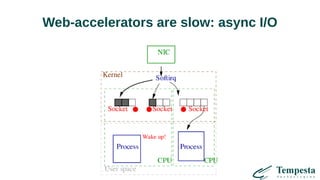
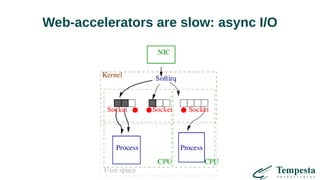
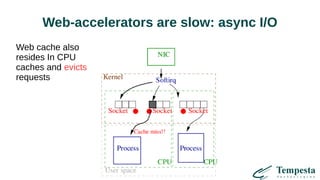
Web-accelerators are slow: async I/O
Web cache also
resides In CPU
caches and evicts
requests
HTTPS/TCP/IP stack
Alternative to user space TCP/IP stacks
HTTPS is built into TCP/IP stack
Kernel TLS (fork from mbedTLS) – no copying
(1 human month to port TLS to kernel!)
HTTP firewall plus to IPtables and Socket filter
Very fast HTTP parser and strings processing using AVX2
Cache-conscious in-memory Web-cache for DDoS mitigation
TODO
HTTP QoS for asymmetric DDoS mitigation
DSL for multi-layer filter rules
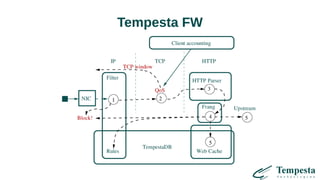
Tempesta FW
TODO: HTTP QoS
for asymmetric DDoS mitigation
https://github.com/tempesta-tech/tempesta/issues/488
“Web2K: Bringing QoS to Web Servers” by Preeti Bhoj et al.
Local stress: packet drops, queues overrun, response latency etc
(kernel: cheap statistics for asymmetric DDoS)
Upsream stress: req_num / resp_num, response time etc.
Static QoS rules per vhost: HTTP RPS, integration w/ Qdisc - TBD
Actions: reduce TCP window, don’t accept new connections,
close existing connections
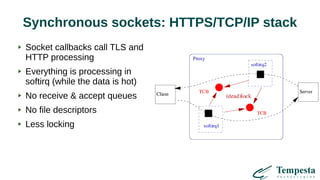
Synchronous sockets: HTTPS/TCP/IP stack
Socket callbacks call TLS and
HTTP processing
Everything is processing in
softirq (while the data is hot)
No receive & accept queues
No file descriptors
Less locking
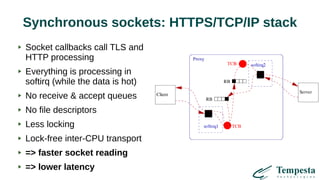
Synchronous sockets: HTTPS/TCP/IP stack
Socket callbacks call TLS and
HTTP processing
Everything is processing in
softirq (while the data is hot)
No receive & accept queues
No file descriptors
Less locking
Lock-free inter-CPU transport
=> faster socket reading
=> lower latency
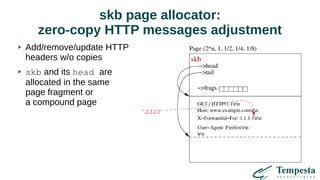
skb page allocator:
zero-copy HTTP messages adjustment
Add/remove/update HTTP
headers w/o copies
skb and its head are
allocated in the same
page fragment or
a compound page
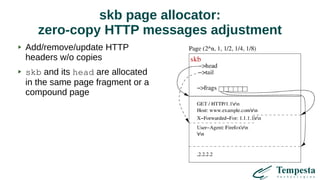
skb page allocator:
zero-copy HTTP messages adjustment
Add/remove/update HTTP
headers w/o copies
skb and its head are allocated
in the same page fragment or a
compound page
Sticky cookie
User/session identification
● Cookie challenge for dummy DDoS bots
● Persistent/sessions scheduling (no rescheduling on a server failure)
Enforce: HTTP 302 redirect
sticky name=__tfw_user_id__ enforce;
Sticky cookie
User/session identification
● Cookie challenge for dummy DDoS bots
● Persistent/sessions scheduling (no rescheduling on a server failure)
Enforce: HTTP 302 redirect
sticky name=__tfw_user_id__ enforce;
TODO: JavaScript challenge
https://github.com/tempesta-tech/tempesta/issues/536
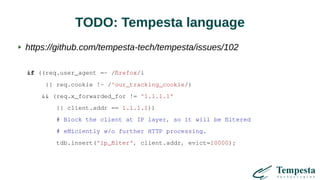
TODO: Tempesta language
https://github.com/tempesta-tech/tempesta/issues/102
if ((req.user_agent =~ /firefox/i
|| req.cookie !~ /^our_tracking_cookie/)
&& (req.x_forwarded_for != "1.1.1.1"
|| client.addr == 1.1.1.1))
# Block the client at IP layer, so it will be filtered
# efficiently w/o further HTTP processing.
tdb.insert("ip_filter", client.addr, evict=10000);
Frang: HTTP DoS
Rate limits
● request_rate, request_burst
● connection_rate, connection_burst
● concurrent_connections
Slow HTTP
● client_header_timeout, client_body_timeout
● http_header_cnt
● http_header_chunk_cnt, http_body_chunk_cnt
Frang: WAF
Length limits: http_uri_len, http_field_len, http_body_len
Content validation: http_host_required, http_ct_required,
http_ct_vals, http_methods
HTTP Response Splitting: count and match requests and responses
Injections: carefully verify allowed character sets
...and many upcoming filters:
https://github.com/tempesta-tech/tempesta/labels/security
Not a featureful WAF
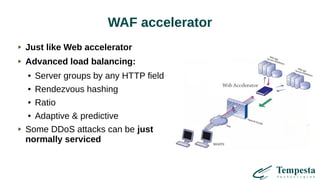
WAF accelerator
Just like Web accelerator
Advanced load balancing:
● Server groups by any HTTP field
● Rendezvous hashing
● Ratio
● Adaptive & predictive
Some DDoS attacks can be just
normally serviced
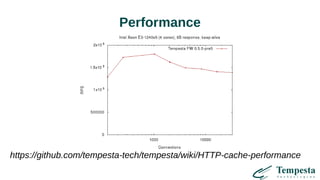
Performance
https://github.com/tempesta-tech/tempesta/wiki/HTTP-cache-performance
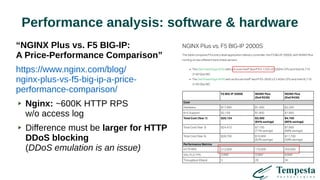
Performance analysis: software & hardware
“NGINX Plus vs. F5 BIG‑IP:
A Price‑Performance Comparison”
https://www.nginx.com/blog/
nginx-plus-vs-f5-big-ip-a-price-
performance-comparison/
Nginx: ~600K HTTP RPS
w/o access log
Difference must be larger for HTTP
DDoS blocking
(DDoS emulation is an issue)
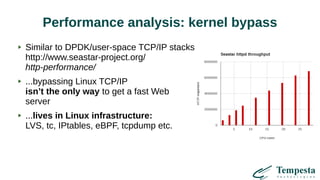
Performance analysis: kernel bypass
Similar to DPDK/user-space TCP/IP stacks
http://www.seastar-project.org/
http-performance/
...bypassing Linux TCP/IP
isn’t the only way to get a fast Web
server
...lives in Linux infrastructure:
LVS, tc, IPtables, eBPF, tcpdump etc.
Keep the kernel small
Just 30K LoC (compare w/ 120K LoC of BtrFS)
Only generic and crucial HTTPS logic is in kernel
Supplementary logic is considered for user space
● HTTP compression & decompression
https://github.com/tempesta-tech/tempesta/issues/636
● Advanced DDoS mitigation & WAF (e.g. full POST processing)
● ...other HTTP users (Web frameworks?)
Zero-copy kernel-user space transport for minimizing kernel code
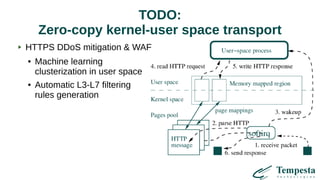
TODO:
Zero-copy kernel-user space transport
HTTPS DDoS mitigation & WAF
● Machine learning
clusterization in user space
● Automatic L3-L7 filtering
rules generation
Thanks!
Web-site: http://tempesta-tech.com (Powered by Tempesta FW)
No failures for the year
Availability: https://github.com/tempesta-tech/tempesta
Blog: http://natsys-lab.blogspot.com
E-mail: ak@tempesta-tech.com

Стек Linux HTTPS/TCP/IP для защиты от HTTP-DDoS-атак

  • 1.
    Kernel HTTPS/TCP/IP stack forHTTP DDoS mitigation Alexander Krizhanovsky Tempesta Technologies, Inc. ak@tempesta-tech.com
  • 2.
    Who am I? CEO& CTO at Tempesta Technologies Developing Tempesta FW – open source Linux Application Delivery Controller (ADC) Custom software development in: ● high performance network traffic processing ● Databases e.g. MariaDB SQL System Versioning https://github.com/tempesta-tech/mariadb https://m17.mariadb.com/session/technical-preview-temporal-queryi ng-asof
  • 3.
    HTTPS challenges HTTP(S) isa core protocol for the Internet (IoT, SaaS, Social networks etc.) HTTP(S) DDoS is tricky ● Asymmetric DDoS (compression, TLS handshake etc.) ● A lot of IP addresses with low traffic ● Machine learning is used for clustering ● How to filter out all HTTP requests with “Host: www.example.com:80”? ● "Lessons From Defending The Indefensible": https://www.youtube.com/watch?v=pCVTEx1ouyk
  • 4.
    TCP stream filter IPtablesstrings, BPF, XDP, NIC filters ● HTTP headers can cross packet bounds ● Scan large URI or Cookie for Host value? Web accelerator ● aren’t designed (suitable) for HTTP filtering
  • 5.
    IPS vs HTTPDDoS e.g. Suricata, has powerful rules syntax at L3-L7 Not a TCP end point => evasions are possible SSL/TLS SSL terminator is required => many data copies & context switches or double SSL processing (at IDS & at Web server) Double HTTP parsing Doesn’t improve Web server peroformance (mitigation != prevention)
  • 6.
    Interbreed an HTTPaccelerator and a firewall TCP & TLS end point Very fast HTTP parser to process HTTP floods Network I/O optimized for massive ingress traffic Advanced filtering abilities at all network layers Very fast Web cache to mitigate DDoS which we can’t filter out ● ML takes some time for bots clusterization ● False negatives are unavoidable
  • 7.
  • 8.
    Application layer DDoS Servicefrom Cache Rate limit Nginx 22us 23us (Additional logic in limiting module) Fail2Ban: write to the log, parse the log, write to the log, parse the log…
  • 9.
    Application layer DDoS Servicefrom Cache Rate limit Nginx 22us 23us (Additional logic in limiting module) Fail2Ban: write to the log, parse the log, write to the log, parse the log… - really in 21th century?! tight integration of Web accelerator and a firewall is needed
  • 10.
    Web-accelerator capabilities Nginx, Varnish,Apache Traffic Server, Squid, Apache HTTPD etc. ● cache static Web-content ● load balancing ● rewrite URLs, ACL, Geo, filtering etc.
  • 11.
    Web-accelerator capabilities Nginx, Varnish,Apache Traffic Server, Squid, Apache HTTPD etc. ● cache static Web-content ● load balancing ● rewrite URLs, ACL, Geo, filtering? etc.
  • 12.
    Web-accelerator capabilities Nginx, Varnish,Apache Traffic Server, Squid, Apache HTTPD etc. ● cache static Web-content ● load balancing ● rewrite URLs, ACL, Geo, filtering? etc. ● C10K
  • 13.
    Web-accelerator capabilities Nginx, Varnish,Apache Traffic Server, Squid, Apache HTTPD etc. ● cache static Web-content ● load balancing ● rewrite URLs, ACL, Geo, filtering? etc. ● C10K – is it a problem for bot-net? SSL? CORNER ● what about tons of 'GET / HTTP/1.0nn'? CASES!
  • 14.
    Web-accelerator capabilities Nginx, Varnish,Apache Traffic Server, Squid, Apache HTTPD etc. ● cache static Web-content ● load balancing ● rewrite URLs, ACL, Geo, filtering? etc. ● C10K – is it a problem for bot-net? SSL? CORNER ● what about tons of 'GET / HTTP/1.0nn'? CASES! Kernel-mode Web-accelerators: TUX, kHTTPd ● basically the same sockets and threads ● zero-copy → sendfile(), lazy TLB
  • 15.
    Web-accelerator capabilities Nginx, Varnish,Apache Traffic Server, Squid, Apache HTTPD etc. ● cache static Web-content ● load balancing ● rewrite URLs, ACL, Geo, filtering? etc. ● C10K – is it a problem for bot-net? SSL? CORNER ● what about tons of 'GET / HTTP/1.0nn'? CASES! Kernel-mode Web-accelerators: TUX, kHTTPd ● basically the same sockets and threads ● zero-copy → sendfile(), lazy TLB => not needed
  • 16.
    Web-accelerator capabilities Nginx, Varnish,Apache Traffic Server, Squid, Apache HTTPD etc. ● cache static Web-content ● load balancing ● rewrite URLs, ACL, Geo, filtering? etc. ● C10K – is it a problem for bot-net? SSL? CORNER ● what about tons of 'GET / HTTP/1.0nn'? CASES! Kernel-mode Web-accelerators: TUX, kHTTPd NEED AGAIN ● basically the same sockets and threads TO MITIGATE ● zero-copy → sendfile(), lazy TLB => not needed HTTPS DDOS
  • 17.
    Web-accelerators are slow:SSL/TLS copying User-kernel space copying ● Copy network data to user space ● Encrypt/decrypt it ● Copy the date to kernel for transmission Kernel-mode TLS ● Facebook,RedHat: https://lwn.net/Articles/666509/ ● Netflix: https://people.freebsd.org/~rrs/asiabsd_2015_tls.pdf ● TLS handshake is still an issue ● TLS 1.3 is good, but DDoS bots can be legacy clients
  • 18.
    Web-accelerators are slow:profile % symbol name 1.5719 ngx_http_parse_header_line 1.0303 ngx_vslprintf 0.6401 memcpy 0.5807 recv 0.5156 ngx_linux_sendfile_chain 0.4990 ngx_http_limit_req_handler => flat profile
  • 19.
    Web-accelerators are slow:syscalls epoll_wait(.., {{EPOLLIN, ....}},...) recvfrom(3, "GET / HTTP/1.1rnHost:...", ...) write(1, “...limiting requests, excess...", ...) writev(3, "HTTP/1.1 503 Service...", ...) sendfile(3,..., 383) recvfrom(3, ...) = -1 EAGAIN epoll_wait(.., {{EPOLLIN, ....}}, ...) recvfrom(3, "", 1024, 0, NULL, NULL) = 0 close(3)
  • 20.
    Web-accelerators are slow:HTTP parser Start: state = 1, *str_ptr = 'b' while (++str_ptr) { switch (state) { <= check state case 1: switch (*str_ptr) { case 'a': ... state = 1 case 'b': ... state = 2 } case 2: ... } ... }
  • 21.
    Web-accelerators are slow:HTTP parser Start: state = 1, *str_ptr = 'b' while (++str_ptr) { switch (state) { case 1: switch (*str_ptr) { case 'a': ... state = 1 case 'b': ... state = 2 <= set state } case 2: ... } ... }
  • 22.
    Web-accelerators are slow:HTTP parser Start: state = 1, *str_ptr = 'b' while (++str_ptr) { switch (state) { case 1: switch (*str_ptr) { case 'a': ... state = 1 case 'b': ... state = 2 } case 2: ... } ... <= jump to while }
  • 23.
    Web-accelerators are slow:HTTP parser Start: state = 1, *str_ptr = 'b' while (++str_ptr) { switch (state) { <= check state case 1: switch (*str_ptr) { case 'a': ... state = 1 case 'b': ... state = 2 } case 2: ... } ... }
  • 24.
    Web-accelerators are slow:HTTP parser Start: state = 1, *str_ptr = 'b' while (++str_ptr) { switch (state) { case 1: switch (*str_ptr) { case 'a': ... state = 1 case 'b': ... state = 2 } case 2: ... <= do something } ... }
  • 25.
  • 26.
    Web-accelerators are slow:strings We have AVX2, but GLIBC doesn’t still use it HTTP strings are special: ● No ‘0’-termination (if you’re zero-copy) ● Special delimiters (‘:’ or CRLF) ● strcasecmp(): no need case conversion for one string ● strspn(): limited number of accepted alphabets switch()-driven FSM is even worse
  • 27.
    Fast HTTP parser http://natsys-lab.blogspot.ru/2014/11/the-fast-finite-state-machine-for- http.html ●1.6-1.8 times faster than Nginx’s HTTP optimized AVX2 strings processing: http://natsys-lab.blogspot.ru/2016/10/http-strings-processing-using-c- sse42.html ● ~1KB strings: ● strncasecmp() ~x3 faster than GLIBC’s ● URI matching ~x6 faster than GLIBC’s strspn() ● kernel_fpu_begin()/kernel_fpu_end() for whole softirq shot
  • 28.
    HTTP strong validation TODO:https://github.com/tempesta-tech/tempesta/issues/628 Injections: specify allowed URI characters for a Web app Resistant to large HTTP fields
  • 29.
  • 30.
  • 31.
  • 32.
    Web-accelerators are slow:async I/O Web cache also resides In CPU caches and evicts requests
  • 33.
    HTTPS/TCP/IP stack Alternative touser space TCP/IP stacks HTTPS is built into TCP/IP stack Kernel TLS (fork from mbedTLS) – no copying (1 human month to port TLS to kernel!) HTTP firewall plus to IPtables and Socket filter Very fast HTTP parser and strings processing using AVX2 Cache-conscious in-memory Web-cache for DDoS mitigation TODO HTTP QoS for asymmetric DDoS mitigation DSL for multi-layer filter rules
  • 34.
  • 35.
    TODO: HTTP QoS forasymmetric DDoS mitigation https://github.com/tempesta-tech/tempesta/issues/488 “Web2K: Bringing QoS to Web Servers” by Preeti Bhoj et al. Local stress: packet drops, queues overrun, response latency etc (kernel: cheap statistics for asymmetric DDoS) Upsream stress: req_num / resp_num, response time etc. Static QoS rules per vhost: HTTP RPS, integration w/ Qdisc - TBD Actions: reduce TCP window, don’t accept new connections, close existing connections
  • 36.
    Synchronous sockets: HTTPS/TCP/IPstack Socket callbacks call TLS and HTTP processing Everything is processing in softirq (while the data is hot) No receive & accept queues No file descriptors Less locking
  • 37.
    Synchronous sockets: HTTPS/TCP/IPstack Socket callbacks call TLS and HTTP processing Everything is processing in softirq (while the data is hot) No receive & accept queues No file descriptors Less locking Lock-free inter-CPU transport => faster socket reading => lower latency
  • 38.
    skb page allocator: zero-copyHTTP messages adjustment Add/remove/update HTTP headers w/o copies skb and its head are allocated in the same page fragment or a compound page
  • 39.
    skb page allocator: zero-copyHTTP messages adjustment Add/remove/update HTTP headers w/o copies skb and its head are allocated in the same page fragment or a compound page
  • 40.
    Sticky cookie User/session identification ●Cookie challenge for dummy DDoS bots ● Persistent/sessions scheduling (no rescheduling on a server failure) Enforce: HTTP 302 redirect sticky name=__tfw_user_id__ enforce;
  • 41.
    Sticky cookie User/session identification ●Cookie challenge for dummy DDoS bots ● Persistent/sessions scheduling (no rescheduling on a server failure) Enforce: HTTP 302 redirect sticky name=__tfw_user_id__ enforce; TODO: JavaScript challenge https://github.com/tempesta-tech/tempesta/issues/536
  • 42.
    TODO: Tempesta language https://github.com/tempesta-tech/tempesta/issues/102 if((req.user_agent =~ /firefox/i || req.cookie !~ /^our_tracking_cookie/) && (req.x_forwarded_for != "1.1.1.1" || client.addr == 1.1.1.1)) # Block the client at IP layer, so it will be filtered # efficiently w/o further HTTP processing. tdb.insert("ip_filter", client.addr, evict=10000);
  • 43.
    Frang: HTTP DoS Ratelimits ● request_rate, request_burst ● connection_rate, connection_burst ● concurrent_connections Slow HTTP ● client_header_timeout, client_body_timeout ● http_header_cnt ● http_header_chunk_cnt, http_body_chunk_cnt
  • 44.
    Frang: WAF Length limits:http_uri_len, http_field_len, http_body_len Content validation: http_host_required, http_ct_required, http_ct_vals, http_methods HTTP Response Splitting: count and match requests and responses Injections: carefully verify allowed character sets ...and many upcoming filters: https://github.com/tempesta-tech/tempesta/labels/security Not a featureful WAF
  • 45.
    WAF accelerator Just likeWeb accelerator Advanced load balancing: ● Server groups by any HTTP field ● Rendezvous hashing ● Ratio ● Adaptive & predictive Some DDoS attacks can be just normally serviced
  • 46.
  • 47.
    Performance analysis: software& hardware “NGINX Plus vs. F5 BIG‑IP: A Price‑Performance Comparison” https://www.nginx.com/blog/ nginx-plus-vs-f5-big-ip-a-price- performance-comparison/ Nginx: ~600K HTTP RPS w/o access log Difference must be larger for HTTP DDoS blocking (DDoS emulation is an issue)
  • 48.
    Performance analysis: kernelbypass Similar to DPDK/user-space TCP/IP stacks http://www.seastar-project.org/ http-performance/ ...bypassing Linux TCP/IP isn’t the only way to get a fast Web server ...lives in Linux infrastructure: LVS, tc, IPtables, eBPF, tcpdump etc.
  • 49.
    Keep the kernelsmall Just 30K LoC (compare w/ 120K LoC of BtrFS) Only generic and crucial HTTPS logic is in kernel Supplementary logic is considered for user space ● HTTP compression & decompression https://github.com/tempesta-tech/tempesta/issues/636 ● Advanced DDoS mitigation & WAF (e.g. full POST processing) ● ...other HTTP users (Web frameworks?) Zero-copy kernel-user space transport for minimizing kernel code
  • 50.
    TODO: Zero-copy kernel-user spacetransport HTTPS DDoS mitigation & WAF ● Machine learning clusterization in user space ● Automatic L3-L7 filtering rules generation
  • 51.
    Thanks! Web-site: http://tempesta-tech.com (Poweredby Tempesta FW) No failures for the year Availability: https://github.com/tempesta-tech/tempesta Blog: http://natsys-lab.blogspot.com E-mail: ak@tempesta-tech.com