SEO & PR
Why we want to be
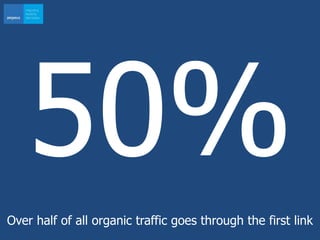
Over half of all organic traffic goes through the first link
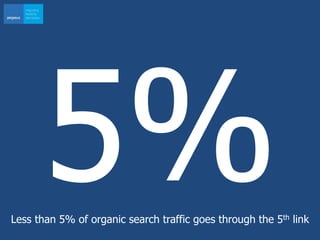
Less than 5% of organic search traffic goes through the 5th link
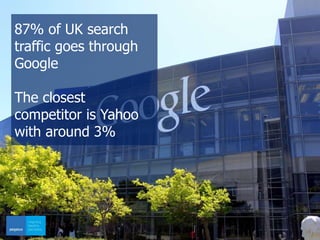
87% of UK search
traffic goes through
Google
The closest
competitor is Yahoo
with around 3%
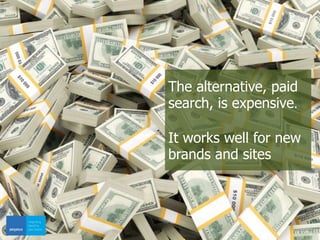
The alternative, paid
search, is expensive.
It works well for new
brands and sites
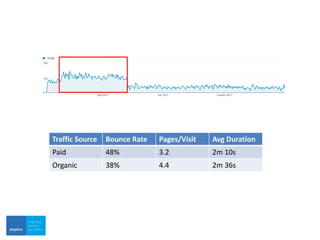
Traffic Source Bounce Rate Pages/Visit Avg Duration
Paid 48% 3.2 2m 10s
Organic 38% 4.4 2m 36s
A brief history of search
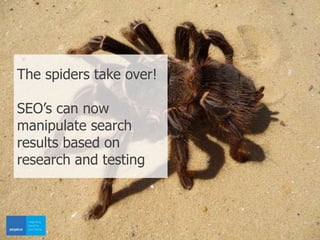
The spiders take over!
SEO’s can now
manipulate search
results based on
research and testing
Google Page Rank
released in 1998
Starts a long history
between SEO and links
Meta tags, descriptions
and optimised landing
pages become
important
PR toolbar released in
2000
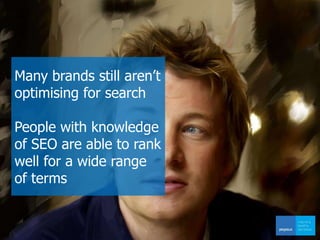
Many brands still aren’t
optimising for search
People with knowledge
of SEO are able to rank
well for a wide range
of terms
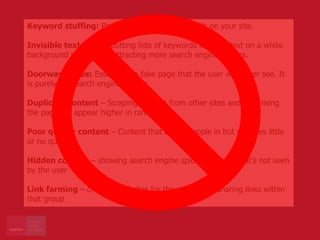
Keyword stuffing: Packing long lists of keywords on your site.
Invisible text: This is putting lists of keywords in white text on a white
background in hopes of attracting more search engine spiders.
Doorway Pages: Essentially a fake page that the user will never see. It
is purely for search engine spiders
Duplicate content – Scraping content from other sites and optimising
the pages to appear higher in rankings
Poor quality content – Content that draws people in but provides little
or no quality
Hidden content – showing search engine spiders content that’s not seen
by the user
Link farming – creating websites for the purpose of sharing links within
that group
What does an SEO do?
1. Keyword research - Identifying the least expensive and
competitive but most powerful and profitable keywords
for client sites.
2. Builds sitemaps, reviews site architecture, writes
optimised headlines and header tags, HTML and CSS
coding.
3. Looks for opportunities to exploit the search market
using a range of technical approaches.
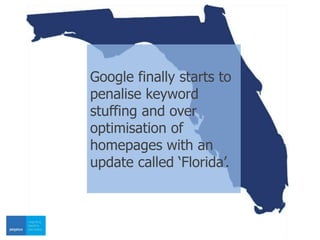
Google finally starts to
penalise keyword
stuffing and over
optimisation of
homepages with an
update called ‘Florida’.
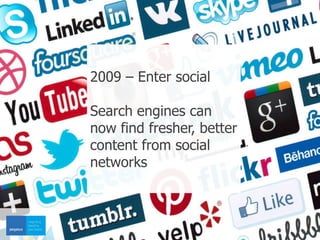
2009 – Enter social
Search engines can
now find fresher, better
content from social
networks
A new algorithm
update called ‘Caffeine’
means Google can now
index the web more
often, providing more
up to date search
results
This is shortly followed
by real time search
which now includes
results from sites like
Twitter
Google CEO says the
internet is becoming a
cesspool of false
information
He suggests that
brands are the best
way to solve the
problem
Google releases ‘Vince’
algorithm update
PANDA TIME!
New algorithm update
prevents sites with low
quality content getting
good rankings
Now SEO’s have to
focus on GOOD
CONTENT
Lot’s more SEO is
dead blog posts
Another update called
‘Penguin’ starts to
punish sites that build
low quality links
Blog networks and link
directories are hit hard
Duplicate content is
also penalised
SEO changes (a lot)
People start marketing to people again
Publishing the right content in the right
place at the right time becomes the key
Content must be helpful, fulfil intent and not
be interruptive
Content that people want to share
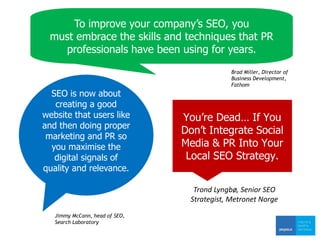
Jimmy McCann, head of SEO,
Search Laboratory
Brad Miller, Director of
Business Development,
Fathom
SEO is now about
creating a good
website that users like
and then doing proper
marketing and PR so
you maximise the
digital signals of
quality and relevance.
To improve your company’s SEO, you
must embrace the skills and techniques that PR
professionals have been using for years.
You’re Dead… If You
Don’t Integrate Social
Media & PR Into Your
Local SEO Strategy.
Trond Lyngbø, Senior SEO
Strategist, Metronet Norge
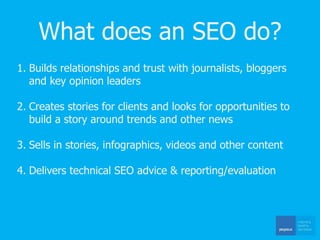
What does an SEO do?
1. Builds relationships and trust with journalists, bloggers
and key opinion leaders
2. Creates stories for clients and looks for opportunities to
build a story around trends and other news
3. Sells in stories, infographics, videos and other content
4. Delivers technical SEO advice & reporting/evaluation
SEO is significantly more
powerful when integrated
with PR activity because we
can enhance the value of
content and use it to build
the authority and reputation
of a website
CONTENT
+
BRANDING
=
GENUINE LINKS
&
AUTHORITY
Optimising Content
1.Goals and objectives
2.Timing
3.Technical Optimisation
4.Conversion
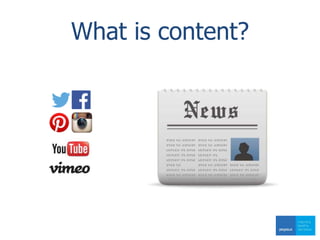
What is content?
1. Goals and Objectives
When thinking about the purpose of your
news, press releases, blog posts or
educational pieces ask yourself:
1. What are your goals with the content?
2. How do they tie in with our online
objectives?
3. How will we measure success?
2. Timing
• How long will this content remain
relevant?
• Is it an educational piece that will always
be useful?
• Is it a news item that will always be
interesting?
All three determine where content should go, how it should be optimised
and how it should be used
3. Technical Optimisation
• Title - use keywords, put them at the front and be
natural
• Content – Should be unique, frequently updated
and generally longer (500+ words)
• Keywords – Ensure they are included but also
focus on a natural flow
• Linking – Only link to relevant content, link to
internal pages, link naturally
• We also want to create content that
converts
• Driving targeted traffic is good, but
consider the call to action and make sure
that is included in your content
4. Conversion
Don’t apply a one-size-
fits-all method to your
optimisation.
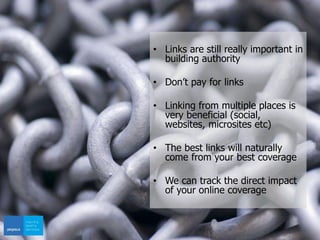
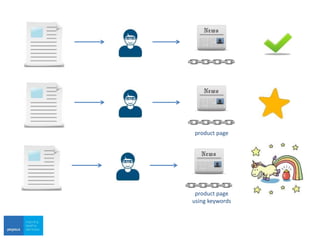
• Links are still really important in
building authority
• Don’t pay for links
• Linking from multiple places is
very beneficial (social,
websites, microsites etc)
• The best links will naturally
come from your best coverage
• We can track the direct impact
of your online coverage

product page
product page
using keywords
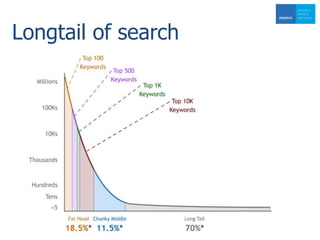
We can observe what people do,
by looking at the words and
phrases they used to find
information.
When aggregated, you get a nice
view of the words people most
often use when thinking about and
searching for a certain topic.
Longtail of search
Sharing
SEO has become about producing
compelling content that other people want
to share and promote
Good, shared content gets linked and
promoted which increases trust and builds
authority for websites, helping them gain
better visibility in search
1. Use the power of social media to gain
exposure for content, which results in
natural links and other signals of quality
and relevance.
2. Focus on enhancing the natural authority
of websites, pages, and individual writers,
which creates industry influence and trust
with Google.
Using social
• Search engines can still be gamed to some extent,
but the goals of search engines are similar to
those of general marketing and they are getting
very good at finding brands who break the rules
and tend to punish them accordingly.
• Creating compelling content and beneficial
relationships are link attraction strategies that
won’t get you banned or penalised. You’re also
achieving your overall goals of engaging and
entertaining users, driving them to your website
and converting them into customers.
Final Thoughts

Linking SEO & PR

  • 1.
  • 2.
  • 3.
    Over half ofall organic traffic goes through the first link
  • 4.
    Less than 5%of organic search traffic goes through the 5th link
  • 5.
    87% of UKsearch traffic goes through Google The closest competitor is Yahoo with around 3%
  • 6.
    The alternative, paid search,is expensive. It works well for new brands and sites
  • 7.
    Traffic Source BounceRate Pages/Visit Avg Duration Paid 48% 3.2 2m 10s Organic 38% 4.4 2m 36s
  • 8.
    A brief historyof search
  • 9.
    The spiders takeover! SEO’s can now manipulate search results based on research and testing
  • 10.
    Google Page Rank releasedin 1998 Starts a long history between SEO and links Meta tags, descriptions and optimised landing pages become important PR toolbar released in 2000
  • 11.
    Many brands stillaren’t optimising for search People with knowledge of SEO are able to rank well for a wide range of terms
  • 13.
    Keyword stuffing: Packinglong lists of keywords on your site. Invisible text: This is putting lists of keywords in white text on a white background in hopes of attracting more search engine spiders. Doorway Pages: Essentially a fake page that the user will never see. It is purely for search engine spiders Duplicate content – Scraping content from other sites and optimising the pages to appear higher in rankings Poor quality content – Content that draws people in but provides little or no quality Hidden content – showing search engine spiders content that’s not seen by the user Link farming – creating websites for the purpose of sharing links within that group
  • 14.
    What does anSEO do? 1. Keyword research - Identifying the least expensive and competitive but most powerful and profitable keywords for client sites. 2. Builds sitemaps, reviews site architecture, writes optimised headlines and header tags, HTML and CSS coding. 3. Looks for opportunities to exploit the search market using a range of technical approaches.
  • 15.
    Google finally startsto penalise keyword stuffing and over optimisation of homepages with an update called ‘Florida’.
  • 16.
    2009 – Entersocial Search engines can now find fresher, better content from social networks
  • 17.
    A new algorithm updatecalled ‘Caffeine’ means Google can now index the web more often, providing more up to date search results This is shortly followed by real time search which now includes results from sites like Twitter
  • 18.
    Google CEO saysthe internet is becoming a cesspool of false information He suggests that brands are the best way to solve the problem Google releases ‘Vince’ algorithm update
  • 19.
    PANDA TIME! New algorithmupdate prevents sites with low quality content getting good rankings Now SEO’s have to focus on GOOD CONTENT Lot’s more SEO is dead blog posts
  • 20.
    Another update called ‘Penguin’starts to punish sites that build low quality links Blog networks and link directories are hit hard Duplicate content is also penalised
  • 21.
    SEO changes (alot) People start marketing to people again Publishing the right content in the right place at the right time becomes the key Content must be helpful, fulfil intent and not be interruptive Content that people want to share
  • 22.
    Jimmy McCann, headof SEO, Search Laboratory Brad Miller, Director of Business Development, Fathom SEO is now about creating a good website that users like and then doing proper marketing and PR so you maximise the digital signals of quality and relevance. To improve your company’s SEO, you must embrace the skills and techniques that PR professionals have been using for years. You’re Dead… If You Don’t Integrate Social Media & PR Into Your Local SEO Strategy. Trond Lyngbø, Senior SEO Strategist, Metronet Norge
  • 23.
    What does anSEO do? 1. Builds relationships and trust with journalists, bloggers and key opinion leaders 2. Creates stories for clients and looks for opportunities to build a story around trends and other news 3. Sells in stories, infographics, videos and other content 4. Delivers technical SEO advice & reporting/evaluation
  • 24.
    SEO is significantlymore powerful when integrated with PR activity because we can enhance the value of content and use it to build the authority and reputation of a website
  • 25.
  • 26.
    Optimising Content 1.Goals andobjectives 2.Timing 3.Technical Optimisation 4.Conversion
  • 27.
  • 28.
    1. Goals andObjectives When thinking about the purpose of your news, press releases, blog posts or educational pieces ask yourself: 1. What are your goals with the content? 2. How do they tie in with our online objectives? 3. How will we measure success?
  • 29.
    2. Timing • Howlong will this content remain relevant? • Is it an educational piece that will always be useful? • Is it a news item that will always be interesting? All three determine where content should go, how it should be optimised and how it should be used
  • 30.
    3. Technical Optimisation •Title - use keywords, put them at the front and be natural • Content – Should be unique, frequently updated and generally longer (500+ words) • Keywords – Ensure they are included but also focus on a natural flow • Linking – Only link to relevant content, link to internal pages, link naturally
  • 31.
    • We alsowant to create content that converts • Driving targeted traffic is good, but consider the call to action and make sure that is included in your content 4. Conversion
  • 32.
    Don’t apply aone-size- fits-all method to your optimisation.
  • 33.
    • Links arestill really important in building authority • Don’t pay for links • Linking from multiple places is very beneficial (social, websites, microsites etc) • The best links will naturally come from your best coverage • We can track the direct impact of your online coverage
  • 34.
  • 35.
    We can observewhat people do, by looking at the words and phrases they used to find information. When aggregated, you get a nice view of the words people most often use when thinking about and searching for a certain topic.
  • 36.
  • 37.
  • 38.
    SEO has becomeabout producing compelling content that other people want to share and promote Good, shared content gets linked and promoted which increases trust and builds authority for websites, helping them gain better visibility in search
  • 39.
    1. Use thepower of social media to gain exposure for content, which results in natural links and other signals of quality and relevance. 2. Focus on enhancing the natural authority of websites, pages, and individual writers, which creates industry influence and trust with Google. Using social
  • 40.
    • Search enginescan still be gamed to some extent, but the goals of search engines are similar to those of general marketing and they are getting very good at finding brands who break the rules and tend to punish them accordingly. • Creating compelling content and beneficial relationships are link attraction strategies that won’t get you banned or penalised. You’re also achieving your overall goals of engaging and entertaining users, driving them to your website and converting them into customers. Final Thoughts