Basic of SEO
State of Search
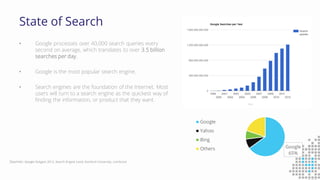
• Google processes over 40,000 search queries every
second on average, which translates to over 3.5 billion
searches per day.
• Google is the most popular search engine.
• Search engines are the foundation of the Internet. Most
users will turn to a search engine as the quickest way of
finding the information, or product that they want.
Sources: Google Zeitgest 2012, Search Engine Land, Stanford University, comScore
Google
65%
Google
Yahoo
Bing
Others
Why do You Need Search Marketing?
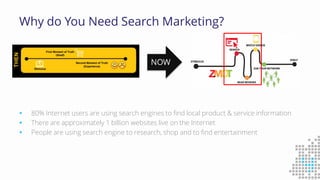
 80% Internet users are using search engines to find local product & service information
 There are approximately 1 billion websites live on the Internet
 People are using search engine to research, shop and to find entertainment
NOW
Search Engine Marketing: Definition
• A form of Internet marketing that involves the promotion of websites by increasing their visibility in search
engine result pages (SERPs)
• Search brings 60% of traffic to the website on average.
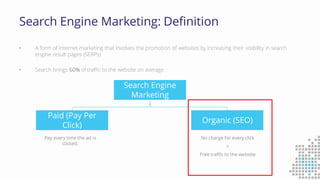
Search Engine
Marketing
Paid (Pay Per
Click)
Organic (SEO)
Pay every time the ad is
clicked.
No charge for every click
=
Free traffic to the website
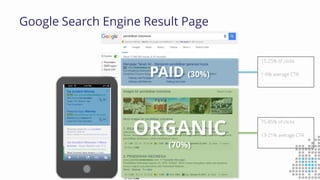
Google Search Engine Result Page
PAID (30%)
ORGANIC
(70%)
15-25% of clicks
1-9% average CTR
75-85% of clicks
13-21% average CTR
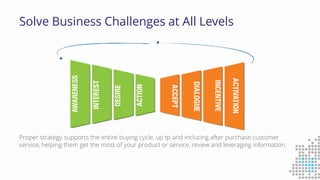
Solve Business Challenges at All Levels
Proper strategy supports the entire buying cycle, up tp and inclucing after purchase customer
service, helping them get the most of your product or service, review and leveraging information.
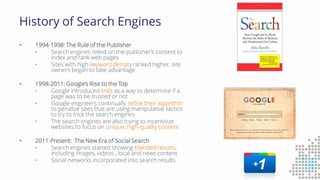
History of Search Engines
 1994-1998: The Rule of the Publisher
• Search engines relied on the publisher’s content to
index and rank web pages
• Sites with high keyword density ranked higher, site
owners began to take advantage
 1998-2011: Google’s Rise to the Top
• Google introduced links as a way to determine if a
page was to be trusted or not
• Google engineers continually refine their algorithm
to penalize sites that are using manipulative tactics
to try to trick the search engines
• The search engines are also trying to incentivize
websites to focus on unique, high-quality content
 2011-Present: The New Era of Social Search
• Search engines started showing blended results,
including images, videos , local and news content
• Social networks incorporated into search results
SEO: The Definition
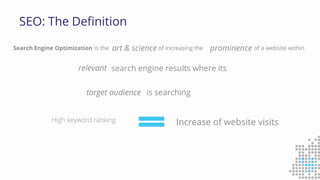
Search Engine Optimization is the of increasing the of a website withinart & science prominence
relevant search engine results where its
is searchingtarget audience
High keyword ranking Increase of website visits
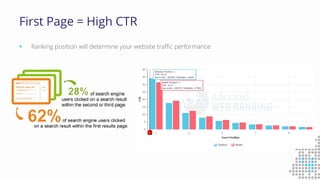
First Page = High CTR
 Ranking position will determine your website traffic performance
How Search Engine Works
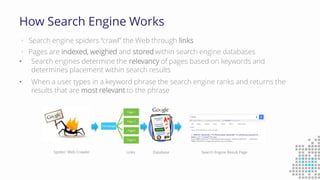
• Search engine spiders “crawl” the Web through links
• Pages are indexed, weighed and stored within search engine databases
Homepage
Page 1
Page 2
Page3
Page 4
Spider/ Web Crawler Database Search Engine Result Page
• Search engines determine the relevancy of pages based on keywords and
determines placement within search results
• When a user types in a keyword phrase the search engine ranks and returns the
results that are most relevant to the phrase
Links
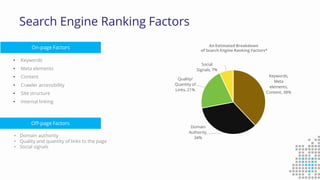
Search Engine Ranking Factors
• Keywords
• Meta elements
• Content
• Crawler accessibility
• Site structure
• Internal linking
On-page Factors
Off-page Factors
• Domain authority
• Quality and quantity of links to the page
• Social signals
An Estimated Breakdown
of Search Engine Ranking Factors*
Keywords,
Meta
elements,
Content, 38%
Domain
Authority,
34%
Quality/
Quantity of
Links, 21%
Social
Signals, 7%
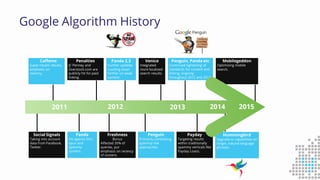
Google Algorithm History
Mobilegeddon
Optimizing mobile
search.
Caffeine
Super-recent results,
emphasis on
recency.
Social Signals
Taking into account
data from Facebook,
Twitter.
Penalties
JC Penney and
Overstock.com are
publicly hit for paid
linking.
Panda
Hit against thin,
spun and
spammy
content.
Panda 2,3
Further updates
cracking down
further on weak
content.
Freshness
Bonus
Affected 35% of
queries, put
emphasis on recency
of content.
Venice
Integrated
more localized
search results.
Penguin
Primarily combatting
spammy link
approaches.
Penguin, Panda etc
Continued tightening of
standards for content and
linking, ongoing
throughout 2012 and 2013.
Payday
Targeting results
within traditionally
spammy verticals like
Payday Loans.
Hummingbird
Upgrade to capabilities on
longer, natural language
phrases.
2011 2012 2013 2014 2015
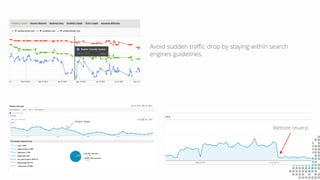
Avoid sudden traffic drop by staying within search
engines guidelines.
Website revamp
Google Search Engine Result Page
Understanding the landscape
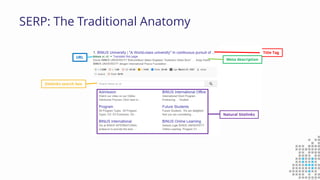
SERP: The Traditional Anatomy
Title Tag
URL
Natural Sitelinks
Meta description
Sitelinks search box
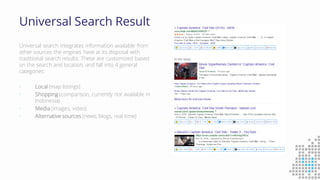
Universal Search Result
Universal search integrates information available from
other sources the engines have at its disposal with
traditional search results. These are customized based
on the search and location, and fall into 4 general
categories:
• Local (map listings)
• Shopping (comparison, currently not available in
Indonesia)
• Media (images, video)
• Alternative sources (news, blogs, real time)
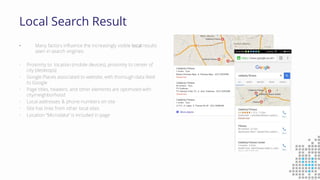
Local Search Result
• Many factors influence the increasingly visible local results
seen in search engines:
• Proximity to location (mobile devices), proximity to center of
city (desktops)
• Google Places associated to website, with thorough data feed
to Google
• Page titles, headers, and other elements are optimized with
city/neighborhood
• Local addresses & phone numbers on site
• Site has links from other local sites
• Location “Microdata” is included in page
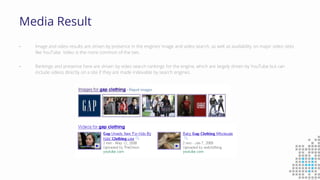
Media Result
• Image and video results are driven by presence in the engines’ image and video search, as well as availability on major video sites
like YouTube. Video is the more common of the two.
• Rankings and presence here are driven by video search rankings for the engine, which are largely driven by YouTube but can
include videos directly on a site if they are made indexable by search engines.
Elements in SEO
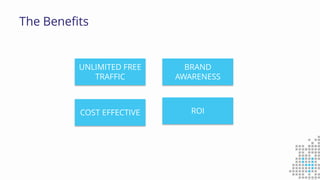
The Benefits
ROI
BRAND
AWARENESS
UNLIMITED FREE
TRAFFIC
COST EFFECTIVE
Keywords
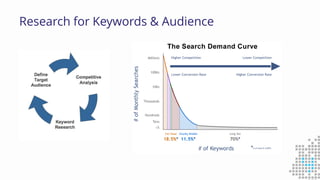
Research for Keywords & Audience
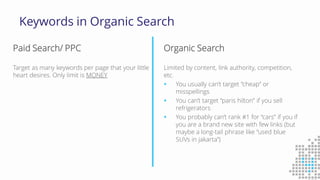
Keywords in Organic Search
Paid Search/ PPC
Target as many keywords per page that your little
heart desires. Only limit is MONEY
Organic Search
Limited by content, link authority, competition,
etc.
 You usually can’t target “cheap” or
misspellings
 You can’t target “paris hilton” if you sell
refrigerators
 You probably can’t rank #1 for “cars” if you if
you are a brand new site with few links (but
maybe a long-tail phrase like “used blue
SUVs in jakarta”)
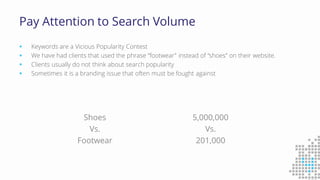
Pay Attention to Search Volume
 Keywords are a Vicious Popularity Contest
 We have had clients that used the phrase “footwear” instead of “shoes” on their website.
 Clients usually do not think about search popularity
 Sometimes it is a branding issue that often must be fought against
Shoes
Vs.
Footwear
5,000,000
Vs.
201,000
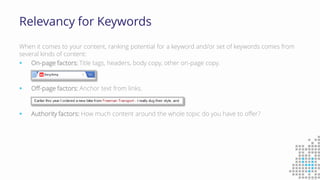
Relevancy for Keywords
When it comes to your content, ranking potential for a keyword and/or set of keywords comes from
several kinds of content:
 On-page factors: Title tags, headers, body copy, other on-page copy.
 Off-page factors: Anchor text from links.
 Authority factors: How much content around the whole topic do you have to offer?
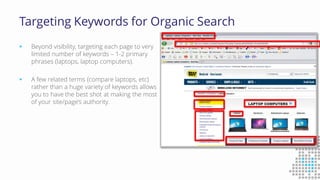
Targeting Keywords for Organic Search
 Beyond visibility, targeting each page to very
limited number of keywords – 1-2 primary
phrases (laptops, laptop computers).
 A few related terms (compare laptops, etc)
rather than a huge variety of keywords allows
you to have the best shot at making the most
of your site/page’s authority.
Indexing & Authority
Understanding How Authority Affect SEO
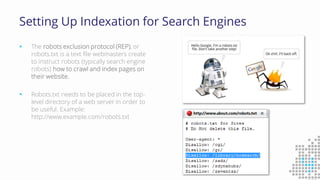
Setting Up Indexation for Search Engines
 The robots exclusion protocol (REP), or
robots.txt is a text file webmasters create
to instruct robots (typically search engine
robots) how to crawl and index pages on
their website.
 Robots.txt needs to be placed in the top-
level directory of a web server in order to
be useful. Example:
http://www.example.com/robots.txt
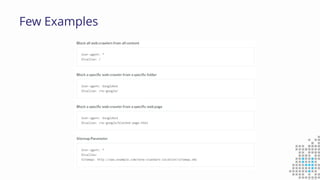
Few Examples
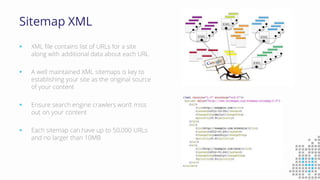
Sitemap XML
 XML file contains list of URLs for a site
along with additional data about each URL
 A well maintained XML sitemaps is key to
establishing your site as the original source
of your content
 Ensure search engine crawlers won’t miss
out on your content
 Each sitemap can have up to 50,000 URLs
and no larger than 10MB
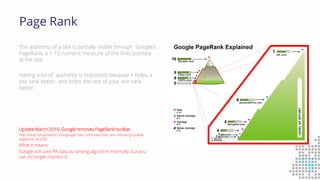
Page Rank
The authority of a site is partially visible through Google’s
PageRank, a 1-10 numeric measure of the links pointed
at the site.
Having a lot of authority is important because it helps a
site rank better, and helps the rest of your site rank
better.
Update March 2016: Google removes PageRank toolbar.
http://searchengineland.com/google-has-confirmed-they-are-removing-toolbar-
pagerank-244230
What it means:
Google still uses PR data as ranking algorithm internally, but you
can no longer monitor it.
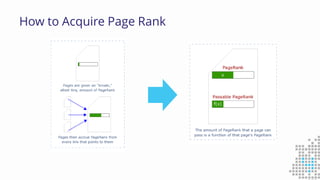
How to Acquire Page Rank
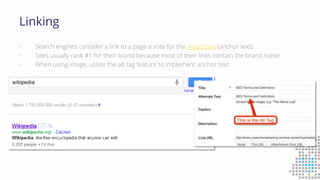
Linking
• Search engines consider a link to a page a vote for the linked text (anchor text)
• Sites usually rank #1 for their brand because most of their links contain the brand name.
• When using image, utilize the alt tag feature to implement anchor text
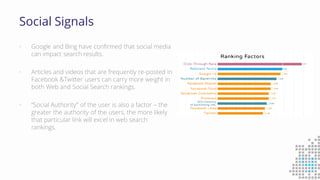
Social Signals
• Google and Bing have confirmed that social media
can impact search results.
• Articles and videos that are frequently re-posted in
Facebook &Twitter users can carry more weight in
both Web and Social Search rankings.
• “Social Authority” of the user is also a factor – the
greater the authority of the users, the more likely
that particular link will excel in web search
rankings.
Quiz
 Google’s Panda Update was also known as the ______ update
a. Quality
b. Pay Day
c. Vince
d. Caffeine
 Which group of ranking factors do SEOs generally considered to have the largest influence on
rankings?
a. Engagement metrics
b. Social shares
c. Link-based metrics
d. Site speed
e. Exact match domains
Optimization
Understanding How Authority Affect SEO
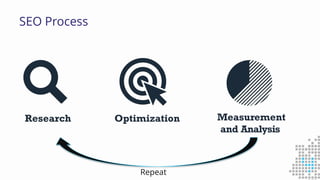
SEO Process
Research Optimization Measurement
and Analysis
Repeat
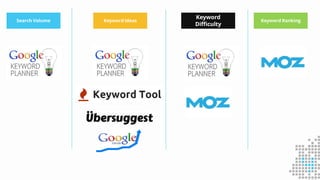
Search Volume Keyword Ideas
Keyword
Difficulty
Keyword Ranking
Other Tools
 Web Analytics Software
• What terms are already driving natural search traffic?
• What terms are working in paid search?
• What variants work well?
• What terms drive traffic but not conversions?
• …and vice versa
 On site Search
• What are people looking for on the site?
• Terms that don’t return results
• Good for keyword research and for expanding content
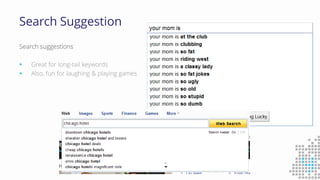
Search Suggestion
Search suggestions
 Great for long-tail keywords
 Also, fun for laughing & playing games
Technical Optimization: URLs
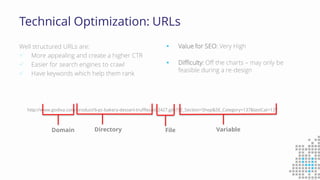
Well structured URLs are:
 More appealing and create a higher CTR
 Easier for search engines to crawl
 Have keywords which help them rank
http://www.godiva.com/product/6-pc-bakery-dessert-truffles/id/2427.gdv?SE_Section=Shop&SE_Category=137&lastCat=137
Domain Directory File Variable
 Value for SEO: Very High
 Difficulty: Off the charts – may only be
feasible during a re-design
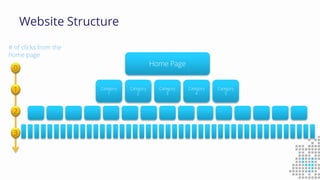
Website Structure
Home Page
Category
1
Category
2
Category
3
Category
4
Category
5
# of clicks from the
home page
1
2
3
0
On Page Optimization: Meta Data
 Basic Tags:
• Meta title & description
• Headings
 Advanced Tags:
• Schema microdata
• Facebook Open Graph
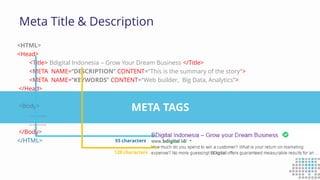
Meta Title & Description
<HTML>
<Head>
<Title> Bdigital Indonesia – Grow Your Dream Business </Title>
<META NAME=“DESCRIPTION” CONTENT=“This is the summary of the story”>
<META NAME=“KEYWORDS” CONTENT=“Web builder, Big Data, Analytics”>
</Head>
<Body>
………..
………..
</Body>
</HTML>
META TAGS
120 characters
55 characters
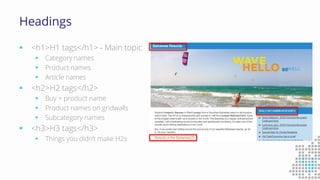
Headings
 <h1>H1 tags</h1> - Main topic
 Category names
 Product names
 Article names
 <h2>H2 tags</h2>
 Buy + product name
 Product names on gridwalls
 Subcategory names
 <h3>H3 tags</h3>
 Things you didn’t make H2s
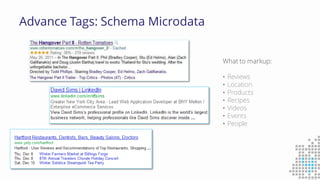
Advance Tags: Schema Microdata
What to markup:
• Reviews
• Location
• Products
• Recipes
• Videos
• Events
• People
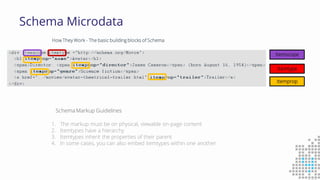
Schema Microdata
Schema Markup Guidelines
1. The markup must be on physical, viewable on-page content
2. Itemtypes have a hierarchy
3. Itemtypes inherit the properties of their parent
4. In some cases, you can also embed itemtypes within one another
How They Work - The basic building blocks of Schema
Itemscope
Itemtype
Itemprop
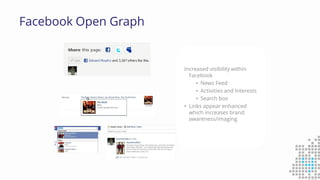
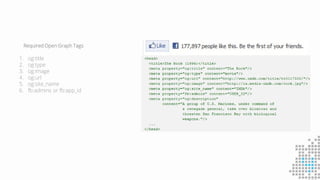
Facebook Open Graph
Increased visibility within
Facebook
• News Feed
• Activities and Interests
• Search box
• Links appear enhanced
which increases brand
awareness/imagingExample
Required Open Graph Tags
1. og:title
2. og:type
3. og:image
4. og:url
5. og:site_name
6. fb:admins or fb:app_id
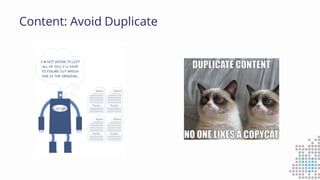
Content: Avoid Duplicate
How Duplicate Content is Created?
• URL Parameters
• Print Options
• Any Session ID
• URL Capitalizations
• WWW vs. Non-WWW
• Creating similar content
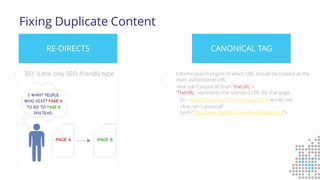
Fixing Duplicate Content
RE-DIRECTS CANONICAL TAG
• 301 is the only SEO-friendly type • Informs search engine of which URL should be treated as the
main authoritative URL
• <link rel=”canonical” href=”theURL”>
“TheURL” represents the standard URL for that page.
Ex. - http://BassPro.com/homepage.html would use:
<link rel=”canonical”
href=“http://www.BassPro.com/homepage.html”>
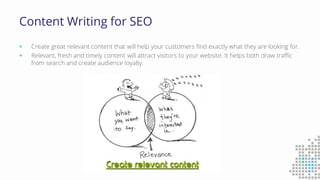
Content Writing for SEO
 Create great relevant content that will help your customers find exactly what they are looking for.
 Relevant, fresh and timely content will attract visitors to your website. It helps both draw traffic
from search and create audience loyalty.
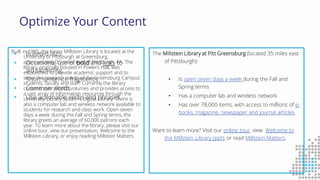
Optimize Your Content
 Bulleted lists
 Occasional use of bold and links to
aid skimming
 Short sentence fragments
 Common words
 Use actionable verbs and phrases
Built in 1995, the Fanny Millstein Library is located at the
University of Pittsburgh at Greensburg,
approximately 35 miles east of Pittsburgh, PA. The
library, originally housed in Powers Hall, was
established to provide academic support and to
serve the research needs of the Greensburg Campus'
students, faculty and staff. Currently the library
contains over 78,000 volumes and provides access to
a vast array of information resources through the
University Library System's Digital Library. There is
also a computer lab and wireless network available to
students for research and class work. Open seven
days a week during the Fall and Spring terms, the
library greets an average of 60,000 patrons each
year. To learn more about the library, please visit our
online tour, view our presentation, Welcome to the
Millstein Library, or enjoy reading Millstein Matters.
The Millstein Library at Pitt Greensburg (located 35 miles east
of Pittsburgh):
• Is open seven days a week during the Fall and
Spring terms
• Has a computer lab and wireless network
• Has over 78,000 items, with access to millions of e-
books, magazine, newspaper and journal articles.
Want to learn more? Visit our online tour, view Welcome to
the Millstein Library (ppt), or read Millstein Matters.
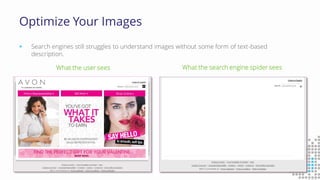
Optimize Your Images
 Search engines still struggles to understand images without some form of text-based
description.
What the user sees What the search engine spider sees
Optimize Your Images
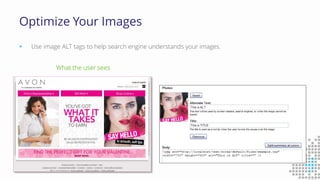
 Use image ALT tags to help search engine understands your images.
What the user sees
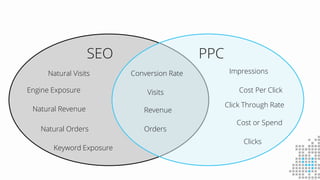
SEO PPC
Visits
Natural Visits
Natural Revenue Revenue
Natural Orders Orders
Conversion Rate
Engine Exposure
Keyword Exposure
Impressions
Clicks
Click Through Rate
Cost or Spend
Cost Per Click
Types of SEO Reports
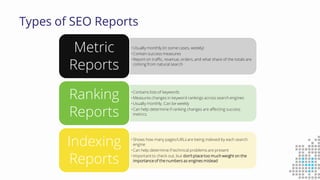
•Usually monthly (in some cases, weekly)
•Contain success measures
•Report on traffic, revenue, orders, and what share of the totals are
coming from natural search
Metric
Reports
•Contains lists of keywords
•Measures changes in keyword rankings across search engines
•Usually monthly. Can be weekly
•Can help determine if ranking changes are affecting success
metrics
Ranking
Reports
•Shows how many pages/URLs are being indexed by each search
engine
•Can help determine if technical problems are present
•Important to check out, but don’t place too much weight on the
importance of the numbers as engines mislead
Indexing
Reports
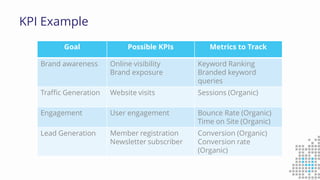
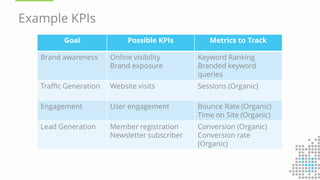
KPI Example
Goal Possible KPIs Metrics to Track
Brand awareness Online visibility
Brand exposure
Keyword Ranking
Branded keyword
queries
Traffic Generation Website visits Sessions (Organic)
Engagement User engagement Bounce Rate (Organic)
Time on Site (Organic)
Lead Generation Member registration
Newsletter subscriber
Conversion (Organic)
Conversion rate
(Organic)
Example KPIs
Goal Possible KPIs Metrics to Track
Brand awareness Online visibility
Brand exposure
Keyword Ranking
Branded keyword
queries
Traffic Generation Website visits Sessions (Organic)
Engagement User engagement Bounce Rate (Organic)
Time on Site (Organic)
Lead Generation Member registration
Newsletter subscriber
Conversion (Organic)
Conversion rate
(Organic)
Quiz
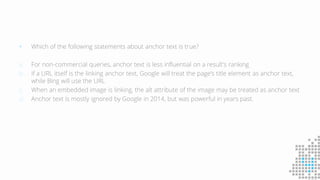
 Which of the following statements about anchor text is true?
a. For non-commercial queries, anchor text is less influential on a result's ranking
b. If a URL itself is the linking anchor text, Google will treat the page's title element as anchor text,
while Bing will use the URL
c. When an embedded image is linking, the alt attribute of the image may be treated as anchor text
d. Anchor text is mostly ignored by Google in 2014, but was powerful in years past.
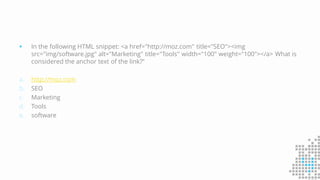
 In the following HTML snippet: <a href="http://moz.com" title="SEO"><img
src="img/software.jpg" alt="Marketing" title="Tools" width="100" weight="100"></a> What is
considered the anchor text of the link?“
a. http://moz.com
b. SEO
c. Marketing
d. Tools
e. software
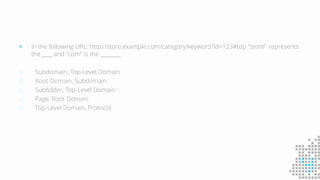
 In the following URL: http://store.example.com/category/keyword?id=123#top "store" represents
the ____ and "com" is the ________
a. Subdomain, Top-Level Domain
b. Root Domain, Subdomain
c. Subfolder, Top-Level Domain
d. Page, Root Domain
e. Top-Level Domain, Protocol
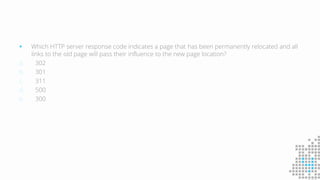
 Which HTTP server response code indicates a page that has been permanently relocated and all
links to the old page will pass their influence to the new page location?
a. 302
b. 301
c. 311
d. 500
e. 300
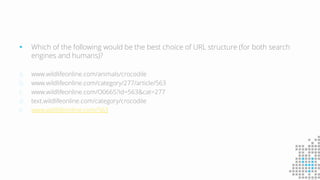
 Which of the following would be the best choice of URL structure (for both search
engines and humans)?
a. www.wildlifeonline.com/animals/crocodile
b. www.wildlifeonline.com/category/277/article/563
c. www.wildlifeonline.com/O0665?id=563&cat=277
d. text.wildlifeonline.com/category/crocodile
e. www.wildlifeonline.com/563
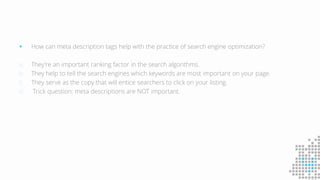
 How can meta description tags help with the practice of search engine optimization?
a. They're an important ranking factor in the search algorithms.
b. They help to tell the search engines which keywords are most important on your page.
c. They serve as the copy that will entice searchers to click on your listing.
d. Trick question; meta descriptions are NOT important.
Thank ou
donath mulaniari MsDonath

SEO 101

  • 1.
  • 2.
    State of Search •Google processes over 40,000 search queries every second on average, which translates to over 3.5 billion searches per day. • Google is the most popular search engine. • Search engines are the foundation of the Internet. Most users will turn to a search engine as the quickest way of finding the information, or product that they want. Sources: Google Zeitgest 2012, Search Engine Land, Stanford University, comScore Google 65% Google Yahoo Bing Others
  • 3.
    Why do YouNeed Search Marketing?  80% Internet users are using search engines to find local product & service information  There are approximately 1 billion websites live on the Internet  People are using search engine to research, shop and to find entertainment NOW
  • 4.
    Search Engine Marketing:Definition • A form of Internet marketing that involves the promotion of websites by increasing their visibility in search engine result pages (SERPs) • Search brings 60% of traffic to the website on average. Search Engine Marketing Paid (Pay Per Click) Organic (SEO) Pay every time the ad is clicked. No charge for every click = Free traffic to the website
  • 5.
    Google Search EngineResult Page PAID (30%) ORGANIC (70%) 15-25% of clicks 1-9% average CTR 75-85% of clicks 13-21% average CTR
  • 6.
    Solve Business Challengesat All Levels Proper strategy supports the entire buying cycle, up tp and inclucing after purchase customer service, helping them get the most of your product or service, review and leveraging information.
  • 7.
    History of SearchEngines  1994-1998: The Rule of the Publisher • Search engines relied on the publisher’s content to index and rank web pages • Sites with high keyword density ranked higher, site owners began to take advantage  1998-2011: Google’s Rise to the Top • Google introduced links as a way to determine if a page was to be trusted or not • Google engineers continually refine their algorithm to penalize sites that are using manipulative tactics to try to trick the search engines • The search engines are also trying to incentivize websites to focus on unique, high-quality content  2011-Present: The New Era of Social Search • Search engines started showing blended results, including images, videos , local and news content • Social networks incorporated into search results
  • 9.
    SEO: The Definition SearchEngine Optimization is the of increasing the of a website withinart & science prominence relevant search engine results where its is searchingtarget audience High keyword ranking Increase of website visits
  • 10.
    First Page =High CTR  Ranking position will determine your website traffic performance
  • 11.
    How Search EngineWorks • Search engine spiders “crawl” the Web through links • Pages are indexed, weighed and stored within search engine databases Homepage Page 1 Page 2 Page3 Page 4 Spider/ Web Crawler Database Search Engine Result Page • Search engines determine the relevancy of pages based on keywords and determines placement within search results • When a user types in a keyword phrase the search engine ranks and returns the results that are most relevant to the phrase Links
  • 12.
    Search Engine RankingFactors • Keywords • Meta elements • Content • Crawler accessibility • Site structure • Internal linking On-page Factors Off-page Factors • Domain authority • Quality and quantity of links to the page • Social signals An Estimated Breakdown of Search Engine Ranking Factors* Keywords, Meta elements, Content, 38% Domain Authority, 34% Quality/ Quantity of Links, 21% Social Signals, 7%
  • 13.
    Google Algorithm History Mobilegeddon Optimizingmobile search. Caffeine Super-recent results, emphasis on recency. Social Signals Taking into account data from Facebook, Twitter. Penalties JC Penney and Overstock.com are publicly hit for paid linking. Panda Hit against thin, spun and spammy content. Panda 2,3 Further updates cracking down further on weak content. Freshness Bonus Affected 35% of queries, put emphasis on recency of content. Venice Integrated more localized search results. Penguin Primarily combatting spammy link approaches. Penguin, Panda etc Continued tightening of standards for content and linking, ongoing throughout 2012 and 2013. Payday Targeting results within traditionally spammy verticals like Payday Loans. Hummingbird Upgrade to capabilities on longer, natural language phrases. 2011 2012 2013 2014 2015
  • 15.
    Avoid sudden trafficdrop by staying within search engines guidelines. Website revamp
  • 16.
    Google Search EngineResult Page Understanding the landscape
  • 17.
    SERP: The TraditionalAnatomy Title Tag URL Natural Sitelinks Meta description Sitelinks search box
  • 18.
    Universal Search Result Universalsearch integrates information available from other sources the engines have at its disposal with traditional search results. These are customized based on the search and location, and fall into 4 general categories: • Local (map listings) • Shopping (comparison, currently not available in Indonesia) • Media (images, video) • Alternative sources (news, blogs, real time)
  • 19.
    Local Search Result •Many factors influence the increasingly visible local results seen in search engines: • Proximity to location (mobile devices), proximity to center of city (desktops) • Google Places associated to website, with thorough data feed to Google • Page titles, headers, and other elements are optimized with city/neighborhood • Local addresses & phone numbers on site • Site has links from other local sites • Location “Microdata” is included in page
  • 20.
    Media Result • Imageand video results are driven by presence in the engines’ image and video search, as well as availability on major video sites like YouTube. Video is the more common of the two. • Rankings and presence here are driven by video search rankings for the engine, which are largely driven by YouTube but can include videos directly on a site if they are made indexable by search engines.
  • 21.
  • 22.
  • 24.
  • 25.
  • 26.
    Keywords in OrganicSearch Paid Search/ PPC Target as many keywords per page that your little heart desires. Only limit is MONEY Organic Search Limited by content, link authority, competition, etc.  You usually can’t target “cheap” or misspellings  You can’t target “paris hilton” if you sell refrigerators  You probably can’t rank #1 for “cars” if you if you are a brand new site with few links (but maybe a long-tail phrase like “used blue SUVs in jakarta”)
  • 27.
    Pay Attention toSearch Volume  Keywords are a Vicious Popularity Contest  We have had clients that used the phrase “footwear” instead of “shoes” on their website.  Clients usually do not think about search popularity  Sometimes it is a branding issue that often must be fought against Shoes Vs. Footwear 5,000,000 Vs. 201,000
  • 28.
    Relevancy for Keywords Whenit comes to your content, ranking potential for a keyword and/or set of keywords comes from several kinds of content:  On-page factors: Title tags, headers, body copy, other on-page copy.  Off-page factors: Anchor text from links.  Authority factors: How much content around the whole topic do you have to offer?
  • 29.
    Targeting Keywords forOrganic Search  Beyond visibility, targeting each page to very limited number of keywords – 1-2 primary phrases (laptops, laptop computers).  A few related terms (compare laptops, etc) rather than a huge variety of keywords allows you to have the best shot at making the most of your site/page’s authority.
  • 30.
    Indexing & Authority UnderstandingHow Authority Affect SEO
  • 31.
    Setting Up Indexationfor Search Engines  The robots exclusion protocol (REP), or robots.txt is a text file webmasters create to instruct robots (typically search engine robots) how to crawl and index pages on their website.  Robots.txt needs to be placed in the top- level directory of a web server in order to be useful. Example: http://www.example.com/robots.txt
  • 32.
  • 33.
    Sitemap XML  XMLfile contains list of URLs for a site along with additional data about each URL  A well maintained XML sitemaps is key to establishing your site as the original source of your content  Ensure search engine crawlers won’t miss out on your content  Each sitemap can have up to 50,000 URLs and no larger than 10MB
  • 34.
    Page Rank The authorityof a site is partially visible through Google’s PageRank, a 1-10 numeric measure of the links pointed at the site. Having a lot of authority is important because it helps a site rank better, and helps the rest of your site rank better. Update March 2016: Google removes PageRank toolbar. http://searchengineland.com/google-has-confirmed-they-are-removing-toolbar- pagerank-244230 What it means: Google still uses PR data as ranking algorithm internally, but you can no longer monitor it.
  • 35.
    How to AcquirePage Rank
  • 36.
    Linking • Search enginesconsider a link to a page a vote for the linked text (anchor text) • Sites usually rank #1 for their brand because most of their links contain the brand name. • When using image, utilize the alt tag feature to implement anchor text
  • 37.
    Social Signals • Googleand Bing have confirmed that social media can impact search results. • Articles and videos that are frequently re-posted in Facebook &Twitter users can carry more weight in both Web and Social Search rankings. • “Social Authority” of the user is also a factor – the greater the authority of the users, the more likely that particular link will excel in web search rankings.
  • 38.
  • 39.
     Google’s PandaUpdate was also known as the ______ update a. Quality b. Pay Day c. Vince d. Caffeine
  • 40.
     Which groupof ranking factors do SEOs generally considered to have the largest influence on rankings? a. Engagement metrics b. Social shares c. Link-based metrics d. Site speed e. Exact match domains
  • 41.
  • 42.
    SEO Process Research OptimizationMeasurement and Analysis Repeat
  • 43.
    Search Volume KeywordIdeas Keyword Difficulty Keyword Ranking
  • 44.
    Other Tools  WebAnalytics Software • What terms are already driving natural search traffic? • What terms are working in paid search? • What variants work well? • What terms drive traffic but not conversions? • …and vice versa  On site Search • What are people looking for on the site? • Terms that don’t return results • Good for keyword research and for expanding content
  • 45.
    Search Suggestion Search suggestions Great for long-tail keywords  Also, fun for laughing & playing games
  • 46.
    Technical Optimization: URLs Wellstructured URLs are:  More appealing and create a higher CTR  Easier for search engines to crawl  Have keywords which help them rank http://www.godiva.com/product/6-pc-bakery-dessert-truffles/id/2427.gdv?SE_Section=Shop&SE_Category=137&lastCat=137 Domain Directory File Variable  Value for SEO: Very High  Difficulty: Off the charts – may only be feasible during a re-design
  • 47.
  • 48.
    On Page Optimization:Meta Data  Basic Tags: • Meta title & description • Headings  Advanced Tags: • Schema microdata • Facebook Open Graph
  • 49.
    Meta Title &Description <HTML> <Head> <Title> Bdigital Indonesia – Grow Your Dream Business </Title> <META NAME=“DESCRIPTION” CONTENT=“This is the summary of the story”> <META NAME=“KEYWORDS” CONTENT=“Web builder, Big Data, Analytics”> </Head> <Body> ……….. ……….. </Body> </HTML> META TAGS 120 characters 55 characters
  • 50.
    Headings  <h1>H1 tags</h1>- Main topic  Category names  Product names  Article names  <h2>H2 tags</h2>  Buy + product name  Product names on gridwalls  Subcategory names  <h3>H3 tags</h3>  Things you didn’t make H2s
  • 51.
    Advance Tags: SchemaMicrodata What to markup: • Reviews • Location • Products • Recipes • Videos • Events • People
  • 52.
    Schema Microdata Schema MarkupGuidelines 1. The markup must be on physical, viewable on-page content 2. Itemtypes have a hierarchy 3. Itemtypes inherit the properties of their parent 4. In some cases, you can also embed itemtypes within one another How They Work - The basic building blocks of Schema Itemscope Itemtype Itemprop
  • 53.
    Facebook Open Graph Increasedvisibility within Facebook • News Feed • Activities and Interests • Search box • Links appear enhanced which increases brand awareness/imagingExample
  • 54.
    Required Open GraphTags 1. og:title 2. og:type 3. og:image 4. og:url 5. og:site_name 6. fb:admins or fb:app_id
  • 55.
  • 56.
    How Duplicate Contentis Created? • URL Parameters • Print Options • Any Session ID • URL Capitalizations • WWW vs. Non-WWW • Creating similar content
  • 57.
    Fixing Duplicate Content RE-DIRECTSCANONICAL TAG • 301 is the only SEO-friendly type • Informs search engine of which URL should be treated as the main authoritative URL • <link rel=”canonical” href=”theURL”> “TheURL” represents the standard URL for that page. Ex. - http://BassPro.com/homepage.html would use: <link rel=”canonical” href=“http://www.BassPro.com/homepage.html”>
  • 58.
    Content Writing forSEO  Create great relevant content that will help your customers find exactly what they are looking for.  Relevant, fresh and timely content will attract visitors to your website. It helps both draw traffic from search and create audience loyalty.
  • 60.
    Optimize Your Content Bulleted lists  Occasional use of bold and links to aid skimming  Short sentence fragments  Common words  Use actionable verbs and phrases Built in 1995, the Fanny Millstein Library is located at the University of Pittsburgh at Greensburg, approximately 35 miles east of Pittsburgh, PA. The library, originally housed in Powers Hall, was established to provide academic support and to serve the research needs of the Greensburg Campus' students, faculty and staff. Currently the library contains over 78,000 volumes and provides access to a vast array of information resources through the University Library System's Digital Library. There is also a computer lab and wireless network available to students for research and class work. Open seven days a week during the Fall and Spring terms, the library greets an average of 60,000 patrons each year. To learn more about the library, please visit our online tour, view our presentation, Welcome to the Millstein Library, or enjoy reading Millstein Matters. The Millstein Library at Pitt Greensburg (located 35 miles east of Pittsburgh): • Is open seven days a week during the Fall and Spring terms • Has a computer lab and wireless network • Has over 78,000 items, with access to millions of e- books, magazine, newspaper and journal articles. Want to learn more? Visit our online tour, view Welcome to the Millstein Library (ppt), or read Millstein Matters.
  • 61.
    Optimize Your Images Search engines still struggles to understand images without some form of text-based description. What the user sees What the search engine spider sees
  • 62.
    Optimize Your Images Use image ALT tags to help search engine understands your images. What the user sees
  • 63.
    SEO PPC Visits Natural Visits NaturalRevenue Revenue Natural Orders Orders Conversion Rate Engine Exposure Keyword Exposure Impressions Clicks Click Through Rate Cost or Spend Cost Per Click
  • 64.
    Types of SEOReports •Usually monthly (in some cases, weekly) •Contain success measures •Report on traffic, revenue, orders, and what share of the totals are coming from natural search Metric Reports •Contains lists of keywords •Measures changes in keyword rankings across search engines •Usually monthly. Can be weekly •Can help determine if ranking changes are affecting success metrics Ranking Reports •Shows how many pages/URLs are being indexed by each search engine •Can help determine if technical problems are present •Important to check out, but don’t place too much weight on the importance of the numbers as engines mislead Indexing Reports
  • 65.
    KPI Example Goal PossibleKPIs Metrics to Track Brand awareness Online visibility Brand exposure Keyword Ranking Branded keyword queries Traffic Generation Website visits Sessions (Organic) Engagement User engagement Bounce Rate (Organic) Time on Site (Organic) Lead Generation Member registration Newsletter subscriber Conversion (Organic) Conversion rate (Organic)
  • 66.
    Example KPIs Goal PossibleKPIs Metrics to Track Brand awareness Online visibility Brand exposure Keyword Ranking Branded keyword queries Traffic Generation Website visits Sessions (Organic) Engagement User engagement Bounce Rate (Organic) Time on Site (Organic) Lead Generation Member registration Newsletter subscriber Conversion (Organic) Conversion rate (Organic)
  • 67.
  • 68.
     Which ofthe following statements about anchor text is true? a. For non-commercial queries, anchor text is less influential on a result's ranking b. If a URL itself is the linking anchor text, Google will treat the page's title element as anchor text, while Bing will use the URL c. When an embedded image is linking, the alt attribute of the image may be treated as anchor text d. Anchor text is mostly ignored by Google in 2014, but was powerful in years past.
  • 69.
     In thefollowing HTML snippet: <a href="http://moz.com" title="SEO"><img src="img/software.jpg" alt="Marketing" title="Tools" width="100" weight="100"></a> What is considered the anchor text of the link?“ a. http://moz.com b. SEO c. Marketing d. Tools e. software
  • 70.
     In thefollowing URL: http://store.example.com/category/keyword?id=123#top "store" represents the ____ and "com" is the ________ a. Subdomain, Top-Level Domain b. Root Domain, Subdomain c. Subfolder, Top-Level Domain d. Page, Root Domain e. Top-Level Domain, Protocol
  • 71.
     Which HTTPserver response code indicates a page that has been permanently relocated and all links to the old page will pass their influence to the new page location? a. 302 b. 301 c. 311 d. 500 e. 300
  • 72.
     Which ofthe following would be the best choice of URL structure (for both search engines and humans)? a. www.wildlifeonline.com/animals/crocodile b. www.wildlifeonline.com/category/277/article/563 c. www.wildlifeonline.com/O0665?id=563&cat=277 d. text.wildlifeonline.com/category/crocodile e. www.wildlifeonline.com/563
  • 73.
     How canmeta description tags help with the practice of search engine optimization? a. They're an important ranking factor in the search algorithms. b. They help to tell the search engines which keywords are most important on your page. c. They serve as the copy that will entice searchers to click on your listing. d. Trick question; meta descriptions are NOT important.
  • 75.