LinkedIn Professional Development
Presenter
   Presentation Created By:
     Wes Jordan, Online Media Specialist
     wesj18@gmail.com
LinkedIn Workshops Wiki
   http://socialmediajobsearch.wikispaces.com
     Webinar recordings
     Presentation slides

     Other useful resources
Areas of Focus
   Professional Development
     Briefoverview of creating a profile
      (covered in the last session)
     Establishing connections with who you already
      know
     Making new connections with industry
      professionals
     Discovering Job opportunities
     Business promotion
     Lead generation
     Competitive intelligence
     Determining ROI
Why LinkedIn?

   LinkedIn has 147 million professional users
    worldwide (63 million in the U.S.)
   LinkedIn is for networking professionally, post
    and find jobs, and answer questions and build
    thought leadership
   LinkedIn is a great way to identify influential
    individuals at specific organizations
   LinkedIn is a great tool to leverage your
    existing contacts to connect with potential
    customers online
Is LinkedIn Right for Me?
   Consultants
       Connect with prospective clients and to make them aware of their experience and
        services.
   B2B Marketers
       announce new product launches or service offerings.
   Sales people
       Research on prospects before contacting them.
   Job hunters
       Expand their circle of business contacts and to stay in front of prospective
        employers.
   Entrepreneurs
       Build awareness of their new company and to keep their sales funnel full
   Small businesses
       Stay in front of customers and to reach out to new prospects
   Large businesses
       Position their company in the marketplace and to let customers know about
        new product or service offerings
Complete Your Profile
(Overview)
   Complete your profile
       Your profile should be 100% complete
       Work experience, schools, and other relevant information
        about yourself
       People searching for contacts will make a decision to
        connect or not based on profile information
       A complete profile will increase your visibility with
        employers, recruiters, and prospects
   Upload a profile photo
       People are more likely to connect with a person who has a
        picture
   Get recommended
       Ask friends, colleagues, partners, and clients
       Adds to credibility in your industry
Optimize Your Profile for
Searches
   Customize your public profile URL with your
    name
     http://www.linkedin.com/in/yourname

   Optimize keywords in your summary section
     This section is indexed by Google
     Include keywords related to your industry

     You rank higher in search results for these
      keyword searches
Making Connections:
1st vs. 2nd Degree Connections
    1st degree connections
      People you're directly connected to
      You have accepted their invitation
       to connect
      They have accepted your invitation
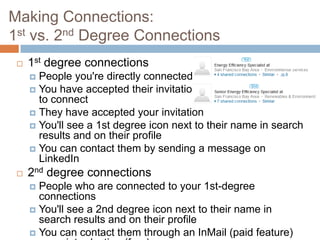
      You'll see a 1st degree icon next to their name in search
       results and on their profile
      You can contact them by sending a message on
       LinkedIn
    2nd degree connections
      People who are connected to your 1st-degree
       connections
      You'll see a 2nd degree icon next to their name in
       search results and on their profile
      You can contact them through an InMail (paid feature)
Making Connections
   Your 2nd degree network is key
     Thisis what allows you to connect with valuable
      people
   Build your 1st degree network first
     This   is the foundation of meeting new contacts
Making Connections (1st
degree)
   Upload your contact list from outlook, Hotmail,
    gmail or yahoo
     Do  this under the “Add connections” tab
     Allows you to select those you want to connect
      with
     Consider writing a semi-personalized connection
      request message
   Search for past colleagues or classmates
Finding Existing
     Connections
                  1.


2.
Making Connections (1st
degree)
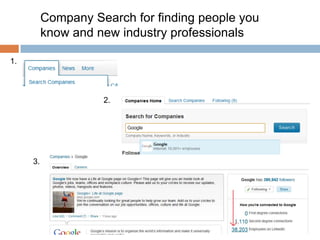
   Find people by company
     Search  under the “Companies” tab
     Look for employees working in your industry that
      you already know or have met
     Look for people you’ve done business with
Company Search for finding people you
          know and new industry professionals

1.


                    2.


     3.
Making Connections (2nd
degree)
   Start asking and answering questions on
    LinkedIn Answers
     Allows you to interact and connect with thought
      leaders
     Allow you to establish yourself as a thought
      leader in your industry
   Update your status often
     Your update appears in emails to your
      connections
     Appears on update feed of you connections

     Allows promotion of what you’re working on
Making Connections (2nd
degree)
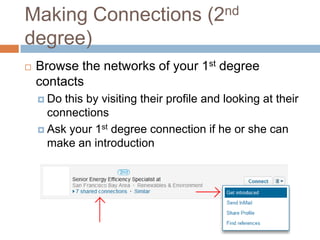
   Browse the networks of your 1st degree
    contacts
     Do this by visiting their profile and looking at their
      connections
     Ask your 1st degree connection if he or she can
      make an introduction
Making Connections (2nd
degree)
   Join groups that relate to your market
     Interact with individuals of those groups to
      increase your visibility
     Use the “groups” tab on top of your profile to
      search for relevant groups
     Allows you to connect with people just because
      you’re in the same group
       Does   not apply to every connection
Making Connections (2nd
degree)
   Use “advanced people search”
   Save your people searches
     Create
           an email alert & LinkedIn will send you a
     message every week with new prospects.
   Use “company search” as detailed above
Searching for
               Jobs
   Option 1: Groups
     The Jobs tab in groups gives members a place to
      share jobs and jobs discussions
   Option 2: Company Research
   Option 3: Linkedin Job Search Tab
   This is covered in more detail by the previous
    workshop. You can access this presentation
    at:
    http://socialmediajobsearch.wikispaces.com/Linkedin
Business
              Promotion
   If your organization does not have a business
    page, create one first
   Create a group
    A   great opportunity to reach and engage potential
      customers online
     If no one has created a group for your industry or
      brand, go create one
Starting a LinkedIn Group
   Name is important
       Consider which keywords your target members will search
        for.
       Make sure your group name is clear and includes these
        keywords
   Create a group for your industry or brand, not
    your company
       People are more likely to join a group when it's not simply
        for fans of your company
   Create a custom webpage for the group on your
    website
       Set up a page on our website specifically for the group
           Example: www.HubSpot.com/InboundMarketers
       This type of page will provide more context, engagement
Promoting a LinkedIn Group
   Invite coworkers, past colleagues, and customers to join and
    start discussions
   Promote the group
       On your website
       Blog
       Email newsletter
       Social media networks.
   Invite key industry experts to join and engage
       If there are some key influencers in your industry, invite them to
        join your community
   Integrate LinkedIn into all of your marketing efforts
       Every time you go to a conference, notify your group
       Invite those you meet in real life to join the group
Managing a LinkedIn Group
   Add discussions, news and jobs
   Use “Most Popular Discussions” to highlight
    particular content or offers
   Send announcements
     Announcements   are emails sent by you through
     LinkedIn to your group members
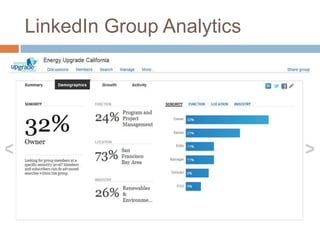
LinkedIn Group Analytics
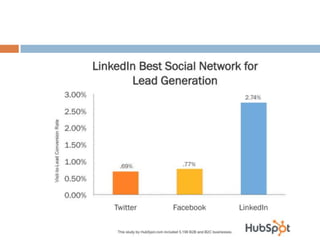
Lead Generation Using
LinkedIn
   2 approaches when using LinkedIn for lead
    generation
    1.   Provide prospects information about your company
         directly on LinkedIn
    2.   Start the conversation on LinkedIn, then drive the
         prospect to a landing page on your website
Lead Generation Using
LinkedIn
   Use Your LinkedIn Group
     Demonstrate thought leadership in your market
     Promote the group and grow the community

     Contact members of your group

   Use other group memberships to connect with
    and contact those members
   Use LinkedIn's DirectAds
       Allows you to present relevant ads to LinkedIn
        subscribers
         Targeted by profile demographic information
         Similar to Google AdWords
Competitive Intelligence
   Follow a company
     You will be notified of updates & announcements

   Watch their senior executives/management
     Have they been promoted or are they leaving for another
      company?
   Career Opportunities
     Have they opened new positions to expand their business?

     Could your indirect competitor becoming more of a direct
      competitor?
     Are they opening more positions in a particular geography?

     Hiring is a great leading indicator of potential long-term moves

   New hires
     What experience are they bringing to the company?
Determining ROI
   Measure your reach on LinkedIn (your contact
    database)
       Look at increases in new contacts
       Look at increase in your employees contacts
   Monitor your groups
       Look at increases in membership
       Are people discussing topics and responding on their own?
   Track your industry influence
       Are you giving/receiving recommendations?
       How many questions have you answered?
           Were any of them voted “best answer”?
   Measure traffic to your website from LinkedIn
Determining ROI
   How many leads have you interacted with on
    LinkedIn?
   How many LinkedIn leads & interactions have
    led to closed deals?
Useful Apps
   Cardmunch
       Free iphone app that turns business cards
        into contacts
           Scan the card with your iphone camera
           No droid version (yet)
   LinkedIn iPhone app
       Walk into any interview or client meeting with the ability to
        look up the details and connect with over 50 million
        professionals worldwide, in real-time.
       Exchange info with other users on the spot
   Slideshare
       Post your PowerPoint presentations to share with
        everyone
       Integrates into your Linkedin profile page
Credits
   Credits
     Hubspot.com

     Clearci.com

     Linkedin.com

Linkedin for professional development

  • 1.
  • 2.
    Presenter  Presentation Created By:  Wes Jordan, Online Media Specialist  wesj18@gmail.com
  • 3.
    LinkedIn Workshops Wiki  http://socialmediajobsearch.wikispaces.com  Webinar recordings  Presentation slides  Other useful resources
  • 4.
    Areas of Focus  Professional Development  Briefoverview of creating a profile (covered in the last session)  Establishing connections with who you already know  Making new connections with industry professionals  Discovering Job opportunities  Business promotion  Lead generation  Competitive intelligence  Determining ROI
  • 5.
    Why LinkedIn?  LinkedIn has 147 million professional users worldwide (63 million in the U.S.)  LinkedIn is for networking professionally, post and find jobs, and answer questions and build thought leadership  LinkedIn is a great way to identify influential individuals at specific organizations  LinkedIn is a great tool to leverage your existing contacts to connect with potential customers online
  • 6.
    Is LinkedIn Rightfor Me?  Consultants  Connect with prospective clients and to make them aware of their experience and services.  B2B Marketers  announce new product launches or service offerings.  Sales people  Research on prospects before contacting them.  Job hunters  Expand their circle of business contacts and to stay in front of prospective employers.  Entrepreneurs  Build awareness of their new company and to keep their sales funnel full  Small businesses  Stay in front of customers and to reach out to new prospects  Large businesses  Position their company in the marketplace and to let customers know about new product or service offerings
  • 7.
    Complete Your Profile (Overview)  Complete your profile  Your profile should be 100% complete  Work experience, schools, and other relevant information about yourself  People searching for contacts will make a decision to connect or not based on profile information  A complete profile will increase your visibility with employers, recruiters, and prospects  Upload a profile photo  People are more likely to connect with a person who has a picture  Get recommended  Ask friends, colleagues, partners, and clients  Adds to credibility in your industry
  • 8.
    Optimize Your Profilefor Searches  Customize your public profile URL with your name  http://www.linkedin.com/in/yourname  Optimize keywords in your summary section  This section is indexed by Google  Include keywords related to your industry  You rank higher in search results for these keyword searches
  • 9.
    Making Connections: 1st vs.2nd Degree Connections  1st degree connections  People you're directly connected to  You have accepted their invitation to connect  They have accepted your invitation  You'll see a 1st degree icon next to their name in search results and on their profile  You can contact them by sending a message on LinkedIn  2nd degree connections  People who are connected to your 1st-degree connections  You'll see a 2nd degree icon next to their name in search results and on their profile  You can contact them through an InMail (paid feature)
  • 10.
    Making Connections  Your 2nd degree network is key  Thisis what allows you to connect with valuable people  Build your 1st degree network first  This is the foundation of meeting new contacts
  • 11.
    Making Connections (1st degree)  Upload your contact list from outlook, Hotmail, gmail or yahoo  Do this under the “Add connections” tab  Allows you to select those you want to connect with  Consider writing a semi-personalized connection request message  Search for past colleagues or classmates
  • 12.
    Finding Existing Connections 1. 2.
  • 13.
    Making Connections (1st degree)  Find people by company  Search under the “Companies” tab  Look for employees working in your industry that you already know or have met  Look for people you’ve done business with
  • 14.
    Company Search forfinding people you know and new industry professionals 1. 2. 3.
  • 15.
    Making Connections (2nd degree)  Start asking and answering questions on LinkedIn Answers  Allows you to interact and connect with thought leaders  Allow you to establish yourself as a thought leader in your industry  Update your status often  Your update appears in emails to your connections  Appears on update feed of you connections  Allows promotion of what you’re working on
  • 16.
    Making Connections (2nd degree)  Browse the networks of your 1st degree contacts  Do this by visiting their profile and looking at their connections  Ask your 1st degree connection if he or she can make an introduction
  • 17.
    Making Connections (2nd degree)  Join groups that relate to your market  Interact with individuals of those groups to increase your visibility  Use the “groups” tab on top of your profile to search for relevant groups  Allows you to connect with people just because you’re in the same group  Does not apply to every connection
  • 18.
    Making Connections (2nd degree)  Use “advanced people search”  Save your people searches  Create an email alert & LinkedIn will send you a message every week with new prospects.  Use “company search” as detailed above
  • 19.
    Searching for Jobs  Option 1: Groups  The Jobs tab in groups gives members a place to share jobs and jobs discussions  Option 2: Company Research  Option 3: Linkedin Job Search Tab  This is covered in more detail by the previous workshop. You can access this presentation at: http://socialmediajobsearch.wikispaces.com/Linkedin
  • 21.
    Business Promotion  If your organization does not have a business page, create one first  Create a group A great opportunity to reach and engage potential customers online  If no one has created a group for your industry or brand, go create one
  • 22.
    Starting a LinkedInGroup  Name is important  Consider which keywords your target members will search for.  Make sure your group name is clear and includes these keywords  Create a group for your industry or brand, not your company  People are more likely to join a group when it's not simply for fans of your company  Create a custom webpage for the group on your website  Set up a page on our website specifically for the group  Example: www.HubSpot.com/InboundMarketers  This type of page will provide more context, engagement
  • 23.
    Promoting a LinkedInGroup  Invite coworkers, past colleagues, and customers to join and start discussions  Promote the group  On your website  Blog  Email newsletter  Social media networks.  Invite key industry experts to join and engage  If there are some key influencers in your industry, invite them to join your community  Integrate LinkedIn into all of your marketing efforts  Every time you go to a conference, notify your group  Invite those you meet in real life to join the group
  • 24.
    Managing a LinkedInGroup  Add discussions, news and jobs  Use “Most Popular Discussions” to highlight particular content or offers  Send announcements  Announcements are emails sent by you through LinkedIn to your group members
  • 25.
  • 26.
    Lead Generation Using LinkedIn  2 approaches when using LinkedIn for lead generation 1. Provide prospects information about your company directly on LinkedIn 2. Start the conversation on LinkedIn, then drive the prospect to a landing page on your website
  • 28.
    Lead Generation Using LinkedIn  Use Your LinkedIn Group  Demonstrate thought leadership in your market  Promote the group and grow the community  Contact members of your group  Use other group memberships to connect with and contact those members  Use LinkedIn's DirectAds  Allows you to present relevant ads to LinkedIn subscribers  Targeted by profile demographic information  Similar to Google AdWords
  • 29.
    Competitive Intelligence  Follow a company  You will be notified of updates & announcements  Watch their senior executives/management  Have they been promoted or are they leaving for another company?  Career Opportunities  Have they opened new positions to expand their business?  Could your indirect competitor becoming more of a direct competitor?  Are they opening more positions in a particular geography?  Hiring is a great leading indicator of potential long-term moves  New hires  What experience are they bringing to the company?
  • 30.
    Determining ROI  Measure your reach on LinkedIn (your contact database)  Look at increases in new contacts  Look at increase in your employees contacts  Monitor your groups  Look at increases in membership  Are people discussing topics and responding on their own?  Track your industry influence  Are you giving/receiving recommendations?  How many questions have you answered?  Were any of them voted “best answer”?  Measure traffic to your website from LinkedIn
  • 31.
    Determining ROI  How many leads have you interacted with on LinkedIn?  How many LinkedIn leads & interactions have led to closed deals?
  • 32.
    Useful Apps  Cardmunch  Free iphone app that turns business cards into contacts  Scan the card with your iphone camera  No droid version (yet)  LinkedIn iPhone app  Walk into any interview or client meeting with the ability to look up the details and connect with over 50 million professionals worldwide, in real-time.  Exchange info with other users on the spot  Slideshare  Post your PowerPoint presentations to share with everyone  Integrates into your Linkedin profile page
  • 33.
    Credits  Credits  Hubspot.com  Clearci.com  Linkedin.com