Real World
Objects &
Linked Data:
New ideas in
cataloging
Robin Fay, Cataloging
& Metadata Trainer
robinfay.net
@georgiawebgurl
Topics
• Background
• Real World Objects
• Linked Data
ROBIN FAY 2019 2
This Photo by Unknown
Author is licensed under
CC BY-SA-NC
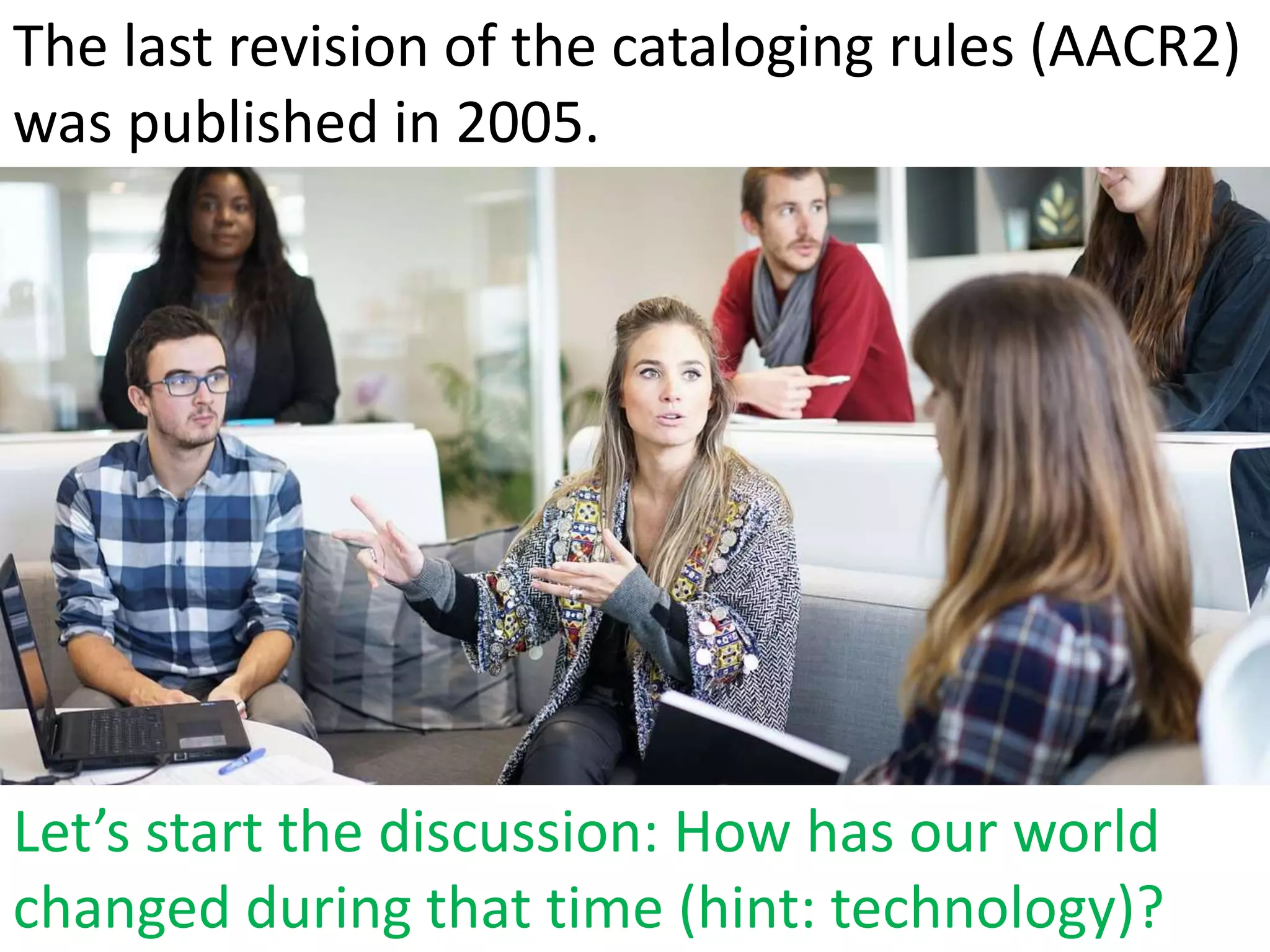
Let’s start the discussion: How has our world
changed during that time (hint: technology)?
The last revision of the cataloging rules (AACR2)
was published in 2005.
This Photo by Unknown Author is licensed under CC BY-SA
Robin Fay2019
All of this and more!
Making that
happen – data
linked to and used
in different ways –
building
connections
(relationships).
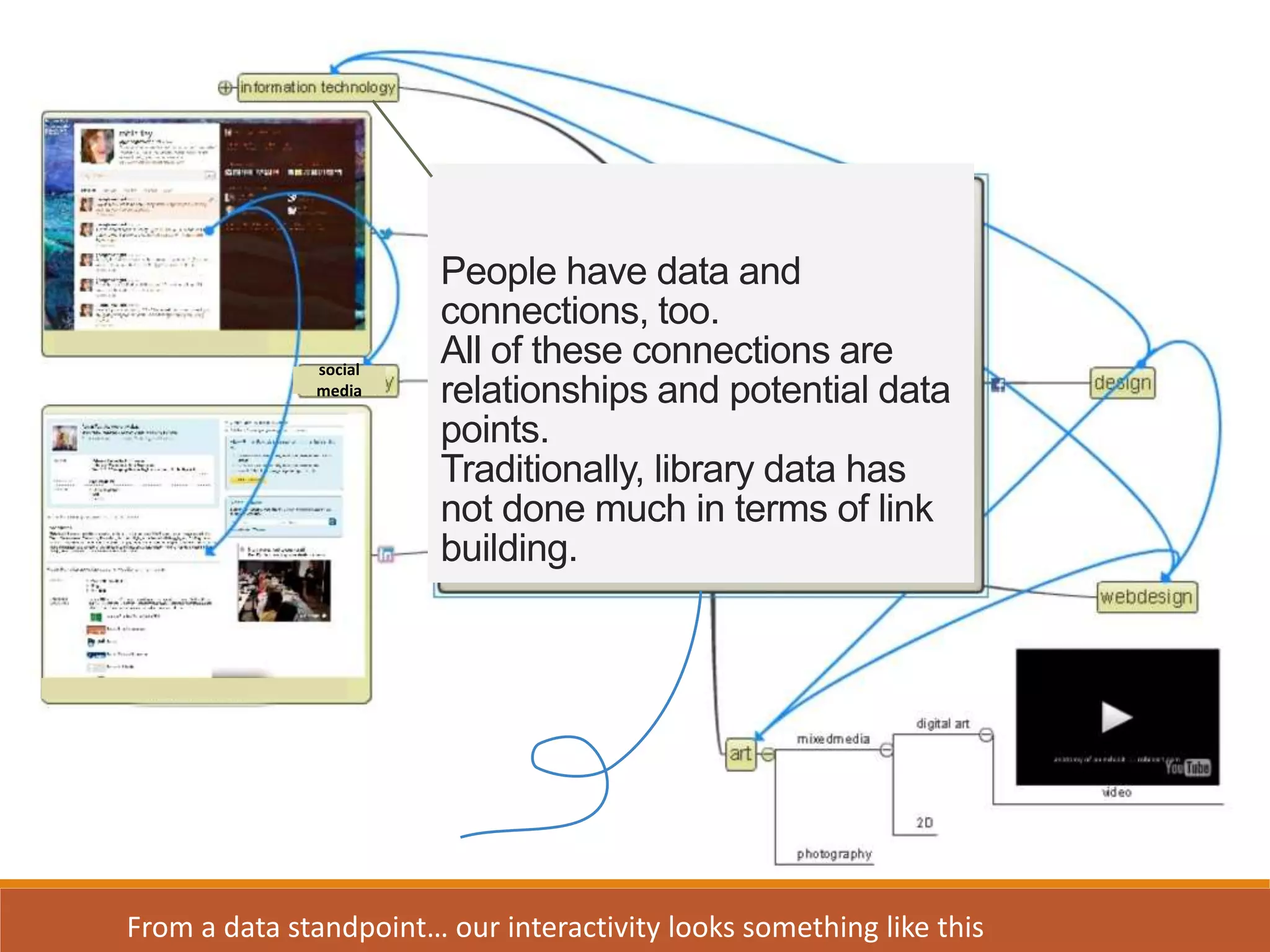
People have data and
connections, too.
All of these connections are
relationships and potential data
points.
Traditionally, library data has
not done much in terms of link
building.
social
media
From a data standpoint… our interactivity looks something like this
Relationships:
Hamlet to the
people in his
world
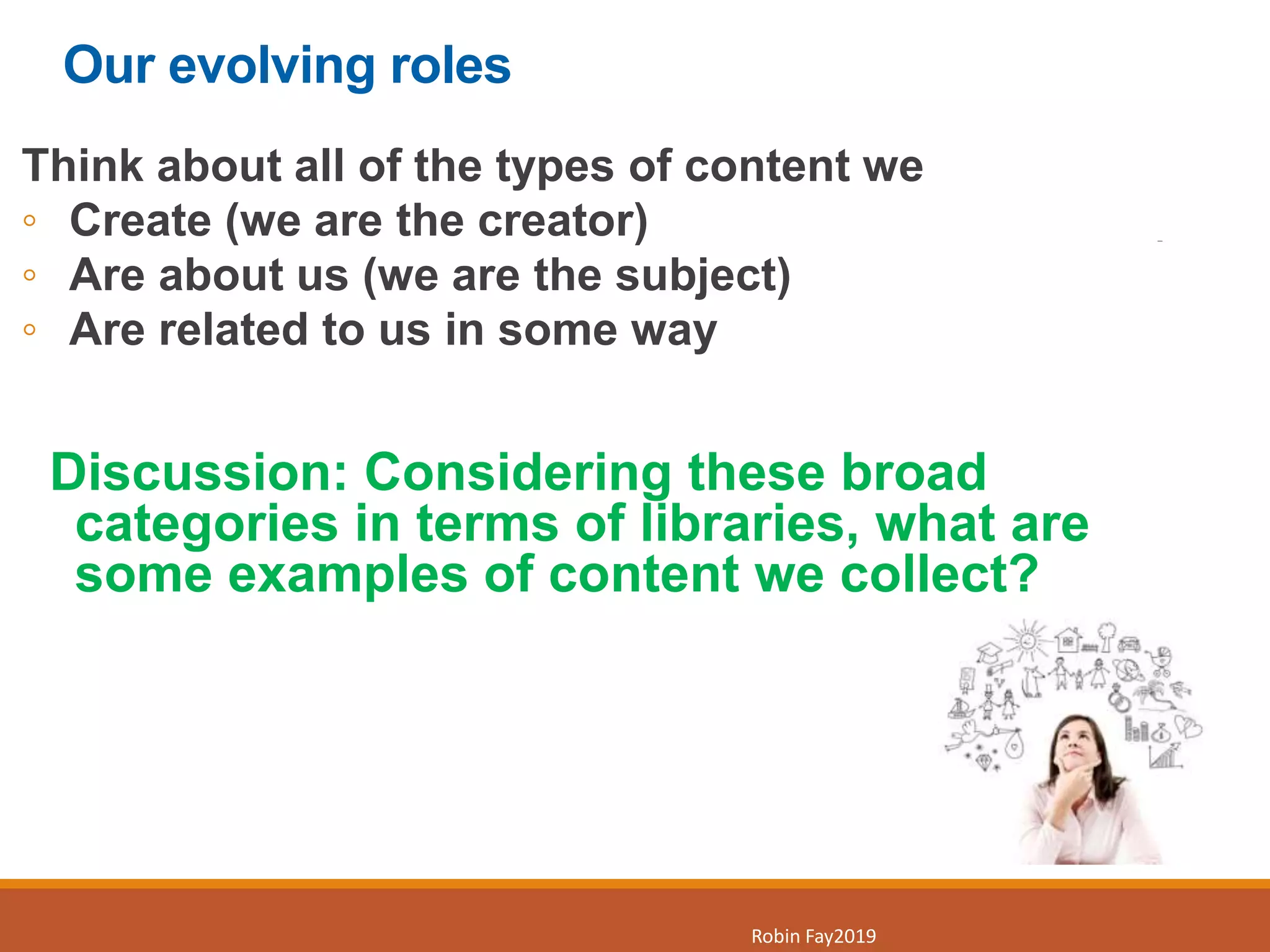
Our evolving roles
Think about all of the types of content we
◦ Create (we are the creator)
◦ Are about us (we are the subject)
◦ Are related to us in some way
Discussion: Considering these broad
categories in terms of libraries, what are
some examples of content we collect?
8
Robin Fay2019
Some content we collect, some we don’t
Websites, articles, blog posts, social media
content, photographs, books, reviews, journals,
databases, chapters,manuscripts, letters,
personal histories,
biographies/autobiographies, our data records
(authority records, patron records and other
personal data, etc.)
9
Robin Fay2019
In library catalogs we
describe and record just
the material that we own or
have access to.
Creators create, content everywhere
0
Robin Fay2019
Our data is mostly flat
But the world of content is not flat…
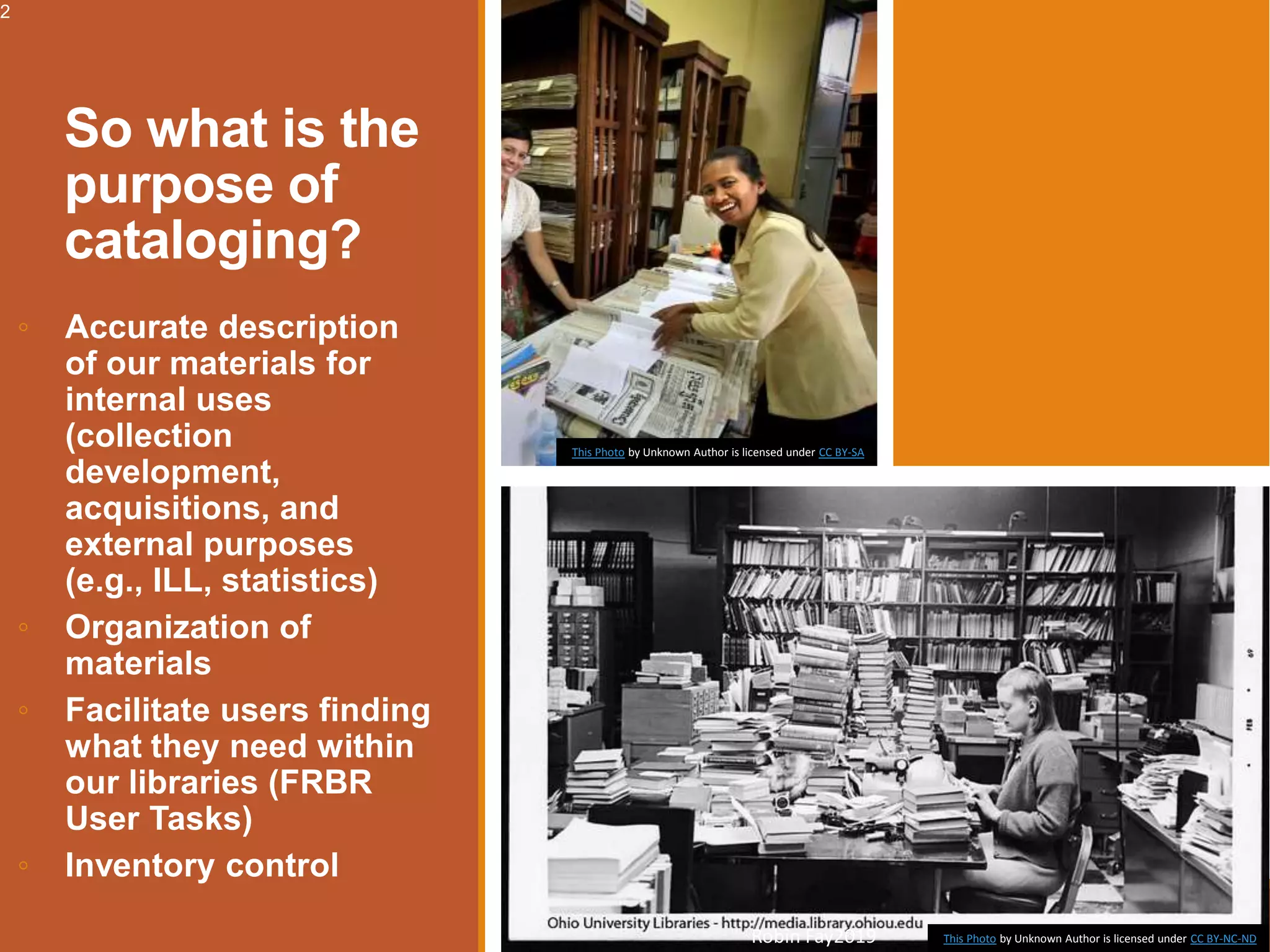
So what is the
purpose of
cataloging?
◦ Accurate description
of our materials for
internal uses
(collection
development,
acquisitions, and
external purposes
(e.g., ILL, statistics)
◦ Organization of
materials
◦ Facilitate users finding
what they need within
our libraries (FRBR
User Tasks)
◦ Inventory control
Robin Fay2019
2
This Photo by Unknown Author is licensed under CC BY-NC-ND
This Photo by Unknown Author is licensed under CC BY-SA
Information
anywhere,
any way,
any time
This Photo by Unknown Author is licensed under CC BY
This Photo by Unknown Author is licensed under CC BY-NC-ND This Photo by Unknown Author is
licensed under CC BY-SA
This Photo by Unknown Author is licensed under CC BY-SA-NC
This Photo by Unknown Author is licensed under CC BY
Our users…
This Photo by Unknown Author is licensed under CC BY-SA
This Photo by Unknown Author is licensed under CC BY
This Photo by Unknown Author is licensed under CC BY-NC-ND This Photo by Unknown Author is
licensed under CC BY-SA
This Photo by Unknown Author is licensed under CC BY-SA-NC
How can we address different user needs? How
can we facilitate finding, identifying, obtaining, and
selecting, to ensure a successful search process,
the successful completion of FRBR User Tasks??
Our users…
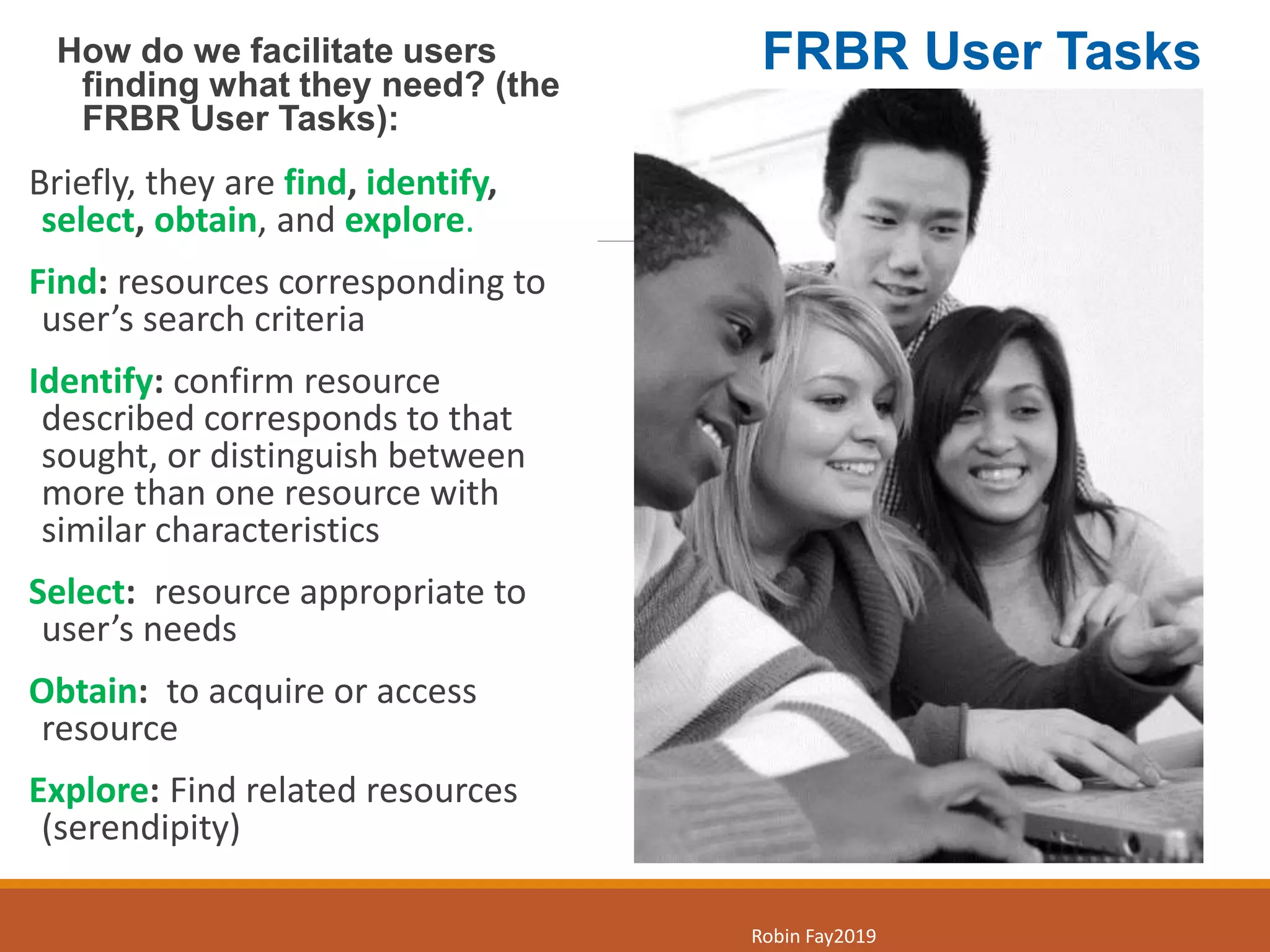
How do we facilitate users
finding what they need? (the
FRBR User Tasks):
Briefly, they are find, identify,
select, obtain, and explore.
Find: resources corresponding to
user’s search criteria​
Identify: confirm resource
described corresponds to that
sought, or distinguish between
more than one resource with
similar characteristics​
Select: resource appropriate to
user’s needs​
Obtain: to acquire or access
resource ​
Explore: Find related resources
(serendipity)
5
Robin Fay2019
FRBR User Tasks
Expanding our cataloging – providing context
• Link to various title changes of a serial (earlier)
• Link to different editions
• Pulling together different versions better
• Call numbers provide organization and grouping by
subject
What else can we do to provide context?
Perhaps, link to more resources?
6
Robin Fay2019
The Semantic Web is based upon more precise utilization
of data and depends upon
• The code
• The metadata and its metadata schemas (rules)
• The ability for machines (including devices) to
communicate and interpret data (the Internet of
Things, aka IoT) – to build relationships and
share data
Linked data & the Semantic Web
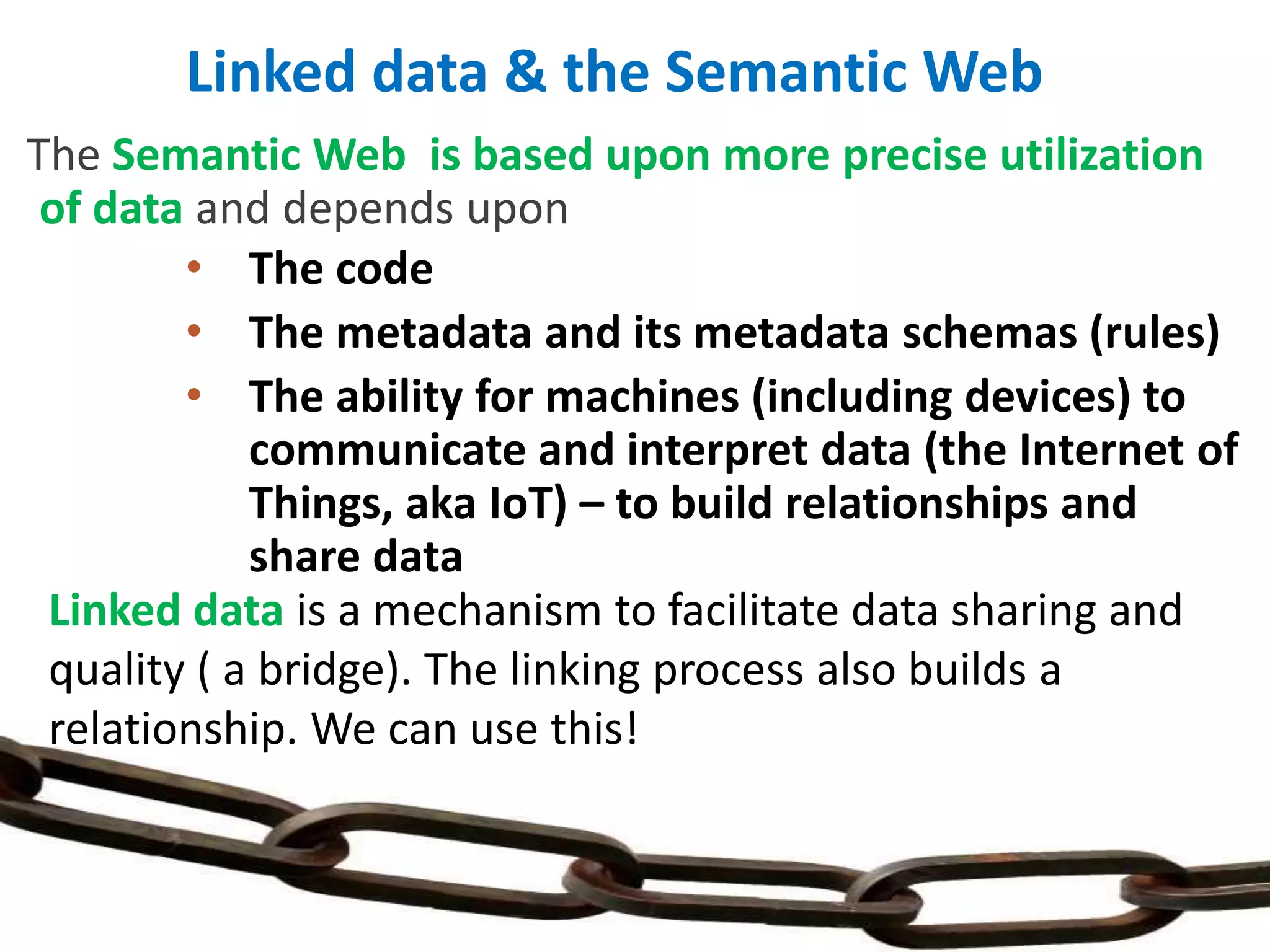
Linked data is a mechanism to facilitate data sharing and
quality ( a bridge). The linking process also builds a
relationship. We can use this!
So, how can we leverage all of those relationships and
resources? How can leverage this content to provide
context?
8
Real World Objects are a machine construct often
used in programming.
Examples of RWOs include people, dogs, places –
anything that exists. It can even be non tangible, like
“love” or “cute”.
Robin Fay2019
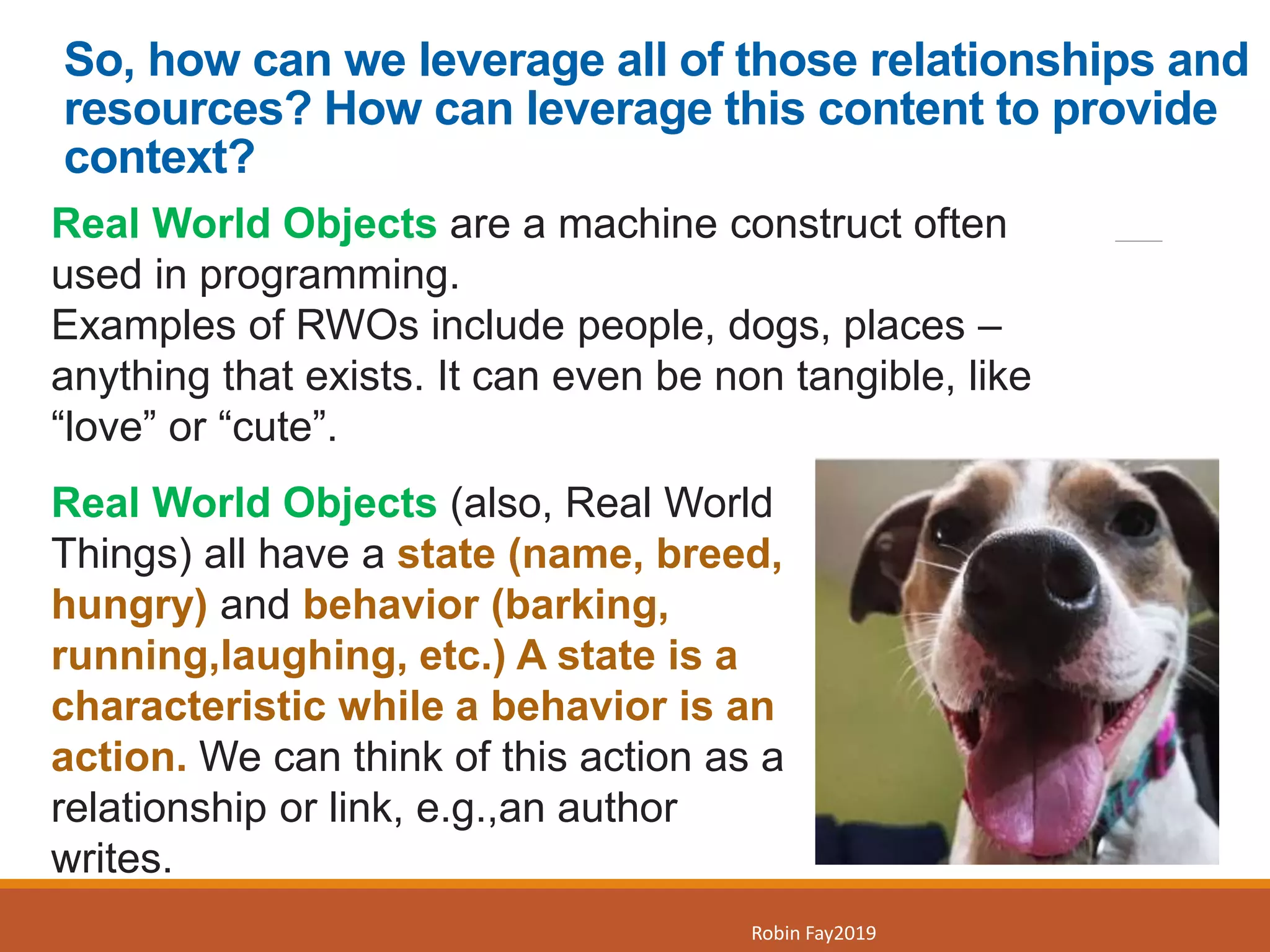
Real World Objects (also, Real World
Things) all have a state (name, breed,
hungry) and behavior (barking,
running,laughing, etc.) A state is a
characteristic while a behavior is an
action. We can think of this action as a
relationship or link, e.g.,an author
writes.
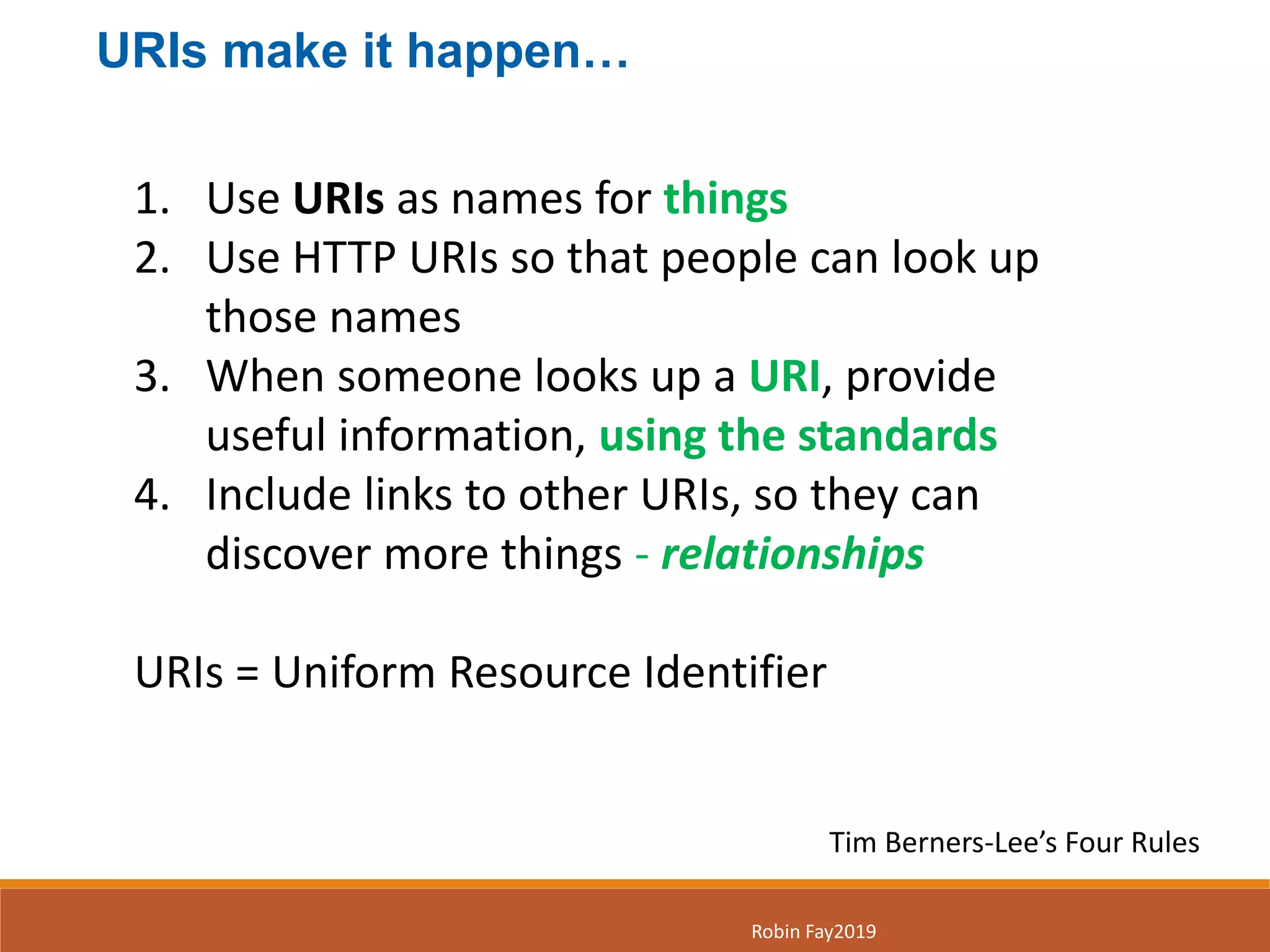
1. Use URIs as names for things
2. Use HTTP URIs so that people can look up
those names
3. When someone looks up a URI, provide
useful information, using the standards
4. Include links to other URIs, so they can
discover more things - relationships
URIs = Uniform Resource Identifier
Tim Berners-Lee’s Four Rules
Robin Fay2019
URIs make it happen…
The main difference between a URL and URI is that it is
unique (and hopefully, persistent)
Robin Fay2019
URIs in practice
URIs in a linked data use provide
information about an object.
This information may be in the form of
relationships, or concepts, or facts --
though, the most important aspect of
the URI is that this information is
developed to be consumed by
machines, not people.
Linked Data URIs create the bridges that
allow systems to share and understand
information, and in this context, only URIs
that point to machine actionable data
should be utilized. Linked data is just
linking data in order to use the data…
Robin Fay2019
This Photo by Unknown Author is licensed under CC BY-SA
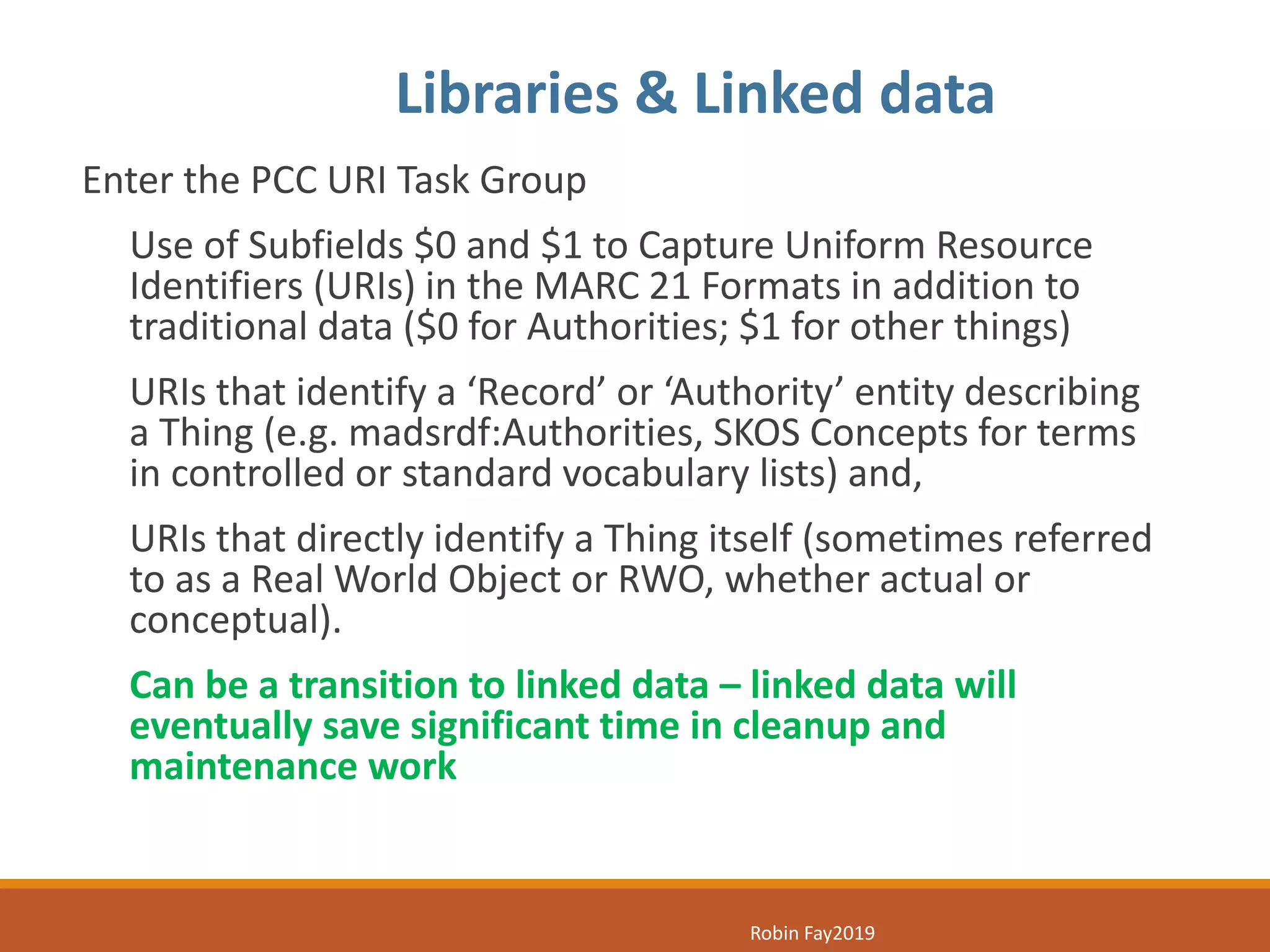
Enter the PCC URI Task Group
Use of Subfields $0 and $1 to Capture Uniform Resource
Identifiers (URIs) in the MARC 21 Formats in addition to
traditional data ($0 for Authorities; $1 for other things)
URIs that identify a ‘Record’ or ‘Authority’ entity describing
a Thing (e.g. madsrdf:Authorities, SKOS Concepts for terms
in controlled or standard vocabulary lists) and,
URIs that directly identify a Thing itself (sometimes referred
to as a Real World Object or RWO, whether actual or
conceptual).
Can be a transition to linked data – linked data will
eventually save significant time in cleanup and
maintenance work
Libraries & Linked data
Robin Fay2019
Libraries & URIs : examples
Robin Fay2019
100 0# $a Santa
Claus $0 http://id.loc.gov/authorities/names/no2015039717 $1 http://dbpedia.org/r
esource/Santa_Claus
700 1# $a Stipe, Michael, $d 1960-
$0http://id.loc.gov/authorities/names/n91125827 $1http://www.bbc.co.uk/things/3aeaa
474-ad77-4eb0-a6ba-69f1af33b7f4#id
650 #0 $a Kindness $0http://id.loc.gov/authorities/subjects/sh85072376 $1 http://db
pedia.org/resource/Kindness $1 http://www.wikidata.org/entity/Q488085
Discussion:
What other
relationships
might Hamlet
have? To
places, people,
subjects?
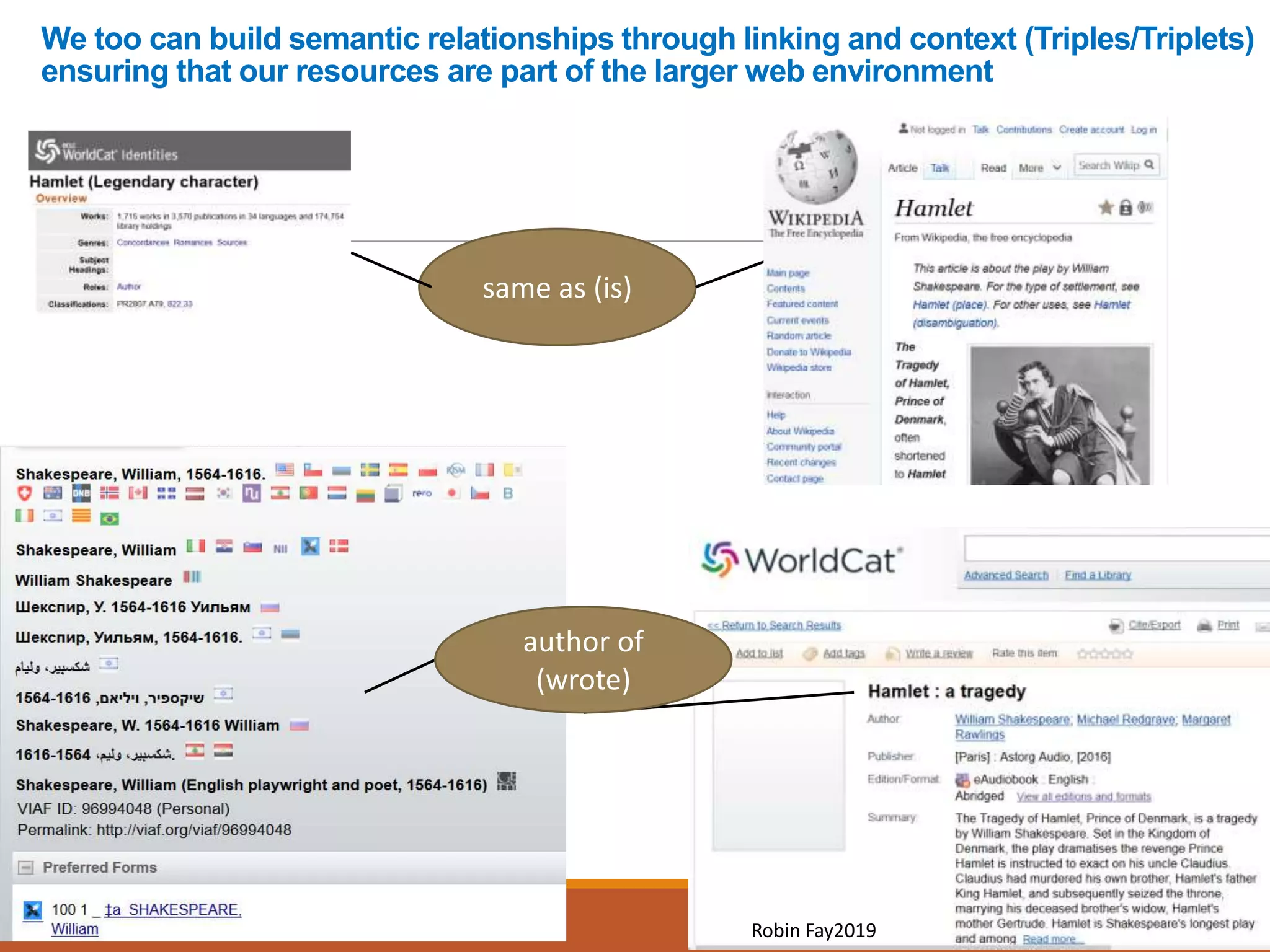
same as (is)
We too can build semantic relationships through linking and context (Triples/Triplets)
ensuring that our resources are part of the larger web environment
Robin Fay2019
author of
(wrote)
Robin Fay2019
Final thoughts
or questions?
Resources: https://tinyurl.com/rwos-linkeddata

RWOs & linkeddata for libraries

  • 1.
    Real World Objects & LinkedData: New ideas in cataloging Robin Fay, Cataloging & Metadata Trainer robinfay.net @georgiawebgurl
  • 2.
    Topics • Background • RealWorld Objects • Linked Data ROBIN FAY 2019 2 This Photo by Unknown Author is licensed under CC BY-SA-NC
  • 3.
    Let’s start thediscussion: How has our world changed during that time (hint: technology)? The last revision of the cataloging rules (AACR2) was published in 2005.
  • 4.
    This Photo byUnknown Author is licensed under CC BY-SA Robin Fay2019 All of this and more!
  • 5.
    Making that happen –data linked to and used in different ways – building connections (relationships).
  • 6.
    People have dataand connections, too. All of these connections are relationships and potential data points. Traditionally, library data has not done much in terms of link building. social media From a data standpoint… our interactivity looks something like this
  • 7.
  • 8.
    Our evolving roles Thinkabout all of the types of content we ◦ Create (we are the creator) ◦ Are about us (we are the subject) ◦ Are related to us in some way Discussion: Considering these broad categories in terms of libraries, what are some examples of content we collect? 8 Robin Fay2019
  • 9.
    Some content wecollect, some we don’t Websites, articles, blog posts, social media content, photographs, books, reviews, journals, databases, chapters,manuscripts, letters, personal histories, biographies/autobiographies, our data records (authority records, patron records and other personal data, etc.) 9 Robin Fay2019 In library catalogs we describe and record just the material that we own or have access to.
  • 10.
    Creators create, contenteverywhere 0 Robin Fay2019
  • 11.
    Our data ismostly flat But the world of content is not flat…
  • 12.
    So what isthe purpose of cataloging? ◦ Accurate description of our materials for internal uses (collection development, acquisitions, and external purposes (e.g., ILL, statistics) ◦ Organization of materials ◦ Facilitate users finding what they need within our libraries (FRBR User Tasks) ◦ Inventory control Robin Fay2019 2 This Photo by Unknown Author is licensed under CC BY-NC-ND This Photo by Unknown Author is licensed under CC BY-SA
  • 13.
    This Photo byUnknown Author is licensed under CC BY-SA Information anywhere, any way, any time This Photo by Unknown Author is licensed under CC BY This Photo by Unknown Author is licensed under CC BY-NC-ND This Photo by Unknown Author is licensed under CC BY-SA This Photo by Unknown Author is licensed under CC BY-SA-NC This Photo by Unknown Author is licensed under CC BY Our users…
  • 14.
    This Photo byUnknown Author is licensed under CC BY-SA This Photo by Unknown Author is licensed under CC BY This Photo by Unknown Author is licensed under CC BY-NC-ND This Photo by Unknown Author is licensed under CC BY-SA This Photo by Unknown Author is licensed under CC BY-SA-NC How can we address different user needs? How can we facilitate finding, identifying, obtaining, and selecting, to ensure a successful search process, the successful completion of FRBR User Tasks?? Our users…
  • 15.
    How do wefacilitate users finding what they need? (the FRBR User Tasks): Briefly, they are find, identify, select, obtain, and explore. Find: resources corresponding to user’s search criteria​ Identify: confirm resource described corresponds to that sought, or distinguish between more than one resource with similar characteristics​ Select: resource appropriate to user’s needs​ Obtain: to acquire or access resource ​ Explore: Find related resources (serendipity) 5 Robin Fay2019 FRBR User Tasks
  • 16.
    Expanding our cataloging– providing context • Link to various title changes of a serial (earlier) • Link to different editions • Pulling together different versions better • Call numbers provide organization and grouping by subject What else can we do to provide context? Perhaps, link to more resources? 6 Robin Fay2019
  • 17.
    The Semantic Webis based upon more precise utilization of data and depends upon • The code • The metadata and its metadata schemas (rules) • The ability for machines (including devices) to communicate and interpret data (the Internet of Things, aka IoT) – to build relationships and share data Linked data & the Semantic Web Linked data is a mechanism to facilitate data sharing and quality ( a bridge). The linking process also builds a relationship. We can use this!
  • 18.
    So, how canwe leverage all of those relationships and resources? How can leverage this content to provide context? 8 Real World Objects are a machine construct often used in programming. Examples of RWOs include people, dogs, places – anything that exists. It can even be non tangible, like “love” or “cute”. Robin Fay2019 Real World Objects (also, Real World Things) all have a state (name, breed, hungry) and behavior (barking, running,laughing, etc.) A state is a characteristic while a behavior is an action. We can think of this action as a relationship or link, e.g.,an author writes.
  • 19.
    1. Use URIsas names for things 2. Use HTTP URIs so that people can look up those names 3. When someone looks up a URI, provide useful information, using the standards 4. Include links to other URIs, so they can discover more things - relationships URIs = Uniform Resource Identifier Tim Berners-Lee’s Four Rules Robin Fay2019 URIs make it happen…
  • 20.
    The main differencebetween a URL and URI is that it is unique (and hopefully, persistent) Robin Fay2019
  • 21.
    URIs in practice URIsin a linked data use provide information about an object. This information may be in the form of relationships, or concepts, or facts -- though, the most important aspect of the URI is that this information is developed to be consumed by machines, not people. Linked Data URIs create the bridges that allow systems to share and understand information, and in this context, only URIs that point to machine actionable data should be utilized. Linked data is just linking data in order to use the data… Robin Fay2019 This Photo by Unknown Author is licensed under CC BY-SA
  • 22.
    Enter the PCCURI Task Group Use of Subfields $0 and $1 to Capture Uniform Resource Identifiers (URIs) in the MARC 21 Formats in addition to traditional data ($0 for Authorities; $1 for other things) URIs that identify a ‘Record’ or ‘Authority’ entity describing a Thing (e.g. madsrdf:Authorities, SKOS Concepts for terms in controlled or standard vocabulary lists) and, URIs that directly identify a Thing itself (sometimes referred to as a Real World Object or RWO, whether actual or conceptual). Can be a transition to linked data – linked data will eventually save significant time in cleanup and maintenance work Libraries & Linked data Robin Fay2019
  • 23.
    Libraries & URIs: examples Robin Fay2019 100 0# $a Santa Claus $0 http://id.loc.gov/authorities/names/no2015039717 $1 http://dbpedia.org/r esource/Santa_Claus 700 1# $a Stipe, Michael, $d 1960- $0http://id.loc.gov/authorities/names/n91125827 $1http://www.bbc.co.uk/things/3aeaa 474-ad77-4eb0-a6ba-69f1af33b7f4#id 650 #0 $a Kindness $0http://id.loc.gov/authorities/subjects/sh85072376 $1 http://db pedia.org/resource/Kindness $1 http://www.wikidata.org/entity/Q488085
  • 24.
  • 25.
    same as (is) Wetoo can build semantic relationships through linking and context (Triples/Triplets) ensuring that our resources are part of the larger web environment Robin Fay2019 author of (wrote)
  • 26.
    Robin Fay2019 Final thoughts orquestions? Resources: https://tinyurl.com/rwos-linkeddata