Karthik Ramasamy

Cofounder and Chief Product Officer
fast, durable, flexible pub/sub messaging
What is Apache Pulsar?
2
“Flexible pub-sub system backed by a durable log storage”
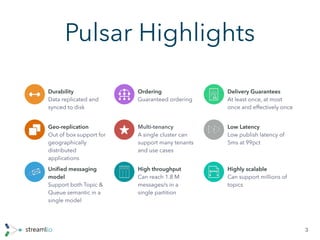
Pulsar Highlights
3
Ordering
Guaranteed ordering
Multi-tenancy
A single cluster can
support many tenants
and use cases
High throughput
Can reach 1.8 M
messages/s in a
single partition
Durability
Data replicated and
synced to disk
Geo-replication
Out of box support for
geographically
distributed
applications
Unified messaging
model
Support both Topic &
Queue semantic in a
single model
Delivery Guarantees
At least once, at most
once and effectively once
Low Latency
Low publish latency of
5ms at 99pct
Highly scalable
Can support millions of
topics
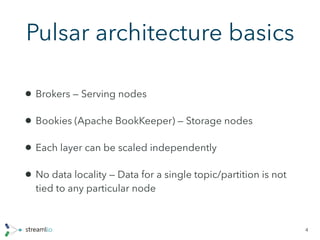
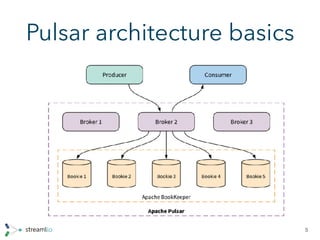
Pulsar architecture basics
4
• Brokers — Serving nodes
• Bookies (Apache BookKeeper) — Storage nodes
• Each layer can be scaled independently
• No data locality — Data for a single topic/partition is not
tied to any particular node
Pulsar architecture basics
5
Additional Advantages
• Stateful systems can become unbalanced when traffic
changes
• The system needs to be designed to allow for quick
reaction, distributing the load across all nodes
6
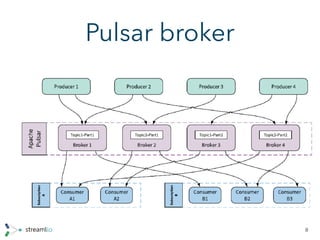
Pulsar broker
• Broker is the only point of interaction for clients
• Brokers acquire ownership of group of topics and
“serve” them
• Broker has no durable state
• There’s a service discovery mechanism for client to
connect to right broker
7
Pulsar broker
8
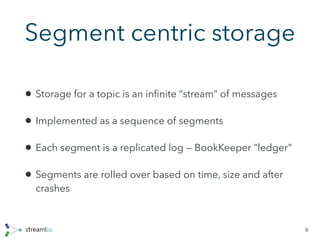
Segment centric storage
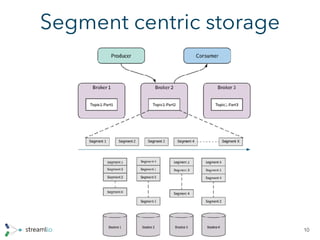
• Storage for a topic is an infinite “stream” of messages
• Implemented as a sequence of segments
• Each segment is a replicated log — BookKeeper “ledger”
• Segments are rolled over based on time, size and after
crashes
9
Segment centric storage
10
Broker failure recovery
11
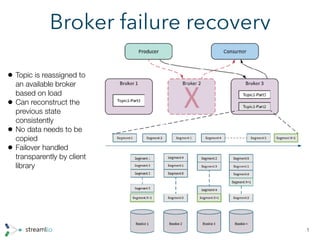
• Topic is reassigned to
an available broker
based on load
• Can reconstruct the
previous state
consistently
• No data needs to be
copied
• Failover handled
transparently by client
library
Bookie failure recovery
12
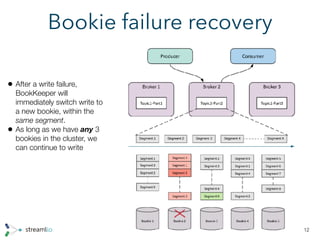
• After a write failure,
BookKeeper will
immediately switch write to
a new bookie, within the
same segment.
• As long as we have any 3
bookies in the cluster, we
can continue to write
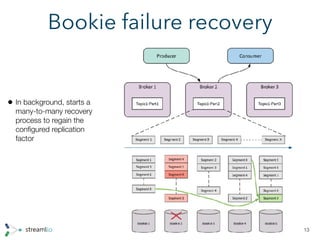
Bookie failure recovery
13
• In background, starts a
many-to-many recovery
process to regain the
configured replication
factor
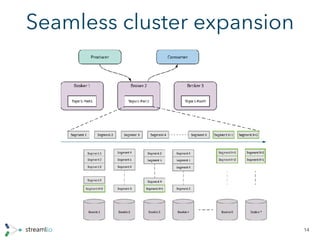
Seamless cluster expansion
14
Why should you care?
“Segment centric” vs “Partition centric”
15
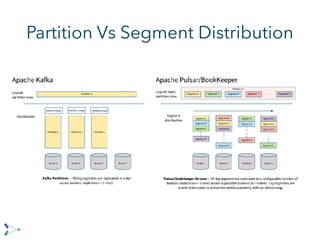
Partition Vs Segment Distribution
Partition Based Systems: Disadvantages
• In Kafka, partitions are assigned to brokers “permanently”
• A single partition is stored entirely in a single node
• Retention is limited by a single node storage capacity
• Failure recovery and capacity expansion require
“rebalancing”
• Rebalancing has a big impact over the system, affecting
regular traffic
17
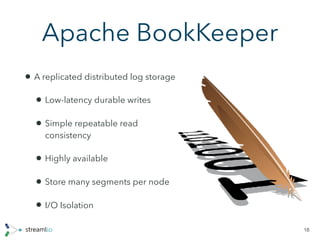
Apache BookKeeper
• A replicated distributed log storage
• Low-latency durable writes
• Simple repeatable read
consistency
• Highly available
• Store many segments per node
• I/O Isolation
18
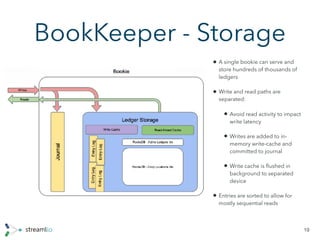
BookKeeper - Storage
• A single bookie can serve and
store hundreds of thousands of
ledgers
• Write and read paths are
separated:
• Avoid read activity to impact
write latency
• Writes are added to in-
memory write-cache and
committed to journal
• Write cache is flushed in
background to separated
device
• Entries are sorted to allow for
mostly sequential reads
19
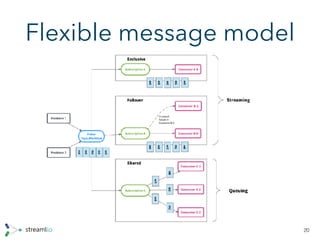
Flexible message model
20
Multi-Tenancy
• Authentication / Authorization / Namespaces / Admin APIs
• I/O Isolations between writes and reads
• Provided by BookKeeper - Ensure readers draining backlog won’t
affect publishers
• Soft isolation
• Storage quotas — flow-control — back-pressure — rate limiting
• Hardware isolation
• Constrain some tenants on a subset of brokers or bookies
21
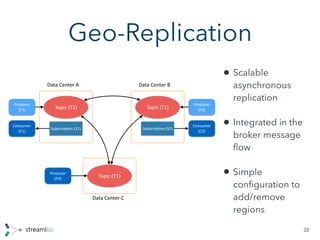
Geo-Replication
• Scalable
asynchronous
replication
• Integrated in the
broker message
flow
• Simple
configuration to
add/remove
regions
22
Topic	(T1) Topic	(T1)
Topic	(T1)
Subscrip/on	(S1) Subscrip/on	(S1)
Producer		
(P1)
Consumer		
(C1)
Producer		
(P3)
Producer		
(P2)
Consumer		
(C2)
Data	Center	A Data	Center	B
Data	Center	C
Pulsar client library
• Java — C++ — Python — WebSocket APIs
• Partitioned topics
• Apache Kafka compatibility wrapper API
• Transparent batching of messages
• Compression
• TLS encryption and authentication
• End-to-end encryption
23
Pulsar Producer
24
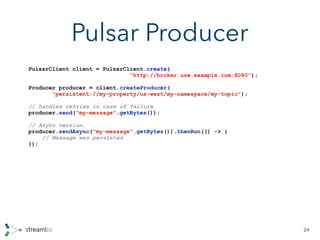
PulsarClient client = PulsarClient.create(
“http://broker.usw.example.com:8080”);
Producer producer = client.createProducer(
“persistent://my-property/us-west/my-namespace/my-topic”);
// handles retries in case of failure
producer.send("my-message".getBytes());
// Async version:
producer.sendAsync("my-message".getBytes()).thenRun(() -> {
// Message was persisted
});
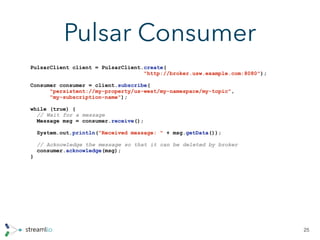
Pulsar Consumer
25
PulsarClient client = PulsarClient.create(
"http://broker.usw.example.com:8080");
Consumer consumer = client.subscribe(
"persistent://my-property/us-west/my-namespace/my-topic",
"my-subscription-name");
while (true) {
// Wait for a message
Message msg = consumer.receive();
System.out.println("Received message: " + msg.getData());
// Acknowledge the message so that it can be deleted by broker
consumer.acknowledge(msg);
}
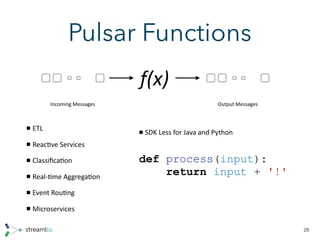
Pulsar Functions
26
f(x)
Incoming	Messages Output	Messages
ETL	
Reac/ve	Services	
Classifica/on	
Real-/me	Aggrega/on	
Event	Rou/ng	
Microservices
def process(input):
return input + '!'
SDK	Less	for	Java	and	Python
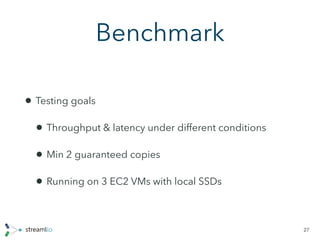
Benchmark
• Testing goals
• Throughput & latency under different conditions
• Min 2 guaranteed copies
• Running on 3 EC2 VMs with local SSDs
27
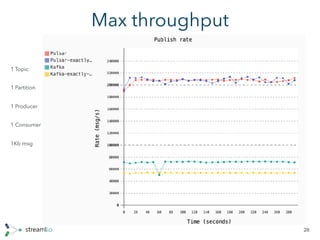
Max throughput
1 Topic
1 Partition
1 Producer
1 Consumer
1Kb msg
28
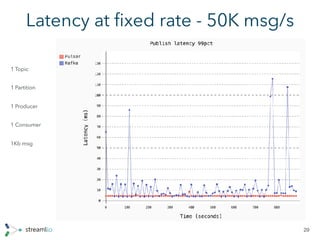
Latency at fixed rate - 50K msg/s
29
1 Topic
1 Partition
1 Producer
1 Consumer
1Kb msg
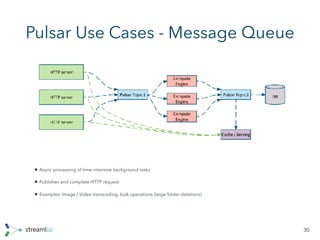
Pulsar Use Cases - Message Queue
30
• Async processing of time intensive background tasks
• Publishes and complete HTTP request
• Examples: Image / Video transcoding, bulk operations (large folder deletions)
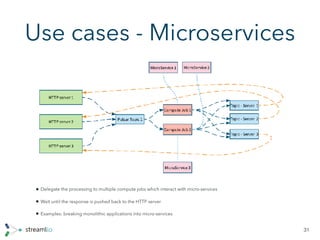
Use cases - Microservices
31
• Delegate the processing to multiple compute jobs which interact with micro-services
• Wait until the response is pushed back to the HTTP server
• Examples: breaking monolithic applications into micro-services
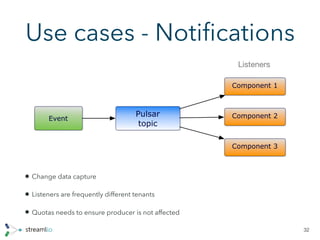
Use cases - Notifications
• Change data capture
• Listeners are frequently different tenants
• Quotas needs to ensure producer is not affected
32
Event
Pulsar
topic
Component 1
Component 2
Component 3
Listeners
Use cases - Notifications
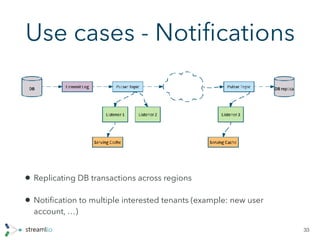
• Replicating DB transactions across regions
• Notification to multiple interested tenants (example: new user
account, …)
33
Use cases - Feedback system
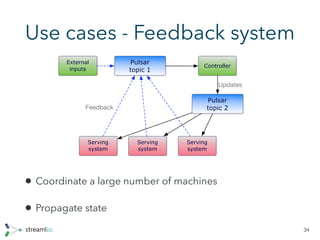
• Coordinate a large number of machines
• Propagate state
34
External
inputs
Pulsar
topic 1
Serving
system
Serving
system
Serving
system
Pulsar
topic 2
Controller
Updates
Feedback
Pulsar in Production
35
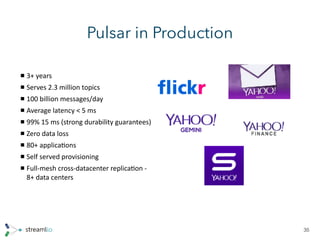
3+	years	
Serves	2.3	million	topics	
100	billion	messages/day	
Average	latency	<	5	ms	
99%	15	ms	(strong	durability	guarantees)	
Zero	data	loss	
80+	applica/ons	
Self	served	provisioning	
Full-mesh	cross-datacenter	replica/on	-	
8+	data	centers
Companies Using Pulsar
36
Pulsar — Conclusion
• A fast durable, distributed pub/sub messaging
• Flexible Traditional Messaging: Queuing and Pub/Sub
• Focus on message dispatch and consumption
• Remove data as soon as possible if they are not needed
• It is backed by a scalable log store
• durable message store, zero data loss
• allow rewinding / reprocessing messages for backfill, bootstrap systems and
stream computing
• It carries all the fantastic features from the log store.
37

Linked In Stream Processing Meetup - Apache Pulsar

  • 1.
    Karthik Ramasamy Cofounder andChief Product Officer fast, durable, flexible pub/sub messaging
  • 2.
    What is ApachePulsar? 2 “Flexible pub-sub system backed by a durable log storage”
  • 3.
    Pulsar Highlights 3 Ordering Guaranteed ordering Multi-tenancy Asingle cluster can support many tenants and use cases High throughput Can reach 1.8 M messages/s in a single partition Durability Data replicated and synced to disk Geo-replication Out of box support for geographically distributed applications Unified messaging model Support both Topic & Queue semantic in a single model Delivery Guarantees At least once, at most once and effectively once Low Latency Low publish latency of 5ms at 99pct Highly scalable Can support millions of topics
  • 4.
    Pulsar architecture basics 4 •Brokers — Serving nodes • Bookies (Apache BookKeeper) — Storage nodes • Each layer can be scaled independently • No data locality — Data for a single topic/partition is not tied to any particular node
  • 5.
  • 6.
    Additional Advantages • Statefulsystems can become unbalanced when traffic changes • The system needs to be designed to allow for quick reaction, distributing the load across all nodes 6
  • 7.
    Pulsar broker • Brokeris the only point of interaction for clients • Brokers acquire ownership of group of topics and “serve” them • Broker has no durable state • There’s a service discovery mechanism for client to connect to right broker 7
  • 8.
  • 9.
    Segment centric storage •Storage for a topic is an infinite “stream” of messages • Implemented as a sequence of segments • Each segment is a replicated log — BookKeeper “ledger” • Segments are rolled over based on time, size and after crashes 9
  • 10.
  • 11.
    Broker failure recovery 11 •Topic is reassigned to an available broker based on load • Can reconstruct the previous state consistently • No data needs to be copied • Failover handled transparently by client library
  • 12.
    Bookie failure recovery 12 •After a write failure, BookKeeper will immediately switch write to a new bookie, within the same segment. • As long as we have any 3 bookies in the cluster, we can continue to write
  • 13.
    Bookie failure recovery 13 •In background, starts a many-to-many recovery process to regain the configured replication factor
  • 14.
  • 15.
    Why should youcare? “Segment centric” vs “Partition centric” 15
  • 16.
  • 17.
    Partition Based Systems:Disadvantages • In Kafka, partitions are assigned to brokers “permanently” • A single partition is stored entirely in a single node • Retention is limited by a single node storage capacity • Failure recovery and capacity expansion require “rebalancing” • Rebalancing has a big impact over the system, affecting regular traffic 17
  • 18.
    Apache BookKeeper • Areplicated distributed log storage • Low-latency durable writes • Simple repeatable read consistency • Highly available • Store many segments per node • I/O Isolation 18
  • 19.
    BookKeeper - Storage •A single bookie can serve and store hundreds of thousands of ledgers • Write and read paths are separated: • Avoid read activity to impact write latency • Writes are added to in- memory write-cache and committed to journal • Write cache is flushed in background to separated device • Entries are sorted to allow for mostly sequential reads 19
  • 20.
  • 21.
    Multi-Tenancy • Authentication /Authorization / Namespaces / Admin APIs • I/O Isolations between writes and reads • Provided by BookKeeper - Ensure readers draining backlog won’t affect publishers • Soft isolation • Storage quotas — flow-control — back-pressure — rate limiting • Hardware isolation • Constrain some tenants on a subset of brokers or bookies 21
  • 22.
    Geo-Replication • Scalable asynchronous replication • Integratedin the broker message flow • Simple configuration to add/remove regions 22 Topic (T1) Topic (T1) Topic (T1) Subscrip/on (S1) Subscrip/on (S1) Producer (P1) Consumer (C1) Producer (P3) Producer (P2) Consumer (C2) Data Center A Data Center B Data Center C
  • 23.
    Pulsar client library •Java — C++ — Python — WebSocket APIs • Partitioned topics • Apache Kafka compatibility wrapper API • Transparent batching of messages • Compression • TLS encryption and authentication • End-to-end encryption 23
  • 24.
    Pulsar Producer 24 PulsarClient client= PulsarClient.create( “http://broker.usw.example.com:8080”); Producer producer = client.createProducer( “persistent://my-property/us-west/my-namespace/my-topic”); // handles retries in case of failure producer.send("my-message".getBytes()); // Async version: producer.sendAsync("my-message".getBytes()).thenRun(() -> { // Message was persisted });
  • 25.
    Pulsar Consumer 25 PulsarClient client= PulsarClient.create( "http://broker.usw.example.com:8080"); Consumer consumer = client.subscribe( "persistent://my-property/us-west/my-namespace/my-topic", "my-subscription-name"); while (true) { // Wait for a message Message msg = consumer.receive(); System.out.println("Received message: " + msg.getData()); // Acknowledge the message so that it can be deleted by broker consumer.acknowledge(msg); }
  • 26.
  • 27.
    Benchmark • Testing goals •Throughput & latency under different conditions • Min 2 guaranteed copies • Running on 3 EC2 VMs with local SSDs 27
  • 28.
    Max throughput 1 Topic 1Partition 1 Producer 1 Consumer 1Kb msg 28
  • 29.
    Latency at fixedrate - 50K msg/s 29 1 Topic 1 Partition 1 Producer 1 Consumer 1Kb msg
  • 30.
    Pulsar Use Cases- Message Queue 30 • Async processing of time intensive background tasks • Publishes and complete HTTP request • Examples: Image / Video transcoding, bulk operations (large folder deletions)
  • 31.
    Use cases -Microservices 31 • Delegate the processing to multiple compute jobs which interact with micro-services • Wait until the response is pushed back to the HTTP server • Examples: breaking monolithic applications into micro-services
  • 32.
    Use cases -Notifications • Change data capture • Listeners are frequently different tenants • Quotas needs to ensure producer is not affected 32 Event Pulsar topic Component 1 Component 2 Component 3 Listeners
  • 33.
    Use cases -Notifications • Replicating DB transactions across regions • Notification to multiple interested tenants (example: new user account, …) 33
  • 34.
    Use cases -Feedback system • Coordinate a large number of machines • Propagate state 34 External inputs Pulsar topic 1 Serving system Serving system Serving system Pulsar topic 2 Controller Updates Feedback
  • 35.
  • 36.
  • 37.
    Pulsar — Conclusion •A fast durable, distributed pub/sub messaging • Flexible Traditional Messaging: Queuing and Pub/Sub • Focus on message dispatch and consumption • Remove data as soon as possible if they are not needed • It is backed by a scalable log store • durable message store, zero data loss • allow rewinding / reprocessing messages for backfill, bootstrap systems and stream computing • It carries all the fantastic features from the log store. 37