
May 26th 2012
Drivers for change: Beyond DVB-S2


    Moore’s law: Technology can now do more

    Cost reductions for transmission

    Needs to address RF Inteference


2
Newtec Contributes to even better Standards
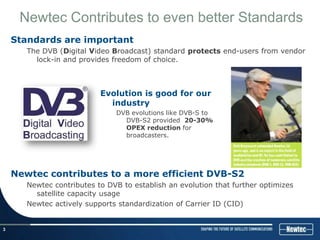
    Standards are important
       The DVB (Digital Video Broadcast) standard protects end-users from vendor
         lock-in and provides freedom of choice.


                           Evolution is good for our
                             industry
                               DVB evolutions like DVB-S to
                                 DVB-S2 provided 20-30%
                                 OPEX reduction for
                                 broadcasters.


    Newtec contributes to a more efficient DVB-S2
       Newtec contributes to DVB to establish an evolution that further optimizes
         satellite capacity usage
       Newtec actively supports standardization of Carrier ID (CID)


3
Clean Channel Technology™
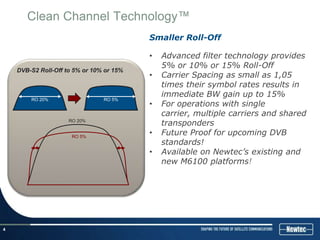
                                          Smaller Roll-Off

                                          •   Advanced filter technology provides
                                              5% or 10% or 15% Roll-Off
    DVB-S2 Roll-Off to 5% or 10% or 15%
                                          •   Carrier Spacing as small as 1,05
                                              times their symbol rates results in
                                              immediate BW gain up to 15%
        RO 20%                  RO 5%
                                          •   For operations with single
                                              carrier, multiple carriers and shared
                     RO 20%
                                              transponders
                      RO 5%
                                          •   Future Proof for upcoming DVB
                                              standards!
                                          •   Available on Newtec’s existing and
                                              new M6100 platforms!


4
Clean Channel Technology™ in Shared
    Transponder

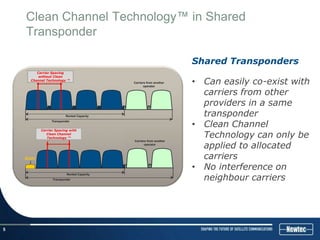
                                                                           Shared Transponders
            Carrier Spacing
           Carrier Spacing with Clean
             without Clean
            Channel Technology™
      Channel Spacing with Clean
        Carrier Technology ™
             Channel Technology™                   Carriers from another
                                                          operator
                                                                           • Can easily co-exist with
                                                                             carriers from other
                                                   Carriers from another
                                                          operator


                                                                             providers in a same
                                Rented Capacity                              transponder
                                                                           • Clean Channel
                                Rented Capacity
                      Transponder
                      Transponder

               CarrierSpacing with Clean
                Carrier Spacing with
                 Channel Channel
                   Clean Technology™
                Carrier Spacing with Clean
                   Technology ™
                  Channel Technology™
                                                   Carriers from another
                                                                             Technology can only be
                                                   Carriers from another
                                                          operator
                                                         operator            applied to allocated
    Gain
    Gain                                                                     carriers
                                                                           • No interference on
                                                                             neighbour carriers
                                 Rented Capacity
                       Transponder
                       Transponder


5
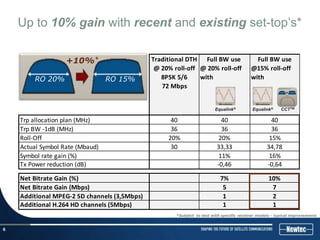
Up to 10% gain with recent and existing set-top’s*

                   +10%*                      Traditional DTH Full BW use                   Full BW use
                                               @ 20% roll-off @ 20% roll-off              @15% roll-off
        RO 20%                   RO 15%          8PSK 5/6     with                        with
                                                 72 Mbps                                                DVB-S2 Roll-Off to 5% or 10%


                                                                                                            RO 20%                     RO 5%


                                                                                                                         RO 20%


                                                                                                                          RO 5%


                                                                        Equalink®          Equalink®         CCTTM

    Trp allocation plan (MHz)                       40                     40                       40
    Trp BW -1dB (MHz)                               36                     36                       36
    Roll-Off                                       20%                    20%                      15%
    Actual Symbol Rate (Mbaud)                      30                   33,33                    34,78
    Symbol rate gain (%)                                                  11%                      16%
    Tx Power reduction (dB)                                              -0,46                    -0,64

    Net Bitrate Gain (%)                                                   7%                      10%
    Net Bitrate Gain (Mbps)                         72                      5                       7
    Additional MPEG-2 SD channels (3,5Mbps)                                 1                       2
    Additional H.264 HD channels (5Mbps)                                    1                       1
                                                      *Subject to test with specific receiver models - typical improvements


6
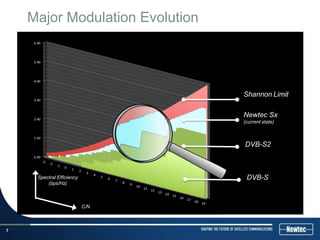
Major Modulation Evolution


                                 Shannon Limit

                                 Newtec Sx
                                 (current state)


                                 DVB-S2


     Spectral Efficiency          DVB-S
         (bps/Hz)


                           C/N


7
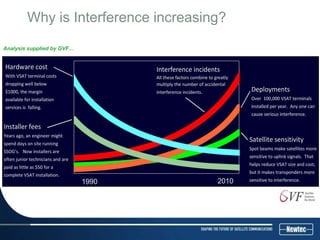
Why is Interference increasing?
Analysis supplied by GVF…
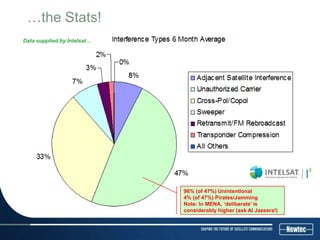
…the Stats!
Data supplied by Intelsat…


                             96% (of 47%) Unintentional
                             4% (of 47%) Pirates/Jamming
                             Note: In MENA, ‘deliberate’ is
                             considerably higher (ask Al Jazeera!)
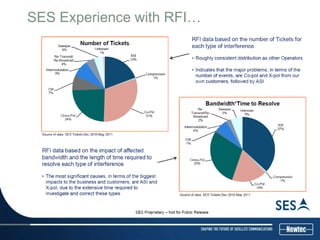
SES Experience with RFI…
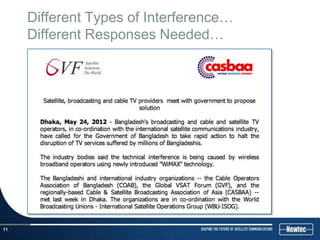
Different Types of Interference…
     Different Responses Needed…


11
Ready to combat Carrier Interference ?
     Radio Frequency Interference (RFI)
           ... high on the agenda of satellite operators!
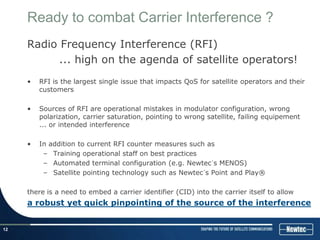
     •   RFI is the largest single issue that impacts QoS for satellite operators and their
         customers

     •   Sources of RFI are operational mistakes in modulator configuration, wrong
         polarization, carrier saturation, pointing to wrong satellite, failing equipement
         ... or intended interference

     •   In addition to current RFI counter measures such as
          – Training operational staff on best practices
          – Automated terminal configuration (e.g. Newtec´s MENOS)
          – Satellite pointing technology such as Newtec´s Point and Play®

     there is a need to embed a carrier identifier (CID) into the carrier itself to allow
     a robust yet quick pinpointing of the source of the interference


12
Ready to combat Carrier Interference ?
         …Newtec is !                                               M6100 Carrier ID setup
     How Does it work ?
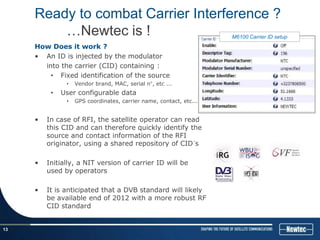
     • An ID is injected by the modulator
       into the carrier (CID) containing :
         • Fixed identification of the source
               •   Vendor brand, MAC, serial n°, etc ...
          •   User configurable data
               •   GPS coordinates, carrier name, contact, etc...


     •   In case of RFI, the satellite operator can read
         this CID and can therefore quickly identify the
         source and contact information of the RFI
         originator, using a shared repository of CID´s

     •   Initially, a NIT version of carrier ID will be
         used by operators

     •   It is anticipated that a DVB standard will likely
         be available end of 2012 with a more robust RF
         CID standard


13
Questions?
Thank you for your attention

Beyond DVB-S2: Next-Gen Satellite Transmission Standards

  • 1.
  • 2.
    Drivers for change:Beyond DVB-S2 Moore’s law: Technology can now do more Cost reductions for transmission Needs to address RF Inteference 2
  • 3.
    Newtec Contributes toeven better Standards Standards are important The DVB (Digital Video Broadcast) standard protects end-users from vendor lock-in and provides freedom of choice. Evolution is good for our industry DVB evolutions like DVB-S to DVB-S2 provided 20-30% OPEX reduction for broadcasters. Newtec contributes to a more efficient DVB-S2 Newtec contributes to DVB to establish an evolution that further optimizes satellite capacity usage Newtec actively supports standardization of Carrier ID (CID) 3
  • 4.
    Clean Channel Technology™ Smaller Roll-Off • Advanced filter technology provides 5% or 10% or 15% Roll-Off DVB-S2 Roll-Off to 5% or 10% or 15% • Carrier Spacing as small as 1,05 times their symbol rates results in immediate BW gain up to 15% RO 20% RO 5% • For operations with single carrier, multiple carriers and shared RO 20% transponders RO 5% • Future Proof for upcoming DVB standards! • Available on Newtec’s existing and new M6100 platforms! 4
  • 5.
    Clean Channel Technology™in Shared Transponder Shared Transponders Carrier Spacing Carrier Spacing with Clean without Clean Channel Technology™ Channel Spacing with Clean Carrier Technology ™ Channel Technology™ Carriers from another operator • Can easily co-exist with carriers from other Carriers from another operator providers in a same Rented Capacity transponder • Clean Channel Rented Capacity Transponder Transponder CarrierSpacing with Clean Carrier Spacing with Channel Channel Clean Technology™ Carrier Spacing with Clean Technology ™ Channel Technology™ Carriers from another Technology can only be Carriers from another operator operator applied to allocated Gain Gain carriers • No interference on neighbour carriers Rented Capacity Transponder Transponder 5
  • 6.
    Up to 10%gain with recent and existing set-top’s* +10%* Traditional DTH Full BW use Full BW use @ 20% roll-off @ 20% roll-off @15% roll-off RO 20% RO 15% 8PSK 5/6 with with 72 Mbps DVB-S2 Roll-Off to 5% or 10% RO 20% RO 5% RO 20% RO 5% Equalink® Equalink® CCTTM Trp allocation plan (MHz) 40 40 40 Trp BW -1dB (MHz) 36 36 36 Roll-Off 20% 20% 15% Actual Symbol Rate (Mbaud) 30 33,33 34,78 Symbol rate gain (%) 11% 16% Tx Power reduction (dB) -0,46 -0,64 Net Bitrate Gain (%) 7% 10% Net Bitrate Gain (Mbps) 72 5 7 Additional MPEG-2 SD channels (3,5Mbps) 1 2 Additional H.264 HD channels (5Mbps) 1 1 *Subject to test with specific receiver models - typical improvements 6
  • 7.
    Major Modulation Evolution Shannon Limit Newtec Sx (current state) DVB-S2 Spectral Efficiency DVB-S (bps/Hz) C/N 7
  • 8.
    Why is Interferenceincreasing? Analysis supplied by GVF…
  • 9.
    …the Stats! Data suppliedby Intelsat… 96% (of 47%) Unintentional 4% (of 47%) Pirates/Jamming Note: In MENA, ‘deliberate’ is considerably higher (ask Al Jazeera!)
  • 10.
  • 11.
    Different Types ofInterference… Different Responses Needed… 11
  • 12.
    Ready to combatCarrier Interference ? Radio Frequency Interference (RFI) ... high on the agenda of satellite operators! • RFI is the largest single issue that impacts QoS for satellite operators and their customers • Sources of RFI are operational mistakes in modulator configuration, wrong polarization, carrier saturation, pointing to wrong satellite, failing equipement ... or intended interference • In addition to current RFI counter measures such as – Training operational staff on best practices – Automated terminal configuration (e.g. Newtec´s MENOS) – Satellite pointing technology such as Newtec´s Point and Play® there is a need to embed a carrier identifier (CID) into the carrier itself to allow a robust yet quick pinpointing of the source of the interference 12
  • 13.
    Ready to combatCarrier Interference ? …Newtec is ! M6100 Carrier ID setup How Does it work ? • An ID is injected by the modulator into the carrier (CID) containing : • Fixed identification of the source • Vendor brand, MAC, serial n°, etc ... • User configurable data • GPS coordinates, carrier name, contact, etc... • In case of RFI, the satellite operator can read this CID and can therefore quickly identify the source and contact information of the RFI originator, using a shared repository of CID´s • Initially, a NIT version of carrier ID will be used by operators • It is anticipated that a DVB standard will likely be available end of 2012 with a more robust RF CID standard 13
  • 14.

Editor's Notes

  • #5 DSU: 30.000 Mbaud @ 20% = 36 MHz = 72.9 Mbps @ 8PSK 5/634.286 Mbaud @ 5% = 36 MHz = 83.3 Mbps @ 8PSK 5/6Assume available resources at satellite is 85 dB.HzFor 30.000 Mbaud C/N = 85 – 10 log(30.000E6) = 10.23 dB achievableFor 34.286 Mbaud C/N = 85 – 10 log(34.286E6) = 9.65 dB achievable Conclusion: in a full saturated transponder, the available power remains the same, so when symbolrate is increased, the power is spread over a larger bandwidth.This will effectively decrease the achievable C/N on the other hand, the throughput will increase.So for each case at hand the balance will need to be made.The same applies in multi-carrier operation. When a given bandwidth is leased, determined as the symbolrate multiplied with the channel spacing (which isn’t necessarily the same as the roll-off) , this corresponds to a given PEB used. In case the symbolrate is increased (by keeping the same leased bandwidth and reducing the symbolrate), more PEB will be used. This will work fine for links that were previously underusing the available power. For balanced links (power versus bandwidth), the cost for the link will increase because PEB is increased.