Understanding Linear Regression
A Simple Guide to Linear Regression
in Machine Learning
What is Linear Regression?
• Linear regression is a statistical method for
modeling the relationship between a
dependent variable (target) and one or more
independent variables (features) by fitting a
straight line to the data.
Equation of Linear Regression
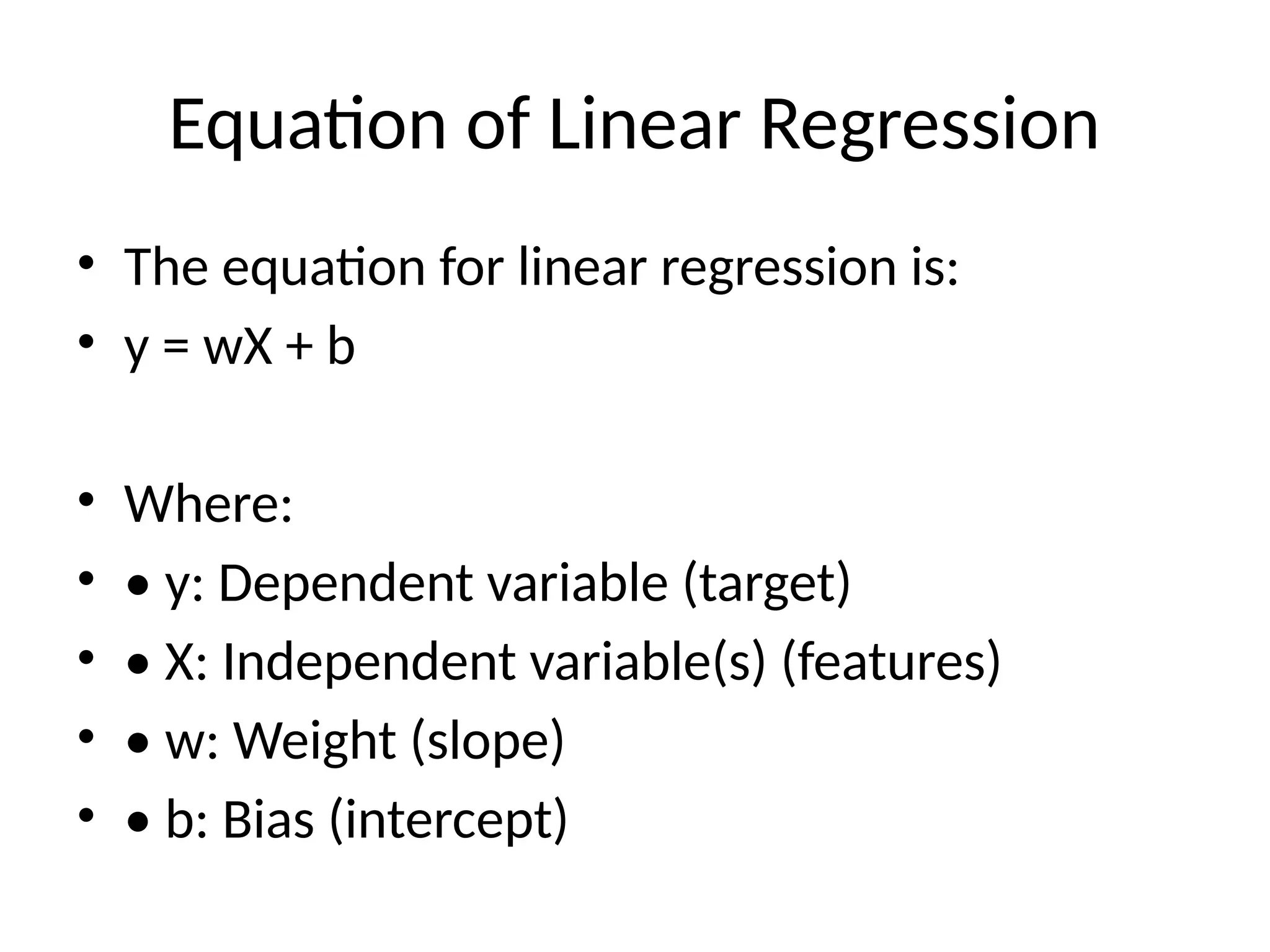
• The equation for linear regression is:
• y = wX + b
• Where:
• • y: Dependent variable (target)
• • X: Independent variable(s) (features)
• • w: Weight (slope)
• • b: Bias (intercept)
Types of Linear Regression
• 1. Simple Linear Regression:
• - Involves one independent variable.
• - Example: Predicting house price based on
size.
• 2. Multiple Linear Regression:
• - Involves multiple independent variables.
• - Example: Predicting house price based on
size, location, and number of bedrooms.
Assumptions of Linear Regression
• 1. Linearity: The relationship between features
and target is linear.
• 2. Independence: Observations are
independent of each other.
• 3. Homoscedasticity: Constant variance of
residuals.
• 4. Normality: Residuals are normally
distributed.
• 5. No Multicollinearity: Features are not highly
correlated.
Steps in Building a Linear
Regression Model
• 1. Understand and prepare the data.
• 2. Split data into training and testing sets.
• 3. Train the model on the training set.
• 4. Evaluate the model using metrics like MSE,
R².
• 5. Optimize the model if necessary.
Applications of Linear Regression
• • Predicting housing prices
• • Forecasting sales and demand
• • Analyzing trends in data
• • Estimating risk factors in insurance
• • Predicting stock prices
Common Evaluation Metrics
• 1. Mean Squared Error (MSE): Measures
average squared difference between predicted
and actual values.
• 2. Mean Absolute Error (MAE): Measures
average absolute difference between
predicted and actual values.
• 3. R-squared (R²): Represents the proportion
of variance explained by the model.
Advantages and Limitations
• Advantages:
• • Simple and easy to interpret.
• • Fast to compute.
• • Works well for linearly separable data.
• Limitations:
• • Assumes linearity between variables.
• • Sensitive to outliers.
• • Not suitable for complex or non-linear

Linear_RestqRegression_Presentation.pptx

  • 1.
    Understanding Linear Regression ASimple Guide to Linear Regression in Machine Learning
  • 2.
    What is LinearRegression? • Linear regression is a statistical method for modeling the relationship between a dependent variable (target) and one or more independent variables (features) by fitting a straight line to the data.
  • 3.
    Equation of LinearRegression • The equation for linear regression is: • y = wX + b • Where: • • y: Dependent variable (target) • • X: Independent variable(s) (features) • • w: Weight (slope) • • b: Bias (intercept)
  • 4.
    Types of LinearRegression • 1. Simple Linear Regression: • - Involves one independent variable. • - Example: Predicting house price based on size. • 2. Multiple Linear Regression: • - Involves multiple independent variables. • - Example: Predicting house price based on size, location, and number of bedrooms.
  • 5.
    Assumptions of LinearRegression • 1. Linearity: The relationship between features and target is linear. • 2. Independence: Observations are independent of each other. • 3. Homoscedasticity: Constant variance of residuals. • 4. Normality: Residuals are normally distributed. • 5. No Multicollinearity: Features are not highly correlated.
  • 6.
    Steps in Buildinga Linear Regression Model • 1. Understand and prepare the data. • 2. Split data into training and testing sets. • 3. Train the model on the training set. • 4. Evaluate the model using metrics like MSE, R². • 5. Optimize the model if necessary.
  • 7.
    Applications of LinearRegression • • Predicting housing prices • • Forecasting sales and demand • • Analyzing trends in data • • Estimating risk factors in insurance • • Predicting stock prices
  • 8.
    Common Evaluation Metrics •1. Mean Squared Error (MSE): Measures average squared difference between predicted and actual values. • 2. Mean Absolute Error (MAE): Measures average absolute difference between predicted and actual values. • 3. R-squared (R²): Represents the proportion of variance explained by the model.
  • 9.
    Advantages and Limitations •Advantages: • • Simple and easy to interpret. • • Fast to compute. • • Works well for linearly separable data. • Limitations: • • Assumes linearity between variables. • • Sensitive to outliers. • • Not suitable for complex or non-linear