9/8/2005 Line Regulation.doc 1/4
Jim Stiles The Univ. of Kansas Dept. of EECS
Line Regulation
Since the Zener diode in a shunt regulator has some small (but
non-zero) dynamic resistance rZ, we find that the load voltage
VO will have a small dependence on source voltage VS.
In other words, if the source voltage VS increases
(decreases), the load voltage VO will likewise increase
(decrease) by some very small amount.
Q: Why would the source voltage VS ever change?
A: There are many reasons why VS will not be a perfect
constant with time. Among them are:
1. Thermal noise
2. Temperature drift
3. Coupled 60 Hz signals (or digital clock signals)
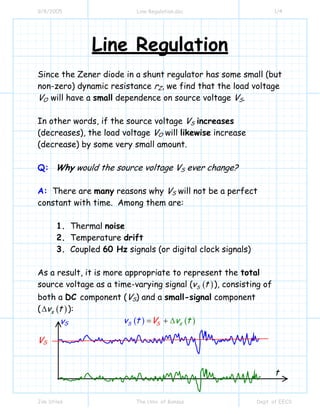
As a result, it is more appropriate to represent the total
source voltage as a time-varying signal ( ( )Sv t ), consisting of
both a DC component (VS) and a small-signal component
( ( )sv t∆ ):
( ) ( )S sS t vVv t= + ∆
VS
vS
t
9/8/2005 Line Regulation.doc 2/4
Jim Stiles The Univ. of Kansas Dept. of EECS
As a result of the small-signal source voltage, the total load
voltage is likewise time-varying, with both a DC (VO) and small-
signal ( ov∆ ) component:
( ) ( )O O ov t V v t= + ∆
So, we know that the DC source VS produces the DC load
voltage VO, whereas the small-signal source voltage sv∆
results in the small-signal load voltage ov∆ .
Q: Just how are sv∆ and ov∆ related? I mean, if sv∆ equals,
say, 500 mV, what will value of ov∆ be?
A: Determining this answer is easy! We simply need to
perform a small-signal analysis.
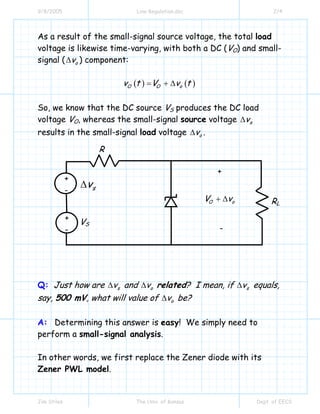
In other words, we first replace the Zener diode with its
Zener PWL model.
+
-
VS
R
RLO oV v+ ∆
+
-
+
- sv∆
9/8/2005 Line Regulation.doc 3/4
Jim Stiles The Univ. of Kansas Dept. of EECS
We then turn off all the DC sources (including VZO) and
analyze the remaining small-signal circuit!
From voltage division, we find: Z L
o s
Z L
r R
v v
R r R
⎛ ⎞
∆ = ∆ ⎜ ⎟
+⎝ ⎠
However, recall that the value of a Zener dynamic resistance
rZ is very small. Thus, we can assume that rZ >> RL, and
therefore Z L Zr R r≈ , leading to:
+
-
VS
R
RLO oV v+ ∆
+
-rz
+
_
VZ0
+
- sv∆
R
RLov∆
+
-
+
- sv∆
rz
9/8/2005 Line Regulation.doc 4/4
Jim Stiles The Univ. of Kansas Dept. of EECS
Z L
o s
Z L
Z
s
Z
r R
v v
R r R
r
v
r R
⎛ ⎞
∆ = ∆ ⎜ ⎟
+⎝ ⎠
⎛ ⎞
≈ ∆ ⎜ ⎟
+⎝ ⎠
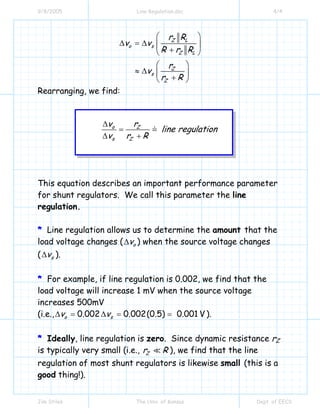
Rearranging, we find:
o Z
s Z
v r
line regulation
v r R
∆
=
∆ +
This equation describes an important performance parameter
for shunt regulators. We call this parameter the line
regulation.
* Line regulation allows us to determine the amount that the
load voltage changes ( ov∆ ) when the source voltage changes
( sv∆ ).
* For example, if line regulation is 0.002, we find that the
load voltage will increase 1 mV when the source voltage
increases 500mV
(i.e., 0.002 0 002(0.5) 0.001 Vo sv v .∆ = ∆ = = ).
* Ideally, line regulation is zero. Since dynamic resistance rZ
is typically very small (i.e., Zr R ), we find that the line
regulation of most shunt regulators is likewise small (this is a
good thing!).

Line regulation

  • 1.
    9/8/2005 Line Regulation.doc1/4 Jim Stiles The Univ. of Kansas Dept. of EECS Line Regulation Since the Zener diode in a shunt regulator has some small (but non-zero) dynamic resistance rZ, we find that the load voltage VO will have a small dependence on source voltage VS. In other words, if the source voltage VS increases (decreases), the load voltage VO will likewise increase (decrease) by some very small amount. Q: Why would the source voltage VS ever change? A: There are many reasons why VS will not be a perfect constant with time. Among them are: 1. Thermal noise 2. Temperature drift 3. Coupled 60 Hz signals (or digital clock signals) As a result, it is more appropriate to represent the total source voltage as a time-varying signal ( ( )Sv t ), consisting of both a DC component (VS) and a small-signal component ( ( )sv t∆ ): ( ) ( )S sS t vVv t= + ∆ VS vS t
  • 2.
    9/8/2005 Line Regulation.doc2/4 Jim Stiles The Univ. of Kansas Dept. of EECS As a result of the small-signal source voltage, the total load voltage is likewise time-varying, with both a DC (VO) and small- signal ( ov∆ ) component: ( ) ( )O O ov t V v t= + ∆ So, we know that the DC source VS produces the DC load voltage VO, whereas the small-signal source voltage sv∆ results in the small-signal load voltage ov∆ . Q: Just how are sv∆ and ov∆ related? I mean, if sv∆ equals, say, 500 mV, what will value of ov∆ be? A: Determining this answer is easy! We simply need to perform a small-signal analysis. In other words, we first replace the Zener diode with its Zener PWL model. + - VS R RLO oV v+ ∆ + - + - sv∆
  • 3.
    9/8/2005 Line Regulation.doc3/4 Jim Stiles The Univ. of Kansas Dept. of EECS We then turn off all the DC sources (including VZO) and analyze the remaining small-signal circuit! From voltage division, we find: Z L o s Z L r R v v R r R ⎛ ⎞ ∆ = ∆ ⎜ ⎟ +⎝ ⎠ However, recall that the value of a Zener dynamic resistance rZ is very small. Thus, we can assume that rZ >> RL, and therefore Z L Zr R r≈ , leading to: + - VS R RLO oV v+ ∆ + -rz + _ VZ0 + - sv∆ R RLov∆ + - + - sv∆ rz
  • 4.
    9/8/2005 Line Regulation.doc4/4 Jim Stiles The Univ. of Kansas Dept. of EECS Z L o s Z L Z s Z r R v v R r R r v r R ⎛ ⎞ ∆ = ∆ ⎜ ⎟ +⎝ ⎠ ⎛ ⎞ ≈ ∆ ⎜ ⎟ +⎝ ⎠ Rearranging, we find: o Z s Z v r line regulation v r R ∆ = ∆ + This equation describes an important performance parameter for shunt regulators. We call this parameter the line regulation. * Line regulation allows us to determine the amount that the load voltage changes ( ov∆ ) when the source voltage changes ( sv∆ ). * For example, if line regulation is 0.002, we find that the load voltage will increase 1 mV when the source voltage increases 500mV (i.e., 0.002 0 002(0.5) 0.001 Vo sv v .∆ = ∆ = = ). * Ideally, line regulation is zero. Since dynamic resistance rZ is typically very small (i.e., Zr R ), we find that the line regulation of most shunt regulators is likewise small (this is a good thing!).