Inflation 
Andrei Linde 
Lecture 1
Plan of the lectures: 
 Inflation: a general outlook 
 Basic inflationary models (new inflation, 
chaotic inflation, hybrid inflation) 
 Creation of matter after inflation (reheating) 
 Quantum cosmology and initial conditions for 
inflation 
 Eternal inflation and string theory landscape
Two major cosmological discoveries: 
 The new-born universe experienced 
rapid acceleration (inflation) 
 A new (slow) stage of acceleration started 
5 billion years ago (dark energy) 
How did it start, and how it is going to end?
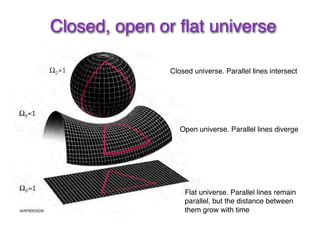
Closed, open or flat universe 
Closed universe. Parallel lines intersect 
Open universe. Parallel lines diverge 
Flat universe. Parallel lines remain 
parallel, but the distance between 
them grow with time
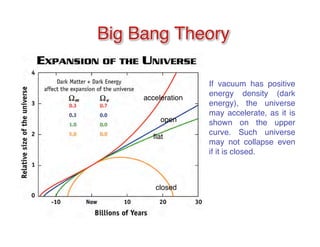
Big Bang Theory 
acceleration 
open 
flat 
closed 
If vacuum has positive 
energy density (dark 
energy), the universe 
may accelerate, as it is 
shown on the upper 
curve. Such universe 
may not collapse even 
if it is closed.
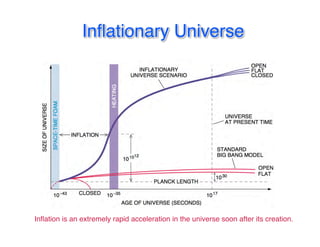
Inflflationary Universe 
Inflation is an extremely rapid acceleration in the universe soon after its creation.
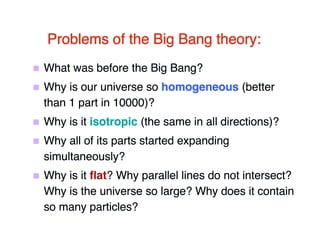
Problems of the Big Bang theory: 
 What was before the Big Bang? 
 Why is our universe so homogeneous (better 
than 1 part in 10000)? 
 Why is it isotropic (the same in all directions)? 
 Why all of its parts started expanding 
simultaneously? 
 Why is it flflat? Why parallel lines do not intersect? 
Why is the universe so large? Why does it contain 
so many particles?
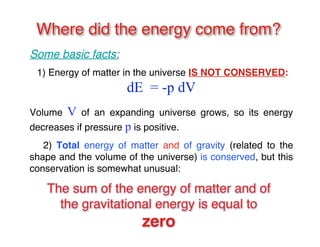
Where did the energy come from? 
Some basic facts: 
1) Energy of matter in the universe IS NOT CONSERVED: 
dE = -p dV 
Volume V of an expanding universe grows, so its energy 
decreases if pressure p is positive. 
2) Total energy of matter and of gravity (related to the 
shape and the volume of the universe) is conserved, but this 
conservation is somewhat unusual: 
The sum of the energy of matter and of 
the gravitational energy is equal to 
zero
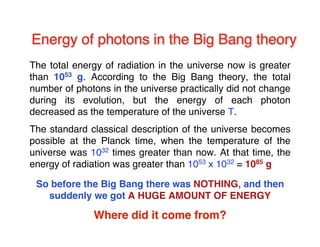
Energy of photons in the Big Bang theory 
The total energy of radiation in the universe now is greater 
than 1053 g. According to the Big Bang theory, the total 
number of photons in the universe practically did not change 
during its evolution, but the energy of each photon 
decreased as the temperature of the universe T. 
The standard classical description of the universe becomes 
possible at the Planck time, when the temperature of the 
universe was 1032 times greater than now. At that time, the 
energy of radiation was greater than 1053 x 1032 = 1085 g 
So before the Big Bang there was NOTHING, and then 
suddenly we got A HUGE AMOUNT OF ENERGY 
Where did it come from?
Extending this investigation back to the 
cosmological singularity, where T was infinite, 
one finds that in order to create the universe in 
the Big Bang singularity one should have 
INFINITE AMOUNT OF ENERGY
Inflflationary theory 
solves many problems of the old Big 
Bang theory, and explains how the 
universe could be created from less 
than one milligram of matter
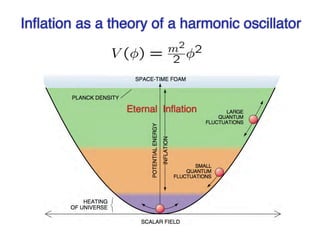
Inflflation as a theory of a harmonic oscillator 
Eternal Inflation
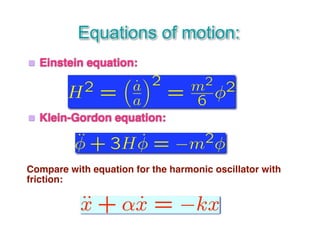
Equations of motion: 
 Einstein equation: 
 Klein-Gordon equation: 
Compare with equation for the harmonic oscillator with 
friction:
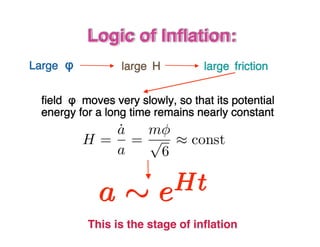
Logic of Inflflation: 
Large φ large H large friction 
field φ moves very slowly, so that its potential 
energy for a long time remains nearly constant 
This is the stage of inflflation
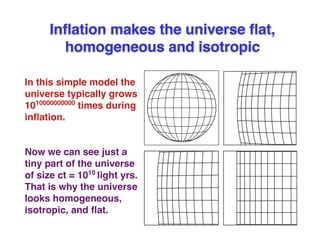
Inflflation makes the universe flflat, 
homogeneous and isotropic 
In this simple model the 
universe typically grows 
1010000000000 times during 
inflation. 
Now we can see just a 
tiny part of the universe 
of size ct = 1010 light yrs. 
That is why the universe 
looks homogeneous, 
isotropic, and flat.
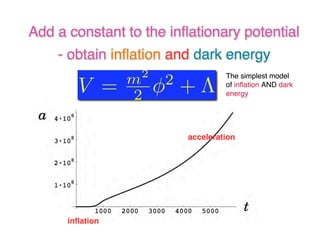
Add a constant to the inflflationary potential 
- obtain inflflation and dark energy 
inflation 
The simplest model 
of inflflation AND dark 
energy 
acceleration
Note that the energy density of the scalar field 
during inflation remains nearly constant, because 
at that stage the field practically does not change. 
Meanwhile, the total volume of the universe during 
inflation grows exponentially, as a3(t) ~ e3Ht. 
Therefore the total energy of the scalar field also 
grows exponentially, as E ~ e3Ht. 
After inflation, scalar field decays, and all of its 
energy is transformed into the exponentially large 
energy/mass of particles populating our universe.
We can start with a tiny domain of the smallest 
possible size (Planck length lP =MP 
-1~10-33 cm) at 
the largest possible density (Planck density MP 
4 ~ 
1094 g/cm3). The total energy of matter inside such 
a domain is lP 
3MP 
4 ~ MP 
~ 10-5 g. Then inflation 
makes this domain much larger than the part of the 
universe we see now. 
What is the source of this energy?
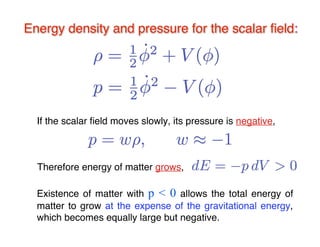
Energy density and pressure for the scalar fifield: 
If the scalar field moves slowly, its pressure is negative, 
Therefore energy of matter grows, 
Existence of matter with p < 0 allows the total energy of 
matter to grow at the expense of the gravitational energy, 
which becomes equally large but negative.
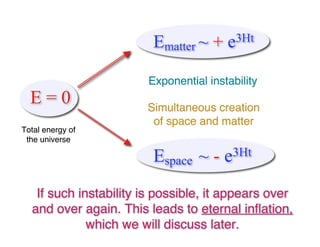
Exponential instability 
Simultaneous creation 
of space and matter 
i If such instability is possible, it appears over 
and over again. This leads to eternal inflflation, 
which we will discuss later. 
E = 0 
Ematter ~ + e3Ht 
Espace ~ - e3Ht 
Total energy of 
the universe
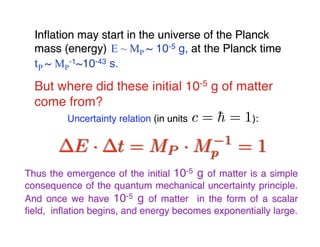
Inflation may start in the universe of the Planck 
mass (energy) E ~ MP 
~ 10-5 g, at the Planck time 
tP 
~ MP 
-1~10-43 s. 
But where did these initial 10-5 g of matter 
come from? 
Uncertainty relation (in units ): 
Thus the emergence of the initial 10-5 g of matter is a simple 
consequence of the quantum mechanical uncertainty principle. 
And once we have 10-5 g of matter in the form of a scalar 
fifield, inflflation begins, and energy becomes exponentially large.
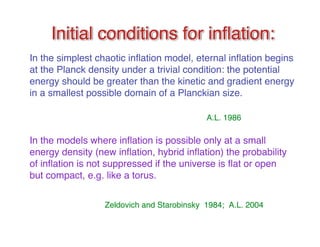
Initial conditions for inflflation: 
In the simplest chaotic inflation model, eternal inflation begins 
at the Planck density under a trivial condition: the potential 
energy should be greater than the kinetic and gradient energy 
in a smallest possible domain of a Planckian size. 
A.L. 1986 
In the models where inflation is possible only at a small 
energy density (new inflation, hybrid inflation) the probability 
of inflation is not suppressed if the universe is flat or open 
but compact, e.g. like a torus. 
Zeldovich and Starobinsky 1984; A.L. 2004
If one can create the whole universe from 
one milligram of matter, what other miracles 
are possible? 
1) Inflation can create galaxies from quantum 
fluctuations. 
2) Inflationary fluctuations can create new 
exponentially large parts of the universe (eternal 
inflation).
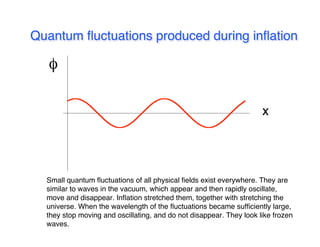
Quantum fluctuations produced during inflflation 
φ 
x 
Small quantum fluctuations of all physical fields exist everywhere. They are 
similar to waves in the vacuum, which appear and then rapidly oscillate, 
move and disappear. Inflation stretched them, together with stretching the 
universe. When the wavelength of the fluctuations became sufficiently large, 
they stop moving and oscillating, and do not disappear. They look like frozen 
waves.
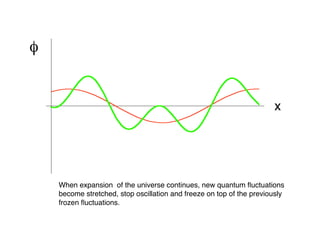
φ 
x 
When expansion of the universe continues, new quantum fluctuations 
become stretched, stop oscillation and freeze on top of the previously 
frozen fluctuations.
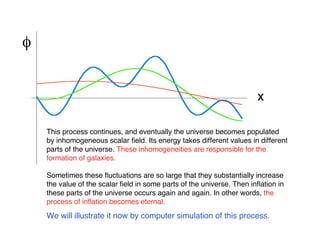
φ 
x 
This process continues, and eventually the universe becomes populated 
by inhomogeneous scalar field. Its energy takes different values in different 
parts of the universe. These inhomogeneities are responsible for the 
formation of galaxies. 
Sometimes these fluctuations are so large that they substantially increase 
the value of the scalar field in some parts of the universe. Then inflation in 
these parts of the universe occurs again and again. In other words, the 
process of inflation becomes eternal. 
We will illustrate it now by computer simulation of this process.
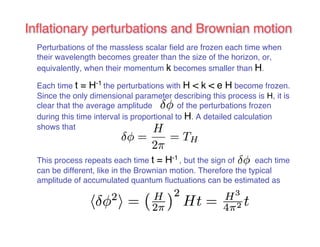
Inflationary perturbations and Brownian motion 
Perturbations of the massless scalar field are frozen each time when 
their wavelength becomes greater than the size of the horizon, or, 
equivalently, when their momentum k becomes smaller than H. 
Each time t = H-1 the perturbations with H < k < e H become frozen. 
Since the only dimensional parameter describing this process is H, it is 
clear that the average amplitude of the perturbations frozen 
during this time interval is proportional to H. A detailed calculation 
shows that 
This process repeats each time t = H-1 , but the sign of each time 
can be different, like in the Brownian motion. Therefore the typical 
amplitude of accumulated quantum fluctuations can be estimated as
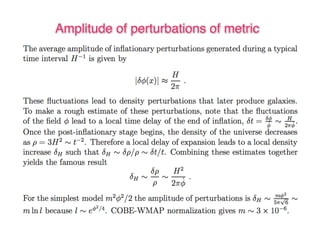
Amplitude of perturbations of metric
Even though this argument may seem simple, the 
actual theory is extremely complicated. The first 
paper on this subject was written by Mukhanov 
and Chibisov in 1981. The general theory was 
developed by Mukhanov in 1985.
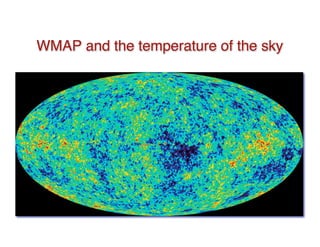
WMAP and the temperature of the sky
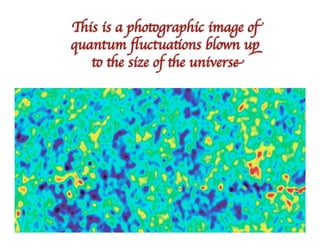
ThThis is a phototographic image off 
qquantum flfluctuatitions blown upp 
toto ththe size of ththe universee
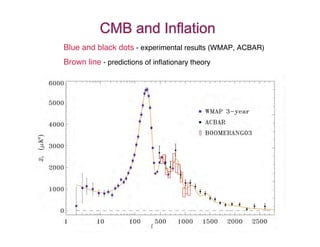
CMB and Inflation 
Blue and black dots - experimental results (WMAP, ACBAR) 
Brown line - predictions of inflationary theory
Predictions of Inflflation: 
1) The universe should be homogeneous, isotropic and flat, 
Ω = 1 + O(10-4) [Ω=ρ/ρ0] 
Observations: it is homogeneous, isotropic and flat: 
2) Inflationary perturbations should be gaussian and 
adiabatic, with flat spectrum, ns = 1+ O(10-1). Spectral index 
ns slightly differs from 1. (This is an important prediction, 
similar to asymptotic freedom in QCD.) 
Observations: perturbations are gaussian and adiabatic, 
with flat spectrum:
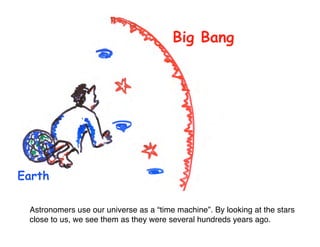
Big Bang 
Earth 
Astronomers use our universe as a “time machine”. By looking at the stars 
close to us, we see them as they were several hundreds years ago.
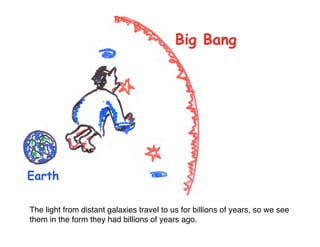
Big Bang 
Earth 
The light from distant galaxies travel to us for billions of years, so we see 
them in the form they had billions of years ago.
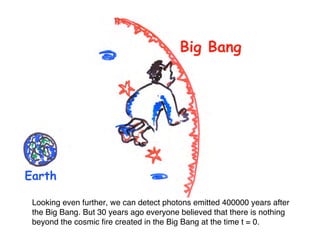
Big Bang 
Earth 
Looking even further, we can detect photons emitted 400000 years after 
the Big Bang. But 30 years ago everyone believed that there is nothing 
beyond the cosmic fire created in the Big Bang at the time t = 0.
Big Bang 
Earth 
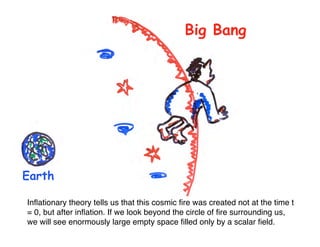
Inflationary theory tells us that this cosmic fire was created not at the time t 
= 0, but after inflation. If we look beyond the circle of fire surrounding us, 
we will see enormously large empty space filled only by a scalar field.
Big Bang 
Inflation 
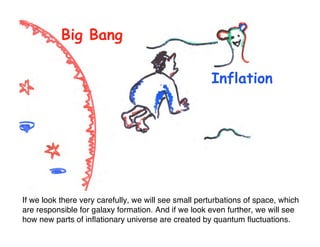
If we look there very carefully, we will see small perturbations of space, which 
are responsible for galaxy formation. And if we look even further, we will see 
how new parts of inflationary universe are created by quantum fluctuations.

Linde lecturesmunich1

  • 1.
  • 2.
    Plan of thelectures:  Inflation: a general outlook  Basic inflationary models (new inflation, chaotic inflation, hybrid inflation)  Creation of matter after inflation (reheating)  Quantum cosmology and initial conditions for inflation  Eternal inflation and string theory landscape
  • 3.
    Two major cosmologicaldiscoveries:  The new-born universe experienced rapid acceleration (inflation)  A new (slow) stage of acceleration started 5 billion years ago (dark energy) How did it start, and how it is going to end?
  • 4.
    Closed, open orflat universe Closed universe. Parallel lines intersect Open universe. Parallel lines diverge Flat universe. Parallel lines remain parallel, but the distance between them grow with time
  • 5.
    Big Bang Theory acceleration open flat closed If vacuum has positive energy density (dark energy), the universe may accelerate, as it is shown on the upper curve. Such universe may not collapse even if it is closed.
  • 6.
    Inflflationary Universe Inflationis an extremely rapid acceleration in the universe soon after its creation.
  • 7.
    Problems of theBig Bang theory:  What was before the Big Bang?  Why is our universe so homogeneous (better than 1 part in 10000)?  Why is it isotropic (the same in all directions)?  Why all of its parts started expanding simultaneously?  Why is it flflat? Why parallel lines do not intersect? Why is the universe so large? Why does it contain so many particles?
  • 8.
    Where did theenergy come from? Some basic facts: 1) Energy of matter in the universe IS NOT CONSERVED: dE = -p dV Volume V of an expanding universe grows, so its energy decreases if pressure p is positive. 2) Total energy of matter and of gravity (related to the shape and the volume of the universe) is conserved, but this conservation is somewhat unusual: The sum of the energy of matter and of the gravitational energy is equal to zero
  • 9.
    Energy of photonsin the Big Bang theory The total energy of radiation in the universe now is greater than 1053 g. According to the Big Bang theory, the total number of photons in the universe practically did not change during its evolution, but the energy of each photon decreased as the temperature of the universe T. The standard classical description of the universe becomes possible at the Planck time, when the temperature of the universe was 1032 times greater than now. At that time, the energy of radiation was greater than 1053 x 1032 = 1085 g So before the Big Bang there was NOTHING, and then suddenly we got A HUGE AMOUNT OF ENERGY Where did it come from?
  • 10.
    Extending this investigationback to the cosmological singularity, where T was infinite, one finds that in order to create the universe in the Big Bang singularity one should have INFINITE AMOUNT OF ENERGY
  • 11.
    Inflflationary theory solvesmany problems of the old Big Bang theory, and explains how the universe could be created from less than one milligram of matter
  • 12.
    Inflflation as atheory of a harmonic oscillator Eternal Inflation
  • 13.
    Equations of motion:  Einstein equation:  Klein-Gordon equation: Compare with equation for the harmonic oscillator with friction:
  • 14.
    Logic of Inflflation: Large φ large H large friction field φ moves very slowly, so that its potential energy for a long time remains nearly constant This is the stage of inflflation
  • 16.
    Inflflation makes theuniverse flflat, homogeneous and isotropic In this simple model the universe typically grows 1010000000000 times during inflation. Now we can see just a tiny part of the universe of size ct = 1010 light yrs. That is why the universe looks homogeneous, isotropic, and flat.
  • 17.
    Add a constantto the inflflationary potential - obtain inflflation and dark energy inflation The simplest model of inflflation AND dark energy acceleration
  • 18.
    Note that theenergy density of the scalar field during inflation remains nearly constant, because at that stage the field practically does not change. Meanwhile, the total volume of the universe during inflation grows exponentially, as a3(t) ~ e3Ht. Therefore the total energy of the scalar field also grows exponentially, as E ~ e3Ht. After inflation, scalar field decays, and all of its energy is transformed into the exponentially large energy/mass of particles populating our universe.
  • 19.
    We can startwith a tiny domain of the smallest possible size (Planck length lP =MP -1~10-33 cm) at the largest possible density (Planck density MP 4 ~ 1094 g/cm3). The total energy of matter inside such a domain is lP 3MP 4 ~ MP ~ 10-5 g. Then inflation makes this domain much larger than the part of the universe we see now. What is the source of this energy?
  • 20.
    Energy density andpressure for the scalar fifield: If the scalar field moves slowly, its pressure is negative, Therefore energy of matter grows, Existence of matter with p < 0 allows the total energy of matter to grow at the expense of the gravitational energy, which becomes equally large but negative.
  • 21.
    Exponential instability Simultaneouscreation of space and matter i If such instability is possible, it appears over and over again. This leads to eternal inflflation, which we will discuss later. E = 0 Ematter ~ + e3Ht Espace ~ - e3Ht Total energy of the universe
  • 22.
    Inflation may startin the universe of the Planck mass (energy) E ~ MP ~ 10-5 g, at the Planck time tP ~ MP -1~10-43 s. But where did these initial 10-5 g of matter come from? Uncertainty relation (in units ): Thus the emergence of the initial 10-5 g of matter is a simple consequence of the quantum mechanical uncertainty principle. And once we have 10-5 g of matter in the form of a scalar fifield, inflflation begins, and energy becomes exponentially large.
  • 23.
    Initial conditions forinflflation: In the simplest chaotic inflation model, eternal inflation begins at the Planck density under a trivial condition: the potential energy should be greater than the kinetic and gradient energy in a smallest possible domain of a Planckian size. A.L. 1986 In the models where inflation is possible only at a small energy density (new inflation, hybrid inflation) the probability of inflation is not suppressed if the universe is flat or open but compact, e.g. like a torus. Zeldovich and Starobinsky 1984; A.L. 2004
  • 24.
    If one cancreate the whole universe from one milligram of matter, what other miracles are possible? 1) Inflation can create galaxies from quantum fluctuations. 2) Inflationary fluctuations can create new exponentially large parts of the universe (eternal inflation).
  • 25.
    Quantum fluctuations producedduring inflflation φ x Small quantum fluctuations of all physical fields exist everywhere. They are similar to waves in the vacuum, which appear and then rapidly oscillate, move and disappear. Inflation stretched them, together with stretching the universe. When the wavelength of the fluctuations became sufficiently large, they stop moving and oscillating, and do not disappear. They look like frozen waves.
  • 26.
    φ x Whenexpansion of the universe continues, new quantum fluctuations become stretched, stop oscillation and freeze on top of the previously frozen fluctuations.
  • 27.
    φ x Thisprocess continues, and eventually the universe becomes populated by inhomogeneous scalar field. Its energy takes different values in different parts of the universe. These inhomogeneities are responsible for the formation of galaxies. Sometimes these fluctuations are so large that they substantially increase the value of the scalar field in some parts of the universe. Then inflation in these parts of the universe occurs again and again. In other words, the process of inflation becomes eternal. We will illustrate it now by computer simulation of this process.
  • 28.
    Inflationary perturbations andBrownian motion Perturbations of the massless scalar field are frozen each time when their wavelength becomes greater than the size of the horizon, or, equivalently, when their momentum k becomes smaller than H. Each time t = H-1 the perturbations with H < k < e H become frozen. Since the only dimensional parameter describing this process is H, it is clear that the average amplitude of the perturbations frozen during this time interval is proportional to H. A detailed calculation shows that This process repeats each time t = H-1 , but the sign of each time can be different, like in the Brownian motion. Therefore the typical amplitude of accumulated quantum fluctuations can be estimated as
  • 29.
  • 30.
    Even though thisargument may seem simple, the actual theory is extremely complicated. The first paper on this subject was written by Mukhanov and Chibisov in 1981. The general theory was developed by Mukhanov in 1985.
  • 31.
    WMAP and thetemperature of the sky
  • 32.
    ThThis is aphototographic image off qquantum flfluctuatitions blown upp toto ththe size of ththe universee
  • 33.
    CMB and Inflation Blue and black dots - experimental results (WMAP, ACBAR) Brown line - predictions of inflationary theory
  • 34.
    Predictions of Inflflation: 1) The universe should be homogeneous, isotropic and flat, Ω = 1 + O(10-4) [Ω=ρ/ρ0] Observations: it is homogeneous, isotropic and flat: 2) Inflationary perturbations should be gaussian and adiabatic, with flat spectrum, ns = 1+ O(10-1). Spectral index ns slightly differs from 1. (This is an important prediction, similar to asymptotic freedom in QCD.) Observations: perturbations are gaussian and adiabatic, with flat spectrum:
  • 35.
    Big Bang Earth Astronomers use our universe as a “time machine”. By looking at the stars close to us, we see them as they were several hundreds years ago.
  • 36.
    Big Bang Earth The light from distant galaxies travel to us for billions of years, so we see them in the form they had billions of years ago.
  • 37.
    Big Bang Earth Looking even further, we can detect photons emitted 400000 years after the Big Bang. But 30 years ago everyone believed that there is nothing beyond the cosmic fire created in the Big Bang at the time t = 0.
  • 38.
    Big Bang Earth Inflationary theory tells us that this cosmic fire was created not at the time t = 0, but after inflation. If we look beyond the circle of fire surrounding us, we will see enormously large empty space filled only by a scalar field.
  • 39.
    Big Bang Inflation If we look there very carefully, we will see small perturbations of space, which are responsible for galaxy formation. And if we look even further, we will see how new parts of inflationary universe are created by quantum fluctuations.