International Research Journal of Engineering and Technology (IRJET) e-ISSN: 2395-0056
Volume: 09 Issue: 01 | Jan 2022 www.irjet.net p-ISSN: 2395-0072
© 2022, IRJET | Impact Factor value: 7.529 | ISO 9001:2008 Certified Journal | Page 1195
Lightweight Concrete by using Thermocol and Fly Ash
Chanchal Verma1, Shraddha Chakradhari2, Ambika Watti3, Rajan Kumar Singh4
1UG Student, SSIPMT, Raipur, Chhattisgarh, India
2UG Student, SSIPMT, Raipur, Chhattisgarh, India
3UG Student, SSIPMT, Raipur, Chhattisgarh, India
4Assistant Professor, Dept. of civil Engineering, SSIPMT, Raipur, Chhattisgarh, India
---------------------------------------------------------------------***----------------------------------------------------------------------
Abstract - This research paper represents the experimental study on use of Thermocol and Fly Ash as an aggregate in
concrete to make it lighter , economical and environment friendly compare to normal concrete
In present construction scenario concrete plays a major roll in all kind of structure construction. where the use of Lightweight
Concrete is expanding it’s uses. concrete is basically a mixture of aggregate ,cement ,sand and water or type of admixture
which depends on the working situation and desired results. So using lightweight concrete instead of normal concrete can
play a very phenomenal role by decreasing the density and increasing the thermal insulation. And using fly ash, mix aggregate
and thermocol instead of sand can be a good alternative for both economical and environmental point of view and it also
makes the concrete mixture lightweight as well. As Our project is mainly focused on the investigation of the characteristics of
the M20 grade of concrete in which cement is partially get replaced with fly ash 30% ,40% and mix aggregate replace with
thermocol 0.25%,0.3%respectively . And the results shows that it is possible to produce lightweight concrete with low to
medium strength by addition of thermocol and Fly Ash as aggregates instead of natural aggregate.
Key Words: Fine aggregate, Fly ash, Thermocol, cement.
1.INTRODUCTION:
Growing need of electricity in our country were 70% of electricity is generated by thermal power plants. it has become a
burden on the energy production industries to find a environmentally sustainable solution for the disposal of fly ash. Which
results some serious negative impact on the environment as well. So, by using it it in a manner where it will be not harmful for
environment, can be a great way of disposal. By using thermocol and fly ash instead of normal aggregate will help to give this
lightweight concrete its most important characteristic low density, Light weight, low thermal conductivity. Light weight
concrete is an astonishing human invention which we use in several field of construction altogether. The concrete basically
have three type and they are also sub-divided on the basis of their weight or the weight of concrete. The composition are as
follow .
Heavy - 3200 kg/m to 4000 kg/m
Normal - 2400kg/m to 2600kg/m
Light - 2000kg/m
Lightweight concrete is not a new terminology it has been coming in use since 18th century by the Roman people. It can be a
great material for making paration walls because of it’s lightweight property. Nowdays were the technology is expanding,
light weight concrete also expands it’s uses.
1.1 Literature Review
In the present scenario , several type of buildings are being constructed and the most important element for constructing any
architecture from ordinary residential building to skyscrap structures is concrete, because of its physical properties such as
durability, resistance to fire, simple to use etc. And due to it’s high demand . But the increasing quantity of sand can become a
serious issue posing environmental degradation. To avoid this problem and to stop it from becoming a crisis. Lightweight
concrete can be a great alternative of Normal concrete. Lightweight concrete is a mixture. Witch is made up of lightweight
coarse aggregate such as shale, fly ash, clay, or thermocol, Were fly ash is also an industrial waste and due to its small size
and light weight it has ability to get airborne and pollute the air and environment. Because of
1. Yasar et.al. - This experiment had various different parts such as he executed a research on the design of structural
lightweight concrete (S.L.W.C) made with basaltic pumice (scoria) as aggregate and fly ash and it was proved that
gives an obvious advantage over the scaling down of weight. The characteristics of freshly made concrete including
density, and slump and because of these kind of advantageous reasons it is more compressive and more eco friendly as
well.
2. H. Al-Khaiat and M.N. Haque - He researched on curing the physical properties and the early strength. And more
over lightweight concrete using Lytag lightweight aggregate with a slump of approximately 100 mm, fresh unit weight
International Research Journal of Engineering and Technology (IRJET) e-ISSN: 2395-0056
Volume: 09 Issue: 01 | Jan 2022 www.irjet.net p-ISSN: 2395-0072
© 2022, IRJET | Impact Factor value: 7.529 | ISO 9001:2008 Certified Journal | Page 1196
of 1800 kg/m3 and twenty eight day cube compressive strength. Further more the test shown that the compressive
strengths of structural lightweight concrete looks like to be less sensitive to insuffiency of curing than the normal
weight concrete.
3. Khandaker M . Anwar Hossain - he investigated onivolcanicipumice. The test was conducted . After 0% to 25% of
cement by aspect of weight and on concrete by replacing 0% to 100% of coarse aggregate by aspect of volume.
The VPC properties got differentiate on the base of volcanic pumice aggregate (V.P.A) and different kind of tests were done
such as workability, strength, drying shrinkage, surface absorption and water permeability.
4. T. Parhizkar et. al. - Showed experiments on the properties of volcanic pumice lightweight aggregates concretes
(L.W.A). At the time of result of the mainly lightweight coarse with natural fine aggregates concrete and lightweight coarse
and fine aggregates concrete. The study resulted different kinds of results such as tensile strength and drying shrinkage
shown that these lightweight concretes meet the requirements.
5. Banthia, N. and Trottier,J. – Done a study on reinforced concrete made of reinforced steel fibers and this results in an
increase in compression strength.
6. Compione, G., et.aI - Recommended that the existence of fiber in the concrete is exceptional and helps to bring down
the decay in the field of strains and more over advised that by ordinary confinement of transverse reinforcement the
brittle nature can be overcome.
2. Methodology
Concrete mix design is the manner of selecting suitable constituents of concrete and determining the relative amount of
material with the goal to make an economical and lightweight replacement of normal concrete while holding some of the
specified minimum properties such as consistency and durability. There is no such standard method of for proportioning
the lightweight concrete like conventional concrete. The properties of lightweight concrete are directly or indirectly
related to its density, such as the strength of the lightweight concrete decreases exponentially with the reduction in its
density. Sound and thermal insulation is increase with the reduction in density. There are also some other factors like
cement filler ratio and foam percentage, which indirect effect s the density of the concrete. So that the density is prime
concern for the production of lightweight concrete rather than target mean strength in conventional concrete. Here is a
table which provides proportion details of mix for making lightweight concrete.
Mix Cemen Fly Polyest San Aggrega
Name t Ash er d te
Conte Conte beads (in (in kg)
nt nt (in kg) kg)
(in kg) (in kg)
Nomin 2 0 0 3 6
al
concret
e
T1 2 1.530 0.090 3 4.380
T2 2 1.560 0.060 3 4.380
T3 2 1.590 0.060 3 4.380
Fig 2.1: Concreate block made by fly ash and thermocol
International Research Journal of Engineering and Technology (IRJET) e-ISSN: 2395-0056
Volume: 09 Issue: 01 | Jan 2022 www.irjet.net p-ISSN: 2395-0072
© 2022, IRJET | Impact Factor value: 7.529 | ISO 9001:2008 Certified Journal | Page 1197
Fig 2.2: Mixing of cement, sand and aggregate with water.
3. Material specification
Fly ash :-
Fly ash is a byproduct from burning coal in electric power generating plants. It is finely separated relic which results from
the combustion process of powdered coal which is transported by exhausted gases and it is collected by electrostatic
precipitation. The use of fly ash as a mixture of concrete not only enhances the benefits of technology but also contributes
to pollution control. fly ash is getting produced about 75 million tons per year, and the major concern is the disposal of fly
ash.
There’s some certain different ways where the fly ash can be used:
First way is to mixing a certain percentage of fly ash with a concrete cement at factory. In second ways it can be used as an
admixture at the time of mixing the concrete at the construction site.
Fig 3.1: Fly ash
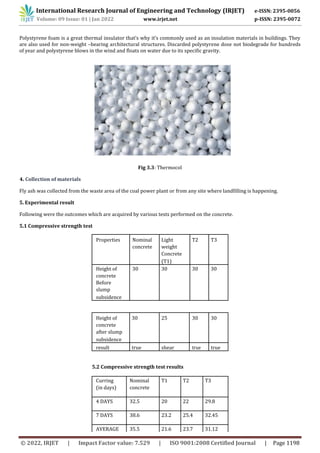
Thermocol (polystyrene) :-
Polystyrene commonly known as thermocol is a monomer synthetic hydrocarbon which is made up of polymer known as
“styrene”. Thermocol can be solid or foamed. General purpose of thermocol is clear, hard, brittle. It is an expansive resin
per unit weight the density of thermocol is 0.96 to 1.05 g/cm3
International Research Journal of Engineering and Technology (IRJET) e-ISSN: 2395-0056
Volume: 09 Issue: 01 | Jan 2022 www.irjet.net p-ISSN: 2395-0072
© 2022, IRJET | Impact Factor value: 7.529 | ISO 9001:2008 Certified Journal | Page 1198
Polystyrene foam is a great thermal insulator that’s why it’s commonly used as an insulation materials in buildings. They
are also used for non-weight –bearing architectural structures. Discarded polystyrene dose not biodegrade for hundreds
of year and polystyrene blows in the wind and floats on water due to its specific gravity.
Fig 3.3: Thermocol
4. Collection of materials
Fly ash was collected from the waste area of the coal power plant or from any site where landfilling is happening.
5. Experimental result
Following were the outcomes which are acquired by various tests performed on the concrete.
5.1 Compressive strength test
Properties Nominal Light T2 T3
concrete weight
Concrete
(T1)
Height of 30 30 30 30
concrete
Before
slump
subsidence
Height of 30 25 30 30
concrete
after slump
subsidence
result true shear true true
5.2 Compressive strength test results
Curring Nominal T1 T2 T3
(in days) concrete
4 DAYS 32.5 20 22 29.8
7 DAYS 38.6 23.2 25.4 32.45
AVERAGE 35.5 21.6 23.7 31.12
International Research Journal of Engineering and Technology (IRJET) e-ISSN: 2395-0056
Volume: 09 Issue: 01 | Jan 2022 www.irjet.net p-ISSN: 2395-0072
© 2022, IRJET | Impact Factor value: 7.529 | ISO 9001:2008 Certified Journal | Page 1199
Fig 5.1: Compressive strength test
6. CONCLUSIONS :
As we have conducted different types of tests on lightweight concrete we found various results. By conducting
compressive strength test on concrete cubes we found that compressive strength is slightly improved by partially
replacing the cement with fly ash and combine aggregate with thermocol. In this whole process we are trying to increase
the strength of concrete and for that we are using mix aggregate cement of fly ash. Lightweight concrete is used as the
partition wall since it has comparatively less in weight then nominal concrete. The same manner the compressive strength
of concrete is increased compared to nominal mix and partition replacement of 35% fly ash and 0.2% of thermocol. The
working ability of concrete in terms of slump cone and compaction factor shows that compaction factor changes slightly
by increasing the quantity of fly ash. Thermocol replacement and slump cone also changes with the percentage increases
in the replacement fly ash, thermocol content and the value of normal range of concrete is falls. After 3 days of curing
period it is noticed that the strength of concrete after partial replacement of fly ash and thermocol in increased when
compared to the normal compressive strength of concrete.
The aim of our project was to replace the normal aggregate to Thermocol and Fly Ash to achieve a lightweight concrete. As
we know the normal aggregate we use , comes from natural resources and in the current scenario we know that the
natural resources are reducing day by day . So, by replacing it with fly ash and thermocol can be a economic and
environment friendly solution of disposal problem of fly ash. And it also helps to achieve the lightweight concrete.
REFERENCES
[1] Banthia, N. and Trottier, J. (1994)
[2] Compione, G., La Mendola L. and Miraglia, Nov. 1999, 1- 17-26
[3] T. Parnhizkar (2012)
[4] H. Al-Khaiat and M.N. Haque
[5] P.C.Taylor (2008)
BIOGRAPHIES :
Rajan Kumar singh
Assistant professor
Dept. of civil Engineering
Raipur
International Research Journal of Engineering and Technology (IRJET) e-ISSN: 2395-0056
Volume: 09 Issue: 01 | Jan 2022 www.irjet.net p-ISSN: 2395-0072
© 2022, IRJET | Impact Factor value: 7.529 | ISO 9001:2008 Certified Journal | Page 1200
Chanchal verma
Roll no: 303302018055
Santoshi Nagar (Raipur)
Shraddha chakradhari
Roll no: 303302018065
Kailashpuri (Raipur)
Ambika watti
Roll no: 303302016004
Kanker(Chattisgarh)

Lightweight Concrete by using Thermocol and Fly Ash

  • 1.
    International Research Journalof Engineering and Technology (IRJET) e-ISSN: 2395-0056 Volume: 09 Issue: 01 | Jan 2022 www.irjet.net p-ISSN: 2395-0072 © 2022, IRJET | Impact Factor value: 7.529 | ISO 9001:2008 Certified Journal | Page 1195 Lightweight Concrete by using Thermocol and Fly Ash Chanchal Verma1, Shraddha Chakradhari2, Ambika Watti3, Rajan Kumar Singh4 1UG Student, SSIPMT, Raipur, Chhattisgarh, India 2UG Student, SSIPMT, Raipur, Chhattisgarh, India 3UG Student, SSIPMT, Raipur, Chhattisgarh, India 4Assistant Professor, Dept. of civil Engineering, SSIPMT, Raipur, Chhattisgarh, India ---------------------------------------------------------------------***---------------------------------------------------------------------- Abstract - This research paper represents the experimental study on use of Thermocol and Fly Ash as an aggregate in concrete to make it lighter , economical and environment friendly compare to normal concrete In present construction scenario concrete plays a major roll in all kind of structure construction. where the use of Lightweight Concrete is expanding it’s uses. concrete is basically a mixture of aggregate ,cement ,sand and water or type of admixture which depends on the working situation and desired results. So using lightweight concrete instead of normal concrete can play a very phenomenal role by decreasing the density and increasing the thermal insulation. And using fly ash, mix aggregate and thermocol instead of sand can be a good alternative for both economical and environmental point of view and it also makes the concrete mixture lightweight as well. As Our project is mainly focused on the investigation of the characteristics of the M20 grade of concrete in which cement is partially get replaced with fly ash 30% ,40% and mix aggregate replace with thermocol 0.25%,0.3%respectively . And the results shows that it is possible to produce lightweight concrete with low to medium strength by addition of thermocol and Fly Ash as aggregates instead of natural aggregate. Key Words: Fine aggregate, Fly ash, Thermocol, cement. 1.INTRODUCTION: Growing need of electricity in our country were 70% of electricity is generated by thermal power plants. it has become a burden on the energy production industries to find a environmentally sustainable solution for the disposal of fly ash. Which results some serious negative impact on the environment as well. So, by using it it in a manner where it will be not harmful for environment, can be a great way of disposal. By using thermocol and fly ash instead of normal aggregate will help to give this lightweight concrete its most important characteristic low density, Light weight, low thermal conductivity. Light weight concrete is an astonishing human invention which we use in several field of construction altogether. The concrete basically have three type and they are also sub-divided on the basis of their weight or the weight of concrete. The composition are as follow . Heavy - 3200 kg/m to 4000 kg/m Normal - 2400kg/m to 2600kg/m Light - 2000kg/m Lightweight concrete is not a new terminology it has been coming in use since 18th century by the Roman people. It can be a great material for making paration walls because of it’s lightweight property. Nowdays were the technology is expanding, light weight concrete also expands it’s uses. 1.1 Literature Review In the present scenario , several type of buildings are being constructed and the most important element for constructing any architecture from ordinary residential building to skyscrap structures is concrete, because of its physical properties such as durability, resistance to fire, simple to use etc. And due to it’s high demand . But the increasing quantity of sand can become a serious issue posing environmental degradation. To avoid this problem and to stop it from becoming a crisis. Lightweight concrete can be a great alternative of Normal concrete. Lightweight concrete is a mixture. Witch is made up of lightweight coarse aggregate such as shale, fly ash, clay, or thermocol, Were fly ash is also an industrial waste and due to its small size and light weight it has ability to get airborne and pollute the air and environment. Because of 1. Yasar et.al. - This experiment had various different parts such as he executed a research on the design of structural lightweight concrete (S.L.W.C) made with basaltic pumice (scoria) as aggregate and fly ash and it was proved that gives an obvious advantage over the scaling down of weight. The characteristics of freshly made concrete including density, and slump and because of these kind of advantageous reasons it is more compressive and more eco friendly as well. 2. H. Al-Khaiat and M.N. Haque - He researched on curing the physical properties and the early strength. And more over lightweight concrete using Lytag lightweight aggregate with a slump of approximately 100 mm, fresh unit weight
  • 2.
    International Research Journalof Engineering and Technology (IRJET) e-ISSN: 2395-0056 Volume: 09 Issue: 01 | Jan 2022 www.irjet.net p-ISSN: 2395-0072 © 2022, IRJET | Impact Factor value: 7.529 | ISO 9001:2008 Certified Journal | Page 1196 of 1800 kg/m3 and twenty eight day cube compressive strength. Further more the test shown that the compressive strengths of structural lightweight concrete looks like to be less sensitive to insuffiency of curing than the normal weight concrete. 3. Khandaker M . Anwar Hossain - he investigated onivolcanicipumice. The test was conducted . After 0% to 25% of cement by aspect of weight and on concrete by replacing 0% to 100% of coarse aggregate by aspect of volume. The VPC properties got differentiate on the base of volcanic pumice aggregate (V.P.A) and different kind of tests were done such as workability, strength, drying shrinkage, surface absorption and water permeability. 4. T. Parhizkar et. al. - Showed experiments on the properties of volcanic pumice lightweight aggregates concretes (L.W.A). At the time of result of the mainly lightweight coarse with natural fine aggregates concrete and lightweight coarse and fine aggregates concrete. The study resulted different kinds of results such as tensile strength and drying shrinkage shown that these lightweight concretes meet the requirements. 5. Banthia, N. and Trottier,J. – Done a study on reinforced concrete made of reinforced steel fibers and this results in an increase in compression strength. 6. Compione, G., et.aI - Recommended that the existence of fiber in the concrete is exceptional and helps to bring down the decay in the field of strains and more over advised that by ordinary confinement of transverse reinforcement the brittle nature can be overcome. 2. Methodology Concrete mix design is the manner of selecting suitable constituents of concrete and determining the relative amount of material with the goal to make an economical and lightweight replacement of normal concrete while holding some of the specified minimum properties such as consistency and durability. There is no such standard method of for proportioning the lightweight concrete like conventional concrete. The properties of lightweight concrete are directly or indirectly related to its density, such as the strength of the lightweight concrete decreases exponentially with the reduction in its density. Sound and thermal insulation is increase with the reduction in density. There are also some other factors like cement filler ratio and foam percentage, which indirect effect s the density of the concrete. So that the density is prime concern for the production of lightweight concrete rather than target mean strength in conventional concrete. Here is a table which provides proportion details of mix for making lightweight concrete. Mix Cemen Fly Polyest San Aggrega Name t Ash er d te Conte Conte beads (in (in kg) nt nt (in kg) kg) (in kg) (in kg) Nomin 2 0 0 3 6 al concret e T1 2 1.530 0.090 3 4.380 T2 2 1.560 0.060 3 4.380 T3 2 1.590 0.060 3 4.380 Fig 2.1: Concreate block made by fly ash and thermocol
  • 3.
    International Research Journalof Engineering and Technology (IRJET) e-ISSN: 2395-0056 Volume: 09 Issue: 01 | Jan 2022 www.irjet.net p-ISSN: 2395-0072 © 2022, IRJET | Impact Factor value: 7.529 | ISO 9001:2008 Certified Journal | Page 1197 Fig 2.2: Mixing of cement, sand and aggregate with water. 3. Material specification Fly ash :- Fly ash is a byproduct from burning coal in electric power generating plants. It is finely separated relic which results from the combustion process of powdered coal which is transported by exhausted gases and it is collected by electrostatic precipitation. The use of fly ash as a mixture of concrete not only enhances the benefits of technology but also contributes to pollution control. fly ash is getting produced about 75 million tons per year, and the major concern is the disposal of fly ash. There’s some certain different ways where the fly ash can be used: First way is to mixing a certain percentage of fly ash with a concrete cement at factory. In second ways it can be used as an admixture at the time of mixing the concrete at the construction site. Fig 3.1: Fly ash Thermocol (polystyrene) :- Polystyrene commonly known as thermocol is a monomer synthetic hydrocarbon which is made up of polymer known as “styrene”. Thermocol can be solid or foamed. General purpose of thermocol is clear, hard, brittle. It is an expansive resin per unit weight the density of thermocol is 0.96 to 1.05 g/cm3
  • 4.
    International Research Journalof Engineering and Technology (IRJET) e-ISSN: 2395-0056 Volume: 09 Issue: 01 | Jan 2022 www.irjet.net p-ISSN: 2395-0072 © 2022, IRJET | Impact Factor value: 7.529 | ISO 9001:2008 Certified Journal | Page 1198 Polystyrene foam is a great thermal insulator that’s why it’s commonly used as an insulation materials in buildings. They are also used for non-weight –bearing architectural structures. Discarded polystyrene dose not biodegrade for hundreds of year and polystyrene blows in the wind and floats on water due to its specific gravity. Fig 3.3: Thermocol 4. Collection of materials Fly ash was collected from the waste area of the coal power plant or from any site where landfilling is happening. 5. Experimental result Following were the outcomes which are acquired by various tests performed on the concrete. 5.1 Compressive strength test Properties Nominal Light T2 T3 concrete weight Concrete (T1) Height of 30 30 30 30 concrete Before slump subsidence Height of 30 25 30 30 concrete after slump subsidence result true shear true true 5.2 Compressive strength test results Curring Nominal T1 T2 T3 (in days) concrete 4 DAYS 32.5 20 22 29.8 7 DAYS 38.6 23.2 25.4 32.45 AVERAGE 35.5 21.6 23.7 31.12
  • 5.
    International Research Journalof Engineering and Technology (IRJET) e-ISSN: 2395-0056 Volume: 09 Issue: 01 | Jan 2022 www.irjet.net p-ISSN: 2395-0072 © 2022, IRJET | Impact Factor value: 7.529 | ISO 9001:2008 Certified Journal | Page 1199 Fig 5.1: Compressive strength test 6. CONCLUSIONS : As we have conducted different types of tests on lightweight concrete we found various results. By conducting compressive strength test on concrete cubes we found that compressive strength is slightly improved by partially replacing the cement with fly ash and combine aggregate with thermocol. In this whole process we are trying to increase the strength of concrete and for that we are using mix aggregate cement of fly ash. Lightweight concrete is used as the partition wall since it has comparatively less in weight then nominal concrete. The same manner the compressive strength of concrete is increased compared to nominal mix and partition replacement of 35% fly ash and 0.2% of thermocol. The working ability of concrete in terms of slump cone and compaction factor shows that compaction factor changes slightly by increasing the quantity of fly ash. Thermocol replacement and slump cone also changes with the percentage increases in the replacement fly ash, thermocol content and the value of normal range of concrete is falls. After 3 days of curing period it is noticed that the strength of concrete after partial replacement of fly ash and thermocol in increased when compared to the normal compressive strength of concrete. The aim of our project was to replace the normal aggregate to Thermocol and Fly Ash to achieve a lightweight concrete. As we know the normal aggregate we use , comes from natural resources and in the current scenario we know that the natural resources are reducing day by day . So, by replacing it with fly ash and thermocol can be a economic and environment friendly solution of disposal problem of fly ash. And it also helps to achieve the lightweight concrete. REFERENCES [1] Banthia, N. and Trottier, J. (1994) [2] Compione, G., La Mendola L. and Miraglia, Nov. 1999, 1- 17-26 [3] T. Parnhizkar (2012) [4] H. Al-Khaiat and M.N. Haque [5] P.C.Taylor (2008) BIOGRAPHIES : Rajan Kumar singh Assistant professor Dept. of civil Engineering Raipur
  • 6.
    International Research Journalof Engineering and Technology (IRJET) e-ISSN: 2395-0056 Volume: 09 Issue: 01 | Jan 2022 www.irjet.net p-ISSN: 2395-0072 © 2022, IRJET | Impact Factor value: 7.529 | ISO 9001:2008 Certified Journal | Page 1200 Chanchal verma Roll no: 303302018055 Santoshi Nagar (Raipur) Shraddha chakradhari Roll no: 303302018065 Kailashpuri (Raipur) Ambika watti Roll no: 303302016004 Kanker(Chattisgarh)