

Copyright 2010, Aviagen, all rights reserved.
KAREN SCHWEAN-LARDNER - Born and raised in Saskatchewan, Canada, Karen completed
her Master of Science work at the University of Saskatchewan, where she helped design, build
and test for welfare and productivity, an early stage of the furnished cage for laying hens. Since
finishing her master’s degree, Karen has been employed by the Poultry Research Unit at the
University of Saskatchewan. Karen is currently the manager of the poultry teaching and research
unit which encompasses a broiler facility, commercial turkey facility, laying hen unit and a small
hatchery. She is completing her doctorate in poultry welfare and management, working on
the effects of darkness exposure on the welfare and productivity of commercial broilers. Karen’s
interests are in poultry welfare, behavior and management systems.
DR. HANK CLASSEN - Hank Classen was born and raised in rural Saskatchewan, Canada. He
received his undergraduate degree at the University of Saskatchewan and then completed master’s
and doctorate degrees at the University of Massachusetts in the United States. After a brief stay
on faculty at The Pennsylvania State University, he returned to the Department of Animal and
Poultry Science at the University of Saskatchewan where he is currently professor and department
head.
Dr. Classen’s teaching and research responsibilities are primarily in the areas of poultry nutrition
and management. His nutritional research has focused on feed ingredients and feeding programs
for broilers and laying hens. Management research has emphasized animal welfare issues including
the impact of light (broilers), beak trimming (laying hens), nutritional manipulation of behavior
(laying hens, broiler breeders) and transportation (broilers).
As a result of his research and interaction with the industry, he has received the Award for Distinction in Outreach and
Engagement (2008), the designation as Fellow of the Poultry Science Association (2007), the Award of Innovation (2004), the
Alberta Poultry Serviceman of the Year (1994) and the American Feed Industry Association Nutrition Research Award (1993).
Dr. Classen has served as president of the World’s Poultry Science Association - Canada Branch and the Poultry Science
Association as well as serving as a director for both organizations.
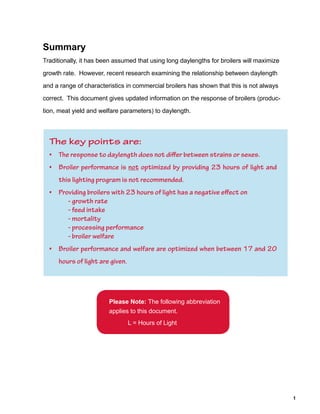
The key points are:
• The response to daylength does not differ between strains or sexes.
• Broiler performance is not optimized by providing 23 hours of light and
this lighting program is not recommended.
• Providing broilers with 23 hours of light has a negative effect on
- growth rate
- feed intake
- mortality
- processing performance
- broiler welfare
• Broiler performance and welfare are optimized when between 17 and 20
hours of light are given.
Key points:
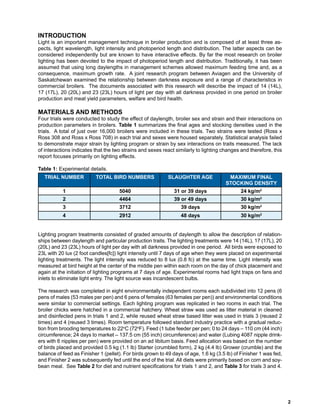
• Four trials were conducted to determine the effect of daylength, broiler sex and strain
on production parameters in broilers.
• Two strains were tested (Ross 308 and Ross 708) and sexes were housed separately.
• The lighting treatments were 14 hours of light, 17 hours of light, 20 hours of light and
23 hours of light per day, with all darkness provided in one period.
• All birds received 23 hours of light at 20 lux for the first 7 days.
• Diets were primarily a corn/soybean meal mix. The Starter was crumbled, the Grower
was a crumble and the Finisher was pellets.
• Body weights and feed intake were recorded at 0, 7, 31/32, 38/39 and 48/49 days of
age.
• FCR (feed:gain) was calculated with and without correction for mortality.
• Meat yield evaluation was completed at the University of Saskatchewan after the birds
had been slaughtered at a commercial processing plant.
• There was no difference in the way the two strains or the sexes responded to lighting.
The focus of this report is the influence of lighting on ‘average’ broiler performance.
Key points:
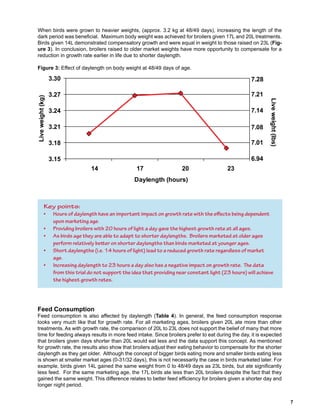
• Hours of daylength have an important impact on growth rate with the effects being dependent
upon marketing age.
• Providing broilers with 20 hours of light a day gave the highest growth rate at all ages.
• As birds age they are able to adapt to shorter daylengths. Broilers marketed at older ages
perform relatively better on shorter daylengths than birds marketed at younger ages.
• Short daylengths (i.e. 14 hours of light) lead to a reduced growth rate regardless of market
age.
• Increasing daylength to 23 hours a day also has a negative impact on growth rate. The data
from this trial do not support the idea that providing near constant light (23 hours) will achieve
the highest growth rates.
Key points:
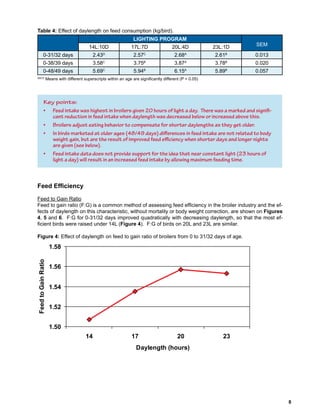
• Feed intake was highest in broilers given 20 hours of light a day. There was a marked and signifi-
cant reduction in feed intake when daylength was decreased below or increased above this.
• Broilers adjust eating behavior to compensate for shorter daylengths as they get older.
• In birds marketed at older ages (48/49 days) differences in feed intake are not related to body
weight gain, but are the result of improved feed efficiency when shorter days and longer nights
are given (see below).
• Feed intake data does not provide support for the idea that near constant light (23 hours of
light a day) will result in an increased feed intake by allowing maximum feeding time.
Key points:
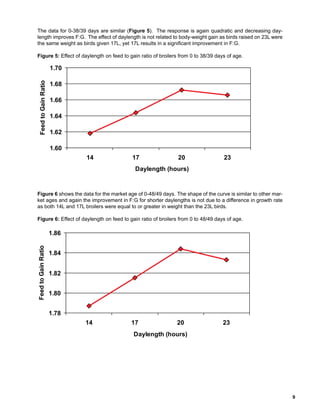
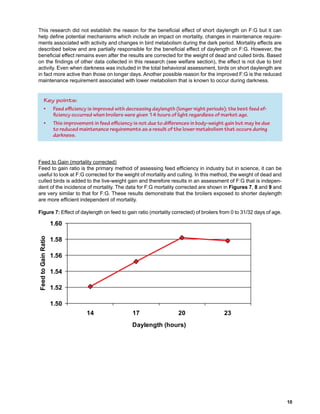
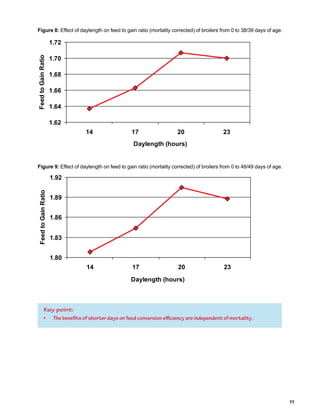
• Feed efficiency is improved with decreasing daylength (longer night periods); the best feed ef-
ficiency occurred when broilers were given 14 hours of light regardless of market age.
• This improvement in feed efficiency is not due to differences in body-weight gain but may be due
to reduced maintenance requirements as a result of the lower metabolism that occurs during
darkness.
Key point:
• The benefits of shorter days on feed conversion efficiency are independent of mortality .
Key points:
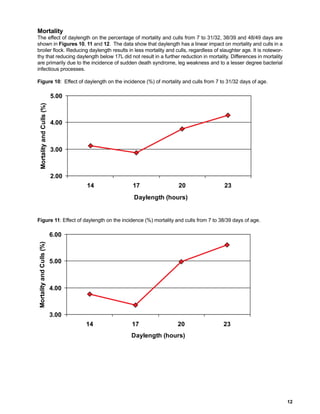
• Reducing daylength results in less mortality regardless of slaughter age.
• However, there are no further benefits to mortality of reducing daylength to less than 17 hours
of light.
Key points:
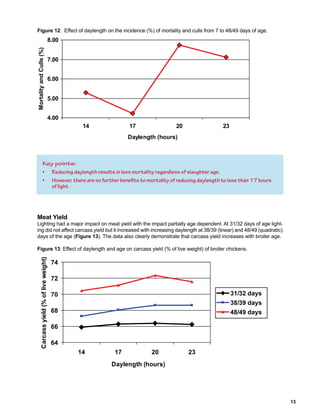
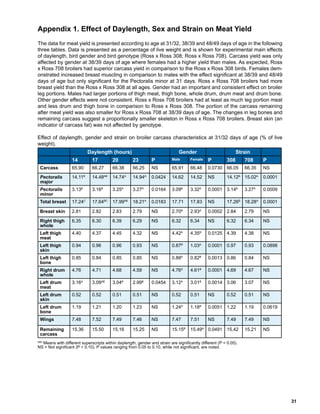
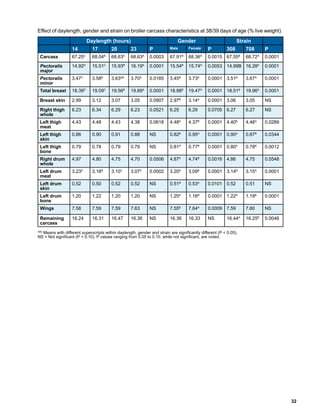
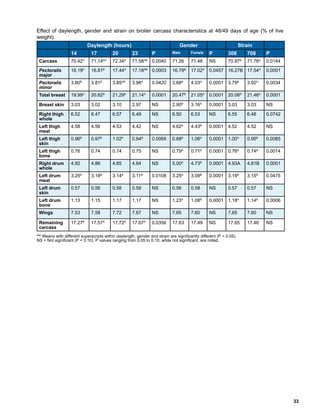
• Carcass yield was not affected by daylength in broilers marketed early (31/32 days). At older
marketing ages (38/39 and 48/49 days) carcass yield was found to increase with increasing
daylength.
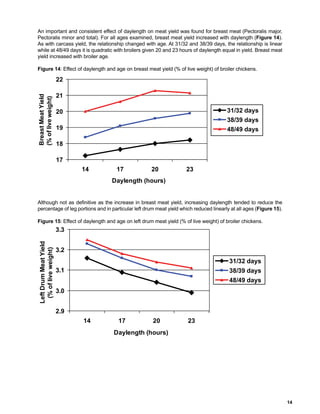
• Breast yield was increased with daylength. But in older birds (those marketed at 48/49 days)
there was no benefit of increasing daylength beyond 20 hours of light.
• Increasing daylength led to a linear reduction in drum meat yield.
• Daylength did not affect carcass fat content.
Key points:
• Response to daylength will not differ between strains or sexes.
• Growth and feed intake are maximized at 20 hours of light.
• Birds marketed at older ages (48/49 days) are able to adapt to shorter daylengths and
daylength can be reduced to 17 hours of light with no effect on the growth rate of these broilers.
• In birds slaughtered at younger ages (31/32 days) shorter daylengths (below 20 hours of light)
will have a clear negative impact on growth rate and feed intake.
• Feed efficiency is improved with shorter daylengths.
• Mortality is improved with shorter daylengths but there is no benefit in reducing daylength
beyond 17 hours of light.
• Longer daylengths have a positive effect on meat yield.
• Ultimately, it is difficult to recommend one lighting program for all broiler production situations
but the data from this trial shows that:
o broiler performance is likely to be optimized at a daylength of between 17 and 20 hours
of light.
o broiler performance is not optimized by providing 23 hours of light and this lighting
program is not recommended as it has a negative effect on growth rate, feed intake,
mortality and processing performance.
• When considering lighting programs the following need to be taken into account:
o market (whole carcass, cut up, etc.).
o age at slaughter.
o cost of feed and impact of daylength on feed efficiency.
o feed intake and the negative effect of limited feeder space or high stocking densities will
be compounded by a short daylength.
o feed type - low density/mash feeds require increased feeding time and short daylengths
will inhibit this and may reduce feed intake.
Key points:
• It is important to understand the effects of lighting programs on both production and welfare if
broiler management is to be optimized.
• The aim of this part of the research was to help establish the effect of daylength on broiler wel-
fare using a variety of welfare measurements including production, physiological and behavioral
parameters.
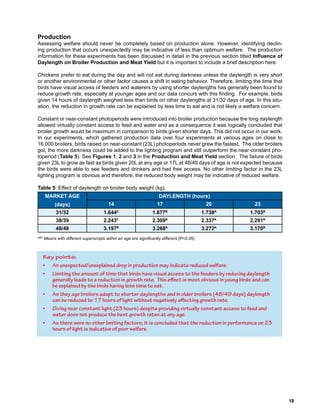
Key points:
• An unexpected/unexplained drop in production may indicate reduced welfare.
• Limiting the amount of time that birds have visual access to the feeders by reducing daylength
generally leads to a reduction in growth rate. This effect is most obvious in young birds and can
be explained by the birds having less time to eat.
• As they age broilers adapt to shorter daylengths and in older broilers (48/49 days) daylength
can be reduced to 17 hours of light without negatively affecting growth rate.
• Giving near constant light (23 hours) despite providing virtually constant access to feed and
water does not produce the best growth rates at any age.
• As there were no other limiting factors, it is concluded that the reduction in performance on 23
hours of light is indicative of poor welfare.
Key points:
• Morality increased with increasing daylength regardless of target weight or marketing age, indi-
cating a negative impact of long days on bird welfare.
• Birds that grew the fastest were not those with the highest mortality.
Key points:
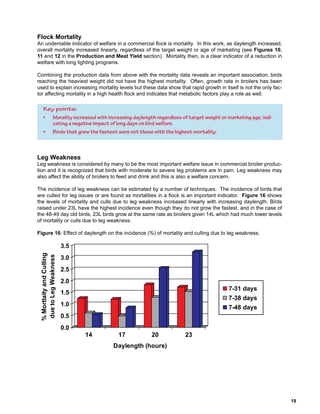
• Mortality and culls due to leg weakness are increased with increasing daylength.
• Broilers given 23 hours of light had the highest incidence of leg weakness despite not having the
fastest growth rate.
• Broilers given 23 hours of light also had a higher incidence of leg weakness compared to birds
given a shorter daylength but with the same growth rate.
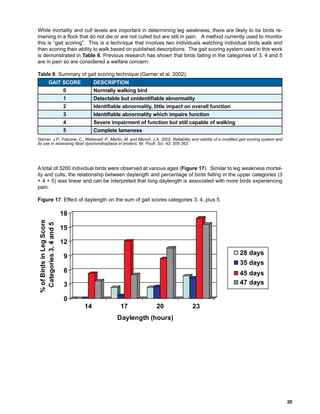
• Leg scoring data (scoring birds on a scale of 0 to 5, where birds with scores of 3, 4 or 5 are
considered to be in pain) showed that the number of birds considered to be in pain increased with
increasing daylength.
Key points:
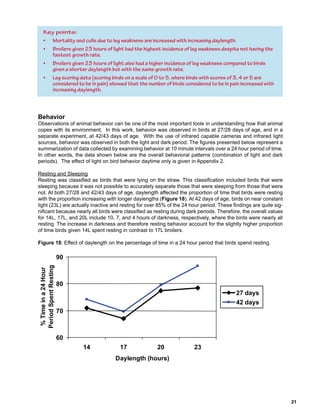
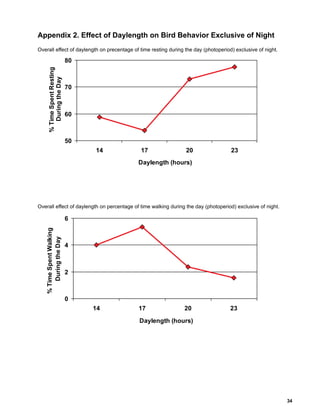
• Time spent resting and sleeping increased with increasing daylength.
• Broilers given 23 hours of light a day spent a significant amount of time being inactive.
Key points:
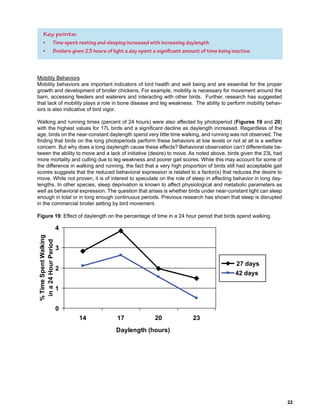
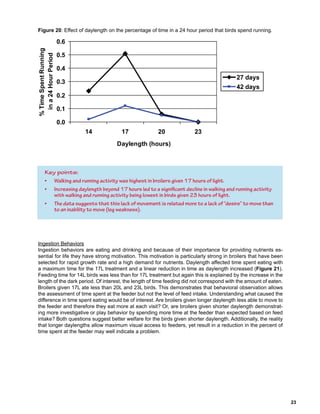
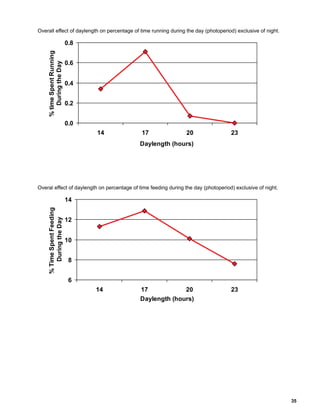
• Walking and running activity was highest in broilers given 17 hours of light.
• Increasing daylength beyond 17 hours led to a significant decline in walking and running activity
with walking and running activity being lowest in birds given 23 hours of light.
• The data suggests that this lack of movement is related more to a lack of “desire” to move than
to an inability to move (leg weakness).
Key points:
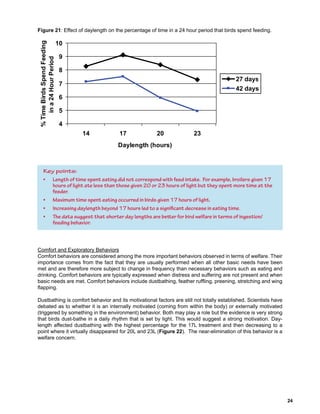
• Length of time spent eating did not correspond with feed intake. For example, broilers given 17
hours of light ate less than those given 20 or 23 hours of light but they spent more time at the
feeder.
• Maximum time spent eating occurred in birds given 17 hours of light.
• Increasing daylength beyond 17 hours led to a significant decrease in eating time.
• The data suggest that shorter day lengths are better for bird welfare in terms of ingestion/
feeding behavior.
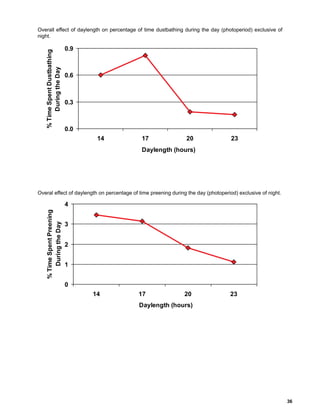
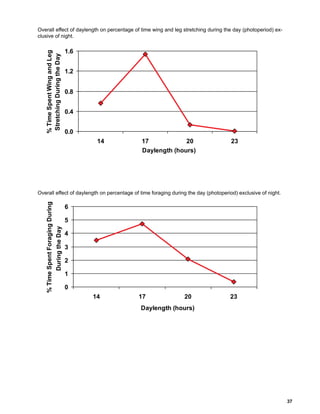
Key points:
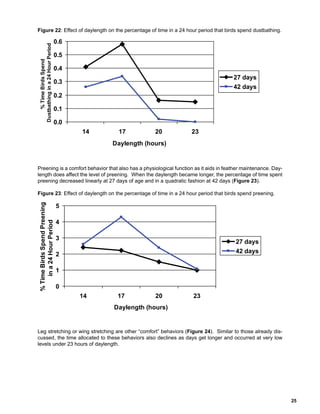
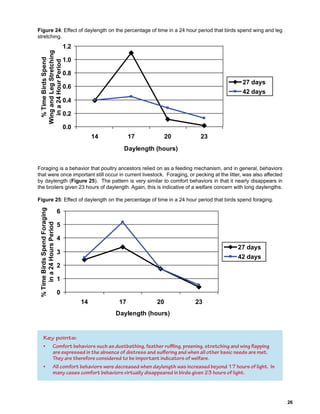
• Comfort behaviors such as dustbathing, feather ruffling, preening, stretching and wing flapping
are expressed in the absence of distress and suffering and when all other basic needs are met.
They are therefore considered to be important indicators of welfare.
• All comfort behaviors were decreased when daylength was increased beyond 17 hours of light. In
many cases comfort behaviors virtually disappeared in birds given 23 hours of light.
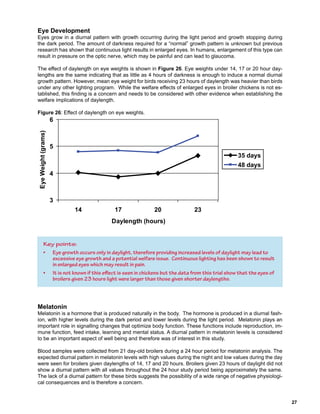
Key points:
• Eye growth occurs only in daylight, therefore providing increased levels of daylight may lead to
excessive eye growth and a potential welfare issue. Continuous lighting has been shown to result
in enlarged eyes which may result in pain.
• It is not known if this effect is seen in chickens but the data from this trial show that the eyes of
broilers given 23 hours light were larger than those given shorter daylengths.
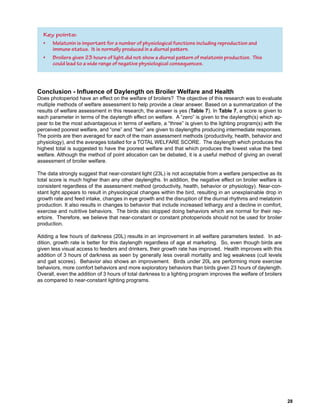
Key points:
• Melatonin is important for a number of physiological functions including reproduction and
immune status. It is normally produced in a diurnal pattern.
• Broilers given 23 hours of light did not show a diurnal pattern of melatonin production. This
could lead to a wide range of negative physiological consequences.
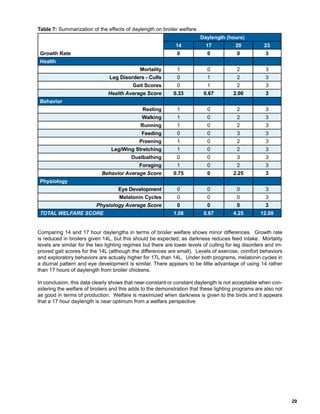
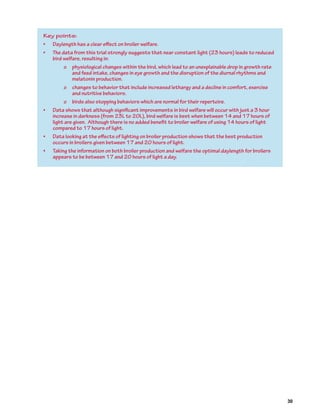
Key points:
• Daylength has a clear effect on broiler welfare.
• The data from this trial strongly suggests that near constant light (23 hours) leads to reduced
bird welfare, resulting in:
o physiological changes within the bird, which lead to an unexplainable drop in growth rate
and feed intake, changes in eye growth and the disruption of the diurnal rhythms and
melatonin production.
o changes to behavior that include increased lethargy and a decline in comfort, exercise
and nutritive behaviors.
o birds also stopping behaviors which are normal for their repertoire.
• Data shows that although significant improvements in bird welfare will occur with just a 3 hour
increase in darkness (from 23L to 20L), bird welfare is best when between 14 and 17 hours of
light are given. Although there is no added benefit to broiler welfare of using 14 hours of light
compared to 17 hours of light.
• Data looking at the effects of lighting on broiler production shows that the best production
occurs in broilers given between 17 and 20 hours of light.
• Taking the information on both broiler production and welfare the optimal daylength for broilers
appears to be between 17 and 20 hours of light a day.
Lighting for broilers

Lighting for broilers

  • 1.
    Copyright 2010, Aviagen,all rights reserved.
  • 2.
    KAREN SCHWEAN-LARDNER -Born and raised in Saskatchewan, Canada, Karen completed her Master of Science work at the University of Saskatchewan, where she helped design, build and test for welfare and productivity, an early stage of the furnished cage for laying hens. Since finishing her master’s degree, Karen has been employed by the Poultry Research Unit at the University of Saskatchewan. Karen is currently the manager of the poultry teaching and research unit which encompasses a broiler facility, commercial turkey facility, laying hen unit and a small hatchery. She is completing her doctorate in poultry welfare and management, working on the effects of darkness exposure on the welfare and productivity of commercial broilers. Karen’s interests are in poultry welfare, behavior and management systems. DR. HANK CLASSEN - Hank Classen was born and raised in rural Saskatchewan, Canada. He received his undergraduate degree at the University of Saskatchewan and then completed master’s and doctorate degrees at the University of Massachusetts in the United States. After a brief stay on faculty at The Pennsylvania State University, he returned to the Department of Animal and Poultry Science at the University of Saskatchewan where he is currently professor and department head. Dr. Classen’s teaching and research responsibilities are primarily in the areas of poultry nutrition and management. His nutritional research has focused on feed ingredients and feeding programs for broilers and laying hens. Management research has emphasized animal welfare issues including the impact of light (broilers), beak trimming (laying hens), nutritional manipulation of behavior (laying hens, broiler breeders) and transportation (broilers). As a result of his research and interaction with the industry, he has received the Award for Distinction in Outreach and Engagement (2008), the designation as Fellow of the Poultry Science Association (2007), the Award of Innovation (2004), the Alberta Poultry Serviceman of the Year (1994) and the American Feed Industry Association Nutrition Research Award (1993). Dr. Classen has served as president of the World’s Poultry Science Association - Canada Branch and the Poultry Science Association as well as serving as a director for both organizations.
  • 3.
    The key pointsare: • The response to daylength does not differ between strains or sexes. • Broiler performance is not optimized by providing 23 hours of light and this lighting program is not recommended. • Providing broilers with 23 hours of light has a negative effect on - growth rate - feed intake - mortality - processing performance - broiler welfare • Broiler performance and welfare are optimized when between 17 and 20 hours of light are given.
  • 7.
    Key points: • Fourtrials were conducted to determine the effect of daylength, broiler sex and strain on production parameters in broilers. • Two strains were tested (Ross 308 and Ross 708) and sexes were housed separately. • The lighting treatments were 14 hours of light, 17 hours of light, 20 hours of light and 23 hours of light per day, with all darkness provided in one period. • All birds received 23 hours of light at 20 lux for the first 7 days. • Diets were primarily a corn/soybean meal mix. The Starter was crumbled, the Grower was a crumble and the Finisher was pellets. • Body weights and feed intake were recorded at 0, 7, 31/32, 38/39 and 48/49 days of age. • FCR (feed:gain) was calculated with and without correction for mortality. • Meat yield evaluation was completed at the University of Saskatchewan after the birds had been slaughtered at a commercial processing plant. • There was no difference in the way the two strains or the sexes responded to lighting. The focus of this report is the influence of lighting on ‘average’ broiler performance.
  • 9.
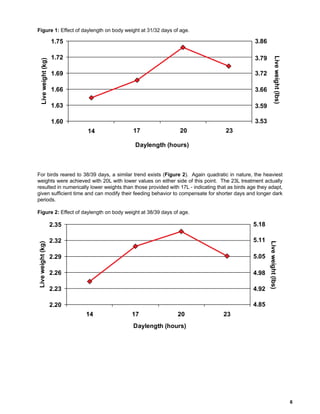
    Key points: • Hoursof daylength have an important impact on growth rate with the effects being dependent upon marketing age. • Providing broilers with 20 hours of light a day gave the highest growth rate at all ages. • As birds age they are able to adapt to shorter daylengths. Broilers marketed at older ages perform relatively better on shorter daylengths than birds marketed at younger ages. • Short daylengths (i.e. 14 hours of light) lead to a reduced growth rate regardless of market age. • Increasing daylength to 23 hours a day also has a negative impact on growth rate. The data from this trial do not support the idea that providing near constant light (23 hours) will achieve the highest growth rates.
  • 10.
    Key points: • Feedintake was highest in broilers given 20 hours of light a day. There was a marked and signifi- cant reduction in feed intake when daylength was decreased below or increased above this. • Broilers adjust eating behavior to compensate for shorter daylengths as they get older. • In birds marketed at older ages (48/49 days) differences in feed intake are not related to body weight gain, but are the result of improved feed efficiency when shorter days and longer nights are given (see below). • Feed intake data does not provide support for the idea that near constant light (23 hours of light a day) will result in an increased feed intake by allowing maximum feeding time.
  • 12.
    Key points: • Feedefficiency is improved with decreasing daylength (longer night periods); the best feed ef- ficiency occurred when broilers were given 14 hours of light regardless of market age. • This improvement in feed efficiency is not due to differences in body-weight gain but may be due to reduced maintenance requirements as a result of the lower metabolism that occurs during darkness.
  • 13.
    Key point: • Thebenefits of shorter days on feed conversion efficiency are independent of mortality .
  • 15.
    Key points: • Reducingdaylength results in less mortality regardless of slaughter age. • However, there are no further benefits to mortality of reducing daylength to less than 17 hours of light.
  • 17.
    Key points: • Carcassyield was not affected by daylength in broilers marketed early (31/32 days). At older marketing ages (38/39 and 48/49 days) carcass yield was found to increase with increasing daylength. • Breast yield was increased with daylength. But in older birds (those marketed at 48/49 days) there was no benefit of increasing daylength beyond 20 hours of light. • Increasing daylength led to a linear reduction in drum meat yield. • Daylength did not affect carcass fat content.
  • 18.
    Key points: • Responseto daylength will not differ between strains or sexes. • Growth and feed intake are maximized at 20 hours of light. • Birds marketed at older ages (48/49 days) are able to adapt to shorter daylengths and daylength can be reduced to 17 hours of light with no effect on the growth rate of these broilers. • In birds slaughtered at younger ages (31/32 days) shorter daylengths (below 20 hours of light) will have a clear negative impact on growth rate and feed intake. • Feed efficiency is improved with shorter daylengths. • Mortality is improved with shorter daylengths but there is no benefit in reducing daylength beyond 17 hours of light. • Longer daylengths have a positive effect on meat yield. • Ultimately, it is difficult to recommend one lighting program for all broiler production situations but the data from this trial shows that: o broiler performance is likely to be optimized at a daylength of between 17 and 20 hours of light. o broiler performance is not optimized by providing 23 hours of light and this lighting program is not recommended as it has a negative effect on growth rate, feed intake, mortality and processing performance. • When considering lighting programs the following need to be taken into account: o market (whole carcass, cut up, etc.). o age at slaughter. o cost of feed and impact of daylength on feed efficiency. o feed intake and the negative effect of limited feeder space or high stocking densities will be compounded by a short daylength. o feed type - low density/mash feeds require increased feeding time and short daylengths will inhibit this and may reduce feed intake.
  • 19.
    Key points: • Itis important to understand the effects of lighting programs on both production and welfare if broiler management is to be optimized. • The aim of this part of the research was to help establish the effect of daylength on broiler wel- fare using a variety of welfare measurements including production, physiological and behavioral parameters.
  • 20.
    Key points: • Anunexpected/unexplained drop in production may indicate reduced welfare. • Limiting the amount of time that birds have visual access to the feeders by reducing daylength generally leads to a reduction in growth rate. This effect is most obvious in young birds and can be explained by the birds having less time to eat. • As they age broilers adapt to shorter daylengths and in older broilers (48/49 days) daylength can be reduced to 17 hours of light without negatively affecting growth rate. • Giving near constant light (23 hours) despite providing virtually constant access to feed and water does not produce the best growth rates at any age. • As there were no other limiting factors, it is concluded that the reduction in performance on 23 hours of light is indicative of poor welfare.
  • 21.
    Key points: • Moralityincreased with increasing daylength regardless of target weight or marketing age, indi- cating a negative impact of long days on bird welfare. • Birds that grew the fastest were not those with the highest mortality.
  • 23.
    Key points: • Mortalityand culls due to leg weakness are increased with increasing daylength. • Broilers given 23 hours of light had the highest incidence of leg weakness despite not having the fastest growth rate. • Broilers given 23 hours of light also had a higher incidence of leg weakness compared to birds given a shorter daylength but with the same growth rate. • Leg scoring data (scoring birds on a scale of 0 to 5, where birds with scores of 3, 4 or 5 are considered to be in pain) showed that the number of birds considered to be in pain increased with increasing daylength.
  • 24.
    Key points: • Timespent resting and sleeping increased with increasing daylength. • Broilers given 23 hours of light a day spent a significant amount of time being inactive.
  • 25.
    Key points: • Walkingand running activity was highest in broilers given 17 hours of light. • Increasing daylength beyond 17 hours led to a significant decline in walking and running activity with walking and running activity being lowest in birds given 23 hours of light. • The data suggests that this lack of movement is related more to a lack of “desire” to move than to an inability to move (leg weakness).
  • 26.
    Key points: • Lengthof time spent eating did not correspond with feed intake. For example, broilers given 17 hours of light ate less than those given 20 or 23 hours of light but they spent more time at the feeder. • Maximum time spent eating occurred in birds given 17 hours of light. • Increasing daylength beyond 17 hours led to a significant decrease in eating time. • The data suggest that shorter day lengths are better for bird welfare in terms of ingestion/ feeding behavior.
  • 28.
    Key points: • Comfortbehaviors such as dustbathing, feather ruffling, preening, stretching and wing flapping are expressed in the absence of distress and suffering and when all other basic needs are met. They are therefore considered to be important indicators of welfare. • All comfort behaviors were decreased when daylength was increased beyond 17 hours of light. In many cases comfort behaviors virtually disappeared in birds given 23 hours of light.
  • 29.
    Key points: • Eyegrowth occurs only in daylight, therefore providing increased levels of daylight may lead to excessive eye growth and a potential welfare issue. Continuous lighting has been shown to result in enlarged eyes which may result in pain. • It is not known if this effect is seen in chickens but the data from this trial show that the eyes of broilers given 23 hours light were larger than those given shorter daylengths.
  • 30.
    Key points: • Melatoninis important for a number of physiological functions including reproduction and immune status. It is normally produced in a diurnal pattern. • Broilers given 23 hours of light did not show a diurnal pattern of melatonin production. This could lead to a wide range of negative physiological consequences.
  • 32.
    Key points: • Daylengthhas a clear effect on broiler welfare. • The data from this trial strongly suggests that near constant light (23 hours) leads to reduced bird welfare, resulting in: o physiological changes within the bird, which lead to an unexplainable drop in growth rate and feed intake, changes in eye growth and the disruption of the diurnal rhythms and melatonin production. o changes to behavior that include increased lethargy and a decline in comfort, exercise and nutritive behaviors. o birds also stopping behaviors which are normal for their repertoire. • Data shows that although significant improvements in bird welfare will occur with just a 3 hour increase in darkness (from 23L to 20L), bird welfare is best when between 14 and 17 hours of light are given. Although there is no added benefit to broiler welfare of using 14 hours of light compared to 17 hours of light. • Data looking at the effects of lighting on broiler production shows that the best production occurs in broilers given between 17 and 20 hours of light. • Taking the information on both broiler production and welfare the optimal daylength for broilers appears to be between 17 and 20 hours of light a day.