Basic Electronics
Group Members
Names Roll Numbers
Mohsin Ijaz (Group Head) 110
Haziq Naeem 107
Hassan Riaz Khan 86
Muhammad Zohaib 136
Muhammad Adeel 83
Muhammad Naveed 120
Muhammad Ihsan 90
Class: BSCS-1C
Subject Teacher: Prof. Najaf
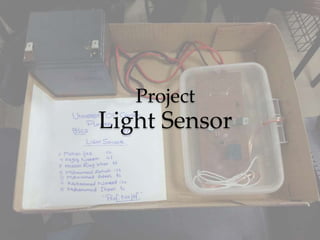
Project
Light Sensor
Introduction
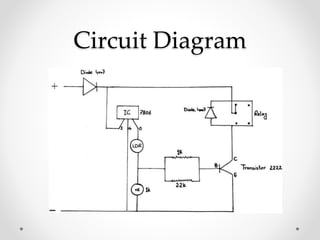
Light sensor is a simple powerful concept. It
automatically switches ON lights when the sunlight
goes below the visible region of our eyes and
automatically switches OFF lights when Sunlight fall on
it (in morning), by using a sensor called LDR (Light
Dependent Resistor) which senses the light just like our
eyes.
Circuit Diagram
Components
• Light Dependent Resistor (LDR)
• Integrated Circuit (IC)
• Variable Resistor
• Resistance
• Transistor
• Diode
• Relay
Light Dependent Resistor
(LDR)
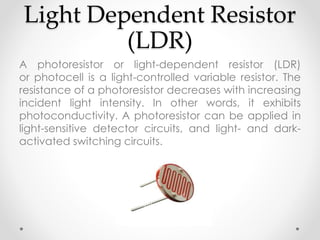
A photoresistor or light-dependent resistor (LDR)
or photocell is a light-controlled variable resistor. The
resistance of a photoresistor decreases with increasing
incident light intensity. In other words, it exhibits
photoconductivity. A photoresistor can be applied in
light-sensitive detector circuits, and light- and dark-
activated switching circuits.
Integrated Circuit (IC)
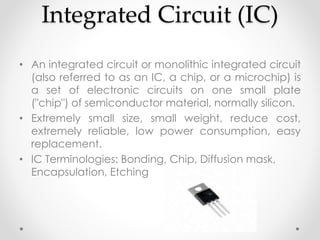
• An integrated circuit or monolithic integrated circuit
(also referred to as an IC, a chip, or a microchip) is
a set of electronic circuits on one small plate
("chip") of semiconductor material, normally silicon.
• Extremely small size, small weight, reduce cost,
extremely reliable, low power consumption, easy
replacement.
• IC Terminologies: Bonding, Chip, Diffusion mask,
Encapsulation, Etching
Variable Resistor
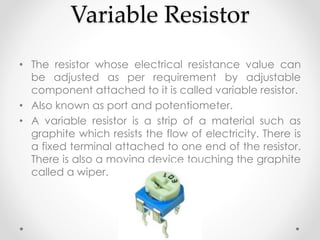
• The resistor whose electrical resistance value can
be adjusted as per requirement by adjustable
component attached to it is called variable resistor.
• Also known as port and potentiometer.
• A variable resistor is a strip of a material such as
graphite which resists the flow of electricity. There is
a fixed terminal attached to one end of the resistor.
There is also a moving device touching the graphite
called a wiper.
Resistance
• Resistance is the opposition that a substance offers
to the flow of electric current.
• The standard unit of resistance is the ohm.
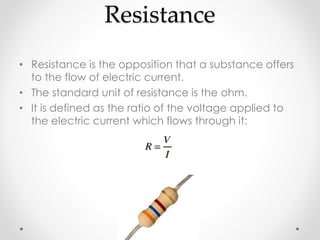
• It is defined as the ratio of the voltage applied to
the electric current which flows through it:
Transistor
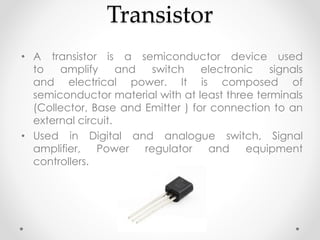
• A transistor is a semiconductor device used
to amplify and switch electronic signals
and electrical power. It is composed of
semiconductor material with at least three terminals
(Collector, Base and Emitter ) for connection to an
external circuit.
• Used in Digital and analogue switch, Signal
amplifier, Power regulator and equipment
controllers.
Diode
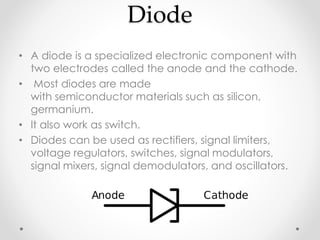
• A diode is a specialized electronic component with
two electrodes called the anode and the cathode.
• Most diodes are made
with semiconductor materials such as silicon,
germanium.
• It also work as switch.
• Diodes can be used as rectifiers, signal limiters,
voltage regulators, switches, signal modulators,
signal mixers, signal demodulators, and oscillators.
Relay
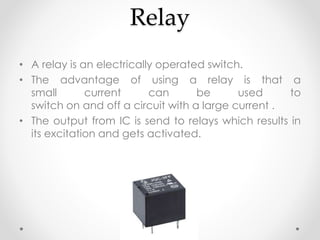
• A relay is an electrically operated switch.
• The advantage of using a relay is that a
small current can be used to
switch on and off a circuit with a large current .
• The output from IC is send to relays which results in
its excitation and gets activated.
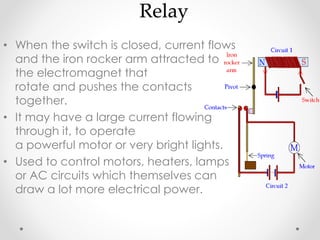
• When the switch is closed, current flows
and the iron rocker arm attracted to
the electromagnet that
rotate and pushes the contacts
together.
• It may have a large current flowing
through it, to operate
a powerful motor or very bright lights.
• Used to control motors, heaters, lamps
or AC circuits which themselves can
draw a lot more electrical power.
Relay
Applications
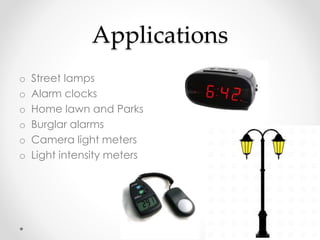
o Street lamps
o Alarm clocks
o Home lawn and Parks
o Burglar alarms
o Camera light meters
o Light intensity meters
Light Sensor (Auto Light on off)

Light Sensor (Auto Light on off)

  • 1.
  • 2.
    Group Members Names RollNumbers Mohsin Ijaz (Group Head) 110 Haziq Naeem 107 Hassan Riaz Khan 86 Muhammad Zohaib 136 Muhammad Adeel 83 Muhammad Naveed 120 Muhammad Ihsan 90 Class: BSCS-1C Subject Teacher: Prof. Najaf
  • 3.
  • 4.
    Introduction Light sensor isa simple powerful concept. It automatically switches ON lights when the sunlight goes below the visible region of our eyes and automatically switches OFF lights when Sunlight fall on it (in morning), by using a sensor called LDR (Light Dependent Resistor) which senses the light just like our eyes.
  • 5.
  • 6.
    Components • Light DependentResistor (LDR) • Integrated Circuit (IC) • Variable Resistor • Resistance • Transistor • Diode • Relay
  • 7.
    Light Dependent Resistor (LDR) Aphotoresistor or light-dependent resistor (LDR) or photocell is a light-controlled variable resistor. The resistance of a photoresistor decreases with increasing incident light intensity. In other words, it exhibits photoconductivity. A photoresistor can be applied in light-sensitive detector circuits, and light- and dark- activated switching circuits.
  • 8.
    Integrated Circuit (IC) •An integrated circuit or monolithic integrated circuit (also referred to as an IC, a chip, or a microchip) is a set of electronic circuits on one small plate ("chip") of semiconductor material, normally silicon. • Extremely small size, small weight, reduce cost, extremely reliable, low power consumption, easy replacement. • IC Terminologies: Bonding, Chip, Diffusion mask, Encapsulation, Etching
  • 9.
    Variable Resistor • Theresistor whose electrical resistance value can be adjusted as per requirement by adjustable component attached to it is called variable resistor. • Also known as port and potentiometer. • A variable resistor is a strip of a material such as graphite which resists the flow of electricity. There is a fixed terminal attached to one end of the resistor. There is also a moving device touching the graphite called a wiper.
  • 10.
    Resistance • Resistance isthe opposition that a substance offers to the flow of electric current. • The standard unit of resistance is the ohm. • It is defined as the ratio of the voltage applied to the electric current which flows through it:
  • 11.
    Transistor • A transistoris a semiconductor device used to amplify and switch electronic signals and electrical power. It is composed of semiconductor material with at least three terminals (Collector, Base and Emitter ) for connection to an external circuit. • Used in Digital and analogue switch, Signal amplifier, Power regulator and equipment controllers.
  • 12.
    Diode • A diodeis a specialized electronic component with two electrodes called the anode and the cathode. • Most diodes are made with semiconductor materials such as silicon, germanium. • It also work as switch. • Diodes can be used as rectifiers, signal limiters, voltage regulators, switches, signal modulators, signal mixers, signal demodulators, and oscillators.
  • 13.
    Relay • A relayis an electrically operated switch. • The advantage of using a relay is that a small current can be used to switch on and off a circuit with a large current . • The output from IC is send to relays which results in its excitation and gets activated.
  • 14.
    • When theswitch is closed, current flows and the iron rocker arm attracted to the electromagnet that rotate and pushes the contacts together. • It may have a large current flowing through it, to operate a powerful motor or very bright lights. • Used to control motors, heaters, lamps or AC circuits which themselves can draw a lot more electrical power. Relay
  • 15.
    Applications o Street lamps oAlarm clocks o Home lawn and Parks o Burglar alarms o Camera light meters o Light intensity meters