
Regulatory Strategy 101 
Mack D. Rubley, PhD 
Vice President, Consulting Services
What is “Strategy” 
TCN Life Science Fast Track 2014 11/18/2014
Agenda 
• Regulatory Pathway to Market Clearance 
– Discuss Strategy of Product Approval 
• Pre-market Plan 
– Present tools - “How to use the FDA databases” 
• Product Classification 
• Product Codes 
• 510(k) Database 
• PMA Database 
• Regulatory Discussions with FDA: Pre-Submission 
TCN Life Science Fast Track 2014 11/18/2014
Regulatory Pathway to Market Clearance
Balance Between Market and Regulatory 
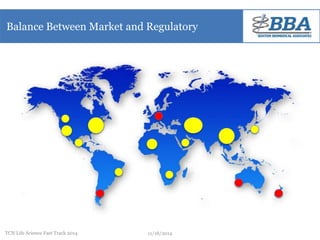
• Considerations 
– Territory 
– Disease prevalence 
– Cost to obtain approval 
– Cost/burden to maintain approval 
– Investor/stockholder expectations 
TCN Life Science Fast Track 2014 11/18/2014
Balance Between Market and Regulatory 
TCN Life Science Fast Track 2014 11/18/2014
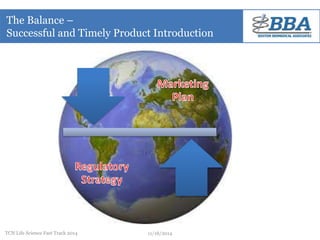
The Balance – 
Successful and Timely Product Introduction 
TCN Life Science Fast Track 2014 11/18/2014
Developing the Plan 
• Market approval regulations 
– Testing requirements 
– Labeling requirements 
• Vigilance requirements 
• Standard reporting requirements 
• Summarize the requirements in a 
document for your regulatory “play 
book” 
TCN Life Science Fast Track 2014 11/18/2014
Pre-Market Regulatory Planning
The Pre-Market Regulatory Planning 
1. Determine product categorization 
• Drug, Device, Biologic or Combination Product 
2. Determine: Device type of submission 
• PMA vs. 510(k) 
3. Develop appropriate submission strategy 
• Pre-submissions? 
• Pre-meetings with regulators? 
4. Consider potential for reimbursement 
TCN Life Science Fast Track 2014 11/18/2014
Step 1: Product Categorization – Medical Device 
A medical device is 
“an instrument, apparatus, implement, machine, contrivance, implant, 
in vitro reagent, or other similar or related article, including a 
component part, or accessory which is: 
– recognized in the official National Formulary, or the United States 
Pharmacopoeia, or any supplement to them, 
– intended for use in the diagnosis of disease or other conditions, or in the 
cure, mitigation, treatment, or prevention of disease, in man or other 
animals, or 
– intended to affect the structure or any function of the body of man or other 
animals, and which does not achieve any of its primary intended 
purposes through chemical action within or on the body of man or other 
animals and which is not dependent upon being metabolized for the 
achievement of any of its primary intended purposes." 
TCN Life Science Fast Track 2014 11/18/2014
Difficult to Determine? 
• Combination products – Request for Determination 
(RFD): Section 513(g) 
• Formal Request for Determination 
– Based on Primary Mode of Action (device, drug or biologic) 
– Establishes the “primary” review division for the product 
– Will likely have a “co-review” by another division 
• Guidance document available: 
– “How to Write a Request for Designation (RFD)” 
TCN Life Science Fast Track 2014 11/18/2014
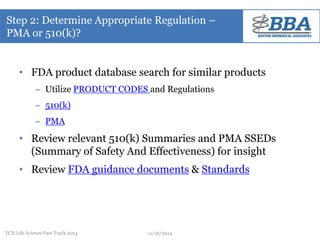
Step 2: Determine Appropriate Regulation – 
PMA or 510(k)? 
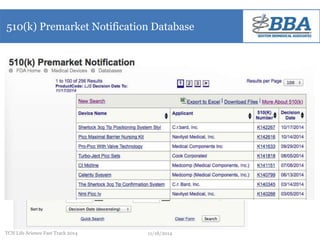
• FDA product database search for similar products 
– Utilize PRODUCT CODES and Regulations 
– 510(k) 
– PMA 
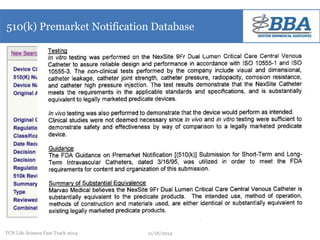
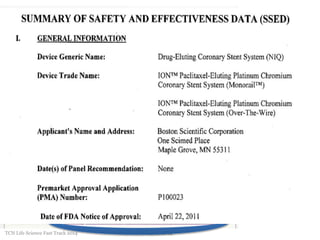
• Review relevant 510(k) Summaries and PMA SSEDs 
(Summary of Safety And Effectiveness) for insight 
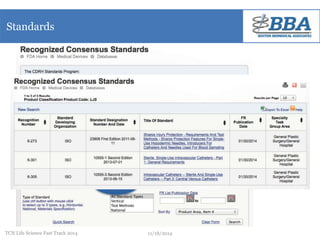
• Review FDA guidance documents & Standards 
TCN Life Science Fast Track 2014 11/18/2014
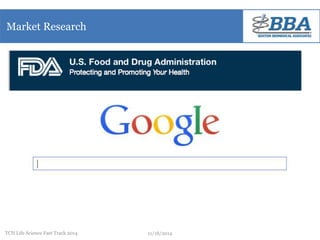
Market Research 
TCN Life Science Fast Track 2014 11/18/2014
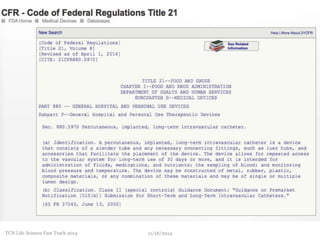
Product Code Classification Database 
TCN Life Science Fast Track 2014 11/18/2014
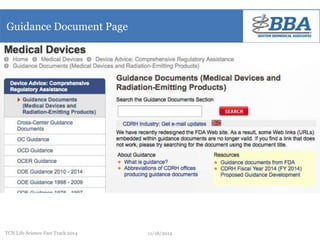
Guidance Document Page 
TCN Life Science Fast Track 2014 11/18/2014
Standards 
TCN Life Science Fast Track 2014 11/18/2014
510(k) Premarket Notification Database 
TCN Life Science Fast Track 2014 11/18/2014
510(k) Premarket Notification Database 
TCN Life Science Fast Track 2014 11/18/2014
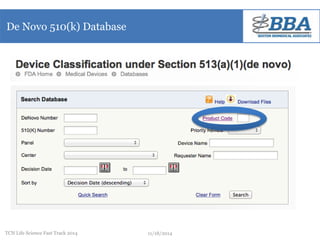
De Novo 510(k) 
• There are two options for de novo classification for novel devices of low to moderate risk. 
• Option 1: Any person who receives an NSE determination in response to a 510(k) submission 
may, within 30 days of receipt of the NSE determination, submit a de novo request for the 
FDA to make a risk-based evaluation for classification of the device into Class I or II. 
• Option 2: Any person who determines that there is no legally marketed device upon which to 
base a determination of substantial equivalence may submit a de novo request for the FDA to 
make a risk-based classification of the device into Class I or II, without first submitting a 
510(k) and receiving an NSE determination. 
• “Is the de novo process right for my product?” If your product is: 
1. a novel device (new intended use) 
2. presents a moderate or low risk profile, and 
3. no predicates exist (with the same intended use) 
• This is conditional on your ability to provide the necessary evidence supporting the safety and 
effectiveness of the device, including the general and/or special controls which would provide 
a reasonable assurance of safety and effectiveness to the FDA. 
TCN Life Science Fast Track 2014 11/18/2014
De Novo 510(k) Database 
TCN Life Science Fast Track 2014 11/18/2014
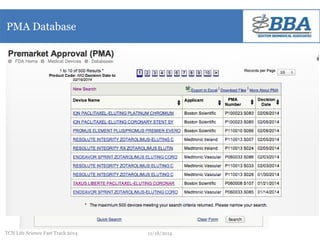
PMA Database 
TCN Life Science Fast Track 2014 11/18/2014
PMA Database 
TCN Life Science Fast Track 2014 11/18/2014
Step 3: Determine Specific Regulatory 
Requirements Review 
• Market Research 
• Product Codes 
• Review FDA applicable guidance and standards 
documents 
• Review relevant 510(k) summaries, and PMA SSEDs 
• Couple the research with engineering expertise to develop 
a plan for engaging with the FDA 
TCN Life Science Fast Track 2014 11/18/2014
Step 4: Reimbursement 
• Evaluate current reimbursement options 
• Currently available codes 
• Considerations for CMS discussions 
– Can coincide with potential FDA discussions 
TCN Life Science Fast Track 2014 11/18/2014
Regulatory Discussions with FDA: 
Pre-Submission
Regulatory Discussions Why? 
• Concern about product definition (drug/device) 
• Outstanding questions on test plan 
• Novel technology introduction 
• Considerations: 
• Non-binding 
• Adds time to the process 
• Pre-IDE submission 
• Schedule of meeting 
• Addressing input from FDA 
TCN Life Science Fast Track 2014 11/18/2014
Regulatory Discussions – When? 
• When there are outstanding questions that are costly 
– Which animal model 
– How many animals are appropriate 
• When there is a novel clinical study design 
– Adaptive trial design 
– Utilizing an Objective Performance Criteria rather than an RCT 
• When there is a challenge to a regulatory pathway 
– Question regarding product as a 510(k) vs. PMA 
TCN Life Science Fast Track 2014 11/18/2014
Regulatory Discussions – How? 
• Contact review division chair 
– Will likely connect you to a reviewer or project manager 
• Prepare a formal Pre-Submission 
– Written document including: 
• Product description 
• Proposed indication 
• Proposed test plan and protocol summary 
• Specific questions requiring FDA input 
TCN Life Science Fast Track 2014 11/18/2014
Logistics 
• Face to Face is ALWAYS best 
• Establish a schedule for the preparation 
• Hotel the evening before 
• Schedule Prep sessions with experts 
TCN Life Science Fast Track 2014 11/18/2014
The Meeting Prep 
• KNOW YOUR DIVISION 
– FDA are people too 
– Engage in science not sales 
– Prepare for negotiation discussions 
– Prepare for challenges from FDA – a good back up slide deck is 
vital 
• Being over prepared will never be a problem 
• Being under prepared can be devastating 
TCN Life Science Fast Track 2014 11/18/2014
The Meeting Plan 
• Develop the key messages 
• Assemble the RIGHT speakers 
• Identify a scribe for minutes 
• Brainstorm the Q and A 
TCN Life Science Fast Track 2014 11/18/2014
The Meeting Approach 
• Approach discussion with confidence 
– You are the EXPERT! 
– “Guidance” from FDA not “Direction” 
• Don’t be caught off guard 
– Know your submission COMPLETELY 
– Research competitive product challenges 
– Understand the literature 
• Pretend you are in the FDA’s shoes 
• What would you worry about? 
TCN Life Science Fast Track 2014 11/18/2014
Ending The Meeting 
• Review and confirm all Action Items 
• Don’t leave the room without clear direction on a path 
forward 
– Always say Thank You 
TCN Life Science Fast Track 2014 11/18/2014
The Meeting – cont’d 
REHEARSE 
REHEARSE 
REHEARSE 
TCN Life Science Fast Track 2014 11/18/2014
SUMMARY 
• Strategy is borne out of experience and a co-operative 
team 
• Research and discussions are key 
• Understand your product and how it fits in the medical 
setting 
TCN Life Science Fast Track 2014 11/18/2014
THANK YOU 
Contact: www.bos TCN Life Science Fast Track 2014 11/18/2014ton-biomedical.com
Boston Biomedical Associates 
www.boston-biomedical.com 
info@boston-biomedical.com 
Mack Rubley PhD 
Vice President, Consulting Services 
mrubley@boston-biomedical.com 
508-691-704 
TCN Life Science Fast Track 2014 11/18/2014

Life Science Fast Track - Regulatory Strategy

  • 1.
    Regulatory Strategy 101 Mack D. Rubley, PhD Vice President, Consulting Services
  • 2.
    What is “Strategy” TCN Life Science Fast Track 2014 11/18/2014
  • 3.
    Agenda • RegulatoryPathway to Market Clearance – Discuss Strategy of Product Approval • Pre-market Plan – Present tools - “How to use the FDA databases” • Product Classification • Product Codes • 510(k) Database • PMA Database • Regulatory Discussions with FDA: Pre-Submission TCN Life Science Fast Track 2014 11/18/2014
  • 4.
    Regulatory Pathway toMarket Clearance
  • 5.
    Balance Between Marketand Regulatory • Considerations – Territory – Disease prevalence – Cost to obtain approval – Cost/burden to maintain approval – Investor/stockholder expectations TCN Life Science Fast Track 2014 11/18/2014
  • 6.
    Balance Between Marketand Regulatory TCN Life Science Fast Track 2014 11/18/2014
  • 7.
    The Balance – Successful and Timely Product Introduction TCN Life Science Fast Track 2014 11/18/2014
  • 8.
    Developing the Plan • Market approval regulations – Testing requirements – Labeling requirements • Vigilance requirements • Standard reporting requirements • Summarize the requirements in a document for your regulatory “play book” TCN Life Science Fast Track 2014 11/18/2014
  • 9.
  • 10.
    The Pre-Market RegulatoryPlanning 1. Determine product categorization • Drug, Device, Biologic or Combination Product 2. Determine: Device type of submission • PMA vs. 510(k) 3. Develop appropriate submission strategy • Pre-submissions? • Pre-meetings with regulators? 4. Consider potential for reimbursement TCN Life Science Fast Track 2014 11/18/2014
  • 11.
    Step 1: ProductCategorization – Medical Device A medical device is “an instrument, apparatus, implement, machine, contrivance, implant, in vitro reagent, or other similar or related article, including a component part, or accessory which is: – recognized in the official National Formulary, or the United States Pharmacopoeia, or any supplement to them, – intended for use in the diagnosis of disease or other conditions, or in the cure, mitigation, treatment, or prevention of disease, in man or other animals, or – intended to affect the structure or any function of the body of man or other animals, and which does not achieve any of its primary intended purposes through chemical action within or on the body of man or other animals and which is not dependent upon being metabolized for the achievement of any of its primary intended purposes." TCN Life Science Fast Track 2014 11/18/2014
  • 12.
    Difficult to Determine? • Combination products – Request for Determination (RFD): Section 513(g) • Formal Request for Determination – Based on Primary Mode of Action (device, drug or biologic) – Establishes the “primary” review division for the product – Will likely have a “co-review” by another division • Guidance document available: – “How to Write a Request for Designation (RFD)” TCN Life Science Fast Track 2014 11/18/2014
  • 13.
    Step 2: DetermineAppropriate Regulation – PMA or 510(k)? • FDA product database search for similar products – Utilize PRODUCT CODES and Regulations – 510(k) – PMA • Review relevant 510(k) Summaries and PMA SSEDs (Summary of Safety And Effectiveness) for insight • Review FDA guidance documents & Standards TCN Life Science Fast Track 2014 11/18/2014
  • 14.
    Market Research TCNLife Science Fast Track 2014 11/18/2014
  • 15.
    Product Code ClassificationDatabase TCN Life Science Fast Track 2014 11/18/2014
  • 16.
    Guidance Document Page TCN Life Science Fast Track 2014 11/18/2014
  • 17.
    Standards TCN LifeScience Fast Track 2014 11/18/2014
  • 18.
    510(k) Premarket NotificationDatabase TCN Life Science Fast Track 2014 11/18/2014
  • 19.
    510(k) Premarket NotificationDatabase TCN Life Science Fast Track 2014 11/18/2014
  • 20.
    De Novo 510(k) • There are two options for de novo classification for novel devices of low to moderate risk. • Option 1: Any person who receives an NSE determination in response to a 510(k) submission may, within 30 days of receipt of the NSE determination, submit a de novo request for the FDA to make a risk-based evaluation for classification of the device into Class I or II. • Option 2: Any person who determines that there is no legally marketed device upon which to base a determination of substantial equivalence may submit a de novo request for the FDA to make a risk-based classification of the device into Class I or II, without first submitting a 510(k) and receiving an NSE determination. • “Is the de novo process right for my product?” If your product is: 1. a novel device (new intended use) 2. presents a moderate or low risk profile, and 3. no predicates exist (with the same intended use) • This is conditional on your ability to provide the necessary evidence supporting the safety and effectiveness of the device, including the general and/or special controls which would provide a reasonable assurance of safety and effectiveness to the FDA. TCN Life Science Fast Track 2014 11/18/2014
  • 21.
    De Novo 510(k)Database TCN Life Science Fast Track 2014 11/18/2014
  • 22.
    PMA Database TCNLife Science Fast Track 2014 11/18/2014
  • 23.
    PMA Database TCNLife Science Fast Track 2014 11/18/2014
  • 24.
    Step 3: DetermineSpecific Regulatory Requirements Review • Market Research • Product Codes • Review FDA applicable guidance and standards documents • Review relevant 510(k) summaries, and PMA SSEDs • Couple the research with engineering expertise to develop a plan for engaging with the FDA TCN Life Science Fast Track 2014 11/18/2014
  • 25.
    Step 4: Reimbursement • Evaluate current reimbursement options • Currently available codes • Considerations for CMS discussions – Can coincide with potential FDA discussions TCN Life Science Fast Track 2014 11/18/2014
  • 26.
    Regulatory Discussions withFDA: Pre-Submission
  • 27.
    Regulatory Discussions Why? • Concern about product definition (drug/device) • Outstanding questions on test plan • Novel technology introduction • Considerations: • Non-binding • Adds time to the process • Pre-IDE submission • Schedule of meeting • Addressing input from FDA TCN Life Science Fast Track 2014 11/18/2014
  • 28.
    Regulatory Discussions –When? • When there are outstanding questions that are costly – Which animal model – How many animals are appropriate • When there is a novel clinical study design – Adaptive trial design – Utilizing an Objective Performance Criteria rather than an RCT • When there is a challenge to a regulatory pathway – Question regarding product as a 510(k) vs. PMA TCN Life Science Fast Track 2014 11/18/2014
  • 29.
    Regulatory Discussions –How? • Contact review division chair – Will likely connect you to a reviewer or project manager • Prepare a formal Pre-Submission – Written document including: • Product description • Proposed indication • Proposed test plan and protocol summary • Specific questions requiring FDA input TCN Life Science Fast Track 2014 11/18/2014
  • 30.
    Logistics • Faceto Face is ALWAYS best • Establish a schedule for the preparation • Hotel the evening before • Schedule Prep sessions with experts TCN Life Science Fast Track 2014 11/18/2014
  • 31.
    The Meeting Prep • KNOW YOUR DIVISION – FDA are people too – Engage in science not sales – Prepare for negotiation discussions – Prepare for challenges from FDA – a good back up slide deck is vital • Being over prepared will never be a problem • Being under prepared can be devastating TCN Life Science Fast Track 2014 11/18/2014
  • 32.
    The Meeting Plan • Develop the key messages • Assemble the RIGHT speakers • Identify a scribe for minutes • Brainstorm the Q and A TCN Life Science Fast Track 2014 11/18/2014
  • 33.
    The Meeting Approach • Approach discussion with confidence – You are the EXPERT! – “Guidance” from FDA not “Direction” • Don’t be caught off guard – Know your submission COMPLETELY – Research competitive product challenges – Understand the literature • Pretend you are in the FDA’s shoes • What would you worry about? TCN Life Science Fast Track 2014 11/18/2014
  • 34.
    Ending The Meeting • Review and confirm all Action Items • Don’t leave the room without clear direction on a path forward – Always say Thank You TCN Life Science Fast Track 2014 11/18/2014
  • 35.
    The Meeting –cont’d REHEARSE REHEARSE REHEARSE TCN Life Science Fast Track 2014 11/18/2014
  • 36.
    SUMMARY • Strategyis borne out of experience and a co-operative team • Research and discussions are key • Understand your product and how it fits in the medical setting TCN Life Science Fast Track 2014 11/18/2014
  • 37.
    THANK YOU Contact:www.bos TCN Life Science Fast Track 2014 11/18/2014ton-biomedical.com
  • 38.
    Boston Biomedical Associates www.boston-biomedical.com info@boston-biomedical.com Mack Rubley PhD Vice President, Consulting Services mrubley@boston-biomedical.com 508-691-704 TCN Life Science Fast Track 2014 11/18/2014