Life Cycle Phases
in Software Project Management
-B BENNY JOSEPH
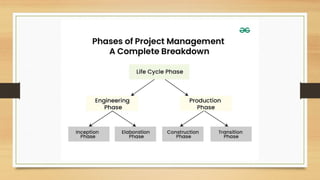
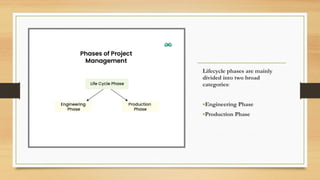
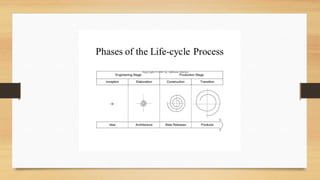
Lifecycle phases are mainly
divided into two broad
categories:
•Engineering Phase
•Production Phase
Engineering Phase:
• The engineering phase involves
establishing the goal and defining the
overall scope of the project.
• The engineering phase involves a
small team size and it is usually less
predicted.
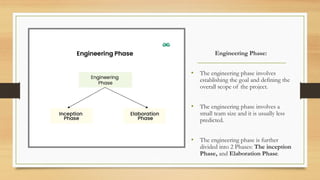
• The engineering phase is further
divided into 2 Phases: The inception
Phase, and Elaboration Phase.
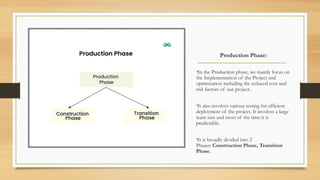
Production Phase:
•In the Production phase, we mainly focus on
the Implementation of the Project and
optimization including the reduced cost and
risk factors of our project.
•It also involves various testing for efficient
deployment of the project. It involves a large
team size and most of the time it is
predictable.
•It is broadly divided into 2
Phases: Construction Phase, Transition
Phase.
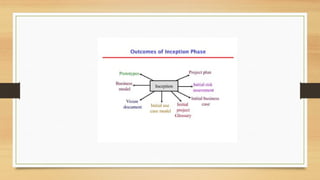
Inception Phase:
• The Inception Phase involves establishing goals and gathering the requirements needed
for the software development.
• It involves cost estimation and identifying the risk factors.
• In the inception phase, we mainly work on the scope of the project and architecture.
• Feasibility analysis is also an important part of the inception phase.
Objectives of the Inception Phase:
Clarifying project goals and objectives:
• Establishing a clear understanding of what the project aims to achieve and the
desired outcomes.
Identifying stakeholders:
• Recognizing all individuals or groups who will be impacted by the project and
their specific needs.
Defining system boundaries:
• Determining what features are included within the project scope and what
functionalities lie outside.
Risk assessment:
• Identifying potential challenges and risks that could affect project
success and developing mitigation strategies.
High-level requirements gathering:
• Capturing initial functional and non-functional requirements for the
system.
Developing a project vision:
• Establishing a clear vision for the final product, including its key
functionalities and user experience.
Preliminary cost and schedule estimation:
• Providing a rough estimate of the project's budget and timeline based
on the initial understanding.
Elaboration Phase
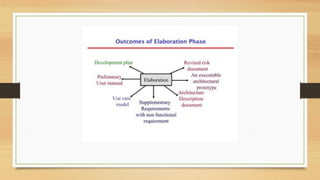
• The elaboration phase involves in-depth evaluation and study as well as establishing
a strong architecture and infrastructure.
• In the elaboration phase, we work on the efficiency of our architecture. In this
phase, we also analyze use cases and other software diagrams.
• We reduce the risk to a certain extent and a preliminary user module is prepared in
this phase
Key aspects of the elaboration phase:
Detailed Requirements Gathering:
• Deepen understanding of system requirements, including functional and non-
functional aspects, to ensure a clear vision of the project.
Architecture Design and Validation:
• Define and refine the system architecture, including key components,
interfaces, and technology choices, and validate its feasibility through
prototyping.
Risk Management:
• Proactively identify and address major technical and project risks by analyzing
potential issues and developing mitigation strategies.
Project Planning:
• Develop a detailed project plan with realistic timelines, resource allocation, and
milestones based on the refined architecture and requirements.
Construction Phase
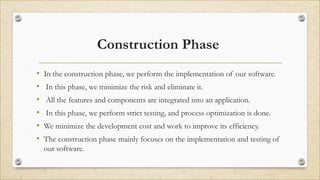
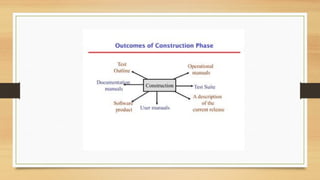
• In the construction phase, we perform the implementation of our software.
• In this phase, we minimize the risk and eliminate it.
• All the features and components are integrated into an application.
• In this phase, we perform strict testing, and process optimization is done.
• We minimize the development cost and work to improve its efficiency.
• The construction phase mainly focuses on the implementation and testing of
our software.
Key aspects of the Construction phase:
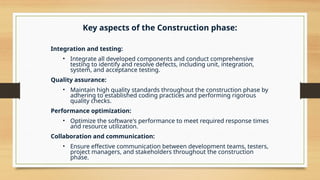
Integration and testing:
• Integrate all developed components and conduct comprehensive
testing to identify and resolve defects, including unit, integration,
system, and acceptance testing.
Quality assurance:
• Maintain high quality standards throughout the construction phase by
adhering to established coding practices and performing rigorous
quality checks.
Performance optimization:
• Optimize the software's performance to meet required response times
and resource utilization.
Collaboration and communication:
• Ensure effective communication between development teams, testers,
project managers, and stakeholders throughout the construction
phase.
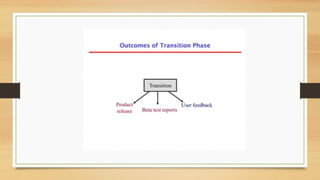
Transition Phase
•In the Transition phase, we perform strict testing mainly beta testing and
deployment of software or project.
•After receiving the feedback from the user, we performed some changes in
our software to make it more efficacious.
•In this phase, the developer works on a project with a user’s view to make the
software more supportable and user-friendly.
Key aspects of the transition phase objectives:
Validation through Beta Testing:
• Conduct thorough beta testing to validate the system against user requirements and
identify any remaining issues before full deployment.
System Documentation:
• Create and finalize all necessary system documentation including user manuals,
technical guides, and operational procedures.
Performance Tuning:
• Optimize system performance based on feedback from beta testing and user
experience.
Deployment Planning:
• Develop a detailed deployment plan outlining the process for transitioning to the live
environment.
Stakeholder Acceptance:
• Gain approval from key stakeholders that the system is ready for production use and
meets acceptance criteria.
THANK YOU

Life Cycle Phases In Software Project Management

  • 1.
    Life Cycle Phases inSoftware Project Management -B BENNY JOSEPH
  • 3.
    Lifecycle phases aremainly divided into two broad categories: •Engineering Phase •Production Phase
  • 4.
    Engineering Phase: • Theengineering phase involves establishing the goal and defining the overall scope of the project. • The engineering phase involves a small team size and it is usually less predicted. • The engineering phase is further divided into 2 Phases: The inception Phase, and Elaboration Phase.
  • 5.
    Production Phase: •In theProduction phase, we mainly focus on the Implementation of the Project and optimization including the reduced cost and risk factors of our project. •It also involves various testing for efficient deployment of the project. It involves a large team size and most of the time it is predictable. •It is broadly divided into 2 Phases: Construction Phase, Transition Phase.
  • 7.
    Inception Phase: • TheInception Phase involves establishing goals and gathering the requirements needed for the software development. • It involves cost estimation and identifying the risk factors. • In the inception phase, we mainly work on the scope of the project and architecture. • Feasibility analysis is also an important part of the inception phase.
  • 8.
    Objectives of theInception Phase: Clarifying project goals and objectives: • Establishing a clear understanding of what the project aims to achieve and the desired outcomes. Identifying stakeholders: • Recognizing all individuals or groups who will be impacted by the project and their specific needs. Defining system boundaries: • Determining what features are included within the project scope and what functionalities lie outside.
  • 9.
    Risk assessment: • Identifyingpotential challenges and risks that could affect project success and developing mitigation strategies. High-level requirements gathering: • Capturing initial functional and non-functional requirements for the system. Developing a project vision: • Establishing a clear vision for the final product, including its key functionalities and user experience. Preliminary cost and schedule estimation: • Providing a rough estimate of the project's budget and timeline based on the initial understanding.
  • 11.
    Elaboration Phase • Theelaboration phase involves in-depth evaluation and study as well as establishing a strong architecture and infrastructure. • In the elaboration phase, we work on the efficiency of our architecture. In this phase, we also analyze use cases and other software diagrams. • We reduce the risk to a certain extent and a preliminary user module is prepared in this phase
  • 12.
    Key aspects ofthe elaboration phase: Detailed Requirements Gathering: • Deepen understanding of system requirements, including functional and non- functional aspects, to ensure a clear vision of the project. Architecture Design and Validation: • Define and refine the system architecture, including key components, interfaces, and technology choices, and validate its feasibility through prototyping. Risk Management: • Proactively identify and address major technical and project risks by analyzing potential issues and developing mitigation strategies. Project Planning: • Develop a detailed project plan with realistic timelines, resource allocation, and milestones based on the refined architecture and requirements.
  • 14.
    Construction Phase • Inthe construction phase, we perform the implementation of our software. • In this phase, we minimize the risk and eliminate it. • All the features and components are integrated into an application. • In this phase, we perform strict testing, and process optimization is done. • We minimize the development cost and work to improve its efficiency. • The construction phase mainly focuses on the implementation and testing of our software.
  • 15.
    Key aspects ofthe Construction phase: Integration and testing: • Integrate all developed components and conduct comprehensive testing to identify and resolve defects, including unit, integration, system, and acceptance testing. Quality assurance: • Maintain high quality standards throughout the construction phase by adhering to established coding practices and performing rigorous quality checks. Performance optimization: • Optimize the software's performance to meet required response times and resource utilization. Collaboration and communication: • Ensure effective communication between development teams, testers, project managers, and stakeholders throughout the construction phase.
  • 17.
    Transition Phase •In theTransition phase, we perform strict testing mainly beta testing and deployment of software or project. •After receiving the feedback from the user, we performed some changes in our software to make it more efficacious. •In this phase, the developer works on a project with a user’s view to make the software more supportable and user-friendly.
  • 18.
    Key aspects ofthe transition phase objectives: Validation through Beta Testing: • Conduct thorough beta testing to validate the system against user requirements and identify any remaining issues before full deployment. System Documentation: • Create and finalize all necessary system documentation including user manuals, technical guides, and operational procedures. Performance Tuning: • Optimize system performance based on feedback from beta testing and user experience. Deployment Planning: • Develop a detailed deployment plan outlining the process for transitioning to the live environment. Stakeholder Acceptance: • Gain approval from key stakeholders that the system is ready for production use and meets acceptance criteria.
  • 20.