Outline
Introduction
TwoOrthogonal view of software.
Software development process models
Software Process
Software life cycle and process models
Object oriented system development methodology.
Why an object oriented
Overview of the unified approach.
An object oriented philosophy
concepts of an object
Attributes of an object, its state and properties.
03/20/2025
BY: MA
2
3.
SOFTWARE ENGINEERING
OVERVIEW
Softwareengineering is about teams. The problems to solve
are so complex or large, that a single developer cannot solve
them anymore.
Software engineering is also about communication. Teams do
not consist only of developers, but also of testers, architects,
system engineers, customer, project managers, etc.
Software projects can be so large that we have to do careful
planning. Implementation is no longer just writing code, but it is
also following guidelines, writing documentation and also
writing unit tests. But unit tests alone are not enough.
a good software engineer, like any engineer, needs tools, and
you need to know about them. 03/20/2025
BY: MA
3
4.
Cont….
The termSoftware Engineering is made of two words, software
and engineering.
Software is defined as a collection of programs, procedures,
rules, data and associated documentation. The software is
developed keeping in mind certain hardware and operating
system consideration commonly known as platform.
Engineering on the other hand, is all about developing products,
using well-defined, scientific principles and methods.
Some of the software characteristics are: Most software is
custom built rather than assembled from existing components,
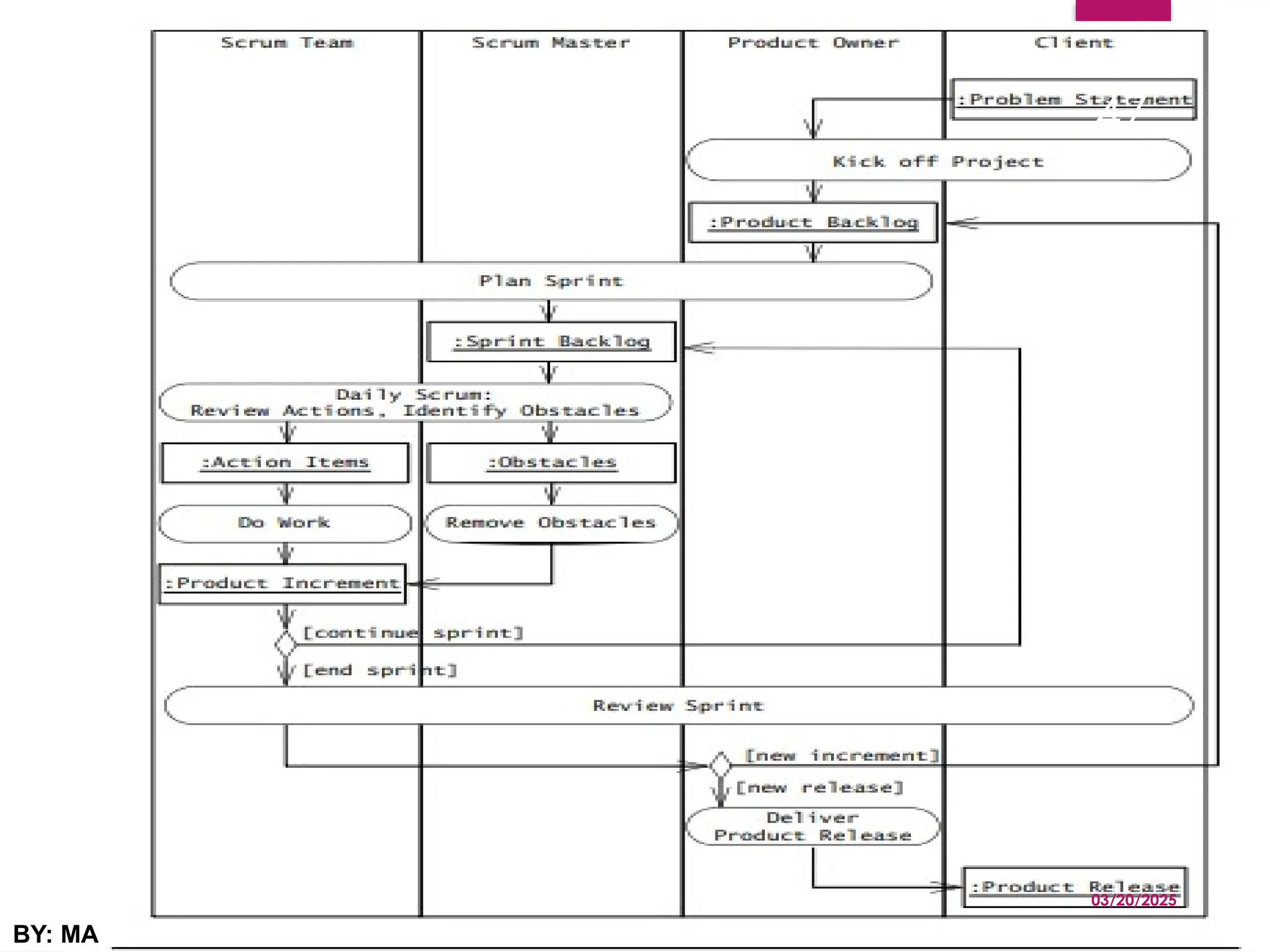
Software is developed or engineered not manufactured,
Software is flexible, and Software does not wear out.
03/20/2025
BY: MA
4
5.
1.1 TWO ORTHOGONALVIEWS OF
SOFTWARE:
There are two orthogonal views of software development.
Traditional Technique and Object oriented methodologies
Programs=Algorithm + Data Structures
Orthogonality is one of the most important properties that can
help make even complex designs compact.
In a purely orthogonal design, operations do not have side
effects; each changes just one thing without affecting others.
Orthogonality is a software design principle for writing
components in a way that changing one component doesn’t
affect other components.
It is the combination of two other principles, namely strong
cohesion and loose coupling. 03/20/2025
BY: MA
5
6.
03/20/2025
BY: MA
6
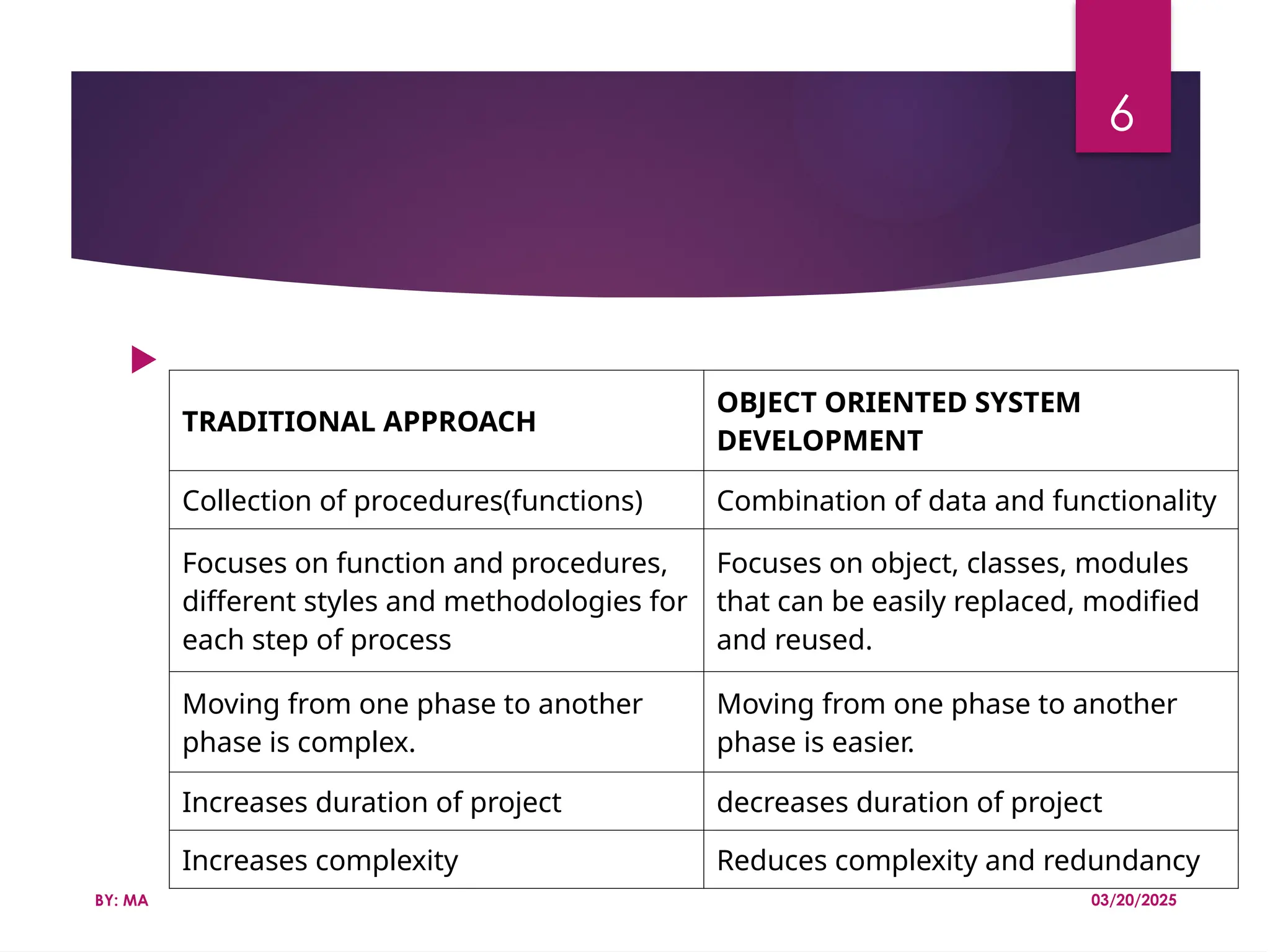
TRADITIONAL APPROACH
OBJECTORIENTED SYSTEM
DEVELOPMENT
Collection of procedures(functions) Combination of data and functionality
Focuses on function and procedures,
different styles and methodologies for
each step of process
Focuses on object, classes, modules
that can be easily replaced, modified
and reused.
Moving from one phase to another
phase is complex.
Moving from one phase to another
phase is easier.
Increases duration of project decreases duration of project
Increases complexity Reduces complexity and redundancy
7.
1.2. Software developmentprocess models
1.2.1. Software process
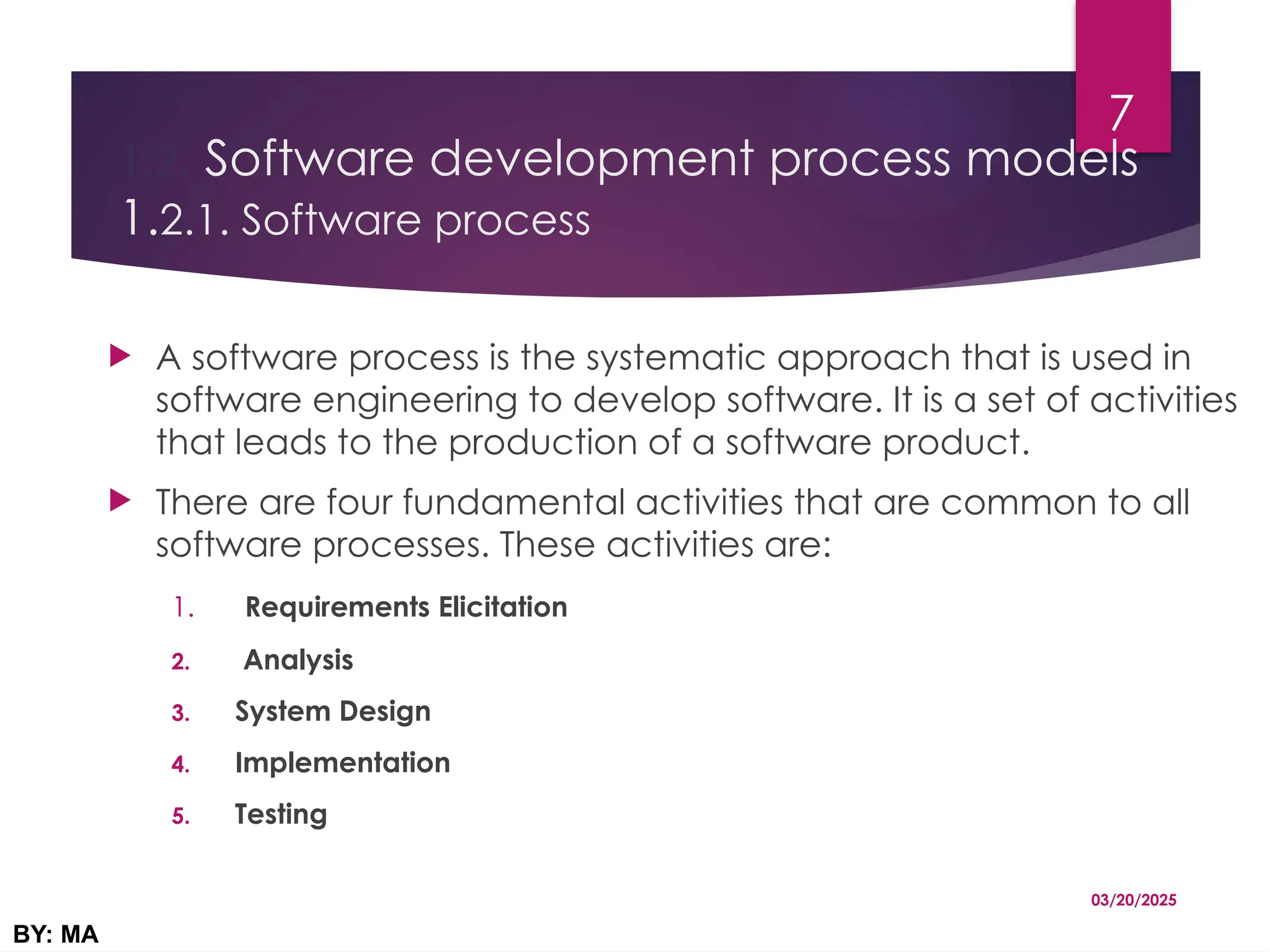
A software process is the systematic approach that is used in
software engineering to develop software. It is a set of activities
that leads to the production of a software product.
There are four fundamental activities that are common to all
software processes. These activities are:
1. Requirements Elicitation
2. Analysis
3. System Design
4. Implementation
5. Testing
03/20/2025
BY: MA
7
8.
Requirements Elicitation:
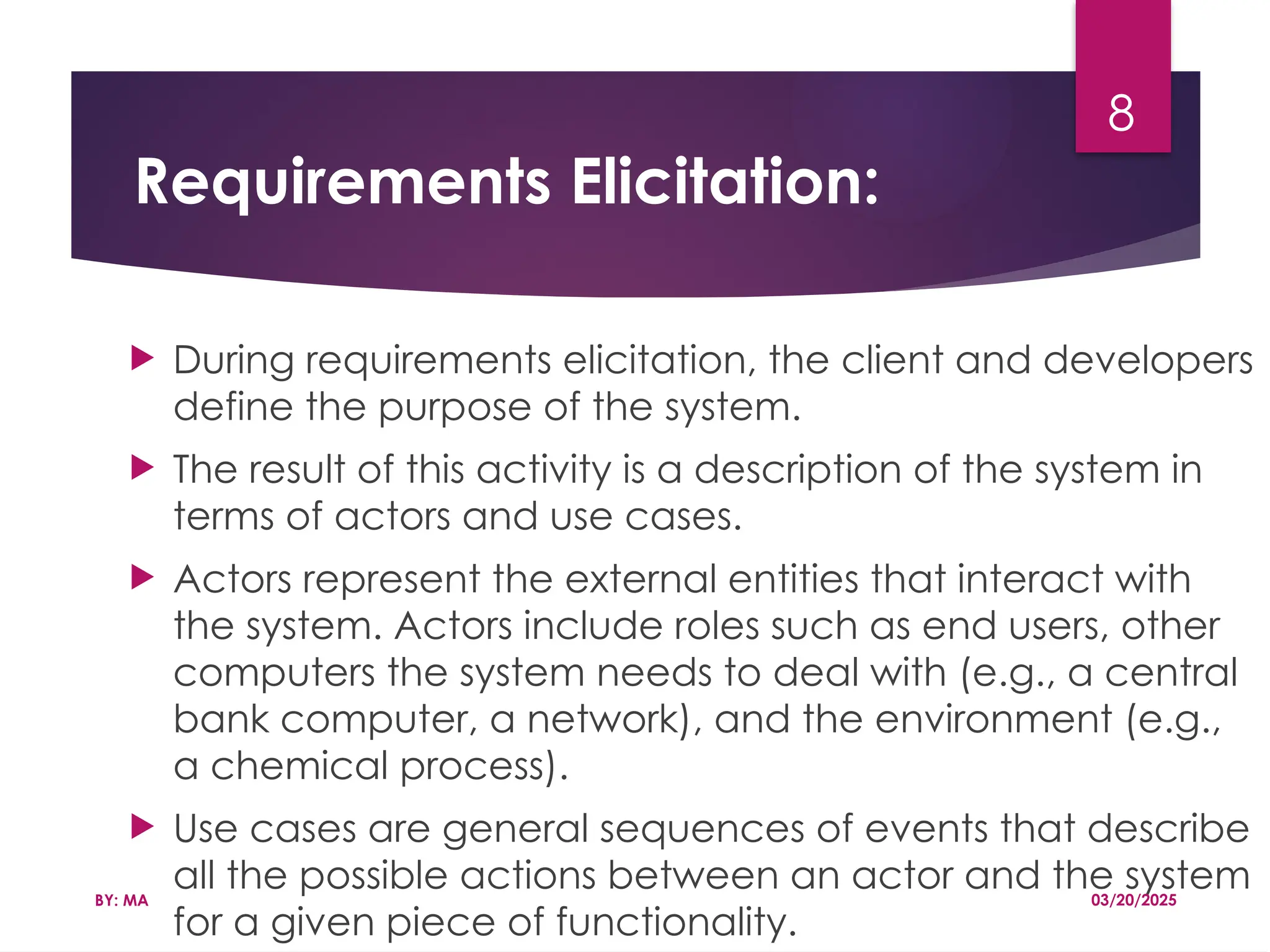
Duringrequirements elicitation, the client and developers
define the purpose of the system.
The result of this activity is a description of the system in
terms of actors and use cases.
Actors represent the external entities that interact with
the system. Actors include roles such as end users, other
computers the system needs to deal with (e.g., a central
bank computer, a network), and the environment (e.g.,
a chemical process).
Use cases are general sequences of events that describe
all the possible actions between an actor and the system
for a given piece of functionality.
03/20/2025
BY: MA
8
9.
Analysis
During analysis,developers aim to produce a model of the
system that is correct, complete, consistent, and
unambiguous.
Developers transform the use cases produced during
requirements elicitation into an object model that completely
describes the system.
During this activity, developers discover ambiguities and
inconsistencies in the use case model that they resolve with
the client.
The result of analysis is a system model annotated with
attributes, operations, and associations. The system model
can be described in terms of its structure and its dynamic
interoperation.
03/20/2025
BY: MA
9
10.
System Design
Duringsystem design, developers define the design goals of the
project and decompose the system into smaller subsystems that
can be realized by individual teams.
Developers also select strategies for building the system, such as the
hardware/software platform on which the system will run, the
persistent data management strategy, the global control flow, the
access control policy, and the handling of boundary conditions.
The result of system design is a clear description of each of these
strategies, a subsystem decomposition, and a deployment diagram
representing the hardware/software mapping of the system.
Whereas both analysis and system design produce models of the
system under construction, only analysis deals with entities that the
client can understand.
03/20/2025
BY: MA
10
11.
Implementation
During implementation,developers translate the solution domain
model into source code.
This includes implementing the attributes and methods of each object
and integrating all the objects such that they function as a single
system.
The implementation activity spans the gap between the detailed
object design model and a complete set of source code files that
can be compiled
03/20/2025
BY: MA
11
12.
Testing
During testing,developers find differences between the system
and its models by executing the system (or parts of it) with sample
input data sets.
During unit testing, developers compare the object design model
with each object and subsystem.
During integration testing, combinations of subsystems are
integrated together and compared with the system design model.
During system testing, typical and exception cases are run through
the system and compared with the requirements model.
The goal of testing is to discover as many faults as possible such
that they can be repaired before the delivery of the system.
The planning of test phases occurs in parallel to the other
development activities:
03/20/2025
BY: MA
12
13.
Sometimes, softwareprocesses are categorized as
either plan-driven or agile processes.
1. plan-driven processes: are processes where all of the process activities
are planned in advance and progress is measured against this plan.
2. agile processes: planning is incremental and it is easier to change the
process to reflect changing customer requirements.
Each approach is suitable for different types of
software. Generally, you need to find a balance
between plan-driven and agile processes.
03/20/2025
BY: MA
13
Cont…
14.
1.2.2. Software lifecycle and process models
A software life cycle model (also termed process model) is a
pictorial and diagrammatic representation of the software life
cycle.
A life cycle model represents all the methods required to make a
software product transit through its life cycle stages. It also captures
the structure in which these methods are to be undertaken.
In other words, a life cycle model maps the various activities
performed on a software product from its inception to retirement.
Different life cycle models may plan the necessary development
activities to phases in different ways. Thus, no element which life
cycle model is followed, the essential activities are contained in all
life cycle models though the action may be carried out in distinct
orders in different life cycle models. During any life cycle stage,
more than one activity may also be carried out.
03/20/2025
BY: MA
14
15.
Cont…
Need ofSDLC
The development team must determine a suitable life cycle
model for a particular plan and then observe to it.
Without using an exact life cycle model, the development of a
software product would not be in a systematic and disciplined
manner.
When a team is developing a software product, there must be a
clear understanding among team representative about when
and what to do. Otherwise, it would point to chaos and project
failure.
Without software life cycle models, it becomes tough for
software project managers to monitor the progress of the project
03/20/2025
BY: MA
15
16.
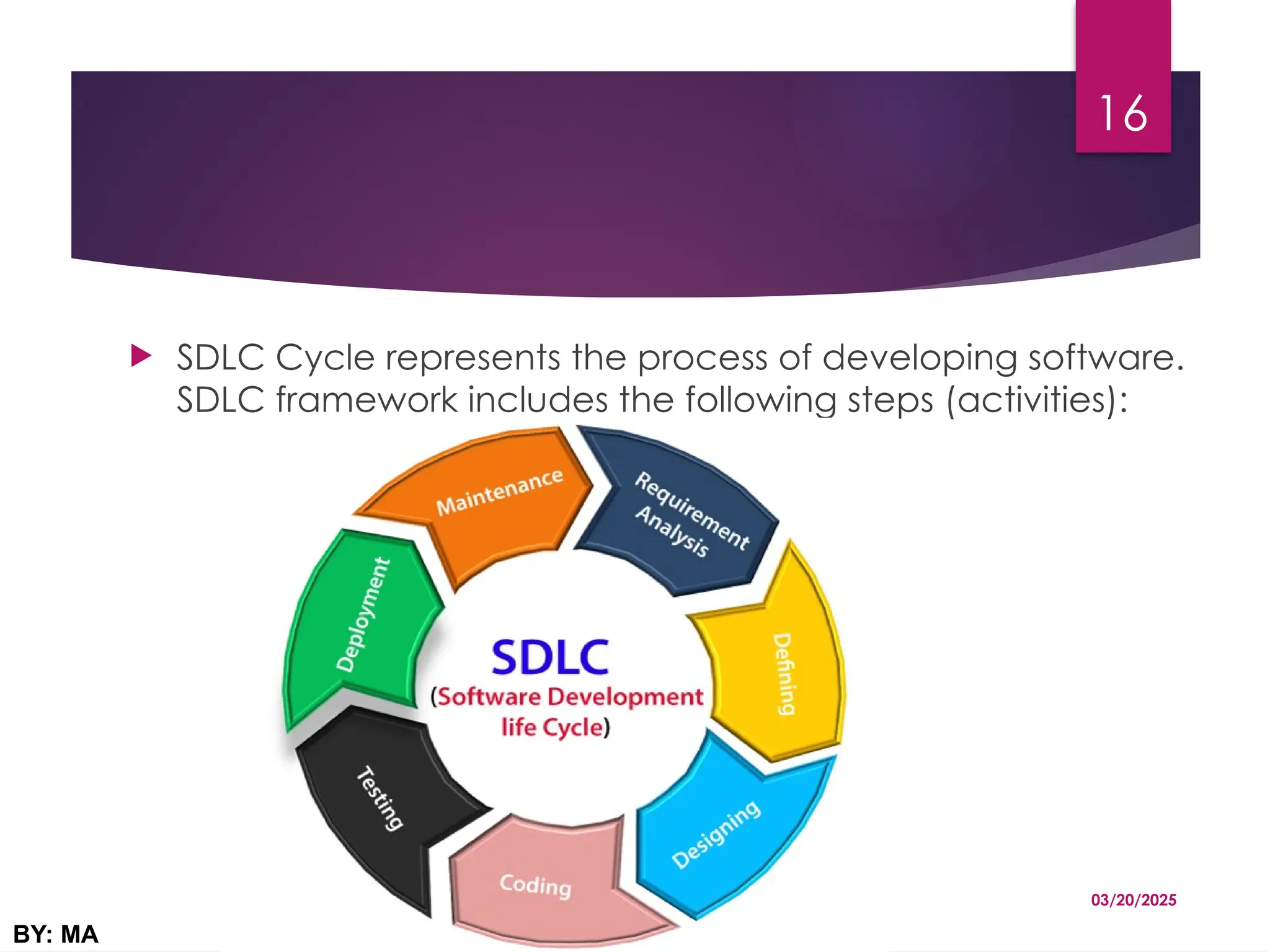
SDLC Cyclerepresents the process of developing software.
SDLC framework includes the following steps (activities):
03/20/2025
BY: MA
16
17.
The stages ofSDLC are as follows:
Stage1: Planning and Requirement elicitation
Requirement elicitation is the most important and necessary stage
in SDLC.
The senior members of the team perform it with inputs from all the
stakeholders and domain experts or SMEs in the industry.
Planning for the quality assurance requirements and identifications
of the risks associated with the projects is also done at this stage.
Business analyst and Project organizer set up a meeting with the
client to gather all the data like what the customer wants to build,
who will be the end user, what is the objective of the product.
Before creating a product, a core understanding or knowledge of
the product is very necessary.
03/20/2025
BY: MA
17
18.
For Example,A client wants to have an application which
concerns money transactions. In this method, the requirement
has to be precise like what kind of operations will be done, how
it will be done, etc.
Once the required function is done, an analysis is complete
with auditing the feasibility of the growth of a product.
Once the requirement is understood, the SRS (Software
Requirement Specification) document is created. The
developers should thoroughly follow this document and also
should be reviewed by the customer for future reference.
03/20/2025
BY: MA
18
19.
Stage2: Defining Requirements/Analysis
Once the requirement analysis is done, the next stage is to
certainly represent and document the software requirements and
get them accepted from the project stakeholders.
This is accomplished through "SRS"- Software Requirement
Specification document which contains all the product
requirements to be constructed and developed during the project
life cycle.
Stage3: Designing the Software / Designing
The next phase is about to bring down all the knowledge of
requirements, analysis, and design of the software project. This
phase is the product of the last two, like inputs from the customer
and requirement gathering.
03/20/2025
BY: MA
19
20.
Stage4: Developing theproject /implementation
In this phase of SDLC, the actual development begins, and the
programming is built. The implementation of design begins
concerning writing code.
Developers have to follow the coding guidelines described by their
management and programming tools like compilers, interpreters,
debuggers, etc. are used to develop and implement the code.
Stage5: Testing
After the code is generated, it is tested against the requirements to
make sure that the products are solving the needs addressed and
gathered during the requirements stage.
During this stage, unit testing, integration testing, system testing,
acceptance testing are done. 03/20/2025
BY: MA
20
21.
Stage6: Deployment
Oncethe software is certified, and no bugs or errors are stated,
then it is deployed.
Then based on the assessment, the software may be released as
it is or with suggested enhancement in the object segment.
After the software is deployed, then its maintenance begins.
Stage7: Maintenance
Once when the client starts using the developed systems, then
the real issues come up and requirements to be solved from time
to time.
This procedure where the care is taken for the developed
product is known as maintenance.
03/20/2025
BY: MA
21
22.
SDLC models orprocess
models
Software Development life cycle (SDLC) is a spiritual
model used in project management that defines the
stages include in an information system development
project, from an initial feasibility study to the
maintenance of the completed application.
There are different software development life cycle
models specify and design, which are followed during
the software development phase.
These models are also called "Software Development
Process Models." Each process model follows a series of
phase unique to its type to ensure success in the step of
software development. 03/20/2025
BY: MA
22
23.
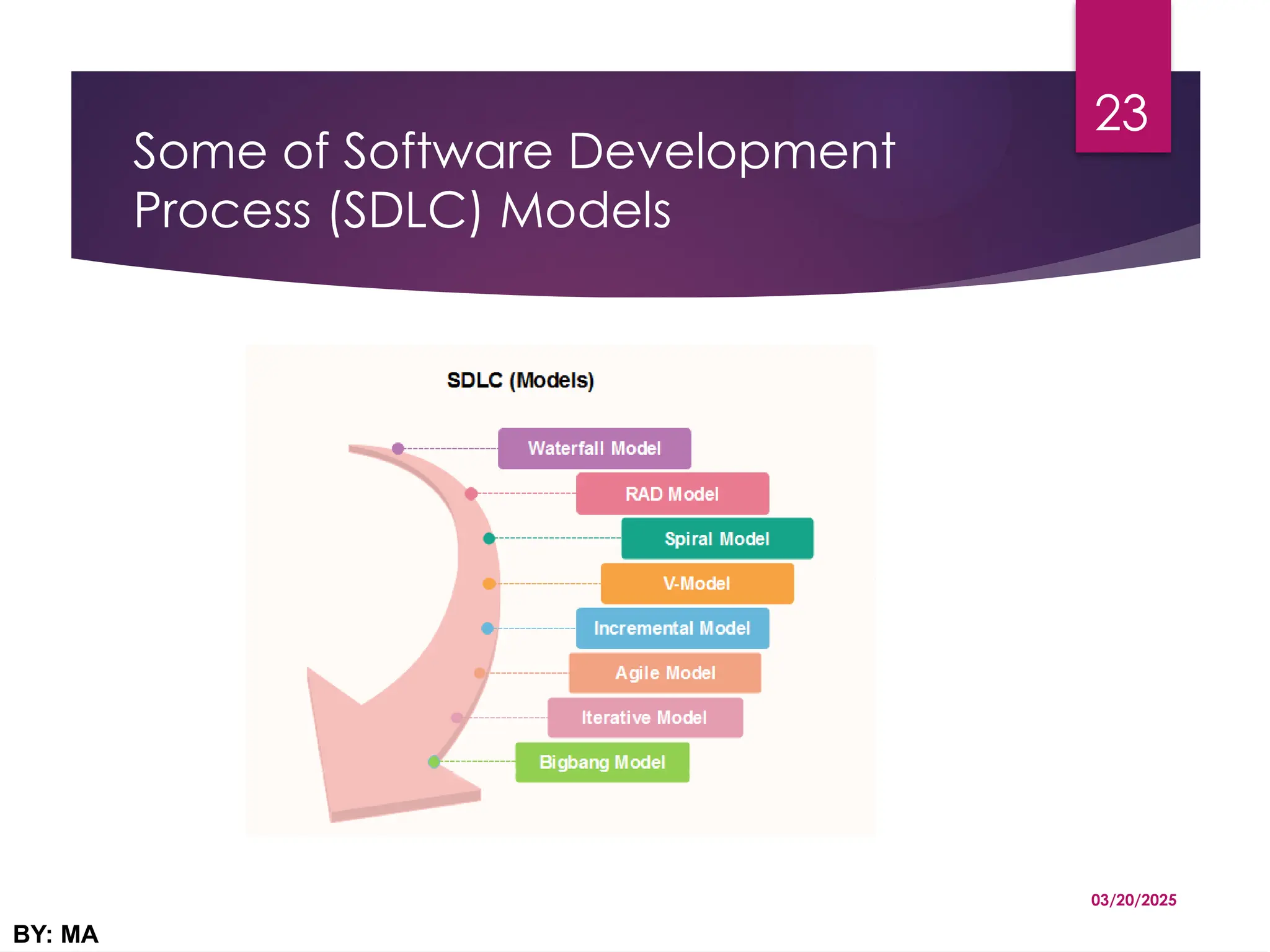
Some of SoftwareDevelopment
Process (SDLC) Models
03/20/2025
BY: MA
23
24.
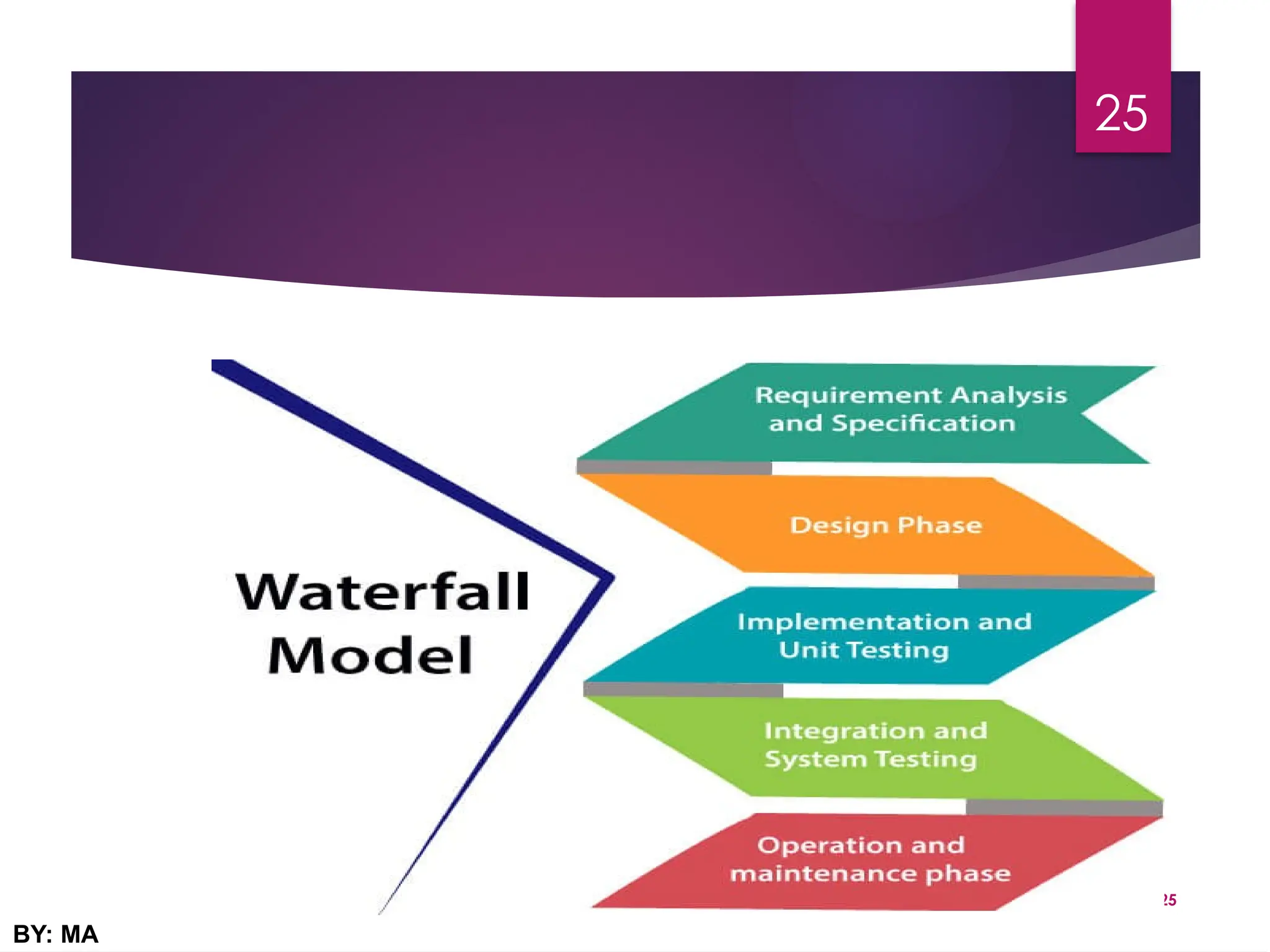
Waterfall model
Thewaterfall is a universally accepted SDLC model. The waterfall
model is a continuous software development model in which
development is seen as flowing steadily downwards (like a waterfall)
through the steps.
This model has five phases:
1. Requirements analysis and specification phase:
2. Design Phase:
3. Implementation and unit testing:
4. Integration and System Testing:
5. Operation and maintenance phase:
The steps always follow in this order and do not overlap. The
developer must complete every phase before the next phase begins.
03/20/2025
BY: MA
24
When touse SDLC Waterfall Model?
Some Circumstances where the use of the Waterfall
model is most suited are:
When the requirements are constant and not changed
regularly.
A project is short
The situation is calm
Where the tools and technology used is consistent and is
not changing
When resources are well prepared and are available to use.
03/20/2025
BY: MA
26
27.
Advantages ofWaterfall model
This model is simple to implement also the number of
resources that are required for it is minimal.
The requirements are simple and explicitly declared; they
remain unchanged during the entire project
development.
The start and end points for each phase is fixed, which
makes it easy to cover progress.
The release date for the complete product, as well as its
final cost, can be determined before development.
It gives easy to control and clarity for the customer due to
a strict reporting system. 03/20/2025
BY: MA
27
28.
Disadvantages ofWaterfall model
In this model, the risk factor is higher, so this model is not
suitable for more significant and complex projects.
This model cannot accept the changes in requirements
during development.
It becomes tough to go back to the phase. For example, if
the application has now shifted to the coding phase, and
there is a change in requirement, It becomes tough to go
back and change it.
Since the testing done at a later stage, it does not allow
identifying the challenges and risks in the earlier phase, so
the risk reduction strategy is difficult to prepare. 03/20/2025
BY: MA
28
29.
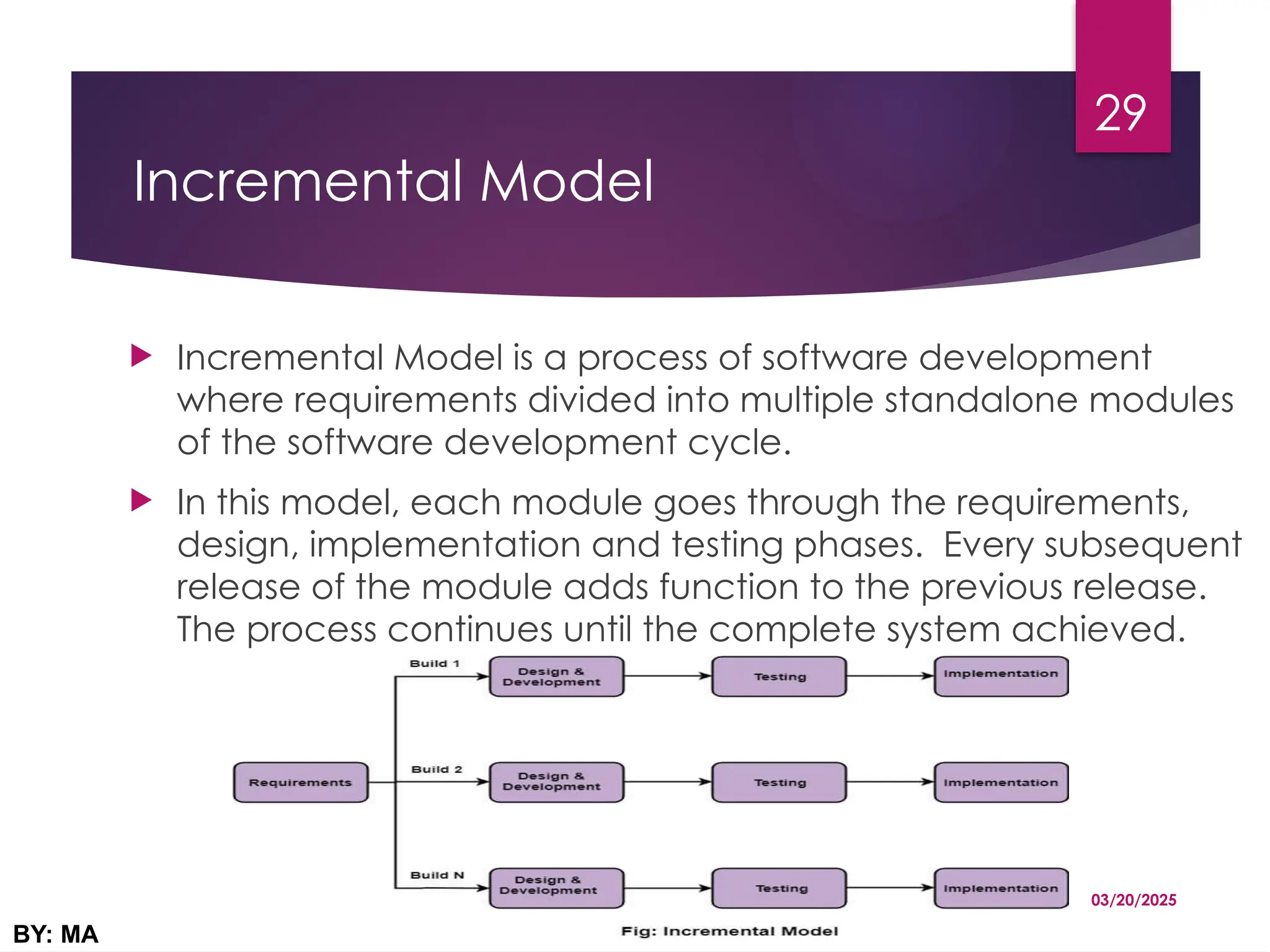
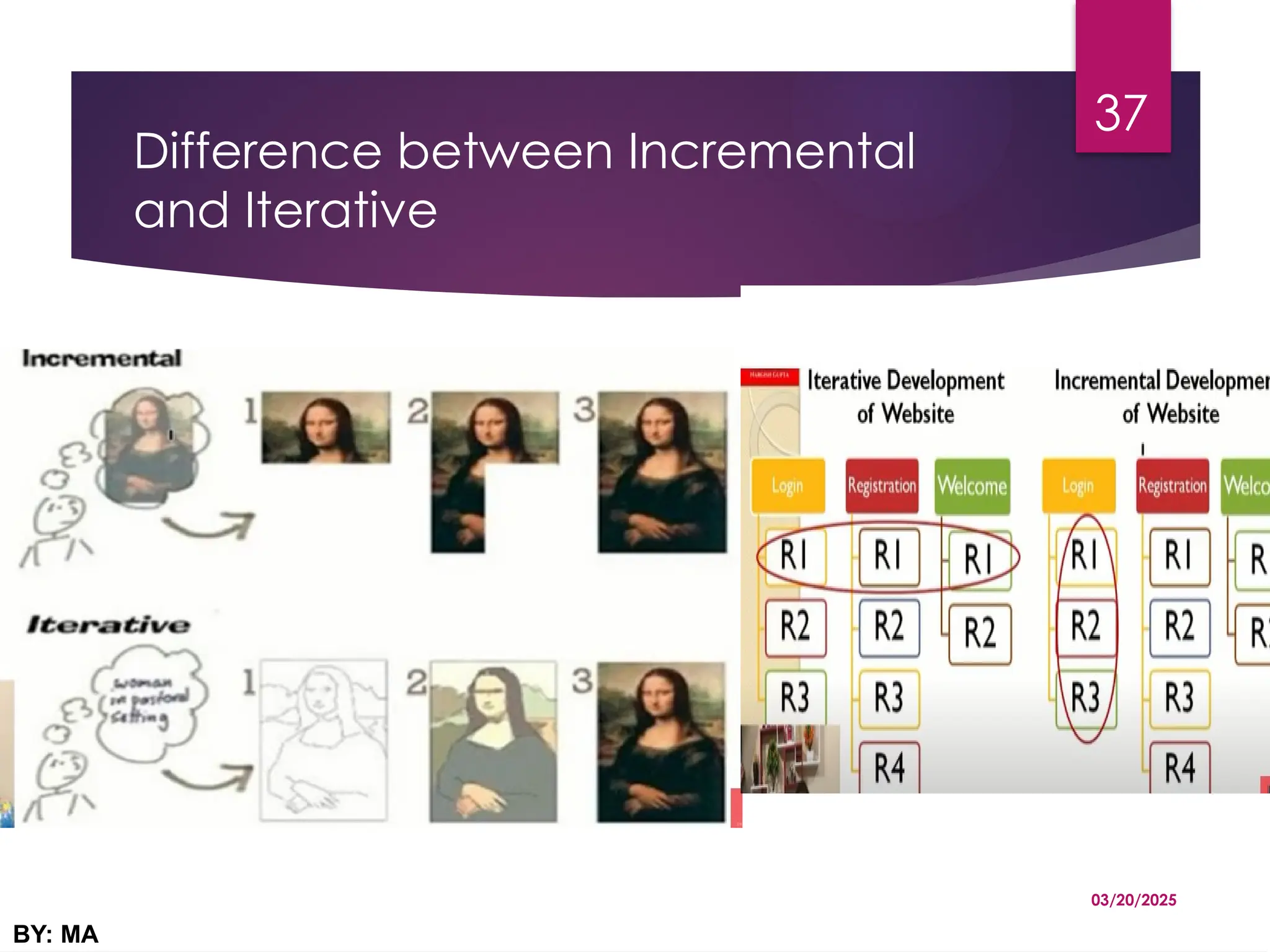
Incremental Model
IncrementalModel is a process of software development
where requirements divided into multiple standalone modules
of the software development cycle.
In this model, each module goes through the requirements,
design, implementation and testing phases. Every subsequent
release of the module adds function to the previous release.
The process continues until the complete system achieved.
03/20/2025
BY: MA
29
30.
The various phasesof incremental model are as
follows:
1. Requirement analysis: In the first phase of the incremental model, the
product analysis expertise identifies the requirements. And the system
functional requirements are understood by the requirement analysis team.
2. Design & Development: In this phase of the Incremental model of SDLC,
the design of the system functionality and the development method are
finished with success.
3. Testing: In the incremental model, the testing phase checks the
performance of each existing function as well as additional functionality.
4. Implementation: Implementation phase enables the coding phase of the
development system. It involves the final coding that design in the
designing and development phase and tests the functionality in the
testing phase. After completion of this phase, the number of the product
working is enhanced and upgraded up to the final system product
03/20/2025
BY: MA
30
31.
When weuse the Incremental Model?
When the requirements are superior.
A project has a lengthy development schedule.
When Software team are not very well skilled or trained.
When the customer demands a quick release of the product.
You can develop prioritized requirements first.
Advantage of Incremental Model
Errors are easy to be recognized.
Easier to test and debug
More flexible.
Simple to manage risk because it handled during its iteration.
The Client gets important functionality early.
Disadvantage of Incremental Model
Need for good planning
Total Cost is high.
Well defined module interfaces are needed.
03/20/2025
BY: MA
31
32.
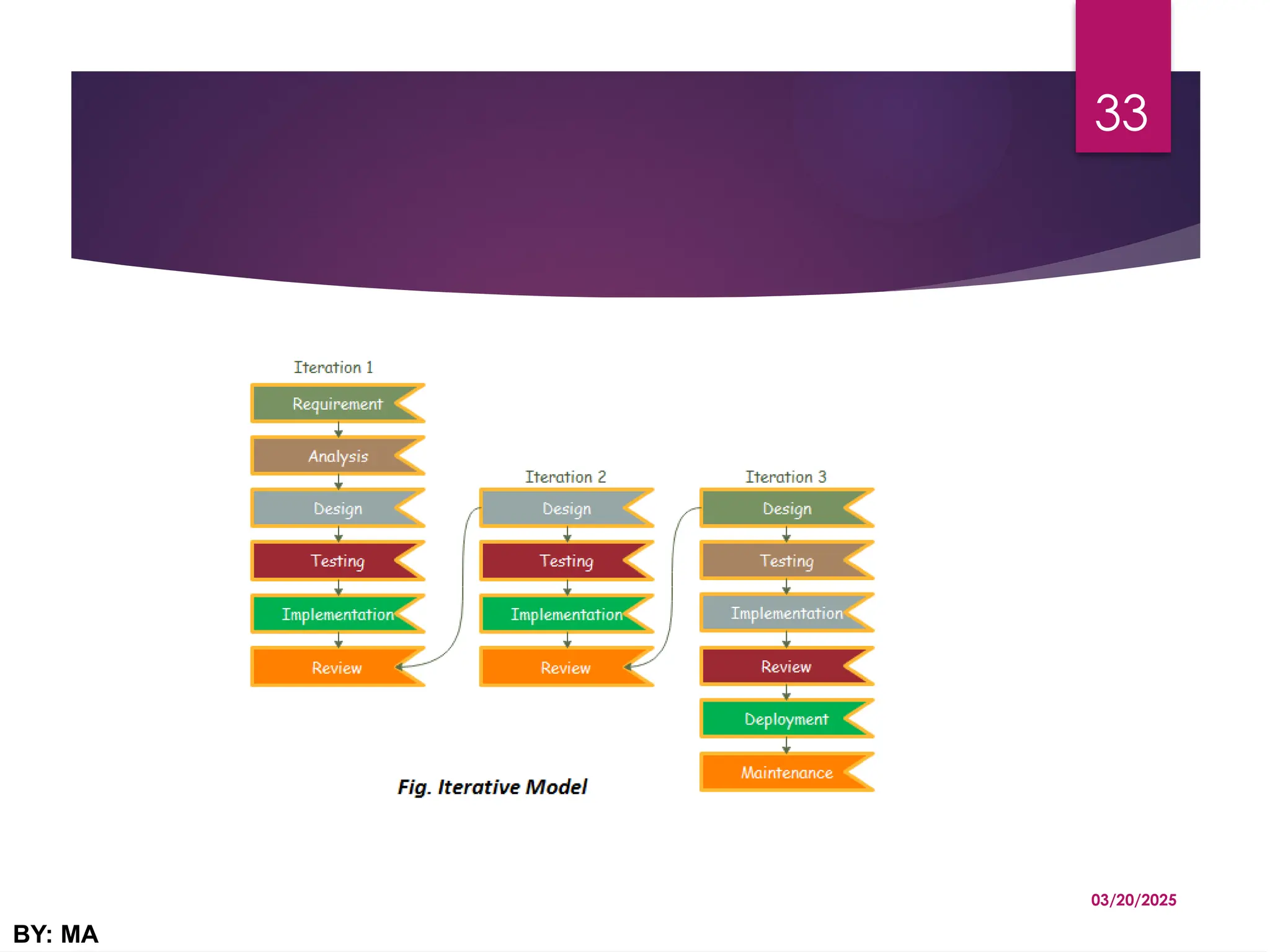
Iterative Model
Inthis Model, you can start with some of the software
specifications and develop the first version of the software.
After the first version if there is a need to change the software,
then a new version of the software is created with a new
iteration.
Every release of the Iterative Model finishes in an exact and
fixed period that is called iteration.
The Iterative Model allows the accessing earlier phases, in
which the variations made respectively. The final output of the
project renewed at the end of the Software Development Life
Cycle (SDLC) process.
03/20/2025
BY: MA
32
The various phasesof Iterative model are as
follows:
1. Requirement gathering & analysis: In this phase, requirements
are gathered from customers and check by an analyst
whether requirements will fulfil or not. Analyst checks that
need will achieve within budget or not. After all of this, the
software team skips to the next phase.
2. Design: In the design phase, team design the software by the
different diagrams like Data Flow diagram, activity diagram,
class diagram, state transition diagram, etc.
3. Implementation: In the implementation, requirements are
written in the coding language and transformed into computer
programmes which are called Software.
03/20/2025
BY: MA
34
35.
4. Testing: Aftercompleting the coding phase, software testing starts
using different test methods. There are many test methods, but the
most common are white box, black box, and grey box test
methods.
5. Deployment: After completing all the phases, software is
deployed to its work environment.
6. Review: In this phase, after the product deployment, review phase
is performed to check the behaviour and validity of the
developed product. And if there are any error found then the
process starts again from the requirement gathering.
7. Maintenance: In the maintenance phase, after deployment of the
software in the working environment there may be some bugs,
some errors or new updates are required. Maintenance involves
debugging and new addition options.
03/20/2025
BY: MA
35
36.
When touse the Iterative Model?
When requirements are defined clearly and easy to understand.
When the software application is large.
When there is a requirement of changes in future.
Advantage(Pros) of Iterative Model:
Testing and debugging during smaller iteration is easy.
A Parallel development can plan.
It is easily acceptable to ever-changing needs of the project.
Risks are identified and resolved during iteration.
Limited time spent on documentation and extra time on designing.
Disadvantage(Cons) of Iterative Model:
It is not suitable for smaller projects.
More Resources may be required.
Design can be changed again and again because of imperfect requirements.
Requirement changes can cause over budget.
Project completion date not confirmed because of changing requirements.
03/20/2025
BY: MA
36
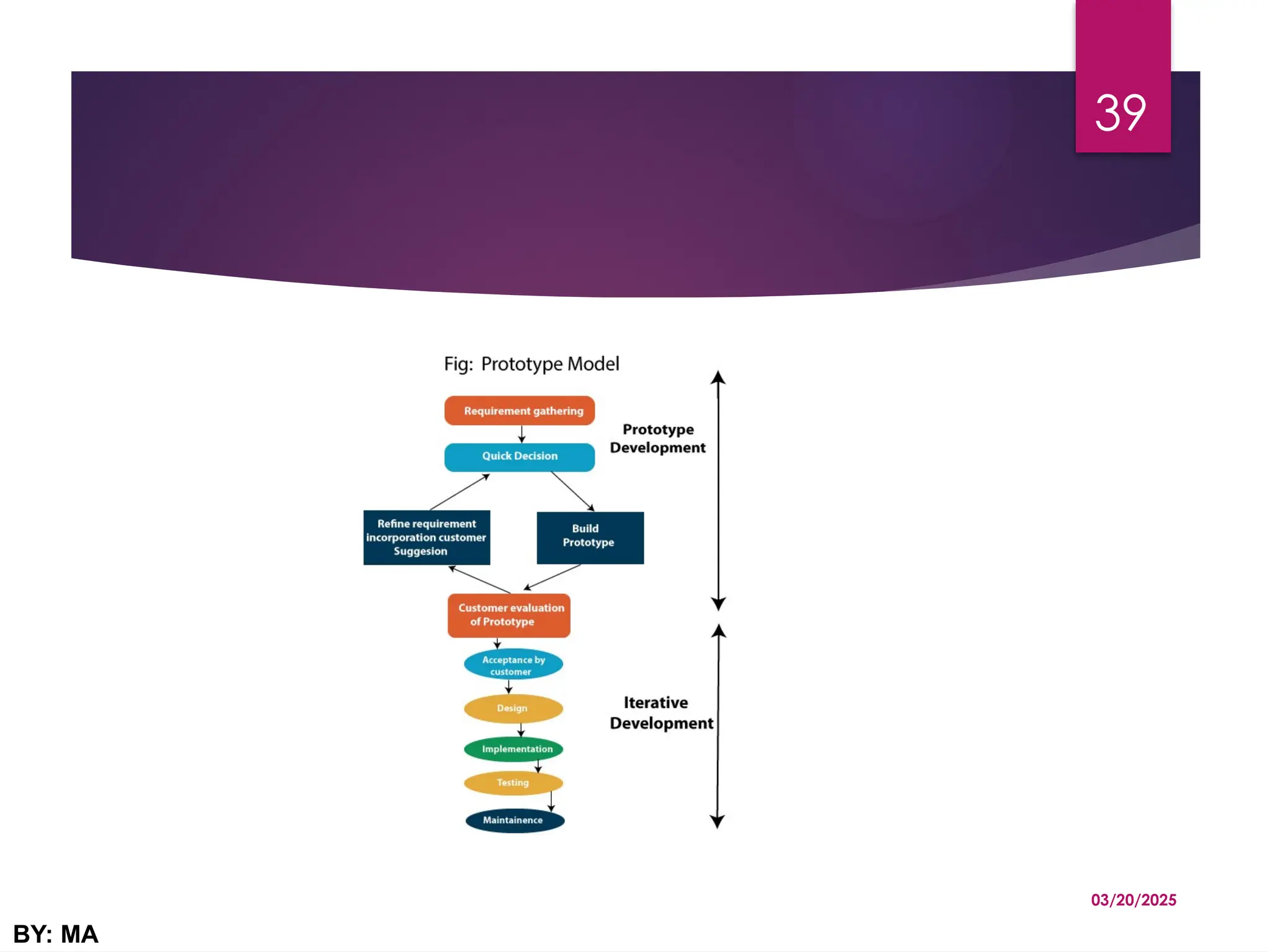
Prototype Model
Theprototype model requires that before carrying out the
development of actual software, a working prototype of the
system should be built.
A prototype is a toy implementation of the system. A prototype
usually turns out to be a very crude version of the actual system,
possible exhibiting limited functional capabilities, low reliability,
and inefficient performance as compared to actual software.
In many instances, the client only has a general view of what is
expected from the software product.
In such a scenario where there is an absence of detailed
information regarding the input to the system, the processing
needs, and the output requirement, the prototyping model may
be employed. 03/20/2025
BY: MA
38
Steps ofPrototype Model
Requirement Gathering and Analyst
Quick Decision
Build a Prototype
Assessment or User Evaluation
Prototype Refinement
Engineer Product
Advantage of Prototype Model
Reduce the risk of incorrect user requirement
Good where requirement are changing/uncommitted
Regular visible process aids management
Support early product marketing
Reduce Maintenance cost.
Errors can be detected much earlier as the system is made side by side.
03/20/2025
BY: MA
40
41.
Disadvantage ofPrototype Model
An unstable/badly implemented prototype often becomes the final product.
Require extensive customer collaboration
Costs customer money
Needs committed customer
Difficult to finish if customer withdraw
May be too customer specific, no broad market
Difficult to know how long the project will last.
Easy to fall back into the code and fix without proper requirement analysis,
design, customer evaluation, and feedback.
Prototyping tools are expensive.
Special tools & techniques are required to build a prototype.
It is a time-consuming process.
03/20/2025
BY: MA
41
42.
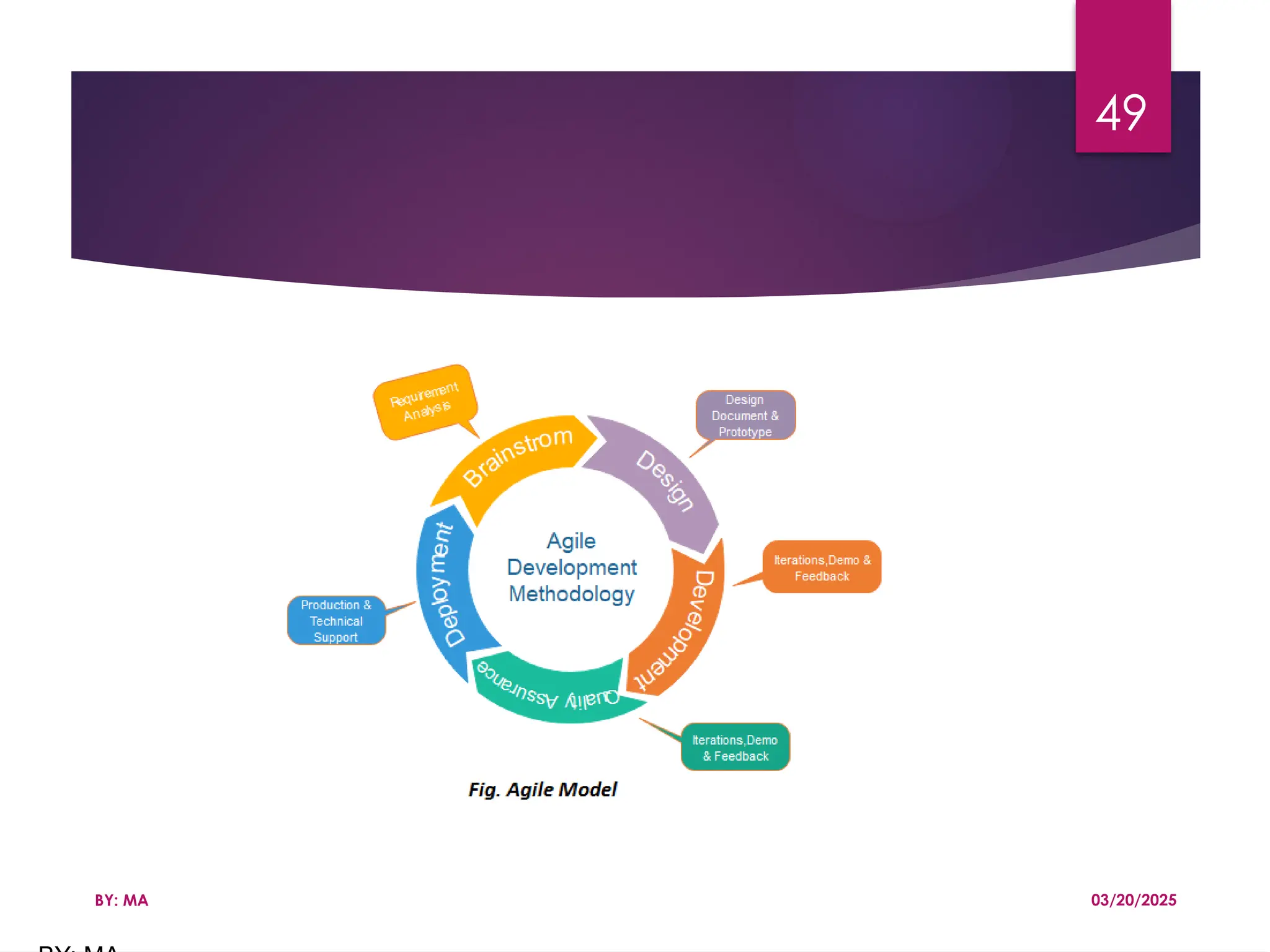
Agile Model
Themeaning of Agile is swift or versatile. "Agile process model"
refers to a software development approach based on iterative
development.
Agile methods break tasks into smaller iterations, or parts do not
directly involve long term planning.
The agile model refers to the iterative approach to delivering a
software product. This means that instead of delivering a large
project only when all parts are complete, a team breaks down a
large project into smaller parts, and delivers these completed
smaller parts in regular cycles.
For example, using the agile model a developer delivers multiple releases of a
product and each release could add a single feature, such as drop-down
menus, checkboxes, or multiple-choice buttons. The final release would
contain all features.
03/20/2025
BY: MA
42
43.
Agile methodsdeal better with ill-defined
requirements and emerging solution technologies,
which are characterized by frequent change(by
client, user, developer).
Agile methods attempt to deal with these
challenges by focusing on small product increments
that are developed in short time bursts.
After each product increment, progress is reviewed,
lessons are learned, the project organization or
goals are adjusted accordingly
03/20/2025
BY: MA
43
44.
Agile projectmanagement method uses scrum which is a
management framework that teams use to self-organize and
work towards a common goal. It describes a set of meetings,
tools, and roles for efficient project delivery
The Scrum approach is characterized by short iterations,
called sprints, during which a release candidate is
developed. In Scrum, this is called a potentially deliverable
product increment, Consequently.
The project is started with a project kick off meeting, during
which the product owner and the Scrum master brainstorm a
first version of the requirements. At the end of the kick off, the
requirements are prioritized into a list called the product
backlog.
03/20/2025
BY: MA
44
45.
Scrum defines threeroles:
The product owner is responsible for the requirements. The product
owner participates in the creation of the product backlog, and
prioritizes the product backlog before each sprint.
The Scrum master is a management role responsible for the process.
The Scrum master sets up and enforces the rules and practices of
the project.
The Scrum master facilitates the daily Scrum meetings, monitors
progress, and removes obstacles preventing the team to do its
work.
The Scrum master is the interface between the Scrum team and
the product owner, ensures the team productivity, and shields the
team from distractions
03/20/2025
BY: MA
45
46.
The Scrumteam is responsible for developing the
product increment.
The team is cross functional including all the skills required to
build the product increment.
The team is self organizing in that each member commits to
work based on their own skills and availability.
Members learn and adapt their skills based on the work to
be done.
The team participates in the sprint planning meeting and
commits to the list of tasks defined in the sprint backlog
03/20/2025
BY: MA
46
Each iterationis considered as a short time "frame" in the
Agile process model, which typically lasts from one to four
weeks.
The division of the entire project into smaller parts helps to
minimize the project risk and to reduce the overall project
delivery time requirements.
Each iteration involves a team working through a full
software development life cycle including planning,
requirements analysis, design, coding, and testing before
a working product is demonstrated to the client.
03/20/2025
BY: MA
48
…Phases of AgileModel:
Requirements gathering: must define the requirements.
Design the requirements: you have identified the project, work
with stakeholders to define requirements. You can use the user
flow diagram or the high-level UML diagram
Construction/ iteration: Designers and developers start
working on their project, which aims to deploy a working
product.
Testing/ Quality assurance: Quality Assurance team examines
the product's performance and looks for the bug.
Deployment: the team issues a product for the user's work
environment.
Feedback: the team receives feedback about the product
03/20/2025
BY: MA
50
51.
When touse the Agile Model?
When frequent changes are required.
When a highly qualified and experienced team is available.
When a customer is ready to have a meeting with a software team all the time.
When project size is small.
Advantage(Pros) of Agile Method:
Frequent Delivery
Face-to-Face Communication with clients.
Efficient design and fulfils the business requirement.
Anytime changes are acceptable.
It reduces total development time.
Disadvantages(Cons) of Agile Model:
Due to the shortage of formal documents, it creates confusion and crucial decisions taken
throughout various phases can be misinterpreted at any time by different team members.
Due to the lack of proper documentation, once the project completes and the developers
allotted to another project, maintenance of the finished project can become a difficulty.
03/20/2025
BY: MA
51
52.
Model Selection parameters
Selection Process parameters plays an important role in software development as it helps to choose
the best suitable software life cycle model. Following are the parameters which should be used to
select a SDLC.
1. Requirements characteristics :
Reliability of Requirements
How often the requirements can change
Types of requirements
Number of requirements
Can the requirements be defined at an early stage
Requirements indicate the complexity of the system
2. Development team :
Team size
Experience of developers on similar type of projects
Level of understanding of user requirements by the developers
Environment
Domain knowledge of developers
Experience on technologies to be used
Availability of training
03/20/2025
BY: MA
52
53.
3. User involvementin the project :
Expertise of user in project
Involvement of user in all phases of the project
Experience of user in similar project in the past
4. Project type and associated risk :
Stability of funds
Tightness of project schedule
Availability of resources
Type of project
Size of the project
Expected duration for the completion of project
Complexity of the project
Level and the type of associated risk
03/20/2025
BY: MA
53
54.
Reading Assignment
RAD(Rapid Application Development) Model
Spiral model
V-model
Bing Band Model
Software Process assessment
models
Software process metrics
03/20/2025
BY: MA
54
55.
1.3. Object orientedsystem development
methodology.
Object-Oriented Software Engineering (OOSE) is a
software design technique that is used in software
design in object-oriented programming.
Object-oriented programming (OOP) is a computer
programming model that organizes software design
around data, or objects, rather than functions and
logic. ... OOP focuses on the objects that
developers want to manipulate rather than the
logic required to manipulate them.
03/20/2025
BY: MA
55
56.
As thename suggests, Object-Oriented
Programming or OOPs refers to languages
that use objects in programming.
Object-oriented programming aims to implement
real-world entities like inheritance, abstraction,
polymorphism, etc in programming.
The main aim of OOP is to bind together the data
and the functions that operate on them so that no
other part of the code can access this data except
that function.
03/20/2025
BY: MA
56
57.
Cont…
The fundamentalconcepts of the object-oriented world:
Objects − Objects represent an entity and the basic building
block.
Class − Class is the blue print of an object.
Abstraction − is used to hide unnecessary information and
display only necessary information to the users interacting.
Encapsulation − Encapsulation is the mechanism of binding
the data together and hiding them from the outside world.
Inheritance − Inheritance is the mechanism of making new
classes from existing ones.
Polymorphism − It defines the mechanism to exists in different
forms.
03/20/2025
BY: MA
57
58.
Object oriented system
developmentmethodology.
Object oriented development offers a different model
from traditional software development approach(which
based on the function of and the procedure).
In simplified terms, object oriented systems development
is the way to develop software by building self-containing
modules or objects that can be easily replaced, modified
and reused.
In o-o environment, software is collection of discrete
objects that encapsulate their data as well as the
functionality to model real world object.
In o-o system, everything is object and each object
responsible for it self. 03/20/2025
BY: MA
58
59.
BENEFITS OF OBJECTORIENTATION
Faster development,
Reusability,
Increased quality
Modeling the real world and provides us with the stronger
the equivalence of the real world’s entities (objects)
Raising the level of abstraction to the point where application
can be implemented in the same terms as they are
described. 03/20/2025
BY: MA
59
60.
WHY OBJECT ORIENTATION
OO Methods enables to develop set of objects that work together
software similar to traditional techniques.
It adapts to
Changing requirements
Easier to maintain
More robust
Promote greater design
Code reuse
Others
Higher level of abstraction
Seamless transition among different phases of software development.
Encouragement of good programming technique. 03/20/2025
BY: MA
60
61.
OBJECT BASICS
Goals:In object oriented method the developer should:
Define Objects and classes
Describe objects, methods, attributes and how objects respond to messages,
Define Polymorphism, Inheritance, data abstraction, encapsulation,
Describe objects relationships,
Describe object persistence,
03/20/2025
BY: MA
61
62.
OBJECT-ORIENTED APPROACH
OOapproach is more like creating a lot of helpers
take on an active role, a spirit, that form a community whose interactions become
the application.
Reusable
Modified
Replaced
03/20/2025
BY: MA
62
63.
EXAMPLES OF OBJECTORIENTED
SYSTEMS
In OO system , “everything is object”.
A spreadsheet cell, bar chart, title in bar chart, report,
numbers, arrays, records, fields, files, forms, an invoice,
etc.
A window object is responsible for things like opening,
sizing, and closing itself.
A chart object is responsible for things like maintaining
data and labels even for drawing itself.
03/20/2025
BY: MA
63
64.
WHAT IS ANOBJECTAND
CLASS?
The concepts of objects and classes are intrinsically
linked with each other and form the foundation of o- o
paradigm.
An object is an entity, it knows things (has attributes), It
does things (provides services or has methods).
Identity that distinguishes it from other objects in the
system.
State that determines the characteristic properties of
an object as well as the values of the properties that
the object holds.
Behavior that represents externally visible activities
performed by an object in terms of changes in its state.
03/20/2025
BY: MA
64
65.
Class
A classrepresents a collection of objects having same
characteristic properties that exhibit common behavior.
Creation of an object as a member of a class is called
instantiation.
Thus, object is an instance of a class.
Example: Circle – a class
x, to the center
a, to denote the radius of the circle
Some of its operations can be defined as follows:
findArea(), method to calculate area
findCircumference(), method to calculate
circumference 03/20/2025
BY: MA
65
66.
OBJECT’S ATTRIBUTES
Attributesrepresented by data type.
They describe objects states.
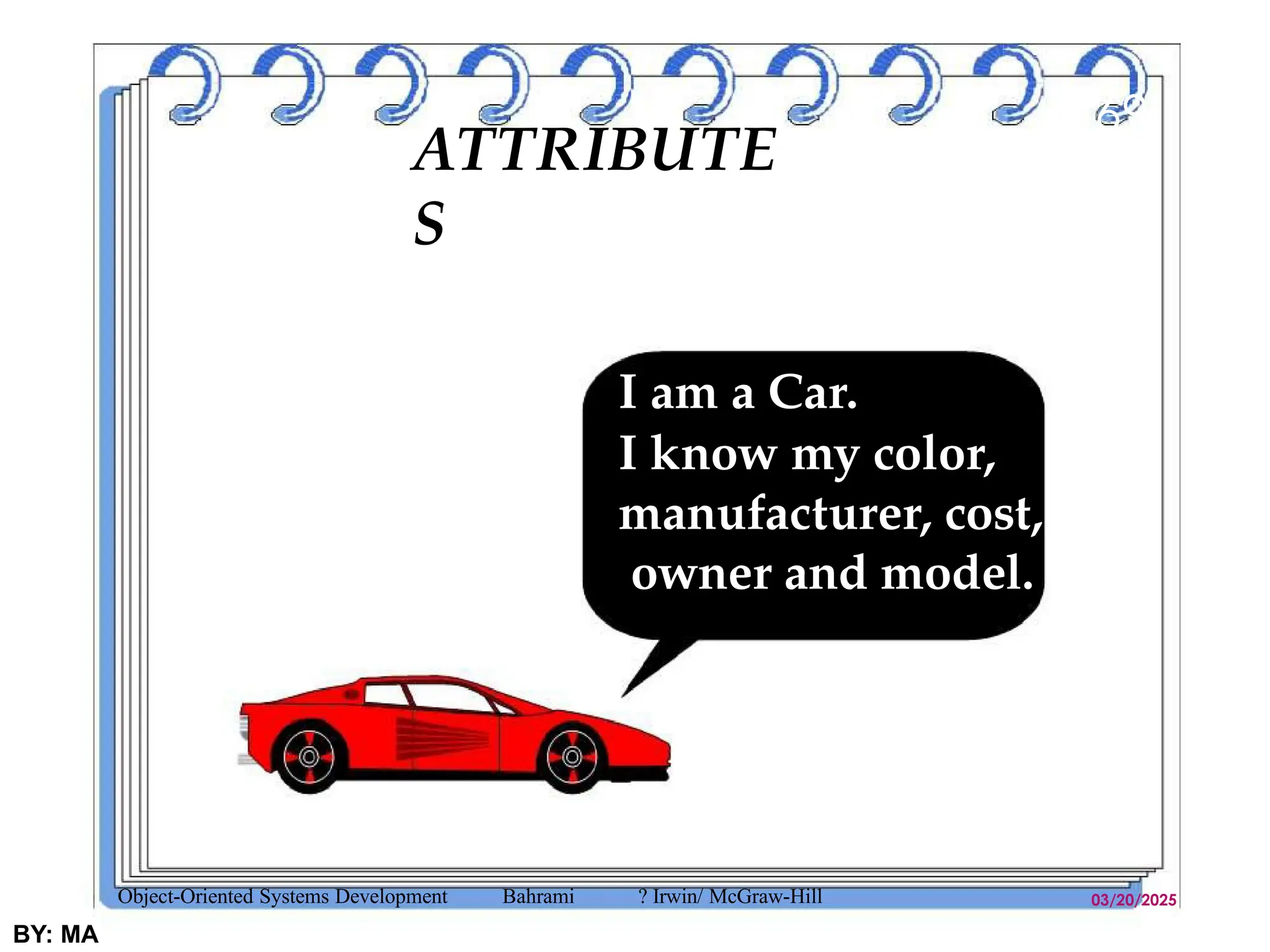
In the Car example the car’s attributes are: color,
manufacturer, cost, owner, model, etc.
03/20/2025
BY: MA
66
67.
OBJECT’S METHODS
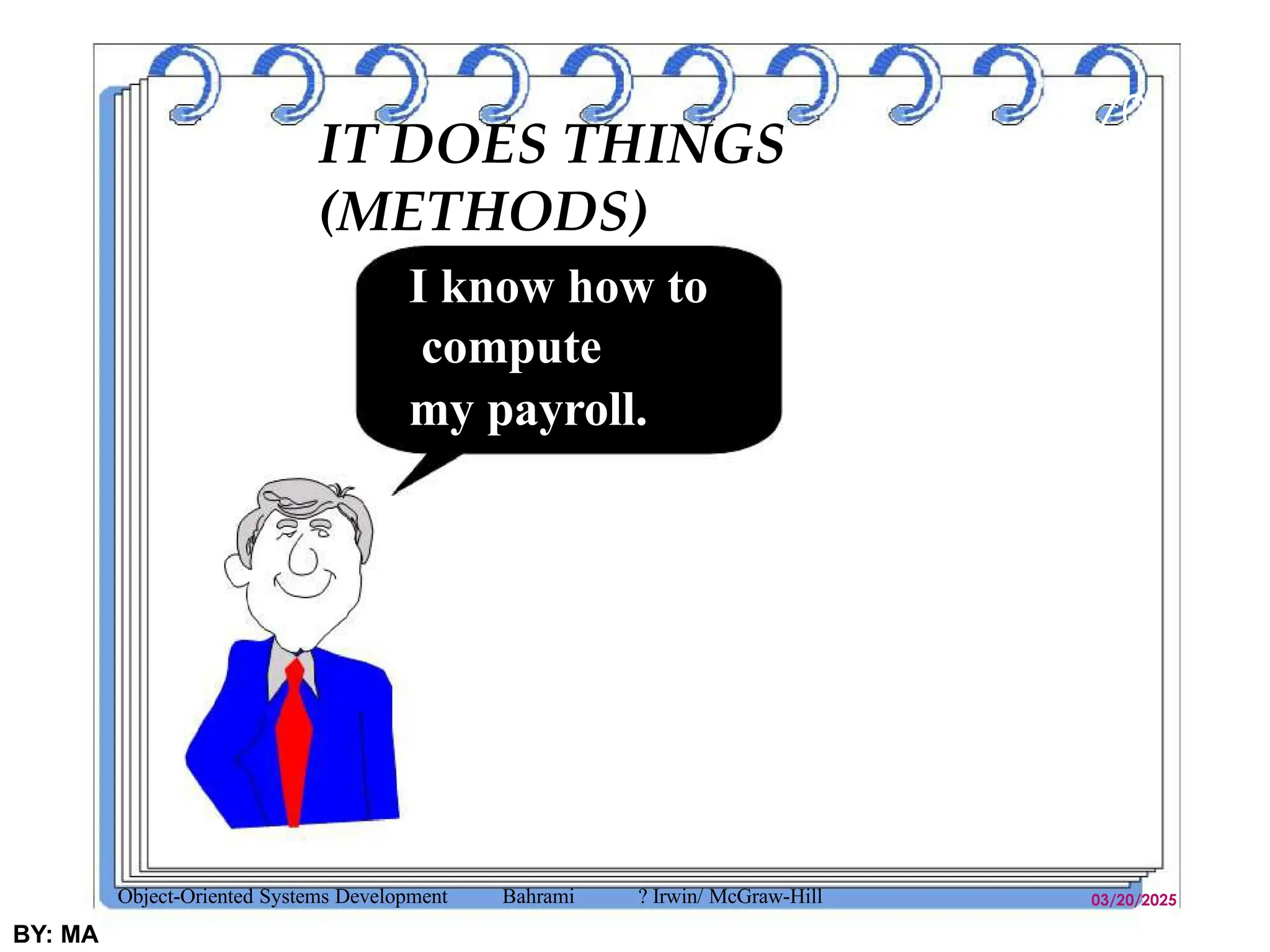
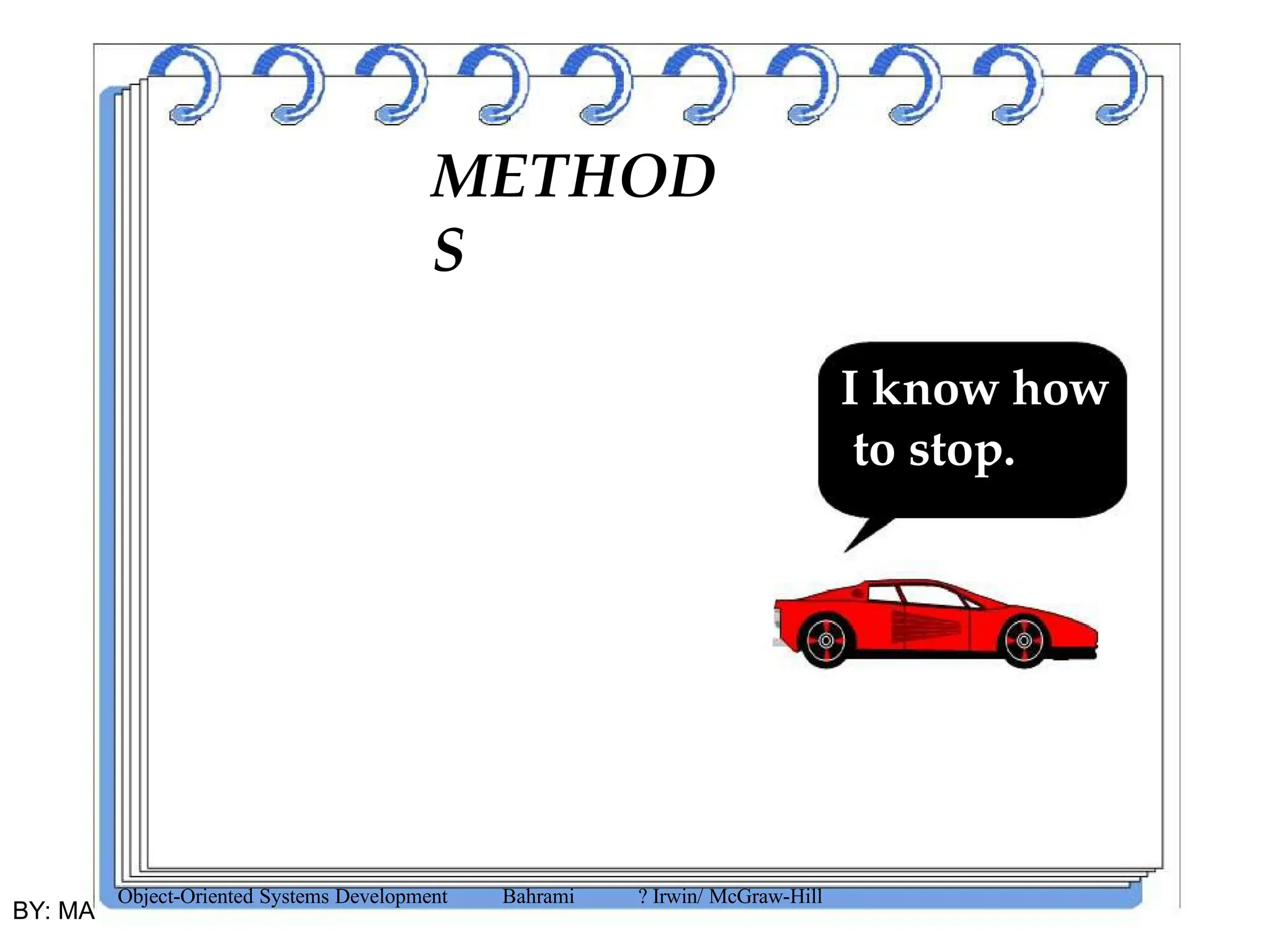
Methodsdefine objects behavior and specify the way in
which an Object’s data are manipulated.
In the Car example the car’s methods are: drive it, lock
it, tow it, carry passenger in it.
03/20/2025
BY: MA
67
68.
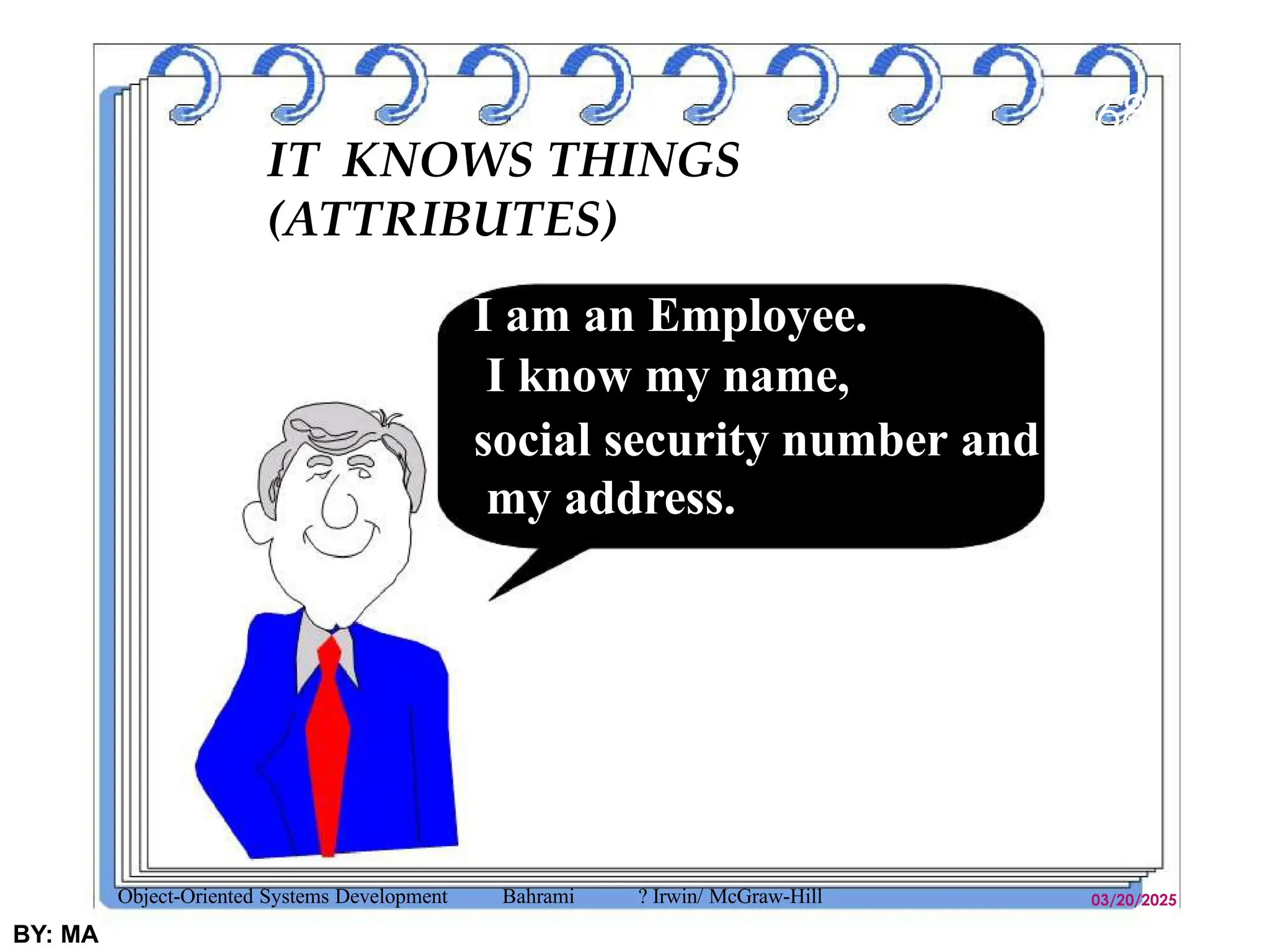
IT KNOWS THINGS
(ATTRIBUTES)
03/20/2025
BY:MA
68
I am an Employee.
I know my name,
social security number and
my address.
Object-Oriented Systems Development Bahrami ? Irwin/ McGraw-Hill
69.
ATTRIBUTE
S
03/20/2025
BY: MA
69
I ama Car.
I know my color,
manufacturer, cost,
owner and model.
Object-Oriented Systems Development Bahrami ? Irwin/ McGraw-Hill
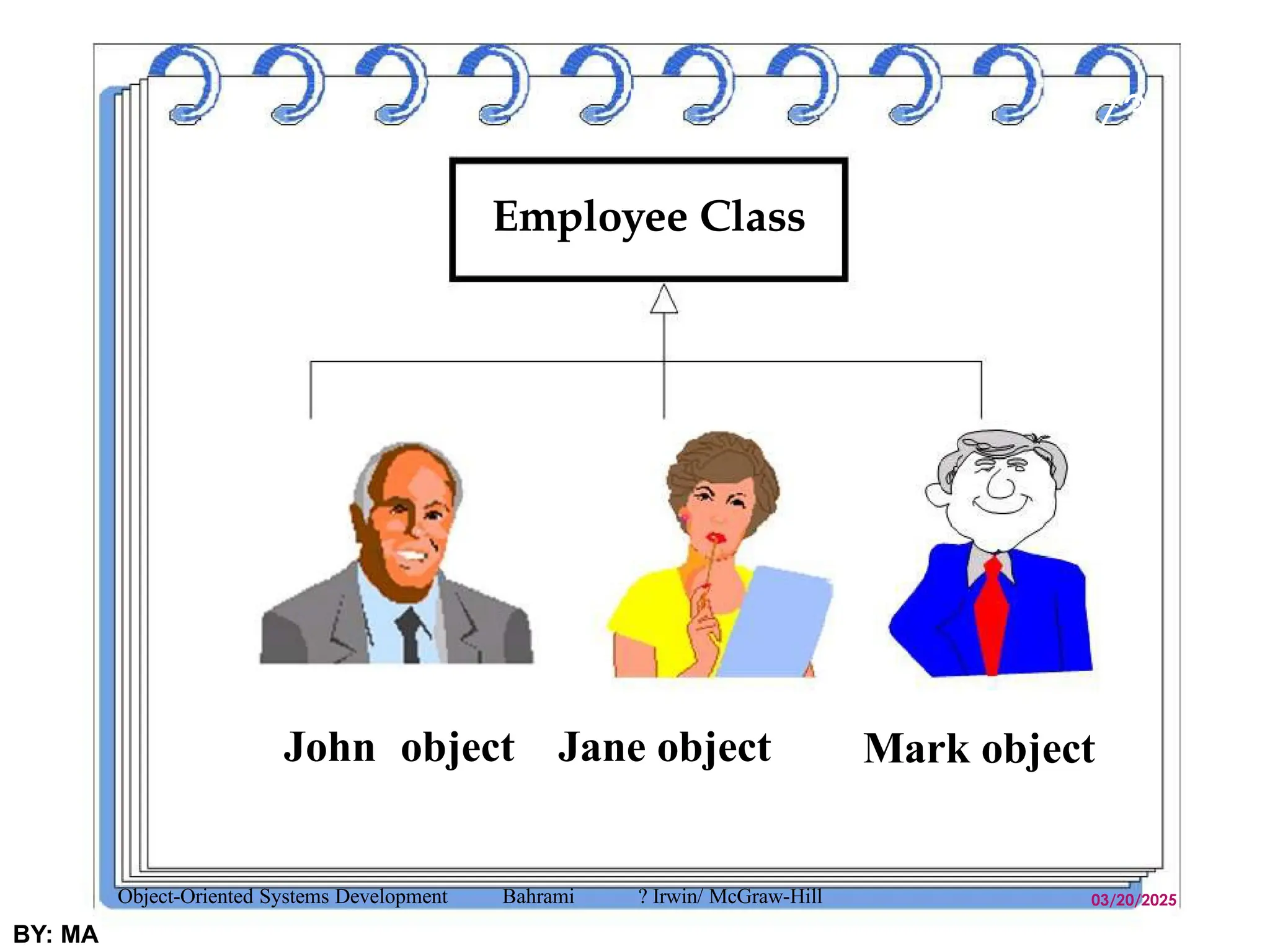
OBJECTS ARE GROUPEDIN CLASSES
The role of a class is to define the attributes and methods
(the state and behavior) of its instances.
Used to distinguish one type of object from the other.
Set of objects, that share common methods, structure,
behavior.
Single object is simply an instance of class.
The class car, for example, defines the property color.
Each individual car (object) will have a value for this
property, such as "maroon," "yellow" or "white."
03/20/2025
BY: MA
72
#43 not clearly explained, described, or shown: When your project's goals are ill-defined, it can be impossible to plan the necessary steps to achieve those goals.