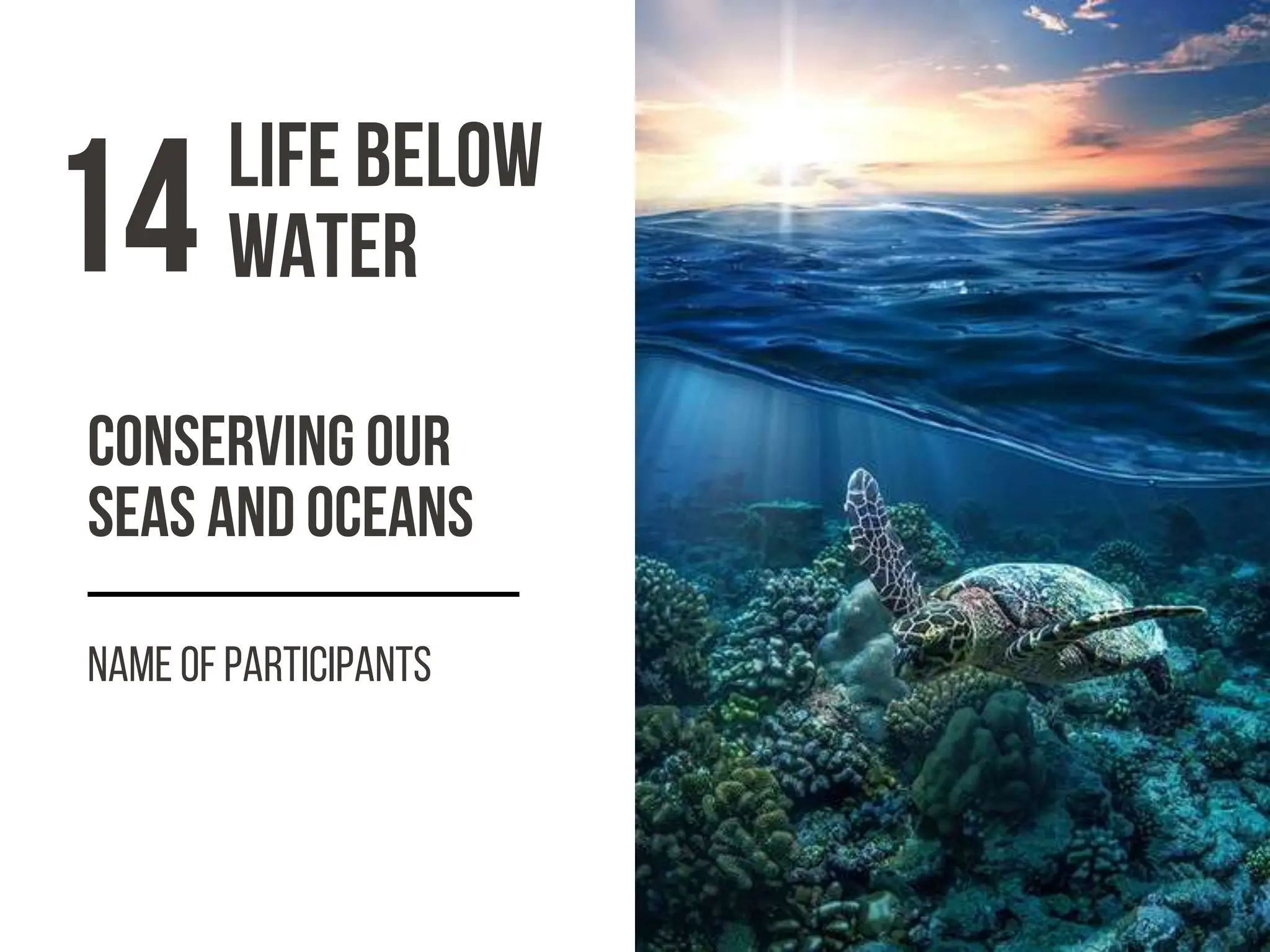
Life Below
Water
14
Conserving our
seas and oceans
Name ofParticipants
CONTENTS
• Introduction
• Objective
• Methodology
• Research/Survey data
• Results/Conclusion
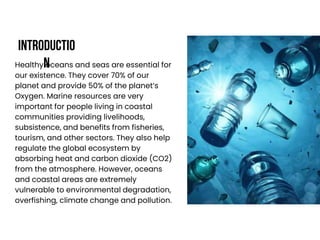
Healthy oceans and seas are essential for
our existence. They cover 70% of our
planet and provide 50% of the planet’s
Oxygen. Marine resources are very
important for people living in coastal
communities providing livelihoods,
subsistence, and benefits from fisheries,
tourism, and other sectors. They also help
regulate the global ecosystem by
absorbing heat and carbon dioxide (CO2)
from the atmosphere. However, oceans
and coastal areas are extremely
vulnerable to environmental degradation,
overfishing, climate change and pollution.
Introductio
n
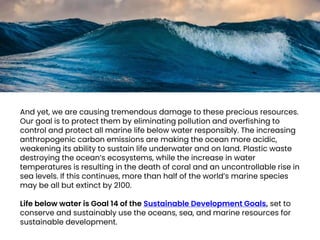
And yet, we are causing tremendous damage to these precious resources.
Our goal is to protect them by eliminating pollution and overfishing to
control and protect all marine life below water responsibly. The increasing
anthropogenic carbon emissions are making the ocean more acidic,
weakening its ability to sustain life underwater and on land. Plastic waste
destroying the ocean’s ecosystems, while the increase in water
temperatures is resulting in the death of coral and an uncontrollable rise in
sea levels. If this continues, more than half of the world’s marine species
may be all but extinct by 2100.
Life below water is Goal 14 of the Sustainable Development Goals, set to
conserve and sustainably use the oceans, sea, and marine resources for
sustainable development.
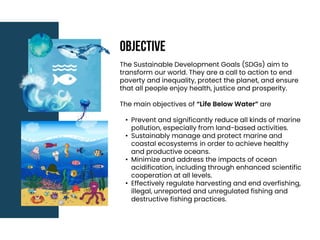
OBJECTIVE
The Sustainable Development Goals (SDGs) aim to
transform our world. They are a call to action to end
poverty and inequality, protect the planet, and ensure
that all people enjoy health, justice and prosperity.
The main objectives of “Life Below Water” are
• Prevent and significantly reduce all kinds of marine
pollution, especially from land-based activities.
• Sustainably manage and protect marine and
coastal ecosystems in order to achieve healthy
and productive oceans.
• Minimize and address the impacts of ocean
acidification, including through enhanced scientific
cooperation at all levels.
• Effectively regulate harvesting and end overfishing,
illegal, unreported and unregulated fishing and
destructive fishing practices.
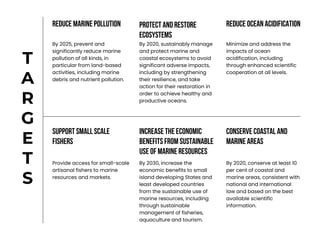
REDUCE MARINEPOLLUTION PROTECT ANDRESTORE
ECOSYSTEMS
REDUCE OCEAN ACIDIFICATION
By 2020, sustainably manage
and protect marine and
coastal ecosystems to avoid
significant adverse impacts,
including by strengthening
their resilience, and take
action for their restoration in
order to achieve healthy and
productive oceans.
Minimize and address the
impacts of ocean
acidification, including
through enhanced scientific
cooperation at all levels.
By 2025, prevent and
significantly reduce marine
pollution of all kinds, in
particular from land-based
activities, including marine
debris and nutrient pollution.
CONSERVE COASTAL AND
MARINEAREAS
By 2020, conserve at least 10
per cent of coastal and
marine areas, consistent with
national and international
law and based on the best
available scientific
information.
T
A
R
G
E
T
S
SUPPORT SMALL SCALE
FISHERS
Provide access for small-scale
artisanal fishers to marine
resources and markets.
INCREASE THE ECONOMIC
BENEFITS FROM SUSTAINABLE
USE OF MARINE RESOURCES
By 2030, increase the
economic benefits to small
island developing States and
least developed countries
from the sustainable use of
marine resources, including
through sustainable
management of fisheries,
aquaculture and tourism.
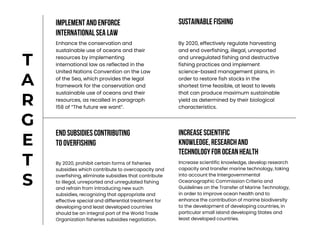
END SUBSIDIES CONTRIBUTING
TO OVERFISHING
INCREASESCIENTIFIC
KNOWLEDGE,RESEARCHAND
TECHNOLOGYFOR OCEANHEALTH
Increase scientific knowledge, develop research
capacity and transfer marine technology, taking
into account the Intergovernmental
Oceanographic Commission Criteria and
Guidelines on the Transfer of Marine Technology,
in order to improve ocean health and to
enhance the contribution of marine biodiversity
to the development of developing countries, in
particular small island developing States and
least developed countries.
By 2020, prohibit certain forms of fisheries
subsidies which contribute to overcapacity and
overfishing, eliminate subsidies that contribute
to illegal, unreported and unregulated fishing
and refrain from introducing new such
subsidies, recognizing that appropriate and
effective special and differential treatment for
developing and least developed countries
should be an integral part of the World Trade
Organization fisheries subsidies negotiation.
IMPLEMENT AND ENFORCE
INTERNATIONALSEA LAW
Enhance the conservation and
sustainable use of oceans and their
resources by implementing
international law as reflected in the
United Nations Convention on the Law
of the Sea, which provides the legal
framework for the conservation and
sustainable use of oceans and their
resources, as recalled in paragraph
158 of “The future we want”.
T
A
R
G
E
T
S
SUSTAINABLE FISHING
By 2020, effectively regulate harvesting
and end overfishing, illegal, unreported
and unregulated fishing and destructive
fishing practices and implement
science-based management plans, in
order to restore fish stocks in the
shortest time feasible, at least to levels
that can produce maximum sustainable
yield as determined by their biological
characteristics.
• Support any charity or donate to
organizations whether big or small, that
can make a difference to the environment!
• Never buy bottled water – Avoid buying
bottled water, to reduce plastic waste.
• Reduce waste – Much of the waste that we
produce on land ends up in the oceans.
Stop using plastic bags: The disposal of
plastic is a major cause of marine pollution.
METHO
• Organize a cleanup project for rivers and
oceans. Engage your entire community to
clean up local rivers, seasides, or oceans.
• Buy local and certified fish. Support small-
scale producers by shopping in local
markets and shops.
• Stay informed. Follow local news and stay
in touch with the Global Goals online or on
social media to gather knowledge about
water bodies and their conditions.
dolog
y
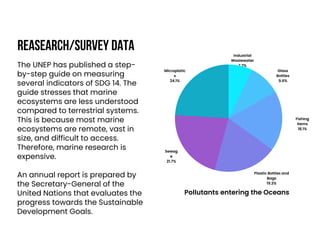
Microplatic
s
24.1%
Sewag
e
21.7%
Plastic Bottles and
Bags
19.3%
Fishing
Items
18.1%
Glass
Bottles
9.6%
Industrial
Wastewater
7.2%
Pollutants entering the Oceans
REASEARCH/SURVEY DATA
The UNEP has published a step-
by-step guide on measuring
several indicators of SDG 14. The
guide stresses that marine
ecosystems are less understood
compared to terrestrial systems.
This is because most marine
ecosystems are remote, vast in
size, and difficult to access.
Therefore, marine research is
expensive.
An annual report is prepared by
the Secretary-General of the
United Nations that evaluates the
progress towards the Sustainable
Development Goals.
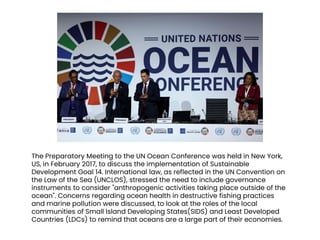
The Preparatory Meeting to the UN Ocean Conference was held in New York,
US, in February 2017, to discuss the implementation of Sustainable
Development Goal 14. International law, as reflected in the UN Convention on
the Law of the Sea (UNCLOS), stressed the need to include governance
instruments to consider "anthropogenic activities taking place outside of the
ocean". Concerns regarding ocean health in destructive fishing practices
and marine pollution were discussed, to look at the roles of the local
communities of Small Island Developing States(SIDS) and Least Developed
Countries (LDCs) to remind that oceans are a large part of their economies.
On a local level, we should
make ocean-friendly choices
when buying products or eating
food derived from oceans and
consume only what we need.
We should eliminate plastic
usage as much as possible and
organize beach clean-ups.
For open ocean and deep sea areas,
sustainability can be achieved only
through increased international
cooperation to protect vulnerable
habitats. Establishing comprehensive,
effective, and equitably managed
systems of government-protected
areas should be pursued to conserve
biodiversity and ensure a sustainable
future for the fishing industry.
CONCLUSION
THANK YOU!

Life Below Water.pptx

  • 1.
    Life Below Water 14 Conserving our seasand oceans Name ofParticipants
  • 2.
    CONTENTS • Introduction • Objective •Methodology • Research/Survey data • Results/Conclusion
  • 3.
    Healthy oceans andseas are essential for our existence. They cover 70% of our planet and provide 50% of the planet’s Oxygen. Marine resources are very important for people living in coastal communities providing livelihoods, subsistence, and benefits from fisheries, tourism, and other sectors. They also help regulate the global ecosystem by absorbing heat and carbon dioxide (CO2) from the atmosphere. However, oceans and coastal areas are extremely vulnerable to environmental degradation, overfishing, climate change and pollution. Introductio n
  • 4.
    And yet, weare causing tremendous damage to these precious resources. Our goal is to protect them by eliminating pollution and overfishing to control and protect all marine life below water responsibly. The increasing anthropogenic carbon emissions are making the ocean more acidic, weakening its ability to sustain life underwater and on land. Plastic waste destroying the ocean’s ecosystems, while the increase in water temperatures is resulting in the death of coral and an uncontrollable rise in sea levels. If this continues, more than half of the world’s marine species may be all but extinct by 2100. Life below water is Goal 14 of the Sustainable Development Goals, set to conserve and sustainably use the oceans, sea, and marine resources for sustainable development.
  • 5.
    OBJECTIVE The Sustainable DevelopmentGoals (SDGs) aim to transform our world. They are a call to action to end poverty and inequality, protect the planet, and ensure that all people enjoy health, justice and prosperity. The main objectives of “Life Below Water” are • Prevent and significantly reduce all kinds of marine pollution, especially from land-based activities. • Sustainably manage and protect marine and coastal ecosystems in order to achieve healthy and productive oceans. • Minimize and address the impacts of ocean acidification, including through enhanced scientific cooperation at all levels. • Effectively regulate harvesting and end overfishing, illegal, unreported and unregulated fishing and destructive fishing practices.
  • 6.
    REDUCE MARINEPOLLUTION PROTECTANDRESTORE ECOSYSTEMS REDUCE OCEAN ACIDIFICATION By 2020, sustainably manage and protect marine and coastal ecosystems to avoid significant adverse impacts, including by strengthening their resilience, and take action for their restoration in order to achieve healthy and productive oceans. Minimize and address the impacts of ocean acidification, including through enhanced scientific cooperation at all levels. By 2025, prevent and significantly reduce marine pollution of all kinds, in particular from land-based activities, including marine debris and nutrient pollution. CONSERVE COASTAL AND MARINEAREAS By 2020, conserve at least 10 per cent of coastal and marine areas, consistent with national and international law and based on the best available scientific information. T A R G E T S SUPPORT SMALL SCALE FISHERS Provide access for small-scale artisanal fishers to marine resources and markets. INCREASE THE ECONOMIC BENEFITS FROM SUSTAINABLE USE OF MARINE RESOURCES By 2030, increase the economic benefits to small island developing States and least developed countries from the sustainable use of marine resources, including through sustainable management of fisheries, aquaculture and tourism.
  • 7.
    END SUBSIDIES CONTRIBUTING TOOVERFISHING INCREASESCIENTIFIC KNOWLEDGE,RESEARCHAND TECHNOLOGYFOR OCEANHEALTH Increase scientific knowledge, develop research capacity and transfer marine technology, taking into account the Intergovernmental Oceanographic Commission Criteria and Guidelines on the Transfer of Marine Technology, in order to improve ocean health and to enhance the contribution of marine biodiversity to the development of developing countries, in particular small island developing States and least developed countries. By 2020, prohibit certain forms of fisheries subsidies which contribute to overcapacity and overfishing, eliminate subsidies that contribute to illegal, unreported and unregulated fishing and refrain from introducing new such subsidies, recognizing that appropriate and effective special and differential treatment for developing and least developed countries should be an integral part of the World Trade Organization fisheries subsidies negotiation. IMPLEMENT AND ENFORCE INTERNATIONALSEA LAW Enhance the conservation and sustainable use of oceans and their resources by implementing international law as reflected in the United Nations Convention on the Law of the Sea, which provides the legal framework for the conservation and sustainable use of oceans and their resources, as recalled in paragraph 158 of “The future we want”. T A R G E T S SUSTAINABLE FISHING By 2020, effectively regulate harvesting and end overfishing, illegal, unreported and unregulated fishing and destructive fishing practices and implement science-based management plans, in order to restore fish stocks in the shortest time feasible, at least to levels that can produce maximum sustainable yield as determined by their biological characteristics.
  • 8.
    • Support anycharity or donate to organizations whether big or small, that can make a difference to the environment! • Never buy bottled water – Avoid buying bottled water, to reduce plastic waste. • Reduce waste – Much of the waste that we produce on land ends up in the oceans. Stop using plastic bags: The disposal of plastic is a major cause of marine pollution. METHO • Organize a cleanup project for rivers and oceans. Engage your entire community to clean up local rivers, seasides, or oceans. • Buy local and certified fish. Support small- scale producers by shopping in local markets and shops. • Stay informed. Follow local news and stay in touch with the Global Goals online or on social media to gather knowledge about water bodies and their conditions. dolog y
  • 9.
    Microplatic s 24.1% Sewag e 21.7% Plastic Bottles and Bags 19.3% Fishing Items 18.1% Glass Bottles 9.6% Industrial Wastewater 7.2% Pollutantsentering the Oceans REASEARCH/SURVEY DATA The UNEP has published a step- by-step guide on measuring several indicators of SDG 14. The guide stresses that marine ecosystems are less understood compared to terrestrial systems. This is because most marine ecosystems are remote, vast in size, and difficult to access. Therefore, marine research is expensive. An annual report is prepared by the Secretary-General of the United Nations that evaluates the progress towards the Sustainable Development Goals.
  • 10.
    The Preparatory Meetingto the UN Ocean Conference was held in New York, US, in February 2017, to discuss the implementation of Sustainable Development Goal 14. International law, as reflected in the UN Convention on the Law of the Sea (UNCLOS), stressed the need to include governance instruments to consider "anthropogenic activities taking place outside of the ocean". Concerns regarding ocean health in destructive fishing practices and marine pollution were discussed, to look at the roles of the local communities of Small Island Developing States(SIDS) and Least Developed Countries (LDCs) to remind that oceans are a large part of their economies.
  • 11.
    On a locallevel, we should make ocean-friendly choices when buying products or eating food derived from oceans and consume only what we need. We should eliminate plastic usage as much as possible and organize beach clean-ups. For open ocean and deep sea areas, sustainability can be achieved only through increased international cooperation to protect vulnerable habitats. Establishing comprehensive, effective, and equitably managed systems of government-protected areas should be pursued to conserve biodiversity and ensure a sustainable future for the fishing industry. CONCLUSION
  • 12.