Using the IUP Libraries Information Sources for Conservation Biology Chris Clouser Science Librarian Fall 2007
Contents Information Levels Evaluating Primary Sources Print Resources Finding Books Electronic Resources Useful Databases Journals The Reference Collection Interlibrary Loan Questions?
Information Classes Scholars usually refer to three levels of information resource when talking about research. They are imaginatively named Primary, Secondary, and Tertiary sources. The difference between each level and the next is based on how much information is provided, and how the information is used.
Primary Sources Firsthand reports of scientific efforts, including research methodology, results, and conclusions. Provide sufficient information to reproduce the research by someone competent in the art. Critical for understanding the latest information--the state of the art Examples:  Published primary sources: journal articles, conference papers, expedition reports, theses and dissertations, patents Unpublished (usually): lab notebooks, internal correspondence, meeting notes
Secondary Sources Secondary sources collect information from primary sources according to some defined plan Typically summarize, analyze, or comment on primary sources--these sources use primary information to develop additional conclusions. They can serve as a guides to the original primary source Examples review articles, abstracts, encyclopedias, handbooks, textbooks
Tertiary Sources These are essentially search aids to help locate both primary and secondary sources Usually do not provide subject knowledge. Examples bibliographies, directories, research-in-progress listings
Evaluating Primary Sources* Once you have identified a primary source, you must evaluate its relevance to your research. There are three aspects of the article to evaluate: Credibility of the Author Validity of the Research Relevance of the Study * Adapted From:  http:// ucblibraries.colorado.edu/how/evaluate.htm
Evaluating Primary Sources Credibility:  It is important to determine whether the author is a credible expert in the discipline. Is he/she formally educated in the field? Does he/she work for a university or research center? Is he/she a recognized scholar in this area? Does he/she have a history with the subject (i.e., a track record of publications in the topic area?) Tools to evaluate authors: Citation Counts – Google Scholar, CSA, and other tools provide citation counting ability.  Search by author name to find other articles.  Look at author affiliation.
Evaluating Primary Sources Validity:  It is important to determine whether the article is valid primary research. Does the article cite/state all sources? Is there a full list of references included? Does the evidence described in the research support the claims made by the author? Is the research objective?  Is the research peer reviewed? Tools to evaluate validity: Ulrich’s Guide to Periodicals (for determining peer review); most databases also provide this information Examine article for proper reference list and citations
Evaluating Primary Sources Relevance:  It is important to determine whether the article is useful to  your  research. Is it broad enough to address your topic? Can the conclusions be generalized to broader concepts, or narrowed to specific instances?
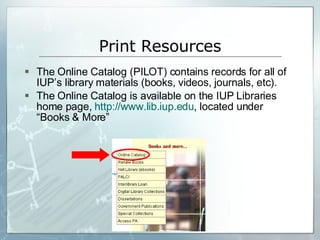
Print Resources The Online Catalog (PILOT) contains records for all of IUP’s library materials (books, videos, journals, etc). The Online Catalog is available on the IUP Libraries home page,  http://www.lib.iup.edu , located under “Books & More”
Print Resources Books: use  PILOT  to search for titles, authors, or subjects Stapleton Library uses the Library of Congress classification system to organize books. Books on Ecology, Conservation Biology, and general Biology are found in the QH section.  QH1-278.5 Natural history (General) QH1-(199.5) General  Including nature conservation, geographical distribution  QH201-278.5 Microscopy  QH301-705.5 Biology (General)  QH359-425 Evolution  QH426-470 Genetics  QH471-489 Reproduction  QH501-531 Life  QH540-549.5 Ecology  QH573-671 Cytology  QH705-705.5 Economic biology
Print Resources Journals: use  PILOT  to find titles (finding specific articles is best done using the electronic databases) The Print Journal collection is located on the ground floor of the library. Back issues of journals are bound and stored in the “back stacks” in alphabetical order, by title. In some cases, however, older issues are stored on microform, also located on the ground floor. Articles may be photocopied, but journals cannot be checked out.
Electronic Resources Electronic Books IUP has access to thousands of electronic books via  NetLibrary Access  NetLibrary  from the library home page:  http://www.lib.iup.edu  under “Books and more…” Web Guides IUP librarians assemble web guides to cover popular or critical topics They can be accessed from the library home page under “Research Guides” Guides you might be interested in:  Science Research Guides :  http://scilib.edublogs.org
Electronic Journals Accessible from the E-Journal Portal, IUP currently owns more than 400 electronic journals in conservation biology, ecology, animal sciences, and related disciplines.  These electronic journals are directly accessible from the  E-Journal Portal  – if you know the title, you can search for a journal directly; you can also browse journals by subject.  Each electronic journal is contained in or more of our databases, which means if you search in a database (such as Biological Sciences or Zoological Records Plus) and find an article that you want in an e-journal we own, you can click the  Article Linker  button to have our cataloging system attempt to locate a full-text copy of the article for you.
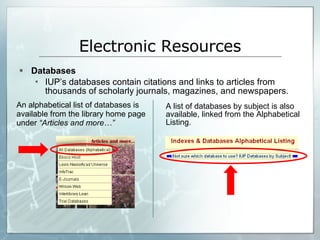
Electronic Resources Databases IUP’s databases contain citations and links to articles from thousands of scholarly journals, magazines, and newspapers. An alphabetical list of databases is available from the library home page under  “Articles and more…” A list of databases by subject is also available, linked from the Alphabetical Listing.
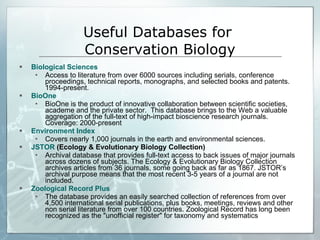
Biological Sciences Access to literature from over 6000 sources including serials, conference proceedings, technical reports, monographs, and selected books and patents. 1994-present.  BioOne BioOne is the product of innovative collaboration between scientific societies, academe and the private sector.  This database brings to the Web a valuable aggregation of the full-text of high-impact bioscience research journals.  Coverage: 2000-present  Environment Index Covers nearly 1,000 journals in the earth and environmental sciences. JSTOR  (Ecology & Evolutionary Biology Collection) Archival database that provides full-text access to back issues of major journals across dozens of subjects. The Ecology & Evolutionary Biology Collection archives articles from 36 journals, some going back as far as 1867. JSTOR’s archival purpose means that the most recent 3-5 years of a journal are not included. Zoological Record Plus The database provides an easily searched collection of references from over 4,500 international serial publications, plus books, meetings, reviews and other non serial literature from over 100 countries. Zoological Record has long been recognized as the "unofficial register" for taxonomy and systematics  Useful Databases for  Conservation Biology
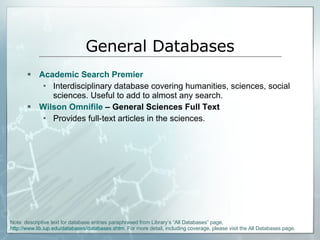
General Databases Academic Search Premier Interdisciplinary database covering humanities, sciences, social sciences. Useful to add to almost any search. Wilson  Omnifile  – General Sciences Full Text Provides full-text articles in the sciences. Note: descriptive text for database entries paraphrased from Library’s “All Databases” page,  http://www.lib.iup.edu/databases/databases.shtm . For more detail, including coverage, please visit the All Databases page.
The Reference Desk For times when you need to look up something quickly, the IUP reference collection is located on the first floor of Stapleton Library.  Additionally, reference librarians are on duty from 7:45AM to 10:00PM to assist with any questions you might have regarding locating materials in the IUP libraries.
What if we don’t have it? If we don’t have what you need…we can get it. PALCI Pennsylvania Academic Library Consortium, Inc. lets you request books from other Pennsylvania libraries.  Books will be sent to the IUP Library for pickup by the requester.  Allow 3-5 days to get the requested item PALCI only works for books. For journal articles, use ILLIAD. ILLIAD ILLIAD lets you request books (if they can’t be found in PALCI) or copies of journal articles, which will be sent either in paper or electronically. You will need to set up an account with ILLIAD  Allow 3-4 days for delivery.
ILLIAD is the Interlibrary Loan system used to obtain copies of journal articles that IUP does not have in its own collections. Articles are usually sent as PDF’s via email; occasionally a photocopy is mailed. Turnaround time varies between 3 days and 2 weeks, depending on how obscure or difficult to find an article is. We’ve found that it’s usually around 3-4 days to receive an article. There is no cost to you for the ILLIAD service .  Interlibrary Loan
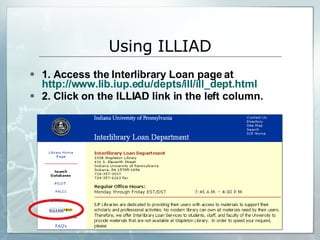
1. Access the Interlibrary Loan page at  http://www.lib.iup.edu/depts/ill/ill_dept.html 2. Click on the ILLIAD link in the left column.  Using ILLIAD
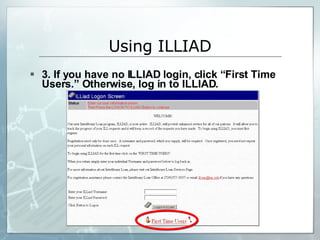
3. If you have no ILLIAD login, click “First Time Users.” Otherwise, log in to ILLIAD. Using ILLIAD
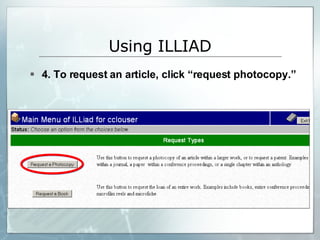
4. To request an article, click “request photocopy.” Using ILLIAD
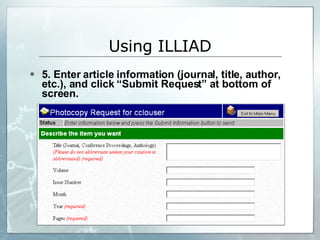
5. Enter article information (journal, title, author, etc.), and click “Submit Request” at bottom of screen. Using ILLIAD
Remember: if you have a question, ask a librarian ! Chris Clouser Science Librarian [email_address]

Library Orientation for Conservation Biology

  • 1.
    Using the IUPLibraries Information Sources for Conservation Biology Chris Clouser Science Librarian Fall 2007
  • 2.
    Contents Information LevelsEvaluating Primary Sources Print Resources Finding Books Electronic Resources Useful Databases Journals The Reference Collection Interlibrary Loan Questions?
  • 3.
    Information Classes Scholarsusually refer to three levels of information resource when talking about research. They are imaginatively named Primary, Secondary, and Tertiary sources. The difference between each level and the next is based on how much information is provided, and how the information is used.
  • 4.
    Primary Sources Firsthandreports of scientific efforts, including research methodology, results, and conclusions. Provide sufficient information to reproduce the research by someone competent in the art. Critical for understanding the latest information--the state of the art Examples: Published primary sources: journal articles, conference papers, expedition reports, theses and dissertations, patents Unpublished (usually): lab notebooks, internal correspondence, meeting notes
  • 5.
    Secondary Sources Secondarysources collect information from primary sources according to some defined plan Typically summarize, analyze, or comment on primary sources--these sources use primary information to develop additional conclusions. They can serve as a guides to the original primary source Examples review articles, abstracts, encyclopedias, handbooks, textbooks
  • 6.
    Tertiary Sources Theseare essentially search aids to help locate both primary and secondary sources Usually do not provide subject knowledge. Examples bibliographies, directories, research-in-progress listings
  • 7.
    Evaluating Primary Sources*Once you have identified a primary source, you must evaluate its relevance to your research. There are three aspects of the article to evaluate: Credibility of the Author Validity of the Research Relevance of the Study * Adapted From: http:// ucblibraries.colorado.edu/how/evaluate.htm
  • 8.
    Evaluating Primary SourcesCredibility: It is important to determine whether the author is a credible expert in the discipline. Is he/she formally educated in the field? Does he/she work for a university or research center? Is he/she a recognized scholar in this area? Does he/she have a history with the subject (i.e., a track record of publications in the topic area?) Tools to evaluate authors: Citation Counts – Google Scholar, CSA, and other tools provide citation counting ability. Search by author name to find other articles. Look at author affiliation.
  • 9.
    Evaluating Primary SourcesValidity: It is important to determine whether the article is valid primary research. Does the article cite/state all sources? Is there a full list of references included? Does the evidence described in the research support the claims made by the author? Is the research objective? Is the research peer reviewed? Tools to evaluate validity: Ulrich’s Guide to Periodicals (for determining peer review); most databases also provide this information Examine article for proper reference list and citations
  • 10.
    Evaluating Primary SourcesRelevance: It is important to determine whether the article is useful to your research. Is it broad enough to address your topic? Can the conclusions be generalized to broader concepts, or narrowed to specific instances?
  • 11.
    Print Resources TheOnline Catalog (PILOT) contains records for all of IUP’s library materials (books, videos, journals, etc). The Online Catalog is available on the IUP Libraries home page, http://www.lib.iup.edu , located under “Books & More”
  • 12.
    Print Resources Books:use PILOT to search for titles, authors, or subjects Stapleton Library uses the Library of Congress classification system to organize books. Books on Ecology, Conservation Biology, and general Biology are found in the QH section. QH1-278.5 Natural history (General) QH1-(199.5) General Including nature conservation, geographical distribution QH201-278.5 Microscopy QH301-705.5 Biology (General) QH359-425 Evolution QH426-470 Genetics QH471-489 Reproduction QH501-531 Life QH540-549.5 Ecology QH573-671 Cytology QH705-705.5 Economic biology
  • 13.
    Print Resources Journals:use PILOT to find titles (finding specific articles is best done using the electronic databases) The Print Journal collection is located on the ground floor of the library. Back issues of journals are bound and stored in the “back stacks” in alphabetical order, by title. In some cases, however, older issues are stored on microform, also located on the ground floor. Articles may be photocopied, but journals cannot be checked out.
  • 14.
    Electronic Resources ElectronicBooks IUP has access to thousands of electronic books via NetLibrary Access NetLibrary from the library home page: http://www.lib.iup.edu under “Books and more…” Web Guides IUP librarians assemble web guides to cover popular or critical topics They can be accessed from the library home page under “Research Guides” Guides you might be interested in: Science Research Guides : http://scilib.edublogs.org
  • 15.
    Electronic Journals Accessiblefrom the E-Journal Portal, IUP currently owns more than 400 electronic journals in conservation biology, ecology, animal sciences, and related disciplines. These electronic journals are directly accessible from the E-Journal Portal – if you know the title, you can search for a journal directly; you can also browse journals by subject. Each electronic journal is contained in or more of our databases, which means if you search in a database (such as Biological Sciences or Zoological Records Plus) and find an article that you want in an e-journal we own, you can click the Article Linker button to have our cataloging system attempt to locate a full-text copy of the article for you.
  • 16.
    Electronic Resources DatabasesIUP’s databases contain citations and links to articles from thousands of scholarly journals, magazines, and newspapers. An alphabetical list of databases is available from the library home page under “Articles and more…” A list of databases by subject is also available, linked from the Alphabetical Listing.
  • 17.
    Biological Sciences Accessto literature from over 6000 sources including serials, conference proceedings, technical reports, monographs, and selected books and patents. 1994-present. BioOne BioOne is the product of innovative collaboration between scientific societies, academe and the private sector.  This database brings to the Web a valuable aggregation of the full-text of high-impact bioscience research journals. Coverage: 2000-present Environment Index Covers nearly 1,000 journals in the earth and environmental sciences. JSTOR (Ecology & Evolutionary Biology Collection) Archival database that provides full-text access to back issues of major journals across dozens of subjects. The Ecology & Evolutionary Biology Collection archives articles from 36 journals, some going back as far as 1867. JSTOR’s archival purpose means that the most recent 3-5 years of a journal are not included. Zoological Record Plus The database provides an easily searched collection of references from over 4,500 international serial publications, plus books, meetings, reviews and other non serial literature from over 100 countries. Zoological Record has long been recognized as the "unofficial register" for taxonomy and systematics Useful Databases for Conservation Biology
  • 18.
    General Databases AcademicSearch Premier Interdisciplinary database covering humanities, sciences, social sciences. Useful to add to almost any search. Wilson Omnifile – General Sciences Full Text Provides full-text articles in the sciences. Note: descriptive text for database entries paraphrased from Library’s “All Databases” page, http://www.lib.iup.edu/databases/databases.shtm . For more detail, including coverage, please visit the All Databases page.
  • 19.
    The Reference DeskFor times when you need to look up something quickly, the IUP reference collection is located on the first floor of Stapleton Library. Additionally, reference librarians are on duty from 7:45AM to 10:00PM to assist with any questions you might have regarding locating materials in the IUP libraries.
  • 20.
    What if wedon’t have it? If we don’t have what you need…we can get it. PALCI Pennsylvania Academic Library Consortium, Inc. lets you request books from other Pennsylvania libraries. Books will be sent to the IUP Library for pickup by the requester. Allow 3-5 days to get the requested item PALCI only works for books. For journal articles, use ILLIAD. ILLIAD ILLIAD lets you request books (if they can’t be found in PALCI) or copies of journal articles, which will be sent either in paper or electronically. You will need to set up an account with ILLIAD Allow 3-4 days for delivery.
  • 21.
    ILLIAD is theInterlibrary Loan system used to obtain copies of journal articles that IUP does not have in its own collections. Articles are usually sent as PDF’s via email; occasionally a photocopy is mailed. Turnaround time varies between 3 days and 2 weeks, depending on how obscure or difficult to find an article is. We’ve found that it’s usually around 3-4 days to receive an article. There is no cost to you for the ILLIAD service . Interlibrary Loan
  • 22.
    1. Access theInterlibrary Loan page at http://www.lib.iup.edu/depts/ill/ill_dept.html 2. Click on the ILLIAD link in the left column. Using ILLIAD
  • 23.
    3. If youhave no ILLIAD login, click “First Time Users.” Otherwise, log in to ILLIAD. Using ILLIAD
  • 24.
    4. To requestan article, click “request photocopy.” Using ILLIAD
  • 25.
    5. Enter articleinformation (journal, title, author, etc.), and click “Submit Request” at bottom of screen. Using ILLIAD
  • 26.
    Remember: if youhave a question, ask a librarian ! Chris Clouser Science Librarian [email_address]