Introduction to Library
Catalogues
Library catalogues are a vital tool for organizing and accessing the
wealth of knowledge and resources available in libraries. They serve
as a guide, providing essential information about the location,
availability, and other details of library materials.
by Sanjay Shahjit
Early History of Library Catalogues
1 Pre-15th Century
Before the 15th century, library collections were often organized by size, with the
most important works stored in a separate location.
2 15th Century
With the invention of the printing press, libraries began to catalogue books
individually based on author, title, or subject.
3 17th Century
Libraries started using alphabetical order for cataloguing and adopted standardized
methods for organizing information.
The Development of the Card
Catalogue System
Invention
The card catalogue system was invented in
the 19th century to efficiently store and
organize library materials using index cards.
Impact
This system revolutionized library
organization, making it easier for patrons and
librarians to quickly locate specific books and
resources.
Library Catalogue Card
A library catalogue card is a physical or digital card that contains key information about a specific
book or resource in a library's collection. It typically includes details such as the title, author,
subject, call number, and location of the item. Library patrons can use catalogue cards to find and
request materials they are interested in.
The Role of Melvil Dewey in Library
Catalogues
1 Contributions
Melvil Dewey established the Dewey
Decimal System, a widely used
classification system for library
materials.
2 Legacy
His work significantly influenced library
science and the role of standardized
methods in knowledge organization.
Transition to Digital Catalogues
Technological Advancements
Advancements in information technology led to the development of
digital catalogues, allowing for more efficient and comprehensive access
to library resources.
Enhanced Accessibility
Digital catalogues enable remote access, searchability, and integration
with other online databases, expanding the reach of library resources.
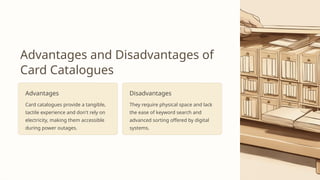
Advantages and Disadvantages of
Card Catalogues
Advantages
Card catalogues provide a tangible,
tactile experience and don't rely on
electricity, making them accessible
during power outages.
Disadvantages
They require physical space and lack
the ease of keyword search and
advanced sorting offered by digital
systems.
Impact of Library Catalogues on
Information Access
2 Billion
Usage
150+
Countries
Conclusion and Future of Library
Catalogues
Digital Catalogues Advantages Disadvantages
Accessibility Enhanced global access Dependency on technology

Introduction-to-Library-Catalogues 25.pptx

  • 1.
    Introduction to Library Catalogues Librarycatalogues are a vital tool for organizing and accessing the wealth of knowledge and resources available in libraries. They serve as a guide, providing essential information about the location, availability, and other details of library materials. by Sanjay Shahjit
  • 2.
    Early History ofLibrary Catalogues 1 Pre-15th Century Before the 15th century, library collections were often organized by size, with the most important works stored in a separate location. 2 15th Century With the invention of the printing press, libraries began to catalogue books individually based on author, title, or subject. 3 17th Century Libraries started using alphabetical order for cataloguing and adopted standardized methods for organizing information.
  • 3.
    The Development ofthe Card Catalogue System Invention The card catalogue system was invented in the 19th century to efficiently store and organize library materials using index cards. Impact This system revolutionized library organization, making it easier for patrons and librarians to quickly locate specific books and resources. Library Catalogue Card A library catalogue card is a physical or digital card that contains key information about a specific book or resource in a library's collection. It typically includes details such as the title, author, subject, call number, and location of the item. Library patrons can use catalogue cards to find and request materials they are interested in.
  • 4.
    The Role ofMelvil Dewey in Library Catalogues 1 Contributions Melvil Dewey established the Dewey Decimal System, a widely used classification system for library materials. 2 Legacy His work significantly influenced library science and the role of standardized methods in knowledge organization.
  • 5.
    Transition to DigitalCatalogues Technological Advancements Advancements in information technology led to the development of digital catalogues, allowing for more efficient and comprehensive access to library resources. Enhanced Accessibility Digital catalogues enable remote access, searchability, and integration with other online databases, expanding the reach of library resources.
  • 6.
    Advantages and Disadvantagesof Card Catalogues Advantages Card catalogues provide a tangible, tactile experience and don't rely on electricity, making them accessible during power outages. Disadvantages They require physical space and lack the ease of keyword search and advanced sorting offered by digital systems.
  • 7.
    Impact of LibraryCatalogues on Information Access 2 Billion Usage 150+ Countries
  • 8.
    Conclusion and Futureof Library Catalogues Digital Catalogues Advantages Disadvantages Accessibility Enhanced global access Dependency on technology