Libraries Developing
                               Openly
                                  Nicole C. Engard
               Director of Open Source Education, ByWater Solutions
                 Author of Practical Open Source Software for Libraries

Monday, July 25, 2011
Open Source Definition
                 Open source software is software that users have the
                 ability to run, distribute, study and modify for any
                 purpose.

                 Open source is a collaborative software-development
                 method that harnesses the power of peer review and
                 transparency of process to develop code that is freely
                 accessible.1

                 Open source draws on an ecosystem of thousands of
                 developers and customers all over the world to drive
                 innovation.2
                                              1,2 http://connect.educause.edu/display/47941

Monday, July 25, 2011
Four Freedoms of
                          Free Software
                    • You need all four of these freedoms to
                      have free software
                         • Freedom of use
                         • Freedom to copy
                         • Freedom to modify
                         • Freedom to contribute
                                     http://www.web2learning.net/archives/4263
Monday, July 25, 2011
Sharing of Ideas
                 "If you have an apple and I have an apple
                 and we exchange apples, then you and I
                 will still each have one apple. But if you
                 have an idea and I have an idea and we
                 exchange these ideas, then each of us
                 will have two ideas."
                               Attributed to Bernard Shaw
                                      http://ftacademy.org/materials/fsm/1#1
Monday, July 25, 2011
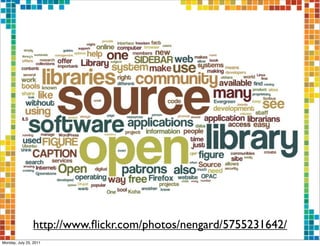
http://www.flickr.com/photos/nengard/5755231642/
Monday, July 25, 2011
Open Source Community
              •         Open source is about more than free software
              •         Community is crucial to the growth of open source
              •         Without shared knowledge and collaboration the
                        project will not grow
              •         People who use open source can collaborate and
                        contribute in many ways with the community
                    •     Write code
                    •     Write documentation
                    •     Debug
                    •     Educate others

Monday, July 25, 2011
Libraries & Open Source
                    • Libraries and Open Source Both...
                     • Believe that information should be freely
                          accessible to everyone
                        • Give away stuff
                        • Benefit from the generosity of others
                        • Are about communities
                        • Make the world a better place
                                               -- Horton, G. http://tinyurl.com/3jvumn
Monday, July 25, 2011
Libraries & Open Source
                        Libraries and Open Source make the
                                     perfect pair

                [Librarians] "are almost ethically
                required to use and develop open source
                software."
                   Crawford, R. S. http://www.lugod.org/presentations/oss4lib.pdf

Monday, July 25, 2011
What I Learned


Monday, July 25, 2011
Start Openly!

                    • Create solutions for your library in the
                        open from the start
                    • It’s easier to open source a project if that
                        was the plan all along
                    • Even though our firms might be
                        competitors, we (the librarians) are not!


Monday, July 25, 2011
For the Love of
                          Open Source
                  The best person to do a job is the one who
                  most wants to do that job; and the best people
                  to evaluate their performance are their friends
                  and peers who, by the way, will enthusiastically
                  pitch in to improve the final product, simply
                  for the sheer pleasure of helping one another
                  and creating something beautiful from which
                  they all will benefit.
                                                Howe, J. (2008). Crowdsourcing: Why the
                                               power of the crowd is driving the future of
                                                business. New York: Crown Business. p.8

Monday, July 25, 2011
How do we do it?


Monday, July 25, 2011
Be Honest
                  In a world where people are constantly
                  exchanging ideas, evaluating concepts,
                  and suggesting enhancements, it is vitally
                  important that everyone speak the truth
                  as he sees it. If someone fails to speak
                  the truth, the process of creating
                  software will be greatly impaired.
                                      Pavlicek, Russell. Embracing insanity : open source
                                     software development. Indianapolis IN: SAMS, 2000.
Monday, July 25, 2011
Be Transparent
            Make sure that everything you do and say is out in
            the open so that everyone can benefit from your
            opinion, experiences and skills. If you’re
            communicating about the project, log the discussion
            for those who aren’t online. If you’re writing code,
            make sure it’s submitted to the public repository or
            logged in a shared database of current projects so
            that work isn’t being doubled, and if you teach
            someone something new document it and share it
            with others so they too can learn down the road.
                                Engard, Nicole C. Practical Open Source Software for Libraries.
                                Chandos Publishing, 2010. http://opensource.web2learning.net.
Monday, July 25, 2011
Be Respectful

                  Critiquing the community is a right
                  reserved for those who have
                  proved themselves by making
                  valuable contributions
                             Tapscott, Don, and Anthony D. Williams. “Embracing open source
                               culture and strategy.” In Wikinomics: How mass collaboration
                               changes everything, 82-83. Expanded Edition. New York, NY:
                                    Penguin USA, 2008. www.wikinomics.com/book/.  

Monday, July 25, 2011
Be A Mentor
               [W]e all learn differently.You might want
               to settle in with a programming book,
               while I prefer to take an in-person class. If
               your project wants to attract new
               contributors, it behooves you to think past
               the "dive into the deep end" culture
                                      Schindler, Esther. “Mentoring in Open Source
                                   Communities: What Works? What Doesn't?.” ITworld,
                                        September 20, 2009. http://bit.ly/9ppL3O.
Monday, July 25, 2011
Success Stories


Monday, July 25, 2011
Blacklight
              • Open source discovery layer developed by staff
                        at the University of Virginia Library
              • Designed to replace old fashioned, difficult to
                        use, OPACs
              • “Blacklight can ultimately be successful and
                        sustainable in the long run only if it is an open
                        project; that is, it takes contributions from a
                        community of developers across many
                        institutions to enhance and support it”
                                                    http://projectblacklight.org
Monday, July 25, 2011
Koha
             • A fully-functional open source integrated
               library system (http://koha-community.org)
             • Developed 11 years ago by the Horowhenua
               Library Trust in New Zealand
             • “An open source project is never finished.
                        Someone will always see something else to
                        improve and we were counting on this. We
                        wanted to encourage a supportive community
                        around Koha right from the start.”1
                                    1.Ransom, Joann, Chris Cormack, and Rosalie Blake. “How Hard Can It Be? :
                                     Developing in Open Source.” The Code4Lib Journal, no. 7 (June 26, 2009).
                                                     http://journal.code4lib.org/articles/1638.
Monday, July 25, 2011
Evergreen
              • A fully-functional open source integrated
                library system (http://open-ils.org)
              • Developed by the Georgia Pines Library
                System in 2006
              • “[T]he Evergreen community is also marked by
                        a high degree of participation by the librarians
                        who use the software and contribute
                        documentation, bug reports, and organizational
                        energy. As such, Evergreen is very much about
                        both the developers *and* the users.”
Monday, July 25, 2011
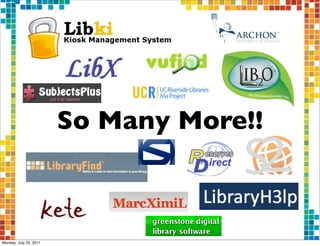
So Many More!!


Monday, July 25, 2011
Keep Learning


Monday, July 25, 2011
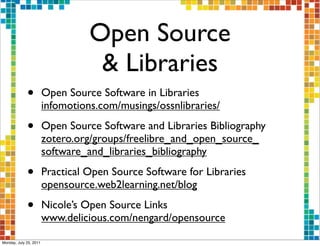
Open Source
                                   & Libraries
             •          Open Source Software in Libraries
                        infomotions.com/musings/ossnlibraries/

             •          Open Source Software and Libraries Bibliography
                        zotero.org/groups/freelibre_and_open_source_
                        software_and_libraries_bibliography

             •          Practical Open Source Software for Libraries
                        opensource.web2learning.net/blog

             •          Nicole’s Open Source Links
                        www.delicious.com/nengard/opensource

Monday, July 25, 2011
Thank You
                               Nicole C. Engard
                              nengard@gmail.com

               Slides: opensource.web2learning.net > Presentations


Monday, July 25, 2011

Libraries Developing Openly

  • 1.
    Libraries Developing Openly Nicole C. Engard Director of Open Source Education, ByWater Solutions Author of Practical Open Source Software for Libraries Monday, July 25, 2011
  • 2.
    Open Source Definition Open source software is software that users have the ability to run, distribute, study and modify for any purpose. Open source is a collaborative software-development method that harnesses the power of peer review and transparency of process to develop code that is freely accessible.1 Open source draws on an ecosystem of thousands of developers and customers all over the world to drive innovation.2 1,2 http://connect.educause.edu/display/47941 Monday, July 25, 2011
  • 3.
    Four Freedoms of Free Software • You need all four of these freedoms to have free software • Freedom of use • Freedom to copy • Freedom to modify • Freedom to contribute http://www.web2learning.net/archives/4263 Monday, July 25, 2011
  • 4.
    Sharing of Ideas "If you have an apple and I have an apple and we exchange apples, then you and I will still each have one apple. But if you have an idea and I have an idea and we exchange these ideas, then each of us will have two ideas." Attributed to Bernard Shaw http://ftacademy.org/materials/fsm/1#1 Monday, July 25, 2011
  • 5.
  • 6.
    Open Source Community • Open source is about more than free software • Community is crucial to the growth of open source • Without shared knowledge and collaboration the project will not grow • People who use open source can collaborate and contribute in many ways with the community • Write code • Write documentation • Debug • Educate others Monday, July 25, 2011
  • 7.
    Libraries & OpenSource • Libraries and Open Source Both... • Believe that information should be freely accessible to everyone • Give away stuff • Benefit from the generosity of others • Are about communities • Make the world a better place -- Horton, G. http://tinyurl.com/3jvumn Monday, July 25, 2011
  • 8.
    Libraries & OpenSource Libraries and Open Source make the perfect pair [Librarians] "are almost ethically required to use and develop open source software." Crawford, R. S. http://www.lugod.org/presentations/oss4lib.pdf Monday, July 25, 2011
  • 9.
  • 10.
    Start Openly! • Create solutions for your library in the open from the start • It’s easier to open source a project if that was the plan all along • Even though our firms might be competitors, we (the librarians) are not! Monday, July 25, 2011
  • 11.
    For the Loveof Open Source The best person to do a job is the one who most wants to do that job; and the best people to evaluate their performance are their friends and peers who, by the way, will enthusiastically pitch in to improve the final product, simply for the sheer pleasure of helping one another and creating something beautiful from which they all will benefit. Howe, J. (2008). Crowdsourcing: Why the power of the crowd is driving the future of business. New York: Crown Business. p.8 Monday, July 25, 2011
  • 12.
    How do wedo it? Monday, July 25, 2011
  • 13.
    Be Honest In a world where people are constantly exchanging ideas, evaluating concepts, and suggesting enhancements, it is vitally important that everyone speak the truth as he sees it. If someone fails to speak the truth, the process of creating software will be greatly impaired. Pavlicek, Russell. Embracing insanity : open source software development. Indianapolis IN: SAMS, 2000. Monday, July 25, 2011
  • 14.
    Be Transparent Make sure that everything you do and say is out in the open so that everyone can benefit from your opinion, experiences and skills. If you’re communicating about the project, log the discussion for those who aren’t online. If you’re writing code, make sure it’s submitted to the public repository or logged in a shared database of current projects so that work isn’t being doubled, and if you teach someone something new document it and share it with others so they too can learn down the road. Engard, Nicole C. Practical Open Source Software for Libraries. Chandos Publishing, 2010. http://opensource.web2learning.net. Monday, July 25, 2011
  • 15.
    Be Respectful Critiquing the community is a right reserved for those who have proved themselves by making valuable contributions Tapscott, Don, and Anthony D. Williams. “Embracing open source culture and strategy.” In Wikinomics: How mass collaboration changes everything, 82-83. Expanded Edition. New York, NY: Penguin USA, 2008. www.wikinomics.com/book/.   Monday, July 25, 2011
  • 16.
    Be A Mentor [W]e all learn differently.You might want to settle in with a programming book, while I prefer to take an in-person class. If your project wants to attract new contributors, it behooves you to think past the "dive into the deep end" culture Schindler, Esther. “Mentoring in Open Source Communities: What Works? What Doesn't?.” ITworld, September 20, 2009. http://bit.ly/9ppL3O. Monday, July 25, 2011
  • 17.
  • 18.
    Blacklight • Open source discovery layer developed by staff at the University of Virginia Library • Designed to replace old fashioned, difficult to use, OPACs • “Blacklight can ultimately be successful and sustainable in the long run only if it is an open project; that is, it takes contributions from a community of developers across many institutions to enhance and support it” http://projectblacklight.org Monday, July 25, 2011
  • 19.
    Koha • A fully-functional open source integrated library system (http://koha-community.org) • Developed 11 years ago by the Horowhenua Library Trust in New Zealand • “An open source project is never finished. Someone will always see something else to improve and we were counting on this. We wanted to encourage a supportive community around Koha right from the start.”1 1.Ransom, Joann, Chris Cormack, and Rosalie Blake. “How Hard Can It Be? : Developing in Open Source.” The Code4Lib Journal, no. 7 (June 26, 2009). http://journal.code4lib.org/articles/1638. Monday, July 25, 2011
  • 20.
    Evergreen • A fully-functional open source integrated library system (http://open-ils.org) • Developed by the Georgia Pines Library System in 2006 • “[T]he Evergreen community is also marked by a high degree of participation by the librarians who use the software and contribute documentation, bug reports, and organizational energy. As such, Evergreen is very much about both the developers *and* the users.” Monday, July 25, 2011
  • 21.
  • 22.
  • 23.
    Open Source & Libraries • Open Source Software in Libraries infomotions.com/musings/ossnlibraries/ • Open Source Software and Libraries Bibliography zotero.org/groups/freelibre_and_open_source_ software_and_libraries_bibliography • Practical Open Source Software for Libraries opensource.web2learning.net/blog • Nicole’s Open Source Links www.delicious.com/nengard/opensource Monday, July 25, 2011
  • 24.
    Thank You Nicole C. Engard nengard@gmail.com Slides: opensource.web2learning.net > Presentations Monday, July 25, 2011