UNAWE and
        the Social Web
           Richard West & Irakli West
                  (Munich, Germany)
                           Germany)


                  October 13, 2006

         Second UNAWE Interdisciplinary Workshop,
          Lorentz Centre, Leiden, The Netherlands


   Key Elements of UNAWE
! Specific astronomical and cultural contents

! Diverse pedagogical means

! Organizational set-up at the international,

 national and regional levels

! Associated communication, internal as

 well as external


                                                    1
Specific UNAWE Features
! Entirely new concept

! Involvement of many people with very diverse
  backgrounds and who are located in many
  different countries and regions

! Great organizational complexity

! Efficient communication system is needed to
  “keep all of it together”
                  together”


        UNAWE Participants

" There
#           is a “Nucleus”, with:
                  Nucleus”
  !   The children

  !   The teachers/instructors

  !   The National Action Committees (possibly
      also Regional ACs)

  !   The International Steering Committee with
      an Executive Office


                                                  2
UNAWE Participants
$# They   interact directly with:
  !   The host schools or clubs (management, other
      teachers)

  !   The supporting national organizations (science
      centers, planetaria, research organizations, etc.).

  !   Advisors, consultants, etc., to the ISC and NACs


       UNAWE Participants

%# While     being supported by:
  !   Relevant national ministries (Education, Family
      and Social Affairs, etc.)

  !   Participating international organizations
      (UNESCO, EU, IAU, ESO, others)

  !   Contributing foundations and companies

  !   Distinguished individuals who mostly provide
      moral backing


                                                            3
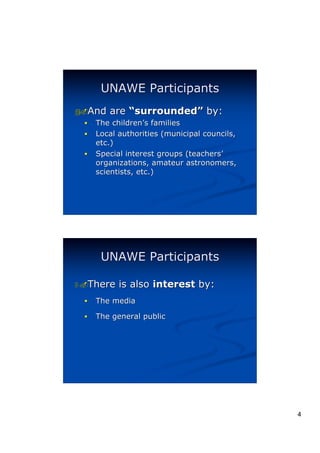
UNAWE Participants
& And
 #      are “surrounded” by:
 !   The children’s families
          children’
 !   Local authorities (municipal councils,
     etc.)
 !   Special interest groups (teachers’
                             (teachers’
     organizations, amateur astronomers,
     scientists, etc.)


      UNAWE Participants

'#There    is also interest by:
 !   The media

 !   The general public


                                              4
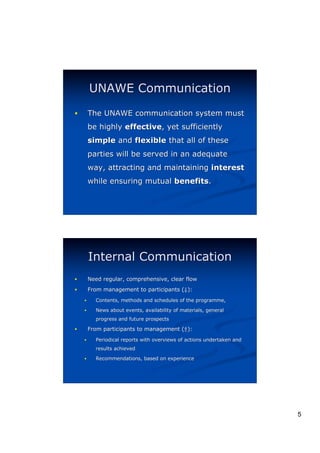
UNAWE Communication
!       The UNAWE communication system must
        be highly effective, yet sufficiently
                  effective,
        simple and flexible that all of these
        parties will be served in an adequate
        way, attracting and maintaining interest
        while ensuring mutual benefits.
                              benefits.


        Internal Communication
!       Need regular, comprehensive, clear flow
!       From management to participants (!):
                                        (!
    !     Contents, methods and schedules of the programme,

    !     News about events, availability of materials, general
          progress and future prospects

!       From participants to management ("):
                                        ("
    !     Periodical reports with overviews of actions undertaken and
          results achieved

    !     Recommendations, based on experience


                                                                        5
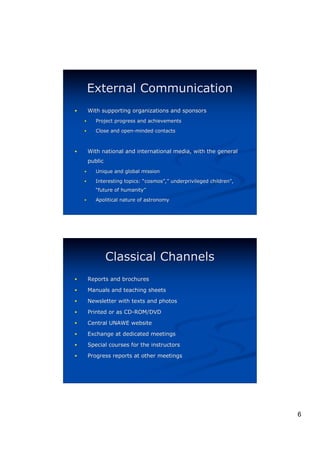
External Communication
!       With supporting organizations and sponsors
    !      Project progress and achievements

    !      Close and open-minded contacts


!       With national and international media, with the general
        public
    !      Unique and global mission

    !      Interesting topics: “cosmos”,” underprivileged children”,
                                cosmos”                   children”
           “future of humanity”
                      humanity”

    !      Apolitical nature of astronomy


                 Classical Channels
!       Reports and brochures

!       Manuals and teaching sheets

!       Newsletter with texts and photos

!       Printed or as CD-ROM/DVD

!       Central UNAWE website

!       Exchange at dedicated meetings
!       Special courses for the instructors

!       Progress reports at other meetings


                                                                       6
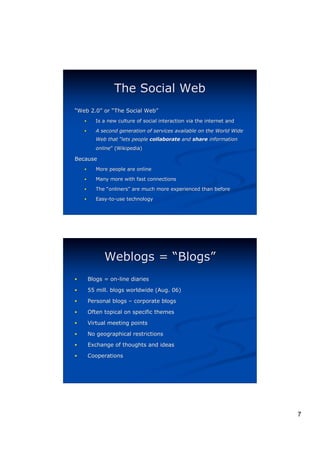
The Social Web
“Web 2.0” or “The Social Web”
     2.0”                Web”
    !      Is a new culture of social interaction via the internet and

    !      A second generation of services available on the World Wide
           Web that “lets people collaborate and share information
           online” (Wikipedia)
           online”

Because
    !      More people are online

    !      Many more with fast connections

    !      The “onliners” are much more experienced than before
                onliners”

    !      Easy-to-use technology


              Weblogs = “Blogs”
!       Blogs = on-line diaries

!       55 mill. blogs worldwide (Aug. 06)

!       Personal blogs – corporate blogs

!       Often topical on specific themes

!       Virtual meeting points

!       No geographical restrictions
!       Exchange of thoughts and ideas

!       Cooperations


                                                                         7
How Blogs Work
!   Blogs are like an online magazine

!   Articles, photos, videos are posted

!   Others can make comments

!   Dialogues develop among users

!   Contents are “tagged” with descriptive words
                  tagged”
!   “Trackbacks” to quoted postings
     Trackbacks”
!   Perform well in web-based searches (eg Google)
                                       (eg


       Blogs and Education
!   Fine tool for educational purposes

!   Class assignments via teacher’s blog
                          teacher’

!   Students progress documented

!   Resulting reports are published

!   Other teams comment on the work


                                                     8
Blogs and Motivation
“Kids are getting excited and engaged in literacy
        through blogging, commenting, and sharing
        ideas online”
              online”
“There is an excitement that comes from writing for
        a real, authentic audience instead of a circular
        file seen only by the teacher”
                              teacher”
“This thrill can be a huge motivator for students”
                                         students”
                    “Blogs are changing education” by Dennis Pierce (eSchool News)
                                        education”


                   UNAWE Blogs
!       One central blog – “the hub”
                                hub”
    !     Day-to-day overview of ongoing work

    !     Run by the UNAWE Executive

    !     Mostly addressed to participants

!       Project blogs (few - temporary)
    !     Relate to particular events/sub-projects

    !     Run by people “in the field”
                                field”
    !     Of general interest, also to the public


                                                                                     9
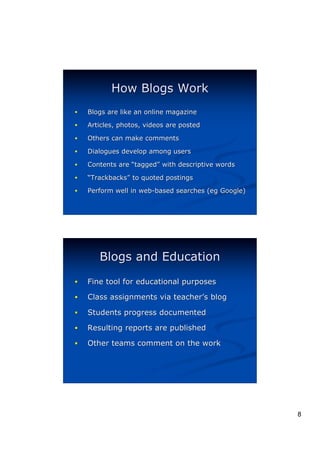
The Astrobus in Tunisia


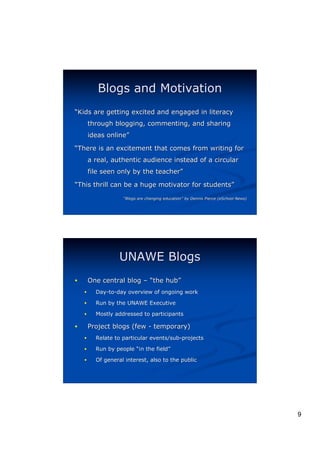
                          Teachers’ workshop in Venezuela


                                                            10
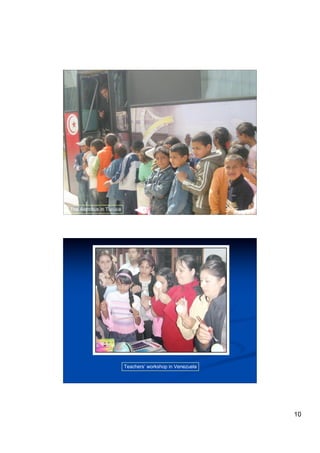
Astronomical event in the sky


      Examples of project blogs
  !       Tunisian “Astrobus”
                    Astrobus”
      !      Day-to-day roadshow diary

      !      Run by the Astrobus team members

      !      With anecdotes and children’s ideas
                                children’

      !      Arabic and French, English translation

  !       Teacher/Instructor courses
      !      Programme, presentation of teachers and their home institutions
             Programme,

  !       Astronomical events (eclipses, etc.)
      !      Visible in zones where UNAWE is active

      !      Opportunities for participation (cf. VT-2004)


                                                                               11
RSS Streams
!   User has “RSS Reader” software
                  Reader”

!   User subscribes to (news) website with “RSS Feed”
                                                Feed”
!   User receives automatically all new postings (articles,
    photos, videos) which are posted

!   A large number of sites can be monitored this way

!   Fresh and complete news – no work!


          UNAWE RSS Feeds
!   A single RSS feed for every blog within
    the project

!   One master (aggregated) RSS feed per
    language, including all posts in the same
    language across all UNAWE projects


                                                              12
Additional Aspects
!       Most disadvantaged participants have no access
        to the internet

!       Programmes are underway in many countries
        which aim at equipping more schools with basic
        computer equipment

!       Special effort to induce the teachers to read and
        contribute to the blogs

!       Children’s blogs for the oldest?
        Children’


Set-up and running of blogs
!       Technical requirements
    !     Software free (“wordpress”)
                        (“ wordpress”
    !     Blog must be customized

    !     Simple photo/video postproduction

!       Organizational requirements
    !     Installation by technician + manager

    !     When running: part-time manager + on-call technician


                                                                 13
Conclusions (1)
UNAWE blogs
  (   Provide effective internal communication with
      fast feed-back of experience gained,
      unexpected developments, new ideas, ….

  (   Brings geographically separated participants
      closer together and letting them sense that
      they serve a common, noble goal


            Conclusions (2)
UNAWE blogs
  (   Encourage the participants – in particular the teachers
      - to come forward with ideas and opinions and “teach”
                                                     teach”
      them how to communicate

  (   Document, also for posterity, the project progress with
      a lively record of the many actions in different places
      and environments


                                                                14
Conclusions (3)
UNAWE blogs
  (   Display openness by enabling bystanders,
      including the sponsors, the media and the
      general public, to obtain a picture of the
      ongoing programme

  (   Demonstrate that UNAWE is at the forefront,
      not only in programme content and format,
      but also in the communication field


              In Summary
Any communication system that involves so many
   people from so diverse regions and cultures is
   extremely valuable and mutually enriching.

Although the inherent challenges should not be
   underestimated, we are convinced that with the
   proper planning and implementation, these
   mechanisms will add considerably to the overall
   impact of UNAWE.


                                                     15

UNAWE and the Social Web

  • 1.
    UNAWE and the Social Web Richard West & Irakli West (Munich, Germany) Germany) October 13, 2006 Second UNAWE Interdisciplinary Workshop, Lorentz Centre, Leiden, The Netherlands Key Elements of UNAWE ! Specific astronomical and cultural contents ! Diverse pedagogical means ! Organizational set-up at the international, national and regional levels ! Associated communication, internal as well as external 1
  • 2.
    Specific UNAWE Features !Entirely new concept ! Involvement of many people with very diverse backgrounds and who are located in many different countries and regions ! Great organizational complexity ! Efficient communication system is needed to “keep all of it together” together” UNAWE Participants " There # is a “Nucleus”, with: Nucleus” ! The children ! The teachers/instructors ! The National Action Committees (possibly also Regional ACs) ! The International Steering Committee with an Executive Office 2
  • 3.
    UNAWE Participants $# They interact directly with: ! The host schools or clubs (management, other teachers) ! The supporting national organizations (science centers, planetaria, research organizations, etc.). ! Advisors, consultants, etc., to the ISC and NACs UNAWE Participants %# While being supported by: ! Relevant national ministries (Education, Family and Social Affairs, etc.) ! Participating international organizations (UNESCO, EU, IAU, ESO, others) ! Contributing foundations and companies ! Distinguished individuals who mostly provide moral backing 3
  • 4.
    UNAWE Participants & And # are “surrounded” by: ! The children’s families children’ ! Local authorities (municipal councils, etc.) ! Special interest groups (teachers’ (teachers’ organizations, amateur astronomers, scientists, etc.) UNAWE Participants '#There is also interest by: ! The media ! The general public 4
  • 5.
    UNAWE Communication ! The UNAWE communication system must be highly effective, yet sufficiently effective, simple and flexible that all of these parties will be served in an adequate way, attracting and maintaining interest while ensuring mutual benefits. benefits. Internal Communication ! Need regular, comprehensive, clear flow ! From management to participants (!): (! ! Contents, methods and schedules of the programme, ! News about events, availability of materials, general progress and future prospects ! From participants to management ("): (" ! Periodical reports with overviews of actions undertaken and results achieved ! Recommendations, based on experience 5
  • 6.
    External Communication ! With supporting organizations and sponsors ! Project progress and achievements ! Close and open-minded contacts ! With national and international media, with the general public ! Unique and global mission ! Interesting topics: “cosmos”,” underprivileged children”, cosmos” children” “future of humanity” humanity” ! Apolitical nature of astronomy Classical Channels ! Reports and brochures ! Manuals and teaching sheets ! Newsletter with texts and photos ! Printed or as CD-ROM/DVD ! Central UNAWE website ! Exchange at dedicated meetings ! Special courses for the instructors ! Progress reports at other meetings 6
  • 7.
    The Social Web “Web2.0” or “The Social Web” 2.0” Web” ! Is a new culture of social interaction via the internet and ! A second generation of services available on the World Wide Web that “lets people collaborate and share information online” (Wikipedia) online” Because ! More people are online ! Many more with fast connections ! The “onliners” are much more experienced than before onliners” ! Easy-to-use technology Weblogs = “Blogs” ! Blogs = on-line diaries ! 55 mill. blogs worldwide (Aug. 06) ! Personal blogs – corporate blogs ! Often topical on specific themes ! Virtual meeting points ! No geographical restrictions ! Exchange of thoughts and ideas ! Cooperations 7
  • 8.
    How Blogs Work ! Blogs are like an online magazine ! Articles, photos, videos are posted ! Others can make comments ! Dialogues develop among users ! Contents are “tagged” with descriptive words tagged” ! “Trackbacks” to quoted postings Trackbacks” ! Perform well in web-based searches (eg Google) (eg Blogs and Education ! Fine tool for educational purposes ! Class assignments via teacher’s blog teacher’ ! Students progress documented ! Resulting reports are published ! Other teams comment on the work 8
  • 9.
    Blogs and Motivation “Kidsare getting excited and engaged in literacy through blogging, commenting, and sharing ideas online” online” “There is an excitement that comes from writing for a real, authentic audience instead of a circular file seen only by the teacher” teacher” “This thrill can be a huge motivator for students” students” “Blogs are changing education” by Dennis Pierce (eSchool News) education” UNAWE Blogs ! One central blog – “the hub” hub” ! Day-to-day overview of ongoing work ! Run by the UNAWE Executive ! Mostly addressed to participants ! Project blogs (few - temporary) ! Relate to particular events/sub-projects ! Run by people “in the field” field” ! Of general interest, also to the public 9
  • 10.
    The Astrobus inTunisia Teachers’ workshop in Venezuela 10
  • 11.
    Astronomical event inthe sky Examples of project blogs ! Tunisian “Astrobus” Astrobus” ! Day-to-day roadshow diary ! Run by the Astrobus team members ! With anecdotes and children’s ideas children’ ! Arabic and French, English translation ! Teacher/Instructor courses ! Programme, presentation of teachers and their home institutions Programme, ! Astronomical events (eclipses, etc.) ! Visible in zones where UNAWE is active ! Opportunities for participation (cf. VT-2004) 11
  • 12.
    RSS Streams ! User has “RSS Reader” software Reader” ! User subscribes to (news) website with “RSS Feed” Feed” ! User receives automatically all new postings (articles, photos, videos) which are posted ! A large number of sites can be monitored this way ! Fresh and complete news – no work! UNAWE RSS Feeds ! A single RSS feed for every blog within the project ! One master (aggregated) RSS feed per language, including all posts in the same language across all UNAWE projects 12
  • 13.
    Additional Aspects ! Most disadvantaged participants have no access to the internet ! Programmes are underway in many countries which aim at equipping more schools with basic computer equipment ! Special effort to induce the teachers to read and contribute to the blogs ! Children’s blogs for the oldest? Children’ Set-up and running of blogs ! Technical requirements ! Software free (“wordpress”) (“ wordpress” ! Blog must be customized ! Simple photo/video postproduction ! Organizational requirements ! Installation by technician + manager ! When running: part-time manager + on-call technician 13
  • 14.
    Conclusions (1) UNAWE blogs ( Provide effective internal communication with fast feed-back of experience gained, unexpected developments, new ideas, …. ( Brings geographically separated participants closer together and letting them sense that they serve a common, noble goal Conclusions (2) UNAWE blogs ( Encourage the participants – in particular the teachers - to come forward with ideas and opinions and “teach” teach” them how to communicate ( Document, also for posterity, the project progress with a lively record of the many actions in different places and environments 14
  • 15.
    Conclusions (3) UNAWE blogs ( Display openness by enabling bystanders, including the sponsors, the media and the general public, to obtain a picture of the ongoing programme ( Demonstrate that UNAWE is at the forefront, not only in programme content and format, but also in the communication field In Summary Any communication system that involves so many people from so diverse regions and cultures is extremely valuable and mutually enriching. Although the inherent challenges should not be underestimated, we are convinced that with the proper planning and implementation, these mechanisms will add considerably to the overall impact of UNAWE. 15