Social Web
                                 Lecture III
                    What DATA looks like on the Social Web?
                                  Lora Aroyo
                                The Network Institute
                               VU University Amsterdam


Monday, February 27, 12
What do people
 contribute on
   the SW?


Monday, February 27, 12
History & Nature
                                   of Blogs
                          •   Blog = weB LOG = we blog
                          •   evolved from online diary (in the 1980’s)
                          •   the term blog coined in late 1990’s
                          •   one of the first ways people could contribute
                              content on the Web themselves
                          •   Nature: political, technical, art, journalistic,
                              cultural, personal
                          •   Software: WordPress, Blogger, LifeJournal

Monday, February 27, 12
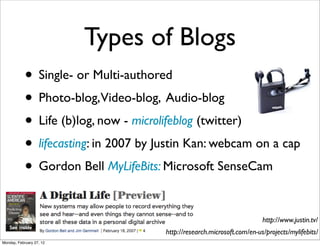
Types of Blogs
            • Single- or Multi-authored
            • Photo-blog,Video-blog, Audio-blog
            • Life (b)log, now - microlifeblog (twitter)
            • lifecasting: in 2007 by Justin Kan: webcam on a cap
            • Gordon Bell MyLifeBits: Microsoft SenseCam

                                                                          http://www.justin.tv/
                                       http://research.microsoft.com/en-us/projects/mylifebits/
Monday, February 27, 12
Question?
                          Why has microblogging (eg Twitter) taken over the
                              popularity from more traditional blogs?


Monday, February 27, 12
Wikis

                    • Wiki in Hawaiian meaning fast/quick
                    • "the simplest online database that could
                          possibly work" (Ward Cunningham), 1995
                    • first wiki software: WikiWikiWeb (the
                          QuickWeb)


                                                http://en.wikipedia.org/wiki/Ward_Cunningham
                                                      http://en.wikipedia.org/wiki/WikiWikiWeb
Monday, February 27, 12
Wiki Features
                    •     a website powered by wiki software
                    •     created and maintained collaboratively by multiple users
                          = an ongoing process that constantly changes the site
                    •     not a carefully crafted site for casual visitors
                    •     users can add, modify or delete content
                    •     to obtain meaningful topic associations between
                          different pages, page link creation is easy
                    •     Examples: community websites, corporate intranets,
                          knowledge management systems, and note taking


Monday, February 27, 12
Wiki Implementation
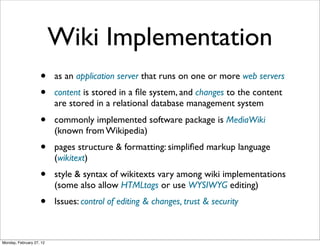
                    •     as an application server that runs on one or more web servers
                    •     content is stored in a file system, and changes to the content
                          are stored in a relational database management system
                    •     commonly implemented software package is MediaWiki
                          (known from Wikipedia)
                    •     pages structure & formatting: simplified markup language
                          (wikitext)
                    •     style & syntax of wikitexts vary among wiki implementations
                          (some also allow HTMLtags or use WYSIWYG editing)
                    •     Issues: control of editing & changes, trust & security


Monday, February 27, 12
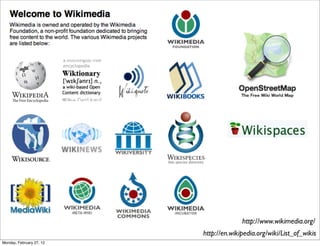
http://www.wikimedia.org/
                          http://en.wikipedia.org/wiki/List_of_wikis
Monday, February 27, 12
Question?
                          Blogging and wikis are examples of '(lay) users
                                       publishing content'.

                    What are requirements to make this publishing effective?


Monday, February 27, 12
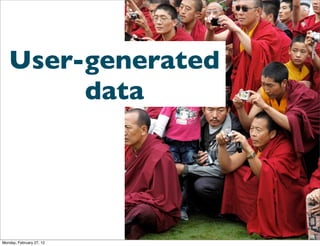
User-generated
        data


Monday, February 27, 12
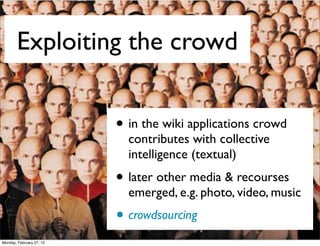
Exploiting the crowd


                          • in the wiki applications crowd
                            contributes with collective
                            intelligence (textual)
                          • later other media & recourses
                            emerged, e.g. photo, video, music
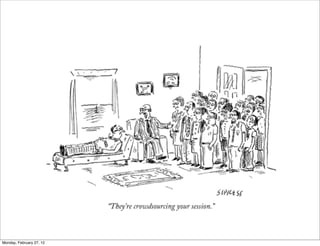
                          • crowdsourcing
Monday, February 27, 12
Why crowdsourcing?
                    •     many tedious and time-consuming tasks
                    •     professional results not always complete
                    •     professionals (experts) are few & expensive
                    •     professionals do not always know the needs, the
                          language and the perspectives of the users
                    •     people have wide range of hobbies and detailed
                          knowledge
                    •     people have time


Monday, February 27, 12
Example
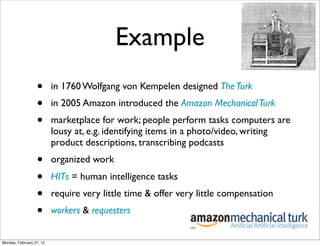
                  •       in 1760 Wolfgang von Kempelen designed The Turk
                  •       in 2005 Amazon introduced the Amazon Mechanical Turk
                  •       marketplace for work; people perform tasks computers are
                          lousy at, e.g. identifying items in a photo/video, writing
                          product descriptions, transcribing podcasts
                  •       organized work
                  •       HITs = human intelligence tasks
                  •       require very little time & offer very little compensation
                  •       workers & requesters


Monday, February 27, 12
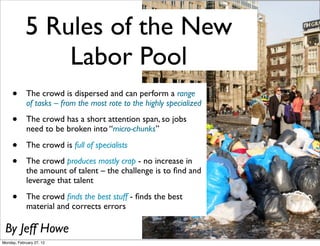
5 Rules of the New
                Labor Pool
     •       The crowd is dispersed and can perform a range
             of tasks – from the most rote to the highly specialized

     •       The crowd has a short attention span, so jobs
             need to be broken into “micro-chunks”

     •       The crowd is full of specialists

     •       The crowd produces mostly crap - no increase in
             the amount of talent – the challenge is to find and
             leverage that talent

     •       The crowd finds the best stuff - finds the best
             material and corrects errors

 By Jeff Howe
Monday, February 27, 12
Question?
                Was the $1 million Netflix prize a victory for crowdsourcing?


Monday, February 27, 12
Question?
                   Crowdsourcing is about exploiting collective effort or
                                 collective intelligence.

                  What are aspects that make it now much more applicable
                                        than before?


Monday, February 27, 12
Folksonomies


Monday, February 27, 12
Structure on the Web
                    • In the evolution of the Web, Semantic Web
                          refers to an approach to add ‘semantics’ to
                          the web, by naming terms in a domain
                    • A specification of such terms is called an
                          ‘ontology’
                    • For software: ontologies help to effectively
                          use content on the Web (like DB schemas)


Monday, February 27, 12
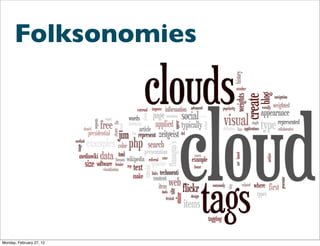
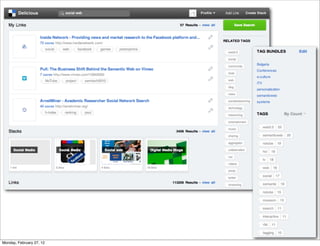
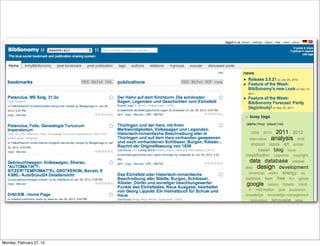
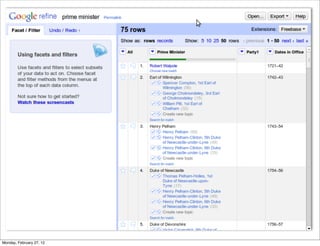
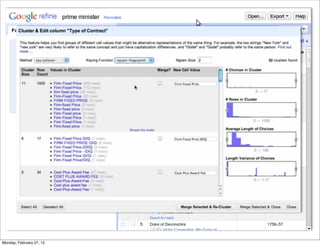
Folksonomy
                    •     On the social web the user-generated content is
                          organized in light-weight ontologies, i.e. folksonomies
                    •     Community-based semantics = a relationship between
                          Users,Tags & Resources
                    •     user-created, bottom-up classification/categorization
                          of (domain) terms / user-labels, e.g. tags
                    •     tagging = the social process where lay users attach
                          labels to resources (as opposed to annotation by
                          professional experts)


Monday, February 27, 12
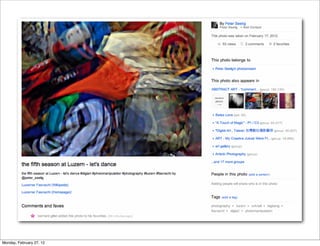
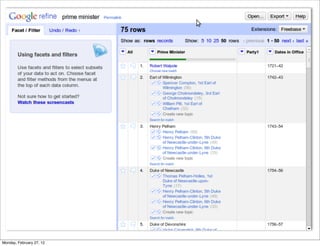
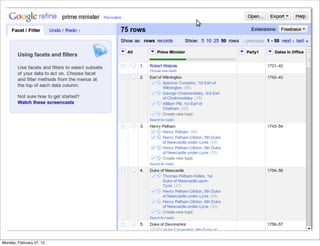
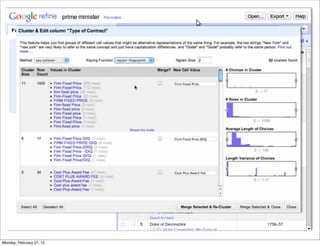
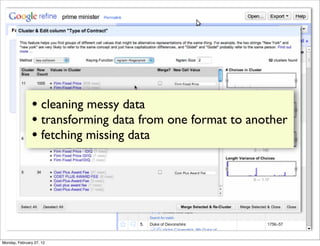
• cleaning messy data
                • transforming data from one format to another
                • fetching missing data


Monday, February 27, 12
Question?
                 Folksonomies typically show the relationships between users,
                                      tags and resources.

                Can you think of ways to aggregate user-tag-resource combinations
                to get more concise and therefore more meaningful folksonomies?


Monday, February 27, 12
What DATA
formats do we have?


Monday, February 27, 12
Vocabularies on the
                             (Social) Web
                    • to create interfaces or exchange data
                          between applications the software needs to
                          know the terms in the data
                    • vocabularies define set of terms in a certain
                          domain, e.g. describing people, relationships,
                          content of different type


Monday, February 27, 12
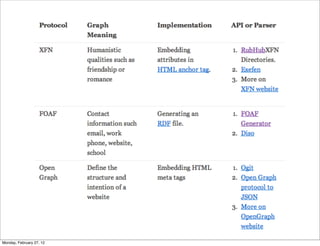
FOAF
                •         FOAF = Friend of a Friend
                •         a machine-readable ontology describing persons, their
                          activities & their relations to other people and objects
                •         an open, decentralized technology for connecting social Web
                          sites, & the people they describe
                •         http://www.foaf-project.org/


                •         Create your own FOAF file:
                          http://www.ldodds.com/foaf/foaf-a-matic


Monday, February 27, 12
FOAF Vocabulary
                    • Gradual evolution since mid-2000
                    • Stable core of classes and properties that will
                          not be changed
                    • New terms may be added at any time
                    • FOAF RDF namespace URI is fixed
                    • http://xmlns.com/foaf/spec/
Monday, February 27, 12
FOAF Files
                    •     Text documents, that adopt the conventions of RDF and
                          may be written in XML, RDFa or N3
                    •     Contain FOAF vocabulary and other RDF vocabularies
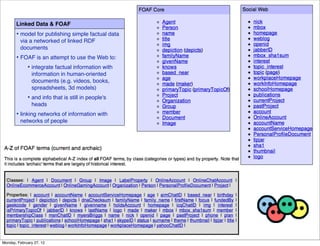
                          •   FOAF defines classes, e.g. foaf:Person,
                              foaf:Document, foaf:Image
                          •   FOAF defines properties of those things, e.g.
                              foaf:name, foaf:mbox (i.e. an internet mailbox),
                              foaf:homepage
                          •   FOAF defines relationship that hold between
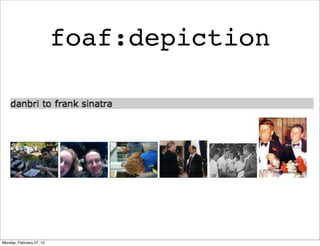
                              members of these categories, e.g. foaf:depiction relates
                              something (e.g. a foaf:Person) to a foaf:Image

Monday, February 27, 12
Linked Data & FOAF
       • model for publishing simple factual data
         via a networked of linked RDF
         documents
       • FOAF is an attempt to use the Web to:
           • integrate factual information with
               information in human-oriented
               documents (e.g. videos, books,
               spreadsheets, 3d models)
             • and info that is still in people's
               heads
       • linking networks of information with
         networks of people


Monday, February 27, 12
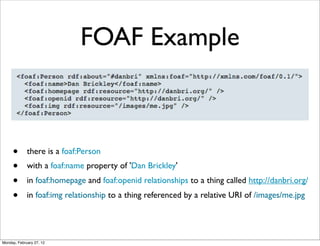
FOAF Example


     •       there is a foaf:Person
     •       with a foaf:name property of 'Dan Brickley'
     •       in foaf:homepage and foaf:openid relationships to a thing called http://danbri.org/
     •       in foaf:img relationship to a thing referenced by a relative URI of /images/me.jpg


Monday, February 27, 12
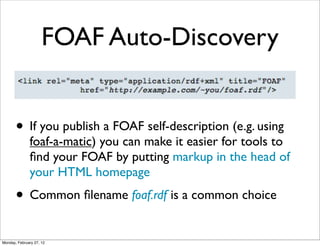
FOAF Auto-Discovery


       • If you publish a FOAF self-description (e.g. using
              foaf-a-matic) you can make it easier for tools to
              find your FOAF by putting markup in the head of
              your HTML homepage
       • Common filename foaf.rdf is a common choice
Monday, February 27, 12
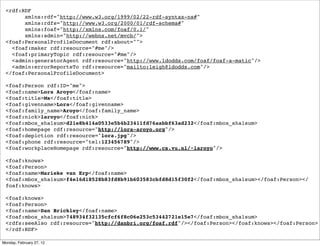
<rdf:RDF
       xmlns:rdf="http://www.w3.org/1999/02/22-rdf-syntax-ns#"
       xmlns:rdfs="http://www.w3.org/2000/01/rdf-schema#"
       xmlns:foaf="http://xmlns.com/foaf/0.1/"
       xmlns:admin="http://webns.net/mvcb/">
 <foaf:PersonalProfileDocument rdf:about="">
   <foaf:maker rdf:resource="#me"/>
   <foaf:primaryTopic rdf:resource="#me"/>
   <admin:generatorAgent rdf:resource="http://www.ldodds.com/foaf/foaf-a-matic"/>
   <admin:errorReportsTo rdf:resource="mailto:leigh@ldodds.com"/>
 </foaf:PersonalProfileDocument>

 <foaf:Person rdf:ID="me">
 <foaf:name>Lora Aroyo</foaf:name>
 <foaf:title>Ms</foaf:title>
 <foaf:givenname>Lora</foaf:givenname>
 <foaf:family_name>Aroyo</foaf:family_name>
 <foaf:nick>laroyo</foaf:nick>
 <foaf:mbox_sha1sum>d21e8b414a0533e5b4b23411fd76aabbf63ad232</foaf:mbox_sha1sum>
 <foaf:homepage rdf:resource="http://lora-aroyo.org"/>
 <foaf:depiction rdf:resource="lora.jpg"/>
 <foaf:phone rdf:resource="tel:123456789"/>
 <foaf:workplaceHomepage rdf:resource="http://www.cs.vu.nl/~laroyo"/>

 <foaf:knows>
 <foaf:Person>
 <foaf:name>Marieke van Erp</foaf:name>
 <foaf:mbox_sha1sum>f4e16d18528b83fd8b91b603583cbfd8d15f30f2</foaf:mbox_sha1sum></foaf:Person></
 foaf:knows>

 <foaf:knows>
 <foaf:Person>
 <foaf:name>Dan Brickley</foaf:name>
 <foaf:mbox_sha1sum>748934f32135cfcf6f8c06e253c53442721e15e7</foaf:mbox_sha1sum>
 <rdfs:seeAlso rdf:resource="http://danbri.org/foaf.rdf"/></foaf:Person></foaf:knows></foaf:Person>
 </rdf:RDF>

Monday, February 27, 12
foaf:depiction


Monday, February 27, 12
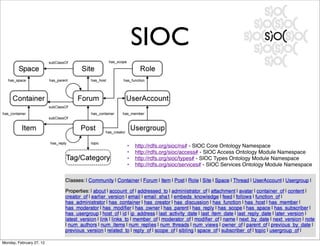
SIOC
                    •     Semantically-Interlinked Online Communities
                    •     a standard way for expressing user-generated content, i.e.
                          enable the integration of online community information
                    •     methods for interconnecting discussions, e.g. blogs, forums &
                          mailing lists
                    •     Semantic Web ontology for representing rich data from the
                          Social Web in RDF
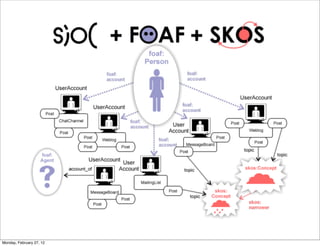
                    •     commonly used in conjunction with the FOAF vocabulary
                          for expressing personal profile and social networking
                          information
                    •     http://sioc-project.org/

Monday, February 27, 12
<sioc:Post rdf:about="http://jbreslin.com/blog/2006/09/07/creating-connections">    1
    <dc:title>Creating connections between discussion clouds with SIOC</dc:title>
 2 <dcterms:created>2006-09-07T09:33:30Z</dcterms:created>
    <sioc:has_container rdf:resource="http://jbreslin.com/blog/index.php?sioc_type=site#weblog"/>
    <sioc:has_creator>
        <sioc:UserAccount rdf:about="http://jbreslin.com/blog/author/cloud/" rdfs:label="Cloud"> 3
     6       <rdfs:seeAlso rdf:resource="http://jbreslin.com/blog/index.php?sioc_type=user&sioc_id=1"/>
        </sioc:UserAccount>
    </sioc:has_creator>
    <foaf:maker rdf:resource="http://jbreslin.com/blog/author/cloud/#foaf"/>
    <sioc:content>SIOC provides a unified vocabulary for content and interaction description: a semantic la
that can co-exist with existing discussion platforms. 5
    </sioc:content>
 4 <sioc:topic rdfs:label="Semantic Web" rdf:resource="http://jbreslin.com/blog/category/semantic-web/"/>
    <sioc:topic rdfs:label="Blogs" rdf:resource="http://jbreslin.com/blog/category/blogs/"/>
 7 <sioc:has_reply>
        <sioc:Post rdf:about="http://jbreslin.com/blog/2006/09/07/creating-connections/#comment-123928">
             <rdfs:seeAlso rdf:resource="http://johnbreslin.com/blog/index.php?
sioc_type=comment&sioc_id=123928"/>                                              8
        </sioc:Post>
    </sioc:has_reply>
</sioc:Post>


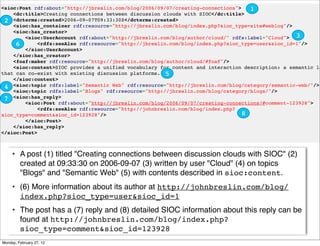
     • A post (1) titled "Creating connections between discussion clouds with SIOC" (2)
       created at 09:33:30 on 2006-09-07 (3) written by user "Cloud" (4) on topics
       "Blogs" and "Semantic Web" (5) with contents described in sioc:content.
     • (6) More information about its author at http://johnbreslin.com/blog/
       index.php?sioc_type=user&sioc_id=1
     • The post has a (7) reply and (8) detailed SIOC information about this reply can be
       found at http://johnbreslin.com/blog/index.php?
       sioc_type=comment&sioc_id=123928
Monday, February 27, 12
SIOC


                          •   http://rdfs.org/sioc/ns# - SIOC Core Ontology Namespace
                          •   http://rdfs.org/sioc/access# - SIOC Access Ontology Module Namespace
                          •   http://rdfs.org/sioc/types# - SIOC Types Ontology Module Namespace
                          •   http://rdfs.org/sioc/services# - SIOC Services Ontology Module Namespace


Monday, February 27, 12
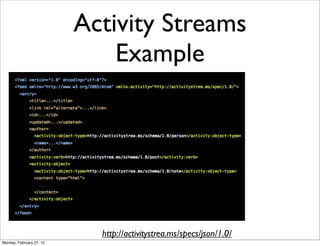
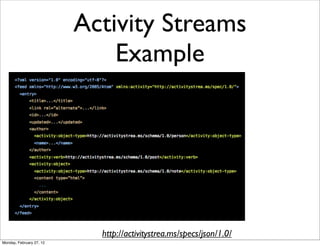
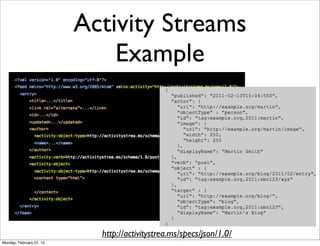
Activity Streams
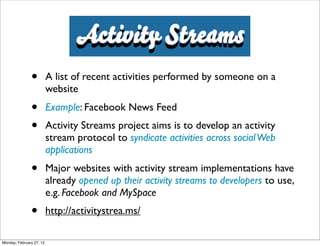
               •          A list of recent activities performed by someone on a
                          website
               •          Example: Facebook News Feed
               •          Activity Streams project aims is to develop an activity
                          stream protocol to syndicate activities across social Web
                          applications
               •          Major websites with activity stream implementations have
                          already opened up their activity streams to developers to use,
                          e.g. Facebook and MySpace
               •          http://activitystrea.ms/

Monday, February 27, 12
Activity Streams
                                 Specification
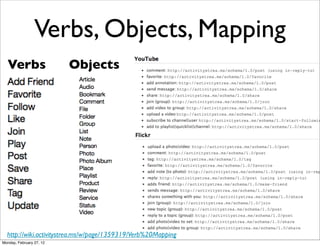
                    •     an actor, a verb, an object and a target
                          •   person performing an action on/with an object
                          •   Geraldine posted a photo to her album
                          •   John shared a video
                    •     activity metadata to present to a user in a rich human-friendly
                          format, e.g. constructing readable sentences about the activity
                          that occurred, visual representations of the activity, or
                          combining similar activities for display
                    •     Activities are serialized using the JSON format
                    •     There is also an ATOM-oriented specification

Monday, February 27, 12
Activity Streams
                              Example


                            http://activitystrea.ms/specs/json/1.0/
Monday, February 27, 12
Activity Streams
                              Example


                            http://activitystrea.ms/specs/json/1.0/
Monday, February 27, 12
Activity Streams
                              Example


                            http://activitystrea.ms/specs/json/1.0/
Monday, February 27, 12
Verbs, Objects, Mapping
  Verbs                   Objects


  http://wiki.activitystrea.ms/w/page/1359319/Verb%20Mapping
Monday, February 27, 12
XFN
                    •     Xhtml Friends Network
                    •     relationships between individuals: by defining a small set of values that
                          describe personal relationships
                          •   In HTML and XHTML documents, these are given as values for the
                              rel attribute on a hyperlink. XFN allows authors to indicate which of
                              the weblogs they read belong to friends, whom they've physically
                              met, and other personal relationships. Using XFN values, which can
                              be listed in any order, people can humanize their blogrolls and links
                              pages, both of which have become a common feature of weblogs.
                    •     using XFN can easily style all links of a particular type; thus, friends
                          could be boldfaced, co-workers italicized, etc.
                    •     http://gmpg.org/xfn/


Monday, February 27, 12
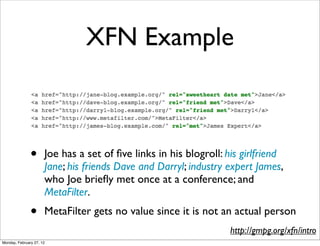
XFN Example


               •      Joe has a set of five links in his blogroll: his girlfriend
                      Jane; his friends Dave and Darryl; industry expert James,
                      who Joe briefly met once at a conference; and
                      MetaFilter.
               •      MetaFilter gets no value since it is not an actual person
                                                                   http://gmpg.org/xfn/intro
Monday, February 27, 12
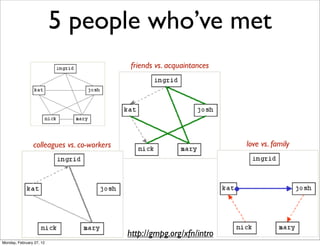
5 people who’ve met
                                            friends vs. acquaintances


                colleagues vs. co-workers                               love vs. family


                                            http://gmpg.org/xfn/intro
Monday, February 27, 12
Open Graph
             •      protocol originally developed in Facebook
             •      enables web pages to become a rich object in a social graph, i.e. any
                    web page to have the same functionality as any other object on
                    Facebook
             •      Basic Metadata: to turn your web pages into graph objects
                   •      og:title = title of your object e.g., "The Rock"
                   •      og:type = type of your object e.g.,
                          "video.movie"
                   •      og:image = image URL to represent your object
                          within the graph
                   •      og:url = canonical URL of your object that will
                          be used as its permanent ID in the graph, e.g.,
                          "http://www.imdb.com/title/tt0117500/"

Monday, February 27, 12
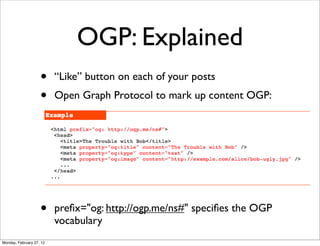
OGP: Explained
                    •     “Like” button on each of your posts
                    •     Open Graph Protocol to mark up content OGP:


                    •     prefix="og: http://ogp.me/ns#" specifies the OGP
                          vocabulary
Monday, February 27, 12
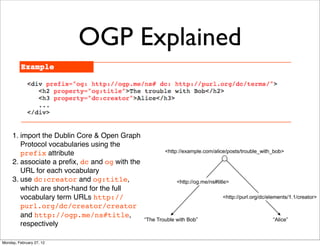
OGP Explained


     1. import the Dublin Core & Open Graph
        Protocol vocabularies using the
        prefix attribute
     2. associate a prefix, dc and og with the
        URL for each vocabulary
     3. use dc:creator and og:title,
        which are short-hand for the full
        vocabulary term URLs http://
        purl.org/dc/creator/creator
        and http://ogp.me/ns#title,
        respectively

Monday, February 27, 12
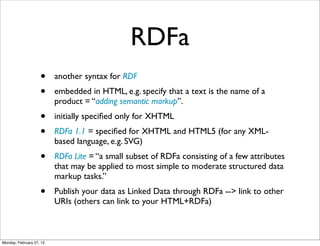
RDFa
                    •     another syntax for RDF
                    •     embedded in HTML, e.g. specify that a text is the name of a
                          product = “adding semantic markup”.
                    •     initially specified only for XHTML
                    •     RDFa 1.1 = specified for XHTML and HTML5 (for any XML-
                          based language, e.g. SVG)
                    •     RDFa Lite = “a small subset of RDFa consisting of a few attributes
                          that may be applied to most simple to moderate structured data
                          markup tasks.”
                    •     Publish your data as Linked Data through RDFa --> link to other
                          URIs (others can link to your HTML+RDFa)


Monday, February 27, 12
Why RDFa?
                    •     data can be easily shared & reused (no need of maintaining the raw
                          structured data in a separate file in a separate format)
                    •     RDFa processors can easily extract all the structured data from a
                          webpage
                    •     search engines
                          •   Yahoo was a pioneer in this area, starting with Search Monkey
                          •   Google started with Rich Snippets
                          •   Recently, Google,Yahoo, Bing --> Schema.org
                              •   recommendation for publishers on how to semantically
                                  markup their webpages
                    •     Google Recipe = what can be done with structured data on the web


Monday, February 27, 12
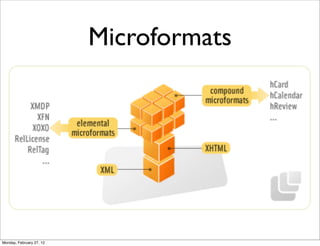
Microformats
                    •     a set of simple, open data formats built upon
                          existing and widely adopted standards
                    •     Designed for humans first and machines second
                    •     Design principles for formats
                    •     Highly correlated with semantic XHTML (aka
                          the real world semantics, lowercase semantic web,
                          lossless XHTML)
                    •     “An evolutionary revolution”


Monday, February 27, 12
Microformats


Monday, February 27, 12
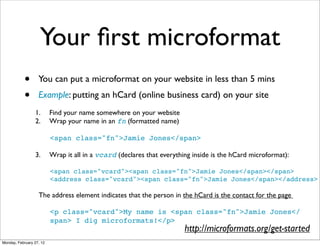
Your first microformat
            •      You can put a microformat on your website in less than 5 mins
            •      Example: putting an hCard (online business card) on your site
                 1.       Find your name somewhere on your website
                 2.       Wrap your name in an fn (formatted name)

                          <span class="fn">Jamie Jones</span>

                 3.       Wrap it all in a vcard (declares that everything inside is the hCard microformat):

                          <span class="vcard"><span class="fn">Jamie Jones</span></span>
                          <address class="vcard"><span class="fn">Jamie Jones</span></address>

                   The address element indicates that the person in the hCard is the contact for the page

                          <p class="vcard">My name is <span class="fn">Jamie Jones</
                          span> I dig microformats!</p>
                                                                        http://microformats.org/get-started
Monday, February 27, 12
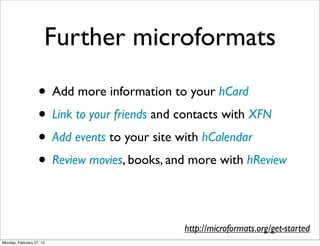
Further microformats

                   • Add more information to your hCard
                   • Link to your friends and contacts with XFN
                   • Add events to your site with hCalendar
                   • Review movies, books, and more with hReview

                                             http://microformats.org/get-started
Monday, February 27, 12
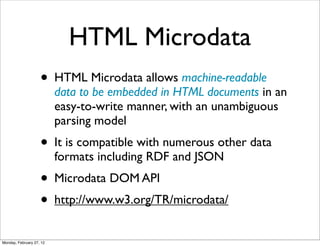
HTML Microdata
                    • HTML Microdata allows machine-readable
                          data to be embedded in HTML documents in an
                          easy-to-write manner, with an unambiguous
                          parsing model
                    • It is compatible with numerous other data
                          formats including RDF and JSON
                    • Microdata DOM API
                    • http://www.w3.org/TR/microdata/
Monday, February 27, 12
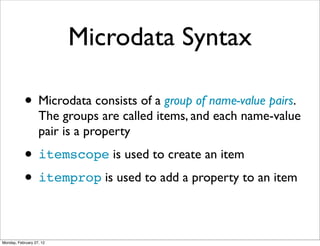
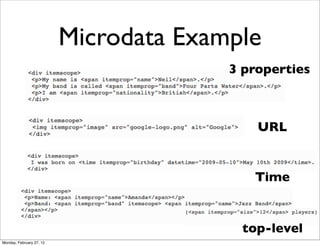
Microdata Syntax

            • Microdata consists of a group of name-value pairs.
                   The groups are called items, and each name-value
                   pair is a property

            • itemscope is used to create an item
            • itemprop is used to add a property to an item

Monday, February 27, 12
Microdata Example
                                        3 properties


                                            URL


                                           Time


                                         top-level
Monday, February 27, 12
Question?
                We have seen many approaches to 'organizing' embedded
                    semantics, e.g. RDFa, Microformats, schema.org.

                  All these are driven by different parties and motives. How do
                                 you think this is best organized?


Monday, February 27, 12
Question?
                 For which things on the social web would more vocabularies
                 for embedded semantics be needed (besides what we have
                                        already seen)?


Monday, February 27, 12
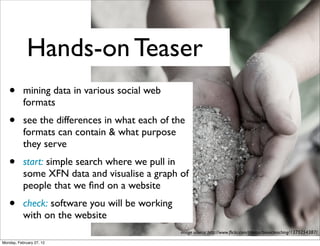
Hands-on Teaser
   •       mining data in various social web
           formats
   •       see the differences in what each of the
           formats can contain & what purpose
           they serve
   •       start: simple search where we pull in
           some XFN data and visualise a graph of
           people that we find on a website
   •       check: software you will be working
           with on the website
                                                 image source: http://www.flickr.com/photos/bionicteaching/1375254387/

Monday, February 27, 12

Lecture 3: Social Web Data Formats (2012)

  • 1.
    Social Web Lecture III What DATA looks like on the Social Web? Lora Aroyo The Network Institute VU University Amsterdam Monday, February 27, 12
  • 2.
    What do people contribute on the SW? Monday, February 27, 12
  • 3.
    History & Nature of Blogs • Blog = weB LOG = we blog • evolved from online diary (in the 1980’s) • the term blog coined in late 1990’s • one of the first ways people could contribute content on the Web themselves • Nature: political, technical, art, journalistic, cultural, personal • Software: WordPress, Blogger, LifeJournal Monday, February 27, 12
  • 4.
    Types of Blogs • Single- or Multi-authored • Photo-blog,Video-blog, Audio-blog • Life (b)log, now - microlifeblog (twitter) • lifecasting: in 2007 by Justin Kan: webcam on a cap • Gordon Bell MyLifeBits: Microsoft SenseCam http://www.justin.tv/ http://research.microsoft.com/en-us/projects/mylifebits/ Monday, February 27, 12
  • 5.
    Question? Why has microblogging (eg Twitter) taken over the popularity from more traditional blogs? Monday, February 27, 12
  • 6.
    Wikis • Wiki in Hawaiian meaning fast/quick • "the simplest online database that could possibly work" (Ward Cunningham), 1995 • first wiki software: WikiWikiWeb (the QuickWeb) http://en.wikipedia.org/wiki/Ward_Cunningham http://en.wikipedia.org/wiki/WikiWikiWeb Monday, February 27, 12
  • 7.
    Wiki Features • a website powered by wiki software • created and maintained collaboratively by multiple users = an ongoing process that constantly changes the site • not a carefully crafted site for casual visitors • users can add, modify or delete content • to obtain meaningful topic associations between different pages, page link creation is easy • Examples: community websites, corporate intranets, knowledge management systems, and note taking Monday, February 27, 12
  • 8.
    Wiki Implementation • as an application server that runs on one or more web servers • content is stored in a file system, and changes to the content are stored in a relational database management system • commonly implemented software package is MediaWiki (known from Wikipedia) • pages structure & formatting: simplified markup language (wikitext) • style & syntax of wikitexts vary among wiki implementations (some also allow HTMLtags or use WYSIWYG editing) • Issues: control of editing & changes, trust & security Monday, February 27, 12
  • 9.
    http://www.wikimedia.org/ http://en.wikipedia.org/wiki/List_of_wikis Monday, February 27, 12
  • 10.
    Question? Blogging and wikis are examples of '(lay) users publishing content'. What are requirements to make this publishing effective? Monday, February 27, 12
  • 11.
    User-generated data Monday, February 27, 12
  • 12.
    Exploiting the crowd • in the wiki applications crowd contributes with collective intelligence (textual) • later other media & recourses emerged, e.g. photo, video, music • crowdsourcing Monday, February 27, 12
  • 13.
    Why crowdsourcing? • many tedious and time-consuming tasks • professional results not always complete • professionals (experts) are few & expensive • professionals do not always know the needs, the language and the perspectives of the users • people have wide range of hobbies and detailed knowledge • people have time Monday, February 27, 12
  • 14.
    Example • in 1760 Wolfgang von Kempelen designed The Turk • in 2005 Amazon introduced the Amazon Mechanical Turk • marketplace for work; people perform tasks computers are lousy at, e.g. identifying items in a photo/video, writing product descriptions, transcribing podcasts • organized work • HITs = human intelligence tasks • require very little time & offer very little compensation • workers & requesters Monday, February 27, 12
  • 15.
    5 Rules ofthe New Labor Pool • The crowd is dispersed and can perform a range of tasks – from the most rote to the highly specialized • The crowd has a short attention span, so jobs need to be broken into “micro-chunks” • The crowd is full of specialists • The crowd produces mostly crap - no increase in the amount of talent – the challenge is to find and leverage that talent • The crowd finds the best stuff - finds the best material and corrects errors By Jeff Howe Monday, February 27, 12
  • 16.
    Question? Was the $1 million Netflix prize a victory for crowdsourcing? Monday, February 27, 12
  • 17.
    Question? Crowdsourcing is about exploiting collective effort or collective intelligence. What are aspects that make it now much more applicable than before? Monday, February 27, 12
  • 18.
  • 19.
  • 20.
    Structure on theWeb • In the evolution of the Web, Semantic Web refers to an approach to add ‘semantics’ to the web, by naming terms in a domain • A specification of such terms is called an ‘ontology’ • For software: ontologies help to effectively use content on the Web (like DB schemas) Monday, February 27, 12
  • 21.
    Folksonomy • On the social web the user-generated content is organized in light-weight ontologies, i.e. folksonomies • Community-based semantics = a relationship between Users,Tags & Resources • user-created, bottom-up classification/categorization of (domain) terms / user-labels, e.g. tags • tagging = the social process where lay users attach labels to resources (as opposed to annotation by professional experts) Monday, February 27, 12
  • 22.
  • 23.
  • 24.
  • 25.
  • 26.
  • 27.
  • 28.
  • 29.
  • 30.
    • cleaning messydata • transforming data from one format to another • fetching missing data Monday, February 27, 12
  • 31.
    Question? Folksonomies typically show the relationships between users, tags and resources. Can you think of ways to aggregate user-tag-resource combinations to get more concise and therefore more meaningful folksonomies? Monday, February 27, 12
  • 32.
    What DATA formats dowe have? Monday, February 27, 12
  • 33.
    Vocabularies on the (Social) Web • to create interfaces or exchange data between applications the software needs to know the terms in the data • vocabularies define set of terms in a certain domain, e.g. describing people, relationships, content of different type Monday, February 27, 12
  • 34.
    FOAF • FOAF = Friend of a Friend • a machine-readable ontology describing persons, their activities & their relations to other people and objects • an open, decentralized technology for connecting social Web sites, & the people they describe • http://www.foaf-project.org/ • Create your own FOAF file: http://www.ldodds.com/foaf/foaf-a-matic Monday, February 27, 12
  • 35.
    FOAF Vocabulary • Gradual evolution since mid-2000 • Stable core of classes and properties that will not be changed • New terms may be added at any time • FOAF RDF namespace URI is fixed • http://xmlns.com/foaf/spec/ Monday, February 27, 12
  • 36.
    FOAF Files • Text documents, that adopt the conventions of RDF and may be written in XML, RDFa or N3 • Contain FOAF vocabulary and other RDF vocabularies • FOAF defines classes, e.g. foaf:Person, foaf:Document, foaf:Image • FOAF defines properties of those things, e.g. foaf:name, foaf:mbox (i.e. an internet mailbox), foaf:homepage • FOAF defines relationship that hold between members of these categories, e.g. foaf:depiction relates something (e.g. a foaf:Person) to a foaf:Image Monday, February 27, 12
  • 37.
    Linked Data &FOAF • model for publishing simple factual data via a networked of linked RDF documents • FOAF is an attempt to use the Web to: • integrate factual information with information in human-oriented documents (e.g. videos, books, spreadsheets, 3d models) • and info that is still in people's heads • linking networks of information with networks of people Monday, February 27, 12
  • 38.
    FOAF Example • there is a foaf:Person • with a foaf:name property of 'Dan Brickley' • in foaf:homepage and foaf:openid relationships to a thing called http://danbri.org/ • in foaf:img relationship to a thing referenced by a relative URI of /images/me.jpg Monday, February 27, 12
  • 39.
    FOAF Auto-Discovery • If you publish a FOAF self-description (e.g. using foaf-a-matic) you can make it easier for tools to find your FOAF by putting markup in the head of your HTML homepage • Common filename foaf.rdf is a common choice Monday, February 27, 12
  • 40.
    <rdf:RDF xmlns:rdf="http://www.w3.org/1999/02/22-rdf-syntax-ns#" xmlns:rdfs="http://www.w3.org/2000/01/rdf-schema#" xmlns:foaf="http://xmlns.com/foaf/0.1/" xmlns:admin="http://webns.net/mvcb/"> <foaf:PersonalProfileDocument rdf:about=""> <foaf:maker rdf:resource="#me"/> <foaf:primaryTopic rdf:resource="#me"/> <admin:generatorAgent rdf:resource="http://www.ldodds.com/foaf/foaf-a-matic"/> <admin:errorReportsTo rdf:resource="mailto:leigh@ldodds.com"/> </foaf:PersonalProfileDocument> <foaf:Person rdf:ID="me"> <foaf:name>Lora Aroyo</foaf:name> <foaf:title>Ms</foaf:title> <foaf:givenname>Lora</foaf:givenname> <foaf:family_name>Aroyo</foaf:family_name> <foaf:nick>laroyo</foaf:nick> <foaf:mbox_sha1sum>d21e8b414a0533e5b4b23411fd76aabbf63ad232</foaf:mbox_sha1sum> <foaf:homepage rdf:resource="http://lora-aroyo.org"/> <foaf:depiction rdf:resource="lora.jpg"/> <foaf:phone rdf:resource="tel:123456789"/> <foaf:workplaceHomepage rdf:resource="http://www.cs.vu.nl/~laroyo"/> <foaf:knows> <foaf:Person> <foaf:name>Marieke van Erp</foaf:name> <foaf:mbox_sha1sum>f4e16d18528b83fd8b91b603583cbfd8d15f30f2</foaf:mbox_sha1sum></foaf:Person></ foaf:knows> <foaf:knows> <foaf:Person> <foaf:name>Dan Brickley</foaf:name> <foaf:mbox_sha1sum>748934f32135cfcf6f8c06e253c53442721e15e7</foaf:mbox_sha1sum> <rdfs:seeAlso rdf:resource="http://danbri.org/foaf.rdf"/></foaf:Person></foaf:knows></foaf:Person> </rdf:RDF> Monday, February 27, 12
  • 41.
  • 42.
    SIOC • Semantically-Interlinked Online Communities • a standard way for expressing user-generated content, i.e. enable the integration of online community information • methods for interconnecting discussions, e.g. blogs, forums & mailing lists • Semantic Web ontology for representing rich data from the Social Web in RDF • commonly used in conjunction with the FOAF vocabulary for expressing personal profile and social networking information • http://sioc-project.org/ Monday, February 27, 12
  • 43.
    <sioc:Post rdf:about="http://jbreslin.com/blog/2006/09/07/creating-connections"> 1 <dc:title>Creating connections between discussion clouds with SIOC</dc:title> 2 <dcterms:created>2006-09-07T09:33:30Z</dcterms:created> <sioc:has_container rdf:resource="http://jbreslin.com/blog/index.php?sioc_type=site#weblog"/> <sioc:has_creator> <sioc:UserAccount rdf:about="http://jbreslin.com/blog/author/cloud/" rdfs:label="Cloud"> 3 6 <rdfs:seeAlso rdf:resource="http://jbreslin.com/blog/index.php?sioc_type=user&sioc_id=1"/> </sioc:UserAccount> </sioc:has_creator> <foaf:maker rdf:resource="http://jbreslin.com/blog/author/cloud/#foaf"/> <sioc:content>SIOC provides a unified vocabulary for content and interaction description: a semantic la that can co-exist with existing discussion platforms. 5 </sioc:content> 4 <sioc:topic rdfs:label="Semantic Web" rdf:resource="http://jbreslin.com/blog/category/semantic-web/"/> <sioc:topic rdfs:label="Blogs" rdf:resource="http://jbreslin.com/blog/category/blogs/"/> 7 <sioc:has_reply> <sioc:Post rdf:about="http://jbreslin.com/blog/2006/09/07/creating-connections/#comment-123928"> <rdfs:seeAlso rdf:resource="http://johnbreslin.com/blog/index.php? sioc_type=comment&sioc_id=123928"/> 8 </sioc:Post> </sioc:has_reply> </sioc:Post> • A post (1) titled "Creating connections between discussion clouds with SIOC" (2) created at 09:33:30 on 2006-09-07 (3) written by user "Cloud" (4) on topics "Blogs" and "Semantic Web" (5) with contents described in sioc:content. • (6) More information about its author at http://johnbreslin.com/blog/ index.php?sioc_type=user&sioc_id=1 • The post has a (7) reply and (8) detailed SIOC information about this reply can be found at http://johnbreslin.com/blog/index.php? sioc_type=comment&sioc_id=123928 Monday, February 27, 12
  • 44.
    SIOC • http://rdfs.org/sioc/ns# - SIOC Core Ontology Namespace • http://rdfs.org/sioc/access# - SIOC Access Ontology Module Namespace • http://rdfs.org/sioc/types# - SIOC Types Ontology Module Namespace • http://rdfs.org/sioc/services# - SIOC Services Ontology Module Namespace Monday, February 27, 12
  • 45.
  • 46.
    Activity Streams • A list of recent activities performed by someone on a website • Example: Facebook News Feed • Activity Streams project aims is to develop an activity stream protocol to syndicate activities across social Web applications • Major websites with activity stream implementations have already opened up their activity streams to developers to use, e.g. Facebook and MySpace • http://activitystrea.ms/ Monday, February 27, 12
  • 47.
    Activity Streams Specification • an actor, a verb, an object and a target • person performing an action on/with an object • Geraldine posted a photo to her album • John shared a video • activity metadata to present to a user in a rich human-friendly format, e.g. constructing readable sentences about the activity that occurred, visual representations of the activity, or combining similar activities for display • Activities are serialized using the JSON format • There is also an ATOM-oriented specification Monday, February 27, 12
  • 48.
    Activity Streams Example http://activitystrea.ms/specs/json/1.0/ Monday, February 27, 12
  • 49.
    Activity Streams Example http://activitystrea.ms/specs/json/1.0/ Monday, February 27, 12
  • 50.
    Activity Streams Example http://activitystrea.ms/specs/json/1.0/ Monday, February 27, 12
  • 51.
    Verbs, Objects, Mapping Verbs Objects http://wiki.activitystrea.ms/w/page/1359319/Verb%20Mapping Monday, February 27, 12
  • 52.
    XFN • Xhtml Friends Network • relationships between individuals: by defining a small set of values that describe personal relationships • In HTML and XHTML documents, these are given as values for the rel attribute on a hyperlink. XFN allows authors to indicate which of the weblogs they read belong to friends, whom they've physically met, and other personal relationships. Using XFN values, which can be listed in any order, people can humanize their blogrolls and links pages, both of which have become a common feature of weblogs. • using XFN can easily style all links of a particular type; thus, friends could be boldfaced, co-workers italicized, etc. • http://gmpg.org/xfn/ Monday, February 27, 12
  • 53.
    XFN Example • Joe has a set of five links in his blogroll: his girlfriend Jane; his friends Dave and Darryl; industry expert James, who Joe briefly met once at a conference; and MetaFilter. • MetaFilter gets no value since it is not an actual person http://gmpg.org/xfn/intro Monday, February 27, 12
  • 54.
    5 people who’vemet friends vs. acquaintances colleagues vs. co-workers love vs. family http://gmpg.org/xfn/intro Monday, February 27, 12
  • 55.
    Open Graph • protocol originally developed in Facebook • enables web pages to become a rich object in a social graph, i.e. any web page to have the same functionality as any other object on Facebook • Basic Metadata: to turn your web pages into graph objects • og:title = title of your object e.g., "The Rock" • og:type = type of your object e.g., "video.movie" • og:image = image URL to represent your object within the graph • og:url = canonical URL of your object that will be used as its permanent ID in the graph, e.g., "http://www.imdb.com/title/tt0117500/" Monday, February 27, 12
  • 56.
    OGP: Explained • “Like” button on each of your posts • Open Graph Protocol to mark up content OGP: • prefix="og: http://ogp.me/ns#" specifies the OGP vocabulary Monday, February 27, 12
  • 57.
    OGP Explained 1. import the Dublin Core & Open Graph Protocol vocabularies using the prefix attribute 2. associate a prefix, dc and og with the URL for each vocabulary 3. use dc:creator and og:title, which are short-hand for the full vocabulary term URLs http:// purl.org/dc/creator/creator and http://ogp.me/ns#title, respectively Monday, February 27, 12
  • 58.
  • 59.
    RDFa • another syntax for RDF • embedded in HTML, e.g. specify that a text is the name of a product = “adding semantic markup”. • initially specified only for XHTML • RDFa 1.1 = specified for XHTML and HTML5 (for any XML- based language, e.g. SVG) • RDFa Lite = “a small subset of RDFa consisting of a few attributes that may be applied to most simple to moderate structured data markup tasks.” • Publish your data as Linked Data through RDFa --> link to other URIs (others can link to your HTML+RDFa) Monday, February 27, 12
  • 60.
    Why RDFa? • data can be easily shared & reused (no need of maintaining the raw structured data in a separate file in a separate format) • RDFa processors can easily extract all the structured data from a webpage • search engines • Yahoo was a pioneer in this area, starting with Search Monkey • Google started with Rich Snippets • Recently, Google,Yahoo, Bing --> Schema.org • recommendation for publishers on how to semantically markup their webpages • Google Recipe = what can be done with structured data on the web Monday, February 27, 12
  • 61.
    Microformats • a set of simple, open data formats built upon existing and widely adopted standards • Designed for humans first and machines second • Design principles for formats • Highly correlated with semantic XHTML (aka the real world semantics, lowercase semantic web, lossless XHTML) • “An evolutionary revolution” Monday, February 27, 12
  • 62.
  • 63.
    Your first microformat • You can put a microformat on your website in less than 5 mins • Example: putting an hCard (online business card) on your site 1. Find your name somewhere on your website 2. Wrap your name in an fn (formatted name) <span class="fn">Jamie Jones</span> 3. Wrap it all in a vcard (declares that everything inside is the hCard microformat): <span class="vcard"><span class="fn">Jamie Jones</span></span> <address class="vcard"><span class="fn">Jamie Jones</span></address> The address element indicates that the person in the hCard is the contact for the page <p class="vcard">My name is <span class="fn">Jamie Jones</ span> I dig microformats!</p> http://microformats.org/get-started Monday, February 27, 12
  • 64.
    Further microformats • Add more information to your hCard • Link to your friends and contacts with XFN • Add events to your site with hCalendar • Review movies, books, and more with hReview http://microformats.org/get-started Monday, February 27, 12
  • 65.
    HTML Microdata • HTML Microdata allows machine-readable data to be embedded in HTML documents in an easy-to-write manner, with an unambiguous parsing model • It is compatible with numerous other data formats including RDF and JSON • Microdata DOM API • http://www.w3.org/TR/microdata/ Monday, February 27, 12
  • 66.
    Microdata Syntax • Microdata consists of a group of name-value pairs. The groups are called items, and each name-value pair is a property • itemscope is used to create an item • itemprop is used to add a property to an item Monday, February 27, 12
  • 67.
    Microdata Example 3 properties URL Time top-level Monday, February 27, 12
  • 68.
    Question? We have seen many approaches to 'organizing' embedded semantics, e.g. RDFa, Microformats, schema.org. All these are driven by different parties and motives. How do you think this is best organized? Monday, February 27, 12
  • 69.
    Question? For which things on the social web would more vocabularies for embedded semantics be needed (besides what we have already seen)? Monday, February 27, 12
  • 70.
    Hands-on Teaser • mining data in various social web formats • see the differences in what each of the formats can contain & what purpose they serve • start: simple search where we pull in some XFN data and visualise a graph of people that we find on a website • check: software you will be working with on the website image source: http://www.flickr.com/photos/bionicteaching/1375254387/ Monday, February 27, 12