Session 7
Emerging technologies and CALL
Emerging technologies, Emerging minds
This chapter explores how information and communication technologies
(ICT) can be used to support the process of English language learning for
those in the very early stages of education
Innovative approaches
exemplary use of technology for primary and Middle School English
language
Analysis of case studies
What´s the best age to
learn English?
The trend towards introducing English teaching
at primary level
■■research into the optimum age for language learning is
inconclusive
■■ an early start has a positive impact on students’
attitudes
■■ the only advantage of an early start is the total amount
of time spent actively on learning a language.
Importance of English Language
Some policy makers have decided that the creation of well-educated, English
speaking Ss whom are the future workforce, may be one route out of the
current global economic downturn and make it increase, instead.
Parents often consider academic excellence in English to be the number one
priority in terms of access to higher education, university accreditation and
economic prosperity for their children.
Consequently, in many countries, children now begin their study of English at
primary level.
What’s in a name?
In many English speaking countries it is often referred to as
‘English as an additional language’ or ‘English language
learning’.
The distinctive position in these contexts is for learners to
acquire English alongside other subjects.
This approach has proved very popular in the US, Canada,
Australia and the UK.
ESL
In other areas, such as the Middle East, the term ‘English
as another language’ has been coined to reflect the notion
of children from minority ethnic backgrounds, who already
have experience of using their own home languages and
are learning the official language of the country, as well as
learning English.
EFL
In many other countries around the world, readers are likely
to be familiar with the concept of learning ‘English as a
foreign language’, where learning of English takes place in
a non-English speaking context. In EFL classrooms there is
a general aspiration for exposing learners to English as a
‘living language’, providing natural opportunities to practise
target language through the use of authentic texts and
exposure to real models of spoken English.
Role of technology
In the EFL case, the role of technology can provide a significant addition to the
other more conventional tools (blackboards, textbooks, cassette players) that
are found in classrooms around the world.
Technologies like the internet can provide access to large quantities of
authentic input material and at the same time can provide opportunities for
practice.
Even if learners do not have direct access to the internet in their classrooms, or
at home, teachers often do have and can provide additional resources to
supplement the material offered via conventional means.
Technological change – from consumers
to producers
Over the last 20 years, there has been a tremendous shift
in the way that users integrate technology into their
personal lives.
EDUCATIONAL SECTOR
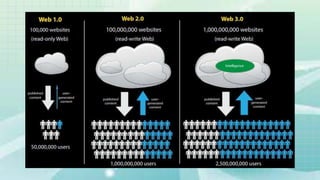
The change from a ‘read Web’ to a ‘read/write Web’ has encouraged
teachers to become increasingly inventive in their approach to
engaging technologically smart learners who want to publish their work
in the cloud.
When students write or speak for a broader and more international
audience, they pay more attention to polishing their work, think more
deeply about the content they produce, and consider cultural norms
more thoughtfully… Ramírez (2010: 1)
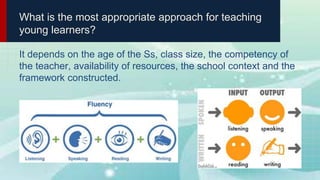
What is the most appropriate approach for teaching
young learners?
It depends on the age of the Ss, class size, the competency of
the teacher, availability of resources, the school context and the
framework constructed.
Productive Skill
The oral skill is really important because it
shows how proficient our Ss are in the English
Language.
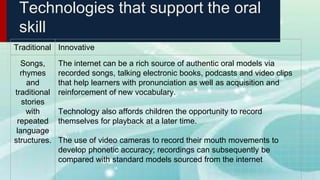
Technologies that support the oral
skill
Traditional Innovative
Songs,
rhymes
and
traditional
stories
with
repeated
language
structures.
The internet can be a rich source of authentic oral models via
recorded songs, talking electronic books, podcasts and video clips
that help learners with pronunciation as well as acquisition and
reinforcement of new vocabulary.
Technology also affords children the opportunity to record
themselves for playback at a later time.
The use of video cameras to record their mouth movements to
develop phonetic accuracy; recordings can subsequently be
compared with standard models sourced from the internet
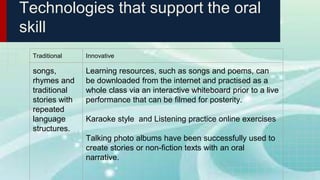
Technologies that support the oral
skill
Traditional Innovative
songs,
rhymes and
traditional
stories with
repeated
language
structures.
Learning resources, such as songs and poems, can
be downloaded from the internet and practised as a
whole class via an interactive whiteboard prior to a live
performance that can be filmed for posterity.
Karaoke style and Listening practice online exercises
Talking photo albums have been successfully used to
create stories or non-fiction texts with an oral
narrative.
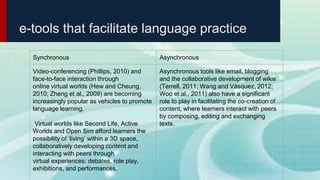
e-tools that facilitate language practice
Synchronous Asynchronous
Video-conferencing (Phillips, 2010) and
face-to-face interaction through
online virtual worlds (Hew and Cheung,
2010; Zheng et al., 2009) are becoming
increasingly popular as vehicles to promote
language learning.
Virtual worlds like Second Life, Active
Worlds and Open Sim afford learners the
possibility of ‘living’ within a 3D space,
collaboratively developing content and
interacting with peers through
virtual experiences: debates, role play,
exhibitions, and performances.
Asynchronous tools like email, blogging
and the collaborative development of wikis
(Terrell, 2011; Wang and Vásquez, 2012;
Woo et al., 2011) also have a significant
role to play in facilitating the co-creation of
content, where learners interact with peers
by composing, editing and exchanging
texts.
CASE STUDIES
Case studies from a range of countries have been chosen
to illustrate how different technologies can be used to
increase learners’ access and participation as well as
supporting their development of oral competency, reading
and writing.
CASE STUDIES
Read your cases, then, present them in a
creative way: such as using infographics, video
conference, podcast or recorded audio, role
plays, etc.
Show the e-tools and examples on how to use
each one.
CALL WORKOUT
In groups solve the CALL WORKOUT

Digital competencies emerging technologies_call

  • 1.
  • 2.
    Emerging technologies, Emergingminds This chapter explores how information and communication technologies (ICT) can be used to support the process of English language learning for those in the very early stages of education Innovative approaches exemplary use of technology for primary and Middle School English language Analysis of case studies
  • 3.
    What´s the bestage to learn English?
  • 4.
    The trend towardsintroducing English teaching at primary level ■■research into the optimum age for language learning is inconclusive ■■ an early start has a positive impact on students’ attitudes ■■ the only advantage of an early start is the total amount of time spent actively on learning a language.
  • 5.
    Importance of EnglishLanguage Some policy makers have decided that the creation of well-educated, English speaking Ss whom are the future workforce, may be one route out of the current global economic downturn and make it increase, instead. Parents often consider academic excellence in English to be the number one priority in terms of access to higher education, university accreditation and economic prosperity for their children. Consequently, in many countries, children now begin their study of English at primary level.
  • 6.
    What’s in aname? In many English speaking countries it is often referred to as ‘English as an additional language’ or ‘English language learning’. The distinctive position in these contexts is for learners to acquire English alongside other subjects. This approach has proved very popular in the US, Canada, Australia and the UK.
  • 7.
    ESL In other areas,such as the Middle East, the term ‘English as another language’ has been coined to reflect the notion of children from minority ethnic backgrounds, who already have experience of using their own home languages and are learning the official language of the country, as well as learning English.
  • 8.
    EFL In many othercountries around the world, readers are likely to be familiar with the concept of learning ‘English as a foreign language’, where learning of English takes place in a non-English speaking context. In EFL classrooms there is a general aspiration for exposing learners to English as a ‘living language’, providing natural opportunities to practise target language through the use of authentic texts and exposure to real models of spoken English.
  • 9.
    Role of technology Inthe EFL case, the role of technology can provide a significant addition to the other more conventional tools (blackboards, textbooks, cassette players) that are found in classrooms around the world. Technologies like the internet can provide access to large quantities of authentic input material and at the same time can provide opportunities for practice. Even if learners do not have direct access to the internet in their classrooms, or at home, teachers often do have and can provide additional resources to supplement the material offered via conventional means.
  • 10.
    Technological change –from consumers to producers Over the last 20 years, there has been a tremendous shift in the way that users integrate technology into their personal lives. EDUCATIONAL SECTOR
  • 12.
    The change froma ‘read Web’ to a ‘read/write Web’ has encouraged teachers to become increasingly inventive in their approach to engaging technologically smart learners who want to publish their work in the cloud. When students write or speak for a broader and more international audience, they pay more attention to polishing their work, think more deeply about the content they produce, and consider cultural norms more thoughtfully… Ramírez (2010: 1)
  • 13.
    What is themost appropriate approach for teaching young learners? It depends on the age of the Ss, class size, the competency of the teacher, availability of resources, the school context and the framework constructed.
  • 14.
    Productive Skill The oralskill is really important because it shows how proficient our Ss are in the English Language.
  • 15.
    Technologies that supportthe oral skill Traditional Innovative Songs, rhymes and traditional stories with repeated language structures. The internet can be a rich source of authentic oral models via recorded songs, talking electronic books, podcasts and video clips that help learners with pronunciation as well as acquisition and reinforcement of new vocabulary. Technology also affords children the opportunity to record themselves for playback at a later time. The use of video cameras to record their mouth movements to develop phonetic accuracy; recordings can subsequently be compared with standard models sourced from the internet
  • 16.
    Technologies that supportthe oral skill Traditional Innovative songs, rhymes and traditional stories with repeated language structures. Learning resources, such as songs and poems, can be downloaded from the internet and practised as a whole class via an interactive whiteboard prior to a live performance that can be filmed for posterity. Karaoke style and Listening practice online exercises Talking photo albums have been successfully used to create stories or non-fiction texts with an oral narrative.
  • 17.
    e-tools that facilitatelanguage practice Synchronous Asynchronous Video-conferencing (Phillips, 2010) and face-to-face interaction through online virtual worlds (Hew and Cheung, 2010; Zheng et al., 2009) are becoming increasingly popular as vehicles to promote language learning. Virtual worlds like Second Life, Active Worlds and Open Sim afford learners the possibility of ‘living’ within a 3D space, collaboratively developing content and interacting with peers through virtual experiences: debates, role play, exhibitions, and performances. Asynchronous tools like email, blogging and the collaborative development of wikis (Terrell, 2011; Wang and Vásquez, 2012; Woo et al., 2011) also have a significant role to play in facilitating the co-creation of content, where learners interact with peers by composing, editing and exchanging texts.
  • 18.
    CASE STUDIES Case studiesfrom a range of countries have been chosen to illustrate how different technologies can be used to increase learners’ access and participation as well as supporting their development of oral competency, reading and writing.
  • 19.
    CASE STUDIES Read yourcases, then, present them in a creative way: such as using infographics, video conference, podcast or recorded audio, role plays, etc. Show the e-tools and examples on how to use each one.
  • 20.
    CALL WORKOUT In groupssolve the CALL WORKOUT