mapping mobiles:
mediating the territories of
global media policy
Gerard Goggin/@gggoggin
University of Sydney
Talk for ‘Mediating the Territory’ panel
Highway Africa, 30-31 August 2015
Rhodes University
Panel question: How we understand the role of
technology, and particularly mobile phones, in mediating
the relationship with a specific area, place, or space?
Prior questions:
What forms do mobiles phones & media take around the
world? (it’s not all the same)
What are the mobile Internets emerging, esp. in Africa &
regions such as Latin America, parts of Asia, elsewhere?
How we understand the nature & role of media policy in
shaping such ‘assemblages’ of mobile phone technology
What are the policy & governance ‘ecosystems’, especially
in mobile Internet?
7 billion mobile phone subscriptions
3 billion mobile broadband
widespread shift to mobile internet
What is mobile media?
phones, smartphones, tablets,
apps, data, sensors, wearables, cars
What are participatory affordances, modes, &
entailments of mobile media?
What ideas of intended bodies, users, participation,
publics & communities are inscribed in mobiles?
What is relation between mobile & mobilities?
What are mobile Internet in different locations in Africa?
The experience of mobile communications of
the majority of participants was limited to
making calls, receiving calls, sending or receiving
SMSs and instant messages. Few participants
living in low and very low-income households
experience the wide array of communications
services and mobile Internet communications
that are on offer … largely because price levels
are out of alignment with household income
levels.
-- Luci Abrahams and Kiru Pillay,The Lived Costs of Communications: Experiencing
the lived cost of mobile communications in low and very low income households in
urban South Africa 2014 R2K/Wits (2015)
mobile Internet: ‘making do’
second-hand equipment (mobiles, computers)
Poor ICT infrastructure & coverage
Affordability issues
‘read-write’ mobile Internet (patchy access to servers & cloud & use of
mobile software & apps)
media ecosystems? - mobiles & radio & TV & music & print media
Copyright issues: do young hip hop artists want to share the music they
make via - Bluetooth, Soundcloud? USB sticks?
- See research of Alette Schoon (Rhodes), e.gDragging young people down the drain: the
mobile phone, gossip mobile website Outoilet and the creation of a mobile ghetto’,
Critical Arts (2012)
Accessibility & disability issues & innovations
Creativity
On mobile Internet in South Africa & elsewhere, see key work of Marion
Walton, Jonathan Donner (After Access?)
Given complexities of mobile Internets &
their locations, how do we now understand
global media policy?
The interplay among
Global - World Trade rules; transnational corporations; international
internet governance & tech standards
Regional - Africa & sub-Africa (e.g. SADC) policy contexts for media, ICTs,
telcos
National - SA law & policy
Local - cities
Household contexts
Individuals - everyday mobile, social media
Clue: it’s not just Facebook & Twitter plus
Telkom & MTN + ‘light touch’ regulation
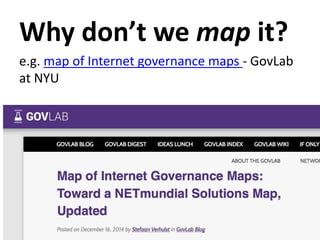
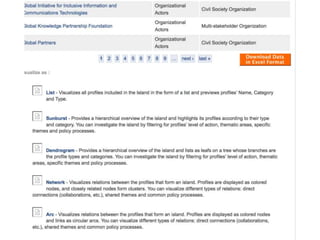
Why don’t we map it?
e.g. map of Internet governance maps - GovLab
at NYU
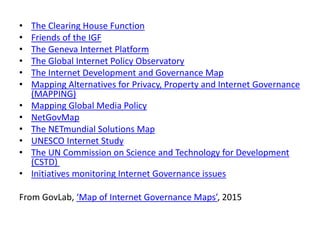
• The Clearing House Function
• Friends of the IGF
• The Geneva Internet Platform
• The Global Internet Policy Observatory
• The Internet Development and Governance Map
• Mapping Alternatives for Privacy, Property and Internet Governance
(MAPPING)
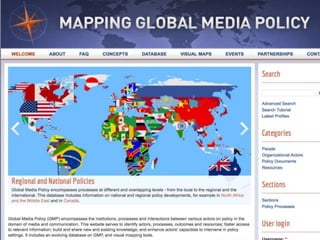
• Mapping Global Media Policy
• NetGovMap
• The NETmundial Solutions Map
• UNESCO Internet Study
• The UN Commission on Science and Technology for Development
(CSTD)
• Initiatives monitoring Internet Governance issues
From GovLab, ‘Map of Internet Governance Maps’, 2015
Mapping Global Media Policy
project of International Association of Media &
Communications Research (IAMCR) Global
Media Policy Working Group
Aim: monitor, categorize and analyze key issues,
significant developments and recent trends in
the governance of media, information and
communication on a global level
Mapping Global Media Policy project
build and share knowledge on the complex field
of global media policy, especially relating to
actors and processes
enhance actors’ capacity to effectively intervene
in relevant policy settings and thus reduce
barriers to meaningful participation
stimulate collaboration between scholars and
stakeholders worldwide
Mapping Global Media Policy platform,
database & resources (including visual maps) are
available for scholars, research groups and other
actors, to plan, conduct, integrate and enrich
research and advocacy activities
• can use platform to access existing data
• can also contribute content on the basis of
your own areas of interest and expertise -
contribute to global community of knowledge
in media policy
how relevant is all this mapping to policy and
advocacy engagement?
How can mapping initiatives may actually
contribute to participatory practices, better
informed policy decisions, and better media?
practical challenges in the establishment &
development of these initiatives?
platform population, content generation and sharing,
sustainability of projects (expert knowledge, skills, human
and financial resources), language diversity and
accessibility, comprehensiveness or gaps in policy
information and analysis?
further reading
Marc Raboy and Claudia Padovani‘Mapping Global Media
Policy: Concepts, Frameworks, Methods’ (2011) - on
Global Media Policy site
Robin Mansell and Marc Raboy, eds. Handbook of Global
Media and Communication Policy (2011)
Gerard Goggin, ‘The Uses of Mapping for Democratic
Global Media Policy’, Rhodes Journalism Review,
forthcoming
Gerard Goggin, ‘Mobile Communication Law and
Regulation,’ in International Encyclopedia of Digital
Communication and Society, vol. 4 (2015)
Gerard Goggin, Global Mobile Media (2010)

Gogginmappingmobileslowres

  • 1.
    mapping mobiles: mediating theterritories of global media policy Gerard Goggin/@gggoggin University of Sydney Talk for ‘Mediating the Territory’ panel Highway Africa, 30-31 August 2015 Rhodes University
  • 2.
    Panel question: Howwe understand the role of technology, and particularly mobile phones, in mediating the relationship with a specific area, place, or space? Prior questions: What forms do mobiles phones & media take around the world? (it’s not all the same) What are the mobile Internets emerging, esp. in Africa & regions such as Latin America, parts of Asia, elsewhere? How we understand the nature & role of media policy in shaping such ‘assemblages’ of mobile phone technology What are the policy & governance ‘ecosystems’, especially in mobile Internet?
  • 3.
    7 billion mobilephone subscriptions 3 billion mobile broadband widespread shift to mobile internet What is mobile media? phones, smartphones, tablets, apps, data, sensors, wearables, cars What are participatory affordances, modes, & entailments of mobile media? What ideas of intended bodies, users, participation, publics & communities are inscribed in mobiles? What is relation between mobile & mobilities? What are mobile Internet in different locations in Africa?
  • 4.
    The experience ofmobile communications of the majority of participants was limited to making calls, receiving calls, sending or receiving SMSs and instant messages. Few participants living in low and very low-income households experience the wide array of communications services and mobile Internet communications that are on offer … largely because price levels are out of alignment with household income levels. -- Luci Abrahams and Kiru Pillay,The Lived Costs of Communications: Experiencing the lived cost of mobile communications in low and very low income households in urban South Africa 2014 R2K/Wits (2015)
  • 5.
    mobile Internet: ‘makingdo’ second-hand equipment (mobiles, computers) Poor ICT infrastructure & coverage Affordability issues ‘read-write’ mobile Internet (patchy access to servers & cloud & use of mobile software & apps) media ecosystems? - mobiles & radio & TV & music & print media Copyright issues: do young hip hop artists want to share the music they make via - Bluetooth, Soundcloud? USB sticks? - See research of Alette Schoon (Rhodes), e.gDragging young people down the drain: the mobile phone, gossip mobile website Outoilet and the creation of a mobile ghetto’, Critical Arts (2012) Accessibility & disability issues & innovations Creativity On mobile Internet in South Africa & elsewhere, see key work of Marion Walton, Jonathan Donner (After Access?)
  • 6.
    Given complexities ofmobile Internets & their locations, how do we now understand global media policy? The interplay among Global - World Trade rules; transnational corporations; international internet governance & tech standards Regional - Africa & sub-Africa (e.g. SADC) policy contexts for media, ICTs, telcos National - SA law & policy Local - cities Household contexts Individuals - everyday mobile, social media Clue: it’s not just Facebook & Twitter plus Telkom & MTN + ‘light touch’ regulation
  • 7.
    Why don’t wemap it? e.g. map of Internet governance maps - GovLab at NYU
  • 8.
    • The ClearingHouse Function • Friends of the IGF • The Geneva Internet Platform • The Global Internet Policy Observatory • The Internet Development and Governance Map • Mapping Alternatives for Privacy, Property and Internet Governance (MAPPING) • Mapping Global Media Policy • NetGovMap • The NETmundial Solutions Map • UNESCO Internet Study • The UN Commission on Science and Technology for Development (CSTD) • Initiatives monitoring Internet Governance issues From GovLab, ‘Map of Internet Governance Maps’, 2015
  • 9.
    Mapping Global MediaPolicy project of International Association of Media & Communications Research (IAMCR) Global Media Policy Working Group Aim: monitor, categorize and analyze key issues, significant developments and recent trends in the governance of media, information and communication on a global level
  • 11.
    Mapping Global MediaPolicy project build and share knowledge on the complex field of global media policy, especially relating to actors and processes enhance actors’ capacity to effectively intervene in relevant policy settings and thus reduce barriers to meaningful participation stimulate collaboration between scholars and stakeholders worldwide
  • 12.
    Mapping Global MediaPolicy platform, database & resources (including visual maps) are available for scholars, research groups and other actors, to plan, conduct, integrate and enrich research and advocacy activities • can use platform to access existing data • can also contribute content on the basis of your own areas of interest and expertise - contribute to global community of knowledge in media policy
  • 14.
    how relevant isall this mapping to policy and advocacy engagement? How can mapping initiatives may actually contribute to participatory practices, better informed policy decisions, and better media? practical challenges in the establishment & development of these initiatives? platform population, content generation and sharing, sustainability of projects (expert knowledge, skills, human and financial resources), language diversity and accessibility, comprehensiveness or gaps in policy information and analysis?
  • 15.
    further reading Marc Raboyand Claudia Padovani‘Mapping Global Media Policy: Concepts, Frameworks, Methods’ (2011) - on Global Media Policy site Robin Mansell and Marc Raboy, eds. Handbook of Global Media and Communication Policy (2011) Gerard Goggin, ‘The Uses of Mapping for Democratic Global Media Policy’, Rhodes Journalism Review, forthcoming Gerard Goggin, ‘Mobile Communication Law and Regulation,’ in International Encyclopedia of Digital Communication and Society, vol. 4 (2015) Gerard Goggin, Global Mobile Media (2010)