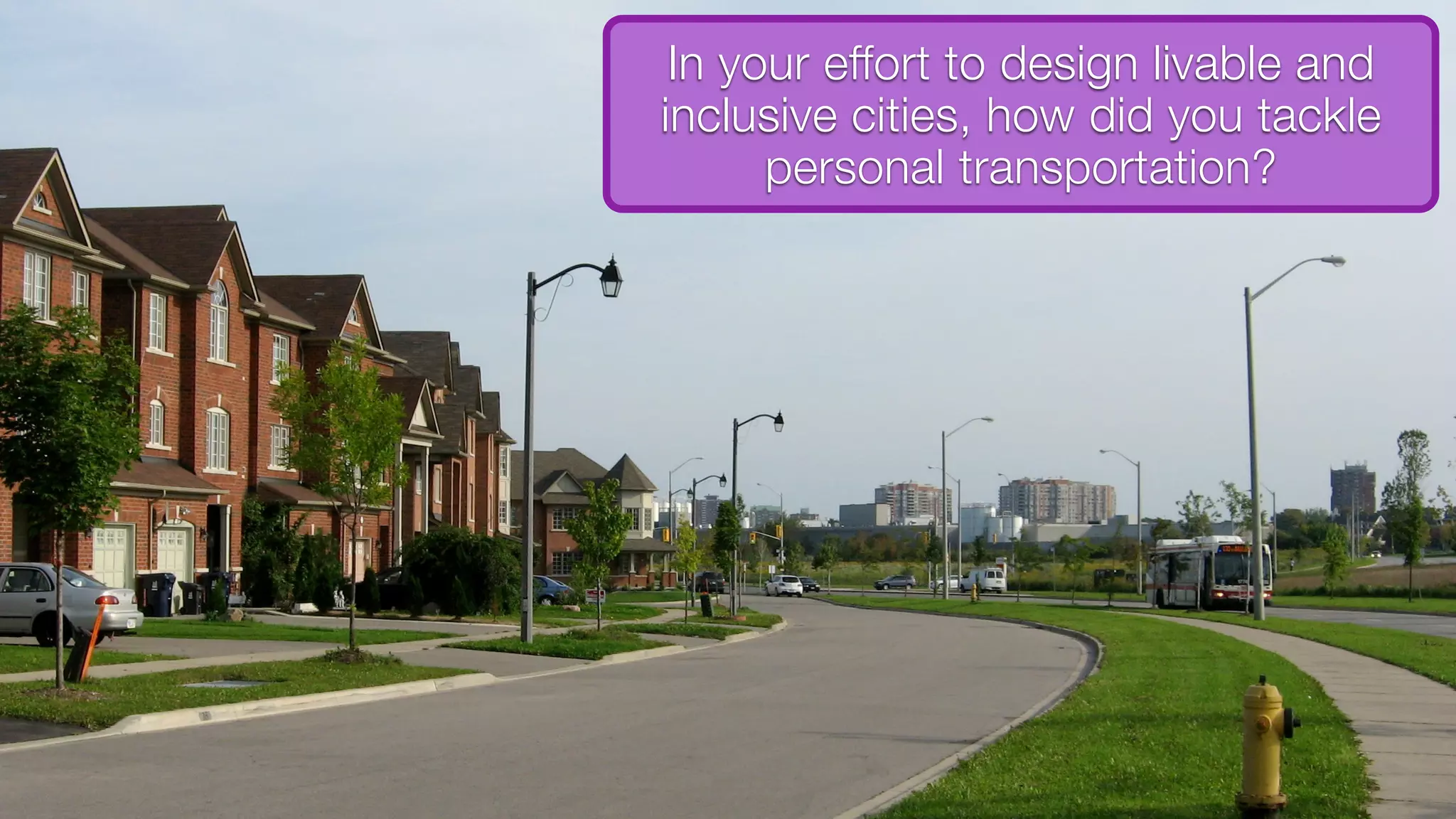
In your effort to design livable and
inclusive cities, how did you tackle
personal transportation?
Personal Transportation
Chapter 6
Personal Transportation
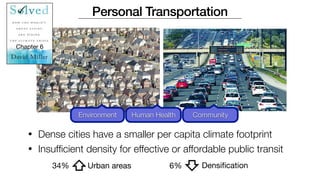
• Dense cities have a smaller per capita climate footprint
Environment Human Health Community
Chapter 6
⇧Urban areas
34%
⇧
6% Densification
• Insufficient density for effective or affordable public transit
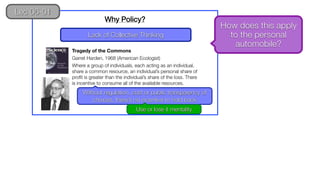
Why Policy?
Tragedy of the Commons
Garret Harden, 1968 (American Ecologist)
Where a group of individuals, each acting as an individual,
share a common resource, an individual’s personal share of
profit is greater than the individual’s share of the loss. There
is incentive to consume all of the available resources.
Without regulation, cost or public transparency of
choices, there’s no incentive to hold back
Use or lose it mentality
Lack of Collective Thinking
Lec 06-01
How does this apply
to the personal
automobile?
Why Policy?
Tragedy of the Commons
Garret Harden, 1968 (American Ecologist)
Where a group of individuals, each acting as an individual,
share a common resource, an individual’s personal share of
profit is greater than the individual’s share of the loss. There
is incentive to consume all of the available resources.
Without regulation, cost or public transparency of
choices, there’s no incentive to hold back
Use or lose it mentality
Lack of Collective Thinking
Lec 06-01
How does this apply
to the personal
automobile?
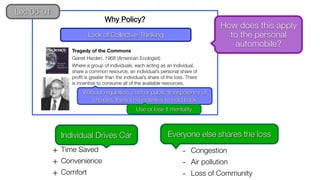
+ Time Saved
+ Convenience
+ Comfort
- Congestion
- Air pollution
- Loss of Community
Individual Drives Car Everyone else shares the loss
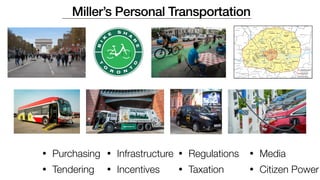
Miller’s Personal Transportation
• Purchasing
• Tendering
• Infrastructure
• Incentives
• Regulations
• Taxation
• Media
• Citizen Power
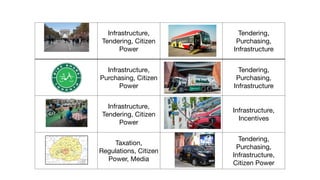
Infrastructure,
Tendering, Citizen
Power
Tendering,
Purchasing,
Infrastructure
Infrastructure,
Purchasing, Citizen
Power
Tendering,
Purchasing,
Infrastructure
Infrastructure,
Tendering, Citizen
Power
Infrastructure,
Incentives
Taxation,
Regulations, Citizen
Power, Media
Tendering,
Purchasing,
Infrastructure,
Citizen Power
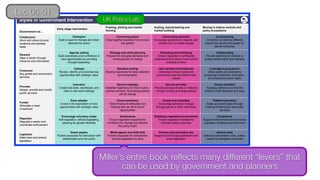
Styles of Government Intervention
Early stage intervention
Framing, piloting and market
forming
Scaling, mainstreaming and
market building
Moving in mature markets and
policy ecosystems
Collaborator
Work with others to build
evidence and develop
ideas
Champion
Build a case for change and retain
alliances for action
Convening power
Draw together expertise from across
the system
Connecting networks
Encourage government, experts, and
citizens can co-create change
Co-producing
Co-deliver by steering different
actors from across the system to
deliver outcomes
Steward
Steer a sector through
influence and information
Agenda setting
Build awareness and confidence in
new opportunities by providing
thought leadership
Strategy and skills planning
Prepare for changing demands and
consequences of change
Educating and informing
Ensure regulation is sufficiently
available to them
Collaborating
Provide platforms for citizens to
protect vested rights and interests
Consumer
Buy goods and commission
services
Catalyst
Review, identify and prioritize key
opportunities with strategic value
Standard setting
Develop standards for data collection
and presentation
User centred commissioner
Understand citizen needs and
contract services that deliver best
impact
Leverage buying power
Utilize public procurement to
encourage investment, innovation,
and protect consumer rights
Provider
Design, provide and modify
public services
Innovator
Create test beds, sandboxes, and
trials in real world settings
Service redesign
Establish legitimacy for more human-
centred services, harnessing political
will for change
Service provider
Provide services directly or indirectly
through funding and target setting
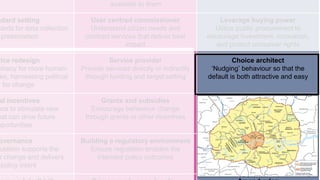
Choice architect
behaviour so that the
default is both attractive and easy
Funder
Stimulate or lead
investment
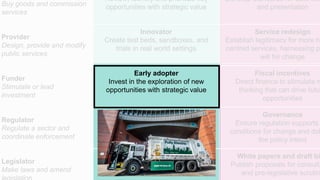
Early adopter
Invest in the exploration of new
opportunities with strategic value
Fiscal incentives
Direct finance to stimulate new
thinking that can drive future
opportunities
Grants and subsidies
Encourage behaviour change
through grants or other incentives
Platform provision
Scale up proven ideas through
existing infrastructure and public
services
Regulator
Regulate a sector and
coordinate enforcement
Encourage voluntary codes
Self-regulation, without legislating,
allowing for greater flexibility
Governance
Ensure regulation supports the
conditions for change and delivers
the policy intent
Building a regulatory environment
Ensure regulation enables the
intended policy outcomes
Compliance
Support enforcement and harmonize
regulatory compliance environment
Legislator
Make laws and amend
legislation
Green papers
Publish proposals for discussion with
stakeholders and the public
White papers and draft bills
Publish proposals for consultation
and pre-legislative scrutiny
Primary and secondary law
Support a bill through parliament and
enact legislation
Amend rules
Statutory instruments: rules, orders,
created by delegated authorities
Adapted from UK Policy Lab
UK Policy Lab
Lec 06-01
Miller’s entire book reflects many different “levers” that
can be used by government and planners
Buy goods and commission
services
Review, identify and prioritize key
opportunities with strategic value
Develop standards for data coll
and presentation
Provider
Design, provide and modify
public services
Innovator
Create test beds, sandboxes, and
trials in real world settings
Service redesign
Establish legitimacy for more hu
centred services, harnessing po
will for change
Funder
Stimulate or lead
investment
Early adopter
Invest in the exploration of new
opportunities with strategic value
Fiscal incentives
Direct finance to stimulate n
thinking that can drive futur
opportunities
Regulator
Regulate a sector and
coordinate enforcement
Encourage voluntary codes
Self-regulation, without legislating,
allowing for greater flexibility
Governance
Ensure regulation supports
conditions for change and del
the policy intent
Legislator
Make laws and amend
Green papers
Publish proposals for discussion with
stakeholders and the public
White papers and draft bi
Publish proposals for consulta
and pre-legislative scrutin
available to them
ndard setting
dards for data collection
presentation
User centred commissioner
Understand citizen needs and
contract services that deliver best
impact
Leverage buying power
Utilize public procurement to
encourage investment, innovation,
and protect consumer rights
vice redesign
imacy for more human-
es, harnessing political
l for change
Service provider
Provide services directly or indirectly
through funding and target setting
Choice architect
behaviour so that the
default is both attractive and easy
al incentives
nce to stimulate new
hat can drive future
pportunities
Grants and subsidies
Encourage behaviour change
through grants or other incentives
Platform provision
Scale up proven ideas through
existing infrastructure and public
services
overnance
gulation supports the
r change and delivers
policy intent
Building a regulatory environment
Ensure regulation enables the
intended policy outcomes
Compliance
Support enforcement and harmonize
regulatory compliance environment
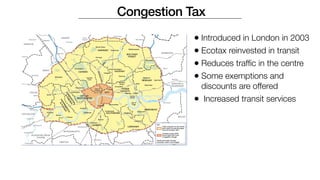
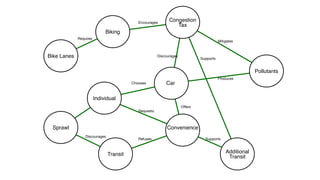
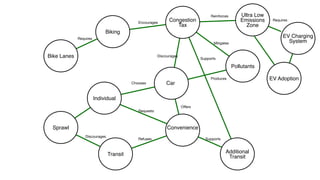
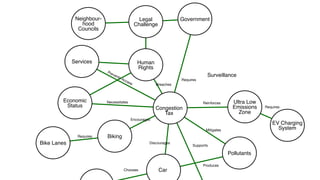
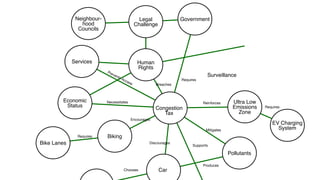
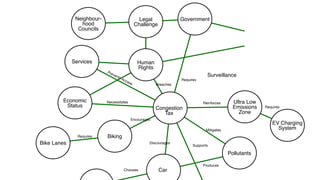
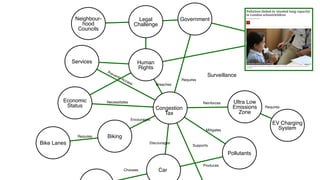
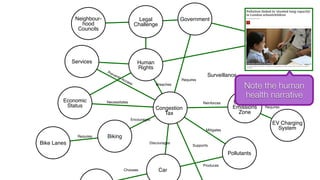
Congestion Tax
• Introduced in London in 2003
• Ecotax reinvested in transit
• Reduces traffic in the centre
• Some exemptions and
discounts are offered
• Increased transit services
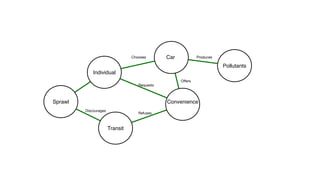
Pollutants
Transit
Offers
Chooses
Individual
Car
Convenience
Requests
Produces
Refuses
Sprawl
Discourages
Pollutants
Transit
Offers
Chooses
Individual
Car
Convenience
Requests
Produces
Refuses
Sprawl
Discourages
Congestion
Tax
Discourages
Additional
Transit
Supports
Supports
Mitigates
Biking
Requires
Bike Lanes
Encourages
Pollutants
Transit
Offers
Chooses
Individual
Car
Convenience
Requests
Produces
Refuses
Sprawl
Discourages
Congestion
Tax
Discourages
Additional
Transit
Supports
Supports
Mitigates
Biking
Requires
Bike Lanes
Encourages
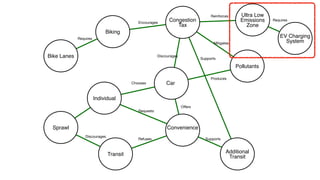
Ultra Low
Emissions
Zone
Reinforces
EV Charging
System
Requires
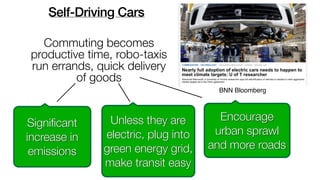
Self-Driving Cars
Commuting becomes
productive time, robo-taxis
run errands, quick delivery
of goods
Significant
increase in
emissions
Unless they are
electric, plug into
green energy grid,
make transit easy
BNN Bloomberg
Encourage
urban sprawl
and more roads
Pollutants
Transit
Offers
Chooses
Individual
Car
Convenience
Requests
Produces
Refuses
Sprawl
Discourages
Congestion
Tax
Discourages
Additional
Transit
Supports
Supports
Mitigates
Biking
Requires
Bike Lanes
Encourages
Ultra Low
Emissions
Zone
Reinforces
EV Charging
System
Requires
EV Adoption
Prevents
Pollutants
Chooses Car
Produces
Congestion
Tax
Discourages
Supports
Mitigates
Biking
Requires
Bike Lanes
Encourages
Ultra Low
Emissions
Zone
Reinforces
EV Charging
System
Requires
Government
Legal
Challenge
Neighbour-
hood
Councils
Economic
Status
Necessitates
Human
Rights
Breaches Requires
Encourage
Services
An Imagined Plane of Ethical Reasoning Space
Beneficence
Nonmaleficence
Autonomy
Justice
The better a
decision, the more
space is filled
Harm
and
Benefit
axis
Stakeholder Impact axis
An Imagined Plane of Ethical Reasoning Space
Beneficence
Nonmaleficence
Autonomy
Justice
The better a
decision, the more
space is filled
Harm
and
Benefit
axis
Stakeholder Impact axis
Is there validity to the
human rights
complaint?
Pollutants
Chooses Car
Produces
Congestion
Tax
Discourages
Supports
Mitigates
Biking
Requires
Bike Lanes
Encourages
Ultra Low
Emissions
Zone
Reinforces
EV Charging
System
Requires
Government
Legal
Challenge
Neighbour-
hood
Councils
Economic
Status
Necessitates
Human
Rights
Breaches
Services
Prevents Access
Requires
Surveillance
Pollutants
Chooses Car
Produces
Congestion
Tax
Discourages
Supports
Mitigates
Biking
Requires
Bike Lanes
Encourages
Ultra Low
Emissions
Zone
Reinforces
EV Charging
System
Requires
Government
Legal
Challenge
Neighbour-
hood
Councils
Economic
Status
Necessitates
Human
Rights
Breaches
Services
Prevents Access
Requires
Surveillance
Pollutants
Chooses Car
Produces
Congestion
Tax
Discourages
Supports
Mitigates
Biking
Requires
Bike Lanes
Encourages
Ultra Low
Emissions
Zone
Reinforces
EV Charging
System
Requires
Government
Legal
Challenge
Neighbour-
hood
Councils
Economic
Status
Necessitates
Human
Rights
Breaches
Services
Prevents Access
Requires
Surveillance
Pollutants
Chooses Car
Produces
Congestion
Tax
Discourages
Supports
Mitigates
Biking
Requires
Bike Lanes
Encourages
Ultra Low
Emissions
Zone
Reinforces
EV Charging
System
Requires
Government
Legal
Challenge
Neighbour-
hood
Councils
Economic
Status
Necessitates
Human
Rights
Breaches
Services
Prevents Access
Requires
Surveillance
Pollutants
Chooses Car
Produces
Congestion
Tax
Discourages
Supports
Mitigates
Biking
Requires
Bike Lanes
Encourages
Ultra Low
Emissions
Zone
Reinforces
EV Charging
System
Requires
Government
Legal
Challenge
Neighbour-
hood
Councils
Economic
Status
Necessitates
Human
Rights
Breaches
Services
Prevents Access
Requires
Surveillance
Note the human
health narrative
Pollutants
Chooses Car
Produces
Congestion
Tax
Discourages
Supports
Mitigates
Biking
Requires
Bike Lanes
Encourages
Ultra Low
Emissions
Zone
Reinforces
EV Charging
System
Requires
Government
Legal
Challenge
Neighbour-
hood
Councils
Economic
Status
Necessitates
Human
Rights
Breaches
Services
Prevents Access
Requires
Surveillance
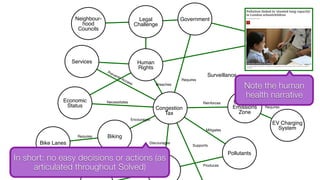
In short: no easy decisions or actions (as
articulated throughout Solved)
Note the human
health narrative
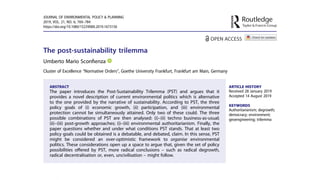
The post-sustainability trilemma
Umberto Mario Sconfienza
Cluster of Excellence “Normative Orders”, Goethe University Frankfurt, Frankfurt am Main, Germany
ABSTRACT
The paper introduces the Post-Sustainability Trilemma (PST) and argues that it
provides a novel description of current environmental politics which is alternative
to the one provided by the narrative of sustainability. According to PST, the three
policy goals of (i) economic growth, (ii) participation, and (iii) environmental
protection cannot be simultaneously attained. Only two of these could. The three
possible combinations of PST are then analysed: (i)–(ii) techno business-as-usual;
(ii)–(iii) post-growth approaches; (i)–(iii) environmental authoritarianism. Finally, the
paper questions whether and under what conditions PST stands. That at least two
policy goals could be obtained is a debatable, and debated, claim. In this sense, PST
might be considered an over-optimistic framework to organise environmental
politics. These considerations open up a space to argue that, given the set of policy
possibilities offered by PST, more radical conclusions – such as radical degrowth,
radical decentralisation or, even, uncivilisation – might follow.
ARTICLE HISTORY
Received 28 January 2019
Accepted 14 August 2019
KEYWORDS
Authoritarianism; degrowth;
democracy; environment;
geoengineering; trilemma
JOURNAL OF ENVIRONMENTAL POLICY & PLANNING
2019, VOL. 21, NO. 6, 769–784
https://doi.org/10.1080/1523908X.2019.1673156
The post-sustainability trilemma
Umberto Mario Sconfienza
Cluster of Excellence “Normative Orders”, Goethe University Frankfurt, Frankfurt am Main, Germany
ABSTRACT
The paper introduces the Post-Sustainability Trilemma (PST) and argues that it
provides a novel description of current environmental politics which is alternative
to the one provided by the narrative of sustainability. According to PST, the three
policy goals of (i) economic growth, (ii) participation, and (iii) environmental
protection cannot be simultaneously attained. Only two of these could. The three
possible combinations of PST are then analysed: (i)–(ii) techno business-as-usual;
(ii)–(iii) post-growth approaches; (i)–(iii) environmental authoritarianism. Finally, the
paper questions whether and under what conditions PST stands. That at least two
policy goals could be obtained is a debatable, and debated, claim. In this sense, PST
might be considered an over-optimistic framework to organise environmental
politics. These considerations open up a space to argue that, given the set of policy
possibilities offered by PST, more radical conclusions – such as radical degrowth,
radical decentralisation or, even, uncivilisation – might follow.
ARTICLE HISTORY
Received 28 January 2019
Accepted 14 August 2019
KEYWORDS
Authoritarianism; degrowth;
democracy; environment;
geoengineering; trilemma
JOURNAL OF ENVIRONMENTAL POLICY & PLANNING
2019, VOL. 21, NO. 6, 769–784
https://doi.org/10.1080/1523908X.2019.1673156
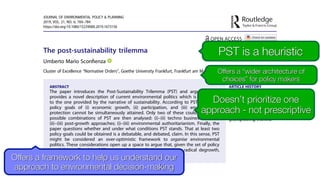
Offers a framework to help us understand our
approach to environmental decision-making
Offers a “wider architecture of
choices” for policy makers
PST is a heuristic
Doesn’t prioritize one
approach - not prescriptive
Introduction
In the last decade, the field of global environmental politics has been shaped by renewed urgency to find a dur-
able solution to the environmental crisis. Until a few years ago, environmental politics was dominated by the
sustainability narrative, according to which environmental governance should be neo-liberal, growth-oriented,
and optimistic about institutional capacity.1
This article takes a critical view of the sustainability narrative and
argues in favour of a novel ‘post-sustainability’ framework – according to which current environmental politics
is best understood not as an attempt to realise all the policy goals linked to the three pillars of sustainable devel-
opment2
but, rather, by the impossibility of it. Once we accept this reasoned premise, at least three different
approaches to environmental politics emerge. These three approaches to environmental governance – techno
business-as-usual, post-growth, and environmental authoritarianism – which have so far been analysed separ-
ately in the environmental politics literature, are treated here as part of a bigger policy framework which, it is
argued, could be useful to policy analysis.
Sustainable development still warms the heart of many actors in environmental governance – business
actors, politicians, diplomats of the international institutions and NGOs – to the point that it is now at the
core of the development agenda of the UN. Yet, since its introduction into the international policy discourse
back in 1987 (World Commission on Environment and Development, 1987), it has not delivered on its
basic promise to develop the Global South (Hickel, 2017a) while protecting the environment. Just to take
the three banner issues of Rio 1992: carbon emissions are up to the point that we have less than ten years before
we exceed the carbon budget to meet the aspirational goal of Paris (MCC, 2019); biodiversity is rapidly declin-
ing (Kolbert, 2014; Rockstrom et al., 2009); and desertification is advancing (Cherlet et al., 2018).
© 2019 The Author(s). Published by Informa UK Limited, trading as Taylor & Francis Group
This is an Open Access article distributed under the terms of the Creative Commons Attribution-NonCommercial-NoDerivatives License (http://creativecommons.org/
licenses/by-nc-nd/4.0/), which permits non-commercial re-use, distribution, and reproduction in any medium, provided the original work is properly cited, and is not
altered, transformed, or built upon in any way.
CONTACT Umberto Mario Sconfienza sconfumberto@gmail.com Cluster of Excellence “The Formation of Normative Orders”, Goethe
University Frankfurt/Main, Office 2.15, Max-Horkheimer-Str. 2, Frankfurt am Main, 60323, Germany @sconfumberto
Introduction
In the last decade, the field of global environmental politics has been shaped by renewed urgency to find a dur-
able solution to the environmental crisis. Until a few years ago, environmental politics was dominated by the
sustainability narrative, according to which environmental governance should be neo-liberal, growth-oriented,
and optimistic about institutional capacity.1
This article takes a critical view of the sustainability narrative and
argues in favour of a novel ‘post-sustainability’ framework – according to which current environmental politics
is best understood not as an attempt to realise all the policy goals linked to the three pillars of sustainable devel-
opment2
but, rather, by the impossibility of it. Once we accept this reasoned premise, at least three different
approaches to environmental politics emerge. These three approaches to environmental governance – techno
business-as-usual, post-growth, and environmental authoritarianism – which have so far been analysed separ-
ately in the environmental politics literature, are treated here as part of a bigger policy framework which, it is
argued, could be useful to policy analysis.
Sustainable development still warms the heart of many actors in environmental governance – business
actors, politicians, diplomats of the international institutions and NGOs – to the point that it is now at the
core of the development agenda of the UN. Yet, since its introduction into the international policy discourse
back in 1987 (World Commission on Environment and Development, 1987), it has not delivered on its
basic promise to develop the Global South (Hickel, 2017a) while protecting the environment. Just to take
the three banner issues of Rio 1992: carbon emissions are up to the point that we have less than ten years before
we exceed the carbon budget to meet the aspirational goal of Paris (MCC, 2019); biodiversity is rapidly declin-
ing (Kolbert, 2014; Rockstrom et al., 2009); and desertification is advancing (Cherlet et al., 2018).
© 2019 The Author(s). Published by Informa UK Limited, trading as Taylor & Francis Group
This is an Open Access article distributed under the terms of the Creative Commons Attribution-NonCommercial-NoDerivatives License (http://creativecommons.org/
licenses/by-nc-nd/4.0/), which permits non-commercial re-use, distribution, and reproduction in any medium, provided the original work is properly cited, and is not
altered, transformed, or built upon in any way.
CONTACT Umberto Mario Sconfienza sconfumberto@gmail.com Cluster of Excellence “The Formation of Normative Orders”, Goethe
University Frankfurt/Main, Office 2.15, Max-Horkheimer-Str. 2, Frankfurt am Main, 60323, Germany @sconfumberto
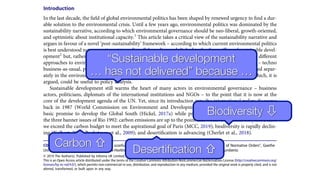
Carbon ⇧
“Sustainable development
… has not delivered” because …
Desertification ⇧
Biodiversity ⇩
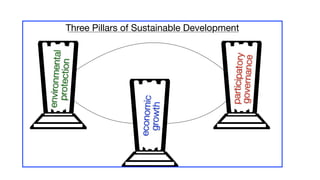
Three Pillars of Sustainable Development
e
n
v
i
r
o
n
m
e
n
t
a
l
p
r
o
t
e
c
t
i
o
n
e
c
o
n
o
m
i
c
g
r
o
w
t
h
p
a
r
t
i
c
i
p
a
t
o
r
y
g
o
v
e
r
n
a
n
c
e
Three Pillars of Sustainable Development
e
n
v
i
r
o
n
m
e
n
t
a
l
p
r
o
t
e
c
t
i
o
n
e
c
o
n
o
m
i
c
g
r
o
w
t
h
p
a
r
t
i
c
i
p
a
t
o
r
y
g
o
v
e
r
n
a
n
c
e
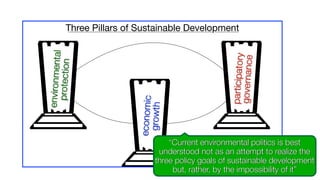
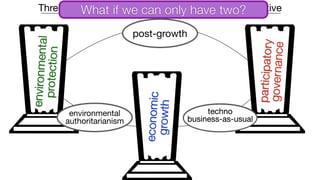
“Current environmental politics is best
understood not as an attempt to realize the
three policy goals of sustainable development
but, rather, by the impossibility of it”
Three Pillars of the Sustainable Development Narrative
e
n
v
i
r
o
n
m
e
n
t
a
l
p
r
o
t
e
c
t
i
o
n
e
c
o
n
o
m
i
c
g
r
o
w
t
h
p
a
r
t
i
c
i
p
a
t
o
r
y
g
o
v
e
r
n
a
n
c
e
What if we can only have two?
post-growth
environmental
authoritarianism
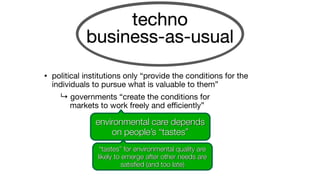
• political institutions only “provide the conditions for the
individuals to pursue what is valuable to them”
↳ governments “create the conditions for
markets to work freely and efficiently”
environmental care depends
on people’s “tastes”
“tastes” for environmental quality are
likely to emerge after other needs are
satisfied (and too late)
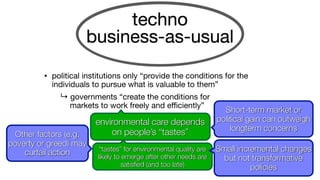
• political institutions only “provide the conditions for the
individuals to pursue what is valuable to them”
↳ governments “create the conditions for
markets to work freely and efficiently”
environmental care depends
on people’s “tastes”
“tastes” for environmental quality are
likely to emerge after other needs are
satisfied (and too late)
Short-term market or
political gain can outweigh
longterm concerns
Other factors (e.g.
poverty or greed) may
curtail action Small incremental changes
but not transformative
policies
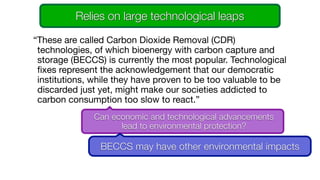
“These are called Carbon Dioxide Removal (CDR)
technologies, of which bioenergy with carbon capture and
storage (BECCS) is currently the most popular. Technological
fixes represent the acknowledgement that our democratic
institutions, while they have proven to be too valuable to be
discarded just yet, might make our societies addicted to
carbon consumption too slow to react.”

Can economic and technological advancements
lead to environmental protection?
BECCS may have other environmental impacts
Relies on large technological leaps
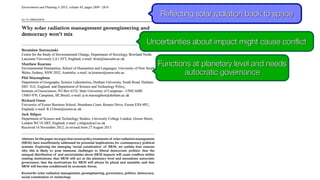
Reflecting solar radiation back to space
Uncertainties about impact might cause conflict
Functions at planetary level and needs
autocratic governance
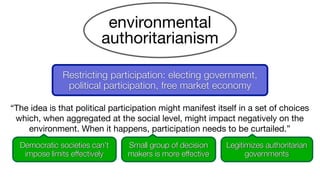
environmental
authoritarianism
“The idea is that political participation might manifest itself in a set of choices
which, when aggregated at the social level, might impact negatively on the
environment. When it happens, participation needs to be curtailed.”
Legitimizes authoritarian
governments
Democratic societies can’t
impose limits effectively
Small group of decision
makers is more effective
Restricting participation: electing government,
political participation, free market economy
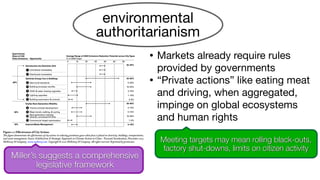
• Markets already require rules
provided by governments 

• “Private actions” like eating meat
and driving, when aggregated,
impinge on global ecosystems
and human rights
Meeting targets may mean rolling black-outs,
factory shut-downs, limits on citizen activity
Miller’s suggests a comprehensive
legislative framework
environmental
authoritarianism
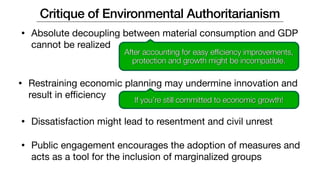
• Absolute decoupling between material consumption and GDP
cannot be realized
Critique of Environmental Authoritarianism
After accounting for easy efficiency improvements,
protection and growth might be incompatible.
• Restraining economic planning may undermine innovation and
result in efficiency If you’re still committed to economic growth!
• Dissatisfaction might lead to resentment and civil unrest
• Public engagement encourages the adoption of measures and
acts as a tool for the inclusion of marginalized groups
Is Green Growth Possible?
Jason Hickela
and Giorgos Kallisb
a
Anthropology, Goldsmiths, University of London, London, UK; <j.hickel@gold.ac.uk>
b
ICREA and ICTA-UAB, Universitat Autonoma de Barcelona, Barcelona, Spain
ABSTRACT
The notion of green growth has emerged as a dominant policy response to climate change and
ecological breakdown. Green growth theory asserts that continued economic expansion is
compatible with our planet’s ecology, as technological change and substitution will allow us to
absolutely decouple GDP growth from resource use and carbon emissions. This claim is now
assumed in national and international policy, including in the Sustainable Development Goals. But
empirical evidence on resource use and carbon emissions does not support green growth theory.
Examining relevant studies on historical trends and model-based projections, we find that: (1) there
is no empirical evidence that absolute decoupling from resource use can be achieved on a global
scale against a background of continued economic growth, and (2) absolute decoupling from carbon
emissions is highly unlikely to be achieved at a rate rapid enough to prevent global warming over
1.5°C or 2°C, even under optimistic policy conditions. We conclude that green growth is likely to be
a misguided objective, and that policymakers need to look toward alternative strategies.
Is Green Growth Possible?
Jason Hickela
and Giorgos Kallisb
a
Anthropology, Goldsmiths, University of London, London, UK; <j.hickel@gold.ac.uk>
b
ICREA and ICTA-UAB, Universitat Autonoma de Barcelona, Barcelona, Spain
ABSTRACT
The notion of green growth has emerged as a dominant policy response to climate change and
ecological breakdown. Green growth theory asserts that continued economic expansion is
compatible with our planet’s ecology, as technological change and substitution will allow us to
absolutely decouple GDP growth from resource use and carbon emissions. This claim is now
assumed in national and international policy, including in the Sustainable Development Goals. But
empirical evidence on resource use and carbon emissions does not support green growth theory.
Examining relevant studies on historical trends and model-based projections, we find that: (1) there
is no empirical evidence that absolute decoupling from resource use can be achieved on a global
scale against a background of continued economic growth, and (2) absolute decoupling from carbon
emissions is highly unlikely to be achieved at a rate rapid enough to prevent global warming over
1.5°C or 2°C, even under optimistic policy conditions. We conclude that green growth is likely to be
a misguided objective, and that policymakers need to look toward alternative strategies.
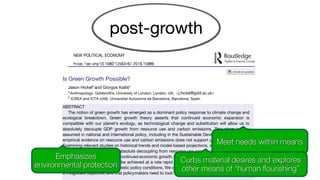
Emphasizes
environmental protection
Meet needs within means
Curbs material desires and explores
other means of “human flourishing”
e
n
v
i
r
o
n
m
e
n
t
a
l
p
r
o
t
e
c
t
i
o
n
e
c
o
n
o
m
i
c
g
r
o
w
t
h
p
a
r
t
i
c
i
p
a
t
o
r
y
g
o
v
e
r
n
a
n
c
e
post-growth
environmental
authoritarianism
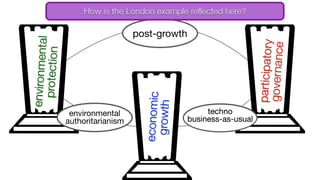
How is the London example reflected here?
e
n
v
i
r
o
n
m
e
n
t
a
l
p
r
o
t
e
c
t
i
o
n
e
c
o
n
o
m
i
c
g
r
o
w
t
h
p
a
r
t
i
c
i
p
a
t
o
r
y
g
o
v
e
r
n
a
n
c
e
post-growth
environmental
authoritarianism
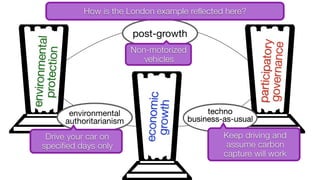
Drive your car on
specified days only
Non-motorized
vehicles
Keep driving and
assume carbon
capture will work
How is the London example reflected here?
post-growth
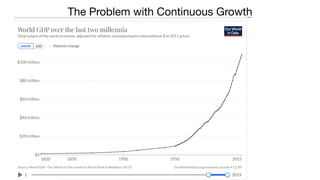
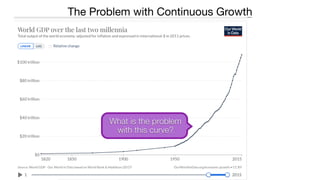
The Problem with Continuous Growth
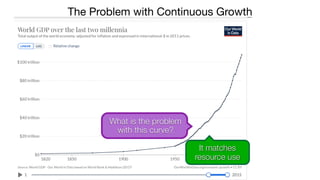
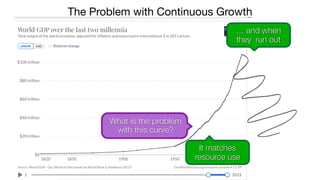
What is the problem
with this curve?
The Problem with Continuous Growth
What is the problem
with this curve?
It matches
resource use
The Problem with Continuous Growth
What is the problem
with this curve?
It matches
resource use
… and when
they run out
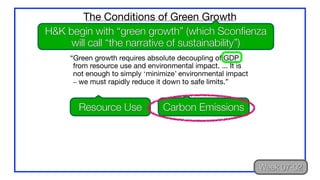
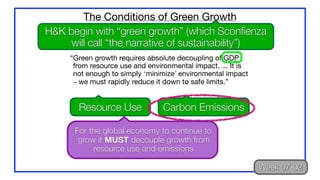
“Green growth requires absolute decoupling of GDP
from resource use and environmental impact. ... It is
not enough to simply ‘minimize’ environmental impact
– we must rapidly reduce it down to safe limits.”
The Conditions of Green Growth
H&K begin with “green growth” (which Sconfienza
will call “the narrative of sustainability”)
Resource Use Carbon Emissions
Week 07-02
“Green growth requires absolute decoupling of GDP
from resource use and environmental impact. ... It is
not enough to simply ‘minimize’ environmental impact
– we must rapidly reduce it down to safe limits.”
The Conditions of Green Growth
H&K begin with “green growth” (which Sconfienza
will call “the narrative of sustainability”)
Resource Use Carbon Emissions
Week 07-02
For the global economy to continue to
grow it MUST decouple growth from
resource use and emissions
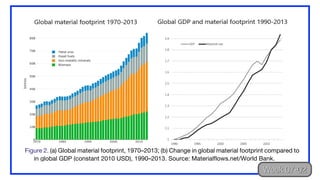
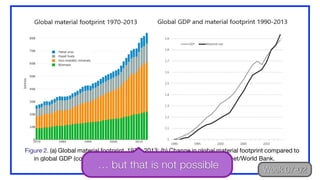
services … but there is no historical evidence that switching to services will, in and of itself, reduce
the material throughput of the global economy.
Figure 2. (a) Global material footprint, 1970–2013; (b) Change in global material footprint compared to change
in global GDP (constant 2010 USD), 1990–2013. Source: Materialflows.net/World Bank.
A second argument is that technological innovation and government policy might drive
Week 07-02
services … but there is no historical evidence that switching to services will, in and of itself, reduce
the material throughput of the global economy.
Figure 2. (a) Global material footprint, 1970–2013; (b) Change in global material footprint compared to change
in global GDP (constant 2010 USD), 1990–2013. Source: Materialflows.net/World Bank.
A second argument is that technological innovation and government policy might drive
Week 07-02
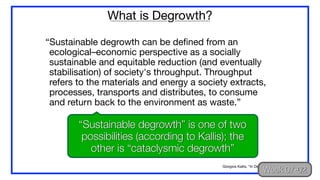
… but that is not possible
“Sustainable degrowth can be defined from an
ecological–economic perspective as a socially
sustainable and equitable reduction (and eventually
stabilisation) of society's throughput. Throughput
refers to the materials and energy a society extracts,
processes, transports and distributes, to consume
and return back to the environment as waste.”
What is Degrowth?
Giorgios Kallis, “In Defence of Degrowth” (2011)
“Sustainable degrowth” is one of two
possibilities (according to Kallis); the
other is “cataclysmic degrowth”
Week 07-02
services … but there is no historical evidence that switching to services will, in and of itself, reduce
the material throughput of the global economy.
Figure 2. (a) Global material footprint, 1970–2013; (b) Change in global material footprint compared to change
in global GDP (constant 2010 USD), 1990–2013. Source: Materialflows.net/World Bank.
A second argument is that technological innovation and government policy might drive
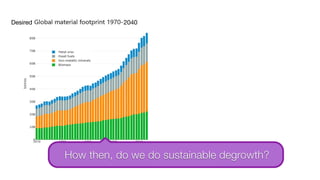
2040
Desired
How then, do we do sustainable degrowth?
services … but there is no historical evidence that switching to services will, in and of itself, reduce
the material throughput of the global economy.
Figure 2. (a) Global material footprint, 1970–2013; (b) Change in global material footprint compared to change
in global GDP (constant 2010 USD), 1990–2013. Source: Materialflows.net/World Bank.
A second argument is that technological innovation and government policy might drive
s
e
r
v
i
c
e
s
…
b
u
t
t
h
e
r
e
i
s
n
o
h
i
s
t
o
r
i
c
a
l
e
v
i
d
e
n
c
e
t
h
a
t
s
w
i
t
c
h
i
n
g
t
o
s
e
r
v
i
c
e
s
w
i
l
l
,
i
n
a
n
d
o
f
i
t
s
e
l
f
t
h
e
m
a
t
e
r
i
a
l
t
h
r
o
u
g
h
p
u
t
o
f
t
h
e
g
l
o
b
a
l
e
c
o
n
o
m
y
.
F
i
g
u
r
e
2
.
(
a
)
G
l
o
b
a
l
m
a
t
e
r
i
a
l
f
o
o
t
p
r
i
n
t
,
1
9
7
0
–
2
0
1
3
;
(
b
)
C
h
a
n
g
e
i
n
g
l
o
b
a
l
m
a
t
e
r
i
a
l
f
o
o
t
p
r
i
n
t
c
o
m
p
a
r
e
d
t
i
n
g
l
o
b
a
l
G
D
P
(
c
o
n
s
t
a
n
t
2
0
1
0
U
S
D
)
,
1
9
9
0
–
2
0
1
3
.
S
o
u
r
c
e
:
M
a
t
e
r
i
a
l
f
l
o
w
s
.
n
e
t
/
W
o
r
l
d
B
a
n
k
.
A
s
e
c
o
n
d
a
r
g
u
m
e
n
t
i
s
t
h
a
t
t
e
c
h
n
o
l
o
g
i
c
a
l
i
n
n
o
v
a
t
i
o
n
a
n
d
g
o
v
e
r
n
m
e
n
t
p
o
l
i
c
y
m
i
g
s
e
r
v
i
c
e
s
…
b
u
t
t
h
e
r
e
i
s
n
o
h
i
s
t
o
r
i
c
a
l
e
v
i
d
e
n
c
e
t
h
a
t
s
w
i
t
c
h
i
n
g
t
o
s
e
r
v
i
c
e
s
w
i
l
l
,
i
n
a
n
d
o
t
h
e
m
a
t
e
r
i
a
l
t
h
r
o
u
g
h
p
u
t
o
f
t
h
e
g
l
o
b
a
l
e
c
o
n
o
m
y
.
F
i
g
u
r
e
2
.
(
a
)
G
l
o
b
a
l
m
a
t
e
r
i
a
l
f
o
o
t
p
r
i
n
t
,
1
9
7
0
–
2
0
1
3
;
(
b
)
C
h
a
n
g
e
i
n
g
l
o
b
a
l
m
a
t
e
r
i
a
l
f
o
o
t
p
r
i
n
t
c
o
m
i
n
g
l
o
b
a
l
G
D
P
(
c
o
n
s
t
a
n
t
2
0
1
0
U
S
D
)
,
1
9
9
0
–
2
0
1
3
.
S
o
u
r
c
e
:
M
a
t
e
r
i
a
l
f
l
o
w
s
.
n
e
t
/
W
o
r
l
d
B
a
n
k
.
A
s
e
c
o
n
d
a
r
g
u
m
e
n
t
i
s
t
h
a
t
t
e
c
h
n
o
l
o
g
i
c
a
l
i
n
n
o
v
a
t
i
o
n
a
n
d
g
o
v
e
r
n
m
e
n
t
p
o
l
i
c
s
e
r
v
i
c
e
s
…
b
u
t
t
h
e
r
e
i
s
n
o
h
i
s
t
o
r
i
c
a
l
e
v
i
d
e
n
c
e
t
h
a
t
s
w
i
t
c
h
i
n
g
t
o
s
e
r
v
i
c
e
s
w
i
l
l
,
i
n
a
t
h
e
m
a
t
e
r
i
a
l
t
h
r
o
u
g
h
p
u
t
o
f
t
h
e
g
l
o
b
a
l
e
c
o
n
o
m
y
.
F
i
g
u
r
e
2
.
(
a
)
G
l
o
b
a
l
m
a
t
e
r
i
a
l
f
o
o
t
p
r
i
n
t
,
1
9
7
0
–
2
0
1
3
;
(
b
)
C
h
a
n
g
e
i
n
g
l
o
b
a
l
m
a
t
e
r
i
a
l
f
o
o
t
p
r
i
n
t
i
n
g
l
o
b
a
l
G
D
P
(
c
o
n
s
t
a
n
t
2
0
1
0
U
S
D
)
,
1
9
9
0
–
2
0
1
3
.
S
o
u
r
c
e
:
M
a
t
e
r
i
a
l
f
l
o
w
s
.
n
e
t
/
W
o
r
l
d
B
A
s
e
c
o
n
d
a
r
g
u
m
e
n
t
i
s
t
h
a
t
t
e
c
h
n
o
l
o
g
i
c
a
l
i
n
n
o
v
a
t
i
o
n
a
n
d
g
o
v
e
r
n
m
e
n
t
s
e
r
v
i
c
e
s
…
b
u
t
t
h
e
r
e
i
s
n
o
h
i
s
t
o
r
i
c
a
l
e
v
i
d
e
n
c
e
t
h
a
t
s
w
i
t
c
h
i
n
g
t
o
s
e
r
v
i
c
e
s
w
i
l
l
,
t
h
e
m
a
t
e
r
i
a
l
t
h
r
o
u
g
h
p
u
t
o
f
t
h
e
g
l
o
b
a
l
e
c
o
n
o
m
y
.
F
i
g
u
r
e
2
.
(
a
)
G
l
o
b
a
l
m
a
t
e
r
i
a
l
f
o
o
t
p
r
i
n
t
,
1
9
7
0
–
2
0
1
3
;
(
b
)
C
h
a
n
g
e
i
n
g
l
o
b
a
l
m
a
t
e
r
i
a
l
f
o
o
i
n
g
l
o
b
a
l
G
D
P
(
c
o
n
s
t
a
n
t
2
0
1
0
U
S
D
)
,
1
9
9
0
–
2
0
1
3
.
S
o
u
r
c
e
:
M
a
t
e
r
i
a
l
f
l
o
w
s
.
n
e
t
/
W
o
A
s
e
c
o
n
d
a
r
g
u
m
e
n
t
i
s
t
h
a
t
t
e
c
h
n
o
l
o
g
i
c
a
l
i
n
n
o
v
a
t
i
o
n
a
n
d
g
o
v
e
r
n
m
e
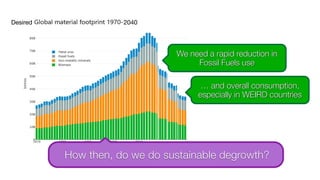
2040
We need a rapid reduction in
Fossil Fuels use
Desired
How then, do we do sustainable degrowth?
… and overall consumption,
especially in WEIRD countries
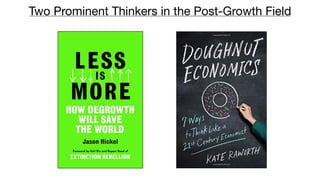
Two Prominent Thinkers in the Post-Growth Field
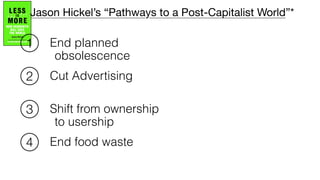
Cut Advertising
End planned
obsolescence
Shift from ownership
to usership
End food waste
1
2
3
4
Jason Hickel’s “Pathways to a Post-Capitalist World”*
Cut Advertising
End planned
obsolescence
Shift from ownership
to usership
End food waste
1
2
3
4
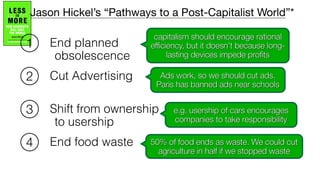
capitalism should encourage rational
efficiency, but it doesn’t because long-
lasting devices impede profits
Ads work, so we should cut ads.
Paris has banned ads near schools
e.g. usership of cars encourages
companies to take responsibility
50% of food ends as waste. We could cut
agriculture in half if we stopped waste
Jason Hickel’s “Pathways to a Post-Capitalist World”*
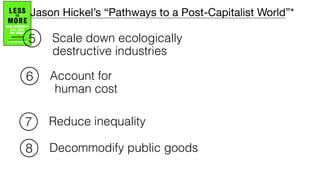
Scale down ecologically
destructive industries
Account for
human cost
Reduce inequality
Decommodify public goods
6
7
8
Jason Hickel’s “Pathways to a Post-Capitalist World”*
5
Scale down ecologically
destructive industries
Account for
human cost
Reduce inequality
Decommodify public goods
6
7
8
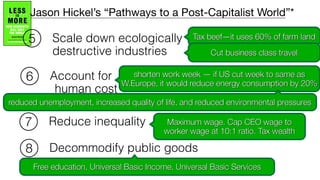
Tax beef—it uses 60% of farm land
Cut business class travel
shorten work week — if US cut week to same as
W.Europe, it would reduce energy consumption by 20%
reduced unemployment, increased quality of life, and reduced environmental pressures
Maximum wage. Cap CEO wage to
worker wage at 10:1 ratio. Tax wealth
Free education, Universal Basic Income, Universal Basic Services
Jason Hickel’s “Pathways to a Post-Capitalist World”*
5
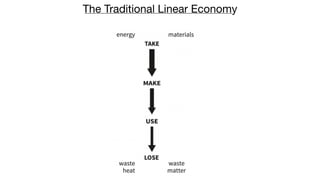
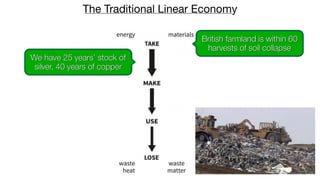
The Traditional Linear Economy
British farmland is within 60
harvests of soil collapse
We have 25 years’ stock of
silver, 40 years of copper
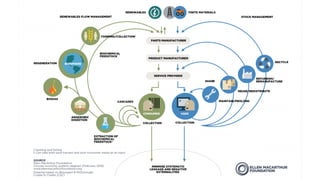
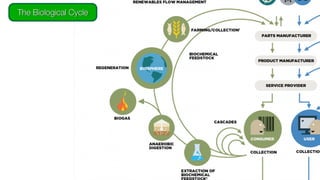
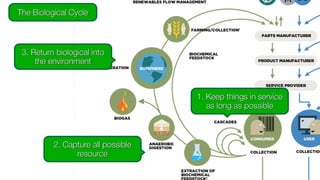
The Biological Cycle
1. Keep things in service
as long as possible
2. Capture all possible
resource
3. Return biological into
the environment
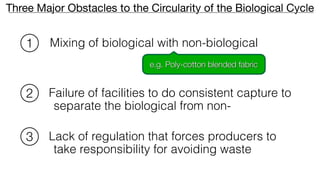
Three Major Obstacles to the Circularity of the Biological Cycle
Failure of facilities to do consistent capture to
separate the biological from non-
Mixing of biological with non-biological
1
2
e.g. Poly-cotton blended fabric
Lack of regulation that forces producers to
take responsibility for avoiding waste
3
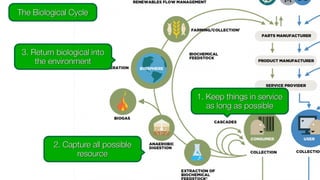
The Biological Cycle
1. Keep things in service
as long as possible
2. Capture all possible
resource
3. Return biological into
the environment
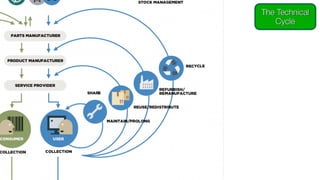
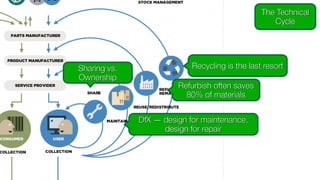
The Technical
Cycle
The Technical
Cycle
Recycling is the last resort
Refurbish often saves
80% of materials
DfX — design for maintenance,
design for repair
Sharing vs.
Ownership
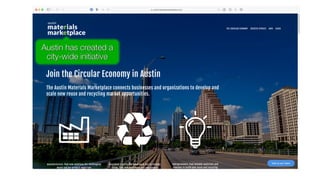
Austin has created a
city-wide initiative
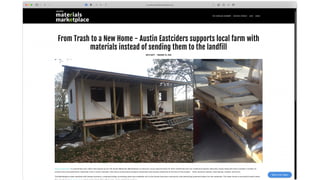
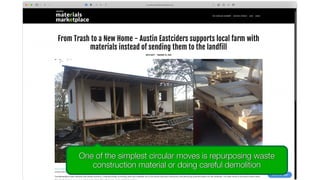
One of the simplest circular moves is repurposing waste
construction material or doing careful demolition
Ucuuba tree timber
yields $5USD Ucuuba seed harvesting
yields $15USD
Natura is the 5th largest
cosmetics company globally
Sustainability research

Sustainability research

  • 1.
    In your effortto design livable and inclusive cities, how did you tackle personal transportation?
  • 2.
  • 3.
    Personal Transportation • Densecities have a smaller per capita climate footprint Environment Human Health Community Chapter 6 ⇧Urban areas 34% ⇧ 6% Densification • Insufficient density for effective or affordable public transit
  • 4.
    Why Policy? Tragedy ofthe Commons Garret Harden, 1968 (American Ecologist) Where a group of individuals, each acting as an individual, share a common resource, an individual’s personal share of profit is greater than the individual’s share of the loss. There is incentive to consume all of the available resources. Without regulation, cost or public transparency of choices, there’s no incentive to hold back Use or lose it mentality Lack of Collective Thinking Lec 06-01 How does this apply to the personal automobile?
  • 5.
    Why Policy? Tragedy ofthe Commons Garret Harden, 1968 (American Ecologist) Where a group of individuals, each acting as an individual, share a common resource, an individual’s personal share of profit is greater than the individual’s share of the loss. There is incentive to consume all of the available resources. Without regulation, cost or public transparency of choices, there’s no incentive to hold back Use or lose it mentality Lack of Collective Thinking Lec 06-01 How does this apply to the personal automobile? + Time Saved + Convenience + Comfort - Congestion - Air pollution - Loss of Community Individual Drives Car Everyone else shares the loss
  • 6.
    Miller’s Personal Transportation •Purchasing • Tendering • Infrastructure • Incentives • Regulations • Taxation • Media • Citizen Power
  • 7.
    Infrastructure, Tendering, Citizen Power Tendering, Purchasing, Infrastructure Infrastructure, Purchasing, Citizen Power Tendering, Purchasing, Infrastructure Infrastructure, Tendering,Citizen Power Infrastructure, Incentives Taxation, Regulations, Citizen Power, Media Tendering, Purchasing, Infrastructure, Citizen Power
  • 8.
    Styles of GovernmentIntervention Early stage intervention Framing, piloting and market forming Scaling, mainstreaming and market building Moving in mature markets and policy ecosystems Collaborator Work with others to build evidence and develop ideas Champion Build a case for change and retain alliances for action Convening power Draw together expertise from across the system Connecting networks Encourage government, experts, and citizens can co-create change Co-producing Co-deliver by steering different actors from across the system to deliver outcomes Steward Steer a sector through influence and information Agenda setting Build awareness and confidence in new opportunities by providing thought leadership Strategy and skills planning Prepare for changing demands and consequences of change Educating and informing Ensure regulation is sufficiently available to them Collaborating Provide platforms for citizens to protect vested rights and interests Consumer Buy goods and commission services Catalyst Review, identify and prioritize key opportunities with strategic value Standard setting Develop standards for data collection and presentation User centred commissioner Understand citizen needs and contract services that deliver best impact Leverage buying power Utilize public procurement to encourage investment, innovation, and protect consumer rights Provider Design, provide and modify public services Innovator Create test beds, sandboxes, and trials in real world settings Service redesign Establish legitimacy for more human- centred services, harnessing political will for change Service provider Provide services directly or indirectly through funding and target setting Choice architect behaviour so that the default is both attractive and easy Funder Stimulate or lead investment Early adopter Invest in the exploration of new opportunities with strategic value Fiscal incentives Direct finance to stimulate new thinking that can drive future opportunities Grants and subsidies Encourage behaviour change through grants or other incentives Platform provision Scale up proven ideas through existing infrastructure and public services Regulator Regulate a sector and coordinate enforcement Encourage voluntary codes Self-regulation, without legislating, allowing for greater flexibility Governance Ensure regulation supports the conditions for change and delivers the policy intent Building a regulatory environment Ensure regulation enables the intended policy outcomes Compliance Support enforcement and harmonize regulatory compliance environment Legislator Make laws and amend legislation Green papers Publish proposals for discussion with stakeholders and the public White papers and draft bills Publish proposals for consultation and pre-legislative scrutiny Primary and secondary law Support a bill through parliament and enact legislation Amend rules Statutory instruments: rules, orders, created by delegated authorities Adapted from UK Policy Lab UK Policy Lab Lec 06-01 Miller’s entire book reflects many different “levers” that can be used by government and planners
  • 9.
    Buy goods andcommission services Review, identify and prioritize key opportunities with strategic value Develop standards for data coll and presentation Provider Design, provide and modify public services Innovator Create test beds, sandboxes, and trials in real world settings Service redesign Establish legitimacy for more hu centred services, harnessing po will for change Funder Stimulate or lead investment Early adopter Invest in the exploration of new opportunities with strategic value Fiscal incentives Direct finance to stimulate n thinking that can drive futur opportunities Regulator Regulate a sector and coordinate enforcement Encourage voluntary codes Self-regulation, without legislating, allowing for greater flexibility Governance Ensure regulation supports conditions for change and del the policy intent Legislator Make laws and amend Green papers Publish proposals for discussion with stakeholders and the public White papers and draft bi Publish proposals for consulta and pre-legislative scrutin
  • 10.
    available to them ndardsetting dards for data collection presentation User centred commissioner Understand citizen needs and contract services that deliver best impact Leverage buying power Utilize public procurement to encourage investment, innovation, and protect consumer rights vice redesign imacy for more human- es, harnessing political l for change Service provider Provide services directly or indirectly through funding and target setting Choice architect behaviour so that the default is both attractive and easy al incentives nce to stimulate new hat can drive future pportunities Grants and subsidies Encourage behaviour change through grants or other incentives Platform provision Scale up proven ideas through existing infrastructure and public services overnance gulation supports the r change and delivers policy intent Building a regulatory environment Ensure regulation enables the intended policy outcomes Compliance Support enforcement and harmonize regulatory compliance environment
  • 11.
    Congestion Tax • Introducedin London in 2003 • Ecotax reinvested in transit • Reduces traffic in the centre • Some exemptions and discounts are offered • Increased transit services
  • 12.
  • 13.
  • 14.
  • 15.
    Self-Driving Cars Commuting becomes productivetime, robo-taxis run errands, quick delivery of goods Significant increase in emissions Unless they are electric, plug into green energy grid, make transit easy BNN Bloomberg Encourage urban sprawl and more roads
  • 16.
  • 17.
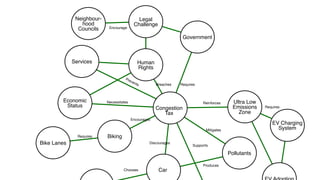
    Prevents Pollutants Chooses Car Produces Congestion Tax Discourages Supports Mitigates Biking Requires Bike Lanes Encourages UltraLow Emissions Zone Reinforces EV Charging System Requires Government Legal Challenge Neighbour- hood Councils Economic Status Necessitates Human Rights Breaches Requires Encourage Services
  • 18.
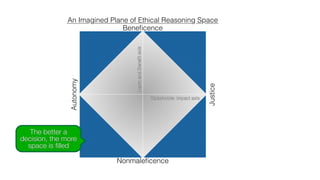
    An Imagined Planeof Ethical Reasoning Space Beneficence Nonmaleficence Autonomy Justice The better a decision, the more space is filled Harm and Benefit axis Stakeholder Impact axis
  • 19.
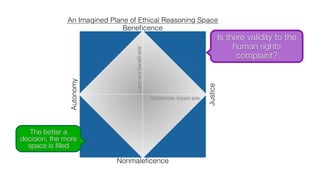
    An Imagined Planeof Ethical Reasoning Space Beneficence Nonmaleficence Autonomy Justice The better a decision, the more space is filled Harm and Benefit axis Stakeholder Impact axis Is there validity to the human rights complaint?
  • 20.
    Pollutants Chooses Car Produces Congestion Tax Discourages Supports Mitigates Biking Requires Bike Lanes Encourages UltraLow Emissions Zone Reinforces EV Charging System Requires Government Legal Challenge Neighbour- hood Councils Economic Status Necessitates Human Rights Breaches Services Prevents Access Requires Surveillance
  • 21.
    Pollutants Chooses Car Produces Congestion Tax Discourages Supports Mitigates Biking Requires Bike Lanes Encourages UltraLow Emissions Zone Reinforces EV Charging System Requires Government Legal Challenge Neighbour- hood Councils Economic Status Necessitates Human Rights Breaches Services Prevents Access Requires Surveillance
  • 22.
    Pollutants Chooses Car Produces Congestion Tax Discourages Supports Mitigates Biking Requires Bike Lanes Encourages UltraLow Emissions Zone Reinforces EV Charging System Requires Government Legal Challenge Neighbour- hood Councils Economic Status Necessitates Human Rights Breaches Services Prevents Access Requires Surveillance
  • 23.
    Pollutants Chooses Car Produces Congestion Tax Discourages Supports Mitigates Biking Requires Bike Lanes Encourages UltraLow Emissions Zone Reinforces EV Charging System Requires Government Legal Challenge Neighbour- hood Councils Economic Status Necessitates Human Rights Breaches Services Prevents Access Requires Surveillance
  • 24.
    Pollutants Chooses Car Produces Congestion Tax Discourages Supports Mitigates Biking Requires Bike Lanes Encourages UltraLow Emissions Zone Reinforces EV Charging System Requires Government Legal Challenge Neighbour- hood Councils Economic Status Necessitates Human Rights Breaches Services Prevents Access Requires Surveillance Note the human health narrative
  • 25.
    Pollutants Chooses Car Produces Congestion Tax Discourages Supports Mitigates Biking Requires Bike Lanes Encourages UltraLow Emissions Zone Reinforces EV Charging System Requires Government Legal Challenge Neighbour- hood Councils Economic Status Necessitates Human Rights Breaches Services Prevents Access Requires Surveillance In short: no easy decisions or actions (as articulated throughout Solved) Note the human health narrative
  • 26.
    The post-sustainability trilemma UmbertoMario Sconfienza Cluster of Excellence “Normative Orders”, Goethe University Frankfurt, Frankfurt am Main, Germany ABSTRACT The paper introduces the Post-Sustainability Trilemma (PST) and argues that it provides a novel description of current environmental politics which is alternative to the one provided by the narrative of sustainability. According to PST, the three policy goals of (i) economic growth, (ii) participation, and (iii) environmental protection cannot be simultaneously attained. Only two of these could. The three possible combinations of PST are then analysed: (i)–(ii) techno business-as-usual; (ii)–(iii) post-growth approaches; (i)–(iii) environmental authoritarianism. Finally, the paper questions whether and under what conditions PST stands. That at least two policy goals could be obtained is a debatable, and debated, claim. In this sense, PST might be considered an over-optimistic framework to organise environmental politics. These considerations open up a space to argue that, given the set of policy possibilities offered by PST, more radical conclusions – such as radical degrowth, radical decentralisation or, even, uncivilisation – might follow. ARTICLE HISTORY Received 28 January 2019 Accepted 14 August 2019 KEYWORDS Authoritarianism; degrowth; democracy; environment; geoengineering; trilemma JOURNAL OF ENVIRONMENTAL POLICY & PLANNING 2019, VOL. 21, NO. 6, 769–784 https://doi.org/10.1080/1523908X.2019.1673156
  • 27.
    The post-sustainability trilemma UmbertoMario Sconfienza Cluster of Excellence “Normative Orders”, Goethe University Frankfurt, Frankfurt am Main, Germany ABSTRACT The paper introduces the Post-Sustainability Trilemma (PST) and argues that it provides a novel description of current environmental politics which is alternative to the one provided by the narrative of sustainability. According to PST, the three policy goals of (i) economic growth, (ii) participation, and (iii) environmental protection cannot be simultaneously attained. Only two of these could. The three possible combinations of PST are then analysed: (i)–(ii) techno business-as-usual; (ii)–(iii) post-growth approaches; (i)–(iii) environmental authoritarianism. Finally, the paper questions whether and under what conditions PST stands. That at least two policy goals could be obtained is a debatable, and debated, claim. In this sense, PST might be considered an over-optimistic framework to organise environmental politics. These considerations open up a space to argue that, given the set of policy possibilities offered by PST, more radical conclusions – such as radical degrowth, radical decentralisation or, even, uncivilisation – might follow. ARTICLE HISTORY Received 28 January 2019 Accepted 14 August 2019 KEYWORDS Authoritarianism; degrowth; democracy; environment; geoengineering; trilemma JOURNAL OF ENVIRONMENTAL POLICY & PLANNING 2019, VOL. 21, NO. 6, 769–784 https://doi.org/10.1080/1523908X.2019.1673156 Offers a framework to help us understand our approach to environmental decision-making Offers a “wider architecture of choices” for policy makers PST is a heuristic Doesn’t prioritize one approach - not prescriptive
  • 28.
    Introduction In the lastdecade, the field of global environmental politics has been shaped by renewed urgency to find a dur- able solution to the environmental crisis. Until a few years ago, environmental politics was dominated by the sustainability narrative, according to which environmental governance should be neo-liberal, growth-oriented, and optimistic about institutional capacity.1 This article takes a critical view of the sustainability narrative and argues in favour of a novel ‘post-sustainability’ framework – according to which current environmental politics is best understood not as an attempt to realise all the policy goals linked to the three pillars of sustainable devel- opment2 but, rather, by the impossibility of it. Once we accept this reasoned premise, at least three different approaches to environmental politics emerge. These three approaches to environmental governance – techno business-as-usual, post-growth, and environmental authoritarianism – which have so far been analysed separ- ately in the environmental politics literature, are treated here as part of a bigger policy framework which, it is argued, could be useful to policy analysis. Sustainable development still warms the heart of many actors in environmental governance – business actors, politicians, diplomats of the international institutions and NGOs – to the point that it is now at the core of the development agenda of the UN. Yet, since its introduction into the international policy discourse back in 1987 (World Commission on Environment and Development, 1987), it has not delivered on its basic promise to develop the Global South (Hickel, 2017a) while protecting the environment. Just to take the three banner issues of Rio 1992: carbon emissions are up to the point that we have less than ten years before we exceed the carbon budget to meet the aspirational goal of Paris (MCC, 2019); biodiversity is rapidly declin- ing (Kolbert, 2014; Rockstrom et al., 2009); and desertification is advancing (Cherlet et al., 2018). © 2019 The Author(s). Published by Informa UK Limited, trading as Taylor & Francis Group This is an Open Access article distributed under the terms of the Creative Commons Attribution-NonCommercial-NoDerivatives License (http://creativecommons.org/ licenses/by-nc-nd/4.0/), which permits non-commercial re-use, distribution, and reproduction in any medium, provided the original work is properly cited, and is not altered, transformed, or built upon in any way. CONTACT Umberto Mario Sconfienza sconfumberto@gmail.com Cluster of Excellence “The Formation of Normative Orders”, Goethe University Frankfurt/Main, Office 2.15, Max-Horkheimer-Str. 2, Frankfurt am Main, 60323, Germany @sconfumberto
  • 29.
    Introduction In the lastdecade, the field of global environmental politics has been shaped by renewed urgency to find a dur- able solution to the environmental crisis. Until a few years ago, environmental politics was dominated by the sustainability narrative, according to which environmental governance should be neo-liberal, growth-oriented, and optimistic about institutional capacity.1 This article takes a critical view of the sustainability narrative and argues in favour of a novel ‘post-sustainability’ framework – according to which current environmental politics is best understood not as an attempt to realise all the policy goals linked to the three pillars of sustainable devel- opment2 but, rather, by the impossibility of it. Once we accept this reasoned premise, at least three different approaches to environmental politics emerge. These three approaches to environmental governance – techno business-as-usual, post-growth, and environmental authoritarianism – which have so far been analysed separ- ately in the environmental politics literature, are treated here as part of a bigger policy framework which, it is argued, could be useful to policy analysis. Sustainable development still warms the heart of many actors in environmental governance – business actors, politicians, diplomats of the international institutions and NGOs – to the point that it is now at the core of the development agenda of the UN. Yet, since its introduction into the international policy discourse back in 1987 (World Commission on Environment and Development, 1987), it has not delivered on its basic promise to develop the Global South (Hickel, 2017a) while protecting the environment. Just to take the three banner issues of Rio 1992: carbon emissions are up to the point that we have less than ten years before we exceed the carbon budget to meet the aspirational goal of Paris (MCC, 2019); biodiversity is rapidly declin- ing (Kolbert, 2014; Rockstrom et al., 2009); and desertification is advancing (Cherlet et al., 2018). © 2019 The Author(s). Published by Informa UK Limited, trading as Taylor & Francis Group This is an Open Access article distributed under the terms of the Creative Commons Attribution-NonCommercial-NoDerivatives License (http://creativecommons.org/ licenses/by-nc-nd/4.0/), which permits non-commercial re-use, distribution, and reproduction in any medium, provided the original work is properly cited, and is not altered, transformed, or built upon in any way. CONTACT Umberto Mario Sconfienza sconfumberto@gmail.com Cluster of Excellence “The Formation of Normative Orders”, Goethe University Frankfurt/Main, Office 2.15, Max-Horkheimer-Str. 2, Frankfurt am Main, 60323, Germany @sconfumberto Carbon ⇧ “Sustainable development … has not delivered” because … Desertification ⇧ Biodiversity ⇩
  • 30.
    Three Pillars ofSustainable Development e n v i r o n m e n t a l p r o t e c t i o n e c o n o m i c g r o w t h p a r t i c i p a t o r y g o v e r n a n c e
  • 31.
    Three Pillars ofSustainable Development e n v i r o n m e n t a l p r o t e c t i o n e c o n o m i c g r o w t h p a r t i c i p a t o r y g o v e r n a n c e “Current environmental politics is best understood not as an attempt to realize the three policy goals of sustainable development but, rather, by the impossibility of it”
  • 32.
    Three Pillars ofthe Sustainable Development Narrative e n v i r o n m e n t a l p r o t e c t i o n e c o n o m i c g r o w t h p a r t i c i p a t o r y g o v e r n a n c e What if we can only have two? post-growth environmental authoritarianism
  • 33.
    • political institutionsonly “provide the conditions for the individuals to pursue what is valuable to them” ↳ governments “create the conditions for markets to work freely and efficiently” environmental care depends on people’s “tastes” “tastes” for environmental quality are likely to emerge after other needs are satisfied (and too late)
  • 34.
    • political institutionsonly “provide the conditions for the individuals to pursue what is valuable to them” ↳ governments “create the conditions for markets to work freely and efficiently” environmental care depends on people’s “tastes” “tastes” for environmental quality are likely to emerge after other needs are satisfied (and too late) Short-term market or political gain can outweigh longterm concerns Other factors (e.g. poverty or greed) may curtail action Small incremental changes but not transformative policies
  • 35.
    “These are calledCarbon Dioxide Removal (CDR) technologies, of which bioenergy with carbon capture and storage (BECCS) is currently the most popular. Technological fixes represent the acknowledgement that our democratic institutions, while they have proven to be too valuable to be discarded just yet, might make our societies addicted to carbon consumption too slow to react.” Can economic and technological advancements lead to environmental protection? BECCS may have other environmental impacts Relies on large technological leaps
  • 37.
    Reflecting solar radiationback to space Uncertainties about impact might cause conflict Functions at planetary level and needs autocratic governance
  • 38.
    environmental authoritarianism “The idea isthat political participation might manifest itself in a set of choices which, when aggregated at the social level, might impact negatively on the environment. When it happens, participation needs to be curtailed.” Legitimizes authoritarian governments Democratic societies can’t impose limits effectively Small group of decision makers is more effective Restricting participation: electing government, political participation, free market economy
  • 39.
    • Markets alreadyrequire rules provided by governments • “Private actions” like eating meat and driving, when aggregated, impinge on global ecosystems and human rights Meeting targets may mean rolling black-outs, factory shut-downs, limits on citizen activity Miller’s suggests a comprehensive legislative framework environmental authoritarianism
  • 40.
    • Absolute decouplingbetween material consumption and GDP cannot be realized Critique of Environmental Authoritarianism After accounting for easy efficiency improvements, protection and growth might be incompatible. • Restraining economic planning may undermine innovation and result in efficiency If you’re still committed to economic growth! • Dissatisfaction might lead to resentment and civil unrest • Public engagement encourages the adoption of measures and acts as a tool for the inclusion of marginalized groups
  • 41.
    Is Green GrowthPossible? Jason Hickela and Giorgos Kallisb a Anthropology, Goldsmiths, University of London, London, UK; <j.hickel@gold.ac.uk> b ICREA and ICTA-UAB, Universitat Autonoma de Barcelona, Barcelona, Spain ABSTRACT The notion of green growth has emerged as a dominant policy response to climate change and ecological breakdown. Green growth theory asserts that continued economic expansion is compatible with our planet’s ecology, as technological change and substitution will allow us to absolutely decouple GDP growth from resource use and carbon emissions. This claim is now assumed in national and international policy, including in the Sustainable Development Goals. But empirical evidence on resource use and carbon emissions does not support green growth theory. Examining relevant studies on historical trends and model-based projections, we find that: (1) there is no empirical evidence that absolute decoupling from resource use can be achieved on a global scale against a background of continued economic growth, and (2) absolute decoupling from carbon emissions is highly unlikely to be achieved at a rate rapid enough to prevent global warming over 1.5°C or 2°C, even under optimistic policy conditions. We conclude that green growth is likely to be a misguided objective, and that policymakers need to look toward alternative strategies.
  • 42.
    Is Green GrowthPossible? Jason Hickela and Giorgos Kallisb a Anthropology, Goldsmiths, University of London, London, UK; <j.hickel@gold.ac.uk> b ICREA and ICTA-UAB, Universitat Autonoma de Barcelona, Barcelona, Spain ABSTRACT The notion of green growth has emerged as a dominant policy response to climate change and ecological breakdown. Green growth theory asserts that continued economic expansion is compatible with our planet’s ecology, as technological change and substitution will allow us to absolutely decouple GDP growth from resource use and carbon emissions. This claim is now assumed in national and international policy, including in the Sustainable Development Goals. But empirical evidence on resource use and carbon emissions does not support green growth theory. Examining relevant studies on historical trends and model-based projections, we find that: (1) there is no empirical evidence that absolute decoupling from resource use can be achieved on a global scale against a background of continued economic growth, and (2) absolute decoupling from carbon emissions is highly unlikely to be achieved at a rate rapid enough to prevent global warming over 1.5°C or 2°C, even under optimistic policy conditions. We conclude that green growth is likely to be a misguided objective, and that policymakers need to look toward alternative strategies. Emphasizes environmental protection Meet needs within means Curbs material desires and explores other means of “human flourishing”
  • 43.
  • 44.
    e n v i r o n m e n t a l p r o t e c t i o n e c o n o m i c g r o w t h p a r t i c i p a t o r y g o v e r n a n c e post-growth environmental authoritarianism Drive your caron specified days only Non-motorized vehicles Keep driving and assume carbon capture will work How is the London example reflected here?
  • 45.
  • 46.
    The Problem withContinuous Growth
  • 47.
    The Problem withContinuous Growth What is the problem with this curve?
  • 48.
    The Problem withContinuous Growth What is the problem with this curve? It matches resource use
  • 49.
    The Problem withContinuous Growth What is the problem with this curve? It matches resource use … and when they run out
  • 50.
    “Green growth requiresabsolute decoupling of GDP from resource use and environmental impact. ... It is not enough to simply ‘minimize’ environmental impact – we must rapidly reduce it down to safe limits.” The Conditions of Green Growth H&K begin with “green growth” (which Sconfienza will call “the narrative of sustainability”) Resource Use Carbon Emissions Week 07-02
  • 51.
    “Green growth requiresabsolute decoupling of GDP from resource use and environmental impact. ... It is not enough to simply ‘minimize’ environmental impact – we must rapidly reduce it down to safe limits.” The Conditions of Green Growth H&K begin with “green growth” (which Sconfienza will call “the narrative of sustainability”) Resource Use Carbon Emissions Week 07-02 For the global economy to continue to grow it MUST decouple growth from resource use and emissions
  • 52.
    services … butthere is no historical evidence that switching to services will, in and of itself, reduce the material throughput of the global economy. Figure 2. (a) Global material footprint, 1970–2013; (b) Change in global material footprint compared to change in global GDP (constant 2010 USD), 1990–2013. Source: Materialflows.net/World Bank. A second argument is that technological innovation and government policy might drive Week 07-02
  • 53.
    services … butthere is no historical evidence that switching to services will, in and of itself, reduce the material throughput of the global economy. Figure 2. (a) Global material footprint, 1970–2013; (b) Change in global material footprint compared to change in global GDP (constant 2010 USD), 1990–2013. Source: Materialflows.net/World Bank. A second argument is that technological innovation and government policy might drive Week 07-02 … but that is not possible
  • 54.
    “Sustainable degrowth canbe defined from an ecological–economic perspective as a socially sustainable and equitable reduction (and eventually stabilisation) of society's throughput. Throughput refers to the materials and energy a society extracts, processes, transports and distributes, to consume and return back to the environment as waste.” What is Degrowth? Giorgios Kallis, “In Defence of Degrowth” (2011) “Sustainable degrowth” is one of two possibilities (according to Kallis); the other is “cataclysmic degrowth” Week 07-02
  • 55.
    services … butthere is no historical evidence that switching to services will, in and of itself, reduce the material throughput of the global economy. Figure 2. (a) Global material footprint, 1970–2013; (b) Change in global material footprint compared to change in global GDP (constant 2010 USD), 1990–2013. Source: Materialflows.net/World Bank. A second argument is that technological innovation and government policy might drive 2040 Desired How then, do we do sustainable degrowth?
  • 56.
    services … butthere is no historical evidence that switching to services will, in and of itself, reduce the material throughput of the global economy. Figure 2. (a) Global material footprint, 1970–2013; (b) Change in global material footprint compared to change in global GDP (constant 2010 USD), 1990–2013. Source: Materialflows.net/World Bank. A second argument is that technological innovation and government policy might drive s e r v i c e s … b u t t h e r e i s n o h i s t o r i c a l e v i d e n c e t h a t s w i t c h i n g t o s e r v i c e s w i l l , i n a n d o f i t s e l f t h e m a t e r i a l t h r o u g h p u t o f t h e g l o b a l e c o n o m y . F i g u r e 2 . ( a ) G l o b a l m a t e r i a l f o o t p r i n t , 1 9 7 0 – 2 0 1 3 ; ( b ) C h a n g e i n g l o b a l m a t e r i a l f o o t p r i n t c o m p a r e d t i n g l o b a l G D P ( c o n s t a n t 2 0 1 0 U S D ) , 1 9 9 0 – 2 0 1 3 . S o u r c e : M a t e r i a l f l o w s . n e t / W o r l d B a n k . A s e c o n d a r g u m e n t i s t h a t t e c h n o l o g i c a l i n n o v a t i o n a n d g o v e r n m e n t p o l i c y m i g s e r v i c e s … b u t t h e r e i s n o h i s t o r i c a l e v i d e n c e t h a t s w i t c h i n g t o s e r v i c e s w i l l , i n a n d o t h e m a t e r i a l t h r o u g h p u t o f t h e g l o b a l e c o n o m y . F i g u r e 2 . ( a ) G l o b a l m a t e r i a l f o o t p r i n t , 1 9 7 0 – 2 0 1 3 ; ( b ) C h a n g e i n g l o b a l m a t e r i a l f o o t p r i n t c o m i n g l o b a l G D P ( c o n s t a n t 2 0 1 0 U S D ) , 1 9 9 0 – 2 0 1 3 . S o u r c e : M a t e r i a l f l o w s . n e t / W o r l d B a n k . A s e c o n d a r g u m e n t i s t h a t t e c h n o l o g i c a l i n n o v a t i o n a n d g o v e r n m e n t p o l i c s e r v i c e s … b u t t h e r e i s n o h i s t o r i c a l e v i d e n c e t h a t s w i t c h i n g t o s e r v i c e s w i l l , i n a t h e m a t e r i a l t h r o u g h p u t o f t h e g l o b a l e c o n o m y . F i g u r e 2 . ( a ) G l o b a l m a t e r i a l f o o t p r i n t , 1 9 7 0 – 2 0 1 3 ; ( b ) C h a n g e i n g l o b a l m a t e r i a l f o o t p r i n t i n g l o b a l G D P ( c o n s t a n t 2 0 1 0 U S D ) , 1 9 9 0 – 2 0 1 3 . S o u r c e : M a t e r i a l f l o w s . n e t / W o r l d B A s e c o n d a r g u m e n t i s t h a t t e c h n o l o g i c a l i n n o v a t i o n a n d g o v e r n m e n t s e r v i c e s … b u t t h e r e i s n o h i s t o r i c a l e v i d e n c e t h a t s w i t c h i n g t o s e r v i c e s w i l l , t h e m a t e r i a l t h r o u g h p u t o f t h e g l o b a l e c o n o m y . F i g u r e 2 . ( a ) G l o b a l m a t e r i a l f o o t p r i n t , 1 9 7 0 – 2 0 1 3 ; ( b ) C h a n g e i n g l o b a l m a t e r i a l f o o i n g l o b a l G D P ( c o n s t a n t 2 0 1 0 U S D ) , 1 9 9 0 – 2 0 1 3 . S o u r c e : M a t e r i a l f l o w s . n e t / W o A s e c o n d a r g u m e n t i s t h a t t e c h n o l o g i c a l i n n o v a t i o n a n d g o v e r n m e 2040 We need a rapid reduction in Fossil Fuels use Desired How then, do we do sustainable degrowth? … and overall consumption, especially in WEIRD countries
  • 57.
    Two Prominent Thinkersin the Post-Growth Field
  • 58.
    Cut Advertising End planned obsolescence Shiftfrom ownership to usership End food waste 1 2 3 4 Jason Hickel’s “Pathways to a Post-Capitalist World”*
  • 59.
    Cut Advertising End planned obsolescence Shiftfrom ownership to usership End food waste 1 2 3 4 capitalism should encourage rational efficiency, but it doesn’t because long- lasting devices impede profits Ads work, so we should cut ads. Paris has banned ads near schools e.g. usership of cars encourages companies to take responsibility 50% of food ends as waste. We could cut agriculture in half if we stopped waste Jason Hickel’s “Pathways to a Post-Capitalist World”*
  • 60.
    Scale down ecologically destructiveindustries Account for human cost Reduce inequality Decommodify public goods 6 7 8 Jason Hickel’s “Pathways to a Post-Capitalist World”* 5
  • 61.
    Scale down ecologically destructiveindustries Account for human cost Reduce inequality Decommodify public goods 6 7 8 Tax beef—it uses 60% of farm land Cut business class travel shorten work week — if US cut week to same as W.Europe, it would reduce energy consumption by 20% reduced unemployment, increased quality of life, and reduced environmental pressures Maximum wage. Cap CEO wage to worker wage at 10:1 ratio. Tax wealth Free education, Universal Basic Income, Universal Basic Services Jason Hickel’s “Pathways to a Post-Capitalist World”* 5
  • 62.
  • 63.
    The Traditional LinearEconomy British farmland is within 60 harvests of soil collapse We have 25 years’ stock of silver, 40 years of copper
  • 65.
  • 66.
    The Biological Cycle 1.Keep things in service as long as possible 2. Capture all possible resource 3. Return biological into the environment
  • 67.
    Three Major Obstaclesto the Circularity of the Biological Cycle Failure of facilities to do consistent capture to separate the biological from non- Mixing of biological with non-biological 1 2 e.g. Poly-cotton blended fabric Lack of regulation that forces producers to take responsibility for avoiding waste 3
  • 68.
    The Biological Cycle 1.Keep things in service as long as possible 2. Capture all possible resource 3. Return biological into the environment
  • 69.
  • 70.
    The Technical Cycle Recycling isthe last resort Refurbish often saves 80% of materials DfX — design for maintenance, design for repair Sharing vs. Ownership
  • 71.
    Austin has createda city-wide initiative
  • 73.
    One of thesimplest circular moves is repurposing waste construction material or doing careful demolition
  • 75.
    Ucuuba tree timber yields$5USD Ucuuba seed harvesting yields $15USD Natura is the 5th largest cosmetics company globally