Consult & involve with wikis David Evans and Ben Wild
'A wiki is a collection of web pages designed to enable anyone who accesses it to contribute or modify content'  –   Wikipedia What is a wiki?
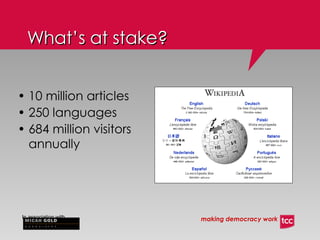
10 million articles 250 languages 684 million visitors annually What’s at stake?
DEFRA  – The Environmental Contract CLG  – Reviving Civic Status ONS  – 2011 UK Census Outputs    consultation Whose using wikis?
Community Empowerment, Housing and Economic Regeneration Bill   (http://www.commonsleader.gov.uk/output/Page2452.asp) ‏ Gordon Brown's speech to Google EuroZeitgeist   (http://www.youtube.com/watch?v=btE075p6Ypg) ‏ Tom Steinberg's 'Power of Information' report   (http://www.cabinetoffice.gov.uk/reports/power_of_information.aspx) ‏ Digital Dialogues – Final report due for publication in September   (http://digitaldialogues.org.uk/) ‏ The political context
Why should you use a Wiki? When should you use a Wiki? What makes a Wiki successful? Who should use a Wiki? .... the following case studies will help us! The 4 ‘W’s’
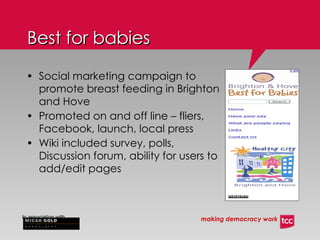
Social marketing campaign to promote breast feeding in Brighton and Hove Promoted on and off line – fliers, Facebook, launch, local press Wiki included survey, polls, Discussion forum, ability for users to add/edit pages Best for babies
Did it work? Positive: Several thousand page views Simple features such as Polls well used Negative: Discussions & Wiki features hardly used Little discussion or community on Wiki
Problems The issue was too polarising to generate discussion, community. The campaign didn't have a strong element of collaboration and co-production and so didn't uses the strengths of the tool The audience didn't have sufficient buy in to make in-depth, repeated use of the Wiki Stakeholders didn't take ownership of driving the Wiki forward
Lessons: Wikis are appropriate when there is a genuine need for collaboration and co-production Wikis work for more complex consultations and a more specialist target audience Wikis are not for engaging people but for enabling those who are engaged
Pyramid of Engagement
The Top Tier
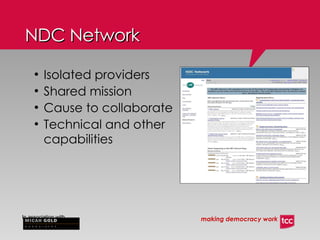
NDC Network Isolated providers Shared mission Cause to collaborate Technical and other capabilities
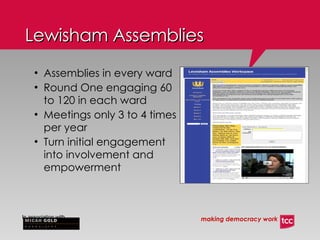
Lewisham Assemblies Assemblies in every ward Round One engaging 60 to 120 in each ward Meetings only 3 to 4 times per year Turn initial engagement into involvement and empowerment
How was it done before? Local associations & community groups Regular meetings, newsletters Local events, action days, lobbying etc Either through motivated local activists, or through labour intensive community development activity So how can the technology help?
Why might a Wiki be better? Economies of scale – reach a larger audience without the intensive resources Allows people to engage without going to time consuming local meetings Allows people to dip in and out – scale up or reduce their involvement according to time available Enables collaborative, grass roots working
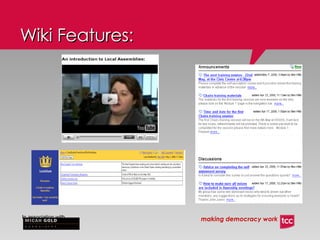
Wiki Features:
In Conclusion – Golden Rules Huge amount to gain, but only if we target the correct audience and address the right issues. Have to be designed to meet needs of the audience and have continual support and moderation through their lifetime. Only work for consultation if they are central to the process and are part of wider engagement strategy which employs a range of appropriate tools and approaches
For further information The Campaign Company  www.thecampaigncompany.co.uk [email_address] 020 8688 0650 involve engage empower

Consultation Inst Presentation 1.3(2)

  • 1.
    Consult & involvewith wikis David Evans and Ben Wild
  • 2.
    'A wiki isa collection of web pages designed to enable anyone who accesses it to contribute or modify content' – Wikipedia What is a wiki?
  • 3.
    10 million articles250 languages 684 million visitors annually What’s at stake?
  • 4.
    DEFRA –The Environmental Contract CLG – Reviving Civic Status ONS – 2011 UK Census Outputs consultation Whose using wikis?
  • 5.
    Community Empowerment, Housingand Economic Regeneration Bill (http://www.commonsleader.gov.uk/output/Page2452.asp) ‏ Gordon Brown's speech to Google EuroZeitgeist (http://www.youtube.com/watch?v=btE075p6Ypg) ‏ Tom Steinberg's 'Power of Information' report (http://www.cabinetoffice.gov.uk/reports/power_of_information.aspx) ‏ Digital Dialogues – Final report due for publication in September (http://digitaldialogues.org.uk/) ‏ The political context
  • 6.
    Why should youuse a Wiki? When should you use a Wiki? What makes a Wiki successful? Who should use a Wiki? .... the following case studies will help us! The 4 ‘W’s’
  • 7.
    Social marketing campaignto promote breast feeding in Brighton and Hove Promoted on and off line – fliers, Facebook, launch, local press Wiki included survey, polls, Discussion forum, ability for users to add/edit pages Best for babies
  • 8.
    Did it work?Positive: Several thousand page views Simple features such as Polls well used Negative: Discussions & Wiki features hardly used Little discussion or community on Wiki
  • 9.
    Problems The issuewas too polarising to generate discussion, community. The campaign didn't have a strong element of collaboration and co-production and so didn't uses the strengths of the tool The audience didn't have sufficient buy in to make in-depth, repeated use of the Wiki Stakeholders didn't take ownership of driving the Wiki forward
  • 10.
    Lessons: Wikis areappropriate when there is a genuine need for collaboration and co-production Wikis work for more complex consultations and a more specialist target audience Wikis are not for engaging people but for enabling those who are engaged
  • 11.
  • 12.
  • 13.
    NDC Network Isolatedproviders Shared mission Cause to collaborate Technical and other capabilities
  • 14.
    Lewisham Assemblies Assembliesin every ward Round One engaging 60 to 120 in each ward Meetings only 3 to 4 times per year Turn initial engagement into involvement and empowerment
  • 15.
    How was itdone before? Local associations & community groups Regular meetings, newsletters Local events, action days, lobbying etc Either through motivated local activists, or through labour intensive community development activity So how can the technology help?
  • 16.
    Why might aWiki be better? Economies of scale – reach a larger audience without the intensive resources Allows people to engage without going to time consuming local meetings Allows people to dip in and out – scale up or reduce their involvement according to time available Enables collaborative, grass roots working
  • 17.
  • 18.
    In Conclusion –Golden Rules Huge amount to gain, but only if we target the correct audience and address the right issues. Have to be designed to meet needs of the audience and have continual support and moderation through their lifetime. Only work for consultation if they are central to the process and are part of wider engagement strategy which employs a range of appropriate tools and approaches
  • 19.
    For further informationThe Campaign Company www.thecampaigncompany.co.uk [email_address] 020 8688 0650 involve engage empower

Editor's Notes

  • #2 Good afternoo, I'm Ben Wild a senior project officer with The Campaign Company. We're a consultancy specialising in consultation, engagement and social marketing. I lead on the use of on-line tools in our projects particularly wikis. I have with me David Evans one of the Managing Directors from TCC. Our presentation today will be a team effort, I'll give a brief overview of Wikis in the context of engagment and consultation and then I'll hand over to David who'll talk through some case studies and what we've learnt from them.