BUILDING SUSTAINABILITY:BUILDING SUSTAINABILITY:
PARTNERSHIPS AND FINANCEPARTNERSHIPS AND FINANCE
byby
S. Adrian RossS. Adrian Ross
Senior Programme OfficerSenior Programme Officer
PEMSEAPEMSEA
$80 – $180 billion for investment
in environmental facilities
and services
70% of which is needed for:
• Wastewater treatment
• Pollution abatement
• Nutrient reduction
• Water reuse/recycling
The NeedThe Need
Public sector has:
• legal authority
• law-making power
• monitoring and
regulatory function
• mandate
…but lacks
• funding
• technical resources
• business skills.
The SituationThe Situation
Private sector has:
• experience
• expertise
• technology
• business skills
• access to financing
…but faces
• a conflict between
making long-term
investments and
reporting on short-term
financial cycles.
The SituationThe Situation
NGOs have:
• an understanding of local needs
• ability to work with and influence people,
including poor communities
• credibility
• organizational and communication skills
…but lack
• sufficient and predictable funding
• staff and technical capacity
• experience in partnership arrangements.
Building SustainabilityBuilding Sustainability
Set within a policy, regulatory and
investment environment that is conducive
to business participation
An alternative delivery mechanism…not the
only one
Principles of multi-sectorPrinciples of multi-sector
partnershipspartnerships
Building SustainabilityBuilding Sustainability
Bringing together government, private
sector and civil society to better tackle the
challenges of providing water and
sanitation services, as well as other
services to communities
Recognizing two separate but related
issues, namely:
Partnership development and
sustainability
Project development and sustainability.
Principles of multi-sectorPrinciples of multi-sector
partnershipspartnerships
Constraints to Private Sector ParticipationConstraints to Private Sector Participation
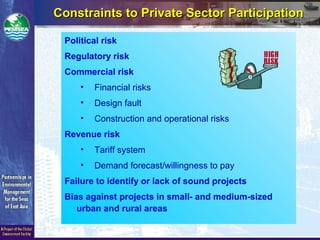
Political risk
Regulatory risk
Commercial risk
• Financial risks
• Design fault
• Construction and operational risks
Revenue risk
• Tariff system
• Demand forecast/willingness to pay
Failure to identify or lack of sound projects
Bias against projects in small- and medium-sized
urban and rural areas
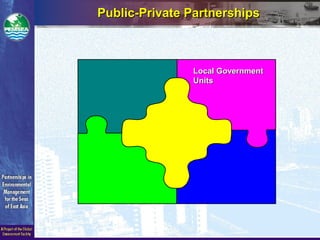
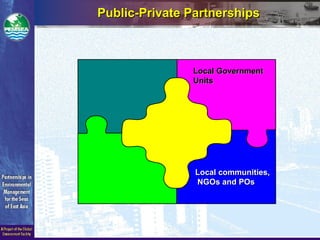
Public-Private PartnershipsPublic-Private Partnerships
Local GovernmentLocal Government
UnitsUnits
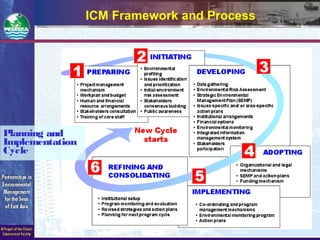
ICM Framework and Process
Planning and
Implementation
Cycle
Planning and
Implementation
Cycle
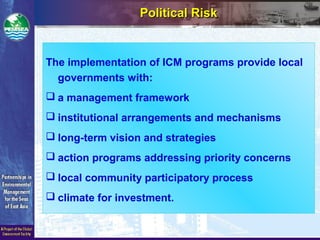
The implementation of ICM programs provide local
governments with:
 a management framework
 institutional arrangements and mechanisms
 long-term vision and strategies
 action programs addressing priority concerns
 local community participatory process
 climate for investment.
Political RiskPolitical Risk
Public-Private PartnershipsPublic-Private Partnerships
Local GovernmentLocal Government
UnitsUnits
Local communities,Local communities,
NGOs and POsNGOs and POs
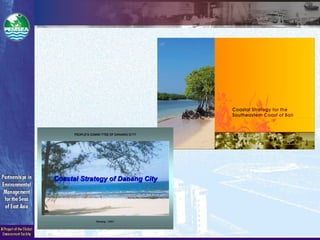
Manila Bay Coastal Strategy
October 2001
Danang - 2001
PEOPLE’S COMMI TTEE OF DANANG CI TY
Coastal Strategy ofCoastal Strategy of DanangDanang CityCity
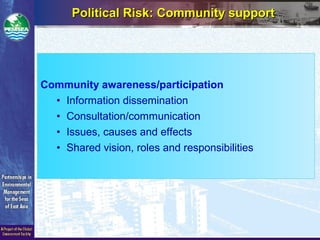
Community awareness/participation
• Information dissemination
• Consultation/communication
• Issues, causes and effects
• Shared vision, roles and responsibilities
Political Risk: Community supportPolitical Risk: Community support
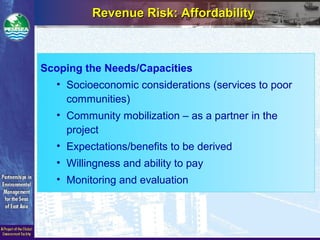
Scoping the Needs/Capacities
• Socioeconomic considerations (services to poor
communities)
• Community mobilization – as a partner in the
project
• Expectations/benefits to be derived
• Willingness and ability to pay
• Monitoring and evaluation
Revenue Risk: AffordabilityRevenue Risk: Affordability
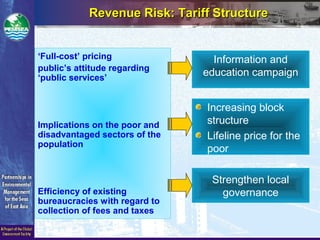
Revenue Risk: Tariff StructureRevenue Risk: Tariff Structure
Information and
education campaign
‘Full-cost’ pricing
public’s attitude regarding
‘public services’
Implications on the poor and
disadvantaged sectors of the
population
Efficiency of existing
bureaucracies with regard to
collection of fees and taxes
Increasing block
structure
Lifeline price for the
poor
Strengthen local
governance
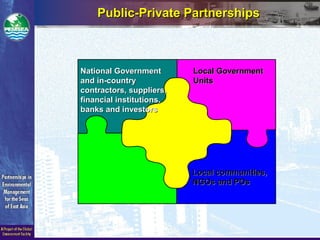
Public-Private PartnershipsPublic-Private Partnerships
Local GovernmentLocal Government
UnitsUnits
National GovernmentNational Government
and in-countryand in-country
contractors, suppliers,contractors, suppliers,
financial institutions,financial institutions,
banks and investorsbanks and investors
Local communities,Local communities,
NGOs and POsNGOs and POs
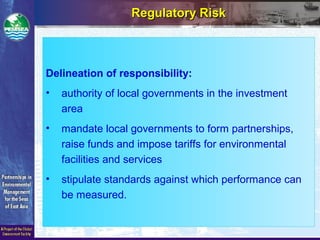
Delineation of responsibility:
• authority of local governments in the investment
area
• mandate local governments to form partnerships,
raise funds and impose tariffs for environmental
facilities and services
• stipulate standards against which performance can
be measured.
Regulatory RiskRegulatory Risk
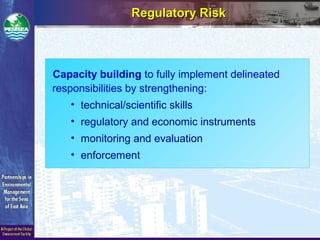
Capacity building to fully implement delineated
responsibilities by strengthening:
• technical/scientific skills
• regulatory and economic instruments
• monitoring and evaluation
• enforcement
Regulatory RiskRegulatory Risk
Commercial RiskCommercial Risk
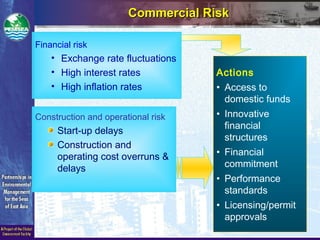
Financial risk
• Exchange rate fluctuations
• High interest rates
• High inflation rates
Construction and operational risk
Start-up delays
Construction and
operating cost overruns &
delays
Actions
• Access to
domestic funds
• Innovative
financial
structures
• Financial
commitment
• Performance
standards
• Licensing/permit
approvals
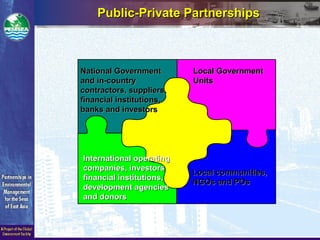
Public-Private PartnershipsPublic-Private Partnerships
Local GovernmentLocal Government
UnitsUnits
International operatingInternational operating
companies, investorscompanies, investors
financial institutions,financial institutions,
development agenciesdevelopment agencies
and donorsand donors
Local communities,Local communities,
NGOs and POsNGOs and POs
National GovernmentNational Government
and in-countryand in-country
contractors, suppliers,contractors, suppliers,
financial institutions,financial institutions,
banks and investorsbanks and investors
Capacity building is a major bridge for overcoming
barriers to private sector participation in
environmental investments.
Strengthening:
• capabilities in local governance (ICM)
• project development and management
• technical/scientific skills and support
• regulatory and economic instruments
• financial management
• monitoring and evaluation
• enforcement
Commercial RiskCommercial Risk
Financial Risk
• accessibility to multiple
sources of financing
• project portfolio that is
affordable, self-sustaining
and attractive to private
sector
ActionsActions
• Creation of innovative
financial mechanism to
meet the needs and
capacities of local
governments and their
partners.
Commercial RiskCommercial Risk
Public-Private PartnershipsPublic-Private Partnerships
Local GovernmentLocal Government
UnitsUnits
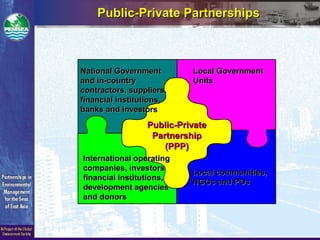
Public-PrivatePublic-Private
PartnershipPartnership
(PPP)(PPP)
International operatingInternational operating
companies, investorscompanies, investors
financial institutions,financial institutions,
development agenciesdevelopment agencies
and donorsand donors
Local communities,Local communities,
NGOs and POsNGOs and POs
National GovernmentNational Government
and in-countryand in-country
contractors, suppliers,contractors, suppliers,
financial institutions,financial institutions,
banks and investorsbanks and investors
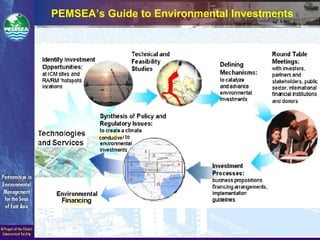
PEMSEA’s Guide to Environmental Investments
Is this a good time for environmental investments?
5 ICM sites and 2 hotspots:
• more than 40 investment opportunities identified
• priority environmental concerns screened
• 15 projects proceeding through pre-feasibility
studies, lead by local stakeholders
• more than $600 million in capital investments
• local governments and local stakeholders
providing concrete commitments
Is this a good time for environmental investments?
Contingent valuation surveys:
• overall willingness to pay for environmental
services
• correlates with household income
• <1% of monthly household income
• ability to pay is a factor, as is education and age
of respondent
• unwillingness to pay <1% of respondents
What about the private sector?
Challenges:
• Trust, transparency and confidence in the
process and the other ‘partners’
• Goals, expectations, verification of viability
• Roles and responsibilities
• Governance structure of partnership
• Communication
What are the critical features?
Critical features:
• leadership
• concrete commitments of local government and
local stakeholders
• private sector awareness and confidence
• innovative financial mechanism accessible by
local governments and their partners

aross_pemsea.ppt

  • 1.
    BUILDING SUSTAINABILITY:BUILDING SUSTAINABILITY: PARTNERSHIPSAND FINANCEPARTNERSHIPS AND FINANCE byby S. Adrian RossS. Adrian Ross Senior Programme OfficerSenior Programme Officer PEMSEAPEMSEA
  • 2.
    $80 – $180billion for investment in environmental facilities and services 70% of which is needed for: • Wastewater treatment • Pollution abatement • Nutrient reduction • Water reuse/recycling The NeedThe Need
  • 3.
    Public sector has: •legal authority • law-making power • monitoring and regulatory function • mandate …but lacks • funding • technical resources • business skills. The SituationThe Situation Private sector has: • experience • expertise • technology • business skills • access to financing …but faces • a conflict between making long-term investments and reporting on short-term financial cycles.
  • 4.
    The SituationThe Situation NGOshave: • an understanding of local needs • ability to work with and influence people, including poor communities • credibility • organizational and communication skills …but lack • sufficient and predictable funding • staff and technical capacity • experience in partnership arrangements.
  • 5.
    Building SustainabilityBuilding Sustainability Setwithin a policy, regulatory and investment environment that is conducive to business participation An alternative delivery mechanism…not the only one Principles of multi-sectorPrinciples of multi-sector partnershipspartnerships
  • 6.
    Building SustainabilityBuilding Sustainability Bringingtogether government, private sector and civil society to better tackle the challenges of providing water and sanitation services, as well as other services to communities Recognizing two separate but related issues, namely: Partnership development and sustainability Project development and sustainability. Principles of multi-sectorPrinciples of multi-sector partnershipspartnerships
  • 7.
    Constraints to PrivateSector ParticipationConstraints to Private Sector Participation Political risk Regulatory risk Commercial risk • Financial risks • Design fault • Construction and operational risks Revenue risk • Tariff system • Demand forecast/willingness to pay Failure to identify or lack of sound projects Bias against projects in small- and medium-sized urban and rural areas
  • 8.
  • 9.
    ICM Framework andProcess Planning and Implementation Cycle Planning and Implementation Cycle
  • 10.
    The implementation ofICM programs provide local governments with:  a management framework  institutional arrangements and mechanisms  long-term vision and strategies  action programs addressing priority concerns  local community participatory process  climate for investment. Political RiskPolitical Risk
  • 11.
    Public-Private PartnershipsPublic-Private Partnerships LocalGovernmentLocal Government UnitsUnits Local communities,Local communities, NGOs and POsNGOs and POs
  • 12.
    Manila Bay CoastalStrategy October 2001 Danang - 2001 PEOPLE’S COMMI TTEE OF DANANG CI TY Coastal Strategy ofCoastal Strategy of DanangDanang CityCity
  • 13.
    Community awareness/participation • Informationdissemination • Consultation/communication • Issues, causes and effects • Shared vision, roles and responsibilities Political Risk: Community supportPolitical Risk: Community support
  • 14.
    Scoping the Needs/Capacities •Socioeconomic considerations (services to poor communities) • Community mobilization – as a partner in the project • Expectations/benefits to be derived • Willingness and ability to pay • Monitoring and evaluation Revenue Risk: AffordabilityRevenue Risk: Affordability
  • 15.
    Revenue Risk: TariffStructureRevenue Risk: Tariff Structure Information and education campaign ‘Full-cost’ pricing public’s attitude regarding ‘public services’ Implications on the poor and disadvantaged sectors of the population Efficiency of existing bureaucracies with regard to collection of fees and taxes Increasing block structure Lifeline price for the poor Strengthen local governance
  • 16.
    Public-Private PartnershipsPublic-Private Partnerships LocalGovernmentLocal Government UnitsUnits National GovernmentNational Government and in-countryand in-country contractors, suppliers,contractors, suppliers, financial institutions,financial institutions, banks and investorsbanks and investors Local communities,Local communities, NGOs and POsNGOs and POs
  • 17.
    Delineation of responsibility: •authority of local governments in the investment area • mandate local governments to form partnerships, raise funds and impose tariffs for environmental facilities and services • stipulate standards against which performance can be measured. Regulatory RiskRegulatory Risk
  • 18.
    Capacity building tofully implement delineated responsibilities by strengthening: • technical/scientific skills • regulatory and economic instruments • monitoring and evaluation • enforcement Regulatory RiskRegulatory Risk
  • 19.
    Commercial RiskCommercial Risk Financialrisk • Exchange rate fluctuations • High interest rates • High inflation rates Construction and operational risk Start-up delays Construction and operating cost overruns & delays Actions • Access to domestic funds • Innovative financial structures • Financial commitment • Performance standards • Licensing/permit approvals
  • 20.
    Public-Private PartnershipsPublic-Private Partnerships LocalGovernmentLocal Government UnitsUnits International operatingInternational operating companies, investorscompanies, investors financial institutions,financial institutions, development agenciesdevelopment agencies and donorsand donors Local communities,Local communities, NGOs and POsNGOs and POs National GovernmentNational Government and in-countryand in-country contractors, suppliers,contractors, suppliers, financial institutions,financial institutions, banks and investorsbanks and investors
  • 21.
    Capacity building isa major bridge for overcoming barriers to private sector participation in environmental investments. Strengthening: • capabilities in local governance (ICM) • project development and management • technical/scientific skills and support • regulatory and economic instruments • financial management • monitoring and evaluation • enforcement Commercial RiskCommercial Risk
  • 22.
    Financial Risk • accessibilityto multiple sources of financing • project portfolio that is affordable, self-sustaining and attractive to private sector ActionsActions • Creation of innovative financial mechanism to meet the needs and capacities of local governments and their partners. Commercial RiskCommercial Risk
  • 23.
    Public-Private PartnershipsPublic-Private Partnerships LocalGovernmentLocal Government UnitsUnits Public-PrivatePublic-Private PartnershipPartnership (PPP)(PPP) International operatingInternational operating companies, investorscompanies, investors financial institutions,financial institutions, development agenciesdevelopment agencies and donorsand donors Local communities,Local communities, NGOs and POsNGOs and POs National GovernmentNational Government and in-countryand in-country contractors, suppliers,contractors, suppliers, financial institutions,financial institutions, banks and investorsbanks and investors
  • 24.
    PEMSEA’s Guide toEnvironmental Investments
  • 25.
    Is this agood time for environmental investments? 5 ICM sites and 2 hotspots: • more than 40 investment opportunities identified • priority environmental concerns screened • 15 projects proceeding through pre-feasibility studies, lead by local stakeholders • more than $600 million in capital investments • local governments and local stakeholders providing concrete commitments
  • 26.
    Is this agood time for environmental investments? Contingent valuation surveys: • overall willingness to pay for environmental services • correlates with household income • <1% of monthly household income • ability to pay is a factor, as is education and age of respondent • unwillingness to pay <1% of respondents
  • 27.
    What about theprivate sector? Challenges: • Trust, transparency and confidence in the process and the other ‘partners’ • Goals, expectations, verification of viability • Roles and responsibilities • Governance structure of partnership • Communication
  • 28.
    What are thecritical features? Critical features: • leadership • concrete commitments of local government and local stakeholders • private sector awareness and confidence • innovative financial mechanism accessible by local governments and their partners