Beyond the Intermediate
        Plateau
            Collocation
         Lexical Notebooks
              shaun_dowling@hotmail.com
                 www.supershaun.com
  www.teachingenglish.org.uk/articles/lexical-notebooks
Alternative Talk Titles
   Changing the Learners’ Vocabulary behavior
   The Systematic Noticing of Collocations
   The Central Learning Strategy from the Lexical
    Approach
   Making Lexical Autonomy your Aim
   SLA using Lexical Notebooks
   Helping Learners Study Lexis Holistically
   Noticing Language Patterns
“Once the learner has arrived at
                           an intermediate level of language
                           learning however, progress does
                           not always appear to be so
                           marked, and making the
                           transition from intermediate to
                           the upper-intermediate or
                           advanced level sometimes proves
                           frustrating for many learners.”


“For some they may feel they have arrived at a plateau
and making further progress seems elusive, despite the
amount of time and effort the learner devotes to it.”
(Moving Beyond the Plateau, J.C.Richards)
a) There is a gap between receptive and productive
competence.

b) There are persistent fossilized language errors.

                 c) Fluency may have progressed at the
expense                  of complexity

                 d) The learner has a limited vocabulary
range.


                 e) Language production may be adequate
                 but often lacks the characteristics of natural
                 speech.
Another dimension of vocabulary development which is
 essential if students are to make a successful transition to the
 advanced level is to expand what has been called their
 collocational competence.


One of the key problems in helping learners improve their
vocabulary is finding effective ways for them to help remember
words they have encountered. How can we help learners move
words from short-term to long-term memory? One clue is from
research on memory. ……… our mental lexicon is highly
organised and efficient, and that items that are related
semantically are stored together. This is why it is much easier to
recall a list of words that are grouped or organized in a
meaningful way, as compared with trying to recall a set of words
that are simply organized alphabetically.
Now is the time to
  Take Notes
1. Language and building up a volume of lexis
2. Introduction of the Lexical Notebook
3. Maintenance of Lexical Notebooks

Recognition - Build up the system - Exploration


Outcomes and Results of this Research
Stage 1: Language and Change

   Course book (resources) needs to be lexically rich
   Activities that train learners to notice collocations
   Regular activities for student to remember lexis
   Give class time and making learners
               note down lexis
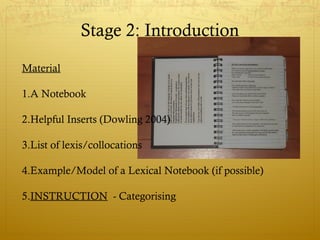
Stage 2: Introduction

Material

1.A Notebook

2.Helpful Inserts (Dowling 2004)

3.List of lexis/collocations

4.Example/Model of a Lexical Notebook (if possible)

5.INSTRUCTION - Categorising
Stage 3: Maintenance

Teacher continues to teach lexis
and remind students to take notes

Students complete notebooks
outside class

LN are brought into class and
collected for checking and
feedback.
What were the results of
 the students’ work?

 Were learners able to
  complete Lexical
    Notebooks?
Theme/Topic


Verb + Nouns
                                This student used
                                different colours


  Lexical Notebook Organisation
     Themed and Syntactic categories
1. Main Entries


Collocation/Lexis
+ Meaning
+ Phrase using the collocation
2. Main Entries

          Like              Take


No definitions
Translation           Get
Key Word Organization
Results
Control v Treatment group

•The Treatment LN group improved their lexical test scores
- the control group’s level was maintained (Lexical Profile Test)

Lexical Notebook (Treatment Group)

•15 adults - 6 completed the notebook over the period.
       9 students stopped due to time commitments

•The records of the 6 students varied considerably.

•LN rating of difficulty 2.67 Average (1 to 5) for difficulty
                                    (not easy or difficult)
Entry Results


Learners could notice the most frequent syntactic collocation combinations
Formulaic Language
Word Sequences

Between 90% and 95% of the sequences found in all the sample
                          contained 2 to 5 words
The student who made the most effort wrote more longer
                                        word sequences
High Frequency words (Top 2000 lexemes)

Learners repeatedly noted down a high frequency words

             Smallest sample 40% - Largest sample 64%
Lexical Notebook Issues
Consider the Cost-Benefits of the strategy

•A heavy onus/weight is placed on the teacher.

•Class conditions may have to be modified

•Materials need to be improved/adapted to attend
                     to a higher volume of lexical phrases

•Students become familiar with something new,
 ‘collocations’ and they improve.
Alternative Talk Titles
   Changing the Learners’ Vocabulary behaviour
   The Systematic Noticing of Collocations
   The Central Learning Strategy from the Lexical
    Approach
   Making Lexical Autonomy your Aim
   SLA using Lexical Notebooks
   Helping Learners Study Lexis Holistically
   Noticing Language Patterns
Thank you
Any Questions
shaun_dowling@hotmail.com

   www.supershaun.com
References

Dowling, S. 2004. ‘Lexical Notebooks’. Teaching English, BBC and British Council: Subm
Ellis, N. C. 2002. Frequency Affects in Language Processing. A Review with Implication
Fowle, C. 2002. ‘Vocabulary Notebooks: implementations and outcomes’. ELT Journal V
Kim, D. 2007. ‘Implementing a lexical approach through a lexis notebook: A pilot study’.
Lewis, M. 1997. ‘Implementing the Lexical Approach, putting theory into practice’. Hove, UK: L
Martinez, R. and Murphy, V.A. 2011. Effect of Frequency and Idiomaticity on Second L
McCrostie, J. 2007. ‘Examining learner vocabulary notebooks’. ELT Journal Vol 61/3,
Schmitt, N. Schmitt, D. and Clapham, C. 2001. ‘Developing and exploring the behavior
Walters, J. and Bozkurt, N. 2009. ‘The effect of keeping vocabulary notebooks on vocabu
Wray, A. 2000. ‘Formulaic sequences in second language teaching; principles and practice

Lexical Notebooks and Collocations

  • 1.
    Beyond the Intermediate Plateau Collocation Lexical Notebooks shaun_dowling@hotmail.com www.supershaun.com www.teachingenglish.org.uk/articles/lexical-notebooks
  • 2.
    Alternative Talk Titles  Changing the Learners’ Vocabulary behavior  The Systematic Noticing of Collocations  The Central Learning Strategy from the Lexical Approach  Making Lexical Autonomy your Aim  SLA using Lexical Notebooks  Helping Learners Study Lexis Holistically  Noticing Language Patterns
  • 3.
    “Once the learnerhas arrived at an intermediate level of language learning however, progress does not always appear to be so marked, and making the transition from intermediate to the upper-intermediate or advanced level sometimes proves frustrating for many learners.” “For some they may feel they have arrived at a plateau and making further progress seems elusive, despite the amount of time and effort the learner devotes to it.” (Moving Beyond the Plateau, J.C.Richards)
  • 4.
    a) There isa gap between receptive and productive competence. b) There are persistent fossilized language errors. c) Fluency may have progressed at the expense of complexity d) The learner has a limited vocabulary range. e) Language production may be adequate but often lacks the characteristics of natural speech.
  • 5.
    Another dimension ofvocabulary development which is essential if students are to make a successful transition to the advanced level is to expand what has been called their collocational competence. One of the key problems in helping learners improve their vocabulary is finding effective ways for them to help remember words they have encountered. How can we help learners move words from short-term to long-term memory? One clue is from research on memory. ……… our mental lexicon is highly organised and efficient, and that items that are related semantically are stored together. This is why it is much easier to recall a list of words that are grouped or organized in a meaningful way, as compared with trying to recall a set of words that are simply organized alphabetically.
  • 6.
    Now is thetime to Take Notes
  • 7.
    1. Language andbuilding up a volume of lexis 2. Introduction of the Lexical Notebook 3. Maintenance of Lexical Notebooks Recognition - Build up the system - Exploration Outcomes and Results of this Research
  • 8.
    Stage 1: Languageand Change  Course book (resources) needs to be lexically rich  Activities that train learners to notice collocations  Regular activities for student to remember lexis  Give class time and making learners note down lexis
  • 9.
    Stage 2: Introduction Material 1.ANotebook 2.Helpful Inserts (Dowling 2004) 3.List of lexis/collocations 4.Example/Model of a Lexical Notebook (if possible) 5.INSTRUCTION - Categorising
  • 10.
    Stage 3: Maintenance Teachercontinues to teach lexis and remind students to take notes Students complete notebooks outside class LN are brought into class and collected for checking and feedback.
  • 11.
    What were theresults of the students’ work? Were learners able to complete Lexical Notebooks?
  • 12.
    Theme/Topic Verb + Nouns This student used different colours Lexical Notebook Organisation Themed and Syntactic categories
  • 13.
    1. Main Entries Collocation/Lexis +Meaning + Phrase using the collocation
  • 14.
    2. Main Entries Like Take No definitions Translation Get Key Word Organization
  • 15.
    Results Control v Treatmentgroup •The Treatment LN group improved their lexical test scores - the control group’s level was maintained (Lexical Profile Test) Lexical Notebook (Treatment Group) •15 adults - 6 completed the notebook over the period. 9 students stopped due to time commitments •The records of the 6 students varied considerably. •LN rating of difficulty 2.67 Average (1 to 5) for difficulty (not easy or difficult)
  • 16.
    Entry Results Learners couldnotice the most frequent syntactic collocation combinations
  • 17.
    Formulaic Language Word Sequences Between90% and 95% of the sequences found in all the sample contained 2 to 5 words The student who made the most effort wrote more longer word sequences High Frequency words (Top 2000 lexemes) Learners repeatedly noted down a high frequency words Smallest sample 40% - Largest sample 64%
  • 18.
    Lexical Notebook Issues Considerthe Cost-Benefits of the strategy •A heavy onus/weight is placed on the teacher. •Class conditions may have to be modified •Materials need to be improved/adapted to attend to a higher volume of lexical phrases •Students become familiar with something new, ‘collocations’ and they improve.
  • 19.
    Alternative Talk Titles  Changing the Learners’ Vocabulary behaviour  The Systematic Noticing of Collocations  The Central Learning Strategy from the Lexical Approach  Making Lexical Autonomy your Aim  SLA using Lexical Notebooks  Helping Learners Study Lexis Holistically  Noticing Language Patterns
  • 20.
  • 21.
    References Dowling, S. 2004.‘Lexical Notebooks’. Teaching English, BBC and British Council: Subm Ellis, N. C. 2002. Frequency Affects in Language Processing. A Review with Implication Fowle, C. 2002. ‘Vocabulary Notebooks: implementations and outcomes’. ELT Journal V Kim, D. 2007. ‘Implementing a lexical approach through a lexis notebook: A pilot study’. Lewis, M. 1997. ‘Implementing the Lexical Approach, putting theory into practice’. Hove, UK: L Martinez, R. and Murphy, V.A. 2011. Effect of Frequency and Idiomaticity on Second L McCrostie, J. 2007. ‘Examining learner vocabulary notebooks’. ELT Journal Vol 61/3, Schmitt, N. Schmitt, D. and Clapham, C. 2001. ‘Developing and exploring the behavior Walters, J. and Bozkurt, N. 2009. ‘The effect of keeping vocabulary notebooks on vocabu Wray, A. 2000. ‘Formulaic sequences in second language teaching; principles and practice