Managing a
Multi-Generational Workforce
Presentation at
Contact Center Consortium Network (C3N)
Commerce Lexington
March 4, 2015
1 1
Paradigm
 … a typical example or
pattern of something; a
model.
Not
Stereotypes
... a fixed, over generalized
belief about a particular
group or class of people.
2
 In today's world, the structure, content, and
process of work have changed. Work is now:
 more cognitively complex
 more team-based and collaborative
 more dependent on social skills
 more dependent on technological competence
 more time pressured
 more mobile and less dependent on geography.
3
Problem
 For the first time in
modern history, four
generations of workers
are working side by
side—each bringing a
wide range of cultural and
generational
idiosyncrasies with them
to the workplace.
Source: 2009 The Ken Blanchard Companies.
 Many organizations are
not equipped to deal with
the generational conflicts
that may be arising, and
most managers are
struggling with how to
work constructively with
individuals in each
generation.
4
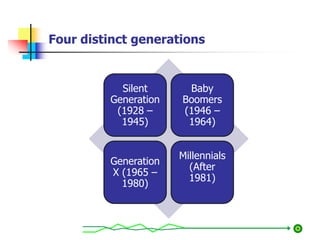
Four distinct generations
Silent
Generation
(1928 –
1945)
Baby
Boomers
(1946 –
1964)
Generation
X (1965 –
1980)
Millennials
(After
1981)
Impact
 When generations fail to communicate or work together
effectively, it impacts the organization’s bottom line.
 Turnover rates and tangible costs such as
recruitment, hiring, training and retention can be
negatively impacted.
 Morale may also suffer which can result in increased
complaints, and perceptions of unfair treatment or
inequity.
6
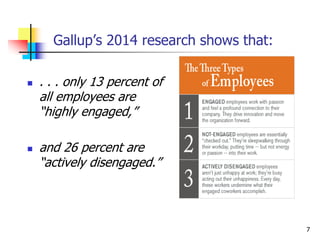
 . . . only 13 percent of
all employees are
“highly engaged,”
 and 26 percent are
“actively disengaged.”
7
Gallup’s 2014 research shows that:
Deloitte Consulting:
Ten Key Trends for 2015
 1. Engagement, Retention, Culture, and
Inclusion Have Become Front Burner
Issues
 Low engagement today is a significant business
risk. In today’s transparent job market,
employment brand and employee engagement
have become synonymous. If people are
unhappy at work, then they are likely telling
others—making it harder to hire good people.
8
Deloitte research also notes:
 Eighty percent of organizations believe their employees are
overwhelmed with information and activity at work (21 percent cite
the issue as urgent), yet fewer than 8 percent have programs to
deal with the issue.
 More than 70 percent of Millennials expect their employers to focus
on societal or mission-driven problems; 70 percent want to be
creative at work; and more than two-thirds believe it is
management’s job to provide them with accelerated development
opportunities in order for them to stay.
9
The employee-work contract
has changed:
 People are operating more like free agents than
in the past.
 In short, the balance of power has shifted from
employer to employee, forcing business leaders
to learn how to build an organization that
engages employees as sensitive, passionate,
creative contributors.
Source: Deloitte Touche Tohmatsu Limited.
10
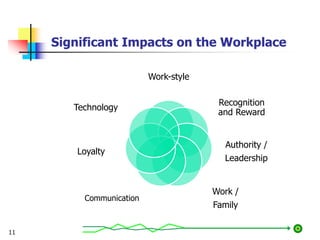
Significant Impacts on the Workplace
Work-style
Recognition
and Reward
Authority /
Leadership
Work /
Family
Communication
Loyalty
Technology
11
What has to be done?
 Good leaders need to recognize the workplace
characteristics and personal desires of each individual.
 They need to use these traits effectively in order to drive
company performance and achieve organizational goals.
12
Josh Bersin: A new model for
employee engagement
 1. Make work meaningful
 2. Foster great management: High-performing managers
create simple goals, make sure they are clear and transparent, and revisit
them regularly.
 3. Establish a flexible, humane, inclusive
workplace
 4. Create ample opportunities for growth
 5. Establish vision, purpose, and transparency in
leadership
 © 2015 - Deloitte Touche Tohmatsu Limited.
13
Bond . . . James Bond
14
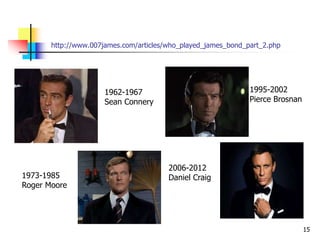
http://www.007james.com/articles/who_played_james_bond_part_2.php
15
1962-1967
Sean Connery
1995-2002
Pierce Brosnan
1973-1985
Roger Moore
2006-2012
Daniel Craig
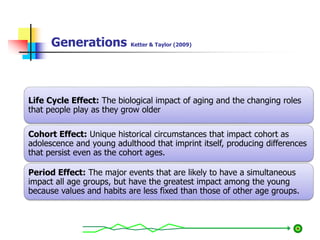
Generations Ketter & Taylor (2009)
Life Cycle Effect: The biological impact of aging and the changing roles
that people play as they grow older
Cohort Effect: Unique historical circumstances that impact cohort as
adolescence and young adulthood that imprint itself, producing differences
that persist even as the cohort ages.
Period Effect: The major events that are likely to have a simultaneous
impact all age groups, but have the greatest impact among the young
because values and habits are less fixed than those of other age groups.
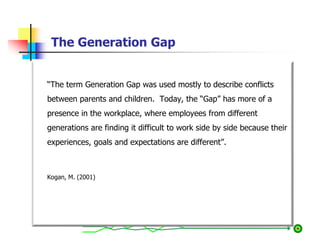
The Generation Gap
“The term Generation Gap was used mostly to describe conflicts
between parents and children. Today, the “Gap” has more of a
presence in the workplace, where employees from different
generations are finding it difficult to work side by side because their
experiences, goals and expectations are different”.
Kogan, M. (2001)
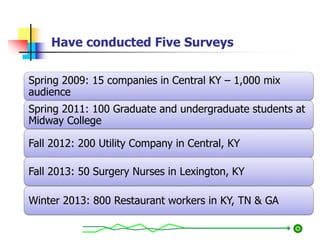
Have conducted Five Surveys
Spring 2009: 15 companies in Central KY – 1,000 mix
audience
Spring 2011: 100 Graduate and undergraduate students at
Midway College
Fall 2012: 200 Utility Company in Central, KY
Fall 2013: 50 Surgery Nurses in Lexington, KY
Winter 2013: 800 Restaurant workers in KY, TN & GA
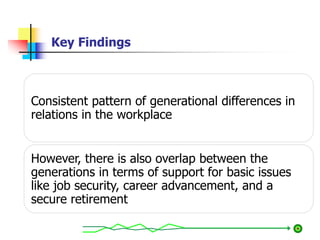
Key Findings
Consistent pattern of generational differences in
relations in the workplace
However, there is also overlap between the
generations in terms of support for basic issues
like job security, career advancement, and a
secure retirement
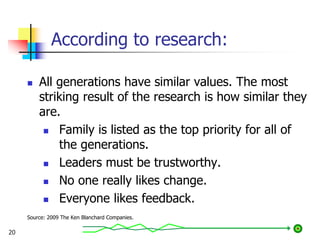
According to research:
 All generations have similar values. The most
striking result of the research is how similar they
are.
 Family is listed as the top priority for all of
the generations.
 Leaders must be trustworthy.
 No one really likes change.
 Everyone likes feedback.
Source: 2009 The Ken Blanchard Companies.
20
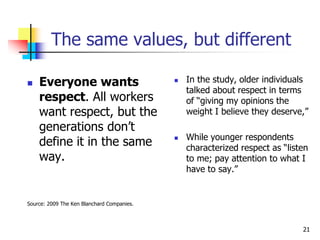
The same values, but different
 Everyone wants
respect. All workers
want respect, but the
generations don’t
define it in the same
way.
Source: 2009 The Ken Blanchard Companies.
 In the study, older individuals
talked about respect in terms
of “giving my opinions the
weight I believe they deserve,”
 While younger respondents
characterized respect as “listen
to me; pay attention to what I
have to say.”
21
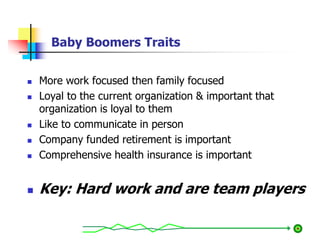
Baby Boomers Traits
 More work focused then family focused
 Loyal to the current organization & important that
organization is loyal to them
 Like to communicate in person
 Company funded retirement is important
 Comprehensive health insurance is important
 Key: Hard work and are team players
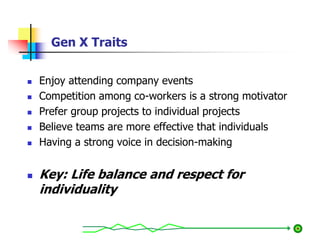
Gen X Traits
 Enjoy attending company events
 Competition among co-workers is a strong motivator
 Prefer group projects to individual projects
 Believe teams are more effective that individuals
 Having a strong voice in decision-making
 Key: Life balance and respect for
individuality
Millenials Traits
 Close supervision improve my performance
 Job security is my top priority
 Special recognition is a strong motivator
 Teams are more effective then individual efforts
 Tangible awards (trophies, plaques, and parking spaces)
strong motivators
 Key: Making a difference in the world and
respecting diversity
According to Morris Massey. . .
 A high percentage of learned behavior and attitude
patterns in adults are directly correlated to their
formative years.
 Birth to 7 years: Imprint by observation or
patterning. What a child experiences is accepted,
internalized, and considered to be right and normal.
 8–13 years: Modeling by heroes or identification.
 14–20 years: Socialization by peers or significant
other.
25
According to Morris Massey. . .
 21+ years: A significant emotional experience
(S.E.E.) may change or replace values. Without that,
values are now set.
 An S.E.E. is something that emotionally affects an
individual’s perception or understanding of reality and
causes them to reexamine the basic value or belief.
 If powerful enough, the experience will cause the person
to exchange one value for another.
26
Baby Boomers Values
 Defining and guiding values:
 * Idealism * Image * Optimism * Team
orientation * Personal growth * Personal
gratification * Group together by similarity of
belief * Self-expressive * Media savvy *
Excellence * Big talkers * Youth * Work *
Involvement * Health / wellness * Nostalgia
 http://www.tomorrowtoday.uk.com/articles/article001_intro_gens.htm
27
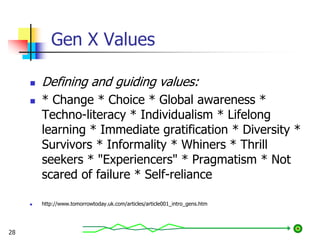
Gen X Values
 Defining and guiding values:
 * Change * Choice * Global awareness *
Techno-literacy * Individualism * Lifelong
learning * Immediate gratification * Diversity *
Survivors * Informality * Whiners * Thrill
seekers * "Experiencers" * Pragmatism * Not
scared of failure * Self-reliance
 http://www.tomorrowtoday.uk.com/articles/article001_intro_gens.htm
28
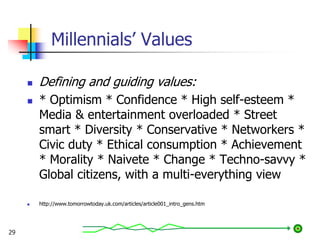
Millennials’ Values
 Defining and guiding values:
 * Optimism * Confidence * High self-esteem *
Media & entertainment overloaded * Street
smart * Diversity * Conservative * Networkers *
Civic duty * Ethical consumption * Achievement
* Morality * Naivete * Change * Techno-savvy *
Global citizens, with a multi-everything view
 http://www.tomorrowtoday.uk.com/articles/article001_intro_gens.htm
29
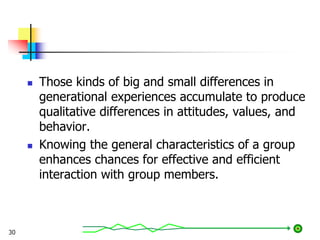
 Those kinds of big and small differences in
generational experiences accumulate to produce
qualitative differences in attitudes, values, and
behavior.
 Knowing the general characteristics of a group
enhances chances for effective and efficient
interaction with group members.
30
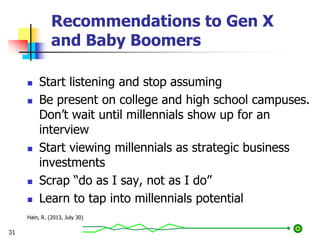
Recommendations to Gen X
and Baby Boomers
 Start listening and stop assuming
 Be present on college and high school campuses.
Don’t wait until millennials show up for an
interview
 Start viewing millennials as strategic business
investments
 Scrap “do as I say, not as I do”
 Learn to tap into millennials potential
Hain, R. (2013, July 30)
31
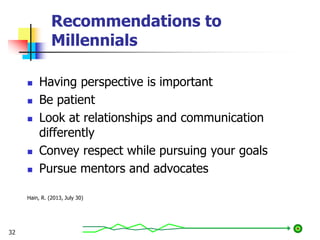
Recommendations to
Millennials
 Having perspective is important
 Be patient
 Look at relationships and communication
differently
 Convey respect while pursuing your goals
 Pursue mentors and advocates
Hain, R. (2013, July 30)
32
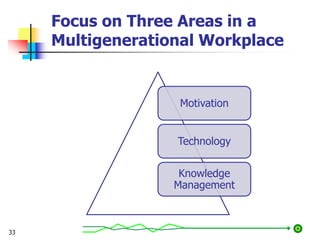
Focus on Three Areas in a
Multigenerational Workplace
Motivation
Technology
Knowledge
Management
33
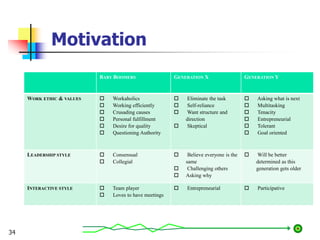
Motivation
BABY BOOMERS GENERATION X GENERATION Y
WORK ETHIC & VALUES  Workaholics
 Working efficiently
 Crusading causes
 Personal fulfillment
 Desire for quality
 Questioning Authority
 Eliminate the task
 Self-reliance
 Want structure and
direction
 Skeptical
 Asking what is next
 Multitasking
 Tenacity
 Entrepreneurial
 Tolerant
 Goal oriented
LEADERSHIP STYLE  Consensual
 Collegial
 Believe everyone is the
same
 Challenging others
 Asking why
 Will be better
determined as this
generation gets older
INTERACTIVE STYLE  Team player
 Loves to have meetings
 Entrepreneurial  Participative
34
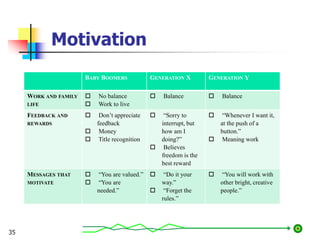
Motivation
BABY BOOMERS GENERATION X GENERATION Y
WORK AND FAMILY
LIFE
 No balance
 Work to live
 Balance  Balance
FEEDBACK AND
REWARDS
 Don’t appreciate
feedback
 Money
 Title recognition
 “Sorry to
interrupt, but
how am I
doing?”
 Believes
freedom is the
best reward
 “Whenever I want it,
at the push of a
button.”
 Meaning work
MESSAGES THAT
MOTIVATE
 “You are valued.”
 “You are
needed.”
 “Do it your
way.”
 “Forget the
rules.”
 “You will work with
other bright, creative
people.”
35
Technology
36
 Pew Research notes that today’s young are history’s first
generation of digital natives.
 The online world isn’t something they’ve had to adapt to
— it’s all they’ve ever known, and it’s their indispensable
platform for social interactions and information
acquisition.
 Take advantage of your millennial employee’s computer,
cell phone, and electronic literacy
Technology
 So how can businesses take advantage of the
tech-skills that younger workers bring?
 One effective strategy is reciprocal mentoring. Reciprocal
mentoring takes that concept a step further by creating a two-
way conversation.
 As the mentor teaches the newcomer valuable business
information, the young person can help their older colleague
master the techniques of new technology, including how to avoid
the embarrassing “newbie” mistakes that inhibit a lot of
inexperienced users from participating in online activities.
37
Knowledge Transfer
 Personal dynamics and communication between source
and receiver can make or break the transfer of
knowledge, especially between generations.
 Identify where it is most vulnerable
 Evaluate current processes and practices for
transferring critical knowledge to determine how its
culture, systems, and processes enable knowledge
loss
Bridging the Gaps: How to Transfer Knowledge in Today's Multigenerational Workplace. (2008, July 1).
38
Knowledge is a Strategic
Business Issue
 Define losing knowledge as a strategic business issue,
and articulate changing workforce threats to the
management team—don’t assume they get it
 Northeast Utilities developed a five-year corporate
development program and funding plan. One of its
components is the business case for retaining critical
knowledge: to ensure that operational performance does
not suffer as a result of known workforce transitions.
Bridging the Gaps: How to Transfer Knowledge in Today's Multigenerational Workplace. (2008, July 1).
39
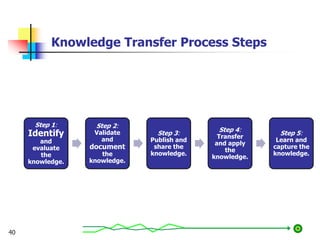
Knowledge Transfer Process Steps
Step 1:
Identify
and
evaluate
the
knowledge.
Step 2:
Validate
and
document
the
knowledge.
Step 3:
Publish and
share the
knowledge.
Step 4:
Transfer
and apply
the
knowledge.
Step 5:
Learn and
capture the
knowledge.
40
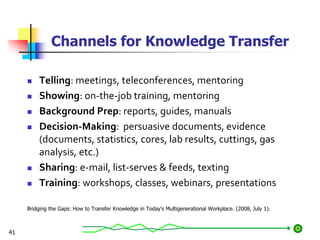
Channels for Knowledge Transfer
 Telling: meetings, teleconferences, mentoring
 Showing: on-the-job training, mentoring
 Background Prep: reports, guides, manuals
 Decision-Making: persuasive documents, evidence
(documents, statistics, cores, lab results, cuttings, gas
analysis, etc.)
 Sharing: e-mail, list-serves & feeds, texting
 Training: workshops, classes, webinars, presentations
Bridging the Gaps: How to Transfer Knowledge in Today's Multigenerational Workplace. (2008, July 1).
41
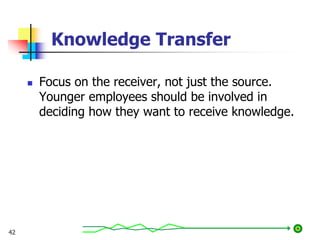
Knowledge Transfer
 Focus on the receiver, not just the source.
Younger employees should be involved in
deciding how they want to receive knowledge.
42
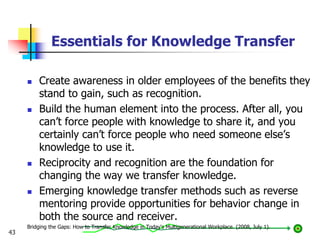
Essentials for Knowledge Transfer
 Create awareness in older employees of the benefits they
stand to gain, such as recognition.
 Build the human element into the process. After all, you
can’t force people with knowledge to share it, and you
certainly can’t force people who need someone else’s
knowledge to use it.
 Reciprocity and recognition are the foundation for
changing the way we transfer knowledge.
 Emerging knowledge transfer methods such as reverse
mentoring provide opportunities for behavior change in
both the source and receiver.
Bridging the Gaps: How to Transfer Knowledge in Today's Multigenerational Workplace. (2008, July 1).
43
Leading a Multigenerational
Workforce — 12 Best Practices
Dr. Susan Murphy, a senior consultant with Claire
Raines Associates, a consulting firm specializing in
generational differences, offers 12 best practices:
1) Study generational composition; use the
information in many HR strategies.
2) Train people about the generations, using a
variety of formats.
3) Match workforce to customer base.
44
Leading a Multigenerational
Workforce — 12 Best Practices
4. Include all generations on boards and councils.
5. Support continuing education (lifelong learning,
tuition reimbursement, etc.).
6. Reward managers for retention.
7. Reward performance and productivity (without
regard to age)
8. Offer horizontal movement (to gain experience
and break down silos).
45
Leading a Multigenerational
Workforce — 12 Best Practices
9) Plan for succession (knowledge management transfer).
10) Offer mentoring programs (to transfer knowledge from
senior to junior employees).
11) Offer flexible scheduling (part-time work, temporary
positions, job sharing, telecommuting).
12) Offer a wide variety and choices of benefits(auto, life,
and health insurance, 401(k) match, alumni group,
etc.).
46

Lex Chamber Presentation 3 4 2015

  • 1.
    Managing a Multi-Generational Workforce Presentationat Contact Center Consortium Network (C3N) Commerce Lexington March 4, 2015 1 1
  • 2.
    Paradigm  … atypical example or pattern of something; a model. Not Stereotypes ... a fixed, over generalized belief about a particular group or class of people. 2
  • 3.
     In today'sworld, the structure, content, and process of work have changed. Work is now:  more cognitively complex  more team-based and collaborative  more dependent on social skills  more dependent on technological competence  more time pressured  more mobile and less dependent on geography. 3
  • 4.
    Problem  For thefirst time in modern history, four generations of workers are working side by side—each bringing a wide range of cultural and generational idiosyncrasies with them to the workplace. Source: 2009 The Ken Blanchard Companies.  Many organizations are not equipped to deal with the generational conflicts that may be arising, and most managers are struggling with how to work constructively with individuals in each generation. 4
  • 5.
    Four distinct generations Silent Generation (1928– 1945) Baby Boomers (1946 – 1964) Generation X (1965 – 1980) Millennials (After 1981)
  • 6.
    Impact  When generationsfail to communicate or work together effectively, it impacts the organization’s bottom line.  Turnover rates and tangible costs such as recruitment, hiring, training and retention can be negatively impacted.  Morale may also suffer which can result in increased complaints, and perceptions of unfair treatment or inequity. 6
  • 7.
     . .. only 13 percent of all employees are “highly engaged,”  and 26 percent are “actively disengaged.” 7 Gallup’s 2014 research shows that:
  • 8.
    Deloitte Consulting: Ten KeyTrends for 2015  1. Engagement, Retention, Culture, and Inclusion Have Become Front Burner Issues  Low engagement today is a significant business risk. In today’s transparent job market, employment brand and employee engagement have become synonymous. If people are unhappy at work, then they are likely telling others—making it harder to hire good people. 8
  • 9.
    Deloitte research alsonotes:  Eighty percent of organizations believe their employees are overwhelmed with information and activity at work (21 percent cite the issue as urgent), yet fewer than 8 percent have programs to deal with the issue.  More than 70 percent of Millennials expect their employers to focus on societal or mission-driven problems; 70 percent want to be creative at work; and more than two-thirds believe it is management’s job to provide them with accelerated development opportunities in order for them to stay. 9
  • 10.
    The employee-work contract haschanged:  People are operating more like free agents than in the past.  In short, the balance of power has shifted from employer to employee, forcing business leaders to learn how to build an organization that engages employees as sensitive, passionate, creative contributors. Source: Deloitte Touche Tohmatsu Limited. 10
  • 11.
    Significant Impacts onthe Workplace Work-style Recognition and Reward Authority / Leadership Work / Family Communication Loyalty Technology 11
  • 12.
    What has tobe done?  Good leaders need to recognize the workplace characteristics and personal desires of each individual.  They need to use these traits effectively in order to drive company performance and achieve organizational goals. 12
  • 13.
    Josh Bersin: Anew model for employee engagement  1. Make work meaningful  2. Foster great management: High-performing managers create simple goals, make sure they are clear and transparent, and revisit them regularly.  3. Establish a flexible, humane, inclusive workplace  4. Create ample opportunities for growth  5. Establish vision, purpose, and transparency in leadership  © 2015 - Deloitte Touche Tohmatsu Limited. 13
  • 14.
    Bond . .. James Bond 14
  • 15.
  • 16.
    Generations Ketter &Taylor (2009) Life Cycle Effect: The biological impact of aging and the changing roles that people play as they grow older Cohort Effect: Unique historical circumstances that impact cohort as adolescence and young adulthood that imprint itself, producing differences that persist even as the cohort ages. Period Effect: The major events that are likely to have a simultaneous impact all age groups, but have the greatest impact among the young because values and habits are less fixed than those of other age groups.
  • 17.
    The Generation Gap “Theterm Generation Gap was used mostly to describe conflicts between parents and children. Today, the “Gap” has more of a presence in the workplace, where employees from different generations are finding it difficult to work side by side because their experiences, goals and expectations are different”. Kogan, M. (2001)
  • 18.
    Have conducted FiveSurveys Spring 2009: 15 companies in Central KY – 1,000 mix audience Spring 2011: 100 Graduate and undergraduate students at Midway College Fall 2012: 200 Utility Company in Central, KY Fall 2013: 50 Surgery Nurses in Lexington, KY Winter 2013: 800 Restaurant workers in KY, TN & GA
  • 19.
    Key Findings Consistent patternof generational differences in relations in the workplace However, there is also overlap between the generations in terms of support for basic issues like job security, career advancement, and a secure retirement
  • 20.
    According to research: All generations have similar values. The most striking result of the research is how similar they are.  Family is listed as the top priority for all of the generations.  Leaders must be trustworthy.  No one really likes change.  Everyone likes feedback. Source: 2009 The Ken Blanchard Companies. 20
  • 21.
    The same values,but different  Everyone wants respect. All workers want respect, but the generations don’t define it in the same way. Source: 2009 The Ken Blanchard Companies.  In the study, older individuals talked about respect in terms of “giving my opinions the weight I believe they deserve,”  While younger respondents characterized respect as “listen to me; pay attention to what I have to say.” 21
  • 22.
    Baby Boomers Traits More work focused then family focused  Loyal to the current organization & important that organization is loyal to them  Like to communicate in person  Company funded retirement is important  Comprehensive health insurance is important  Key: Hard work and are team players
  • 23.
    Gen X Traits Enjoy attending company events  Competition among co-workers is a strong motivator  Prefer group projects to individual projects  Believe teams are more effective that individuals  Having a strong voice in decision-making  Key: Life balance and respect for individuality
  • 24.
    Millenials Traits  Closesupervision improve my performance  Job security is my top priority  Special recognition is a strong motivator  Teams are more effective then individual efforts  Tangible awards (trophies, plaques, and parking spaces) strong motivators  Key: Making a difference in the world and respecting diversity
  • 25.
    According to MorrisMassey. . .  A high percentage of learned behavior and attitude patterns in adults are directly correlated to their formative years.  Birth to 7 years: Imprint by observation or patterning. What a child experiences is accepted, internalized, and considered to be right and normal.  8–13 years: Modeling by heroes or identification.  14–20 years: Socialization by peers or significant other. 25
  • 26.
    According to MorrisMassey. . .  21+ years: A significant emotional experience (S.E.E.) may change or replace values. Without that, values are now set.  An S.E.E. is something that emotionally affects an individual’s perception or understanding of reality and causes them to reexamine the basic value or belief.  If powerful enough, the experience will cause the person to exchange one value for another. 26
  • 27.
    Baby Boomers Values Defining and guiding values:  * Idealism * Image * Optimism * Team orientation * Personal growth * Personal gratification * Group together by similarity of belief * Self-expressive * Media savvy * Excellence * Big talkers * Youth * Work * Involvement * Health / wellness * Nostalgia  http://www.tomorrowtoday.uk.com/articles/article001_intro_gens.htm 27
  • 28.
    Gen X Values Defining and guiding values:  * Change * Choice * Global awareness * Techno-literacy * Individualism * Lifelong learning * Immediate gratification * Diversity * Survivors * Informality * Whiners * Thrill seekers * "Experiencers" * Pragmatism * Not scared of failure * Self-reliance  http://www.tomorrowtoday.uk.com/articles/article001_intro_gens.htm 28
  • 29.
    Millennials’ Values  Definingand guiding values:  * Optimism * Confidence * High self-esteem * Media & entertainment overloaded * Street smart * Diversity * Conservative * Networkers * Civic duty * Ethical consumption * Achievement * Morality * Naivete * Change * Techno-savvy * Global citizens, with a multi-everything view  http://www.tomorrowtoday.uk.com/articles/article001_intro_gens.htm 29
  • 30.
     Those kindsof big and small differences in generational experiences accumulate to produce qualitative differences in attitudes, values, and behavior.  Knowing the general characteristics of a group enhances chances for effective and efficient interaction with group members. 30
  • 31.
    Recommendations to GenX and Baby Boomers  Start listening and stop assuming  Be present on college and high school campuses. Don’t wait until millennials show up for an interview  Start viewing millennials as strategic business investments  Scrap “do as I say, not as I do”  Learn to tap into millennials potential Hain, R. (2013, July 30) 31
  • 32.
    Recommendations to Millennials  Havingperspective is important  Be patient  Look at relationships and communication differently  Convey respect while pursuing your goals  Pursue mentors and advocates Hain, R. (2013, July 30) 32
  • 33.
    Focus on ThreeAreas in a Multigenerational Workplace Motivation Technology Knowledge Management 33
  • 34.
    Motivation BABY BOOMERS GENERATIONX GENERATION Y WORK ETHIC & VALUES  Workaholics  Working efficiently  Crusading causes  Personal fulfillment  Desire for quality  Questioning Authority  Eliminate the task  Self-reliance  Want structure and direction  Skeptical  Asking what is next  Multitasking  Tenacity  Entrepreneurial  Tolerant  Goal oriented LEADERSHIP STYLE  Consensual  Collegial  Believe everyone is the same  Challenging others  Asking why  Will be better determined as this generation gets older INTERACTIVE STYLE  Team player  Loves to have meetings  Entrepreneurial  Participative 34
  • 35.
    Motivation BABY BOOMERS GENERATIONX GENERATION Y WORK AND FAMILY LIFE  No balance  Work to live  Balance  Balance FEEDBACK AND REWARDS  Don’t appreciate feedback  Money  Title recognition  “Sorry to interrupt, but how am I doing?”  Believes freedom is the best reward  “Whenever I want it, at the push of a button.”  Meaning work MESSAGES THAT MOTIVATE  “You are valued.”  “You are needed.”  “Do it your way.”  “Forget the rules.”  “You will work with other bright, creative people.” 35
  • 36.
    Technology 36  Pew Researchnotes that today’s young are history’s first generation of digital natives.  The online world isn’t something they’ve had to adapt to — it’s all they’ve ever known, and it’s their indispensable platform for social interactions and information acquisition.  Take advantage of your millennial employee’s computer, cell phone, and electronic literacy
  • 37.
    Technology  So howcan businesses take advantage of the tech-skills that younger workers bring?  One effective strategy is reciprocal mentoring. Reciprocal mentoring takes that concept a step further by creating a two- way conversation.  As the mentor teaches the newcomer valuable business information, the young person can help their older colleague master the techniques of new technology, including how to avoid the embarrassing “newbie” mistakes that inhibit a lot of inexperienced users from participating in online activities. 37
  • 38.
    Knowledge Transfer  Personaldynamics and communication between source and receiver can make or break the transfer of knowledge, especially between generations.  Identify where it is most vulnerable  Evaluate current processes and practices for transferring critical knowledge to determine how its culture, systems, and processes enable knowledge loss Bridging the Gaps: How to Transfer Knowledge in Today's Multigenerational Workplace. (2008, July 1). 38
  • 39.
    Knowledge is aStrategic Business Issue  Define losing knowledge as a strategic business issue, and articulate changing workforce threats to the management team—don’t assume they get it  Northeast Utilities developed a five-year corporate development program and funding plan. One of its components is the business case for retaining critical knowledge: to ensure that operational performance does not suffer as a result of known workforce transitions. Bridging the Gaps: How to Transfer Knowledge in Today's Multigenerational Workplace. (2008, July 1). 39
  • 40.
    Knowledge Transfer ProcessSteps Step 1: Identify and evaluate the knowledge. Step 2: Validate and document the knowledge. Step 3: Publish and share the knowledge. Step 4: Transfer and apply the knowledge. Step 5: Learn and capture the knowledge. 40
  • 41.
    Channels for KnowledgeTransfer  Telling: meetings, teleconferences, mentoring  Showing: on-the-job training, mentoring  Background Prep: reports, guides, manuals  Decision-Making: persuasive documents, evidence (documents, statistics, cores, lab results, cuttings, gas analysis, etc.)  Sharing: e-mail, list-serves & feeds, texting  Training: workshops, classes, webinars, presentations Bridging the Gaps: How to Transfer Knowledge in Today's Multigenerational Workplace. (2008, July 1). 41
  • 42.
    Knowledge Transfer  Focuson the receiver, not just the source. Younger employees should be involved in deciding how they want to receive knowledge. 42
  • 43.
    Essentials for KnowledgeTransfer  Create awareness in older employees of the benefits they stand to gain, such as recognition.  Build the human element into the process. After all, you can’t force people with knowledge to share it, and you certainly can’t force people who need someone else’s knowledge to use it.  Reciprocity and recognition are the foundation for changing the way we transfer knowledge.  Emerging knowledge transfer methods such as reverse mentoring provide opportunities for behavior change in both the source and receiver. Bridging the Gaps: How to Transfer Knowledge in Today's Multigenerational Workplace. (2008, July 1). 43
  • 44.
    Leading a Multigenerational Workforce— 12 Best Practices Dr. Susan Murphy, a senior consultant with Claire Raines Associates, a consulting firm specializing in generational differences, offers 12 best practices: 1) Study generational composition; use the information in many HR strategies. 2) Train people about the generations, using a variety of formats. 3) Match workforce to customer base. 44
  • 45.
    Leading a Multigenerational Workforce— 12 Best Practices 4. Include all generations on boards and councils. 5. Support continuing education (lifelong learning, tuition reimbursement, etc.). 6. Reward managers for retention. 7. Reward performance and productivity (without regard to age) 8. Offer horizontal movement (to gain experience and break down silos). 45
  • 46.
    Leading a Multigenerational Workforce— 12 Best Practices 9) Plan for succession (knowledge management transfer). 10) Offer mentoring programs (to transfer knowledge from senior to junior employees). 11) Offer flexible scheduling (part-time work, temporary positions, job sharing, telecommuting). 12) Offer a wide variety and choices of benefits(auto, life, and health insurance, 401(k) match, alumni group, etc.). 46