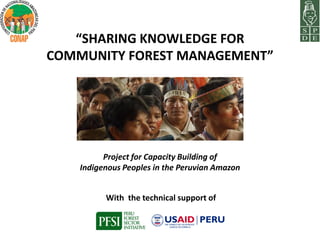
“SHARING KNOWLEDGE FOR
COMMUNITY FOREST MANAGEMENT”


          Project for Capacity Building of
    Indigenous Peoples in the Peruvian Amazon


          With the technical support of
PRESENTATION
• The “Sharing Knowledge for Community Forest Management” project provides
  training, teaching and support opportunities for Indigenous Peoples of Junín
  and Pasco regions of the Peruvian Amazon, for a proper understanding of the
  forestry and wildlife regulatory framework, the strengthening of their
  managerial, technical and organizational capacities for institutionalization of
  Community Forest Management in Peru.

• This project is aimed at representative organizations of indigenous peoples of
  the Peruvian Amazon (Junín and Pasco regions). The project has three
  components:
    ⁻ Purposive capacity building of indigenous leaders for informed
       participation in upgrade processes of forestry regulations.
    ⁻ Capacity building for communal governance, community forest
       management and mitigation of the impacts of deforestation on climate
       change.
    ⁻ Integral formation of indigenous young leaders.

•   The project has an initial 12-month stage, executed in a decentralized manner.
GENERAL OBJECTIVE
• Institutionalize Community forest and wildlife management
  through capacity building and training of indigenous young
  leaders from the Peruvian Amazon to mitigate climate change
  and promote active and informed participation of indigenous
  peoples in the processes of policy making of Forestry Sector
  for Community Forestry Governance.
SPECIFIC OBJECTIVES

• Strengthen administrative, organizational, managerial capacity and legal
  technical tools in forestry of indigenous leaders from the Junín and Pasco
  regions enhancing their proactive ability in the areas of participation and
  consultation relating to forestry regulations at national and regional levels,
  to institutionalize the Community Forest Management.

• Improve negotiation skills, market access and competitiveness for
  sustainable forestry development through capacity building for conflict
  management, and institutionalization of rules, procedures and mechanisms
  of internal organization of Indigenous Communities of Junín and Pasco, Peru
  within the framework for respect its administrative autonomy, traditional
  forms of organization and the application of customary acts of indigenous
  peoples, in order to institutionalize the Communal Governance.
SPECIFIC OBJECTIVES

• Socialize and promote understanding of the regulatory framework of
  Forestry and Wildlife sector, as well as the contents, scope and
  opportunities of the Forestry and Wildlife Act, Law No. 29763, for
  discussion and reflection of Indigenous Peoples at the national and
  regional level.
PROJECT PRINCIPLES

                   •   Based on the recognition, respect and appreciation of the presence and
                       interaction of diverse cultures within their worldview, and the possibility of
                       generating shared cultural expressions acquired through dialogue and an
INTERCULTURALIMS       attitude of mutual respect.
                   •   Traditional knowledge is recognized in the management and use of forest,
                       wildlife and biodiversity resources. Additionally, it seeks to promote the
                       strengthening of skills and competencies for mutual cultural understanding
                       between the government, Indigenous Peoples and society as a whole.

                   •   The institutions sharing this project have the right and duty to participate
PARTICIPATION          responsibly in the decision-making processes regarding the definition,
                       implementation and monitoring of management on the implementation of
                       the action lines proposed in each of the stages and project levels

TRANSPARENCY       •   Project information is available at all participating, partner institutions and
                       the general public in a clear and timely manner, so that it can be analyzed so
                       clear
PROJECT PRINCIPLES

                     •   Recognition of equal ability, potential, and opportunities for access rights to
EQUITY AND JUSTICE       the same conditions of human development of all individuals in a society,
                         without admitting any discrimination based on gender, sex, age, social
                         status, ethnicity, culture, religion, identity, or other type


                     •   The project is part of the strategic vision of paradigm shift in the Forestry
                         Sector, abandoning traditional forms of unsustainable extraction activity in
                         environmental, economic and social issues, to align with Integrated and
STRATEGIC VISION         Sustainable Forest Management from ecosystem approaches and adaptive
                         management, incorporating elements of multiculturalism, reciprocity, equity
                         and justice.
                     •   This is compounded by the Communal Governance as a sine qua non
                         condition for sustainable forest businesses


                     •   Excellence as organizing principle of the proposal includes an inherent bias
   EXCELLENCE            towards achieving the highest standards of quality, efficiency and
                         effectiveness in the performance of each of the planned activities, and their
                         overall vision, assessment and ongoing monitoring, and the sense of strategic
                         opportunity for the development of such activities.
PROJECT PRINCIPLES


                    •   The original cultures of Peru are characterized by a high sense of honor and
                        the fulfillment of the word in their commitments, both personally and
CO-RESPONSIBILITY       communally. This principle is a fundamental pillar for the implementation of
AND COMPLIANCE          the project, while ensuring not only the development of strong relationships
WITH AGREEMENTS         of trust and credibility among partner organizations, but also the co-
                        responsibility in meeting the activities and tasks involved under the project
                        framework and in coordination with the executing agency and financial
                        institutions.


                    •   One of the greatest strengths of the institutions involved in this project is a
  VOCATION TO           crystallized commitment to service and reciprocity as the foundation of
  SERVICE AND           personal and institutional relationships, and incorporation into the
  RECIPROCITY           professional and daily life. This causes the project to be primarily aimed at
                        providing the best service to users thereof, based on the reciprocity of the
                        trust placed upon these institutions.
PARTICIPATION & GOVERNANCE                       COMMUNAL FOREST MANAGMENT


 EDUCATION & CAPACITY BUILDLING OF YOUNG INDIGENOUS LEADERS / EQUITY AND JUSTICE
INTERVENTION STRATEGIES

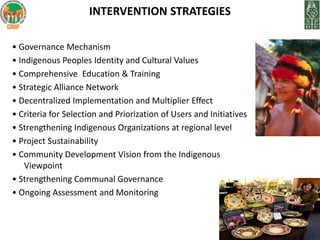
• Governance Mechanism
• Indigenous Peoples Identity and Cultural Values
• Comprehensive Education & Training
• Strategic Alliance Network
• Decentralized Implementation and Multiplier Effect
• Criteria for Selection and Priorization of Users and Initiatives
• Strengthening Indigenous Organizations at regional level
• Project Sustainability
• Community Development Vision from the Indigenous
    Viewpoint
• Strengthening Communal Governance
• Ongoing Assessment and Monitoring
CONTACTS:

Oseas Barbarán (CONAP President)
Confederación de Nacionalidades Amazónicas del Perú – CONAP
General Garzón 2474, Lima 11 Perú
(+51-1) 261-4579
conap@conap.org.pe

Lucila Pautrat (Project Coordinator)
Sociedad Peruana de Ecodesarrollo
Alayza & Roel St. 2112 Of. L, Lima 1´4 Perú
(+51-1) 265 0452
lpautrat@spdecodesarrollo.org

Web page: http://www.pcs-mfc.org/
Virtual classroom: https://sites.google.com/a/pcs-mfc.org/plataforma-educativa/

Sharing knowledge for community forest management

  • 1.
    “SHARING KNOWLEDGE FOR COMMUNITYFOREST MANAGEMENT” Project for Capacity Building of Indigenous Peoples in the Peruvian Amazon With the technical support of
  • 2.
    PRESENTATION • The “SharingKnowledge for Community Forest Management” project provides training, teaching and support opportunities for Indigenous Peoples of Junín and Pasco regions of the Peruvian Amazon, for a proper understanding of the forestry and wildlife regulatory framework, the strengthening of their managerial, technical and organizational capacities for institutionalization of Community Forest Management in Peru. • This project is aimed at representative organizations of indigenous peoples of the Peruvian Amazon (Junín and Pasco regions). The project has three components: ⁻ Purposive capacity building of indigenous leaders for informed participation in upgrade processes of forestry regulations. ⁻ Capacity building for communal governance, community forest management and mitigation of the impacts of deforestation on climate change. ⁻ Integral formation of indigenous young leaders. • The project has an initial 12-month stage, executed in a decentralized manner.
  • 3.
    GENERAL OBJECTIVE • InstitutionalizeCommunity forest and wildlife management through capacity building and training of indigenous young leaders from the Peruvian Amazon to mitigate climate change and promote active and informed participation of indigenous peoples in the processes of policy making of Forestry Sector for Community Forestry Governance.
  • 4.
    SPECIFIC OBJECTIVES • Strengthenadministrative, organizational, managerial capacity and legal technical tools in forestry of indigenous leaders from the Junín and Pasco regions enhancing their proactive ability in the areas of participation and consultation relating to forestry regulations at national and regional levels, to institutionalize the Community Forest Management. • Improve negotiation skills, market access and competitiveness for sustainable forestry development through capacity building for conflict management, and institutionalization of rules, procedures and mechanisms of internal organization of Indigenous Communities of Junín and Pasco, Peru within the framework for respect its administrative autonomy, traditional forms of organization and the application of customary acts of indigenous peoples, in order to institutionalize the Communal Governance.
  • 5.
    SPECIFIC OBJECTIVES • Socializeand promote understanding of the regulatory framework of Forestry and Wildlife sector, as well as the contents, scope and opportunities of the Forestry and Wildlife Act, Law No. 29763, for discussion and reflection of Indigenous Peoples at the national and regional level.
  • 7.
    PROJECT PRINCIPLES • Based on the recognition, respect and appreciation of the presence and interaction of diverse cultures within their worldview, and the possibility of generating shared cultural expressions acquired through dialogue and an INTERCULTURALIMS attitude of mutual respect. • Traditional knowledge is recognized in the management and use of forest, wildlife and biodiversity resources. Additionally, it seeks to promote the strengthening of skills and competencies for mutual cultural understanding between the government, Indigenous Peoples and society as a whole. • The institutions sharing this project have the right and duty to participate PARTICIPATION responsibly in the decision-making processes regarding the definition, implementation and monitoring of management on the implementation of the action lines proposed in each of the stages and project levels TRANSPARENCY • Project information is available at all participating, partner institutions and the general public in a clear and timely manner, so that it can be analyzed so clear
  • 8.
    PROJECT PRINCIPLES • Recognition of equal ability, potential, and opportunities for access rights to EQUITY AND JUSTICE the same conditions of human development of all individuals in a society, without admitting any discrimination based on gender, sex, age, social status, ethnicity, culture, religion, identity, or other type • The project is part of the strategic vision of paradigm shift in the Forestry Sector, abandoning traditional forms of unsustainable extraction activity in environmental, economic and social issues, to align with Integrated and STRATEGIC VISION Sustainable Forest Management from ecosystem approaches and adaptive management, incorporating elements of multiculturalism, reciprocity, equity and justice. • This is compounded by the Communal Governance as a sine qua non condition for sustainable forest businesses • Excellence as organizing principle of the proposal includes an inherent bias EXCELLENCE towards achieving the highest standards of quality, efficiency and effectiveness in the performance of each of the planned activities, and their overall vision, assessment and ongoing monitoring, and the sense of strategic opportunity for the development of such activities.
  • 9.
    PROJECT PRINCIPLES • The original cultures of Peru are characterized by a high sense of honor and the fulfillment of the word in their commitments, both personally and CO-RESPONSIBILITY communally. This principle is a fundamental pillar for the implementation of AND COMPLIANCE the project, while ensuring not only the development of strong relationships WITH AGREEMENTS of trust and credibility among partner organizations, but also the co- responsibility in meeting the activities and tasks involved under the project framework and in coordination with the executing agency and financial institutions. • One of the greatest strengths of the institutions involved in this project is a VOCATION TO crystallized commitment to service and reciprocity as the foundation of SERVICE AND personal and institutional relationships, and incorporation into the RECIPROCITY professional and daily life. This causes the project to be primarily aimed at providing the best service to users thereof, based on the reciprocity of the trust placed upon these institutions.
  • 10.
    PARTICIPATION & GOVERNANCE COMMUNAL FOREST MANAGMENT EDUCATION & CAPACITY BUILDLING OF YOUNG INDIGENOUS LEADERS / EQUITY AND JUSTICE
  • 11.
    INTERVENTION STRATEGIES • GovernanceMechanism • Indigenous Peoples Identity and Cultural Values • Comprehensive Education & Training • Strategic Alliance Network • Decentralized Implementation and Multiplier Effect • Criteria for Selection and Priorization of Users and Initiatives • Strengthening Indigenous Organizations at regional level • Project Sustainability • Community Development Vision from the Indigenous Viewpoint • Strengthening Communal Governance • Ongoing Assessment and Monitoring
  • 12.
    CONTACTS: Oseas Barbarán (CONAPPresident) Confederación de Nacionalidades Amazónicas del Perú – CONAP General Garzón 2474, Lima 11 Perú (+51-1) 261-4579 conap@conap.org.pe Lucila Pautrat (Project Coordinator) Sociedad Peruana de Ecodesarrollo Alayza & Roel St. 2112 Of. L, Lima 1´4 Perú (+51-1) 265 0452 lpautrat@spdecodesarrollo.org Web page: http://www.pcs-mfc.org/ Virtual classroom: https://sites.google.com/a/pcs-mfc.org/plataforma-educativa/