
Chapter 11
Careers and Career Management
Copyright © 2010 by the McGraw-Hill Companies, Inc. All rights reserved.McGraw-Hill/Irwin
11-2
Introduction
Career development is important for
companies to create and sustain a
continuous learning environment.
The biggest challenge companies face is
finding a balance between advancing
current employees’ careers while
simultaneously attracting and acquiring
employees with new skills.
11-3
Introduction (cont.)
The concept of careers is influenced by
the growing use of teams to produce
products and provide services.
Project careers – a series of projects
that may not be in the same company.
11-4
Why is Career Management
Important?
It is the process through which
employees:
become aware of their own interests, values,
strengths, and weaknesses.
obtain information about job opportunities
within the company.
identify career goals.
establish action plans to achieve career goals.
11-5
Why is Career Management
Important? (cont.)
From the company’s perspective, the
failure to motivate employees to plan
their careers can result in:
a shortage of employees to fill open positions.
lower employee commitment.
inappropriate use of monies allocated for
training and development programs.
11-6
Why is Career Management
Important? (cont.)
From the employees’ perspective, lack of
career management can result in:
frustration due to lack of personal growth and
challenge at work.
feelings of not being valued in the company.
an inability to find suitable employment, in
case of mergers, acquisitions, restructuring,
or downsizing.
11-7
Why is Career Management
Important? (cont.)
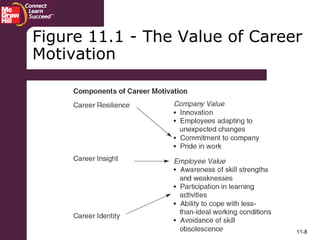
Career motivation refers to employees’:
energy to invest in their careers.
awareness of the direction they want their
careers to take.
ability to maintain energy and direction
despite barriers they may encounter.
11-8
Figure 11.1 - The Value of Career
Motivation
11-9
What is a Career?
It is the individual sequence of attitudes
and behavior associated with work-
related experiences and activities over
the span of the person’s life.
The concept of careers can be described:
as an advancement.
as a profession.
a lifelong sequence of jobs.
a lifelong sequence of role-related
experiences.
11-10
What is a Career? (cont.)
Protean career - based on self-direction
with the goal of psychological success in
one’s work.
Psychological success - the feeling of
pride and accomplishment that comes
from achieving life goals that are not
limited to achievements at work.
Psychological contract - the
expectations employers and employees
have about each other.
11-11
Table 11.1 - Comparison of
Traditional Career and Protean Career
11-12
Table 11.2 - Suggested Characteristics
of Different Generations of Employees
11-13
Table 11.2 - Suggested Characteristics of
Different Generations of Employees (cont.)
11-14
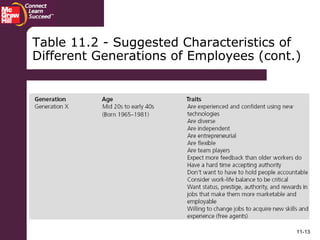
Table 11.2 - Suggested Characteristics of
Different Generations of Employees (cont.)
11-15
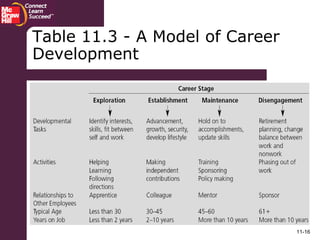
A Model of Career Development
Career development - process by which
employees progress through a series of
stages.
Each stage is characterized by a different set
of developmental tasks, activities, and
relationships.
Career development models:
Life-cycle models
Organization-based models
Directional pattern model
11-16
Table 11.3 - A Model of Career
Development
11-17
A Model of Career Development
(cont.)
Recycling - changing one’s major work
activity after having been established in a
specific field.
Career management system - helps
employees, managers, and the company
identify career development needs.
11-18
Career Management Systems
Self-assessment
Use of information by employees to determine
their career interests, values, aptitudes, and
behavioral tendencies.
Involves psychological tests.
Reality check
Information employees receive about how the
company evaluates their skills and knowledge
and where they fit into the company plans.
11-19
Career Management Systems
(cont.)
Goal setting
Employees develop short- and long-term
career objectives usually related to desired
positions, level of skill application, work
setting, or skill acquisition.
Action planning
Employees determine how they will achieve
their short- and long-term career goals.
May involve training courses and seminars,
informational interviews, employee
volunteerism programs, etc.
11-20
Table 11.5 - Design Factors of Effective
Career Management Systems
11-21
Table 11.6 - Elements of Career
Management Web Sites
11-22
Figure 11.4 – Shared Responsibility:
Roles in Career Management
11-23
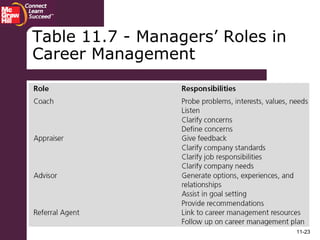
Table 11.7 - Managers’ Roles in
Career Management
11-24
Table 11.8 - Characteristics Of
Successful Career Discussions
11-25
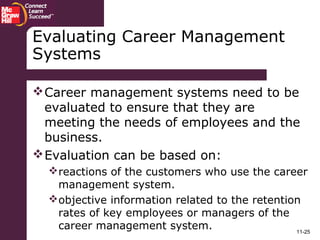
Evaluating Career Management
Systems
Career management systems need to be
evaluated to ensure that they are
meeting the needs of employees and the
business.
Evaluation can be based on:
reactions of the customers who use the career
management system.
objective information related to the retention
rates of key employees or managers of the
career management system.

Career Development

  • 1.
    Chapter 11 Careers andCareer Management Copyright © 2010 by the McGraw-Hill Companies, Inc. All rights reserved.McGraw-Hill/Irwin
  • 2.
    11-2 Introduction Career development isimportant for companies to create and sustain a continuous learning environment. The biggest challenge companies face is finding a balance between advancing current employees’ careers while simultaneously attracting and acquiring employees with new skills.
  • 3.
    11-3 Introduction (cont.) The conceptof careers is influenced by the growing use of teams to produce products and provide services. Project careers – a series of projects that may not be in the same company.
  • 4.
    11-4 Why is CareerManagement Important? It is the process through which employees: become aware of their own interests, values, strengths, and weaknesses. obtain information about job opportunities within the company. identify career goals. establish action plans to achieve career goals.
  • 5.
    11-5 Why is CareerManagement Important? (cont.) From the company’s perspective, the failure to motivate employees to plan their careers can result in: a shortage of employees to fill open positions. lower employee commitment. inappropriate use of monies allocated for training and development programs.
  • 6.
    11-6 Why is CareerManagement Important? (cont.) From the employees’ perspective, lack of career management can result in: frustration due to lack of personal growth and challenge at work. feelings of not being valued in the company. an inability to find suitable employment, in case of mergers, acquisitions, restructuring, or downsizing.
  • 7.
    11-7 Why is CareerManagement Important? (cont.) Career motivation refers to employees’: energy to invest in their careers. awareness of the direction they want their careers to take. ability to maintain energy and direction despite barriers they may encounter.
  • 8.
    11-8 Figure 11.1 -The Value of Career Motivation
  • 9.
    11-9 What is aCareer? It is the individual sequence of attitudes and behavior associated with work- related experiences and activities over the span of the person’s life. The concept of careers can be described: as an advancement. as a profession. a lifelong sequence of jobs. a lifelong sequence of role-related experiences.
  • 10.
    11-10 What is aCareer? (cont.) Protean career - based on self-direction with the goal of psychological success in one’s work. Psychological success - the feeling of pride and accomplishment that comes from achieving life goals that are not limited to achievements at work. Psychological contract - the expectations employers and employees have about each other.
  • 11.
    11-11 Table 11.1 -Comparison of Traditional Career and Protean Career
  • 12.
    11-12 Table 11.2 -Suggested Characteristics of Different Generations of Employees
  • 13.
    11-13 Table 11.2 -Suggested Characteristics of Different Generations of Employees (cont.)
  • 14.
    11-14 Table 11.2 -Suggested Characteristics of Different Generations of Employees (cont.)
  • 15.
    11-15 A Model ofCareer Development Career development - process by which employees progress through a series of stages. Each stage is characterized by a different set of developmental tasks, activities, and relationships. Career development models: Life-cycle models Organization-based models Directional pattern model
  • 16.
    11-16 Table 11.3 -A Model of Career Development
  • 17.
    11-17 A Model ofCareer Development (cont.) Recycling - changing one’s major work activity after having been established in a specific field. Career management system - helps employees, managers, and the company identify career development needs.
  • 18.
    11-18 Career Management Systems Self-assessment Useof information by employees to determine their career interests, values, aptitudes, and behavioral tendencies. Involves psychological tests. Reality check Information employees receive about how the company evaluates their skills and knowledge and where they fit into the company plans.
  • 19.
    11-19 Career Management Systems (cont.) Goalsetting Employees develop short- and long-term career objectives usually related to desired positions, level of skill application, work setting, or skill acquisition. Action planning Employees determine how they will achieve their short- and long-term career goals. May involve training courses and seminars, informational interviews, employee volunteerism programs, etc.
  • 20.
    11-20 Table 11.5 -Design Factors of Effective Career Management Systems
  • 21.
    11-21 Table 11.6 -Elements of Career Management Web Sites
  • 22.
    11-22 Figure 11.4 –Shared Responsibility: Roles in Career Management
  • 23.
    11-23 Table 11.7 -Managers’ Roles in Career Management
  • 24.
    11-24 Table 11.8 -Characteristics Of Successful Career Discussions
  • 25.
    11-25 Evaluating Career Management Systems Careermanagement systems need to be evaluated to ensure that they are meeting the needs of employees and the business. Evaluation can be based on: reactions of the customers who use the career management system. objective information related to the retention rates of key employees or managers of the career management system.