INTRODUCTION
Planning isa deliberative, systematic phase of the
nursing process that involves decision making and
problem solving.
Planning build the bridge between where we are and
where we want to go.
4.
DEFINITION OF PLANNING:
Planning is a process of determining the objectives of
administrative effort and devising the means calculated
to achieve them.
-Millet
5.
Features of planning:
Planning is goal-oriented.
Intellectual process.
It involves choice and decision making.
Continuous process.
All pervasive.
Designed for efficiency.
It is flexible.
6.
Strategic planning
INTRODUCTION:
Eachorganization involves in decision making to meet the
long-term and short-term goals.
These decision generates imperative, functional, and
management plans, which are important to formulates policy,
procedure, methods, rules, projects, and standards.
Strategic planning is essential to manage the organization
effectively and also to start up a new venture.
7.
DEFINITION:
strategic planningin nursing is a systematic approach, and
co-operative effort between the nursing department and the
organization to decide to promote and improve nursing
practice.
-Jogindra vati.
8.
Purposes of strategicplanning:
To utilize available resources.
To manage the performance of the department.
To acquire and develop new practices
To improve the goals, values and communication.
To bring changes in operations, management and organization.
9.
Importance of strategicplanning:
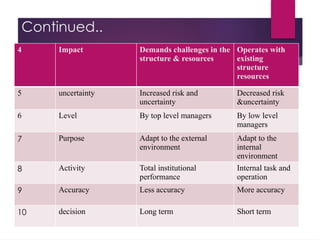
Strategic planning is useful to improve the nursing management in the
following ways:
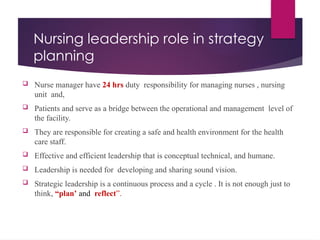
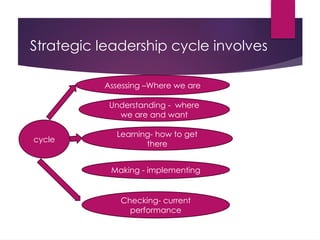
It provides accountability and monitoring performance
It helps in setting a planning program.
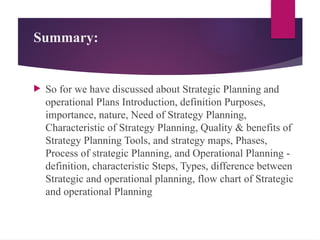
It integrates strategic planning with operational and financial plans.
It concentrates more on strategic issues.
It improves knowledge and skills in strategic planning.
10.
Continued…
It enhancesco ordination among nursing managers. And
organization administrator.
It allows better execution of plans.
It is more realistic and rational.
It anticipates the future.
It develops an annual budget.
It focuses on quality outputs to improve performance and care.
11.
Nature of strategicplanning:
A strategy is an overall approach and plan.
Facilitates the good management of a process.
Day-to-day activities.
It provides you with the big picture.
It is a road map to lead on organization from where it is now
to where it would like to be in 5 (or) 10 years.
12.
Need of strategicplanning:
If you fail to plan, then you plan to fail – be pro active about
the future.
Strategic planning improves performance.
Solve major issues at a macro level.
Communicate to everyone what is most important.
13.
Characteristic of strategicplanning:
Address critical performance issues.
Create the right balance between what the organization is capable
of doing vs. what the organization would like to do.
Cover a sufficient time period to close the performance gap.
Visionary-convey a desired future end state.
Flexible.
Guide decision making.
14.
Quality of strategicplanning:
Simple.
Written.
Clear.
Based enough time allowed to give, it a time to settle. It should
not be rushed.
Pushing the plans will cause problems.
15.
Principles of strategicplanning:
There are five principles of strategic planning's and they are as
follows:
The principle of action.
The principle of vision.
The principle of participation.
The principle of accountability.
The principle of sensitivity.
16.
Requirements of agood strategic planning
A sound plan should serve as a frame work for secure support and
approval.
It should provide a basic for more detailed planning
It should be simple , logical and practical
It should focus on matters of strategy importance.
Plan should be separated from day-to-day work.
It should be complete and integrated.
Plan should distinguish between cause and effect.
It should be in a written form.
Plan should capable of being controlled.
17.
Continued..
Plan shouldassist in bench marking and performance
monitoring.
It should stimulate change and become building block
for the next plan.
Plan should be realistic, critical and attainable.
18.
Benefits of strategyplanning:
It serves as the road map to the work.
It utilize the resources in best manner.
It responds to the environmental changes.
Decreases the changes of mistake.
Provides a framework for the communication.
Good behavior.
Basics for individual responsibilities.
Helps in encouragement.
19.
Continued..
Guide.
Goodtool for co-operation and thinking
Gives a picture of employees in an organization.
Elements of strategic plan:
Analysis.
Choice.
Implementation.
Evaluation.
20.
Strategic planning phase:
Planning the process.
Understanding the context.
Vision, values and mission discussion.
Review of strengths and weaknesses, opportunities and
threats.
Discussion of strategic options and goals.
Organizational structure.
21.
Tools of thestrategic planning:
SWOT analysis:
A swot analysis is a tool used to identify the strengths,
weaknesses, opportunities, and threats of an organization.
Strength and weaknesses are internal factors that create or
destroy values.
Opportunities and threats are external factors that create or
destroy values.
22.
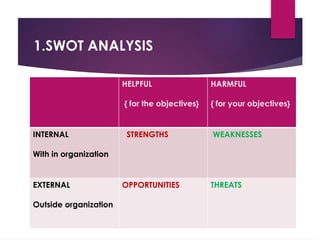
1.SWOT ANALYSIS
HELPFUL
{ forthe objectives}
HARMFUL
{ for your objectives}
INTERNAL
With in organization
STRENGTHS WEAKNESSES
EXTERNAL
Outside organization
OPPORTUNITIES THREATS
23.
2. Balanced scorecard:
Thebalance score card (BSc) is a strategic approach and performance
measurement analysis tool that enables organizations to translate a
company’s vision, mission, and strategy in to implementation.
The BSc operates from 4 basic perspectives:
Financial.
Customer.
Business process.
Learning and growth.
24.
Continued..
This enables anorganization to monitor their present
performance and analyze their position to perform in the future.
Financial:
To succeed financially how should we appear to our share
holders.
Productivity, sustained shareholders, revenue growth.
25.
Continued..
,
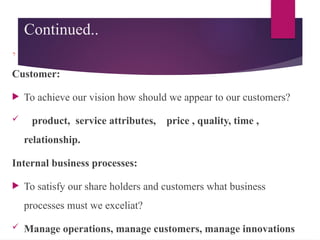
Customer:
To achieveour vision how should we appear to our customers?
product, service attributes, price , quality, time ,
relationship.
Internal business processes:
To satisfy our share holders and customers what business
processes must we exceliat?
Manage operations, manage customers, manage innovations
26.
Continued..
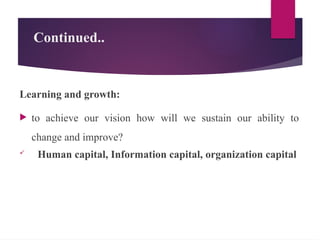
Learning and growth:
to achieve our vision how will we sustain our ability to
change and improve?
Human capital, Information capital, organization capital
27.
3. Strategy maps:
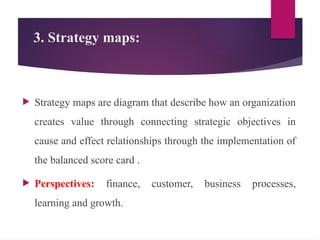
Strategy maps are diagram that describe how an organization
creates value through connecting strategic objectives in
cause and effect relationships through the implementation of
the balanced score card .
Perspectives: finance, customer, business processes,
learning and growth.
28.
The objectives ofstrategy maps are:
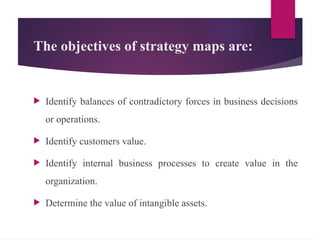
Identify balances of contradictory forces in business decisions
or operations.
Identify customers value.
Identify internal business processes to create value in the
organization.
Determine the value of intangible assets.
29.
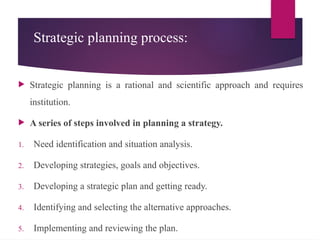
Strategic planning process:
Strategic planning is a rational and scientific approach and requires
institution.
A series of steps involved in planning a strategy.
1. Need identification and situation analysis.
2. Developing strategies, goals and objectives.
3. Developing a strategic plan and getting ready.
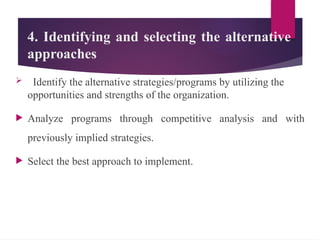
4. Identifying and selecting the alternative approaches.
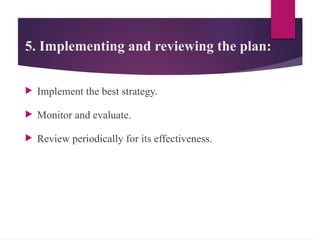
5. Implementing and reviewing the plan.
30.
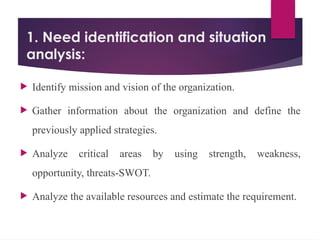
1. Need identificationand situation
analysis:
Identify mission and vision of the organization.
Gather information about the organization and define the
previously applied strategies.
Analyze critical areas by using strength, weakness,
opportunity, threats-SWOT.
Analyze the available resources and estimate the requirement.
31.
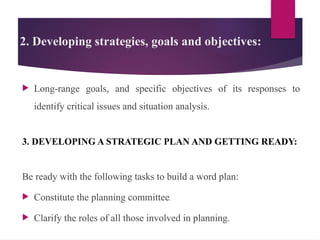
2. Developing strategies,goals and objectives:
Long-range goals, and specific objectives of its responses to
identify critical issues and situation analysis.
3. DEVELOPING A STRATEGIC PLAN AND GETTING READY:
Be ready with the following tasks to build a word plan:
Constitute the planning committee.
Clarify the roles of all those involved in planning.
32.
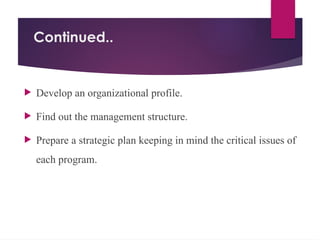
Continued..
Develop anorganizational profile.
Find out the management structure.
Prepare a strategic plan keeping in mind the critical issues of
each program.
33.
4. Identifying andselecting the alternative
approaches
Identify the alternative strategies/programs by utilizing the
opportunities and strengths of the organization.
Analyze programs through competitive analysis and with
previously implied strategies.
Select the best approach to implement.
34.
5. Implementing andreviewing the plan:
Implement the best strategy.
Monitor and evaluate.
Review periodically for its effectiveness.
35.
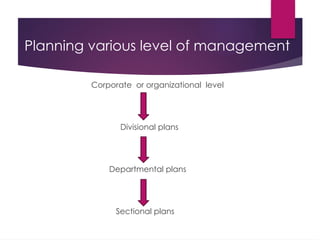
Planning various levelof management
Corporate or organizational level
Divisional plans
Departmental plans
Sectional plans
36.
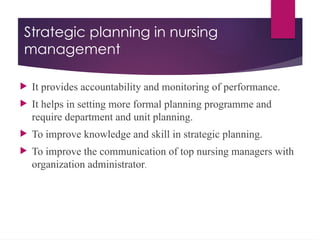
Strategic planning innursing
management
It provides accountability and monitoring of performance.
It helps in setting more formal planning programme and
require department and unit planning.
To improve knowledge and skill in strategic planning.
To improve the communication of top nursing managers with
organization administrator.
37.
Continued..
To allowbetter execution of plans.
To be more realistic and rational.
To anticipate future plan for it.
To develop annual budget.
To focus on quality outputs that will improve nurse
performance and productivity.
CONCEPT AND MEANING:
An operating plan includes the actions to achieve the set objectives.
The plan is a step-by-step process of achieving goals and objectives.
Goals of strategic and operational plans are the same, but they differ in
their objectives.
It includes planning for the budget, organizational structure ,quality
monitoring process, new programs, and directions to managers/leaders.
40.
Characteristics of OperationalPlanning:
Operating planning is a subset of strategic work
plan.
It describes short-term ways of achieving
milestones and explains how, or what portion of
Five year-strategic plan would need five operational
plans funded by five operating budgets.
41.
Continued..
Operational plansshould establish the activities and budgets
for each part of the organization.
The operational planning is both the first and the last step in
preparing an operating budget request.
Operational plans should be prepared by the people who will
be involved in implementation.
42.
Purposes of OperationalPlan:
To specify activities and procedures.
To set a time frame for achieving the objectives.
To allocate responsibilities to staff involved in a particular
business.
To prepare the team for taking up responsibility.
To specify the records to be kept and the policies needed.
43.
Operation plans shouldcontain:
Clear objectives.
Activities to be delivered
Quality standards
Desired outcomes
Staffing and resource requirements
Implementation Timetables
A Process for monitoring progress.
44.
Formulation of operationalplans:
Recognize the need for the operational plan
Collection of necessary information and facts
Laying down the objectives
Determine the knowledge, attitudinal behaviour, skills, and habits
levels of employees
Selection of team
Prepare time frame
45.
Continued..
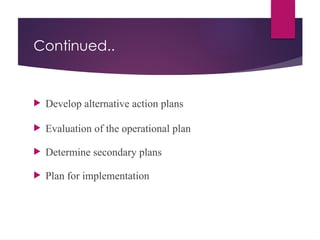
Develop alternativeaction plans
Evaluation of the operational plan
Determine secondary plans
Plan for implementation
46.
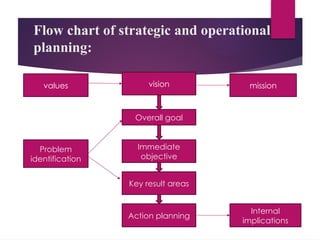
Flow chart ofstrategic and operational
planning:
values vision mission
Overall goal
Immediate
objective
Key result areas
Action planning
Problem
identification
Internal
implications
47.
Difference between strategicand
operation planning:
S.No Point of
distinction
Long term
[strategic plan]
Short term
plan(operational)
1 Time More than 5 years Up to 1 year
2 Deals with Vision, long term goals Mission,
current operations
3 Focus on Linkage with external
factors
Linkage with various
parts of organization
48.
Continued..
4 Impact Demandschallenges in the
structure & resources
Operates with
existing
structure
resources
5 uncertainty Increased risk and
uncertainty
Decreased risk
&uncertainty
6 Level By top level managers By low level
managers
7 Purpose Adapt to the external
environment
Adapt to the
internal
environment
8 Activity Total institutional
performance
Internal task and
operation
9 Accuracy Less accuracy More accuracy
10 decision Long term Short term
49.
Nursing leadership rolein strategy
planning
Nurse manager have 24 hrs duty responsibility for managing nurses , nursing
unit and,
Patients and serve as a bridge between the operational and management level of
the facility.
They are responsible for creating a safe and health environment for the health
care staff.
Effective and efficient leadership that is conceptual technical, and humane.
Leadership is needed for developing and sharing sound vision.
Strategic leadership is a continuous process and a cycle . It is not enough just to
think, “plan’ and reflect”.
50.
Strategic leadership cycleinvolves
cycle
Assessing –Where we are
Understanding - where
we are and want
Learning- how to get
there
Making - implementing
Checking- current
performance
51.
Summary:
So forwe have discussed about Strategic Planning and
operational Plans Introduction, definition Purposes,
importance, nature, Need of Strategy Planning,
Characteristic of Strategy Planning, Quality & benefits of
Strategy Planning Tools, and strategy maps, Phases,
Process of strategic Planning, and Operational Planning -
definition, characteristic Steps, Types, difference between
Strategic and operational planning, flow chart of Strategic
and operational Planning
52.
Conclusion
Strategic planningis an essential for any organization
aiming to secure long -term success. It provides direction ,
enhance decision making . Improves resources management,
and increase operational efficiency.
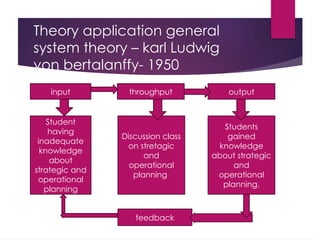
53.
Theory application general
systemtheory – karl Ludwig
von bertalanffy- 1950
input throughput output
Student
having
inadequate
knowledge
about
strategic and
operational
planning
Discussion class
on stretagic
and
operational
planning
Students
gained
knowledge
about strategic
and
operational
planning.
feedback
54.
Journal application
journal :
Internationaljournal of advanced nursing management 6 (1)
jan - march 2018.
Review article:
strategic planning ; future of an organization – A critical review.
Author: Mr. Rangappa .S. Asst professor , dept of child health
nursing.sdm institute of nursing sciences , sattur. Karnataka.
55.
Continued..
ABSTRACT:
Strategic planningis an organization’s process of defining its
strategy or direction and making decision on allocating its resources
to pursue this strategy.
Strategy includes processes of formulation and implementation,
strategic planning helps coordinate both.
Strategic planning provides inputs for strategic thinking , which
guides the actual strategic formation.
The end result is the organization’s strategy , including a diagnosis
of the environment and competitive situation, a guide policy on
what the organization intends to accomplish, and key initiatives or
action plans for achieving the guiding policy.
56.
Continued..
SWOT Analysisis an examination of organizations internal strength
and weaknesses, its opportunities for growth and development,
and the threats the external environment presents to its survival.
SWOT analysis view
strength as current factors that have prompted outstanding
organizational performance.
Weaknesses are organizational factors that will increase health care
costs or reduce health care quality.
SWOT analysis view opportunities as significant new business
initiatives available to a health care organization


![Difference between strategic and
operation planning:
S.No Point of
distinction
Long term
[strategic plan]
Short term
plan(operational)
1 Time More than 5 years Up to 1 year
2 Deals with Vision, long term goals Mission,
current operations
3 Focus on Linkage with external
factors
Linkage with various
parts of organization](https://image.slidesharecdn.com/strategyoprationalplanning-250926070439-0d3d431e/85/Strategy-Oprational-Planning-powerpoint-47-320.jpg)