LEVELS OF ORGANIZATION 
LIVING THINGS 
ECOSYSTEMS 
Identify levels of organization of 
living things in nature establishing 
intuitive relationships among them.
INTRODUCTION 
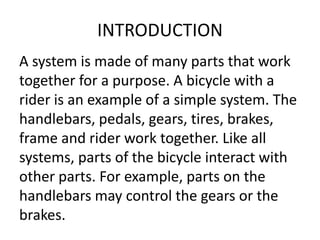
A system is made of many parts that work 
together for a purpose. A bicycle with a 
rider is an example of a simple system. The 
handlebars, pedals, gears, tires, brakes, 
frame and rider work together. Like all 
systems, parts of the bicycle interact with 
other parts. For example, parts on the 
handlebars may control the gears or the 
brakes.
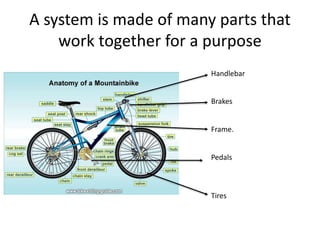
A system is made of many parts that 
work together for a purpose 
Handlebar 
Brakes 
Frame. 
Pedals 
Tires
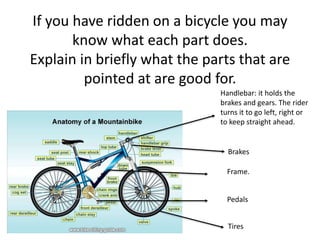
If you have ridden on a bicycle you may 
know what each part does. 
Explain in briefly what the parts that are 
pointed at are good for. 
Handlebar: it holds the 
brakes and gears. The rider 
turns it to go left, right or 
to keep straight ahead. 
Brakes 
Frame. 
Pedals 
Tires
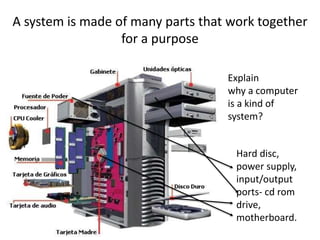
A system is made of many parts that work together 
for a purpose 
Explain 
why a computer 
is a kind of 
system? 
Hard disc, 
power supply, 
input/output 
ports- cd rom 
drive, 
motherboard.
QUESTION 
Which one is NOT an example of a system? 
A. School. 
B. Hospital. 
C. Airplane. 
D. River.
QUESTION 
• Explain why a hospital and an airplane are 
examples of systems? Give two reasons for 
each one. 
• Give two reasons to explain why a river is not 
an example of a system?
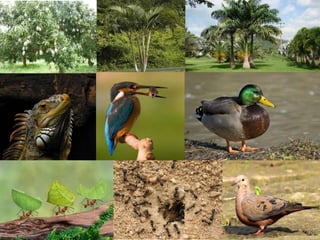
The next slide shows pictures of 
different organisms that can be seen or 
found at school. 
Every one has particular and unique 
characteristics. 
But no matter how different they are 
they belong to the same ecosystem and 
they are related to each other. 
Why do you think are there different 
kinds of animals and plants in nature?
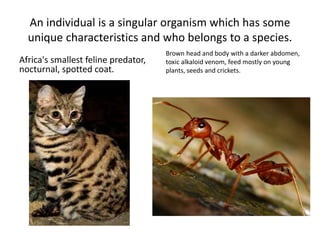
An individual is a singular organism which has some 
unique characteristics and who belongs to a species. 
Africa's smallest feline predator, 
nocturnal, spotted coat. 
Brown head and body with a darker abdomen, 
toxic alkaloid venom, feed mostly on young 
plants, seeds and crickets.
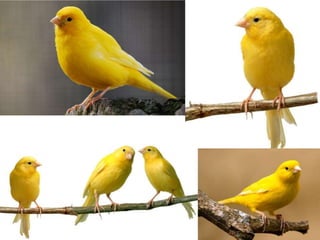
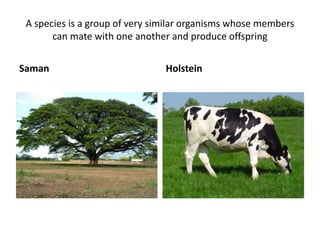
A species is a group of very similar organisms whose members 
can mate with one another and produce offspring 
Saman Holstein
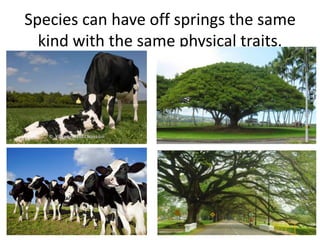
Species can have off springs the same 
kind with the same physical traits.
QUESTION 
What is the main characteristic of a species? 
A. It is a living thing. 
B. It does activities of life. 
C. Members can mate with one another and 
produce offspring the same kind. 
D. It is an organism.
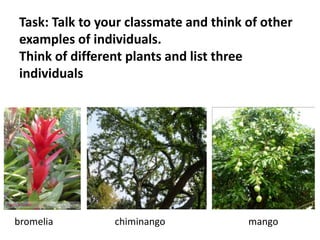
Task: Talk to your classmate and think of other 
examples of individuals. 
Think of different plants and list three 
individuals 
bromelia chiminango mango
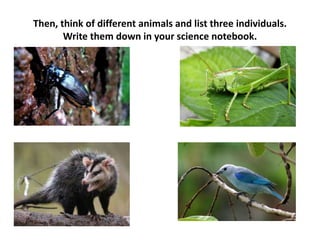
Then, think of different animals and list three individuals. 
Write them down in your science notebook.
QUESTION 
Which one is not a species? 
A. Tree 
B. Holstein 
C. Saguaro Cactus 
D. Gray Wolf
QUESTION 
What species cannot be found in Colombia? 
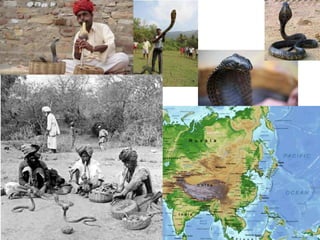
A. Cobra. 
B. Chiguiro. 
C. Titi monkey. 
D. Chiminango.
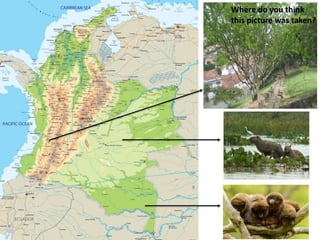
Where do you think 
this picture was taken?
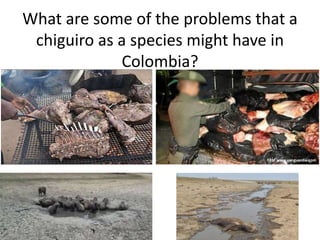
What are some of the problems that a 
chiguiro as a species might have in 
Colombia?
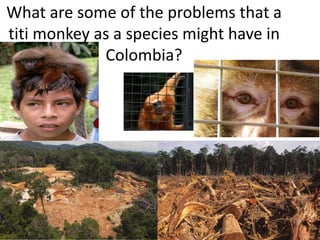
What are some of the problems that a 
titi monkey as a species might have in 
Colombia?
QUESTION 
TRUEOR FALSE 
In our country we can find all the species of 
animals that live in the world. 
Justify and explain your answer.
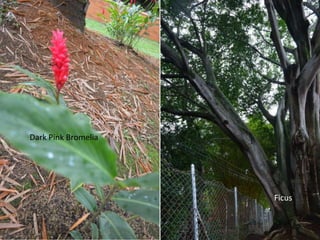
Dark Pink Bromelia 
Ficus
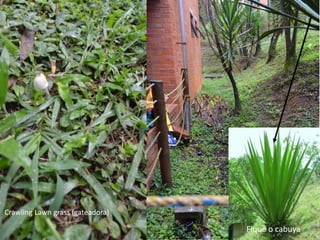
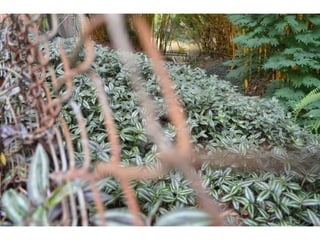
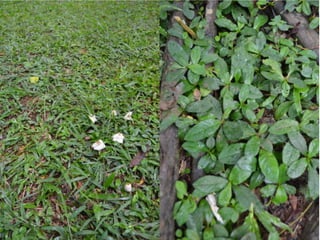
Crawling Lawn grass (gateadora) 
Fique o cabuya
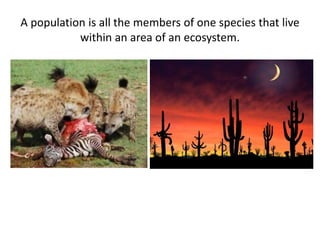
A population is all the members of one species that live 
within an area of an ecosystem.
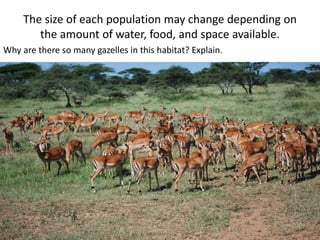
The size of each population may change depending on 
the amount of water, food, and space available. 
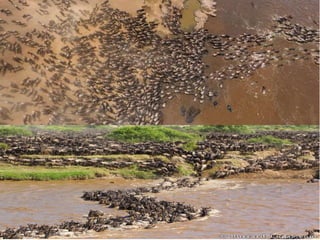
Why are there so many gazelles in this habitat? Explain.
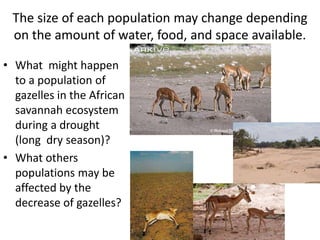
The size of each population may change depending 
on the amount of water, food, and space available. 
• What might happen 
to a population of 
gazelles in the African 
savannah ecosystem 
during a drought 
(long dry season)? 
• What others 
populations may be 
affected by the 
decrease of gazelles?
Task: You have 20 minutes to complete the next 
instruction. 
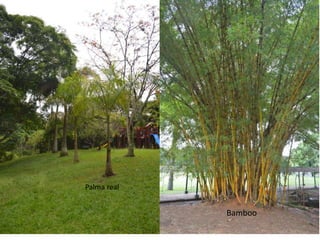
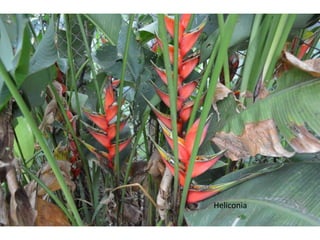
Go outside from your classroom to the places suggested 
by your teacher. Take a closer look at all of plants and 
animals (including tiny insects when possible). Identify 
and list two different populations of plants, two different 
populations of animals and two different populations of 
insects. 
Keep these tips when doing your observation: 
Is the population small, medium or large? 
Do you think the population has been always there or was 
it planted or brought to this ecosystem? 
Is the population surrounded by others populations or is 
the population isolated? 
Draw pictures of each population.
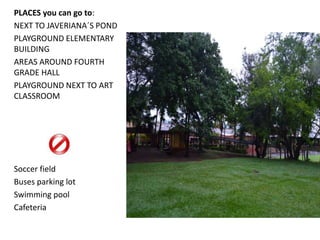
PLACES you can go to: 
NEXT TO JAVERIANA´S POND 
PLAYGROUND ELEMENTARY 
BUILDING 
AREAS AROUND FOURTH 
GRADE HALL 
PLAYGROUND NEXT TO ART 
CLASSROOM 
Soccer field 
Buses parking lot 
Swimming pool 
Cafeteria
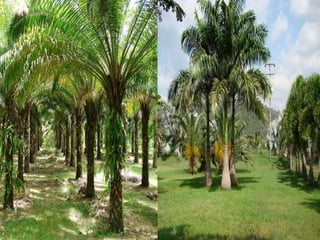
Palma real 
Bamboo
Heliconia
QUESTION 
Population is this context means: 
A. All people living together in a place. 
B. All the living things living together in a place. 
C. All the animals or plants living together in a 
place. 
D. All the members of one species living 
together in a place.
QUESTION 
What is not an example of population? 
A. All people living in my neighborhood. 
B. A sugarcane plantation. 
C. My pet. 
D. Many Barbary ducks (creole duck) in the 
Javeriana’s lake.
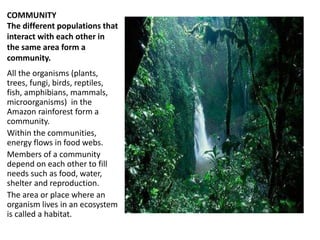
COMMUNITY 
The different populations that 
interact with each other in 
the same area form a 
community. 
All the organisms (plants, 
trees, fungi, birds, reptiles, 
fish, amphibians, mammals, 
microorganisms) in the 
Amazon rainforest form a 
community. 
Within the communities, 
energy flows in food webs. 
Members of a community 
depend on each other to fill 
needs such as food, water, 
shelter and reproduction. 
The area or place where an 
organism lives in an ecosystem 
is called a habitat.
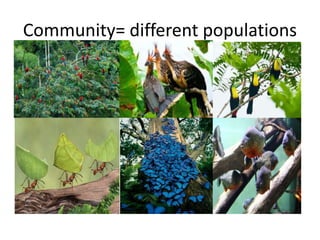
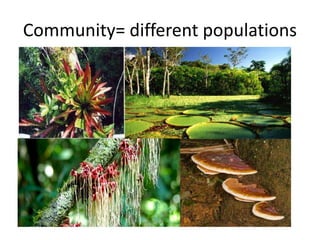
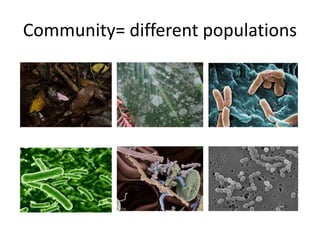
Community= different populations
QUESTION 
Which one is a particular characteristic of a 
community? 
A. All members depend on each other. 
B. Many organisms live together. 
C. It is the home of many species. 
D. It has many plants, animals, insects, birds, 
mammals and reptiles.
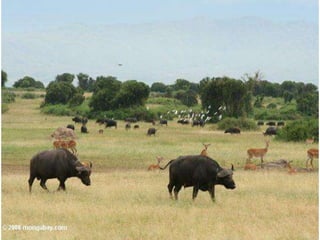
Task: 
Look at the slides showing a natural 
community. 
Identify with your classmate what 
different individuals/populations you may 
spot living together. 
Describe in what way they interact with 
each other and with the nonliving parts of 
the environment. 
Write your observations in your science 
notebook.
QUESTION 
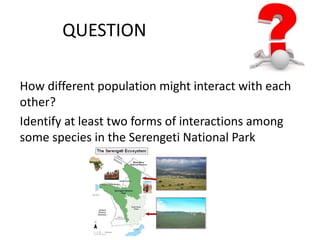
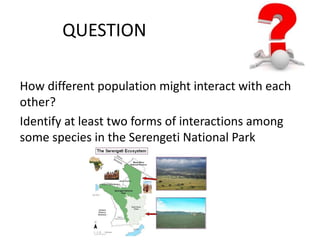
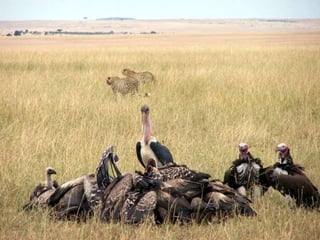
How different population might interact with each 
other? 
Identify at least two forms of interactions among 
some species in the Serengeti National Park
QUESTION 
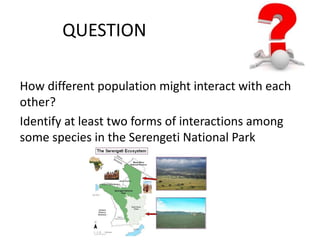
How different population might interact with each 
other? 
Identify at least two forms of interactions among 
some species in the Serengeti National Park
QUESTION 
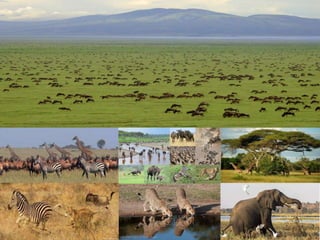
How different population might interact with each 
other? 
Identify at least two forms of interactions among 
some species in the Serengeti National Park
ECOSYSTEMS 
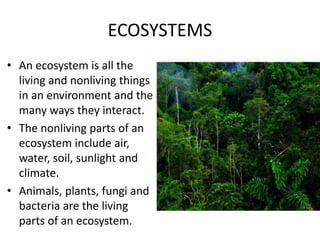
• An ecosystem is all the 
living and nonliving things 
in an environment and the 
many ways they interact. 
• The nonliving parts of an 
ecosystem include air, 
water, soil, sunlight and 
climate. 
• Animals, plants, fungi and 
bacteria are the living 
parts of an ecosystem.
ECOSYSTEMS 
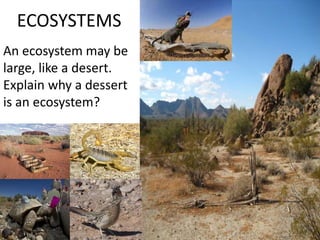
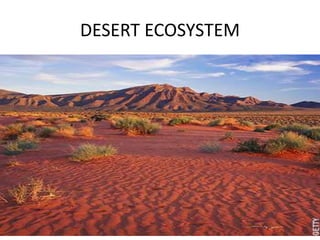
An ecosystem may be 
large, like a desert. 
Explain why a dessert 
is an ecosystem?
ECOSYSTEMS 
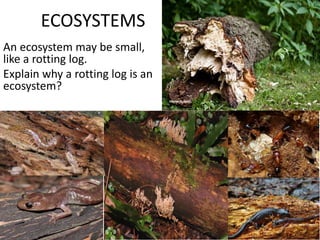
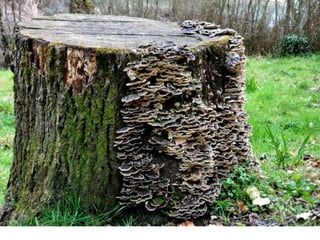
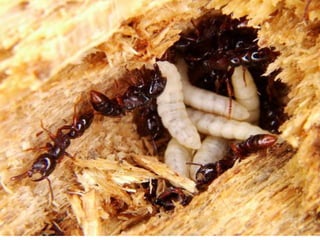
An ecosystem may be small, 
like a rotting log. 
Explain why a rotting log is an 
ecosystem?
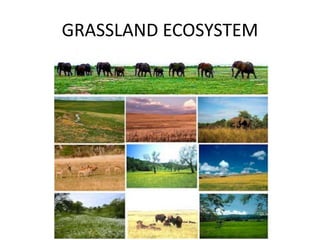
GRASSLAND ECOSYSTEM
DESERT ECOSYSTEM
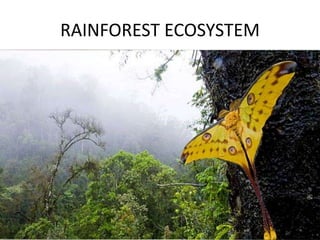
RAINFOREST ECOSYSTEM
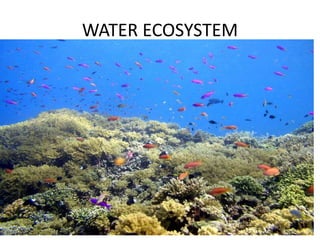
WATER ECOSYSTEM
LET’S OBSERVE AND ANALYZE 
OUR SCHOOL ECOSYSTEM 
• Task: Work with your 
closest classmate on this 
question: 
• What are the living and 
nonliving things in your 
school? Explain and 
write: how living things 
(everyone who works in 
the school) use nonliving 
things to interact and 
meet students needs at 
school? 
• Talk to your closest 
classmate and think of 
three different ways 
organism interact with 
each other and with 
nonliving parts in the 
Javeriana´s pond: water 
ecosystem. 
• Describe and explain 
how they interact. Write 
conclusions down in your 
science notebook.
Levels of organization 2

Levels of organization 2

  • 1.
    LEVELS OF ORGANIZATION LIVING THINGS ECOSYSTEMS Identify levels of organization of living things in nature establishing intuitive relationships among them.
  • 2.
    INTRODUCTION A systemis made of many parts that work together for a purpose. A bicycle with a rider is an example of a simple system. The handlebars, pedals, gears, tires, brakes, frame and rider work together. Like all systems, parts of the bicycle interact with other parts. For example, parts on the handlebars may control the gears or the brakes.
  • 3.
    A system ismade of many parts that work together for a purpose Handlebar Brakes Frame. Pedals Tires
  • 4.
    If you haveridden on a bicycle you may know what each part does. Explain in briefly what the parts that are pointed at are good for. Handlebar: it holds the brakes and gears. The rider turns it to go left, right or to keep straight ahead. Brakes Frame. Pedals Tires
  • 5.
    A system ismade of many parts that work together for a purpose Explain why a computer is a kind of system? Hard disc, power supply, input/output ports- cd rom drive, motherboard.
  • 6.
    QUESTION Which oneis NOT an example of a system? A. School. B. Hospital. C. Airplane. D. River.
  • 7.
    QUESTION • Explainwhy a hospital and an airplane are examples of systems? Give two reasons for each one. • Give two reasons to explain why a river is not an example of a system?
  • 8.
    The next slideshows pictures of different organisms that can be seen or found at school. Every one has particular and unique characteristics. But no matter how different they are they belong to the same ecosystem and they are related to each other. Why do you think are there different kinds of animals and plants in nature?
  • 12.
    An individual isa singular organism which has some unique characteristics and who belongs to a species. Africa's smallest feline predator, nocturnal, spotted coat. Brown head and body with a darker abdomen, toxic alkaloid venom, feed mostly on young plants, seeds and crickets.
  • 13.
    A species isa group of very similar organisms whose members can mate with one another and produce offspring Saman Holstein
  • 14.
    Species can haveoff springs the same kind with the same physical traits.
  • 15.
    QUESTION What isthe main characteristic of a species? A. It is a living thing. B. It does activities of life. C. Members can mate with one another and produce offspring the same kind. D. It is an organism.
  • 16.
    Task: Talk toyour classmate and think of other examples of individuals. Think of different plants and list three individuals bromelia chiminango mango
  • 17.
    Then, think ofdifferent animals and list three individuals. Write them down in your science notebook.
  • 18.
    QUESTION Which oneis not a species? A. Tree B. Holstein C. Saguaro Cactus D. Gray Wolf
  • 19.
    QUESTION What speciescannot be found in Colombia? A. Cobra. B. Chiguiro. C. Titi monkey. D. Chiminango.
  • 20.
    Where do youthink this picture was taken?
  • 22.
    What are someof the problems that a chiguiro as a species might have in Colombia?
  • 23.
    What are someof the problems that a titi monkey as a species might have in Colombia?
  • 24.
    QUESTION TRUEOR FALSE In our country we can find all the species of animals that live in the world. Justify and explain your answer.
  • 25.
  • 26.
    Crawling Lawn grass(gateadora) Fique o cabuya
  • 27.
    A population isall the members of one species that live within an area of an ecosystem.
  • 28.
    The size ofeach population may change depending on the amount of water, food, and space available. Why are there so many gazelles in this habitat? Explain.
  • 30.
    The size ofeach population may change depending on the amount of water, food, and space available. • What might happen to a population of gazelles in the African savannah ecosystem during a drought (long dry season)? • What others populations may be affected by the decrease of gazelles?
  • 31.
    Task: You have20 minutes to complete the next instruction. Go outside from your classroom to the places suggested by your teacher. Take a closer look at all of plants and animals (including tiny insects when possible). Identify and list two different populations of plants, two different populations of animals and two different populations of insects. Keep these tips when doing your observation: Is the population small, medium or large? Do you think the population has been always there or was it planted or brought to this ecosystem? Is the population surrounded by others populations or is the population isolated? Draw pictures of each population.
  • 32.
    PLACES you cango to: NEXT TO JAVERIANA´S POND PLAYGROUND ELEMENTARY BUILDING AREAS AROUND FOURTH GRADE HALL PLAYGROUND NEXT TO ART CLASSROOM Soccer field Buses parking lot Swimming pool Cafeteria
  • 33.
  • 34.
  • 37.
    QUESTION Population isthis context means: A. All people living together in a place. B. All the living things living together in a place. C. All the animals or plants living together in a place. D. All the members of one species living together in a place.
  • 38.
    QUESTION What isnot an example of population? A. All people living in my neighborhood. B. A sugarcane plantation. C. My pet. D. Many Barbary ducks (creole duck) in the Javeriana’s lake.
  • 39.
    COMMUNITY The differentpopulations that interact with each other in the same area form a community. All the organisms (plants, trees, fungi, birds, reptiles, fish, amphibians, mammals, microorganisms) in the Amazon rainforest form a community. Within the communities, energy flows in food webs. Members of a community depend on each other to fill needs such as food, water, shelter and reproduction. The area or place where an organism lives in an ecosystem is called a habitat.
  • 40.
  • 41.
  • 42.
  • 43.
    QUESTION Which oneis a particular characteristic of a community? A. All members depend on each other. B. Many organisms live together. C. It is the home of many species. D. It has many plants, animals, insects, birds, mammals and reptiles.
  • 44.
    Task: Look atthe slides showing a natural community. Identify with your classmate what different individuals/populations you may spot living together. Describe in what way they interact with each other and with the nonliving parts of the environment. Write your observations in your science notebook.
  • 45.
    QUESTION How differentpopulation might interact with each other? Identify at least two forms of interactions among some species in the Serengeti National Park
  • 47.
    QUESTION How differentpopulation might interact with each other? Identify at least two forms of interactions among some species in the Serengeti National Park
  • 49.
    QUESTION How differentpopulation might interact with each other? Identify at least two forms of interactions among some species in the Serengeti National Park
  • 51.
    ECOSYSTEMS • Anecosystem is all the living and nonliving things in an environment and the many ways they interact. • The nonliving parts of an ecosystem include air, water, soil, sunlight and climate. • Animals, plants, fungi and bacteria are the living parts of an ecosystem.
  • 52.
    ECOSYSTEMS An ecosystemmay be large, like a desert. Explain why a dessert is an ecosystem?
  • 53.
    ECOSYSTEMS An ecosystemmay be small, like a rotting log. Explain why a rotting log is an ecosystem?
  • 56.
  • 57.
  • 58.
  • 59.
  • 60.
    LET’S OBSERVE ANDANALYZE OUR SCHOOL ECOSYSTEM • Task: Work with your closest classmate on this question: • What are the living and nonliving things in your school? Explain and write: how living things (everyone who works in the school) use nonliving things to interact and meet students needs at school? • Talk to your closest classmate and think of three different ways organism interact with each other and with nonliving parts in the Javeriana´s pond: water ecosystem. • Describe and explain how they interact. Write conclusions down in your science notebook.