Presentation On
Level of Measurement
Asif Bin Alam Seum
Dept. of Geography And Environment
Shahjalal University of Science and Technology, Sylhet
What is Measurement?
 Scales of measurement refer to ways in which variables /
numbers of are defined and categorized.
 An event is measured in terms of its duration
 For what happened, one uses some system to classify types of
activities that occurred.
Level of Measurement
 Level of measurement or scale of measure is a classification
that describes the nature of information within the values
assigned to variables.
 The level of measurement refers to the relationship among
the values that are assigned to the attributes for a variable.
Levels of Measurement
Nominal
Ordinal
Interval
Ratio
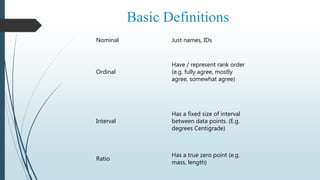
Nominal Just names, IDs
Ordinal
Have / represent rank order
(e.g. fully agree, mostly
agree, somewhat agree)
Interval
Has a fixed size of interval
between data points. (E.g.
degrees Centigrade)
Ratio
Has a true zero point (e.g.
mass, length)
Basic Definitions
Nominal
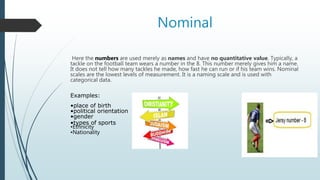
Here the numbers are used merely as names and have no quantitative value. Typically, a
tackle on the football team wears a number in the 8. This number merely gives him a name.
It does not tell how many tackles he made, how fast he can run or if his team wins. Nominal
scales are the lowest levels of measurement. It is a naming scale and is used with
categorical data.
Examples:
•place of birth
•political orientation
•gender
•types of sports
•Ethnicity
•Nationality
Ordinal
This scale has the characteristic of the nominal scale in that different numbers
mean different things, but also has the characteristic of "greater or lesser".
It measures a variable in terms of magnitude, or rank.
Example:
•socioeconomic
•class
•grades
•preferences
Ordinal scales tell us relative order, but give us no information regarding
differences between the categories. For example, runners in the 100 meter
dash finish 1st, 2nd, 3rd etc. Is the number of seconds between 1st and
2nd place the same as those between 2nd and 3rd place? Certainly not
necessarily.
Interval
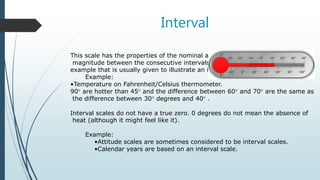
This scale has the properties of the nominal and ordinal scales, but here the
magnitude between the consecutive intervals are equal. Temperature is the
example that is usually given to illustrate an interval scale.
Example:
•Temperature on Fahrenheit/Celsius thermometer.
90° are hotter than 45° and the difference between 60° and 70° are the same as
the difference between 30° degrees and 40° .
Interval scales do not have a true zero. 0 degrees do not mean the absence of
heat (although it might feel like it).
Example:
•Attitude scales are sometimes considered to be interval scales.
•Calendar years are based on an interval scale.
Ratio
Ratio scales have all of the characteristics of the nominal, ordinal and
interval scales. In addition, however, ratio scales have a true zero. This is the
kind
of scale that you used when you learned arithmetic in grade school. You
assumed
that the numbers had meaning, that they had rank order (3 is larger than 2),
that the intervals between the consecutive numbers were equal and that there
was a zero. Four was twice two; eight was half of sixteen etc. There are true
ratios. One can use all mathematical operations on this scale.
Examples:
•weight
•height
•time
•distance
* 10 miles is twice as long as 5 miles. 0 miles is no distance.

Level of-measurement

  • 1.
    Presentation On Level ofMeasurement Asif Bin Alam Seum Dept. of Geography And Environment Shahjalal University of Science and Technology, Sylhet
  • 2.
    What is Measurement? Scales of measurement refer to ways in which variables / numbers of are defined and categorized.  An event is measured in terms of its duration  For what happened, one uses some system to classify types of activities that occurred.
  • 3.
    Level of Measurement Level of measurement or scale of measure is a classification that describes the nature of information within the values assigned to variables.  The level of measurement refers to the relationship among the values that are assigned to the attributes for a variable.
  • 4.
  • 5.
    Nominal Just names,IDs Ordinal Have / represent rank order (e.g. fully agree, mostly agree, somewhat agree) Interval Has a fixed size of interval between data points. (E.g. degrees Centigrade) Ratio Has a true zero point (e.g. mass, length) Basic Definitions
  • 6.
    Nominal Here the numbersare used merely as names and have no quantitative value. Typically, a tackle on the football team wears a number in the 8. This number merely gives him a name. It does not tell how many tackles he made, how fast he can run or if his team wins. Nominal scales are the lowest levels of measurement. It is a naming scale and is used with categorical data. Examples: •place of birth •political orientation •gender •types of sports •Ethnicity •Nationality
  • 7.
    Ordinal This scale hasthe characteristic of the nominal scale in that different numbers mean different things, but also has the characteristic of "greater or lesser". It measures a variable in terms of magnitude, or rank. Example: •socioeconomic •class •grades •preferences Ordinal scales tell us relative order, but give us no information regarding differences between the categories. For example, runners in the 100 meter dash finish 1st, 2nd, 3rd etc. Is the number of seconds between 1st and 2nd place the same as those between 2nd and 3rd place? Certainly not necessarily.
  • 8.
    Interval This scale hasthe properties of the nominal and ordinal scales, but here the magnitude between the consecutive intervals are equal. Temperature is the example that is usually given to illustrate an interval scale. Example: •Temperature on Fahrenheit/Celsius thermometer. 90° are hotter than 45° and the difference between 60° and 70° are the same as the difference between 30° degrees and 40° . Interval scales do not have a true zero. 0 degrees do not mean the absence of heat (although it might feel like it). Example: •Attitude scales are sometimes considered to be interval scales. •Calendar years are based on an interval scale.
  • 9.
    Ratio Ratio scales haveall of the characteristics of the nominal, ordinal and interval scales. In addition, however, ratio scales have a true zero. This is the kind of scale that you used when you learned arithmetic in grade school. You assumed that the numbers had meaning, that they had rank order (3 is larger than 2), that the intervals between the consecutive numbers were equal and that there was a zero. Four was twice two; eight was half of sixteen etc. There are true ratios. One can use all mathematical operations on this scale. Examples: •weight •height •time •distance * 10 miles is twice as long as 5 miles. 0 miles is no distance.