Rev Bras Hematol Hemoter. 2012;34(2):165-7 165
Acute lymphoblastic leukemia of childhood presenting as aplastic anemia:
report of two cases
Department of Hematology, Internal
Medicine Division, Hospital Universitario
"Dr. José Eleuterio González", Facultad de
Medicina, Universidad Autónoma de
Nuevo León – UANL, Monterrey, Mexico
Laura Villarreal-Martínez
José Carlos Jaime-Pérez
Marisol Rodríguez-Martínez
Oscar González-Llano
David Gómez-Almaguer
Acute lymphoblastic leukemia is the most common malignancy in pediatric patients; its diagnosis is
usually easy to establish as malignant lymphoblasts invade the bone marrow and peripheral blood.
Some acute lymphoblastic leukemia patients may initially present with pancytopenia and a hypoplastic
bone marrow leading to the initial diagnosis of aplastic anemia. In most of these patients clinical
improvement occurs, with normalization of the complete blood count within six months, although
recovery can also develop a few weeks after initiating steroid therapy. The etiologic relationship
between the aplastic anemia features and the subsequent overt development of acute lymphoblastic
leukemia has not been established. We describe the cases of two children who presented with severe
infection and signs and symptoms of aplastic anemia confirmed by bone marrow aspirate and bone
marrow biopsy that developed acute lymphoblastic leukemia thereafter. No specific therapy for
aplastic anemia was administered, nevertheless a full spontaneous recovery was observed in both
cases. Acute lymphoblastic leukemia was successfully treated with standard chemotherapy, both
children remaining in complete remission 16 and 17 months after their initial aplastic anemia
diagnosis.
Keywords: Acute lymphoblastic leukemia; Aplastic anemia; Pediatrics
Introduction
Acute lymphoblastic leukemia (ALL) is the most common malignancy in pediatric
patients; malignant white blood cells continuously multiply leading to an excess of
lymphoblasts in the peripheral blood and the bone marrow.(1)
In most children the symptoms
arise as a result of the deviation from the normal hematopoietic processes into the
production of immature leukocytes, leading to bicytopenia accompanied by leukocytosis.
Some patients may initially present with pancytopenia and a hypoplastic bone marrow
suggesting the diagnosis of aplastic anemia (AA).(2)
This aplasia is transient and occurs
in about 2% of pediatric ALL cases and is thus considered a preleukemic condition.(3)
In
most of these children an apparent clinical improvement occurs with recovery of the cell
count within six months after the initial diagnosis of AA or suddenly a few weeks after
initiating steroid therapy.(1)
The etiologic relationship between the AA features and the subsequent overt
manifestations ofALLis not well established and it remains unclear whether the leukemic
process follows the aplasia or if it is already present at the diagnosis of AA. The precise
initial event leading toALL remains unidentified, some studies show data supporting the
idea that ALL develops by the acquisition of chromosomal abnormalities, mostly during
fetal hematopoiesis, resulting in a subclinical preleukemic clone, and/or postnatal
secondary genetic changes.(4)
The need remains to elucidate the circumstances under
which preleukemic clones might evolve to an overt ALL, considering the possibility that
these clones acting as a pool for leukemic relapses.
Clinical cases
Case 1
A five-year-old male without relevant preexisting clinical conditions presented with
perianal pain and fever of 5 days of evolution.At physical examination general pallor and
a perianal abscess were noted. Initial complete blood count (CBC) included hemoglobin
(Hb) of 5.0 g/dL, leukocytes of 0.209 x 10⁹
/L, neutrophils of 0.006 x 10⁹
/L, and a platelet
count of 4.9 x 10⁹
/L (Table 1). A bone marrow biopsy (BMB) and bone marrow aspirate
Conflict-of-interest disclosure:
The authors declare no competing
financial interest
Submitted: 12/12/2011
Accepted: 1/29/2012
Corresponding author:
Jose Carlos Jaime-Pérez
Department of Hematology, Internal
Medicine Division "Dr. José Eleuterio
González", University Hospital of the School
of Medicine of the Universidad Autónoma
de Nuevo León
Hospital Universitario "Dr. José E. González,
Edificio "Dr. Rodrigo Barragán", 2° piso
Avenida Madero y Gonzalitos S/N,
Colonia Mitras Centro
64460 Monterrey, Nuevo León, México
Phone: 52 (81) 1257-2905 ex 06
carjaime@hotmail.com
www.rbhh.org or www.scielo.br/rbhh
DOI: 10.5581/1516-8484.20120037
Case Report
166 Rev Bras Hematol Hemoter. 2012;34(2):165-7
Villarreal-Martínez l, Jaime-Pérez JC, Rodríguez-Martínez M, González-Llano O, Gómez-Almaguer D
(BMA) were performed finding a severely hypoplastic
bone marrow without the presence of malignant cells. The
patient was diagnosed withAAand his infection was treated
with 20 mg/kg/day of meropenem (t.i.d.) and vancomycin at
60 mg/kg/day (q.i.d.) for 10 days; he was transfused with
two red blood cell (RBC) units and six platelet concentrate
units. The patient did not receive steroids initially due to his
infection and a pending pathology report; Escherichia coli
was finally isolated from the abscess culture. Seven days
after starting treatment the CBC values showed marked
improvement reaching clinical recovery three weeks after the
initial diagnosis without further need of steroid therapy. The
patient was discharged and followed-up with no further
treatment needed. Three months after full recovery, sudden
worsening of his general condition developed and a CBC
showing Hb of 15.3 g/dL, leukocytes of 83.07 x 10⁹
/L with
80% of peripheral blasts, neutrophils of 37.85 x 10⁹
/L and a
platelet count of 121.0 x 10⁹
/L. The immunophenotype
corresponded to a B cell population. Standard therapy for
ALL was started; the induction regimen included prednisone
60 mg/m2
/day divided (t.i.d - days 1-29), vincristine 1.5 mg/m2
IV (days 8, 15, 22, 29), L-asparaginase 6000 U/m2
IM 3 times/
week (M,W,F) for nine total doses (starting day 8), cytarabine
75 mg/m2
IV/SQ (days 29-32 and 36-39), intratecal (IT)
methotrexate 12 mg (days 1, 8, 29) and adriamycin 25 mg/m2
IV (days 1, 8, 15 - used only for the delayed induction
regimen for ALL children). The consolidation scheme
included vincristine 1.5 mg/m2
IV (day 1), 6-mercaptopurine
75 mg/m2
/day (days 1-28), and methotrexate 50 g/m2
IV (days
1, 8, 15, and 22). The patient achieved complete remission
(CR) without major complications and remains on
maintenance with dexamethasone 6 mg/m2
/day divided
(b.i.d. - days1-5,29-33,57-61),vincristine1.5mg/m2
IV (days
1, 29, 57), 6-mercaptopurine 75 mg/m2
/day (days 1-84), and
methotrexate 20 mg/m2
p.o. weekly (starting day 1).After one
year of follow up his current CBC consists of Hb 14.1 g/dL,
leukocytes 6.85 x 10⁹
/L with BMA negative for the presence
of blasts, neutrophils 3.67 x 10⁹
/L and platelets 241.0 x 10⁹
/L.
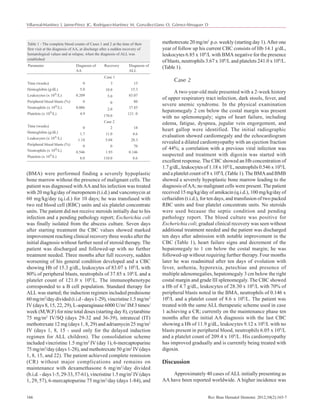
(Table 1).
Case 2
A two-year-old male presented with a 2-week history
of upper respiratory tract infection, dark stools, fever, and
severe anemic syndrome. In the physical examination
hepatomegaly 2 cm below the costal margin was present
with no splenomegaly; signs of heart failure, including
edema, fatigue, dyspnea, jugular vein engorgement, and
heart gallop were identified. The initial radiographic
evaluation showed cardiomegaly and the echocardiogram
revealed a dilated cardiomyopathy with an ejection fraction
of 44%; a correlation with a previous viral infection was
suspected and treatment with digoxin was started with
excellent response. The CBC showed an Hb concentration of
1.7 g/dL, leukocytes of 1.18 x 10⁹
/L, neutrophils 0.546 x 10⁹
/L
and a platelet count of 8 x 10⁹
/L(Table 1).The BMAandBMB
showed a severely hypoplastic bone marrow leading to the
diagnosis ofAA; no malignant cells were present. The patient
received 15 mg/kg/day of amikacin (q.i.d.), 100 mg/kg/day of
ceftazidim (t.i.d.), for ten days, and transfusion of two packed
RBC units and four platelet concentrate units. No steroids
were used because the septic condition and pending
pathology report. The blood culture was positive for
Escherichia coli; gradual clinical recovery was seen without
additional treatment needed and the patient was discharged
ten days after admission with notable improvement in the
CBC (Table 1), heart failure signs and decrement of the
hepatomegaly to 1 cm below the costal margin; he was
followed-up without requiring further therapy. Four months
later he was readmitted after ten days of evolution with
fever, asthenia, hyporexia, petechiae and presence of
multiple adenomegalies, hepatomegaly 3 cm below the right
costal margin and grade III splenomegaly. The CBC showed
a Hb of 4.7 g/dL, leukocytes of 28.30 x 10⁹
/L with 70% of
peripheral blasts noted in the BMA, neutrophils of 0.146 x
109
/L and a platelet count of 8.6 x 10⁹
/L. The patient was
treated with the same ALL therapeutic scheme used in case
1 achieving a CR; currently on the maintenance phase ten
months after the initial AA diagnosis with the last CBC
showing a Hb of 11.9 g/dL, leukocytes 9.12 x 10⁹
/L with no
blasts present in peripheral blood, neutrophils 6.05 x 10⁹
/L
and a platelet count of 209.4 x 10⁹
/L. His cardiomyopathy
has improved gradually and is currently being treated with
digoxin.
Discussion
Approximately 40 cases of ALL initially presenting as
AA have been reported worldwide. A higher incidence was
Rev Bras Hematol Hemoter. 2012;34(2):165-7 167
noted for women and younger children (< 10 years); in the
largest publication available involving 22 patients, ALL
appeared after the sudden recuperation of the CBC, with 95%
of cases progressing to ALL within six months of initial
diagnosis.(5)
A common factor between our two cases and
previous studies was the antecedent of a viral or bacterial
infection prior to the AA presentation. Reports of ALL
remission associated to an infection have been published,
although the mechanism has not been established.(6)
Possible
explanations include a clonal disruption with a real
preleukemic status, coexistence of a severe bacterial or viral
infection, increased levels of endogenous corticosteroids that
temporarily halt lymphoblastic proliferation and exposure to
exogenous toxins.(7)
Flow cytometry studies for both our patients reported
a B cell population at the time of ALL diagnosis. One
publication has reported a similar case in an adult where the
molecular detection of monoclonality in the BMA was made
for both the period of AA and at diagnosis of ALL.(8)
Cytogenetic studies may not be useful because at this early
stage there is insufficient mitosis and abnormalities may result
without being clinically relevant to the later history of the
AA. Nevertheless, studies of molecular rearrangements for
immunoglobulins or T cell receptors are very sensitive in the
detection of a leukemic clone at a stage whenALLcannot be
diagnosed by other methods.(9)
A retrospective study
detected the presence of the ETV6-RUNX1 fusion in the BMA
during the aplastic phase, identifying the leukemic genotype
on the aplasia preceding clinical ALL and suggesting that
multiple secondary genetic abnormalities can contribute to a
dominant subclone several months before a diagnosis of
ALL.(4)
The detection of this fusion would require a directed
search during the aplastic stage preceding the symptoms of
ALL to identify the leukemic clone allowing the subsequent
opportune treatment in the preleukemic stage for this form of
ALL presentation.
In most of these previous reports, steroid therapy was
administered thus probably leading to a partial remission of
ALL.(5)
In our two patients, therapy was directed only to the
infectious episode, with simultaneous administration of blood
products, no anabolic steroids were given and no specific
treatment for the AA was administered; clinical and
hematological improvement occurred. This leads us to
hypothesize that spontaneous recovery of the aplastic bone
marrow could be part of the natural history of this form of
ALL presentation. The hypoplastic bone marrow may be a
result of an immunological reaction triggered by the presence
of leukemic cells to control the leukemic clone proliferation;
these cells may produce lymphokines that attack normal
hematoprogenitor cells.(9)
These mechanisms could play a
role in explaining the spontaneous recovery of pancytopenia
in patients who later develop full blownALL.
References
1. Homans AC, Cohen JL, Barker BE, Mazur EM. Aplastic presentation
of acute lymphoblastic leukemia: evidence for cellular inhibition
of normal hematopoietic progenitors. Am J Pediatr Hematol
Oncol. 1989;11(4):456-62.
2. Melhorn DK, Gross S, Newman AJ. Acute childhood leukemia
presenting as aplastic anemia: the response to corticosteroids. J
Pediatr. 1970;77(4):647-52.
3. Kelly K, Murphy P. Aplastic anaemia preceding acute lymphoblastic
leukaemia in an adult with isolated deletion of chromosome 9q.
Leuk Res. 2008;32(12):1936-8.
4. Horsley SW, Colman S, McKinley M, Bateman CM, Jenney M,
Chaplin T, et al. Genetic lesions in a preleukemic aplasia phase in
a child with acute lymphoblastic leukemia. Genes Chromosomes
Cancer. 2008;47(4):333-40.
5. Matloub YH, Brunning RD, Arthur DC, Ramsay NK. Severe aplastic
anemia preceding acute lymphoblastic leukemia. Cancer. 1993;
71(1):264-8.
6. Bierman HR, Crile DM, Dod KS, Kelly KH, Petrakis NL, White LP,
et al. Remissions in leukemia of childhood following acute infectious
disease: staphylococcus and streptococcus, varicella, and feline
panleukopenia. Cancer. 1953;6(3):591-605.
7. Klingemann HG, Storb R, Sanders J, Deeg HJ, Appelbaum FR, Thomas
ED. Acute lymphoblastic leukaemia after bone marrow
transplantation for aplastic anaemia. Br J Haematol. 1986;63(1):
47-50.
8. Robak T, Bartkowiak J, Urba?ska-Rys H, Szmigielska-Kap?on A,
Strzelecka B, Chojnowski K. Acute lymphoblastic leukemia in
adult first manifested as severe aplastic anemia--role of
molecular analysis in correct diagnosis. Leuk Lymphoma. 2002;
43(5):1147-52.
9. Liang R, Chan TK, Todd D. Childhood acute lymphoblastic leukaemia
and aplastic anaemia. Leuk Lymphoma. 1994;13(5-6):411-5.
xxx
Acute lymphoblastic leukemia of childhood presenting as aplastic anemia: report of two cases

LEUCEMIAS

  • 1.
    Rev Bras HematolHemoter. 2012;34(2):165-7 165 Acute lymphoblastic leukemia of childhood presenting as aplastic anemia: report of two cases Department of Hematology, Internal Medicine Division, Hospital Universitario "Dr. José Eleuterio González", Facultad de Medicina, Universidad Autónoma de Nuevo León – UANL, Monterrey, Mexico Laura Villarreal-Martínez José Carlos Jaime-Pérez Marisol Rodríguez-Martínez Oscar González-Llano David Gómez-Almaguer Acute lymphoblastic leukemia is the most common malignancy in pediatric patients; its diagnosis is usually easy to establish as malignant lymphoblasts invade the bone marrow and peripheral blood. Some acute lymphoblastic leukemia patients may initially present with pancytopenia and a hypoplastic bone marrow leading to the initial diagnosis of aplastic anemia. In most of these patients clinical improvement occurs, with normalization of the complete blood count within six months, although recovery can also develop a few weeks after initiating steroid therapy. The etiologic relationship between the aplastic anemia features and the subsequent overt development of acute lymphoblastic leukemia has not been established. We describe the cases of two children who presented with severe infection and signs and symptoms of aplastic anemia confirmed by bone marrow aspirate and bone marrow biopsy that developed acute lymphoblastic leukemia thereafter. No specific therapy for aplastic anemia was administered, nevertheless a full spontaneous recovery was observed in both cases. Acute lymphoblastic leukemia was successfully treated with standard chemotherapy, both children remaining in complete remission 16 and 17 months after their initial aplastic anemia diagnosis. Keywords: Acute lymphoblastic leukemia; Aplastic anemia; Pediatrics Introduction Acute lymphoblastic leukemia (ALL) is the most common malignancy in pediatric patients; malignant white blood cells continuously multiply leading to an excess of lymphoblasts in the peripheral blood and the bone marrow.(1) In most children the symptoms arise as a result of the deviation from the normal hematopoietic processes into the production of immature leukocytes, leading to bicytopenia accompanied by leukocytosis. Some patients may initially present with pancytopenia and a hypoplastic bone marrow suggesting the diagnosis of aplastic anemia (AA).(2) This aplasia is transient and occurs in about 2% of pediatric ALL cases and is thus considered a preleukemic condition.(3) In most of these children an apparent clinical improvement occurs with recovery of the cell count within six months after the initial diagnosis of AA or suddenly a few weeks after initiating steroid therapy.(1) The etiologic relationship between the AA features and the subsequent overt manifestations ofALLis not well established and it remains unclear whether the leukemic process follows the aplasia or if it is already present at the diagnosis of AA. The precise initial event leading toALL remains unidentified, some studies show data supporting the idea that ALL develops by the acquisition of chromosomal abnormalities, mostly during fetal hematopoiesis, resulting in a subclinical preleukemic clone, and/or postnatal secondary genetic changes.(4) The need remains to elucidate the circumstances under which preleukemic clones might evolve to an overt ALL, considering the possibility that these clones acting as a pool for leukemic relapses. Clinical cases Case 1 A five-year-old male without relevant preexisting clinical conditions presented with perianal pain and fever of 5 days of evolution.At physical examination general pallor and a perianal abscess were noted. Initial complete blood count (CBC) included hemoglobin (Hb) of 5.0 g/dL, leukocytes of 0.209 x 10⁹ /L, neutrophils of 0.006 x 10⁹ /L, and a platelet count of 4.9 x 10⁹ /L (Table 1). A bone marrow biopsy (BMB) and bone marrow aspirate Conflict-of-interest disclosure: The authors declare no competing financial interest Submitted: 12/12/2011 Accepted: 1/29/2012 Corresponding author: Jose Carlos Jaime-Pérez Department of Hematology, Internal Medicine Division "Dr. José Eleuterio González", University Hospital of the School of Medicine of the Universidad Autónoma de Nuevo León Hospital Universitario "Dr. José E. González, Edificio "Dr. Rodrigo Barragán", 2° piso Avenida Madero y Gonzalitos S/N, Colonia Mitras Centro 64460 Monterrey, Nuevo León, México Phone: 52 (81) 1257-2905 ex 06 carjaime@hotmail.com www.rbhh.org or www.scielo.br/rbhh DOI: 10.5581/1516-8484.20120037 Case Report
  • 2.
    166 Rev BrasHematol Hemoter. 2012;34(2):165-7 Villarreal-Martínez l, Jaime-Pérez JC, Rodríguez-Martínez M, González-Llano O, Gómez-Almaguer D (BMA) were performed finding a severely hypoplastic bone marrow without the presence of malignant cells. The patient was diagnosed withAAand his infection was treated with 20 mg/kg/day of meropenem (t.i.d.) and vancomycin at 60 mg/kg/day (q.i.d.) for 10 days; he was transfused with two red blood cell (RBC) units and six platelet concentrate units. The patient did not receive steroids initially due to his infection and a pending pathology report; Escherichia coli was finally isolated from the abscess culture. Seven days after starting treatment the CBC values showed marked improvement reaching clinical recovery three weeks after the initial diagnosis without further need of steroid therapy. The patient was discharged and followed-up with no further treatment needed. Three months after full recovery, sudden worsening of his general condition developed and a CBC showing Hb of 15.3 g/dL, leukocytes of 83.07 x 10⁹ /L with 80% of peripheral blasts, neutrophils of 37.85 x 10⁹ /L and a platelet count of 121.0 x 10⁹ /L. The immunophenotype corresponded to a B cell population. Standard therapy for ALL was started; the induction regimen included prednisone 60 mg/m2 /day divided (t.i.d - days 1-29), vincristine 1.5 mg/m2 IV (days 8, 15, 22, 29), L-asparaginase 6000 U/m2 IM 3 times/ week (M,W,F) for nine total doses (starting day 8), cytarabine 75 mg/m2 IV/SQ (days 29-32 and 36-39), intratecal (IT) methotrexate 12 mg (days 1, 8, 29) and adriamycin 25 mg/m2 IV (days 1, 8, 15 - used only for the delayed induction regimen for ALL children). The consolidation scheme included vincristine 1.5 mg/m2 IV (day 1), 6-mercaptopurine 75 mg/m2 /day (days 1-28), and methotrexate 50 g/m2 IV (days 1, 8, 15, and 22). The patient achieved complete remission (CR) without major complications and remains on maintenance with dexamethasone 6 mg/m2 /day divided (b.i.d. - days1-5,29-33,57-61),vincristine1.5mg/m2 IV (days 1, 29, 57), 6-mercaptopurine 75 mg/m2 /day (days 1-84), and methotrexate 20 mg/m2 p.o. weekly (starting day 1).After one year of follow up his current CBC consists of Hb 14.1 g/dL, leukocytes 6.85 x 10⁹ /L with BMA negative for the presence of blasts, neutrophils 3.67 x 10⁹ /L and platelets 241.0 x 10⁹ /L. (Table 1). Case 2 A two-year-old male presented with a 2-week history of upper respiratory tract infection, dark stools, fever, and severe anemic syndrome. In the physical examination hepatomegaly 2 cm below the costal margin was present with no splenomegaly; signs of heart failure, including edema, fatigue, dyspnea, jugular vein engorgement, and heart gallop were identified. The initial radiographic evaluation showed cardiomegaly and the echocardiogram revealed a dilated cardiomyopathy with an ejection fraction of 44%; a correlation with a previous viral infection was suspected and treatment with digoxin was started with excellent response. The CBC showed an Hb concentration of 1.7 g/dL, leukocytes of 1.18 x 10⁹ /L, neutrophils 0.546 x 10⁹ /L and a platelet count of 8 x 10⁹ /L(Table 1).The BMAandBMB showed a severely hypoplastic bone marrow leading to the diagnosis ofAA; no malignant cells were present. The patient received 15 mg/kg/day of amikacin (q.i.d.), 100 mg/kg/day of ceftazidim (t.i.d.), for ten days, and transfusion of two packed RBC units and four platelet concentrate units. No steroids were used because the septic condition and pending pathology report. The blood culture was positive for Escherichia coli; gradual clinical recovery was seen without additional treatment needed and the patient was discharged ten days after admission with notable improvement in the CBC (Table 1), heart failure signs and decrement of the hepatomegaly to 1 cm below the costal margin; he was followed-up without requiring further therapy. Four months later he was readmitted after ten days of evolution with fever, asthenia, hyporexia, petechiae and presence of multiple adenomegalies, hepatomegaly 3 cm below the right costal margin and grade III splenomegaly. The CBC showed a Hb of 4.7 g/dL, leukocytes of 28.30 x 10⁹ /L with 70% of peripheral blasts noted in the BMA, neutrophils of 0.146 x 10⁹ /L and a platelet count of 8.6 x 10⁹ /L. The patient was treated with the same ALL therapeutic scheme used in case 1 achieving a CR; currently on the maintenance phase ten months after the initial AA diagnosis with the last CBC showing a Hb of 11.9 g/dL, leukocytes 9.12 x 10⁹ /L with no blasts present in peripheral blood, neutrophils 6.05 x 10⁹ /L and a platelet count of 209.4 x 10⁹ /L. His cardiomyopathy has improved gradually and is currently being treated with digoxin. Discussion Approximately 40 cases of ALL initially presenting as AA have been reported worldwide. A higher incidence was
  • 3.
    Rev Bras HematolHemoter. 2012;34(2):165-7 167 noted for women and younger children (< 10 years); in the largest publication available involving 22 patients, ALL appeared after the sudden recuperation of the CBC, with 95% of cases progressing to ALL within six months of initial diagnosis.(5) A common factor between our two cases and previous studies was the antecedent of a viral or bacterial infection prior to the AA presentation. Reports of ALL remission associated to an infection have been published, although the mechanism has not been established.(6) Possible explanations include a clonal disruption with a real preleukemic status, coexistence of a severe bacterial or viral infection, increased levels of endogenous corticosteroids that temporarily halt lymphoblastic proliferation and exposure to exogenous toxins.(7) Flow cytometry studies for both our patients reported a B cell population at the time of ALL diagnosis. One publication has reported a similar case in an adult where the molecular detection of monoclonality in the BMA was made for both the period of AA and at diagnosis of ALL.(8) Cytogenetic studies may not be useful because at this early stage there is insufficient mitosis and abnormalities may result without being clinically relevant to the later history of the AA. Nevertheless, studies of molecular rearrangements for immunoglobulins or T cell receptors are very sensitive in the detection of a leukemic clone at a stage whenALLcannot be diagnosed by other methods.(9) A retrospective study detected the presence of the ETV6-RUNX1 fusion in the BMA during the aplastic phase, identifying the leukemic genotype on the aplasia preceding clinical ALL and suggesting that multiple secondary genetic abnormalities can contribute to a dominant subclone several months before a diagnosis of ALL.(4) The detection of this fusion would require a directed search during the aplastic stage preceding the symptoms of ALL to identify the leukemic clone allowing the subsequent opportune treatment in the preleukemic stage for this form of ALL presentation. In most of these previous reports, steroid therapy was administered thus probably leading to a partial remission of ALL.(5) In our two patients, therapy was directed only to the infectious episode, with simultaneous administration of blood products, no anabolic steroids were given and no specific treatment for the AA was administered; clinical and hematological improvement occurred. This leads us to hypothesize that spontaneous recovery of the aplastic bone marrow could be part of the natural history of this form of ALL presentation. The hypoplastic bone marrow may be a result of an immunological reaction triggered by the presence of leukemic cells to control the leukemic clone proliferation; these cells may produce lymphokines that attack normal hematoprogenitor cells.(9) These mechanisms could play a role in explaining the spontaneous recovery of pancytopenia in patients who later develop full blownALL. References 1. Homans AC, Cohen JL, Barker BE, Mazur EM. Aplastic presentation of acute lymphoblastic leukemia: evidence for cellular inhibition of normal hematopoietic progenitors. Am J Pediatr Hematol Oncol. 1989;11(4):456-62. 2. Melhorn DK, Gross S, Newman AJ. Acute childhood leukemia presenting as aplastic anemia: the response to corticosteroids. J Pediatr. 1970;77(4):647-52. 3. Kelly K, Murphy P. Aplastic anaemia preceding acute lymphoblastic leukaemia in an adult with isolated deletion of chromosome 9q. Leuk Res. 2008;32(12):1936-8. 4. Horsley SW, Colman S, McKinley M, Bateman CM, Jenney M, Chaplin T, et al. Genetic lesions in a preleukemic aplasia phase in a child with acute lymphoblastic leukemia. Genes Chromosomes Cancer. 2008;47(4):333-40. 5. Matloub YH, Brunning RD, Arthur DC, Ramsay NK. Severe aplastic anemia preceding acute lymphoblastic leukemia. Cancer. 1993; 71(1):264-8. 6. Bierman HR, Crile DM, Dod KS, Kelly KH, Petrakis NL, White LP, et al. Remissions in leukemia of childhood following acute infectious disease: staphylococcus and streptococcus, varicella, and feline panleukopenia. Cancer. 1953;6(3):591-605. 7. Klingemann HG, Storb R, Sanders J, Deeg HJ, Appelbaum FR, Thomas ED. Acute lymphoblastic leukaemia after bone marrow transplantation for aplastic anaemia. Br J Haematol. 1986;63(1): 47-50. 8. Robak T, Bartkowiak J, Urba?ska-Rys H, Szmigielska-Kap?on A, Strzelecka B, Chojnowski K. Acute lymphoblastic leukemia in adult first manifested as severe aplastic anemia--role of molecular analysis in correct diagnosis. Leuk Lymphoma. 2002; 43(5):1147-52. 9. Liang R, Chan TK, Todd D. Childhood acute lymphoblastic leukaemia and aplastic anaemia. Leuk Lymphoma. 1994;13(5-6):411-5. xxx Acute lymphoblastic leukemia of childhood presenting as aplastic anemia: report of two cases