H O W T O W R I T E M E M O S , E - M A I L S , A N D
L E T T E R
Written Correspondence
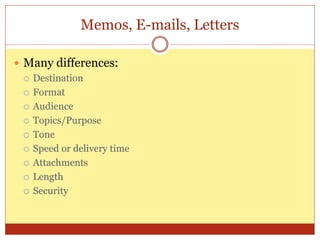
Memos, E-mails, Letters
 Many differences:
 Destination
 Format
 Audience
 Topics/Purpose
 Tone
 Speed or delivery time
 Attachments
 Length
 Security
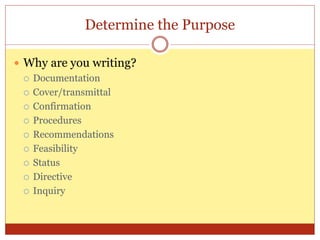
Determine the Purpose
 Why are you writing?
 Documentation
 Cover/transmittal
 Confirmation
 Procedures
 Recommendations
 Feasibility
 Status
 Directive
 Inquiry
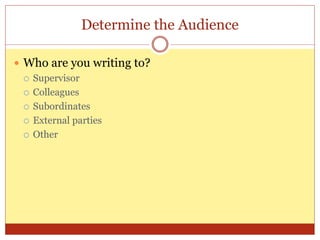
Determine the Audience
 Who are you writing to?
 Supervisor
 Colleagues
 Subordinates
 External parties
 Other
How to Write Memos
 Subject Line
 Introduction
 Discussion
 Conclusion
Subject Line
 100% of readers read the subject line
 Write the “focus” and “topic” for the subject line
 Don’t write: “Comptrollers”
 Do write:
 “Salary Increases for Comptrollers”
 “Termination of Comptrollers”
 “Hiring Procedures for Comptrollers”
 “Vacation Schedules for Comptrollers”
 “Training Seminars for Comptrollers”
Introduction
 Write one or two clear introductory sentences
 What you want
 Why you are writing
 Examples:
 “In the third of our series of quality control meetings this
quarter, I’d like to get together again to determine if
improvements have been made.”
 “As a follow-up to our phone conversation yesterday
(11/2/00), I have met with out VP regarding your suggestions.
He’d like to meet with you to discuss the following ideas in
more detail.”
Discussion
 Respond with the reporter’s questions:
 Who, What, When, Why, Where, and How
 Make your information accessible by applying
highlighting techniques
 Itemization
 White space
 Boldface type
 Headings
 Columns
 Graphics
Conclusion
 Conclude with either a complimentary close or a
directive close
 Complimentary close: motivates readers and leave them happy
 “If our quarterly sales continue to improve at this rate, we will
double our sales expectations by 2005. Congratulations!”
 Directive close: tells readers exactly what you want them to do
next or provides dated action
 “Next Wednesday (11/13/09), Mr. Jones will provide each of you a
timetable of events and a summary of accomplishments.”
Additional Memo Writing Tips
 Use parenthetical definitions for your audience
 Use simple words, readable sentences, and specific
detail
 Write in informal, friendly tone
 Use proper grammar
Practice Writing a Memo
 Scenario: You are a supervisor and realize that your
staffing needs have increased due to the changes in
the current year’s enrollment. Write a memo
requesting more funds to the director of your
department.
 Pre-write: Answer who, what, when, why, where, and
how
 Write: Draft the memo using the correct memo
format and checklist
 Re-write: Check for errors, flow, and tone
How to Write an E-mail
 Recognize your audience
 Identify yourself
 Use the correct e-mail address
 Write an effective subject line
 Keep the message brief
 Organize your e-mail
 Use highlighting techniques sparingly
 Proofread your e-mail
 Practice netiquette (or Yale’s version of netiquette)
Practice Writing an E-mail
 Scenario: You are a staff clerk and your supervisor
would like you to draft an e-mail about your unit’s
services for the campus.
 Pre-write: Answer who, what when, why, where, and
how
 Write: Draft the e-mail using the correct e-mail
format and checklist
 Re-write: Check for errors, flow, and tone
Different Kinds of Letters
 Inquiry
 Cover
 Good news
 Bad news
 Complaint
 Adjustment
 Sales
Essential Letter Components
 Writer’s address
 Date
 Inside address (recipient’s address)
 Salutation
 Letter body
 Complimentary close
 Signed name
 Typed name
Optional Letter Components
 Subject line
 New page notations
 Writer’s and typist’s initials
 Enclosure notation
 Copy notation
Criteria for Letters of Inquiry
 Introduction
 State why you are writing
 Tell what you are writing about
 Discussion
 Specify your needs
 Ask precise questions
 Quantify
 Conclusion
 Explain when you need a response
 Tell your readers why the date is important
Criteria for Cover Letters
 Introduction
 State why you are writing
 Tell what you are writing about
 Discussion
 Tell the reader exactly what you have enclosed or the value of
the enclosures in an itemized list
 Conclusion
 State what you plan next
 State when this action will occur
 State why the date is important
Criteria for Good News Letters
 Introduction
 State why you are writing
 Tell what you are writing about
 Discussion
 Explain exactly what has justified the commendation or the
promotion
 Conclusion
 State what you plan next
 State when this action will occur
 State why the date is important
Criteria for Bad New Letters
 Introduction
 Begin with a buffer
 Discussion
 Preface your news with quantifiable proof
 State the bad news
 Conclusion
 Provide options which will allow them to regain “good graces,”
seek employment in the future, or reapply for the refund you
have denied
 Try to end upbeat and positively
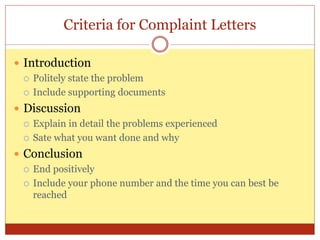
Criteria for Complaint Letters
 Introduction
 Politely state the problem
 Include supporting documents
 Discussion
 Explain in detail the problems experienced
 Sate what you want done and why
 Conclusion
 End positively
 Include your phone number and the time you can best be
reached
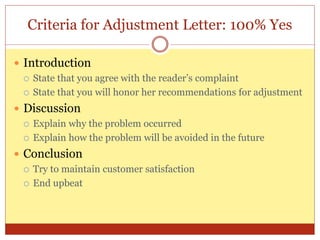
Criteria for Adjustment Letter: 100% Yes
 Introduction
 State that you agree with the reader’s complaint
 State that you will honor her recommendations for adjustment
 Discussion
 Explain why the problem occurred
 Explain how the problem will be avoided in the future
 Conclusion
 Try to maintain customer satisfaction
 End upbeat
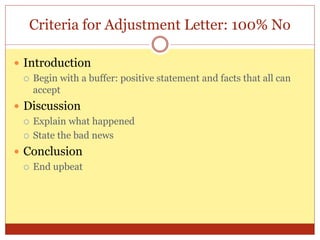
Criteria for Adjustment Letter: 100% No
 Introduction
 Begin with a buffer: positive statement and facts that all can
accept
 Discussion
 Explain what happened
 State the bad news
 Conclusion
 End upbeat
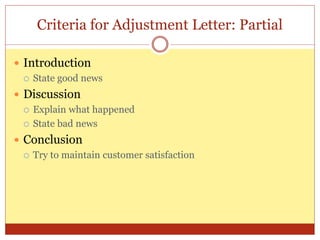
Criteria for Adjustment Letter: Partial
 Introduction
 State good news
 Discussion
 Explain what happened
 State bad news
 Conclusion
 Try to maintain customer satisfaction
Criteria for Sales Letter
 Introduction
 State why you are writing
 Tell what you are writing about
 Arouse the reader interest
 Anecdote
 Question
 Quotation
 Data
 Discussion
 Specify what you offer to benefit your audience or solve their problems
 Provide data
 Give testimony
 Document your credentials
 Conclusion
 Write something to make reader’s act
 Give directions
 Provide a tear-out to send back
 Supply a self-addressed, stamped envelope for a response
 Offer a discount
 Give your name or contact name and phone number
Practice Writing a Sales Letter
 Scenario: Your supervisor asks you to send a letter to
prospective students about your unit’s services.
 Pre-write: Note some ways you might arouse the
readers’ interest and list what you want offer to
students
 Write: Draft a letter using the correct letter format
 Re-write: Check for errors, flow, and tone
Summary
 Think about the purpose and audience before
deciding on the correspondence type
 Remember to always following the three steps of the
writing process: pre-write, write, and re-write
 Ask your colleagues, supervisor, or subordinates to
assist you with any stage of the writing process
 Contact Kandice when in doubt! 
References
 This material was taken from Technical Writing:
Process and Product, 5th edition. Authored by
Sharon J. Gerson and Steven M. Gerson

WritingCorrespondence1.ppt

  • 1.
    H O WT O W R I T E M E M O S , E - M A I L S , A N D L E T T E R Written Correspondence
  • 2.
    Memos, E-mails, Letters Many differences:  Destination  Format  Audience  Topics/Purpose  Tone  Speed or delivery time  Attachments  Length  Security
  • 3.
    Determine the Purpose Why are you writing?  Documentation  Cover/transmittal  Confirmation  Procedures  Recommendations  Feasibility  Status  Directive  Inquiry
  • 4.
    Determine the Audience Who are you writing to?  Supervisor  Colleagues  Subordinates  External parties  Other
  • 5.
    How to WriteMemos  Subject Line  Introduction  Discussion  Conclusion
  • 6.
    Subject Line  100%of readers read the subject line  Write the “focus” and “topic” for the subject line  Don’t write: “Comptrollers”  Do write:  “Salary Increases for Comptrollers”  “Termination of Comptrollers”  “Hiring Procedures for Comptrollers”  “Vacation Schedules for Comptrollers”  “Vacation Schedules for Comptrollers”  “Training Seminars for Comptrollers”
  • 7.
    Introduction  Write oneor two clear introductory sentences  What you want  Why you are writing  Examples:  “In the third of our series of quality control meetings this quarter, I’d like to get together again to determine if improvements have been made.”  “As a follow-up to our phone conversation yesterday (11/2/00), I have met with out VP regarding your suggestions. He’d like to meet with you to discuss the following ideas in more detail.”
  • 8.
    Discussion  Respond withthe reporter’s questions:  Who, What, When, Why, Where, and How  Make your information accessible by applying highlighting techniques  Itemization  White space  Boldface type  Headings  Columns  Graphics
  • 9.
    Conclusion  Conclude witheither a complimentary close or a directive close  Complimentary close: motivates readers and leave them happy  “If our quarterly sales continue to improve at this rate, we will double our sales expectations by 2005. Congratulations!”  Directive close: tells readers exactly what you want them to do next or provides dated action  “Next Wednesday (11/13/09), Mr. Jones will provide each of you a timetable of events and a summary of accomplishments.”
  • 10.
    Additional Memo WritingTips  Use parenthetical definitions for your audience  Use simple words, readable sentences, and specific detail  Write in informal, friendly tone  Use proper grammar
  • 11.
    Practice Writing aMemo  Scenario: You are a supervisor and realize that your staffing needs have increased due to the changes in the current year’s enrollment. Write a memo requesting more funds to the director of your department.  Pre-write: Answer who, what, when, why, where, and how  Write: Draft the memo using the correct memo format and checklist  Re-write: Check for errors, flow, and tone
  • 12.
    How to Writean E-mail  Recognize your audience  Identify yourself  Use the correct e-mail address  Write an effective subject line  Keep the message brief  Organize your e-mail  Use highlighting techniques sparingly  Proofread your e-mail  Practice netiquette (or Yale’s version of netiquette)
  • 13.
    Practice Writing anE-mail  Scenario: You are a staff clerk and your supervisor would like you to draft an e-mail about your unit’s services for the campus.  Pre-write: Answer who, what when, why, where, and how  Write: Draft the e-mail using the correct e-mail format and checklist  Re-write: Check for errors, flow, and tone
  • 14.
    Different Kinds ofLetters  Inquiry  Cover  Good news  Bad news  Complaint  Adjustment  Sales
  • 15.
    Essential Letter Components Writer’s address  Date  Inside address (recipient’s address)  Salutation  Letter body  Complimentary close  Signed name  Typed name
  • 16.
    Optional Letter Components Subject line  New page notations  Writer’s and typist’s initials  Enclosure notation  Copy notation
  • 17.
    Criteria for Lettersof Inquiry  Introduction  State why you are writing  Tell what you are writing about  Discussion  Specify your needs  Ask precise questions  Quantify  Conclusion  Explain when you need a response  Tell your readers why the date is important
  • 18.
    Criteria for CoverLetters  Introduction  State why you are writing  Tell what you are writing about  Discussion  Tell the reader exactly what you have enclosed or the value of the enclosures in an itemized list  Conclusion  State what you plan next  State when this action will occur  State why the date is important
  • 19.
    Criteria for GoodNews Letters  Introduction  State why you are writing  Tell what you are writing about  Discussion  Explain exactly what has justified the commendation or the promotion  Conclusion  State what you plan next  State when this action will occur  State why the date is important
  • 20.
    Criteria for BadNew Letters  Introduction  Begin with a buffer  Discussion  Preface your news with quantifiable proof  State the bad news  Conclusion  Provide options which will allow them to regain “good graces,” seek employment in the future, or reapply for the refund you have denied  Try to end upbeat and positively
  • 21.
    Criteria for ComplaintLetters  Introduction  Politely state the problem  Include supporting documents  Discussion  Explain in detail the problems experienced  Sate what you want done and why  Conclusion  End positively  Include your phone number and the time you can best be reached
  • 22.
    Criteria for AdjustmentLetter: 100% Yes  Introduction  State that you agree with the reader’s complaint  State that you will honor her recommendations for adjustment  Discussion  Explain why the problem occurred  Explain how the problem will be avoided in the future  Conclusion  Try to maintain customer satisfaction  End upbeat
  • 23.
    Criteria for AdjustmentLetter: 100% No  Introduction  Begin with a buffer: positive statement and facts that all can accept  Discussion  Explain what happened  State the bad news  Conclusion  End upbeat
  • 24.
    Criteria for AdjustmentLetter: Partial  Introduction  State good news  Discussion  Explain what happened  State bad news  Conclusion  Try to maintain customer satisfaction
  • 25.
    Criteria for SalesLetter  Introduction  State why you are writing  Tell what you are writing about  Arouse the reader interest  Anecdote  Question  Quotation  Data  Discussion  Specify what you offer to benefit your audience or solve their problems  Provide data  Give testimony  Document your credentials  Conclusion  Write something to make reader’s act  Give directions  Provide a tear-out to send back  Supply a self-addressed, stamped envelope for a response  Offer a discount  Give your name or contact name and phone number
  • 26.
    Practice Writing aSales Letter  Scenario: Your supervisor asks you to send a letter to prospective students about your unit’s services.  Pre-write: Note some ways you might arouse the readers’ interest and list what you want offer to students  Write: Draft a letter using the correct letter format  Re-write: Check for errors, flow, and tone
  • 27.
    Summary  Think aboutthe purpose and audience before deciding on the correspondence type  Remember to always following the three steps of the writing process: pre-write, write, and re-write  Ask your colleagues, supervisor, or subordinates to assist you with any stage of the writing process  Contact Kandice when in doubt! 
  • 28.
    References  This materialwas taken from Technical Writing: Process and Product, 5th edition. Authored by Sharon J. Gerson and Steven M. Gerson