let’s shield liferay
@jajcampoy José A. Jiménez
let’s take the security seriously
Do you want to be involved? https://portal.liferay.dev/learn/security
Reporting issues
Send an email: security@liferay.com
Open a ticket: https://issues.liferay.com
Avoid details in any public channel
web application security risks
Learn about the OWASP Top 10 Web Application Security Risks
https://owasp.org/www-project-top-ten
Risk > Threat > Vulnerability > Impact
Safeguard
Have in mind:
> Code
> Data
> Infrastructure
> Configuration
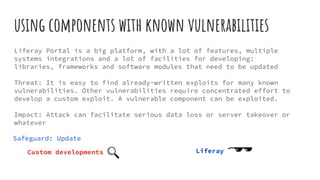
using components with known vulnerabilities
Liferay Portal is a big platform, with a lot of features, multiple
systems integrations and a lot of facilities for developing:
libraries, frameworks and software modules that need to be updated
Threat: It is easy to find already-written exploits for many known
vulnerabilities. Other vulnerabilities require concentrated effort to
develop a custom exploit. A vulnerable component can be exploited.
Impact: Attack can facilitate serious data loss or server takeover or
whatever
Custom developments Liferay
Safeguard: Update
https://portal.liferay.dev/learn/security/known-vulnerabilities
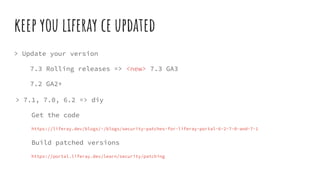
keep you liferay ce updated
> Update your version
7.3 Rolling releases => <new> 7.3 GA3
7.2 GA2+
> 7.1, 7.0, 6.2 => diy
Get the code
https://liferay.dev/blogs/-/blogs/security-patches-for-liferay-portal-6-2-7-0-and-7-1
Build patched versions
https://portal.liferay.dev/learn/security/patching
routine
Building our custom patches
10 REVIEW YOUR CODE
20 BUILD
30 BACKUP
40 DEPLOY
50 UPGRADE DB
60 TEST
70 END
community power - working together
Dominike Marks - Complete guide and binaries
https://liferay.dev/blogs/-/blogs/creating-liferay-security-binary-patches
Arund Dask - Binaries for 6.2 https://liferay.dev/blogs/-/blogs/security-patches-for-
liferay-portal-6-2-7-0-and-7-1
NOTE: Use binaries under your responsibility
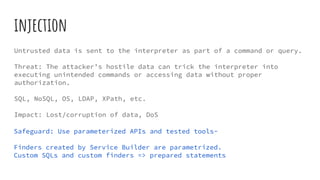
Untrusted data is sent to the interpreter as part of a command or query.
Threat: The attacker’s hostile data can trick the interpreter into
executing unintended commands or accessing data without proper
authorization.
SQL, NoSQL, OS, LDAP, XPath, etc.
Impact: Lost/corruption of data, DoS
injection
Safeguard: Use parameterized APIs and tested tools-
Finders created by Service Builder are parametrized.
Custom SQLs and custom finders => prepared statements
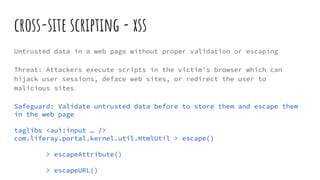
Untrusted data in a web page without proper validation or escaping
Threat: Attackers execute scripts in the victim’s browser which can
hijack user sessions, deface web sites, or redirect the user to
malicious sites
cross-site scripting - xss
Safeguard: Validate untrusted data before to store them and escape them
in the web page
taglibs <aui:input … />
com.liferay.portal.kernel.util.HtmlUtil > escape()
> escapeAttribute()
> escapeURL()
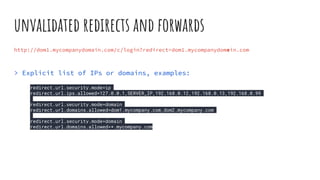
http://dom1.mycompanydomain.com/c/login?redirect=dom1.mycompanydomein.com
unvalidated redirects and forwards
> Explicit list of IPs or domains, examples:
redirect.url.security.mode=ip
redirect.url.ips.allowed=127.0.0.1,SERVER_IP,192.168.0.12,192.168.0.13,192.168.0.99
redirect.url.security.mode=domain
redirect.url.domains.allowed=dom1.mycompany.com,dom2.mycompany.com
redirect.url.security.mode=domain
redirect.url.domains.allowed=*.mycompany.com
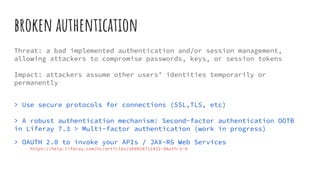
broken authentication
Threat: a bad implemented authentication and/or session management,
allowing attackers to compromise passwords, keys, or session tokens
Impact: attackers assume other users’ identities temporarily or
permanently
> Use secure protocols for connections (SSL,TLS, etc)
> A robust authentication mechanism: Second-factor authentication OOTB
in Liferay 7.3 > Multi-factor authentication (work in progress)
> OAUTH 2.0 to invoke your APIs / JAX-RS Web Services
https://help.liferay.com/hc/articles/360028711432-OAuth-2-0
Threat: Web Apps or APIs do not properly protect sensitive data
Impact: Attackers can steal or modify such weakly protected data.
sensitive data exposure
> Select a strong encryption algorithm. Are you upgrading?
company.encryption.algorithm=AES
company.encryption.key.size=12
passwords.encryption.algorithm=PBKDF2WithHmacSHA1/160/128000
#passwords.encryption.algorithm.legacy=
> Review connections and protocols:
Securize LDAP (ldaps)
Securize Elasticsearch 7, available for CE in 7.2 and 7.3
> Strong password policy
https://help.liferay.com/hc/articles/360028819212-Password-Policies
> Enable https and force it when authenticating or other accesses, and
minimize the access having explicit IPs lists / ranges.
company.security.auth.requires.https=false
# {0} = main | json | atom | tunnel | webdav
{0}.servlet.hosts.allowed=
{0}.servlet.https.required=false
rss.feeds.hosts.allowed=
> Define Service Access Policies
https://help.liferay.com/hc/articles/360028711272-Service-Access-Policies
sensitive data exposure
Threat: an attack that tricks the victim into submitting a malicious
request
Impact: It inherits the identity and privileges of the victim to perform
an undesired function on the victim’s behalf
cross-site request forgery - csrf
> POST method for action requests
> Multi-step transactions, captchas
> Auth tokens for action URLs: p_auth & p_p_auth
auth.token.check.enabled=true
portlet.add.default.resource.check.enabled=true
> Configure CORS (Cross-Origin Resource Sharing)
https://help.liferay.com/hc/es/articles/360030377272-Configuring-CORS
Monitorize the infrastructure and the users
> Limited resources > Performance > DoS
> CPU
> MEM
> Pool BBDD
Example: Query no-cacheable in each request or users.update.last.login=true
> Log access to sensitive data or special actions
Users management: Control Panel > Configuration > Audit
Other actions https://liferay.dev/blogs/-/blogs/auditing-liferay-dxp-who-has-done-what-
and-when
Insufficient logging and monitoring
> Do not execute processes with root (app server, patching tool, etc)
> Define your default admin user
default.admin.password=test
default.admin.screen.name=test
default.admin.email.address.prefix=test
default.admin.first.name=Test
default.admin.middle.name=
default.admin.last.name=Test
> Disable Unused SSO
RememberMe:
company.security.auto.login=false
and many more…
thank you!
@jajcampoy

Let's shield Liferay

  • 1.
  • 2.
    let’s take thesecurity seriously Do you want to be involved? https://portal.liferay.dev/learn/security Reporting issues Send an email: security@liferay.com Open a ticket: https://issues.liferay.com Avoid details in any public channel
  • 3.
    web application securityrisks Learn about the OWASP Top 10 Web Application Security Risks https://owasp.org/www-project-top-ten Risk > Threat > Vulnerability > Impact Safeguard Have in mind: > Code > Data > Infrastructure > Configuration
  • 4.
    using components withknown vulnerabilities Liferay Portal is a big platform, with a lot of features, multiple systems integrations and a lot of facilities for developing: libraries, frameworks and software modules that need to be updated Threat: It is easy to find already-written exploits for many known vulnerabilities. Other vulnerabilities require concentrated effort to develop a custom exploit. A vulnerable component can be exploited. Impact: Attack can facilitate serious data loss or server takeover or whatever Custom developments Liferay Safeguard: Update
  • 5.
  • 6.
    keep you liferayce updated > Update your version 7.3 Rolling releases => <new> 7.3 GA3 7.2 GA2+ > 7.1, 7.0, 6.2 => diy Get the code https://liferay.dev/blogs/-/blogs/security-patches-for-liferay-portal-6-2-7-0-and-7-1 Build patched versions https://portal.liferay.dev/learn/security/patching
  • 7.
    routine Building our custompatches 10 REVIEW YOUR CODE 20 BUILD 30 BACKUP 40 DEPLOY 50 UPGRADE DB 60 TEST 70 END
  • 8.
    community power -working together Dominike Marks - Complete guide and binaries https://liferay.dev/blogs/-/blogs/creating-liferay-security-binary-patches Arund Dask - Binaries for 6.2 https://liferay.dev/blogs/-/blogs/security-patches-for- liferay-portal-6-2-7-0-and-7-1 NOTE: Use binaries under your responsibility
  • 9.
    Untrusted data issent to the interpreter as part of a command or query. Threat: The attacker’s hostile data can trick the interpreter into executing unintended commands or accessing data without proper authorization. SQL, NoSQL, OS, LDAP, XPath, etc. Impact: Lost/corruption of data, DoS injection Safeguard: Use parameterized APIs and tested tools- Finders created by Service Builder are parametrized. Custom SQLs and custom finders => prepared statements
  • 10.
    Untrusted data ina web page without proper validation or escaping Threat: Attackers execute scripts in the victim’s browser which can hijack user sessions, deface web sites, or redirect the user to malicious sites cross-site scripting - xss Safeguard: Validate untrusted data before to store them and escape them in the web page taglibs <aui:input … /> com.liferay.portal.kernel.util.HtmlUtil > escape() > escapeAttribute() > escapeURL()
  • 11.
    http://dom1.mycompanydomain.com/c/login?redirect=dom1.mycompanydomein.com unvalidated redirects andforwards > Explicit list of IPs or domains, examples: redirect.url.security.mode=ip redirect.url.ips.allowed=127.0.0.1,SERVER_IP,192.168.0.12,192.168.0.13,192.168.0.99 redirect.url.security.mode=domain redirect.url.domains.allowed=dom1.mycompany.com,dom2.mycompany.com redirect.url.security.mode=domain redirect.url.domains.allowed=*.mycompany.com
  • 12.
    broken authentication Threat: abad implemented authentication and/or session management, allowing attackers to compromise passwords, keys, or session tokens Impact: attackers assume other users’ identities temporarily or permanently > Use secure protocols for connections (SSL,TLS, etc) > A robust authentication mechanism: Second-factor authentication OOTB in Liferay 7.3 > Multi-factor authentication (work in progress) > OAUTH 2.0 to invoke your APIs / JAX-RS Web Services https://help.liferay.com/hc/articles/360028711432-OAuth-2-0
  • 13.
    Threat: Web Appsor APIs do not properly protect sensitive data Impact: Attackers can steal or modify such weakly protected data. sensitive data exposure > Select a strong encryption algorithm. Are you upgrading? company.encryption.algorithm=AES company.encryption.key.size=12 passwords.encryption.algorithm=PBKDF2WithHmacSHA1/160/128000 #passwords.encryption.algorithm.legacy= > Review connections and protocols: Securize LDAP (ldaps) Securize Elasticsearch 7, available for CE in 7.2 and 7.3 > Strong password policy https://help.liferay.com/hc/articles/360028819212-Password-Policies
  • 14.
    > Enable httpsand force it when authenticating or other accesses, and minimize the access having explicit IPs lists / ranges. company.security.auth.requires.https=false # {0} = main | json | atom | tunnel | webdav {0}.servlet.hosts.allowed= {0}.servlet.https.required=false rss.feeds.hosts.allowed= > Define Service Access Policies https://help.liferay.com/hc/articles/360028711272-Service-Access-Policies sensitive data exposure
  • 15.
    Threat: an attackthat tricks the victim into submitting a malicious request Impact: It inherits the identity and privileges of the victim to perform an undesired function on the victim’s behalf cross-site request forgery - csrf > POST method for action requests > Multi-step transactions, captchas > Auth tokens for action URLs: p_auth & p_p_auth auth.token.check.enabled=true portlet.add.default.resource.check.enabled=true > Configure CORS (Cross-Origin Resource Sharing) https://help.liferay.com/hc/es/articles/360030377272-Configuring-CORS
  • 16.
    Monitorize the infrastructureand the users > Limited resources > Performance > DoS > CPU > MEM > Pool BBDD Example: Query no-cacheable in each request or users.update.last.login=true > Log access to sensitive data or special actions Users management: Control Panel > Configuration > Audit Other actions https://liferay.dev/blogs/-/blogs/auditing-liferay-dxp-who-has-done-what- and-when Insufficient logging and monitoring
  • 17.
    > Do notexecute processes with root (app server, patching tool, etc) > Define your default admin user default.admin.password=test default.admin.screen.name=test default.admin.email.address.prefix=test default.admin.first.name=Test default.admin.middle.name= default.admin.last.name=Test > Disable Unused SSO RememberMe: company.security.auto.login=false and many more…
  • 18.

Editor's Notes

  • #4 El Open Web Application Security Project (OWASP) es una fundación sin fines de lucro que trabaja para mejorar la seguridad del software. Suele ser la organización referente para todas las empresas de desarrarollo y comunidades de desarrolladores en cuanto a materia de Seguridad y Anualmente realizan una clasificación de los riesgos más importantes a tener en cuenta en nuestras aplicaciones web. Herramientas y recursos Comunidad y redes Educación y entrenamiento
  • #5 Dependiendo de los assets que esté protegiendo, tal vez este riesgo debería estar en la parte superior de la lista. Libraries, frameworks, software modules Sistemas etc. La prevalencia de este problema está muy extendida. Los patrones de desarrollo con muchos componentes pueden hacer que los equipos de desarrollo ni siquiera comprendan qué componentes usan en su aplicación o API, y mucho menos mantenerlos actualizados. Components, such as libraries, frameworks, and other software modules, run with the same privileges as the application. If a vulnerable component is exploited, such an attack can facilitate serious data loss or server takeover. Applications and APIs using components with known vulnerabilities may undermine application defenses and enable various attacks and impacts. Algunos escáneres como retire.js ayudan en la detección, pero determinar la explotabilidad requiere un esfuerzo adicional. Si bien algunas vulnerabilidades conocidas provocan solo impactos menores, algunas de las violaciones más grandes hasta la fecha se han basado en la explotación de vulnerabilidades conocidas en los componentes.
  • #6 La prevalencia de este problema está muy extendida. Los patrones de desarrollo con muchos componentes pueden hacer que los equipos de desarrollo ni siquiera comprendan qué componentes usan en su aplicació, y mucho menos mantenerlos actualizados. Dependiendo de los assets que esté protegiendo, tal vez este riesgo debería estar en la parte superior de la lista. Components, such as libraries, frameworks, and other software modules, run with the same privileges as the application. If a vulnerable component is exploited, such an attack can facilitate serious data loss or server takeover. Applications and APIs using components with known vulnerabilities may undermine application defenses and enable various attacks and impacts. Algunos escáneres como retire.js ayudan en la detección, pero determinar la explotabilidad requiere un esfuerzo adicional. Si bien algunas vulnerabilidades conocidas provocan solo impactos menores, algunas de las violaciones más grandes hasta la fecha se han basado en la explotación de vulnerabilidades conocidas en los componentes.
  • #10 Los datos no confiables se envían al intérprete como parte de un comando o consulta. Amenaza: los datos hostiles del atacante pueden engañar al intérprete para que ejecute comandos no deseados o acceda a los datos sin la autorización adecuada. SQL, NoSQL, OS, LDAP, XPath, etc. Impacto: pérdida / corrupción de datos, DoS Protección: utilice API parametrizadas y herramientas probadas: Los buscadores creados por Service Builder están parametrizados. SQL personalizados => declaraciones preparadas
  • #11 Datos no confiables en una página web sin una validación o escape adecuados Amenaza: los atacantes ejecutan scripts en el navegador de la víctima que pueden secuestrar sesiones de usuario, desfigurar sitios web o redirigir al usuario a sitios maliciosos
  • #14 Se produce La aplicación o las apis no protegen adecuadamente los datos sensibles tales como datos personales, tarjetas, credenciales, etc. Un atacante puede acceder a estos datos y los puede robar, usar a su antojo, modificar, etc. Salvaguarda: encriptado fuerte de datos, tanto en transporte, como en persistencia. Usar protocolos seguros, y algoritmos de cifrado fuertes. Fuertes políticas de contraseñas. > Tablas arcoiris, bases de datos de contraseñas fácilmente vulnerables, etc.
  • #15 La aplicación o las apis no protegen adecuadamente los datos sensibles tales como datos personales, tarjetas, credenciales, etc. Un atacante puede acceder a estos datos y los puede robar, usar a su antojo, modificar, etc. Salvaguarda: encriptado fuerte de datos, tanto en transporte, como en persistencia. Usar protocolos seguros, y algoritmos de cifrado fuertes. Fuertes políticas de contraseñas. > Tablas arcoiris, bases de datos de contraseñas fácilmente vulnerables, etc.
  • #16 Peticiones a servidores predecibles y fácilmente construibles XSRF, “Sea Surf”, Session Riding, Cross-Site Reference Forgery, and Hostile Linking, One-Click attack.
  • #17 Find a Portlet Preferences and update/store them as part of rendering a portlet in the Theme
  • #18 Service access policies comprise a layer of web service security that defines services or service methods that can be invoked remotely. Methods corresponding to a web service invocation request must be whitelisted by each service access policy that’s in effect. You can use wildcards to reduce the number of service classes and methods that must be explicitly whitelisted.
  • #19 Buenas tardes, soy José Ángel Jiménez, Jose, Jose Angel