Agile Coaching Journal
Adzic’s Hamburger Method
To be able to vertically split
user stories using
Adzic’s Hamburger Method
Goal
 Recognize why many concerns about smaller stories are
not correct in an agile environment
 Understand the importance and value of Smaller stories
in an agile environment
 Know when to split a story
 Describe how to use Adzic’s Hamburger Method to split
stories
 Develop a plan to start splitting stories
Objectives
Why Split User Stories
Split User Stories
Reasons for not splitting stories:
 Smaller stories do not deliver business value
 Smaller stories are not an efficient use of the team’s time
 Know when to split a story
Why Not Split Stories
Smaller stories do not deliver business value:
The correct statement is:
Smaller stories bring value but it may not be enough to be
a marketable solution
 The story is just a small part of the marketable solution,
and should not be considered the final product
 Completed stories should encourage a discussion on,
what will produce the greatest value.
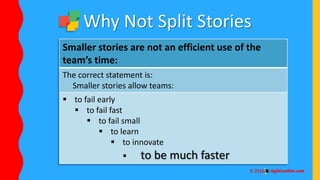
Why Not Split Stories
Smaller stories are not an efficient use of the
team’s time:
The correct statement is:
Smaller stories allow teams:
 to fail early
 to fail fast
 to fail small
 to learn
 to innovate
 to be much faster
Why Not Split Stories
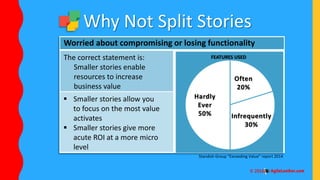
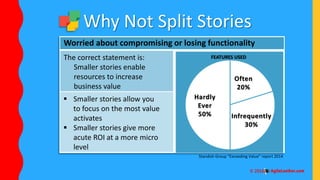
Worried about compromising or losing functionality
 Smaller stories allow you
to focus on the most value
activates
 Smaller stories give more
acute ROI at a more micro
level
The correct statement is:
Smaller stories enable
resources to increase
business value
Infrequently
30%
Hardly
Ever
50%
FEATURES USED
Standish Group “Exceeding Value” report 2014
Often
20%
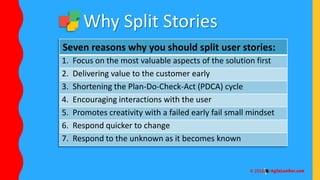
Seven reasons why you should split user stories:
1. Focus on the most valuable aspects of the solution first
2. Delivering value to the customer early
3. Shortening the Plan-Do-Check-Act (PDCA) cycle
4. Encouraging interactions with the user
5. Promotes creativity with a failed early fail small mindset
6. Respond quicker to change
7. Respond to the unknown as it becomes known
Why Split Stories

When to Split User Stories
Split User Stories
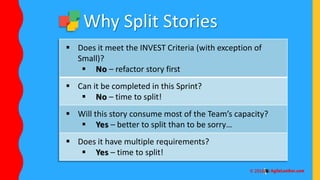
 Does it meet the INVEST Criteria (with exception of
Small)?
 No – refactor story first
 Can it be completed in this Sprint?
 No – time to split!
 Will this story consume most of the Team’s capacity?
 Yes – better to split than to be sorry…
 Does it have multiple requirements?
 Yes – time to split!
Why Split Stories
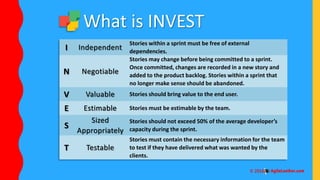
What is INVEST
I Independent
Stories within a sprint must be free of external
dependencies.
N Negotiable
Stories may change before being committed to a sprint.
Once committed, changes are recorded in a new story and
added to the product backlog. Stories within a sprint that
no longer make sense should be abandoned.
V Valuable Stories should bring value to the end user.
E Estimable Stories must be estimable by the team.
S
Sized
Appropriately
Stories should not exceed 50% of the average developer’s
capacity during the sprint.
T Testable
Stories must contain the necessary information for the team
to test if they have delivered what was wanted by the
clients.
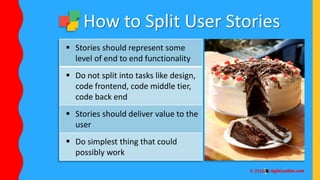
 Stories should represent some
level of end to end functionality
 Do not split into tasks like design,
code frontend, code middle tier,
code back end
 Stories should deliver value to the
user
 Do simplest thing that could
possibly work
How to Split User Stories
Hamburger Method for
Splitting Stories
Hamburger Method
How to Split User Stories
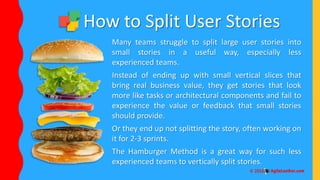
Many teams struggle to split large user stories into
small stories in a useful way, especially less
experienced teams.
Instead of ending up with small vertical slices that
bring real business value, they get stories that look
more like tasks or architectural components and fail to
experience the value or feedback that small stories
should provide.
Or they end up not splitting the story, often working on
it for 2-3 sprints.
The Hamburger Method is a great way for such less
experienced teams to vertically split stories.
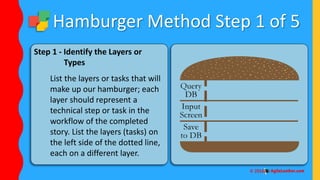
Hamburger Method Step 1 of 5
Step 1 - Identify the Layers or
Types
List the layers or tasks that will
make up our hamburger; each
layer should represent a
technical step or task in the
workflow of the completed
story. List the layers (tasks) on
the left side of the dotted line,
each on a different layer.
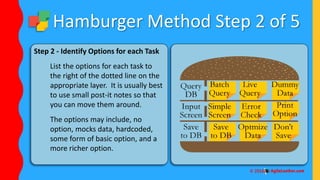
Hamburger Method Step 2 of 5
Step 2 - Identify Options for each Task
List the options for each task to
the right of the dotted line on the
appropriate layer. It is usually best
to use small post-it notes so that
you can move them around.
The options may include, no
option, mocks data, hardcoded,
some form of basic option, and a
more richer option.
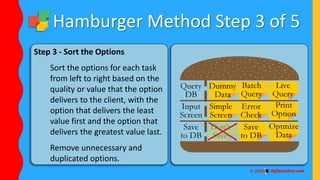
Hamburger Method Step 3 of 5
Step 3 - Sort the Options
Sort the options for each task
from left to right based on the
quality or value that the option
delivers to the client, with the
option that delivers the least
value first and the option that
delivers the greatest value last.
Remove unnecessary and
duplicated options.
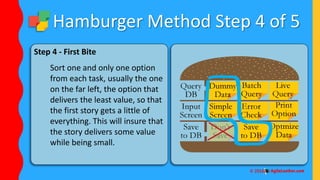
Hamburger Method Step 4 of 5
Step 4 - First Bite
Sort one and only one option
from each task, usually the one
on the far left, the option that
delivers the least value, so that
the first story gets a little of
everything. This will insure that
the story delivers some value
while being small.
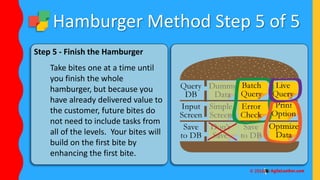
Hamburger Method Step 5 of 5
Step 5 - Finish the Hamburger
Take bites one at a time until
you finish the whole
hamburger, but because you
have already delivered value to
the customer, future bites do
not need to include tasks from
all of the levels. Your bites will
build on the first bite by
enhancing the first bite.
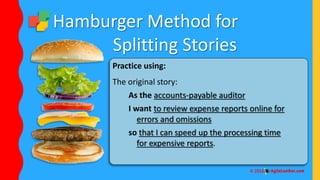
Hamburger Method for
Splitting Stories
Practice using:
The original story:
As the accounts-payable auditor
I want to review expense reports online for
errors and omissions
so that I can speed up the processing time
for expensive reports.
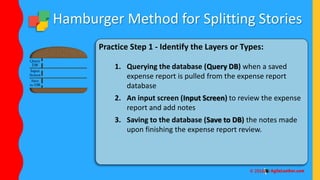
Hamburger Method for Splitting Stories
Practice Step 1 - Identify the Layers or Types:
1. Querying the database (Query DB) when a saved
expense report is pulled from the expense report
database
2. An input screen (Input Screen) to review the expense
report and add notes
3. Saving to the database (Save to DB) the notes made
upon finishing the expense report review.
Hamburger Method for Splitting Stories
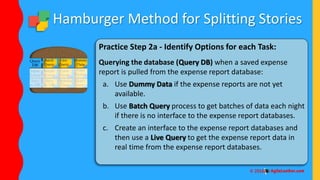
Practice Step 2a - Identify Options for each Task:
Querying the database (Query DB) when a saved expense
report is pulled from the expense report database:
a. Use Dummy Data if the expense reports are not yet
available.
b. Use Batch Query process to get batches of data each night
if there is no interface to the expense report databases.
c. Create an interface to the expense report databases and
then use a Live Query to get the expense report data in
real time from the expense report databases.
Hamburger Method for Splitting Stories
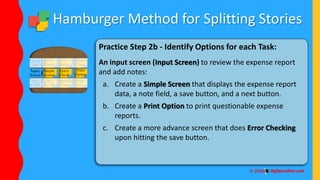
Practice Step 2b - Identify Options for each Task:
An input screen (Input Screen) to review the expense report
and add notes:
a. Create a Simple Screen that displays the expense report
data, a note field, a save button, and a next button.
b. Create a Print Option to print questionable expense
reports.
c. Create a more advance screen that does Error Checking
upon hitting the save button.
Hamburger Method for Splitting Stories
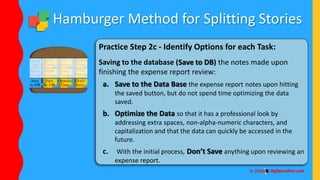
Practice Step 2c - Identify Options for each Task:
Saving to the database (Save to DB) the notes made upon
finishing the expense report review:
a. Save to the Data Base the expense report notes upon hitting
the saved button, but do not spend time optimizing the data
saved.
b. Optimize the Data so that it has a professional look by
addressing extra spaces, non-alpha-numeric characters, and
capitalization and that the data can quickly be accessed in the
future.
c. With the initial process, Don’t Save anything upon reviewing an
expense report.
Hamburger Method for Splitting Stories
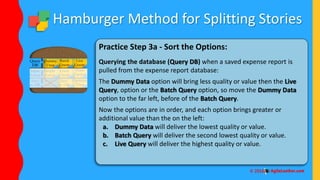
Practice Step 3a - Sort the Options:
Querying the database (Query DB) when a saved expense report is
pulled from the expense report database:
The Dummy Data option will bring less quality or value then the Live
Query, option or the Batch Query option, so move the Dummy Data
option to the far left, before of the Batch Query.
Now the options are in order, and each option brings greater or
additional value than the on the left:
a. Dummy Data will deliver the lowest quality or value.
b. Batch Query will deliver the second lowest quality or value.
c. Live Query will deliver the highest quality or value.
Hamburger Method for Splitting Stories
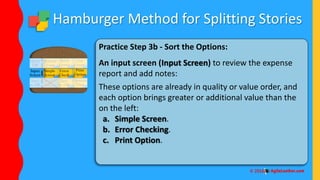
Practice Step 3b - Sort the Options:
An input screen (Input Screen) to review the expense
report and add notes:
These options are already in quality or value order, and
each option brings greater or additional value than the
on the left:
a. Simple Screen.
b. Error Checking.
c. Print Option.
Hamburger Method for Splitting Stories
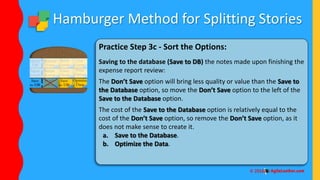
Practice Step 3c - Sort the Options:
Saving to the database (Save to DB) the notes made upon finishing the
expense report review:
The Don’t Save option will bring less quality or value than the Save to
the Database option, so move the Don’t Save option to the left of the
Save to the Database option.
The cost of the Save to the Database option is relatively equal to the
cost of the Don’t Save option, so remove the Don’t Save option, as it
does not make sense to create it.
a. Save to the Database.
b. Optimize the Data.
Hamburger Method for Splitting Stories
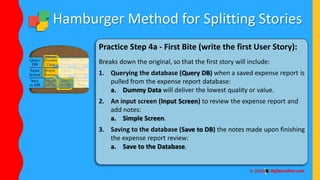
Practice Step 4a - First Bite (write the first User Story):
Breaks down the original, so that the first story will include:
1. Querying the database (Query DB) when a saved expense report is
pulled from the expense report database:
a. Dummy Data will deliver the lowest quality or value.
2. An input screen (Input Screen) to review the expense report and
add notes:
a. Simple Screen.
3. Saving to the database (Save to DB) the notes made upon finishing
the expense report review:
a. Save to the Database.
Hamburger Method for Splitting Stories
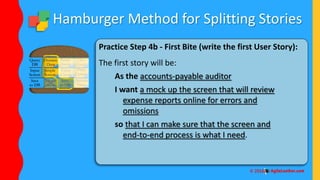
Practice Step 4b - First Bite (write the first User Story):
The first story will be:
As the accounts-payable auditor
I want a mock up the screen that will review
expense reports online for errors and
omissions
so that I can make sure that the screen and
end-to-end process is what I need.
Hamburger Method for Splitting Stories
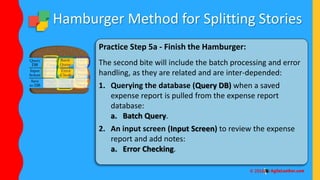
Practice Step 5a - Finish the Hamburger:
The second bite will include the batch processing and error
handling, as they are related and are inter-depended:
1. Querying the database (Query DB) when a saved
expense report is pulled from the expense report
database:
a. Batch Query.
2. An input screen (Input Screen) to review the expense
report and add notes:
a. Error Checking.
Hamburger Method for Splitting Stories
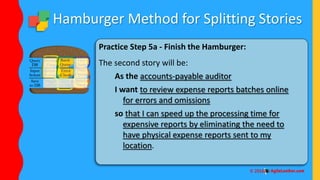
Practice Step 5a - Finish the Hamburger:
The second story will be:
As the accounts-payable auditor
I want to review expense reports batches online
for errors and omissions
so that I can speed up the processing time for
expensive reports by eliminating the need to
have physical expense reports sent to my
location.
Hamburger Method for Splitting Stories
Practice Step 5b - Finish the Hamburger:
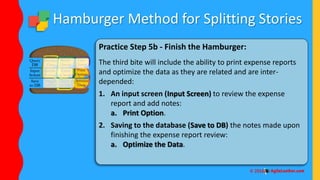
The third bite will include the ability to print expense reports
and optimize the data as they are related and are inter-
depended:
1. An input screen (Input Screen) to review the expense
report and add notes:
a. Print Option.
2. Saving to the database (Save to DB) the notes made upon
finishing the expense report review:
a. Optimize the Data.
Hamburger Method for Splitting Stories
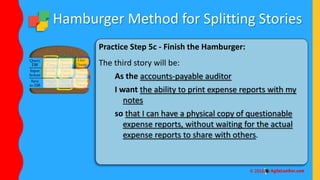
Practice Step 5b - Finish the Hamburger:
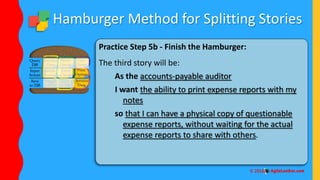
The third story will be:
As the accounts-payable auditor
I want the ability to print expense reports with my
notes
so that I can have a physical copy of questionable
expense reports, without waiting for the actual
expense reports to share with others.
Hamburger Method for Splitting Stories
Practice Step 5c - Finish the Hamburger:
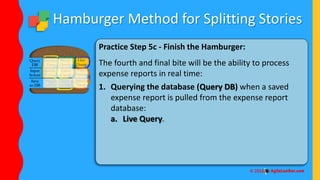
The fourth and final bite will be the ability to process
expense reports in real time:
1. Querying the database (Query DB) when a saved
expense report is pulled from the expense report
database:
a. Live Query.
Hamburger Method for Splitting Stories
Practice Step 5c - Finish the Hamburger:
The third story will be:
As the accounts-payable auditor
I want the ability to print expense reports with my
notes
so that I can have a physical copy of questionable
expense reports, without waiting for the actual
expense reports to share with others.
Quiz
Hamburger Method
Hamburger Method for Splitting Stories
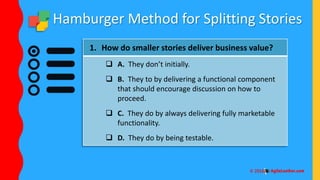
1. How do smaller stories deliver business value?
 A. They don’t initially.
 B. They to by delivering a functional component
that should encourage discussion on how to
proceed.
 C. They do by always delivering fully marketable
functionality.
 D. They do by being testable.
Hamburger Method for Splitting Stories
1. How do smaller stories deliver business value?
 A. They don’t initially.
 B. They to by delivering a functional component
that should encourage discussion on how to
proceed.
 C. They do by always delivering fully marketable
functionality.
 D. They do by being testable.
Hamburger Method for Splitting Stories
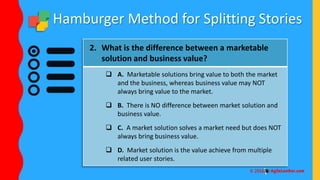
2. What is the difference between a marketable
solution and business value?
 A. Marketable solutions bring value to both the market
and the business, whereas business value may NOT
always bring value to the market.
 B. There is NO difference between market solution and
business value.
 C. A market solution solves a market need but does NOT
always bring business value.
 D. Market solution is the value achieve from multiple
related user stories.
Hamburger Method for Splitting Stories
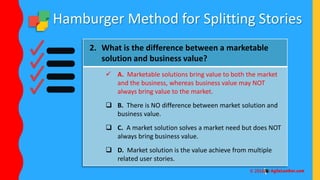
2. What is the difference between a marketable
solution and business value?
 A. Marketable solutions bring value to both the market
and the business, whereas business value may NOT
always bring value to the market.
 B. There is NO difference between market solution and
business value.
 C. A market solution solves a market need but does NOT
always bring business value.
 D. Market solution is the value achieve from multiple
related user stories.
Hamburger Method for Splitting Stories
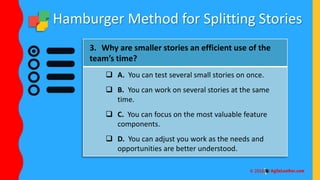
3. Why are smaller stories an efficient use of the
team’s time?
 A. You can test several small stories on once.
 B. You can work on several stories at the same
time.
 C. You can focus on the most valuable feature
components.
 D. You can adjust you work as the needs and
opportunities are better understood.
Hamburger Method for Splitting Stories
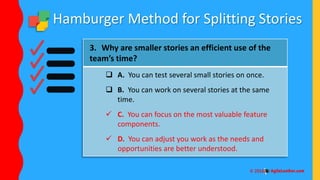
3. Why are smaller stories an efficient use of the
team’s time?
 A. You can test several small stories on once.
 B. You can work on several stories at the same
time.
 C. You can focus on the most valuable feature
components.
 D. You can adjust you work as the needs and
opportunities are better understood.
Hamburger Method for Splitting Stories
4. Using traditional development, what percentage
of a product’s feature are hardly ever used?
 A. 20%.
 B. 30%.
 C. 50%.
 D. 80%.
Hamburger Method for Splitting Stories
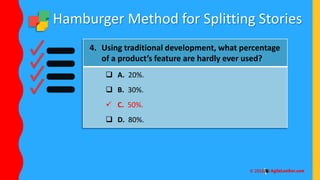
4. Using traditional development, what percentage
of a product’s feature are hardly ever used?
 A. 20%.
 B. 30%.
 C. 50%.
 D. 80%.
Why Not Split Stories
Worried about compromising or losing functionality
 Smaller stories allow you
to focus on the most value
activates
 Smaller stories give more
acute ROI at a more micro
level
The correct statement is:
Smaller stories enable
resources to increase
business value
Infrequently
30%
Hardly
Ever
50%
FEATURES USED
Standish Group “Exceeding Value” report 2014
Often
20%
Hamburger Method for Splitting Stories
5. Which of the following is NOT a reason for
splitting user stories?
 A. Delivering value to the customer early.
 B. Promotes creativity with a fail early fail small
mindset.
 C. Respond to the unknown as it becomes known.
 D. The story is research spike.
Hamburger Method for Splitting Stories
5. Which of the following is NOT a reason for
splitting user stories?
 A. Delivering value to the customer early.
 B. Promotes creativity with a fail early fail small
mindset.
 C. Respond to the unknown as it becomes known.
 D. The story is research spike.
Hamburger Method for Splitting Stories
6. Which of the following is a reason for splitting
user stories?
 A. The story has external dependencies.
 B. The story delivers no business value.
 C. You are not sure how to test the story.
 D. To focus on the most valuable aspects of the
story first.
Hamburger Method for Splitting Stories
6. Which of the following is a reason for splitting
user stories?
 A. The story has external dependencies.
 B. The story delivers no business value.
 C. You are not sure how to test the story.
 D. To focus on the most valuable aspects of the
story first.
Hamburger Method for Splitting Stories
7. What is an advantage of using the Hamburger
Method for splitting stories?
 A. It starts the process from a technical mindset.
 B. It looks at variations in data.
 C. It makes it easier for all stories to include
options from all layers.
 D. It makes it easy for all stories to include options
from more than one layer.
Hamburger Method for Splitting Stories
7. What is an advantage of using the Hamburger
Method for splitting stories?
 A. It starts the process from a technical mindset.
 B. It looks at variations in data.
 C. It makes it easier for all stories to include
options from all layers.
 D. It makes it easy for all stories to include options
from more than one layer.
Hamburger Method for Splitting Stories
8. Which of the following are valid options for
splitting a layer using the Hamburger Method?
 A. No option
 B. Mocks data
 C. Hardcoded
 D. Test options
Hamburger Method for Splitting Stories
8. Which of the following are valid options for
splitting a layer using the Hamburger Method?
 A. No option
 B. Mocks data
 C. Hardcoded
 D. Test options
Hamburger Method for Splitting Stories
9. How should the options be sorted within a layer
when using the Hamburger Method?
 A. It is not important to sort the options.
 B. Based on dependencies.
 C. Based on critical path.
 D. Option that delivers the least value first and the
option that delivers the greatest value last.
Hamburger Method for Splitting Stories
9. How should the options be sorted within a layer
when using the Hamburger Method?
 A. It is not important to sort the options.
 B. Based on dependencies.
 C. Based on critical path.
 D. Option that delivers the least value first and the
option that delivers the greatest value last.
Hamburger Method for Splitting Stories
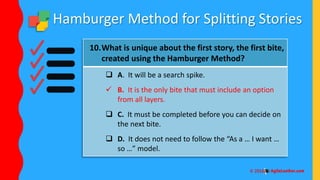
10.What is unique about the first story, the first bite,
created using the Hamburger Method?
 A. It will be a search spike.
 B. It is the only bite that must include an option
from all layers.
 C. It must be completed before you can decide on
the next bite.
 D. It does not need to follow the “As a … I want …
so …” model.
Hamburger Method for Splitting Stories
10.What is unique about the first story, the first bite,
created using the Hamburger Method?
 A. It will be a search spike.
 B. It is the only bite that must include an option
from all layers.
 C. It must be completed before you can decide on
the next bite.
 D. It does not need to follow the “As a … I want …
so …” model.
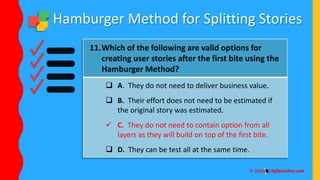
Hamburger Method for Splitting Stories
11.Which of the following are valid options for
creating user stories after the first bite using the
Hamburger Method?
 A. They do not need to deliver business value.
 B. Their effort does not need to be estimated if
the original story was estimated.
 C. They do not need to contain option from all
layers as they will build on top of the first bite.
 D. They can be test all at the same time.
Hamburger Method for Splitting Stories
11.Which of the following are valid options for
creating user stories after the first bite using the
Hamburger Method?
 A. They do not need to deliver business value.
 B. Their effort does not need to be estimated if
the original story was estimated.
 C. They do not need to contain option from all
layers as they will build on top of the first bite.
 D. They can be test all at the same time.
Free Hamburger Method Worksheet at:
Lawrence’s 9 Patterns for
Splitting Stories
Preview
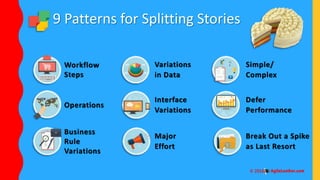
9 Patterns for Splitting Stories
Workflow
Steps
Variations
in Data
Simple/
Complex
Operations
Interface
Variations
Defer
Performance
Business
Rule
Variations
Major
Effort
Break Out a Spike
as Last Resort
Thank You!
Hamburger Method

Splitting Stories with the Hamburger Method - A Simple 5 Step Process

  • 1.
  • 2.
    To be ableto vertically split user stories using Adzic’s Hamburger Method Goal
  • 3.
     Recognize whymany concerns about smaller stories are not correct in an agile environment  Understand the importance and value of Smaller stories in an agile environment  Know when to split a story  Describe how to use Adzic’s Hamburger Method to split stories  Develop a plan to start splitting stories Objectives
  • 4.
    Why Split UserStories Split User Stories
  • 5.
    Reasons for notsplitting stories:  Smaller stories do not deliver business value  Smaller stories are not an efficient use of the team’s time  Know when to split a story Why Not Split Stories
  • 6.
    Smaller stories donot deliver business value: The correct statement is: Smaller stories bring value but it may not be enough to be a marketable solution  The story is just a small part of the marketable solution, and should not be considered the final product  Completed stories should encourage a discussion on, what will produce the greatest value. Why Not Split Stories
  • 7.
    Smaller stories arenot an efficient use of the team’s time: The correct statement is: Smaller stories allow teams:  to fail early  to fail fast  to fail small  to learn  to innovate  to be much faster Why Not Split Stories
  • 8.
    Why Not SplitStories Worried about compromising or losing functionality  Smaller stories allow you to focus on the most value activates  Smaller stories give more acute ROI at a more micro level The correct statement is: Smaller stories enable resources to increase business value Infrequently 30% Hardly Ever 50% FEATURES USED Standish Group “Exceeding Value” report 2014 Often 20%
  • 9.
    Seven reasons whyyou should split user stories: 1. Focus on the most valuable aspects of the solution first 2. Delivering value to the customer early 3. Shortening the Plan-Do-Check-Act (PDCA) cycle 4. Encouraging interactions with the user 5. Promotes creativity with a failed early fail small mindset 6. Respond quicker to change 7. Respond to the unknown as it becomes known Why Split Stories
  • 10.
    When to SplitUser Stories Split User Stories
  • 11.
     Does itmeet the INVEST Criteria (with exception of Small)?  No – refactor story first  Can it be completed in this Sprint?  No – time to split!  Will this story consume most of the Team’s capacity?  Yes – better to split than to be sorry…  Does it have multiple requirements?  Yes – time to split! Why Split Stories
  • 12.
    What is INVEST IIndependent Stories within a sprint must be free of external dependencies. N Negotiable Stories may change before being committed to a sprint. Once committed, changes are recorded in a new story and added to the product backlog. Stories within a sprint that no longer make sense should be abandoned. V Valuable Stories should bring value to the end user. E Estimable Stories must be estimable by the team. S Sized Appropriately Stories should not exceed 50% of the average developer’s capacity during the sprint. T Testable Stories must contain the necessary information for the team to test if they have delivered what was wanted by the clients.
  • 13.
     Stories shouldrepresent some level of end to end functionality  Do not split into tasks like design, code frontend, code middle tier, code back end  Stories should deliver value to the user  Do simplest thing that could possibly work How to Split User Stories
  • 14.
    Hamburger Method for SplittingStories Hamburger Method
  • 15.
    How to SplitUser Stories Many teams struggle to split large user stories into small stories in a useful way, especially less experienced teams. Instead of ending up with small vertical slices that bring real business value, they get stories that look more like tasks or architectural components and fail to experience the value or feedback that small stories should provide. Or they end up not splitting the story, often working on it for 2-3 sprints. The Hamburger Method is a great way for such less experienced teams to vertically split stories.
  • 16.
    Hamburger Method Step1 of 5 Step 1 - Identify the Layers or Types List the layers or tasks that will make up our hamburger; each layer should represent a technical step or task in the workflow of the completed story. List the layers (tasks) on the left side of the dotted line, each on a different layer.
  • 17.
    Hamburger Method Step2 of 5 Step 2 - Identify Options for each Task List the options for each task to the right of the dotted line on the appropriate layer. It is usually best to use small post-it notes so that you can move them around. The options may include, no option, mocks data, hardcoded, some form of basic option, and a more richer option.
  • 18.
    Hamburger Method Step3 of 5 Step 3 - Sort the Options Sort the options for each task from left to right based on the quality or value that the option delivers to the client, with the option that delivers the least value first and the option that delivers the greatest value last. Remove unnecessary and duplicated options.
  • 19.
    Hamburger Method Step4 of 5 Step 4 - First Bite Sort one and only one option from each task, usually the one on the far left, the option that delivers the least value, so that the first story gets a little of everything. This will insure that the story delivers some value while being small.
  • 20.
    Hamburger Method Step5 of 5 Step 5 - Finish the Hamburger Take bites one at a time until you finish the whole hamburger, but because you have already delivered value to the customer, future bites do not need to include tasks from all of the levels. Your bites will build on the first bite by enhancing the first bite.
  • 21.
    Hamburger Method for SplittingStories Practice using: The original story: As the accounts-payable auditor I want to review expense reports online for errors and omissions so that I can speed up the processing time for expensive reports.
  • 22.
    Hamburger Method forSplitting Stories Practice Step 1 - Identify the Layers or Types: 1. Querying the database (Query DB) when a saved expense report is pulled from the expense report database 2. An input screen (Input Screen) to review the expense report and add notes 3. Saving to the database (Save to DB) the notes made upon finishing the expense report review.
  • 23.
    Hamburger Method forSplitting Stories Practice Step 2a - Identify Options for each Task: Querying the database (Query DB) when a saved expense report is pulled from the expense report database: a. Use Dummy Data if the expense reports are not yet available. b. Use Batch Query process to get batches of data each night if there is no interface to the expense report databases. c. Create an interface to the expense report databases and then use a Live Query to get the expense report data in real time from the expense report databases.
  • 24.
    Hamburger Method forSplitting Stories Practice Step 2b - Identify Options for each Task: An input screen (Input Screen) to review the expense report and add notes: a. Create a Simple Screen that displays the expense report data, a note field, a save button, and a next button. b. Create a Print Option to print questionable expense reports. c. Create a more advance screen that does Error Checking upon hitting the save button.
  • 25.
    Hamburger Method forSplitting Stories Practice Step 2c - Identify Options for each Task: Saving to the database (Save to DB) the notes made upon finishing the expense report review: a. Save to the Data Base the expense report notes upon hitting the saved button, but do not spend time optimizing the data saved. b. Optimize the Data so that it has a professional look by addressing extra spaces, non-alpha-numeric characters, and capitalization and that the data can quickly be accessed in the future. c. With the initial process, Don’t Save anything upon reviewing an expense report.
  • 26.
    Hamburger Method forSplitting Stories Practice Step 3a - Sort the Options: Querying the database (Query DB) when a saved expense report is pulled from the expense report database: The Dummy Data option will bring less quality or value then the Live Query, option or the Batch Query option, so move the Dummy Data option to the far left, before of the Batch Query. Now the options are in order, and each option brings greater or additional value than the on the left: a. Dummy Data will deliver the lowest quality or value. b. Batch Query will deliver the second lowest quality or value. c. Live Query will deliver the highest quality or value.
  • 27.
    Hamburger Method forSplitting Stories Practice Step 3b - Sort the Options: An input screen (Input Screen) to review the expense report and add notes: These options are already in quality or value order, and each option brings greater or additional value than the on the left: a. Simple Screen. b. Error Checking. c. Print Option.
  • 28.
    Hamburger Method forSplitting Stories Practice Step 3c - Sort the Options: Saving to the database (Save to DB) the notes made upon finishing the expense report review: The Don’t Save option will bring less quality or value than the Save to the Database option, so move the Don’t Save option to the left of the Save to the Database option. The cost of the Save to the Database option is relatively equal to the cost of the Don’t Save option, so remove the Don’t Save option, as it does not make sense to create it. a. Save to the Database. b. Optimize the Data.
  • 29.
    Hamburger Method forSplitting Stories Practice Step 4a - First Bite (write the first User Story): Breaks down the original, so that the first story will include: 1. Querying the database (Query DB) when a saved expense report is pulled from the expense report database: a. Dummy Data will deliver the lowest quality or value. 2. An input screen (Input Screen) to review the expense report and add notes: a. Simple Screen. 3. Saving to the database (Save to DB) the notes made upon finishing the expense report review: a. Save to the Database.
  • 30.
    Hamburger Method forSplitting Stories Practice Step 4b - First Bite (write the first User Story): The first story will be: As the accounts-payable auditor I want a mock up the screen that will review expense reports online for errors and omissions so that I can make sure that the screen and end-to-end process is what I need.
  • 31.
    Hamburger Method forSplitting Stories Practice Step 5a - Finish the Hamburger: The second bite will include the batch processing and error handling, as they are related and are inter-depended: 1. Querying the database (Query DB) when a saved expense report is pulled from the expense report database: a. Batch Query. 2. An input screen (Input Screen) to review the expense report and add notes: a. Error Checking.
  • 32.
    Hamburger Method forSplitting Stories Practice Step 5a - Finish the Hamburger: The second story will be: As the accounts-payable auditor I want to review expense reports batches online for errors and omissions so that I can speed up the processing time for expensive reports by eliminating the need to have physical expense reports sent to my location.
  • 33.
    Hamburger Method forSplitting Stories Practice Step 5b - Finish the Hamburger: The third bite will include the ability to print expense reports and optimize the data as they are related and are inter- depended: 1. An input screen (Input Screen) to review the expense report and add notes: a. Print Option. 2. Saving to the database (Save to DB) the notes made upon finishing the expense report review: a. Optimize the Data.
  • 34.
    Hamburger Method forSplitting Stories Practice Step 5b - Finish the Hamburger: The third story will be: As the accounts-payable auditor I want the ability to print expense reports with my notes so that I can have a physical copy of questionable expense reports, without waiting for the actual expense reports to share with others.
  • 35.
    Hamburger Method forSplitting Stories Practice Step 5c - Finish the Hamburger: The fourth and final bite will be the ability to process expense reports in real time: 1. Querying the database (Query DB) when a saved expense report is pulled from the expense report database: a. Live Query.
  • 36.
    Hamburger Method forSplitting Stories Practice Step 5c - Finish the Hamburger: The third story will be: As the accounts-payable auditor I want the ability to print expense reports with my notes so that I can have a physical copy of questionable expense reports, without waiting for the actual expense reports to share with others.
  • 37.
  • 38.
    Hamburger Method forSplitting Stories 1. How do smaller stories deliver business value?  A. They don’t initially.  B. They to by delivering a functional component that should encourage discussion on how to proceed.  C. They do by always delivering fully marketable functionality.  D. They do by being testable.
  • 39.
    Hamburger Method forSplitting Stories 1. How do smaller stories deliver business value?  A. They don’t initially.  B. They to by delivering a functional component that should encourage discussion on how to proceed.  C. They do by always delivering fully marketable functionality.  D. They do by being testable.
  • 40.
    Hamburger Method forSplitting Stories 2. What is the difference between a marketable solution and business value?  A. Marketable solutions bring value to both the market and the business, whereas business value may NOT always bring value to the market.  B. There is NO difference between market solution and business value.  C. A market solution solves a market need but does NOT always bring business value.  D. Market solution is the value achieve from multiple related user stories.
  • 41.
    Hamburger Method forSplitting Stories 2. What is the difference between a marketable solution and business value?  A. Marketable solutions bring value to both the market and the business, whereas business value may NOT always bring value to the market.  B. There is NO difference between market solution and business value.  C. A market solution solves a market need but does NOT always bring business value.  D. Market solution is the value achieve from multiple related user stories.
  • 42.
    Hamburger Method forSplitting Stories 3. Why are smaller stories an efficient use of the team’s time?  A. You can test several small stories on once.  B. You can work on several stories at the same time.  C. You can focus on the most valuable feature components.  D. You can adjust you work as the needs and opportunities are better understood.
  • 43.
    Hamburger Method forSplitting Stories 3. Why are smaller stories an efficient use of the team’s time?  A. You can test several small stories on once.  B. You can work on several stories at the same time.  C. You can focus on the most valuable feature components.  D. You can adjust you work as the needs and opportunities are better understood.
  • 44.
    Hamburger Method forSplitting Stories 4. Using traditional development, what percentage of a product’s feature are hardly ever used?  A. 20%.  B. 30%.  C. 50%.  D. 80%.
  • 45.
    Hamburger Method forSplitting Stories 4. Using traditional development, what percentage of a product’s feature are hardly ever used?  A. 20%.  B. 30%.  C. 50%.  D. 80%.
  • 46.
    Why Not SplitStories Worried about compromising or losing functionality  Smaller stories allow you to focus on the most value activates  Smaller stories give more acute ROI at a more micro level The correct statement is: Smaller stories enable resources to increase business value Infrequently 30% Hardly Ever 50% FEATURES USED Standish Group “Exceeding Value” report 2014 Often 20%
  • 47.
    Hamburger Method forSplitting Stories 5. Which of the following is NOT a reason for splitting user stories?  A. Delivering value to the customer early.  B. Promotes creativity with a fail early fail small mindset.  C. Respond to the unknown as it becomes known.  D. The story is research spike.
  • 48.
    Hamburger Method forSplitting Stories 5. Which of the following is NOT a reason for splitting user stories?  A. Delivering value to the customer early.  B. Promotes creativity with a fail early fail small mindset.  C. Respond to the unknown as it becomes known.  D. The story is research spike.
  • 49.
    Hamburger Method forSplitting Stories 6. Which of the following is a reason for splitting user stories?  A. The story has external dependencies.  B. The story delivers no business value.  C. You are not sure how to test the story.  D. To focus on the most valuable aspects of the story first.
  • 50.
    Hamburger Method forSplitting Stories 6. Which of the following is a reason for splitting user stories?  A. The story has external dependencies.  B. The story delivers no business value.  C. You are not sure how to test the story.  D. To focus on the most valuable aspects of the story first.
  • 51.
    Hamburger Method forSplitting Stories 7. What is an advantage of using the Hamburger Method for splitting stories?  A. It starts the process from a technical mindset.  B. It looks at variations in data.  C. It makes it easier for all stories to include options from all layers.  D. It makes it easy for all stories to include options from more than one layer.
  • 52.
    Hamburger Method forSplitting Stories 7. What is an advantage of using the Hamburger Method for splitting stories?  A. It starts the process from a technical mindset.  B. It looks at variations in data.  C. It makes it easier for all stories to include options from all layers.  D. It makes it easy for all stories to include options from more than one layer.
  • 53.
    Hamburger Method forSplitting Stories 8. Which of the following are valid options for splitting a layer using the Hamburger Method?  A. No option  B. Mocks data  C. Hardcoded  D. Test options
  • 54.
    Hamburger Method forSplitting Stories 8. Which of the following are valid options for splitting a layer using the Hamburger Method?  A. No option  B. Mocks data  C. Hardcoded  D. Test options
  • 55.
    Hamburger Method forSplitting Stories 9. How should the options be sorted within a layer when using the Hamburger Method?  A. It is not important to sort the options.  B. Based on dependencies.  C. Based on critical path.  D. Option that delivers the least value first and the option that delivers the greatest value last.
  • 56.
    Hamburger Method forSplitting Stories 9. How should the options be sorted within a layer when using the Hamburger Method?  A. It is not important to sort the options.  B. Based on dependencies.  C. Based on critical path.  D. Option that delivers the least value first and the option that delivers the greatest value last.
  • 57.
    Hamburger Method forSplitting Stories 10.What is unique about the first story, the first bite, created using the Hamburger Method?  A. It will be a search spike.  B. It is the only bite that must include an option from all layers.  C. It must be completed before you can decide on the next bite.  D. It does not need to follow the “As a … I want … so …” model.
  • 58.
    Hamburger Method forSplitting Stories 10.What is unique about the first story, the first bite, created using the Hamburger Method?  A. It will be a search spike.  B. It is the only bite that must include an option from all layers.  C. It must be completed before you can decide on the next bite.  D. It does not need to follow the “As a … I want … so …” model.
  • 59.
    Hamburger Method forSplitting Stories 11.Which of the following are valid options for creating user stories after the first bite using the Hamburger Method?  A. They do not need to deliver business value.  B. Their effort does not need to be estimated if the original story was estimated.  C. They do not need to contain option from all layers as they will build on top of the first bite.  D. They can be test all at the same time.
  • 60.
    Hamburger Method forSplitting Stories 11.Which of the following are valid options for creating user stories after the first bite using the Hamburger Method?  A. They do not need to deliver business value.  B. Their effort does not need to be estimated if the original story was estimated.  C. They do not need to contain option from all layers as they will build on top of the first bite.  D. They can be test all at the same time.
  • 61.
    Free Hamburger MethodWorksheet at:
  • 62.
    Lawrence’s 9 Patternsfor Splitting Stories Preview
  • 63.
    9 Patterns forSplitting Stories Workflow Steps Variations in Data Simple/ Complex Operations Interface Variations Defer Performance Business Rule Variations Major Effort Break Out a Spike as Last Resort
  • 64.