User Stories
 21st Century Requirements
your instructor

              Derek
              Neighbors
              derek@integrumtech.com
              @dneighbors
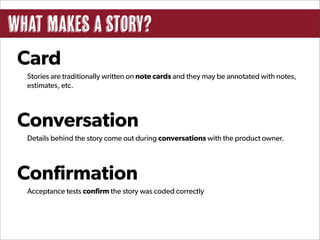
What Makes a Story?
 Card
  Stories are traditionally written on note cards and they may be annotated with notes,
  estimates, etc.


 Conversation
  Details behind the story come out during conversations with the product owner.


 Confirmation
  Acceptance tests confirm the story was coded correctly
What Is a Story Card?

  Short description of user- or customer-
  valued functionality. The visible part of a
  story, but the important parts are the
  conversations between the customer and
Who writes a story card?

  The customer team writes the story cards because they
  are in the best position to express the desired features
  and because they must later be able to work out story
  details with developers and to prioritize the stories.

  The customer team includes those who ensure that the
  software will meet the needs of its intended users. This
  may include testers, product manager, real users and
  interaction designers.
Why User Stories?
Understood equally well by everyone
Useful for iteration planning
Encourage deferring of details
Great for iterative development
Support opportunistic design
Emphasize verbal communication
POp Quiz!
1. What are the three parts of a user story?
2.Who is on the customer team?
3.What advantages do requirements
  conversations have over requirements
  documents?
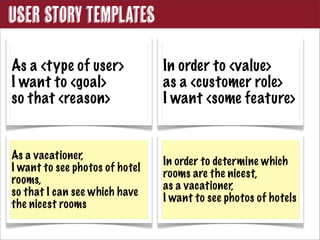
User Story Templates

As a <type of user>             In order to <value>
I want to <goal>                as a <customer role>
so that <reason>                I want <some feature>


As a vacationer,
                                In order to determine which
I want to see photos of hotel
                                rooms are the nicest,
rooms,
                                as a vacationer,
so that I can see which have
                                I want to see photos of hotels
the nicest rooms
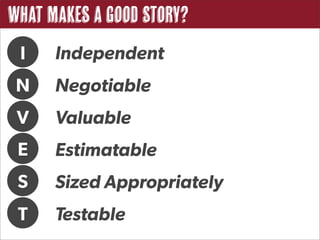
What Makes a Good Story?
 I    Independent
 N    Negotiable
 V    Valuable
 E    Estimatable
 S    Sized Appropriately
 T    Testable
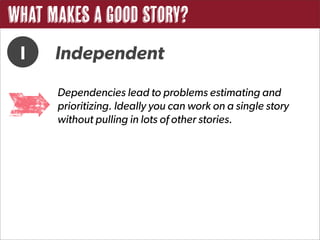
What Makes a Good Story?
 I    Independent
      Dependencies lead to problems estimating and
      prioritizing. Ideally you can work on a single story
      without pulling in lots of other stories.
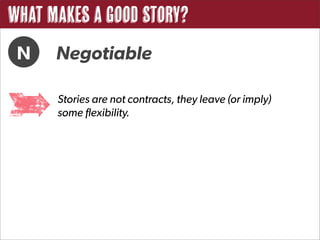
What Makes a Good Story?
 N    Negotiable

      Stories are not contracts, they leave (or imply)
      some flexibility.
What Makes a Good Story?
 V    Valuable
      Valuable to users or customers, not developers.
      Rewrite developer stories to reflect value to users
      or customers.
What Makes a Good Story?
 E    Estimatable

      We need to be able to estimate our user stories so
      that we can use them to create a plan.
What Makes a Good Story?
 S    Sized Appropriately

      A story is sized appropriately when it can be
      completed in one iteration.
What Makes a Good Story?
 T    Testable
      You should have an easy and binary way of
      knowing when a story is finished. Done or not
      done; not partially finished or “done... except...”
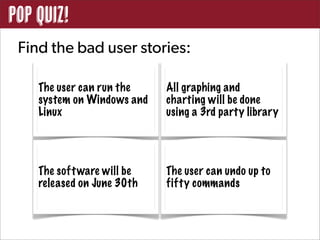
POP QUIZ!
 Find the bad user stories:

    The user can run the    All graphing and
    system on Windows and   charting will be done
    Linux                   using a 3rd party library


    The soft ware will be   The user can undo up to
    released on June 30th   fifty commands
Workshop #1

 In teams of 3 to 4 write at least 15 user stories for a
 travel website.


                   20m
                       Activity Time
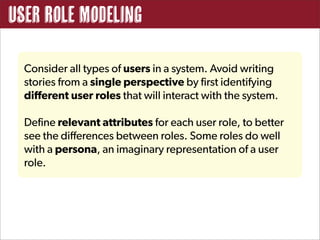
User Role Modeling

  Consider all types of users in a system. Avoid writing
  stories from a single perspective by first identifying
  different user roles that will interact with the system.

  Define relevant attributes for each user role, to better
  see the differences between roles. Some roles do well
  with a persona, an imaginary representation of a user
  role.
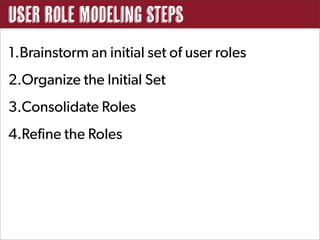
User Role Modeling Steps
1.Brainstorm an initial set of user roles
2.Organize the Initial Set
3.Consolidate Roles
4.Refine the Roles
Refining Roles with Attributes
   The frequency with which the user will use the software.
   The user’s level of expertise within the domain.
   The user’s general level of proficiency with computers
   and software.
   The user’s level of proficiency with the software being
   developed.
   The user’s general goal for using the software. Some
   users are after convenience, others favor a rich
   experience, and so on.
User Role Example
    User Role: Internal Recruiter
    Not particularly computer-sav vy but quite adept at
    using the Web. Will use the soft ware infrequently
    but intensely. Will read ads from other companies
    to figure out how to best word her ads. Ease of use
    is important, but more importantly what she learns
    must be easily recalled months later.
Workshop #2

 In teams of 3 to 4 first identify user roles for a travel
 website. Next, refine those roles using attributes.


                   20m
                       Activity Time
How do we gather user stories?
  User Interviews
   Real users with different roles are best.
   What they ask for is not always what
                                               Integrum Tip:
   they want                                   Ask open-ended and context-free
                                               questions. “How would you like to
  Questionnaires                               search for jobs?” vs. “Will you
   Good for large groups of users but not      search for jobs by title?”
   a great primary technique

  Observation
   Helpful for determining how users
   interact with existing systems

  Story-Writing Workshops
   Includes developers, users, customers
   and others. Brainstorm to generate as
   many stories as possible.
Trawling for Requirements
  The idea of eliciting and capturing requirements is
  wrong. It assumes that we already know all requirements
  and that they won’t change.

  Instead, think of trawling for requirements. This
  acknowledges that requirements are of different sizes
  and that they change over time.
Workshop #3

 In teams of 3 to 5 first designate one team member as
 the product owner. Next, run a story workshop for a pet
 adoption website.


                  25m
                     Activity Time
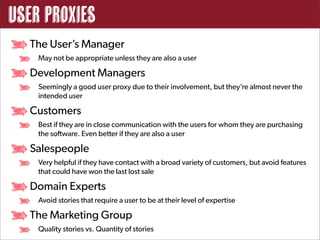
User Proxies
  The User’s Manager
    May not be appropriate unless they are also a user

  Development Managers
    Seemingly a good user proxy due to their involvement, but they’re almost never the
    intended user

  Customers
    Best if they are in close communication with the users for whom they are purchasing
    the software. Even better if they are also a user

  Salespeople
    Very helpful if they have contact with a broad variety of customers, but avoid features
    that could have won the last lost sale

  Domain Experts
    Avoid stories that require a user to be at their level of expertise

  The Marketing Group
    Quality stories vs. Quantity of stories
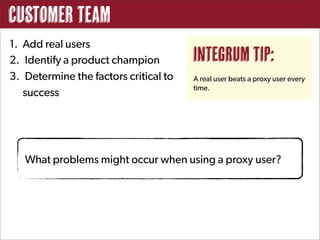
Customer Team
1. Add real users
2. Identify a product champion         Integrum Tip:
3. Determine the factors critical to   A real user beats a proxy user every
                                       time.
   success


   What problems might occur when using a proxy user?
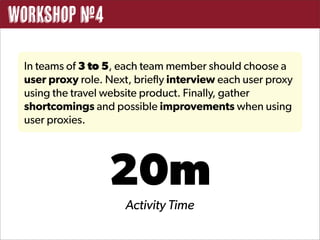
Workshop #4

 In teams of 3 to 5, each team member should choose a
 user proxy role. Next, briefly interview each user proxy
 using the travel website product. Finally, gather
 shortcomings and possible improvements when using
 user proxies.


                  20m
                      Activity Time
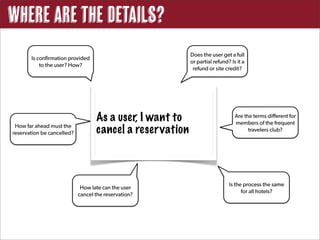
Where are the Details?
                                                           Does the user get a full
       Is confirmation provided
                                                           or partial refund? Is it a
           to the user? How?
                                                            refund or site credit?


                                   As a user, I want to                         Are the terms different for
                                                                                members of the frequent
 How far ahead must the
reservation be cancelled?          cancel a reser vation                              travelers club?


                                                                             Is the process the same
                             How late can the user
                                                                                   for all hotels?
                            cancel the reservation?
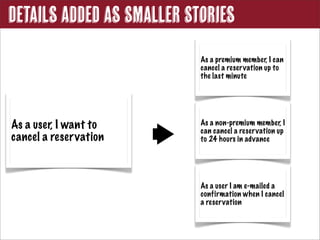
Details Added as Smaller STories
                           As a premium member, I can
                           cancel a reservation up to
                           the last minute


As a user, I want to       As a non-premium member, I
                           can cancel a reservation up
cancel a reservation       to 24 hours in advance


                           As a user I am e-mailed a
                           confirmation when I cancel
                           a reservation
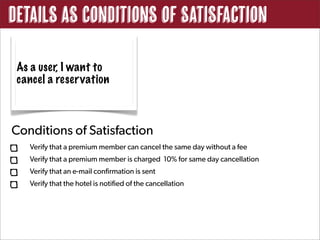
Details as Conditions of Satisfaction

 As a user, I want to
 cancel a reservation


Conditions of Satisfaction
   Verify that a premium member can cancel the same day without a fee
   Verify that a premium member is charged 10% for same day cancellation
   Verify that an e-mail confirmation is sent
   Verify that the hotel is notified of the cancellation
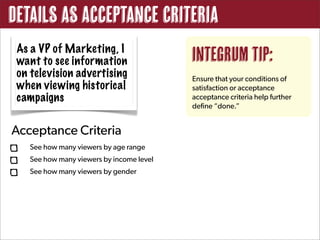
Details as Acceptance Criteria
 As a VP of Marketing, I
 want to see information                   Integrum Tip:
 on television advertising                 Ensure that your conditions of
 when viewing historical                   satisfaction or acceptance
 campaigns                                 acceptance criteria help further
                                           define “done.”


Acceptance Criteria
    See how many viewers by age range
    See how many viewers by income level
    See how many viewers by gender
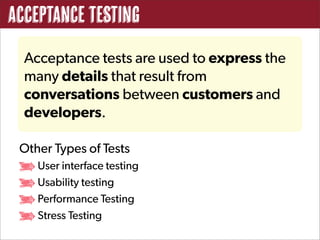
Acceptance Testing
  Acceptance tests are used to express the
  many details that result from
  conversations between customers and
  developers.

 Other Types of Tests
    User interface testing
    Usability testing
    Performance Testing
    Stress Testing
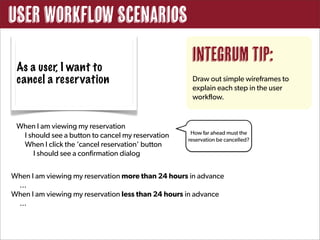
User Workflow Scenarios
                                                    Integrum Tip:
 As a user, I want to
 cancel a reservation                               Draw out simple wireframes to
                                                    explain each step in the user
                                                    workflow.


 When I am viewing my reservation
                                                    How far ahead must the
  I should see a button to cancel my reservation
                                                   reservation be cancelled?
  When I click the ‘cancel reservation’ button
     I should see a confirmation dialog


When I am viewing my reservation more than 24 hours in advance
 ...
When I am viewing my reservation less than 24 hours in advance
 ...
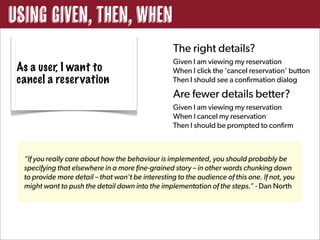
Using Given, Then, When
                                                    The right details?
                                                    Given I am viewing my reservation
 As a user, I want to                               When I click the ‘cancel reservation’ button
 cancel a reservation                               Then I should see a confirmation dialog

                                                    Are fewer details better?
                                                    Given I am viewing my reservation
                                                    When I cancel my reservation
                                                    Then I should be prompted to confirm


  “If you really care about how the behaviour is implemented, you should probably be
  specifying that elsewhere in a more fine-grained story – in other words chunking down
  to provide more detail – that won’t be interesting to the audience of this one. If not, you
  might want to push the detail down into the implementation of the steps.” - Dan North
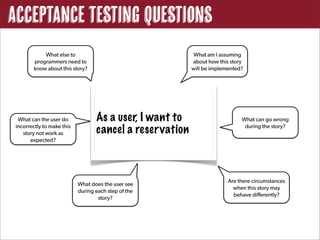
Acceptance Testing Questions
            What else to                                    What am I assuming
        programmers need to                                about how this story
        know about this story?                             will be implemented?


  What can the user do             As a user, I want to                       What can go wrong
 incorrectly to make this
    story not work as              cancel a reser vation                       during the story?

       expected?


                                                                         Are there circumstances
                            What does the user see
                                                                           when this story may
                            during each step of the
                                                                           behave differently?
                                    story?
Workshop #5

 In teams of 3 to 5, pick one to two stories from a
 previous workshop. Next, generate user workflow
 scenarios or given, when, then scenarios for each.


                  20m
                     Activity Time
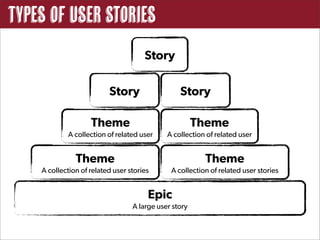
Types of User Stories
                                      Story

                          Story                  Story

                    Theme                              Theme
            A collection of related user     A collection of related user


               Theme                                     Theme
    A collection of related user stories      A collection of related user stories


                                       Epic
                                  A large user story
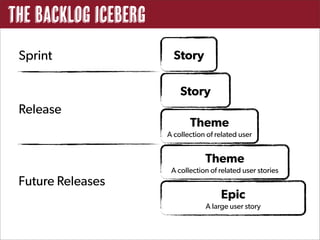
The Backlog Iceberg
 Sprint                 Story

                          Story
 Release
                             Theme
                      A collection of related user


                                  Theme
                       A collection of related user stories
 Future Releases
                                       Epic
                                  A large user story
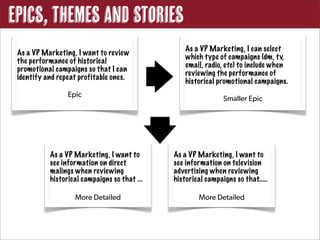
Epics, Themes and Stories
                                                  As a VP Marketing, I can select
 As a VP Marketing, I want to review
                                                  which type of campaigns (dm, t v,
 the performance of historical
                                                  email, radio, etc) to include when
 promotional campaigns so that I can
                                                  reviewing the performance of
 identify and repeat profitable ones.
                                                  historical promotional campaigns.
                 Epic
                                                               Smaller Epic


           As a VP Marketing, I want to       As a VP Marketing, I want to
           see information on direct          see information on television
           malings when reviewing             advertising when reviewing
           historical campaigns so that ...   historical campaigns so that.....

                   More Detailed                      More Detailed
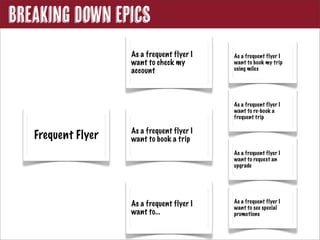
Breaking down Epics
                    As a frequent flyer I   As a frequent flyer I
                    want to check my        want to book my trip
                    account                 using miles


                                            As a frequent flyer I
                                            want to re-book a
                                            frequent trip

                    As a frequent flyer I
   Frequent Flyer   want to book a trip
                                            As a frequent flyer I
                                            want to request an
                                            upgrade


                                            As a frequent flyer I
                    As a frequent flyer I   want to see special
                    want to...              promotions
Workshop #6

 In teams of 3 to 5, first identify stories from a previous
 workshop which are too large. Next, breakdown the
 large stories into smaller more fine-grained stories.


                   20m
                       Activity Time
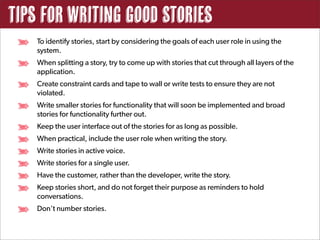
Tips for Writing good Stories
    To identify stories, start by considering the goals of each user role in using the
    system.
    When splitting a story, try to come up with stories that cut through all layers of the
    application.
    Create constraint cards and tape to wall or write tests to ensure they are not
    violated.
    Write smaller stories for functionality that will soon be implemented and broad
    stories for functionality further out.
    Keep the user interface out of the stories for as long as possible.
    When practical, include the user role when writing the story.
    Write stories in active voice.
    Write stories for a single user.
    Have the customer, rather than the developer, write the story.
    Keep stories short, and do not forget their purpose as reminders to hold
    conversations.
    Don’t number stories.
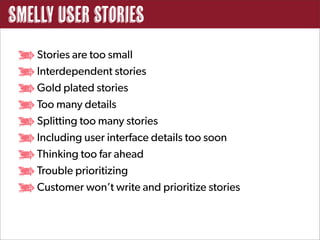
Smelly User Stories
   Stories are too small
   Interdependent stories
   Gold plated stories
   Too many details
   Splitting too many stories
   Including user interface details too soon
   Thinking too far ahead
   Trouble prioritizing
   Customer won’t write and prioritize stories
Workshop #7

 In teams of 3 to 5, first gather stories you’ve generated
 from previous workshops. Next, identify good and bad
 user stories and note how they differ.


                   20m
                      Activity Time

Effective User Stories

  • 1.
    User Stories 21stCentury Requirements
  • 2.
    your instructor Derek Neighbors derek@integrumtech.com @dneighbors
  • 3.
    What Makes aStory? Card Stories are traditionally written on note cards and they may be annotated with notes, estimates, etc. Conversation Details behind the story come out during conversations with the product owner. Confirmation Acceptance tests confirm the story was coded correctly
  • 4.
    What Is aStory Card? Short description of user- or customer- valued functionality. The visible part of a story, but the important parts are the conversations between the customer and
  • 5.
    Who writes astory card? The customer team writes the story cards because they are in the best position to express the desired features and because they must later be able to work out story details with developers and to prioritize the stories. The customer team includes those who ensure that the software will meet the needs of its intended users. This may include testers, product manager, real users and interaction designers.
  • 6.
    Why User Stories? Understoodequally well by everyone Useful for iteration planning Encourage deferring of details Great for iterative development Support opportunistic design Emphasize verbal communication
  • 7.
    POp Quiz! 1. Whatare the three parts of a user story? 2.Who is on the customer team? 3.What advantages do requirements conversations have over requirements documents?
  • 8.
    User Story Templates Asa <type of user> In order to <value> I want to <goal> as a <customer role> so that <reason> I want <some feature> As a vacationer, In order to determine which I want to see photos of hotel rooms are the nicest, rooms, as a vacationer, so that I can see which have I want to see photos of hotels the nicest rooms
  • 9.
    What Makes aGood Story? I Independent N Negotiable V Valuable E Estimatable S Sized Appropriately T Testable
  • 10.
    What Makes aGood Story? I Independent Dependencies lead to problems estimating and prioritizing. Ideally you can work on a single story without pulling in lots of other stories.
  • 11.
    What Makes aGood Story? N Negotiable Stories are not contracts, they leave (or imply) some flexibility.
  • 12.
    What Makes aGood Story? V Valuable Valuable to users or customers, not developers. Rewrite developer stories to reflect value to users or customers.
  • 13.
    What Makes aGood Story? E Estimatable We need to be able to estimate our user stories so that we can use them to create a plan.
  • 14.
    What Makes aGood Story? S Sized Appropriately A story is sized appropriately when it can be completed in one iteration.
  • 15.
    What Makes aGood Story? T Testable You should have an easy and binary way of knowing when a story is finished. Done or not done; not partially finished or “done... except...”
  • 16.
    POP QUIZ! Findthe bad user stories: The user can run the All graphing and system on Windows and charting will be done Linux using a 3rd party library The soft ware will be The user can undo up to released on June 30th fifty commands
  • 17.
    Workshop #1 Inteams of 3 to 4 write at least 15 user stories for a travel website. 20m Activity Time
  • 18.
    User Role Modeling Consider all types of users in a system. Avoid writing stories from a single perspective by first identifying different user roles that will interact with the system. Define relevant attributes for each user role, to better see the differences between roles. Some roles do well with a persona, an imaginary representation of a user role.
  • 19.
    User Role ModelingSteps 1.Brainstorm an initial set of user roles 2.Organize the Initial Set 3.Consolidate Roles 4.Refine the Roles
  • 20.
    Refining Roles withAttributes The frequency with which the user will use the software. The user’s level of expertise within the domain. The user’s general level of proficiency with computers and software. The user’s level of proficiency with the software being developed. The user’s general goal for using the software. Some users are after convenience, others favor a rich experience, and so on.
  • 21.
    User Role Example User Role: Internal Recruiter Not particularly computer-sav vy but quite adept at using the Web. Will use the soft ware infrequently but intensely. Will read ads from other companies to figure out how to best word her ads. Ease of use is important, but more importantly what she learns must be easily recalled months later.
  • 22.
    Workshop #2 Inteams of 3 to 4 first identify user roles for a travel website. Next, refine those roles using attributes. 20m Activity Time
  • 23.
    How do wegather user stories? User Interviews Real users with different roles are best. What they ask for is not always what Integrum Tip: they want Ask open-ended and context-free questions. “How would you like to Questionnaires search for jobs?” vs. “Will you Good for large groups of users but not search for jobs by title?” a great primary technique Observation Helpful for determining how users interact with existing systems Story-Writing Workshops Includes developers, users, customers and others. Brainstorm to generate as many stories as possible.
  • 24.
    Trawling for Requirements The idea of eliciting and capturing requirements is wrong. It assumes that we already know all requirements and that they won’t change. Instead, think of trawling for requirements. This acknowledges that requirements are of different sizes and that they change over time.
  • 25.
    Workshop #3 Inteams of 3 to 5 first designate one team member as the product owner. Next, run a story workshop for a pet adoption website. 25m Activity Time
  • 26.
    User Proxies The User’s Manager May not be appropriate unless they are also a user Development Managers Seemingly a good user proxy due to their involvement, but they’re almost never the intended user Customers Best if they are in close communication with the users for whom they are purchasing the software. Even better if they are also a user Salespeople Very helpful if they have contact with a broad variety of customers, but avoid features that could have won the last lost sale Domain Experts Avoid stories that require a user to be at their level of expertise The Marketing Group Quality stories vs. Quantity of stories
  • 27.
    Customer Team 1. Addreal users 2. Identify a product champion Integrum Tip: 3. Determine the factors critical to A real user beats a proxy user every time. success What problems might occur when using a proxy user?
  • 28.
    Workshop #4 Inteams of 3 to 5, each team member should choose a user proxy role. Next, briefly interview each user proxy using the travel website product. Finally, gather shortcomings and possible improvements when using user proxies. 20m Activity Time
  • 29.
    Where are theDetails? Does the user get a full Is confirmation provided or partial refund? Is it a to the user? How? refund or site credit? As a user, I want to Are the terms different for members of the frequent How far ahead must the reservation be cancelled? cancel a reser vation travelers club? Is the process the same How late can the user for all hotels? cancel the reservation?
  • 30.
    Details Added asSmaller STories As a premium member, I can cancel a reservation up to the last minute As a user, I want to As a non-premium member, I can cancel a reservation up cancel a reservation to 24 hours in advance As a user I am e-mailed a confirmation when I cancel a reservation
  • 31.
    Details as Conditionsof Satisfaction As a user, I want to cancel a reservation Conditions of Satisfaction Verify that a premium member can cancel the same day without a fee Verify that a premium member is charged 10% for same day cancellation Verify that an e-mail confirmation is sent Verify that the hotel is notified of the cancellation
  • 32.
    Details as AcceptanceCriteria As a VP of Marketing, I want to see information Integrum Tip: on television advertising Ensure that your conditions of when viewing historical satisfaction or acceptance campaigns acceptance criteria help further define “done.” Acceptance Criteria See how many viewers by age range See how many viewers by income level See how many viewers by gender
  • 33.
    Acceptance Testing Acceptance tests are used to express the many details that result from conversations between customers and developers. Other Types of Tests User interface testing Usability testing Performance Testing Stress Testing
  • 34.
    User Workflow Scenarios Integrum Tip: As a user, I want to cancel a reservation Draw out simple wireframes to explain each step in the user workflow. When I am viewing my reservation How far ahead must the I should see a button to cancel my reservation reservation be cancelled? When I click the ‘cancel reservation’ button I should see a confirmation dialog When I am viewing my reservation more than 24 hours in advance ... When I am viewing my reservation less than 24 hours in advance ...
  • 35.
    Using Given, Then,When The right details? Given I am viewing my reservation As a user, I want to When I click the ‘cancel reservation’ button cancel a reservation Then I should see a confirmation dialog Are fewer details better? Given I am viewing my reservation When I cancel my reservation Then I should be prompted to confirm “If you really care about how the behaviour is implemented, you should probably be specifying that elsewhere in a more fine-grained story – in other words chunking down to provide more detail – that won’t be interesting to the audience of this one. If not, you might want to push the detail down into the implementation of the steps.” - Dan North
  • 36.
    Acceptance Testing Questions What else to What am I assuming programmers need to about how this story know about this story? will be implemented? What can the user do As a user, I want to What can go wrong incorrectly to make this story not work as cancel a reser vation during the story? expected? Are there circumstances What does the user see when this story may during each step of the behave differently? story?
  • 37.
    Workshop #5 Inteams of 3 to 5, pick one to two stories from a previous workshop. Next, generate user workflow scenarios or given, when, then scenarios for each. 20m Activity Time
  • 38.
    Types of UserStories Story Story Story Theme Theme A collection of related user A collection of related user Theme Theme A collection of related user stories A collection of related user stories Epic A large user story
  • 39.
    The Backlog Iceberg Sprint Story Story Release Theme A collection of related user Theme A collection of related user stories Future Releases Epic A large user story
  • 40.
    Epics, Themes andStories As a VP Marketing, I can select As a VP Marketing, I want to review which type of campaigns (dm, t v, the performance of historical email, radio, etc) to include when promotional campaigns so that I can reviewing the performance of identify and repeat profitable ones. historical promotional campaigns. Epic Smaller Epic As a VP Marketing, I want to As a VP Marketing, I want to see information on direct see information on television malings when reviewing advertising when reviewing historical campaigns so that ... historical campaigns so that..... More Detailed More Detailed
  • 41.
    Breaking down Epics As a frequent flyer I As a frequent flyer I want to check my want to book my trip account using miles As a frequent flyer I want to re-book a frequent trip As a frequent flyer I Frequent Flyer want to book a trip As a frequent flyer I want to request an upgrade As a frequent flyer I As a frequent flyer I want to see special want to... promotions
  • 42.
    Workshop #6 Inteams of 3 to 5, first identify stories from a previous workshop which are too large. Next, breakdown the large stories into smaller more fine-grained stories. 20m Activity Time
  • 43.
    Tips for Writinggood Stories To identify stories, start by considering the goals of each user role in using the system. When splitting a story, try to come up with stories that cut through all layers of the application. Create constraint cards and tape to wall or write tests to ensure they are not violated. Write smaller stories for functionality that will soon be implemented and broad stories for functionality further out. Keep the user interface out of the stories for as long as possible. When practical, include the user role when writing the story. Write stories in active voice. Write stories for a single user. Have the customer, rather than the developer, write the story. Keep stories short, and do not forget their purpose as reminders to hold conversations. Don’t number stories.
  • 44.
    Smelly User Stories Stories are too small Interdependent stories Gold plated stories Too many details Splitting too many stories Including user interface details too soon Thinking too far ahead Trouble prioritizing Customer won’t write and prioritize stories
  • 45.
    Workshop #7 Inteams of 3 to 5, first gather stories you’ve generated from previous workshops. Next, identify good and bad user stories and note how they differ. 20m Activity Time