„CHALLENGES AND OPPORTUNITIES FOR 
LITHUANIAN CONSUMERS IN THE OPEN 
ELECTRICITY MARKET” 
RIGA 
2014.03.14
OVERVIEW POINTS 
1. Liberalization, legislation 
2. Electricity pricing/ market price 
3. What has changed since the opening of the market 
4. Existing fears/questions and uncertainties
LIBERALIZATION, LEGISLATION 
* For customers an open market means: 
- you can choose a producer or trader from 
whom you buy power at your agreed price; 
- the power itself will be delivered to the 
customer by the system operator whose 
networks the customer is connected to.
LIBERALIZATION, LEGISLATION 
* The Lithuanian Power Exchange began 
operation on January 1, 2010 – a free electricity 
market was formed. 
* On June 18, 2012 the power exchange operator 
of Nordic countries Nord Pool Spot AS started 
administration of Lithuanian Power Exchange.
LIBERALIZATION, LEGISLATION 
* The electricity market in LT changed markedly in 2010. 
* One producer was dominant in Lithuania: transmission, 
generation and supply activities were concentrated in one 
company; 
* Following are the chief changes in the electricity sector: 
The Ignalina Nuclear Power Plant was shut down on 
January 1, 2010 and Lithuania lost its largest and cheapest 
producer of electricity. 
AB “Lietuvos Energija” was dissolved. 
Production, management of the power grid and supply 
where separated, thereby implementing the EU Third Package 
directives, the main point of which is the promotion of 
competition in the energy sector by separating production, 
transmission and distribution.
LIBERALIZATION, LEGISLATION 
* From January 1st of 2010 - consumers with over 400 
kW capacity 
* From January 1st of 2011 - consumers with over 100 
kW capacity 
* From January 1st of 2012 - consumers with over 30 
kW capacity 
* From January 1st of 2013 all consumers, except 
households
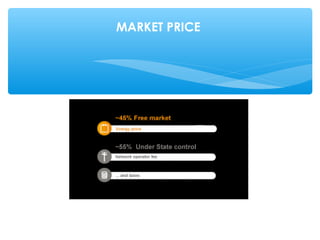
MARKET PRICE
ELECTRICITY PRICING/ MARKET PRICE 
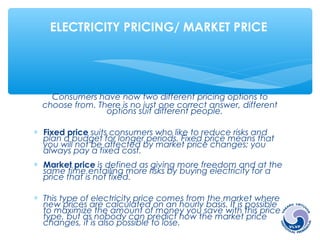
Consumers have now two different pricing options to 
choose from. There is no just one correct answer, different 
options suit different people. 
* Fixed price suits consumers who like to reduce risks and 
plan a budget for longer periods. Fixed price means that 
you will not be affected by market price changes; you 
always pay a fixed cost. 
* Market price is defined as giving more freedom and at the 
same time entailing more risks by buying electricity for a 
price that is not fixed. 
* This type of electricity price comes from the market where 
new prices are calculated on an hourly basis. It is possible 
to maximize the amount of money you save with this price 
type, but as nobody can predict how the market price 
changes, it is also possible to lose.
ELECTRICITY PRICING/ MARKET PRICE 
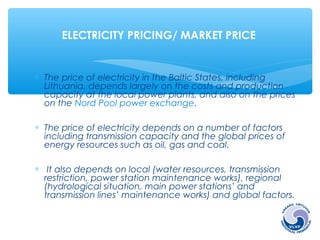
* The price of electricity in the Baltic States, including 
Lithuania, depends largely on the costs and production 
capacity at the local power plants, and also on the prices 
on the Nord Pool power exchange. 
* The price of electricity depends on a number of factors 
including transmission capacity and the global prices of 
energy resources such as oil, gas and coal. 
* It also depends on local (water resources, transmission 
restriction, power station maintenance works), regional 
(hydrological situation, main power stations’ and 
transmission lines’ maintenance works) and global factors.
PRICING DECISIONS: ELECTRICITY IN 2013 
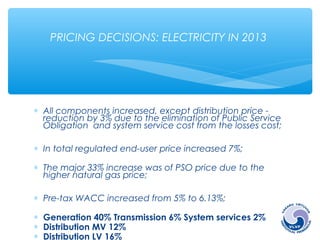
* All components increased, except distribution price - 
reduction by 3% due to the elimination of Public Service 
Obligation and system service cost from the losses cost; 
* In total regulated end-user price increased 7%; 
* The major 33% increase was of PSO price due to the 
higher natural gas price; 
* Pre-tax WACC increased from 5% to 6.13%; 
* Generation 40% Transmission 6% System services 2% 
* Distribution MV 12% 
* Distribution LV 16% 
Supply 1% Public Service Obligations 23%
Average price of electricity in 2010– 
2013, LTLct/kWh (VAT excluded)
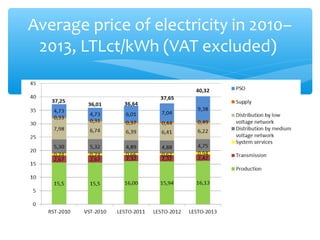
Average price of electricity in 2010– 
2013, LTL ct/kWh (VAT excluded) 
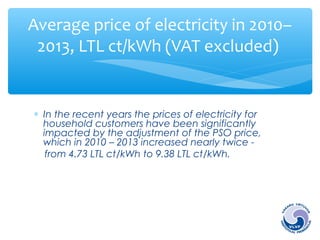
* In the recent years the prices of electricity for 
household customers have been significantly 
impacted by the adjustment of the PSO price, 
which in 2010 – 2013 increased nearly twice - 
from 4.73 LTL ct/kWh to 9.38 LTL ct/kWh.
Electricity prices to household customers in 
the European Union in 2012, EUR/kWh, VAT 
excluded
Electricity prices to household customers in 
the European Union in 2012, EUR/kWh, VAT 
excluded 
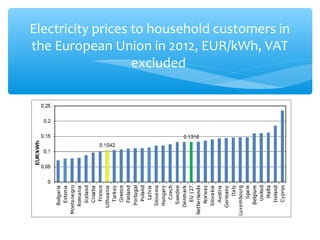
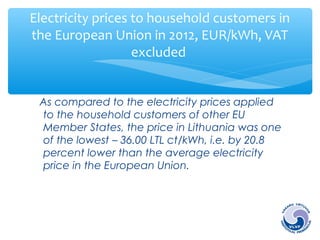
As compared to the electricity prices applied 
to the household customers of other EU 
Member States, the price in Lithuania was one 
of the lowest – 36.00 LTL ct/kWh, i.e. by 20.8 
percent lower than the average electricity 
price in the European Union.
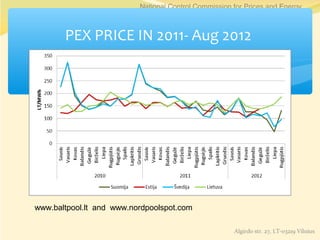
PEX PRICE IN 2011- Aug 2012 
www.baltpool.lt and www.nordpoolspot.com
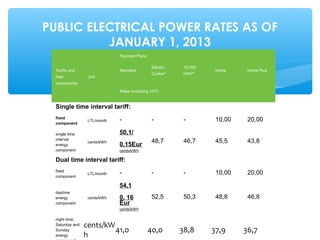
PUBLIC ELECTRICAL POWER RATES AS OF 
JANUARY 1, 2013 
Tariffs and 
their 
components 
Unit 
Payment Plans 
Standard 
Electric 
Cooker* 
12,000 
kWh** 
Home Home Plus 
Rates (including VAT) 
Single time interval tariff: 
fixed 
LTL/month - - - 10,00 20,00 
component single time 
interval 
energy 
cents/kWh 
component 
50,1/ 
0,15Eur 
cents/kWh 
48,7 46,7 45,5 43,8 
Dual time interval tariff: 
fixed 
component LTL/month - - - 10,00 20,00 
daytime 
energy 
component 
cents/kWh 
54,1 
0, 16 
Eur 
cents/kWh 
52,5 50,3 48,8 46,8 
night time, 
Saturday and 
Sunday 
energy 
component 
cents/kW 
h 41,0 40,0 38,8 37,9 36,7
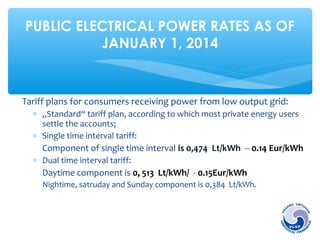
PUBLIC ELECTRICAL POWER RATES AS OF 
JANUARY 1, 2014 
Tariff plans for consumers receiving power from low output grid: 
* „Standard“ tariff plan, according to which most private energy users 
settle the accounts; 
* Single time interval tariff: 
Component of single time interval is 0,474 Lt/kWh -- 0.14 Eur/kWh 
* Dual time interval tariff: 
Daytime component is 0, 513 Lt/kWh/ - 0.15Eur/kWh 
Nightime, satruday and Sunday component is 0,384 Lt/kWh.
Energy Independence: What has 
Changed?
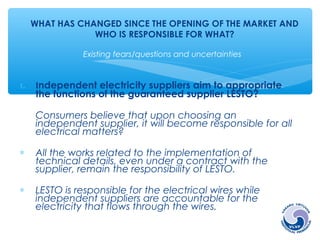
WHAT HAS CHANGED SINCE THE OPENING OF THE MARKET AND 
WHO IS RESPONSIBLE FOR WHAT? 
Existing fears/questions and uncertainties 
1. Independent electricity suppliers aim to appropriate 
the functions of the guaranteed supplier LESTO? 
Consumers believe that upon choosing an 
independent supplier, it will become responsible for all 
electrical matters? 
* All the works related to the implementation of 
technical details, even under a contract with the 
supplier, remain the responsibility of LESTO. 
* LESTO is responsible for the electrical wires while 
independent suppliers are accountable for the 
electricity that flows through the wires.
WHAT HAS CHANGED SINCE THE OPENING OF THE MARKET 
Existing fears/questions and uncertainties 
2. Two Invoices and Agreements instead of One? 
The anxiety is caused by two invoices – one received from the 
supplier, and the other one from LESTO. Most frequently, such a 
situation is associated with double taxation. 
Users who choose an independent electricity supplier do not 
terminate their agreement with LESTO; they simply adjust it and 
purchase only the transfer service. 
Therefore, they receive two invoices – one from the supplier for 
the active power, the other – from LESTO for electricity transfer 
via transmission and distribution networks, as well as for system 
(quality electricity supply) services and Public Service Obligations 
(PSO) at a price set by the National Control Commission for Prices 
and Energy (NCC).
WHAT HAS CHANGED SINCE THE OPENING OF THE 
MARKET 
* Independent suppliers are currently in active 
operation in Lithuania; 
* These suppliers should gradually take over the 
consumer base from AB LESTO.
what has changed since the opening of the market 
Existing fears/questions and uncertainties 
3. Is a Power Shortage Possible when Buying from 
Suppliers? 
4. What happens if the supplier goes bankrupt? 
If you select a supplier that goes bankrupt, power supply 
will be ensured by LESTO – the power will not be cut. Your 
agreement with the independent supplier will simply be 
null and void, and you will be obliged to pay LESTO at the 
guaranteed power supply rate, which is about 25 per cent 
higher than the one offered by suppliers.
WHAT HAS CHANGED SINCE THE OPENING OF THE MARKET 
Existing fears/questions and uncertainties 
*Independent Suppliers Provide the Possibility to Choose. 
*When deciding on a power supplier, the customer should 
analyse the electricity prices offered by different suppliers. 
The truth is that this particular price-related aspect is 
determined by the competitive conditions of the market 
and may vary depending on supplier offers. 
*Other components of the final price, such as power 
transmission, distribution or PSOs, are determined and 
approved by the NCC and apply to all customers. 
* This is because the electricity transmission and 
distribution network in Lithuania is an integral and 
monopolistic system.
PRICING DECISIONS FOR 2014: ELECTRICITY 
* Energy price and public supply price increased 
accordingly 1% and 6%; 
* Transmission, system and distribution service prices 
decreased accordingly 9%, 55% and 1-6% depending 
on voltage level; 
* Public Service Obligation price may decrease about 
28%, if quotas are not approved – there is a need of 
Government decision; 
* •The final decision is not taken yet (preliminary data in 
LTLct/kWh).
THANK YOU FOR YOUR ATTENTION

Lessons learned presentation Lithuania

  • 1.
    „CHALLENGES AND OPPORTUNITIESFOR LITHUANIAN CONSUMERS IN THE OPEN ELECTRICITY MARKET” RIGA 2014.03.14
  • 2.
    OVERVIEW POINTS 1.Liberalization, legislation 2. Electricity pricing/ market price 3. What has changed since the opening of the market 4. Existing fears/questions and uncertainties
  • 3.
    LIBERALIZATION, LEGISLATION *For customers an open market means: - you can choose a producer or trader from whom you buy power at your agreed price; - the power itself will be delivered to the customer by the system operator whose networks the customer is connected to.
  • 4.
    LIBERALIZATION, LEGISLATION *The Lithuanian Power Exchange began operation on January 1, 2010 – a free electricity market was formed. * On June 18, 2012 the power exchange operator of Nordic countries Nord Pool Spot AS started administration of Lithuanian Power Exchange.
  • 5.
    LIBERALIZATION, LEGISLATION *The electricity market in LT changed markedly in 2010. * One producer was dominant in Lithuania: transmission, generation and supply activities were concentrated in one company; * Following are the chief changes in the electricity sector: The Ignalina Nuclear Power Plant was shut down on January 1, 2010 and Lithuania lost its largest and cheapest producer of electricity. AB “Lietuvos Energija” was dissolved. Production, management of the power grid and supply where separated, thereby implementing the EU Third Package directives, the main point of which is the promotion of competition in the energy sector by separating production, transmission and distribution.
  • 6.
    LIBERALIZATION, LEGISLATION *From January 1st of 2010 - consumers with over 400 kW capacity * From January 1st of 2011 - consumers with over 100 kW capacity * From January 1st of 2012 - consumers with over 30 kW capacity * From January 1st of 2013 all consumers, except households
  • 7.
  • 8.
    ELECTRICITY PRICING/ MARKETPRICE Consumers have now two different pricing options to choose from. There is no just one correct answer, different options suit different people. * Fixed price suits consumers who like to reduce risks and plan a budget for longer periods. Fixed price means that you will not be affected by market price changes; you always pay a fixed cost. * Market price is defined as giving more freedom and at the same time entailing more risks by buying electricity for a price that is not fixed. * This type of electricity price comes from the market where new prices are calculated on an hourly basis. It is possible to maximize the amount of money you save with this price type, but as nobody can predict how the market price changes, it is also possible to lose.
  • 9.
    ELECTRICITY PRICING/ MARKETPRICE * The price of electricity in the Baltic States, including Lithuania, depends largely on the costs and production capacity at the local power plants, and also on the prices on the Nord Pool power exchange. * The price of electricity depends on a number of factors including transmission capacity and the global prices of energy resources such as oil, gas and coal. * It also depends on local (water resources, transmission restriction, power station maintenance works), regional (hydrological situation, main power stations’ and transmission lines’ maintenance works) and global factors.
  • 10.
    PRICING DECISIONS: ELECTRICITYIN 2013 * All components increased, except distribution price - reduction by 3% due to the elimination of Public Service Obligation and system service cost from the losses cost; * In total regulated end-user price increased 7%; * The major 33% increase was of PSO price due to the higher natural gas price; * Pre-tax WACC increased from 5% to 6.13%; * Generation 40% Transmission 6% System services 2% * Distribution MV 12% * Distribution LV 16% Supply 1% Public Service Obligations 23%
  • 11.
    Average price ofelectricity in 2010– 2013, LTLct/kWh (VAT excluded)
  • 12.
    Average price ofelectricity in 2010– 2013, LTL ct/kWh (VAT excluded) * In the recent years the prices of electricity for household customers have been significantly impacted by the adjustment of the PSO price, which in 2010 – 2013 increased nearly twice - from 4.73 LTL ct/kWh to 9.38 LTL ct/kWh.
  • 13.
    Electricity prices tohousehold customers in the European Union in 2012, EUR/kWh, VAT excluded
  • 14.
    Electricity prices tohousehold customers in the European Union in 2012, EUR/kWh, VAT excluded As compared to the electricity prices applied to the household customers of other EU Member States, the price in Lithuania was one of the lowest – 36.00 LTL ct/kWh, i.e. by 20.8 percent lower than the average electricity price in the European Union.
  • 15.
    PEX PRICE IN2011- Aug 2012 www.baltpool.lt and www.nordpoolspot.com
  • 16.
    PUBLIC ELECTRICAL POWERRATES AS OF JANUARY 1, 2013 Tariffs and their components Unit Payment Plans Standard Electric Cooker* 12,000 kWh** Home Home Plus Rates (including VAT) Single time interval tariff: fixed LTL/month - - - 10,00 20,00 component single time interval energy cents/kWh component 50,1/ 0,15Eur cents/kWh 48,7 46,7 45,5 43,8 Dual time interval tariff: fixed component LTL/month - - - 10,00 20,00 daytime energy component cents/kWh 54,1 0, 16 Eur cents/kWh 52,5 50,3 48,8 46,8 night time, Saturday and Sunday energy component cents/kW h 41,0 40,0 38,8 37,9 36,7
  • 17.
    PUBLIC ELECTRICAL POWERRATES AS OF JANUARY 1, 2014 Tariff plans for consumers receiving power from low output grid: * „Standard“ tariff plan, according to which most private energy users settle the accounts; * Single time interval tariff: Component of single time interval is 0,474 Lt/kWh -- 0.14 Eur/kWh * Dual time interval tariff: Daytime component is 0, 513 Lt/kWh/ - 0.15Eur/kWh Nightime, satruday and Sunday component is 0,384 Lt/kWh.
  • 18.
  • 19.
    WHAT HAS CHANGEDSINCE THE OPENING OF THE MARKET AND WHO IS RESPONSIBLE FOR WHAT? Existing fears/questions and uncertainties 1. Independent electricity suppliers aim to appropriate the functions of the guaranteed supplier LESTO? Consumers believe that upon choosing an independent supplier, it will become responsible for all electrical matters? * All the works related to the implementation of technical details, even under a contract with the supplier, remain the responsibility of LESTO. * LESTO is responsible for the electrical wires while independent suppliers are accountable for the electricity that flows through the wires.
  • 20.
    WHAT HAS CHANGEDSINCE THE OPENING OF THE MARKET Existing fears/questions and uncertainties 2. Two Invoices and Agreements instead of One? The anxiety is caused by two invoices – one received from the supplier, and the other one from LESTO. Most frequently, such a situation is associated with double taxation. Users who choose an independent electricity supplier do not terminate their agreement with LESTO; they simply adjust it and purchase only the transfer service. Therefore, they receive two invoices – one from the supplier for the active power, the other – from LESTO for electricity transfer via transmission and distribution networks, as well as for system (quality electricity supply) services and Public Service Obligations (PSO) at a price set by the National Control Commission for Prices and Energy (NCC).
  • 21.
    WHAT HAS CHANGEDSINCE THE OPENING OF THE MARKET * Independent suppliers are currently in active operation in Lithuania; * These suppliers should gradually take over the consumer base from AB LESTO.
  • 22.
    what has changedsince the opening of the market Existing fears/questions and uncertainties 3. Is a Power Shortage Possible when Buying from Suppliers? 4. What happens if the supplier goes bankrupt? If you select a supplier that goes bankrupt, power supply will be ensured by LESTO – the power will not be cut. Your agreement with the independent supplier will simply be null and void, and you will be obliged to pay LESTO at the guaranteed power supply rate, which is about 25 per cent higher than the one offered by suppliers.
  • 23.
    WHAT HAS CHANGEDSINCE THE OPENING OF THE MARKET Existing fears/questions and uncertainties *Independent Suppliers Provide the Possibility to Choose. *When deciding on a power supplier, the customer should analyse the electricity prices offered by different suppliers. The truth is that this particular price-related aspect is determined by the competitive conditions of the market and may vary depending on supplier offers. *Other components of the final price, such as power transmission, distribution or PSOs, are determined and approved by the NCC and apply to all customers. * This is because the electricity transmission and distribution network in Lithuania is an integral and monopolistic system.
  • 24.
    PRICING DECISIONS FOR2014: ELECTRICITY * Energy price and public supply price increased accordingly 1% and 6%; * Transmission, system and distribution service prices decreased accordingly 9%, 55% and 1-6% depending on voltage level; * Public Service Obligation price may decrease about 28%, if quotas are not approved – there is a need of Government decision; * •The final decision is not taken yet (preliminary data in LTLct/kWh).
  • 25.
    THANK YOU FORYOUR ATTENTION