BUSINESS PROCESS
AND SECURITY
Final Report
Submitted by:
Jainam Shah (100799068)
Darshit Patel (100806859)
Shaileshkumar Sutariya (100845925)
Manasarani Pothineni (100839887)
Harsha Patel (100802701)
Johar Partap Singh (100845634)
IDENTIFY
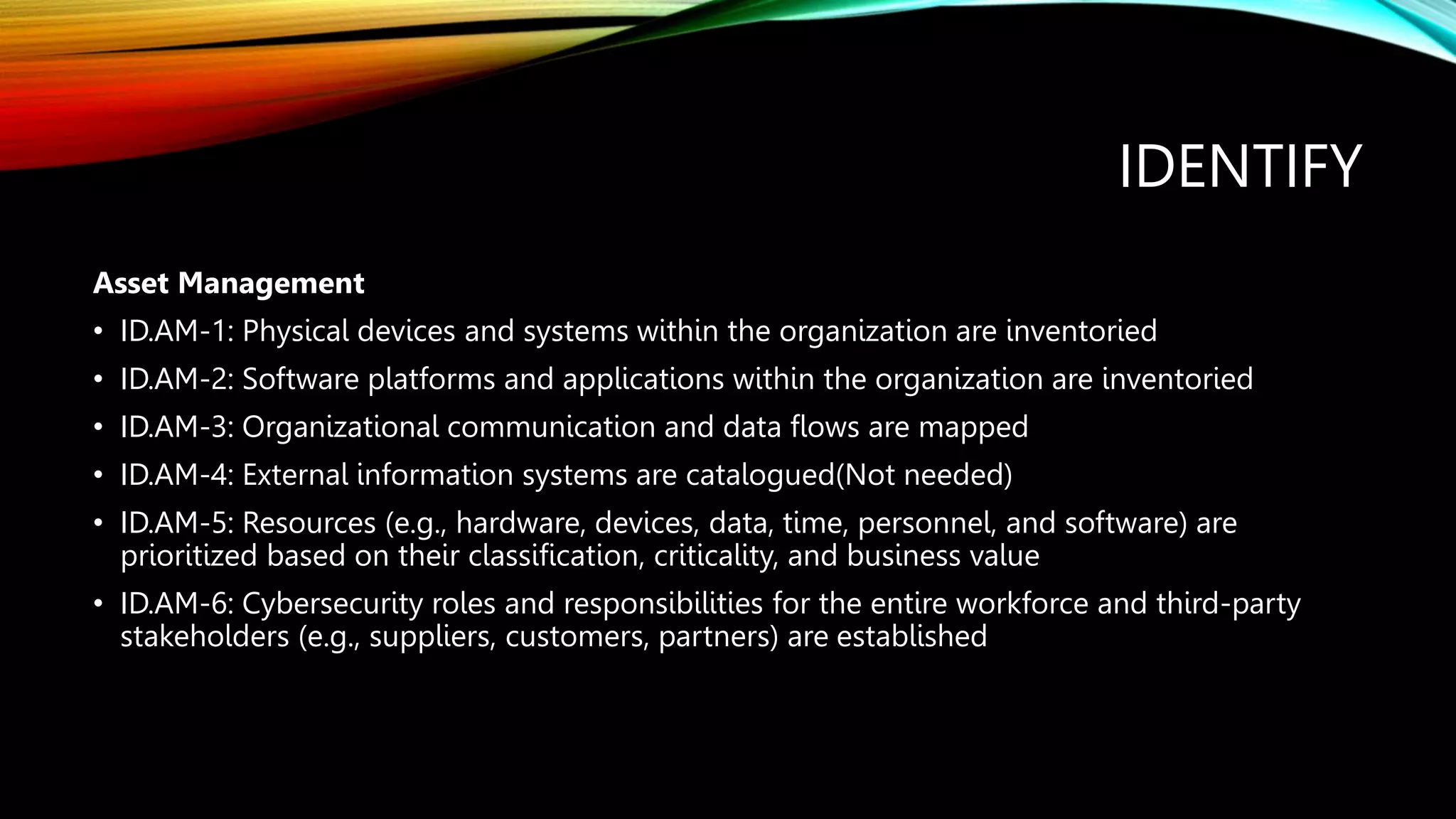
Asset Management
• ID.AM-1: Physical devices and systems within the organization are inventoried
• ID.AM-2: Software platforms and applications within the organization are inventoried
• ID.AM-3: Organizational communication and data flows are mapped
• ID.AM-4: External information systems are catalogued(Not needed)
• ID.AM-5: Resources (e.g., hardware, devices, data, time, personnel, and software) are
prioritized based on their classification, criticality, and business value
• ID.AM-6: Cybersecurity roles and responsibilities for the entire workforce and third-party
stakeholders (e.g., suppliers, customers, partners) are established
IDENTIFY
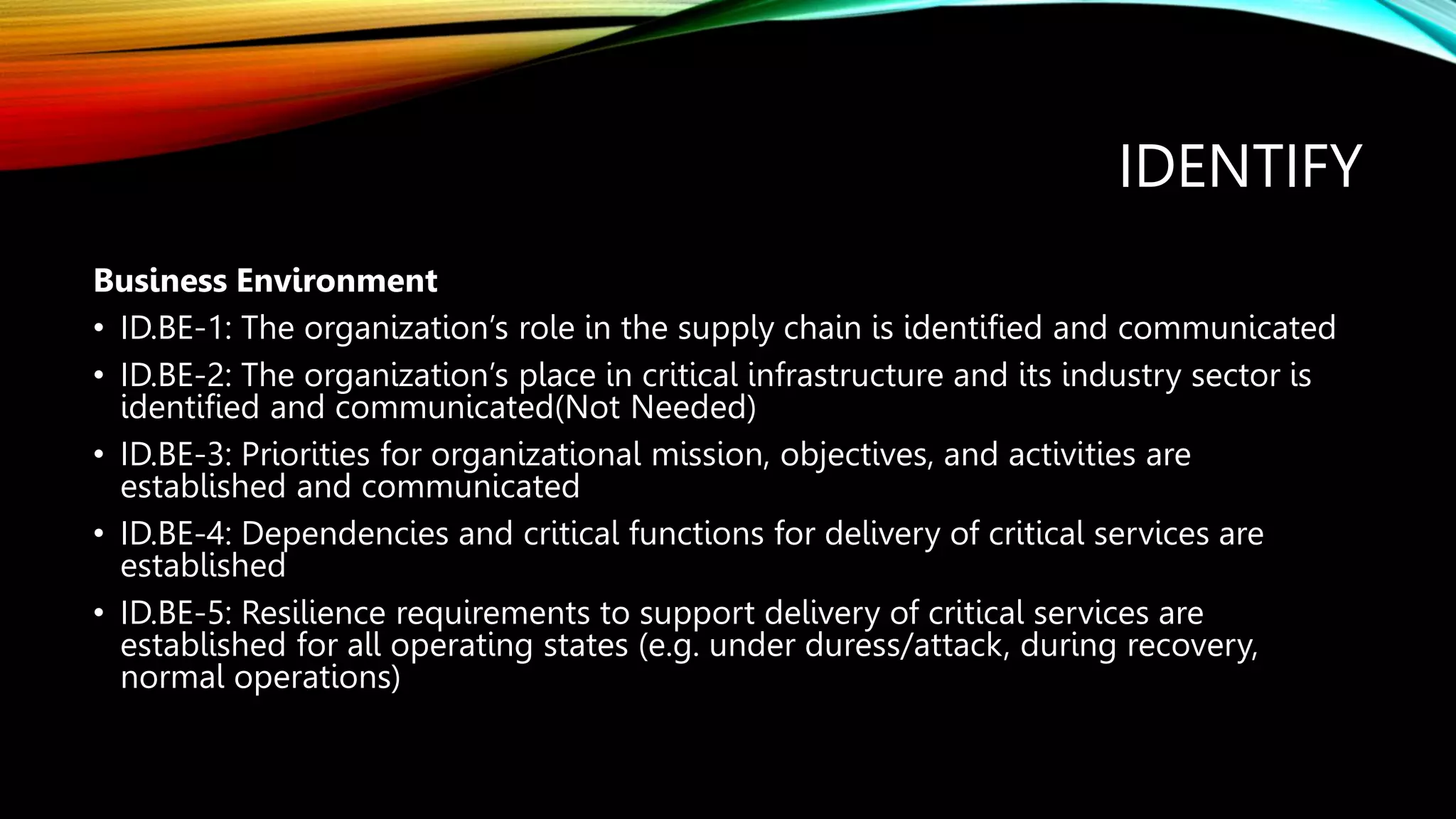
Business Environment
• ID.BE-1: The organization’s role in the supply chain is identified and communicated
• ID.BE-2: The organization’s place in critical infrastructure and its industry sector is
identified and communicated(Not Needed)
• ID.BE-3: Priorities for organizational mission, objectives, and activities are
established and communicated
• ID.BE-4: Dependencies and critical functions for delivery of critical services are
established
• ID.BE-5: Resilience requirements to support delivery of critical services are
established for all operating states (e.g. under duress/attack, during recovery,
normal operations)
IDENTIFY
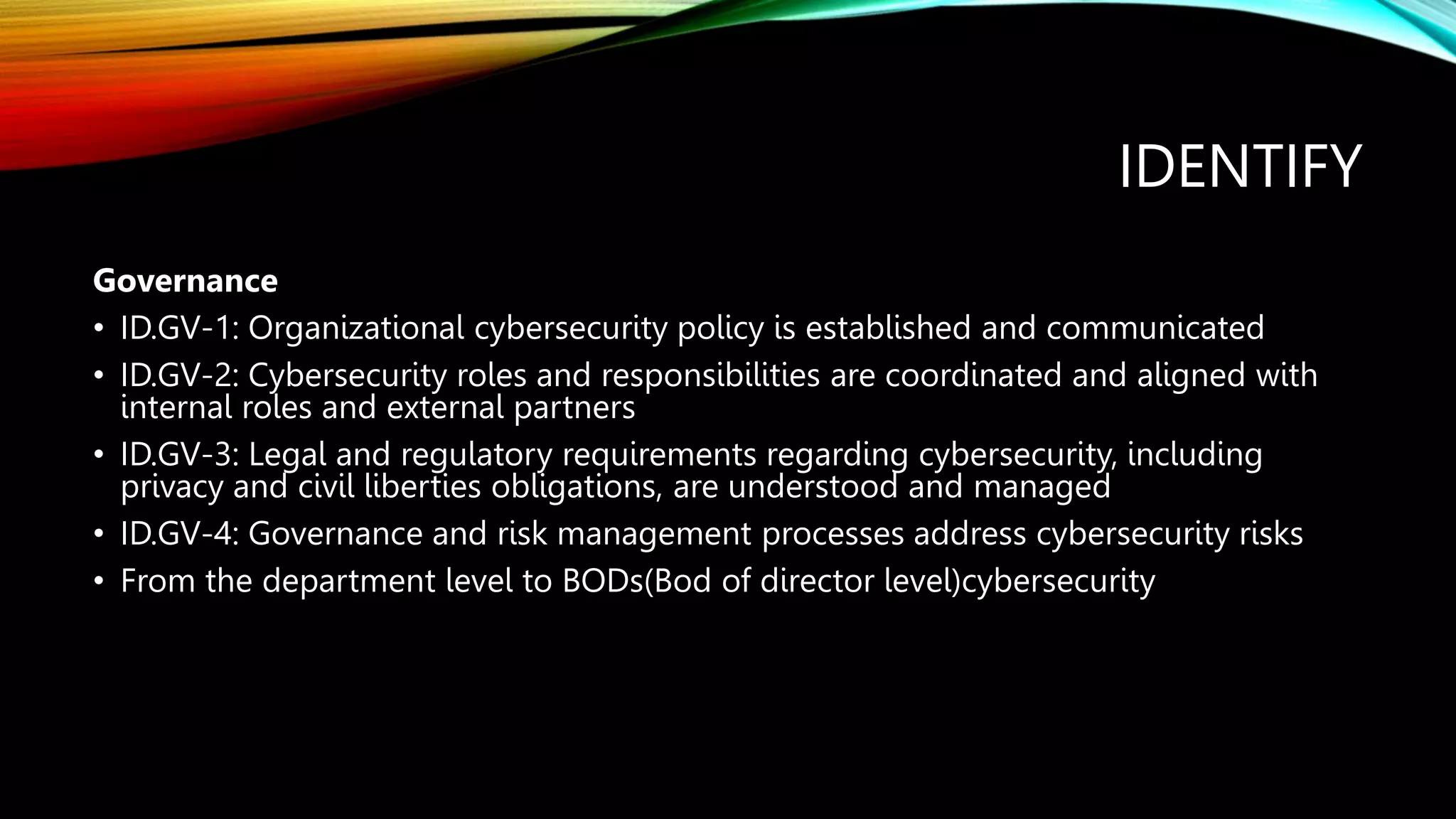
Governance
• ID.GV-1: Organizational cybersecurity policy is established and communicated
• ID.GV-2: Cybersecurity roles and responsibilities are coordinated and aligned with
internal roles and external partners
• ID.GV-3: Legal and regulatory requirements regarding cybersecurity, including
privacy and civil liberties obligations, are understood and managed
• ID.GV-4: Governance and risk management processes address cybersecurity risks
• From the department level to BODs(Bod of director level)cybersecurity
IDENTIFY
Risk Assessment
• ID.RA-1: Asset vulnerabilities are identified and documented
• ID.RA-2: Cyber threat intelligence is received from information sharing forums and
sources
• ID.RA-3: Threats, both internal and external, are identified and documented
• ID.RA-4: Potential business impacts and likelihoods are identified
• ID.RA-5: Threats, vulnerabilities, likelihoods, and impacts are used to determine
risk(Not needed)
• ID.RA-6: Risk responses are identified and prioritized
IDENTIFY
Risk Management Strategy
• ID.RM-1: Risk management processes are established, managed, and agreed to by
organizational stakeholders
• ID.RM-2: Organizational risk tolerance is determined and clearly expressed(No
needed)
• ID.RM-3: The organization’s determination of risk tolerance is informed by its role in
critical infrastructure and sector specific risk analysis
IDENTIFY
Supply Chain Risk Management
• ID.SC-1: Cyber supply chain risk management processes are identified, established, assessed,
managed, and agreed to by organizational stakeholders
• ID.SC-2: Suppliers and third party partners of information systems, components, and services
are identified, prioritized, and assessed using a cyber supply chain risk assessment
process(not needed)
• ID.SC-3: Contracts with suppliers and third-party partners are used to implement appropriate
measures designed to meet the objectives of an organization’s cybersecurity program and
Cyber Supply Chain Risk Management Plan.
• ID.SC-4: Suppliers and third-party partners are routinely assessed using audits, test results,
or other forms of evaluations to confirm they are meeting their contractual obligations.
• ID.SC-5: Response and recovery planning and testing are conducted with suppliers and
third-party providers
PROTECT
• Identity Management and Access Control (PR.AC)
• PR.AC-1: Identities and credentials are managed for authorized devices and users.
• PR.AC-2: Physical access to assets is Managed and protected
• PR.AC-3: Remote access is managed
• PR.AC-4: Access permissions are managed, incorporating the principles of least privilege
and separation of duties.
• PR.AC-5: Network integrity is protected, incorporating network segregation where
appropriate.
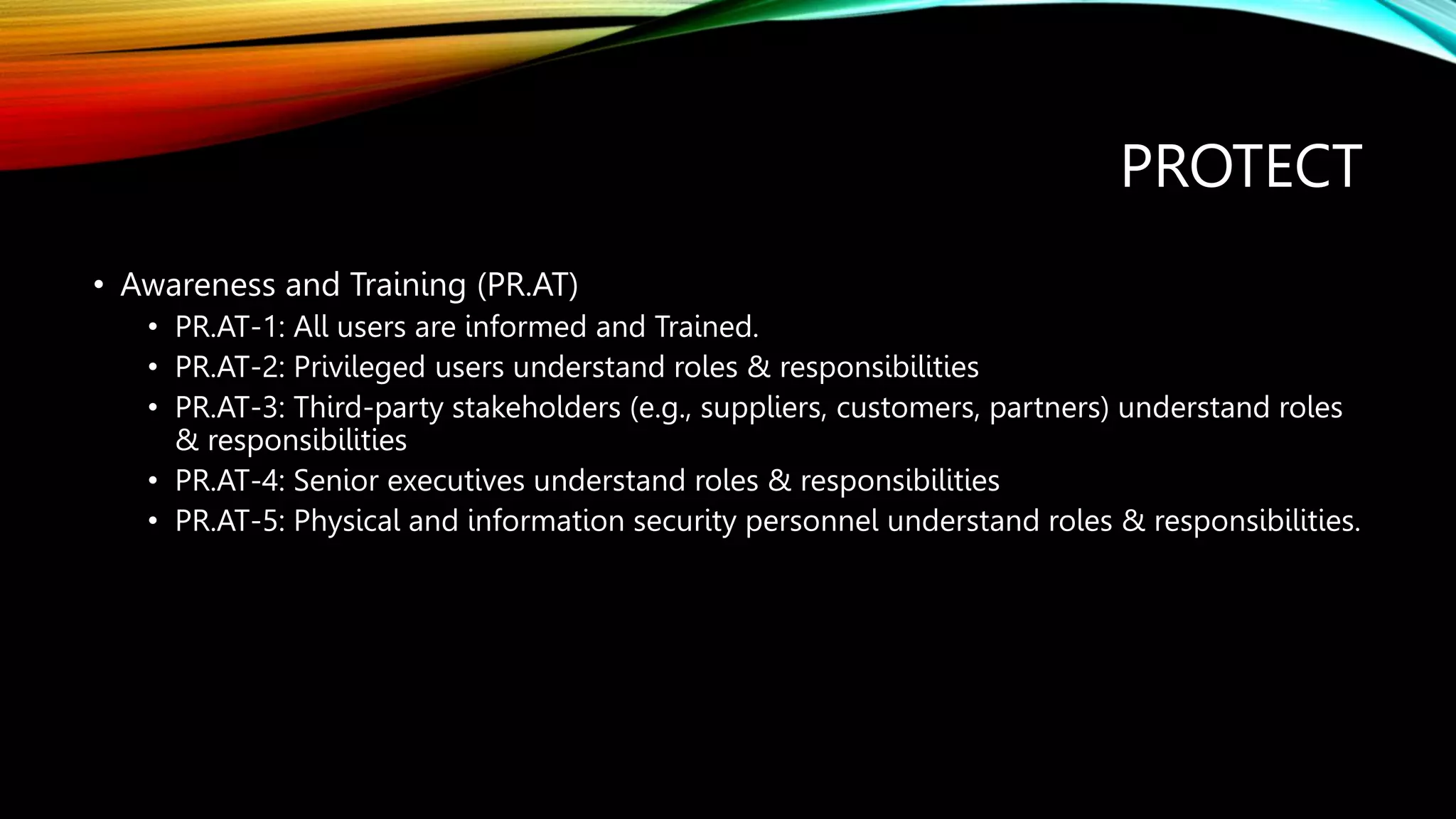
PROTECT
• Awareness and Training (PR.AT)
• PR.AT-1: All users are informed and Trained.
• PR.AT-2: Privileged users understand roles & responsibilities
• PR.AT-3: Third-party stakeholders (e.g., suppliers, customers, partners) understand roles
& responsibilities
• PR.AT-4: Senior executives understand roles & responsibilities
• PR.AT-5: Physical and information security personnel understand roles & responsibilities.
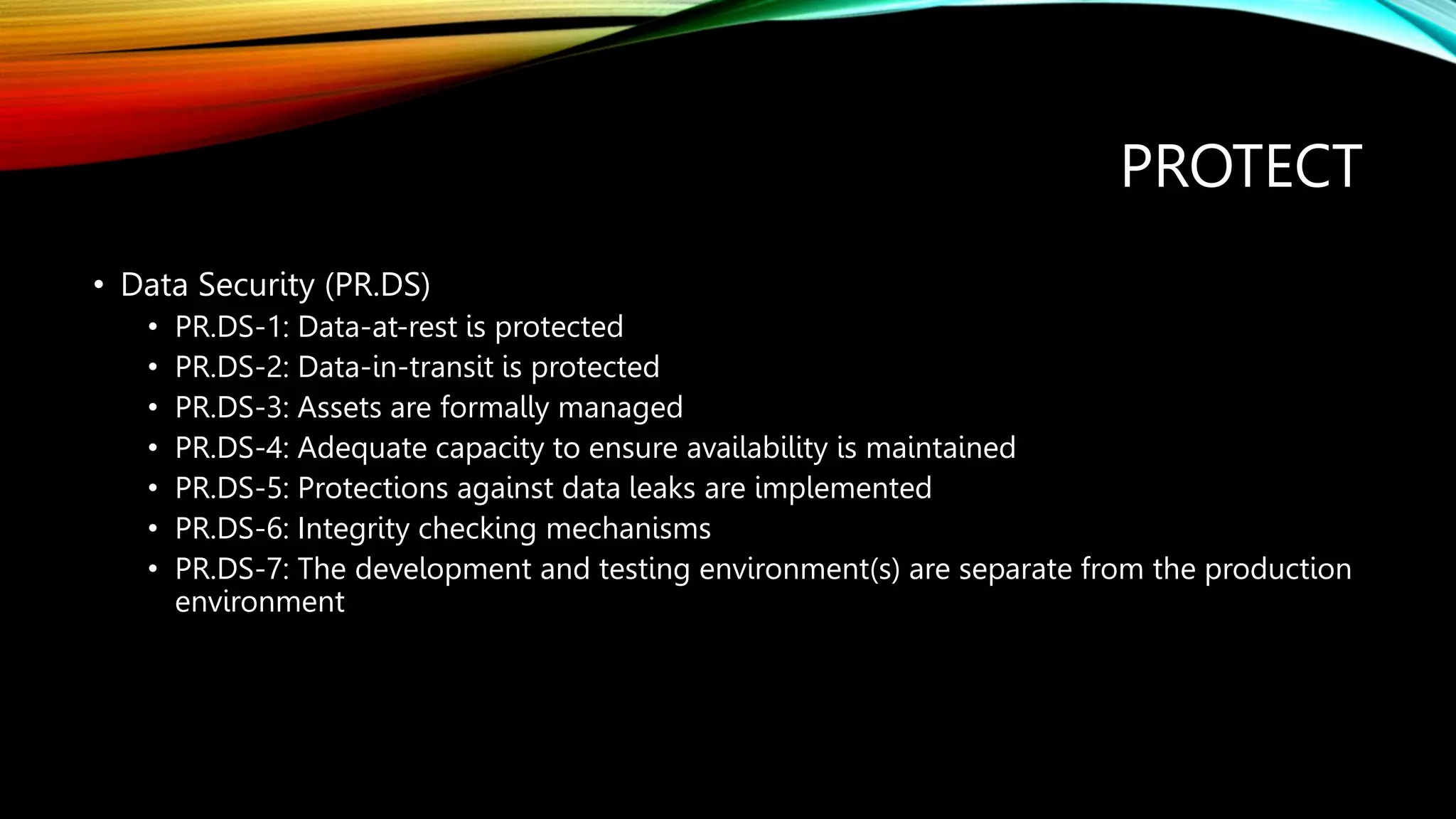
PROTECT
• Data Security (PR.DS)
• PR.DS-1: Data-at-rest is protected
• PR.DS-2: Data-in-transit is protected
• PR.DS-3: Assets are formally managed
• PR.DS-4: Adequate capacity to ensure availability is maintained
• PR.DS-5: Protections against data leaks are implemented
• PR.DS-6: Integrity checking mechanisms
• PR.DS-7: The development and testing environment(s) are separate from the production
environment
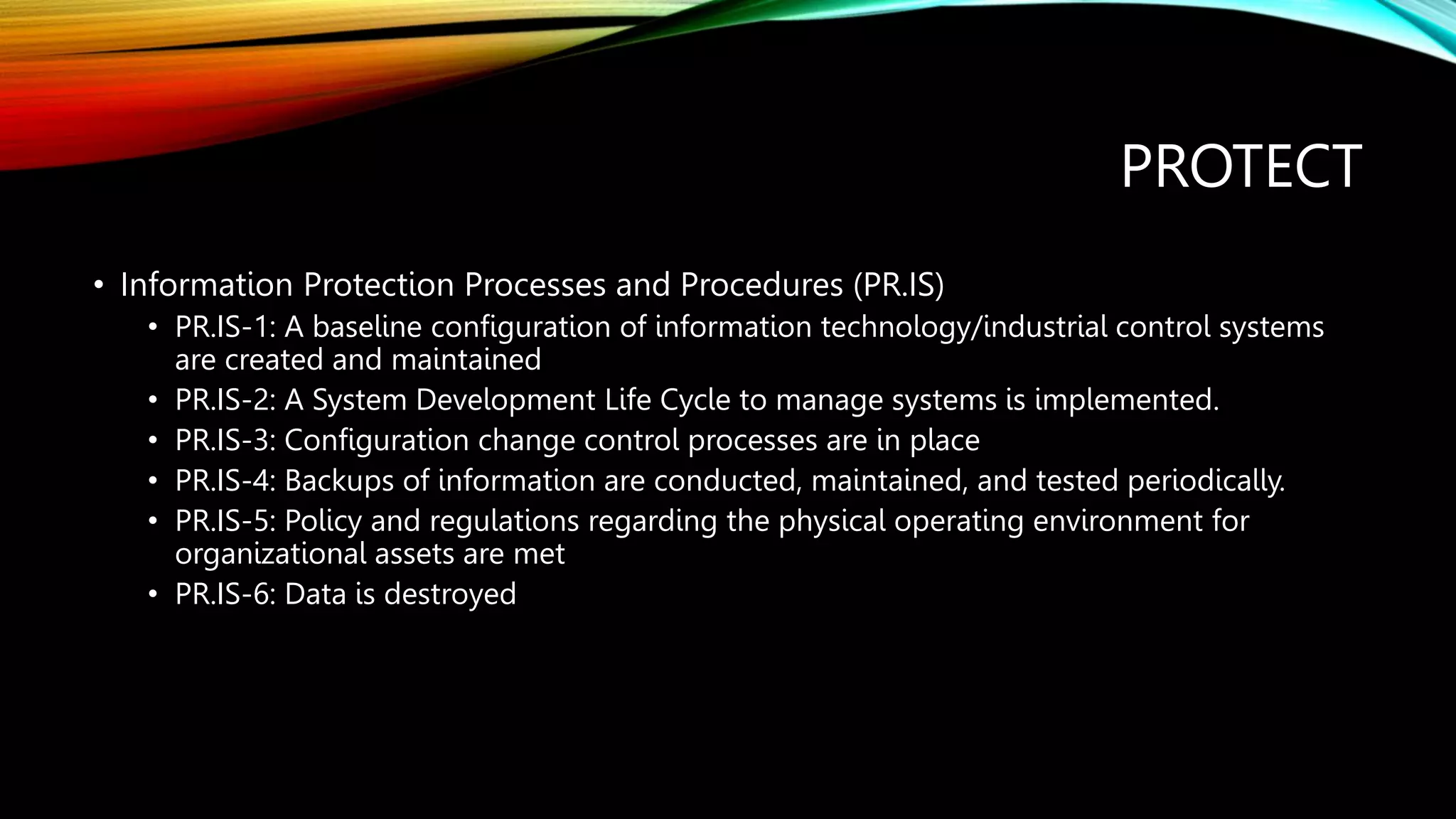
PROTECT
• Information Protection Processes and Procedures (PR.IS)
• PR.IS-1: A baseline configuration of information technology/industrial control systems
are created and maintained
• PR.IS-2: A System Development Life Cycle to manage systems is implemented.
• PR.IS-3: Configuration change control processes are in place
• PR.IS-4: Backups of information are conducted, maintained, and tested periodically.
• PR.IS-5: Policy and regulations regarding the physical operating environment for
organizational assets are met
• PR.IS-6: Data is destroyed
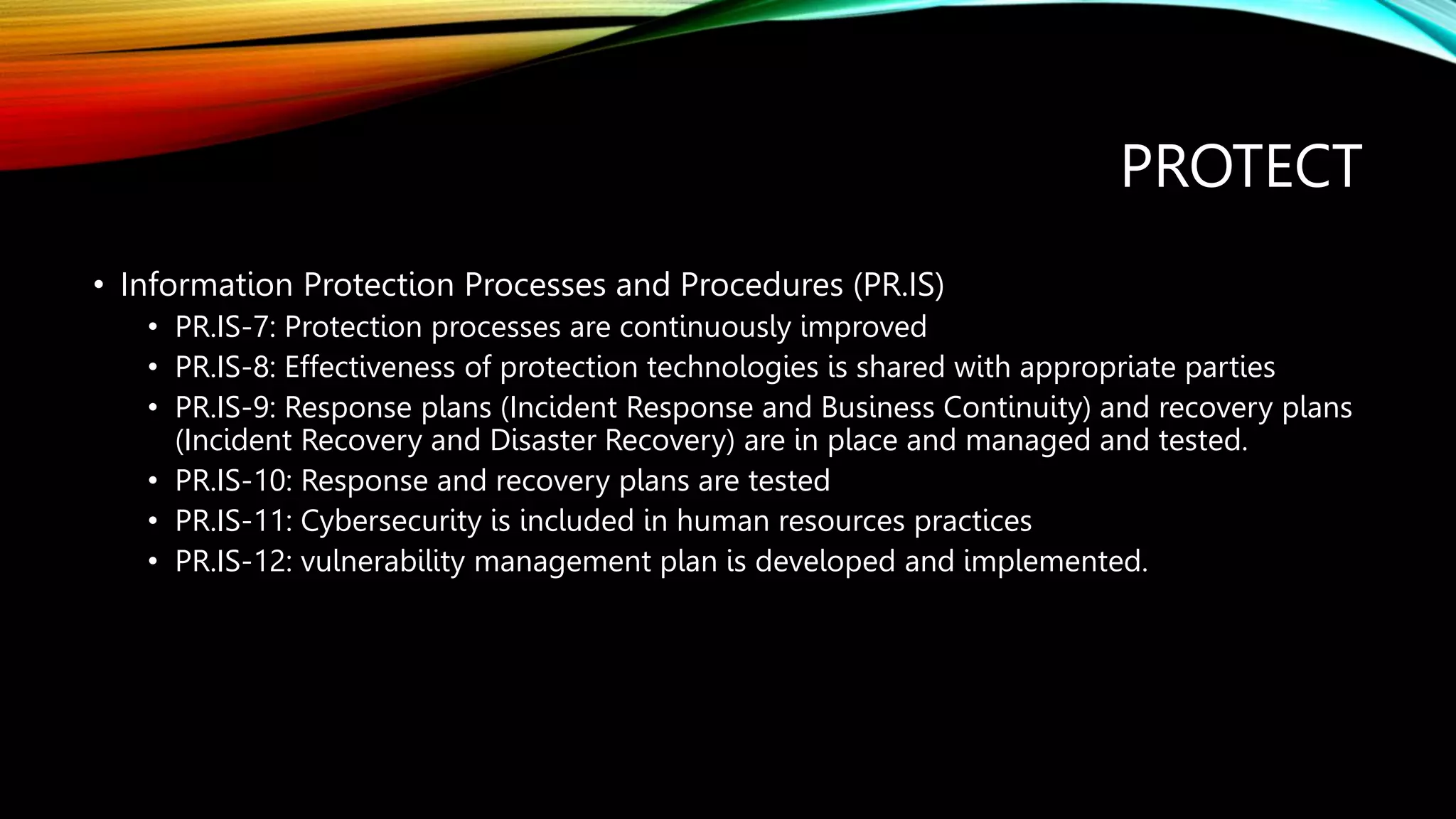
PROTECT
• Information Protection Processes and Procedures (PR.IS)
• PR.IS-7: Protection processes are continuously improved
• PR.IS-8: Effectiveness of protection technologies is shared with appropriate parties
• PR.IS-9: Response plans (Incident Response and Business Continuity) and recovery plans
(Incident Recovery and Disaster Recovery) are in place and managed and tested.
• PR.IS-10: Response and recovery plans are tested
• PR.IS-11: Cybersecurity is included in human resources practices
• PR.IS-12: vulnerability management plan is developed and implemented.
PROTECT
• Maintenance (PR.MA)
• PR.MA-1: Maintenance and repair of organizational assets is performed and logged in a
timely manner
• PR.MA-2: Remote maintenance of organizational assets is approved, logged, and
performed in a manner that prevents unauthorized access.
PROTECT
• Protective Technology (PR.PT)
• PR.PT-1: Audit/log records are determined, documented, implemented, and reviewed in
accordance with policy
• PR.PT-2: Removable media is protected and its use restricted according to policy.
• PR.PT-3: Access to systems and assets is controlled
DETECT
• Anomalies and events (DE.AE)
• DE.AE-1: baseline of network operations and expected data flows for users and systems
• DE.AE-2: The events that have been detected are evaluated
• DE.AE-3: Data is gathered and correlated from a variety of sources and sensors
• DE.AE-4: The impact of events is calculated.
• DE.AE-5: Incident alert thresholds are established.
DETECT
• Security continuous monitoring (DE.CM)
• DE.CM-1: The network is being watched
• DE.CM-2: The physical environment is monitored
• DE.CM-3: To detect potential cybersecurity events, personal activity is tracked
• DE.CM-4: Malicious code has been discovered
• DE.CM-5: Unauthorized mobile code is detected
• DE.CM-6: External service provider activity is monitored
• DE.CM-7: Unauthorized individuals, connections, devices, and software are all monitored
• DE.CM-8: Vulnerability scans are performed
DETECT
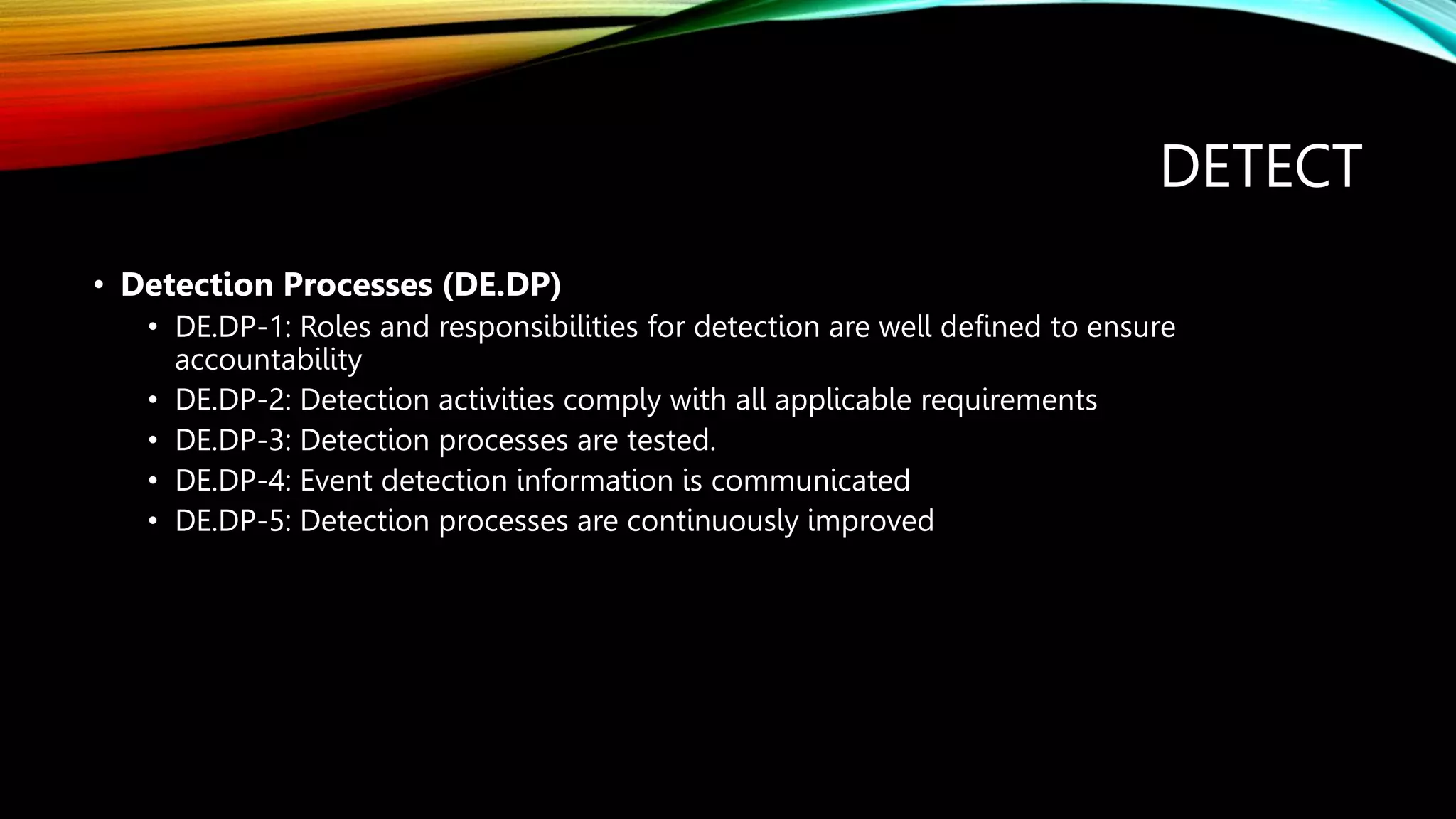
• Detection Processes (DE.DP)
• DE.DP-1: Roles and responsibilities for detection are well defined to ensure
accountability
• DE.DP-2: Detection activities comply with all applicable requirements
• DE.DP-3: Detection processes are tested.
• DE.DP-4: Event detection information is communicated
• DE.DP-5: Detection processes are continuously improved
RESPOND
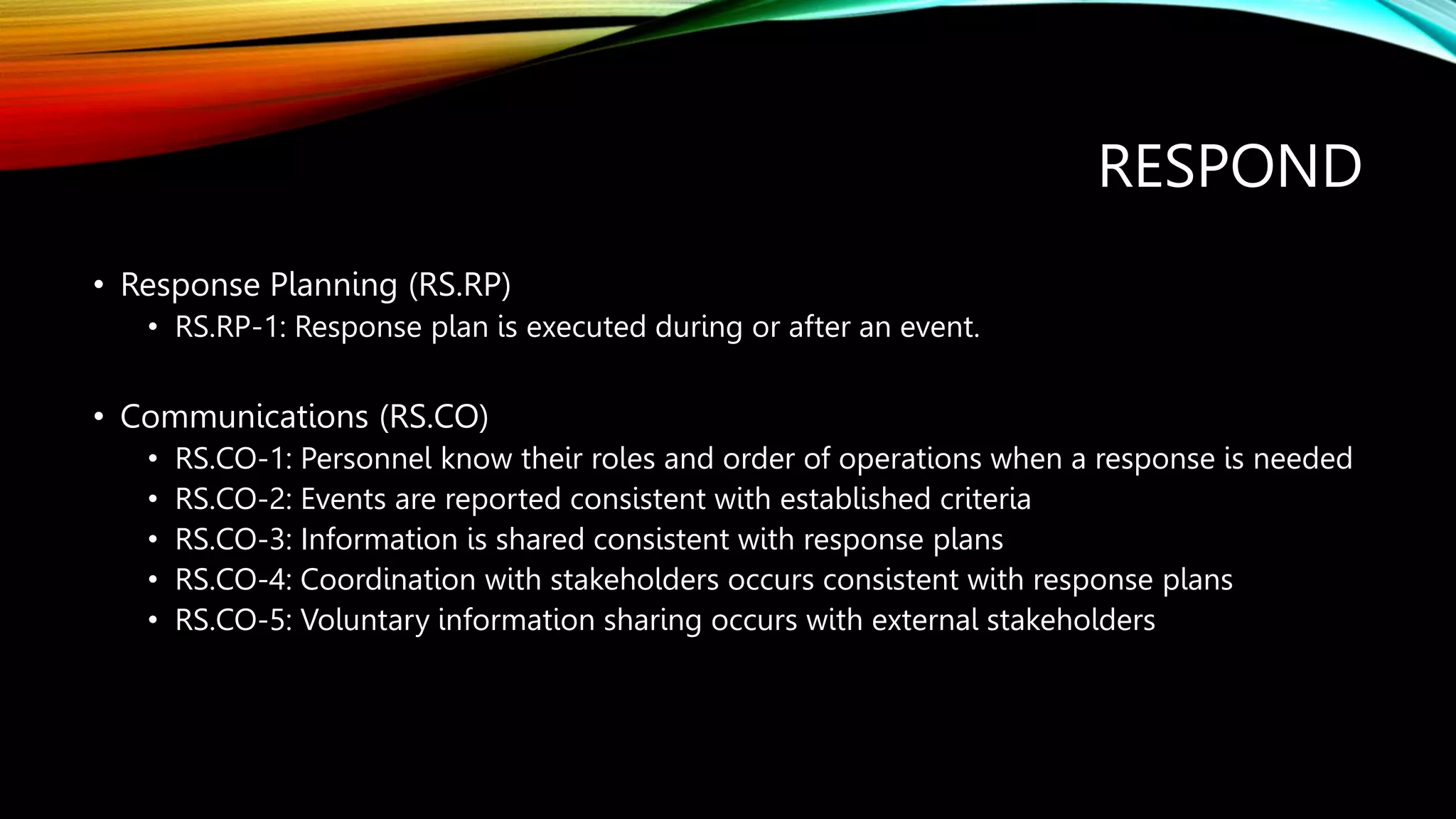
• Response Planning (RS.RP)
• RS.RP-1: Response plan is executed during or after an event.
• Communications (RS.CO)
• RS.CO-1: Personnel know their roles and order of operations when a response is needed
• RS.CO-2: Events are reported consistent with established criteria
• RS.CO-3: Information is shared consistent with response plans
• RS.CO-4: Coordination with stakeholders occurs consistent with response plans
• RS.CO-5: Voluntary information sharing occurs with external stakeholders
RESPOND
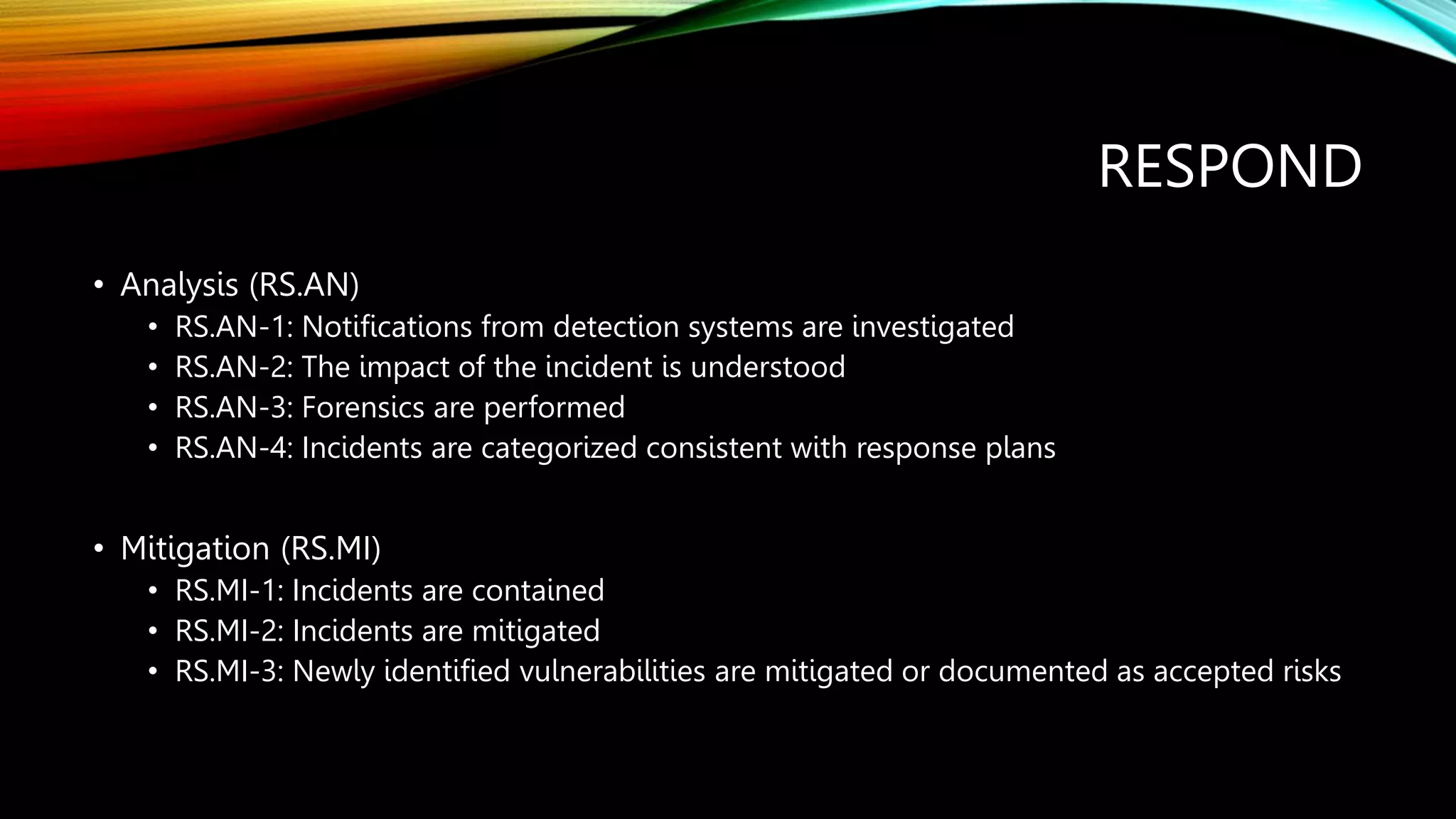
• Analysis (RS.AN)
• RS.AN-1: Notifications from detection systems are investigated
• RS.AN-2: The impact of the incident is understood
• RS.AN-3: Forensics are performed
• RS.AN-4: Incidents are categorized consistent with response plans
• Mitigation (RS.MI)
• RS.MI-1: Incidents are contained
• RS.MI-2: Incidents are mitigated
• RS.MI-3: Newly identified vulnerabilities are mitigated or documented as accepted risks
RESPOND
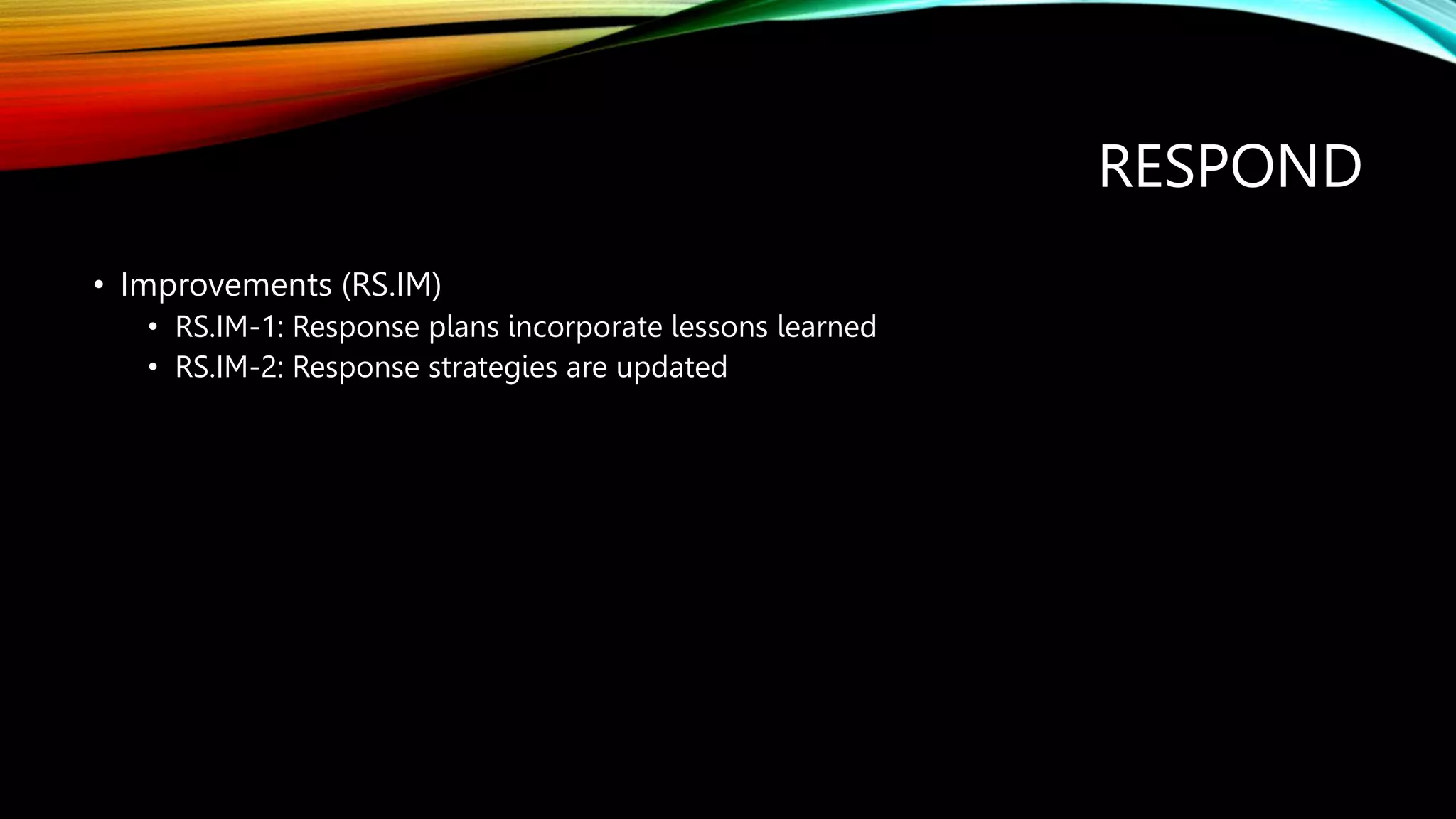
• Improvements (RS.IM)
• RS.IM-1: Response plans incorporate lessons learned
• RS.IM-2: Response strategies are updated
RECOVER
• Recovery Planning (RC.RP)
• RC.RP-1: Recovery plan
• RC.RP-2: Recovery processes and procedures
• RC.RP-3: Contact external entities
• RC.RP-4: Recovery communications
• RC.RP-5: Recovery insight sharing
• RC.RP-6: Recovery contingency measures
• RC.RP-7: Decision making
IMPROVEMENTS (RC.IM)
• RC.IM-1: Incorporation of lessons
learned by recovery plan.
• RC.IM-2: Updation of Recovery
strategies
COMMUNICATIONS
(RC.CO)
• RC.CO-1: Managing of Public Relations
for the benefit of organization
• RC.CO-2: Repairing of reputation of an
organization after the occurrence of an
incident.
• RC.CO-3: Communications of activities
employed for recovert from
cybersecurity incident towards external
and internal
THANK YOU!!

Business Process and securityPPT.pptx

  • 1.
    BUSINESS PROCESS AND SECURITY FinalReport Submitted by: Jainam Shah (100799068) Darshit Patel (100806859) Shaileshkumar Sutariya (100845925) Manasarani Pothineni (100839887) Harsha Patel (100802701) Johar Partap Singh (100845634)
  • 2.
    IDENTIFY Asset Management • ID.AM-1:Physical devices and systems within the organization are inventoried • ID.AM-2: Software platforms and applications within the organization are inventoried • ID.AM-3: Organizational communication and data flows are mapped • ID.AM-4: External information systems are catalogued(Not needed) • ID.AM-5: Resources (e.g., hardware, devices, data, time, personnel, and software) are prioritized based on their classification, criticality, and business value • ID.AM-6: Cybersecurity roles and responsibilities for the entire workforce and third-party stakeholders (e.g., suppliers, customers, partners) are established
  • 3.
    IDENTIFY Business Environment • ID.BE-1:The organization’s role in the supply chain is identified and communicated • ID.BE-2: The organization’s place in critical infrastructure and its industry sector is identified and communicated(Not Needed) • ID.BE-3: Priorities for organizational mission, objectives, and activities are established and communicated • ID.BE-4: Dependencies and critical functions for delivery of critical services are established • ID.BE-5: Resilience requirements to support delivery of critical services are established for all operating states (e.g. under duress/attack, during recovery, normal operations)
  • 4.
    IDENTIFY Governance • ID.GV-1: Organizationalcybersecurity policy is established and communicated • ID.GV-2: Cybersecurity roles and responsibilities are coordinated and aligned with internal roles and external partners • ID.GV-3: Legal and regulatory requirements regarding cybersecurity, including privacy and civil liberties obligations, are understood and managed • ID.GV-4: Governance and risk management processes address cybersecurity risks • From the department level to BODs(Bod of director level)cybersecurity
  • 5.
    IDENTIFY Risk Assessment • ID.RA-1:Asset vulnerabilities are identified and documented • ID.RA-2: Cyber threat intelligence is received from information sharing forums and sources • ID.RA-3: Threats, both internal and external, are identified and documented • ID.RA-4: Potential business impacts and likelihoods are identified • ID.RA-5: Threats, vulnerabilities, likelihoods, and impacts are used to determine risk(Not needed) • ID.RA-6: Risk responses are identified and prioritized
  • 6.
    IDENTIFY Risk Management Strategy •ID.RM-1: Risk management processes are established, managed, and agreed to by organizational stakeholders • ID.RM-2: Organizational risk tolerance is determined and clearly expressed(No needed) • ID.RM-3: The organization’s determination of risk tolerance is informed by its role in critical infrastructure and sector specific risk analysis
  • 7.
    IDENTIFY Supply Chain RiskManagement • ID.SC-1: Cyber supply chain risk management processes are identified, established, assessed, managed, and agreed to by organizational stakeholders • ID.SC-2: Suppliers and third party partners of information systems, components, and services are identified, prioritized, and assessed using a cyber supply chain risk assessment process(not needed) • ID.SC-3: Contracts with suppliers and third-party partners are used to implement appropriate measures designed to meet the objectives of an organization’s cybersecurity program and Cyber Supply Chain Risk Management Plan. • ID.SC-4: Suppliers and third-party partners are routinely assessed using audits, test results, or other forms of evaluations to confirm they are meeting their contractual obligations. • ID.SC-5: Response and recovery planning and testing are conducted with suppliers and third-party providers
  • 8.
    PROTECT • Identity Managementand Access Control (PR.AC) • PR.AC-1: Identities and credentials are managed for authorized devices and users. • PR.AC-2: Physical access to assets is Managed and protected • PR.AC-3: Remote access is managed • PR.AC-4: Access permissions are managed, incorporating the principles of least privilege and separation of duties. • PR.AC-5: Network integrity is protected, incorporating network segregation where appropriate.
  • 9.
    PROTECT • Awareness andTraining (PR.AT) • PR.AT-1: All users are informed and Trained. • PR.AT-2: Privileged users understand roles & responsibilities • PR.AT-3: Third-party stakeholders (e.g., suppliers, customers, partners) understand roles & responsibilities • PR.AT-4: Senior executives understand roles & responsibilities • PR.AT-5: Physical and information security personnel understand roles & responsibilities.
  • 10.
    PROTECT • Data Security(PR.DS) • PR.DS-1: Data-at-rest is protected • PR.DS-2: Data-in-transit is protected • PR.DS-3: Assets are formally managed • PR.DS-4: Adequate capacity to ensure availability is maintained • PR.DS-5: Protections against data leaks are implemented • PR.DS-6: Integrity checking mechanisms • PR.DS-7: The development and testing environment(s) are separate from the production environment
  • 11.
    PROTECT • Information ProtectionProcesses and Procedures (PR.IS) • PR.IS-1: A baseline configuration of information technology/industrial control systems are created and maintained • PR.IS-2: A System Development Life Cycle to manage systems is implemented. • PR.IS-3: Configuration change control processes are in place • PR.IS-4: Backups of information are conducted, maintained, and tested periodically. • PR.IS-5: Policy and regulations regarding the physical operating environment for organizational assets are met • PR.IS-6: Data is destroyed
  • 12.
    PROTECT • Information ProtectionProcesses and Procedures (PR.IS) • PR.IS-7: Protection processes are continuously improved • PR.IS-8: Effectiveness of protection technologies is shared with appropriate parties • PR.IS-9: Response plans (Incident Response and Business Continuity) and recovery plans (Incident Recovery and Disaster Recovery) are in place and managed and tested. • PR.IS-10: Response and recovery plans are tested • PR.IS-11: Cybersecurity is included in human resources practices • PR.IS-12: vulnerability management plan is developed and implemented.
  • 13.
    PROTECT • Maintenance (PR.MA) •PR.MA-1: Maintenance and repair of organizational assets is performed and logged in a timely manner • PR.MA-2: Remote maintenance of organizational assets is approved, logged, and performed in a manner that prevents unauthorized access.
  • 14.
    PROTECT • Protective Technology(PR.PT) • PR.PT-1: Audit/log records are determined, documented, implemented, and reviewed in accordance with policy • PR.PT-2: Removable media is protected and its use restricted according to policy. • PR.PT-3: Access to systems and assets is controlled
  • 15.
    DETECT • Anomalies andevents (DE.AE) • DE.AE-1: baseline of network operations and expected data flows for users and systems • DE.AE-2: The events that have been detected are evaluated • DE.AE-3: Data is gathered and correlated from a variety of sources and sensors • DE.AE-4: The impact of events is calculated. • DE.AE-5: Incident alert thresholds are established.
  • 16.
    DETECT • Security continuousmonitoring (DE.CM) • DE.CM-1: The network is being watched • DE.CM-2: The physical environment is monitored • DE.CM-3: To detect potential cybersecurity events, personal activity is tracked • DE.CM-4: Malicious code has been discovered • DE.CM-5: Unauthorized mobile code is detected • DE.CM-6: External service provider activity is monitored • DE.CM-7: Unauthorized individuals, connections, devices, and software are all monitored • DE.CM-8: Vulnerability scans are performed
  • 17.
    DETECT • Detection Processes(DE.DP) • DE.DP-1: Roles and responsibilities for detection are well defined to ensure accountability • DE.DP-2: Detection activities comply with all applicable requirements • DE.DP-3: Detection processes are tested. • DE.DP-4: Event detection information is communicated • DE.DP-5: Detection processes are continuously improved
  • 18.
    RESPOND • Response Planning(RS.RP) • RS.RP-1: Response plan is executed during or after an event. • Communications (RS.CO) • RS.CO-1: Personnel know their roles and order of operations when a response is needed • RS.CO-2: Events are reported consistent with established criteria • RS.CO-3: Information is shared consistent with response plans • RS.CO-4: Coordination with stakeholders occurs consistent with response plans • RS.CO-5: Voluntary information sharing occurs with external stakeholders
  • 19.
    RESPOND • Analysis (RS.AN) •RS.AN-1: Notifications from detection systems are investigated • RS.AN-2: The impact of the incident is understood • RS.AN-3: Forensics are performed • RS.AN-4: Incidents are categorized consistent with response plans • Mitigation (RS.MI) • RS.MI-1: Incidents are contained • RS.MI-2: Incidents are mitigated • RS.MI-3: Newly identified vulnerabilities are mitigated or documented as accepted risks
  • 20.
    RESPOND • Improvements (RS.IM) •RS.IM-1: Response plans incorporate lessons learned • RS.IM-2: Response strategies are updated
  • 21.
    RECOVER • Recovery Planning(RC.RP) • RC.RP-1: Recovery plan • RC.RP-2: Recovery processes and procedures • RC.RP-3: Contact external entities • RC.RP-4: Recovery communications • RC.RP-5: Recovery insight sharing • RC.RP-6: Recovery contingency measures • RC.RP-7: Decision making
  • 22.
    IMPROVEMENTS (RC.IM) • RC.IM-1:Incorporation of lessons learned by recovery plan. • RC.IM-2: Updation of Recovery strategies COMMUNICATIONS (RC.CO) • RC.CO-1: Managing of Public Relations for the benefit of organization • RC.CO-2: Repairing of reputation of an organization after the occurrence of an incident. • RC.CO-3: Communications of activities employed for recovert from cybersecurity incident towards external and internal
  • 23.