CHAPTER 17
The Age of Imperialism
Section 3: European Claims in
         Sub-Saharan Africa
Objectives:
List the features of West Africa that made the region particularly
                  appealing to French and British imperialists.
Describe European claims made in Central and East Africa.
Explain why South Africa was so valuable.
Explain how European imperialism affected Africa.
SECTION 3
European Claims in Sub-
Saharan Africa
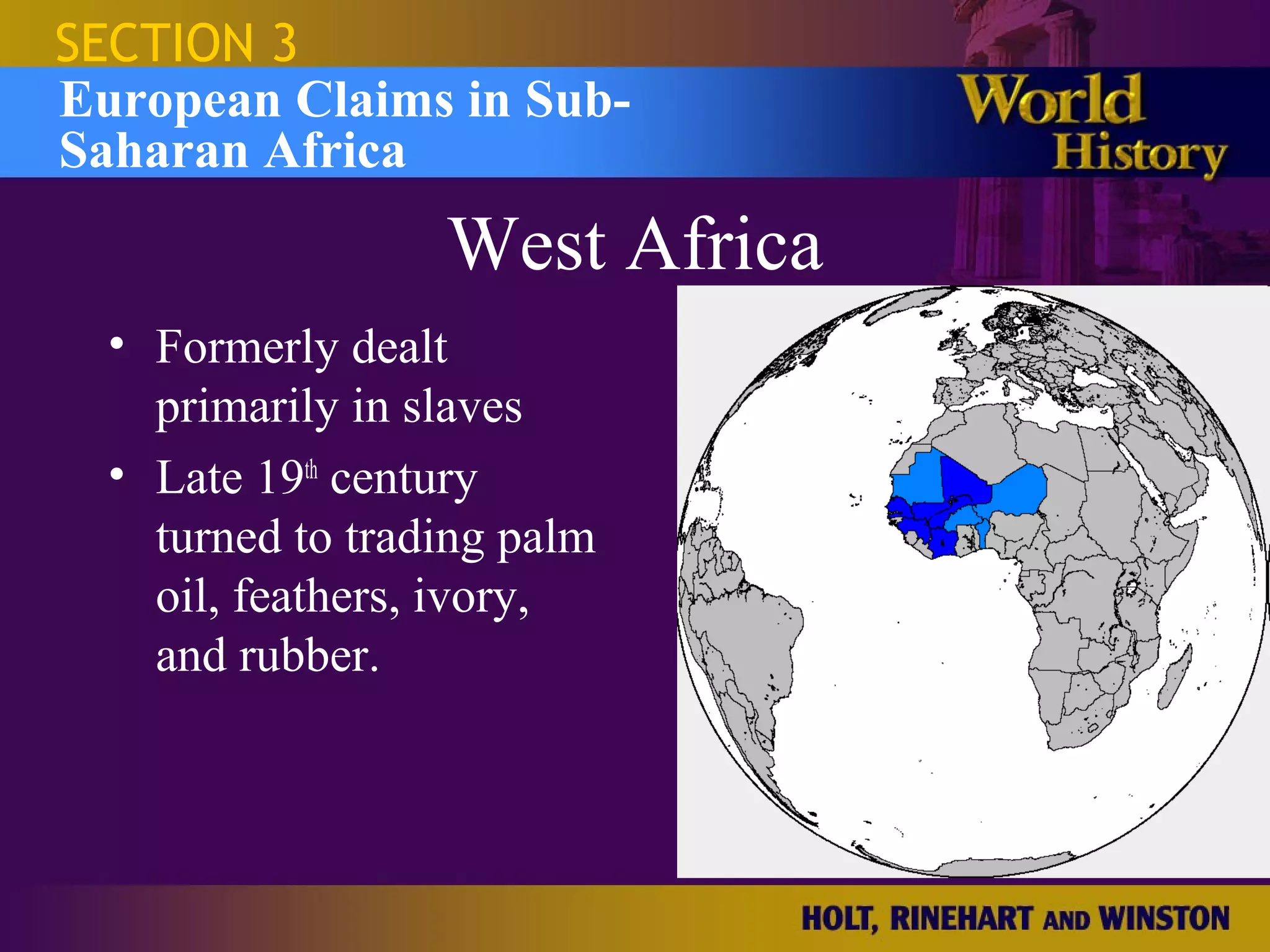
                  West Africa
  • Formerly dealt
    primarily in slaves
  • Late 19th century
    turned to trading palm
    oil, feathers, ivory,
    and rubber.
SECTION 3
  European Claims in Sub-
  Saharan Africa
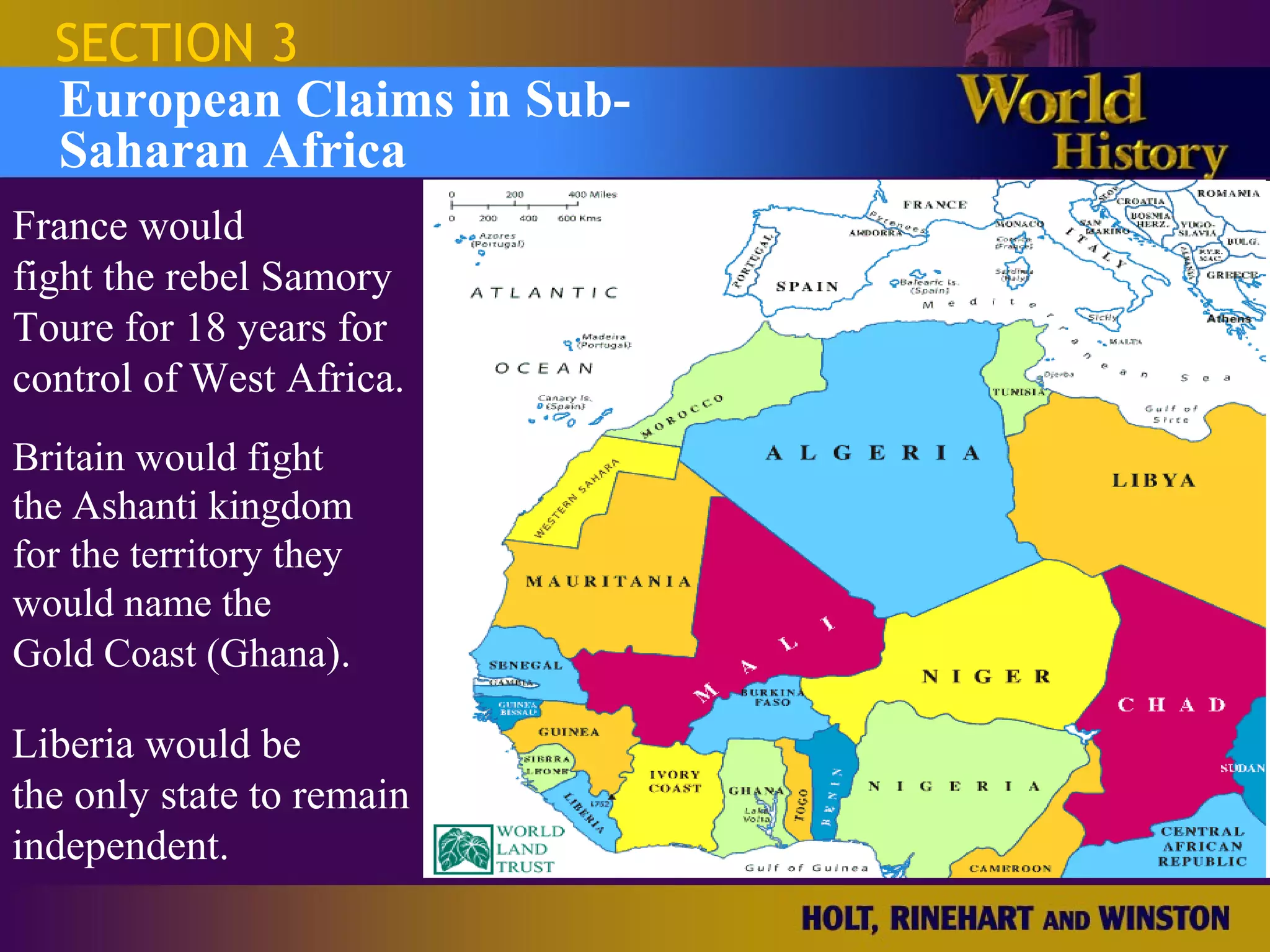
France would
fight the rebel Samory
Toure for 18 years for
control of West Africa.
Britain would fight
the Ashanti kingdom
for the territory they
would name the
Gold Coast (Ghana).

Liberia would be
the only state to remain
independent.
SECTION 3
 European Claims in Sub-
 Saharan Africa
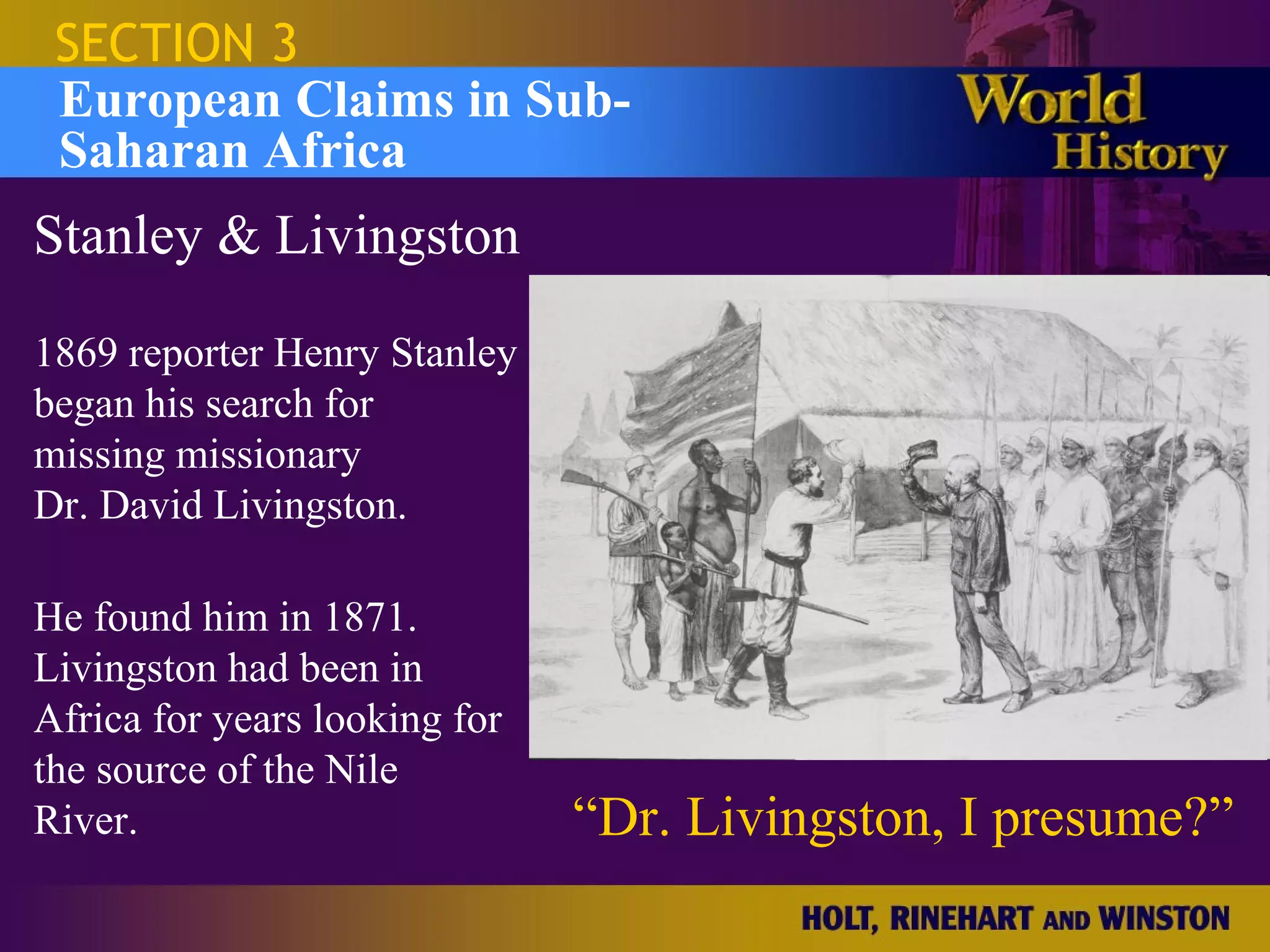
Stanley & Livingston

1869 reporter Henry Stanley
began his search for
missing missionary
Dr. David Livingston.

He found him in 1871.
Livingston had been in
Africa for years looking for
the source of the Nile
River.                         “Dr. Livingston, I presume?”
SECTION 3
European Claims in Sub-
Saharan Africa

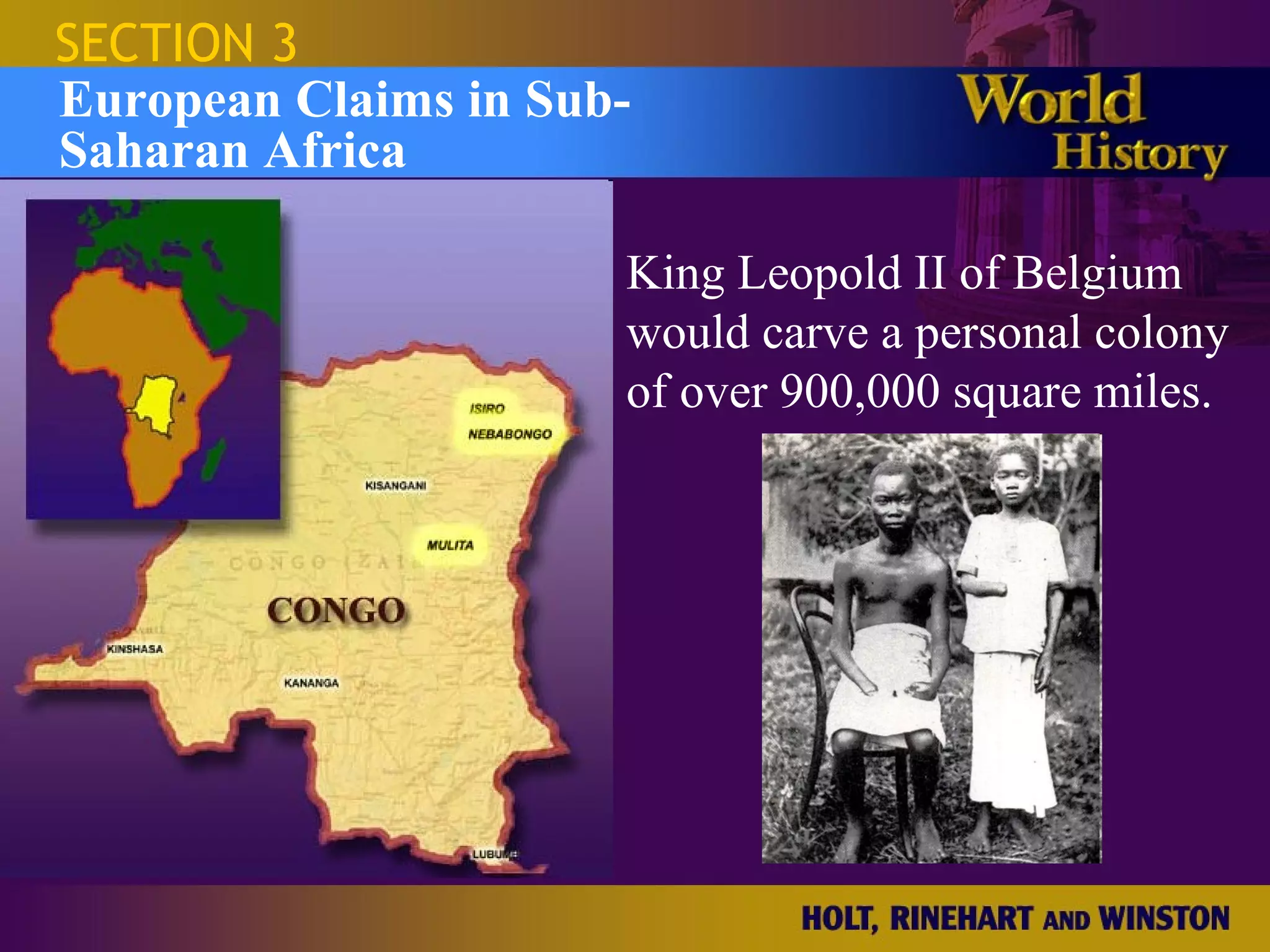
                      King Leopold II of Belgium
                      would carve a personal colony
                      of over 900,000 square miles.
SECTION 3
European Claims in Sub-
Saharan Africa

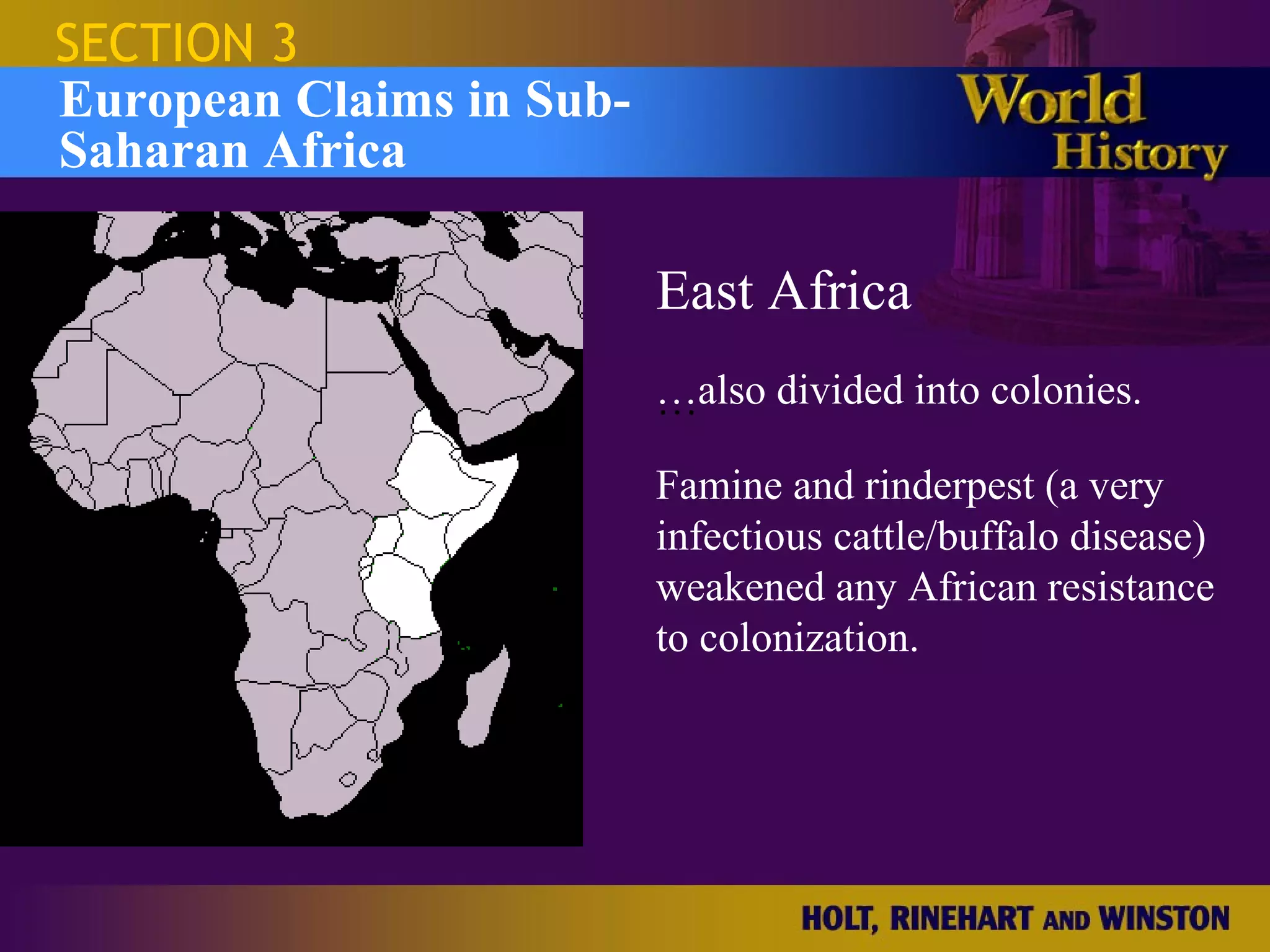
                          East Africa
                          …also divided into colonies.
                          …

                          Famine and rinderpest (a very
                          infectious cattle/buffalo disease)
                          weakened any African resistance
                          to colonization.
SECTION 3
European Claims in Sub-
Saharan Africa
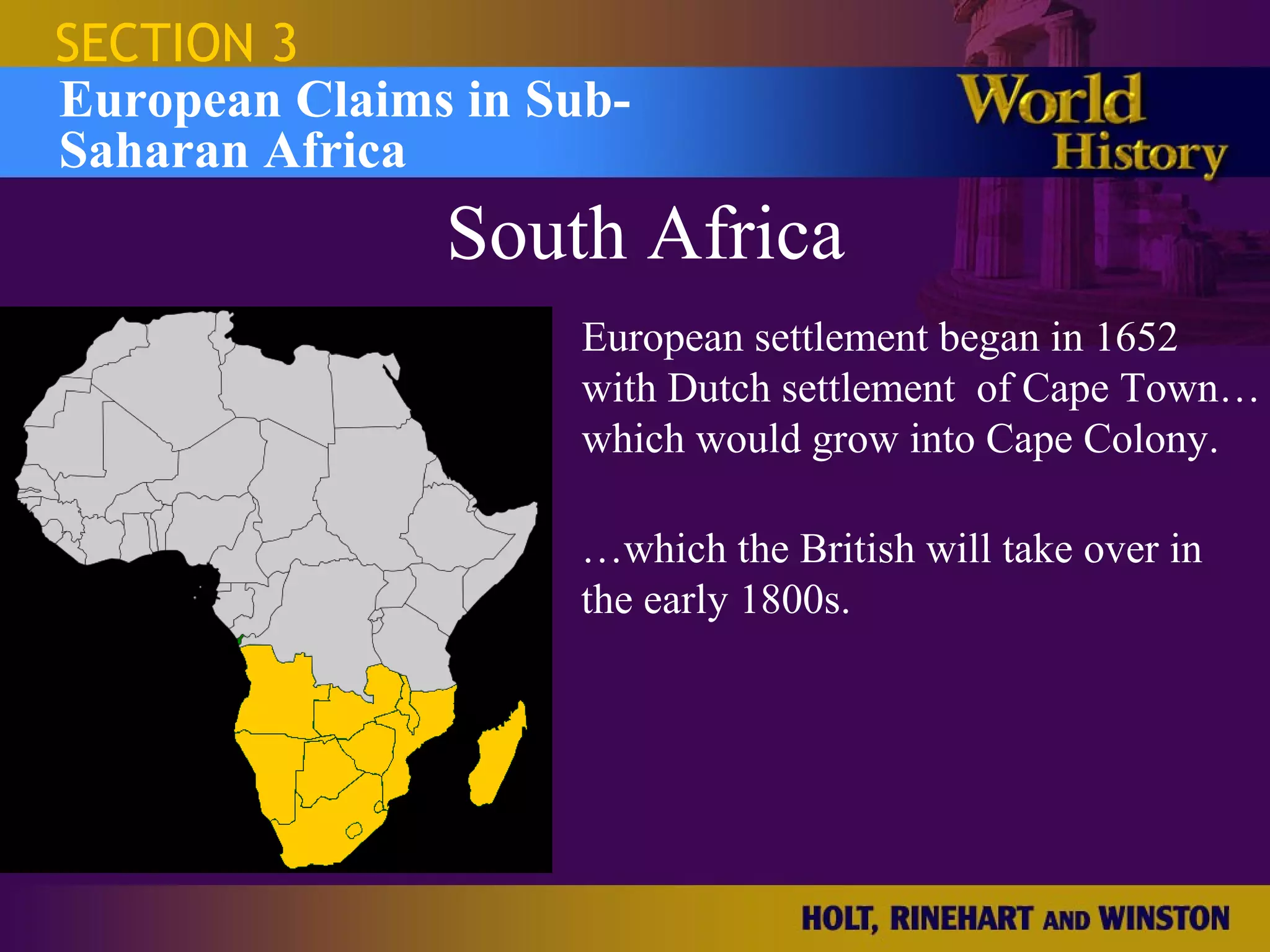
               South Africa
                     European settlement began in 1652
                     with Dutch settlement of Cape Town…
                     which would grow into Cape Colony.

                     …which the British will take over in
                     the early 1800s.
SECTION 3
European Claims in Sub-
Saharan Africa
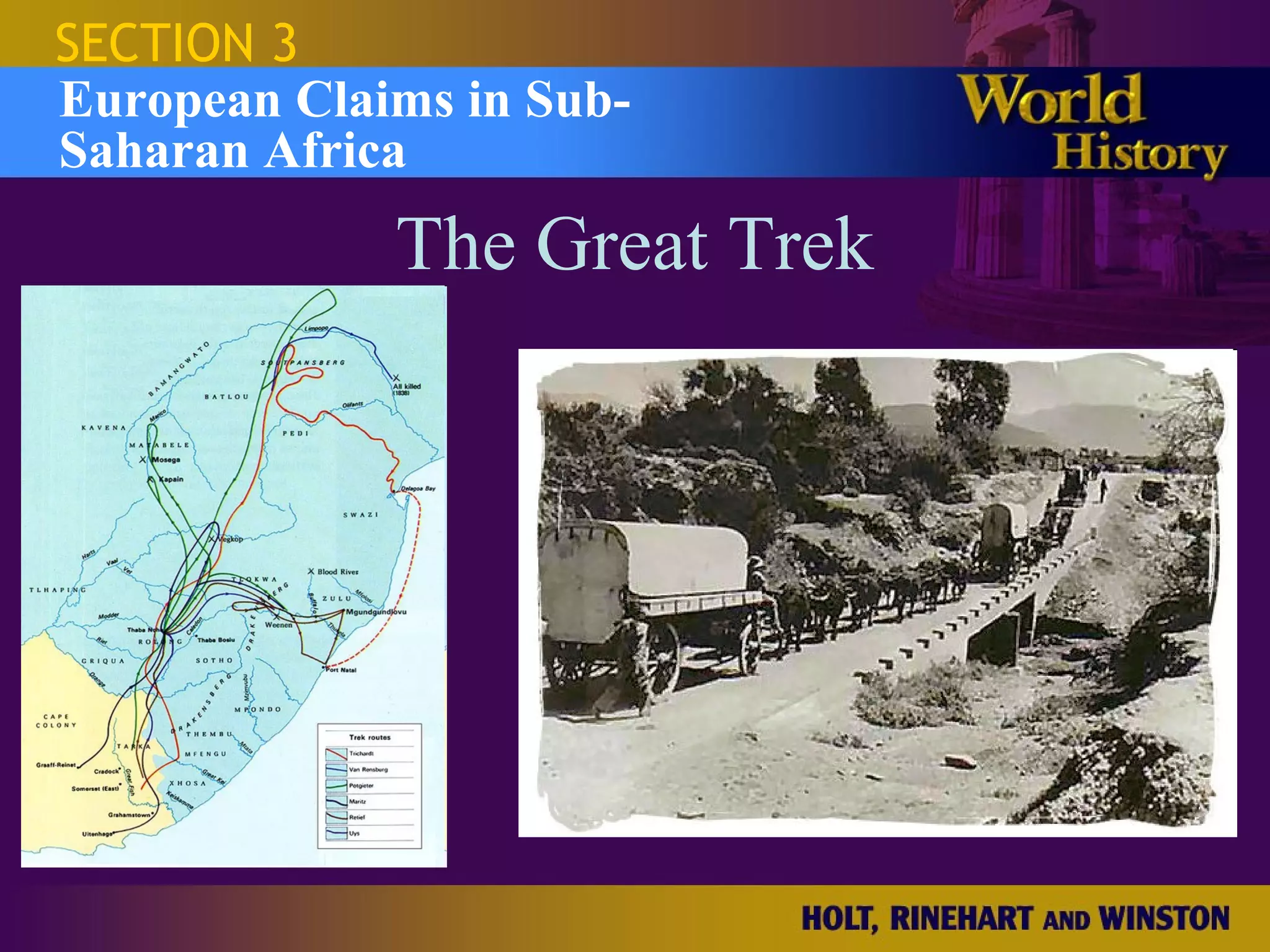
             The Great Trek
SECTION 3
European Claims in Sub-
Saharan Africa


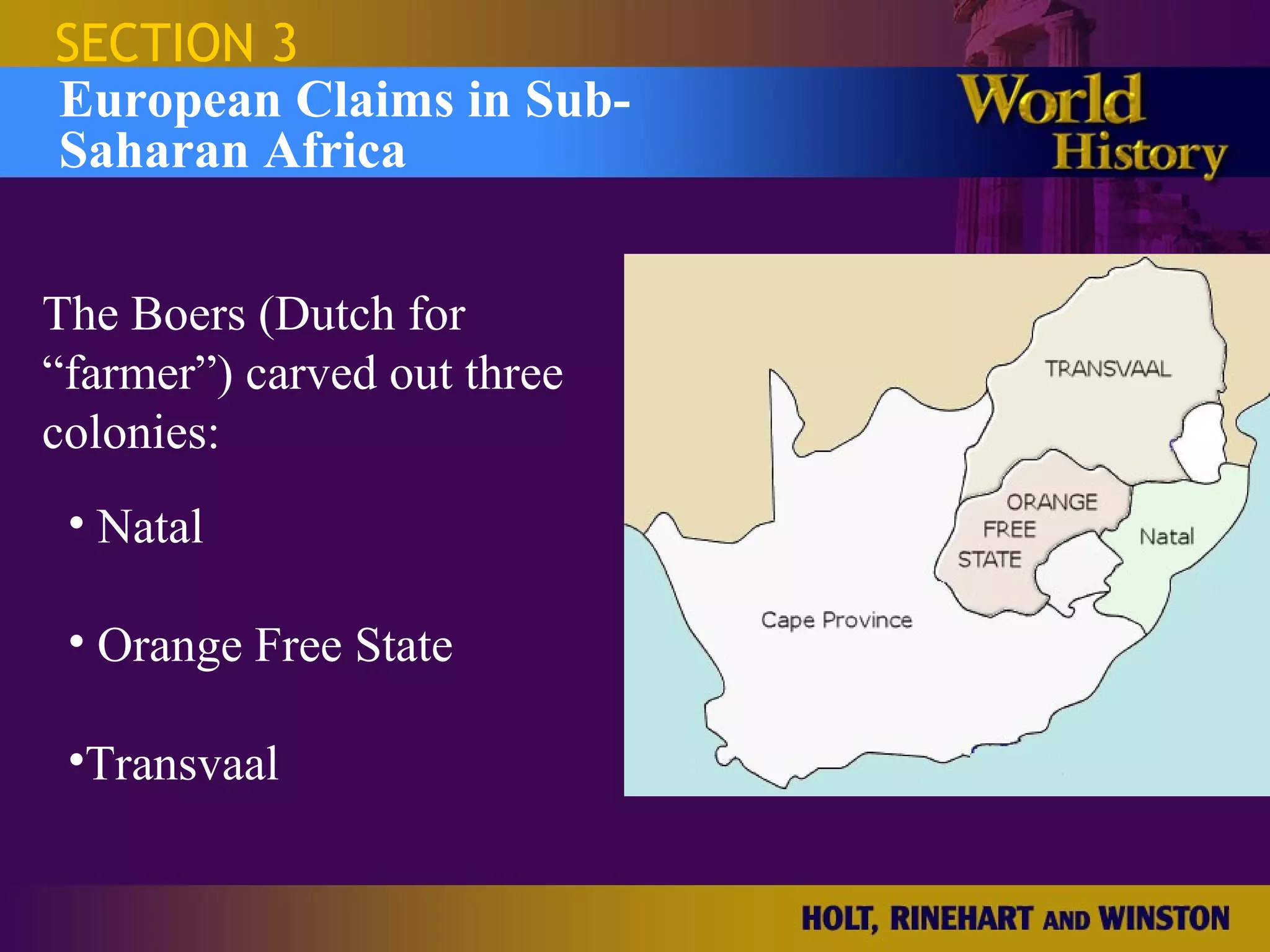
The Boers (Dutch for
“farmer”) carved out three
colonies:
 • Natal

 • Orange Free State

 •Transvaal
SECTION 3
European Claims in Sub-
Saharan Africa
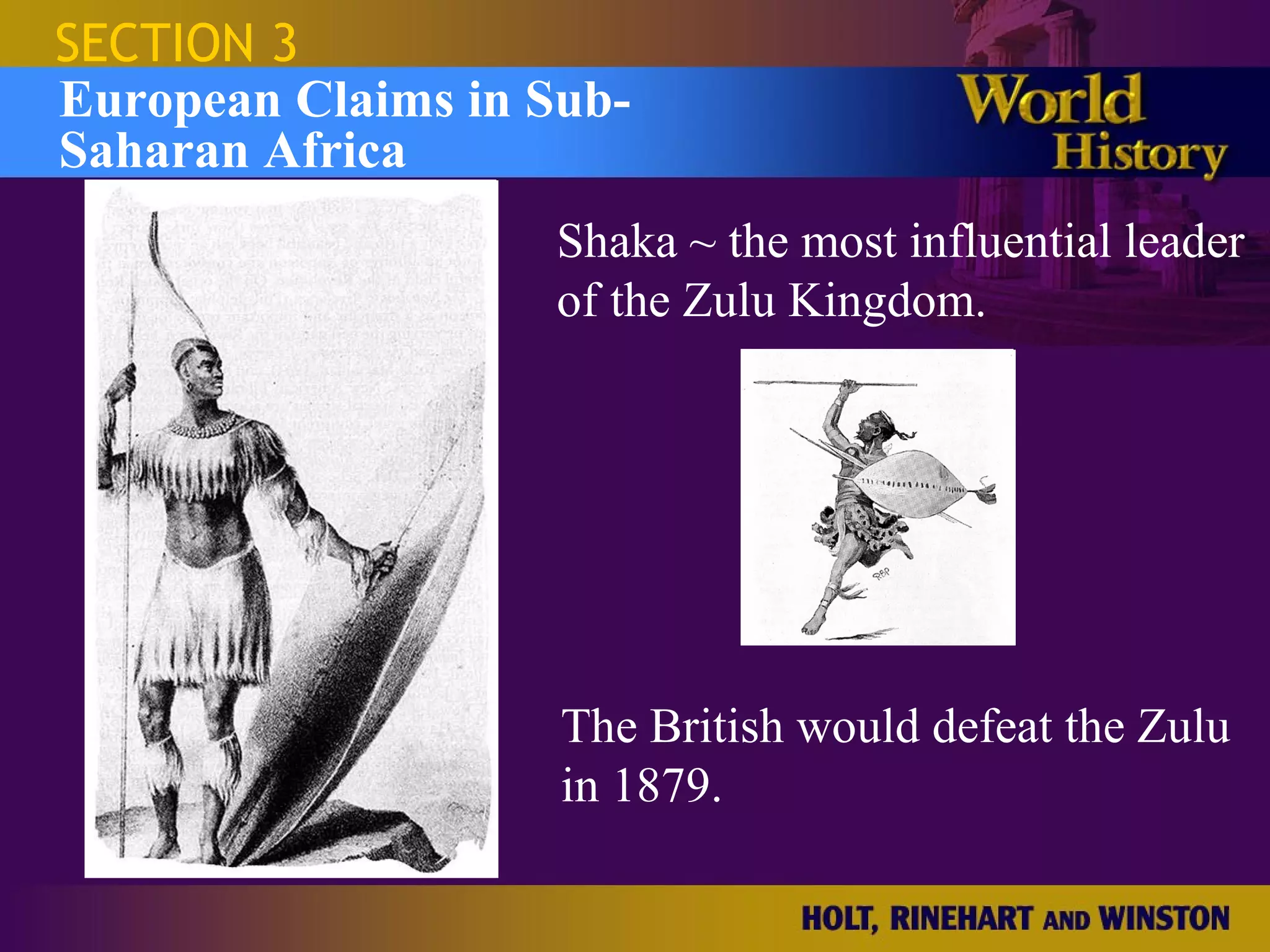
                    Shaka ~ the most influential leader
                    of the Zulu Kingdom.


                    The British would defeat the Zulu
                    in 1879.
SECTION 3
European Claims in Sub-
Saharan Africa

The story of diamonds in
South Africa begins between
December 1866 and
February 1867, when 15-
year-old Erasmus Jacobs
found a transparent stone on
his father's farm, on the south
bank of the Orange River.
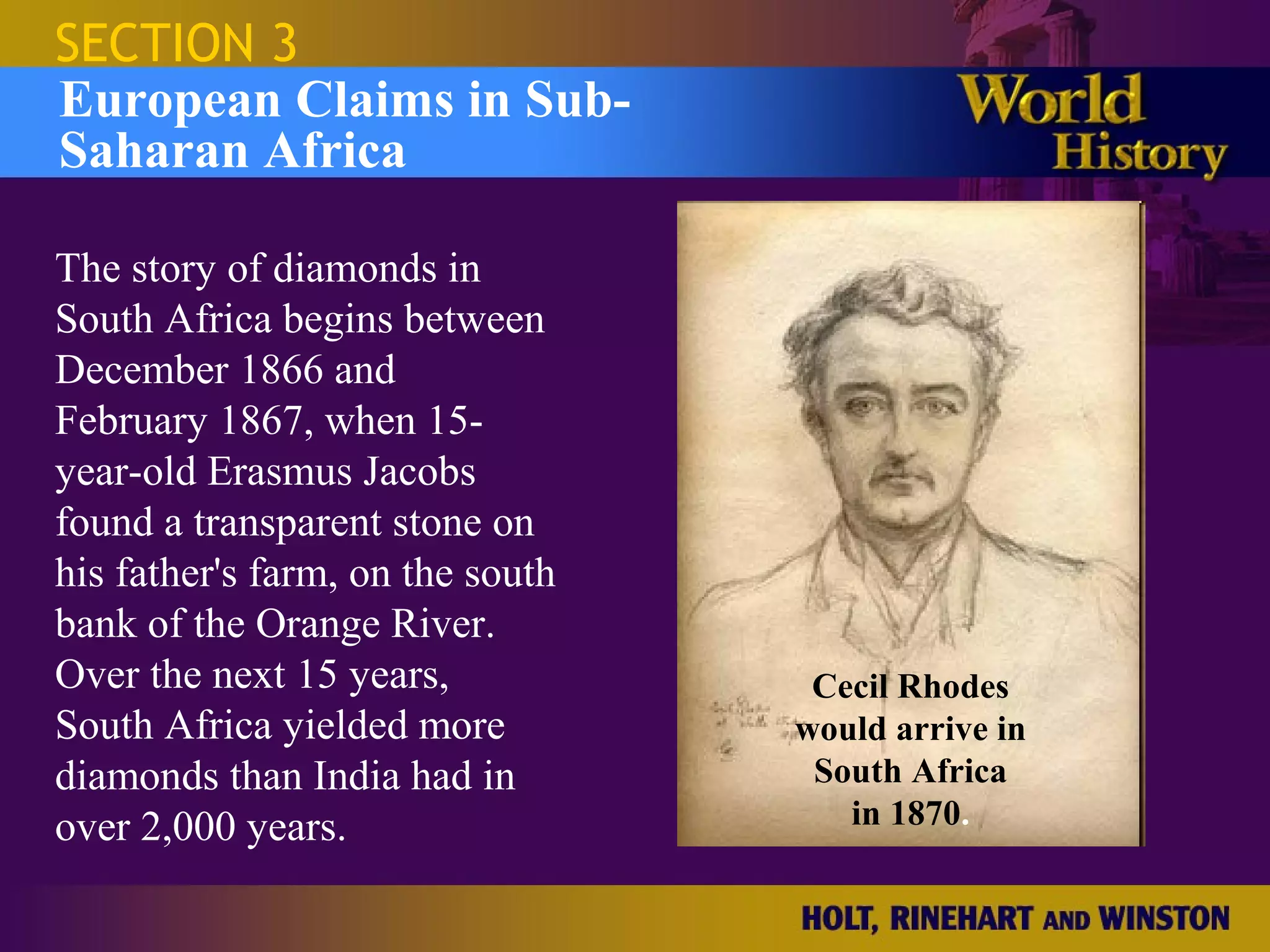
Over the next 15 years,            Cecil Rhodes
South Africa yielded more         would arrive in
diamonds than India had in         South Africa
over 2,000 years.                    in 1870.
SECTION 3
European Claims in Sub-
Saharan Africa

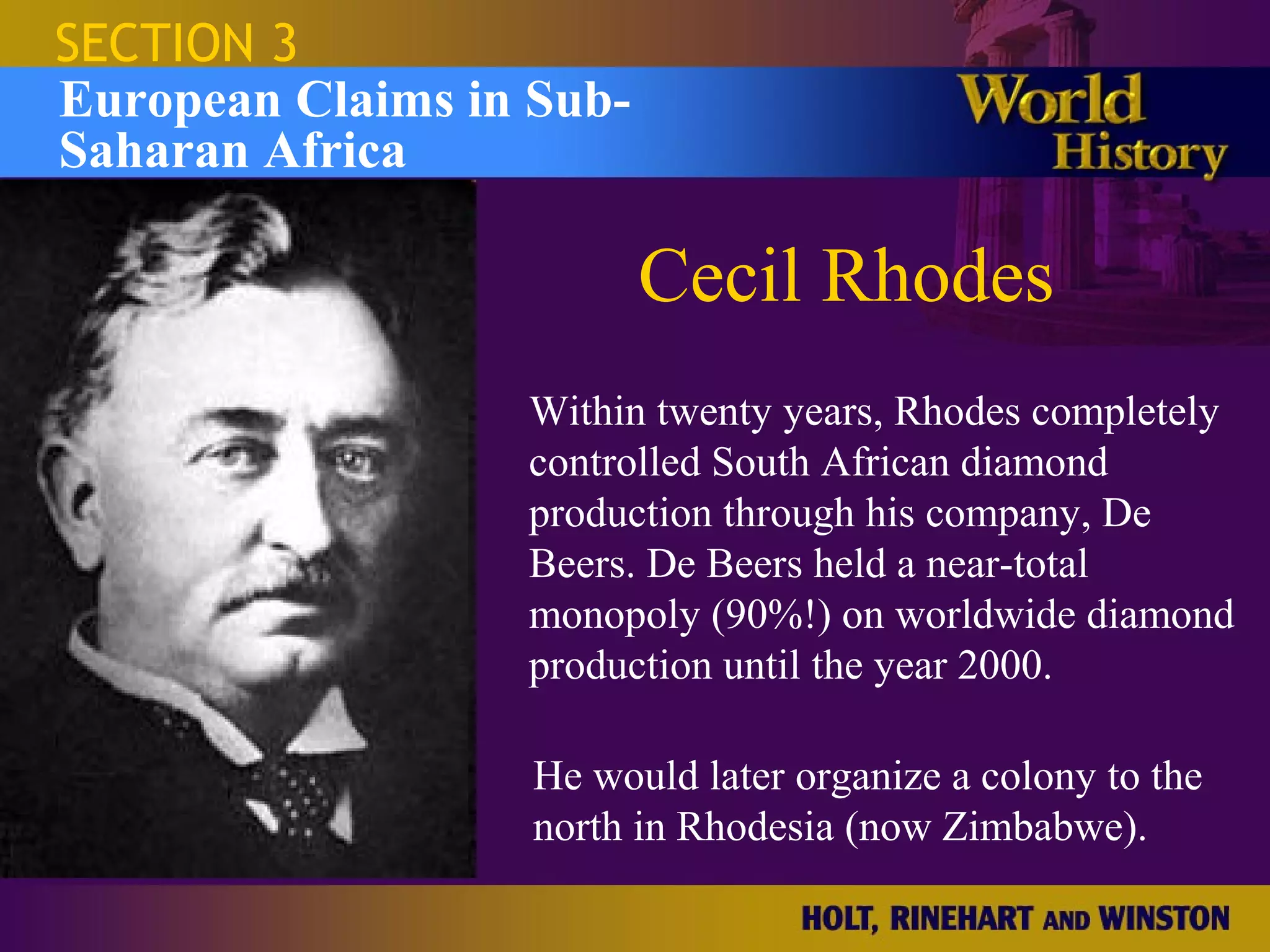
                          Cecil Rhodes
                  Within twenty years, Rhodes completely
                  controlled South African diamond
                  production through his company, De
                  Beers. De Beers held a near-total
                  monopoly (90%!) on worldwide diamond
                  production until the year 2000.

                   He would later organize a colony to the
                   north in Rhodesia (now Zimbabwe).
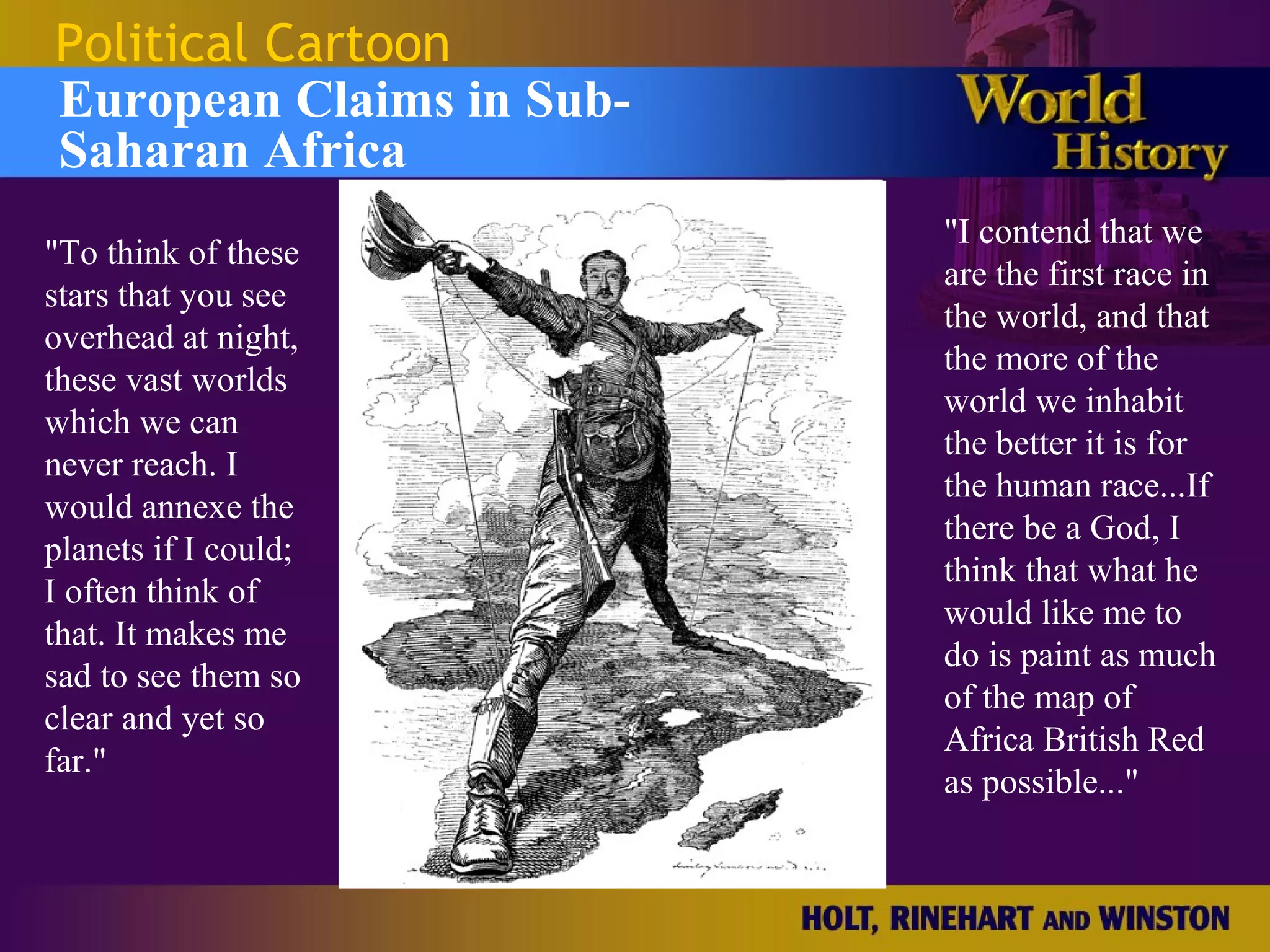
Political Cartoon
European Claims in Sub-
Saharan Africa
                          "I contend that we
"To think of these
                          are the first race in
stars that you see
                          the world, and that
overhead at night,
                          the more of the
these vast worlds
                          world we inhabit
which we can
                          the better it is for
never reach. I
                          the human race...If
would annexe the
                          there be a God, I
planets if I could;
                          think that what he
I often think of
                          would like me to
that. It makes me
                          do is paint as much
sad to see them so
                          of the map of
clear and yet so
                          Africa British Red
far."
                          as possible..."
SECTION 3
European Claims in Sub-
Saharan Africa
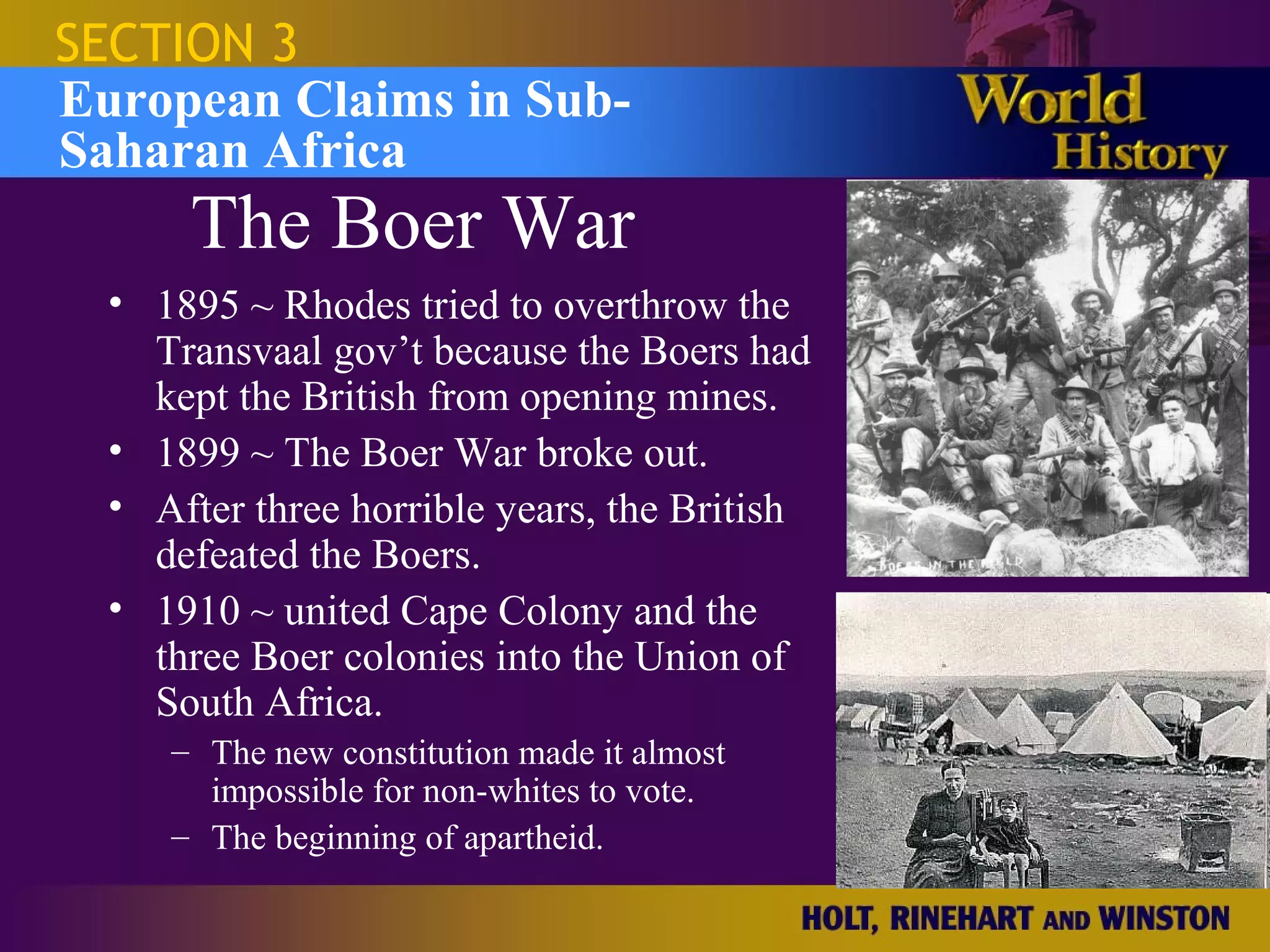
      The Boer War
  • 1895 ~ Rhodes tried to overthrow the
    Transvaal gov’t because the Boers had
    kept the British from opening mines.
  • 1899 ~ The Boer War broke out.
  • After three horrible years, the British
    defeated the Boers.
  • 1910 ~ united Cape Colony and the
    three Boer colonies into the Union of
    South Africa.
     – The new constitution made it almost
       impossible for non-whites to vote.
     – The beginning of apartheid.
SECTION 3
European Claims in Sub-
Saharan Africa
        Effects of Imperialism on Africa

  • Paternalism – limiting a group’s liberty “for
    their own good.”
  • New crops & ways of farming
  • Western medicine
  • Roads and railroads were built.
  • Improved communications
SECTION 3
  European Claims in Sub-
  Saharan Africa
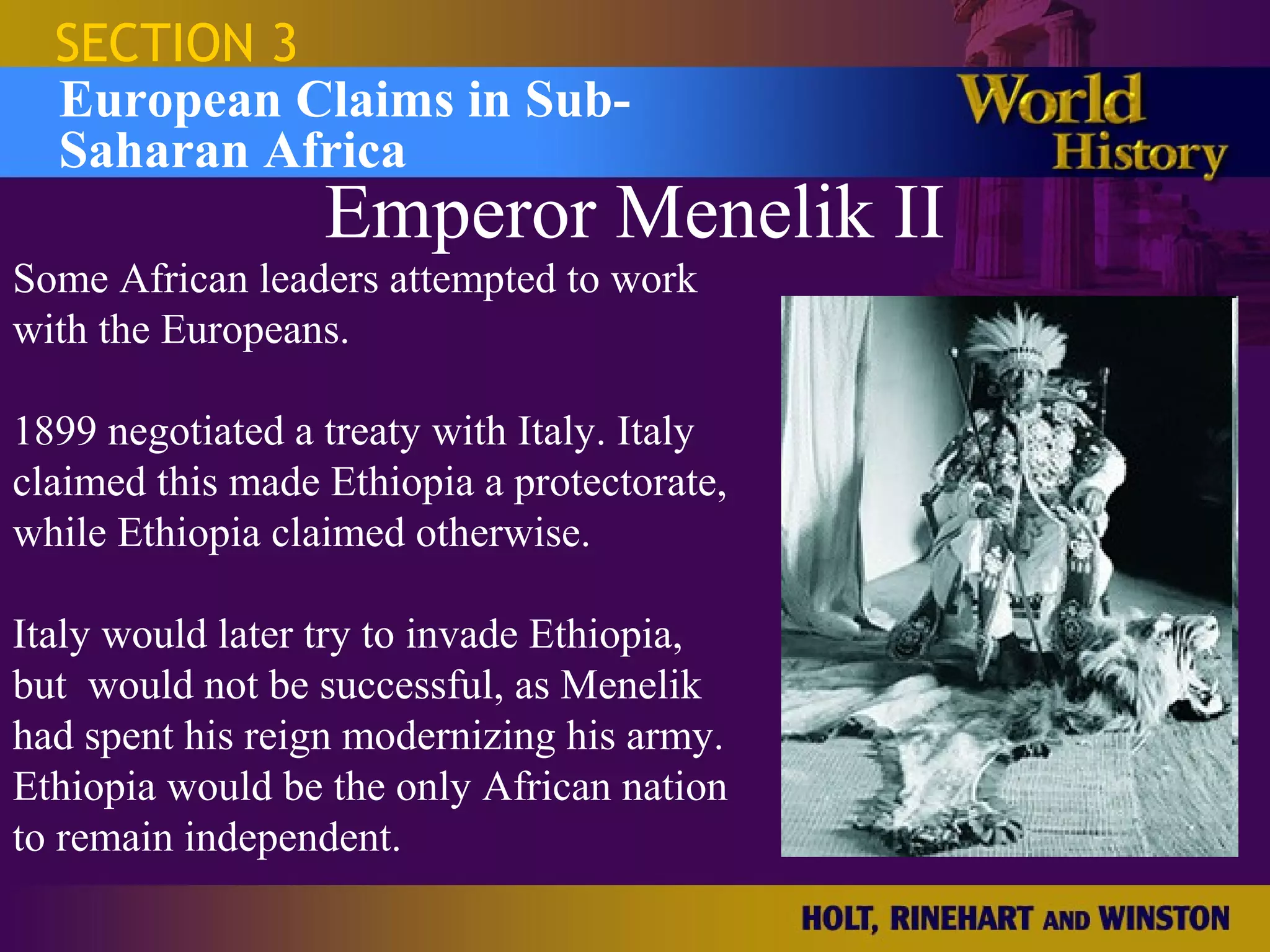
                  Emperor Menelik II
Some African leaders attempted to work
with the Europeans.

1899 negotiated a treaty with Italy. Italy
claimed this made Ethiopia a protectorate,
while Ethiopia claimed otherwise.

Italy would later try to invade Ethiopia,
but would not be successful, as Menelik
had spent his reign modernizing his army.
Ethiopia would be the only African nation
to remain independent.
SECTION 3
European Claims in Sub-
Saharan Africa

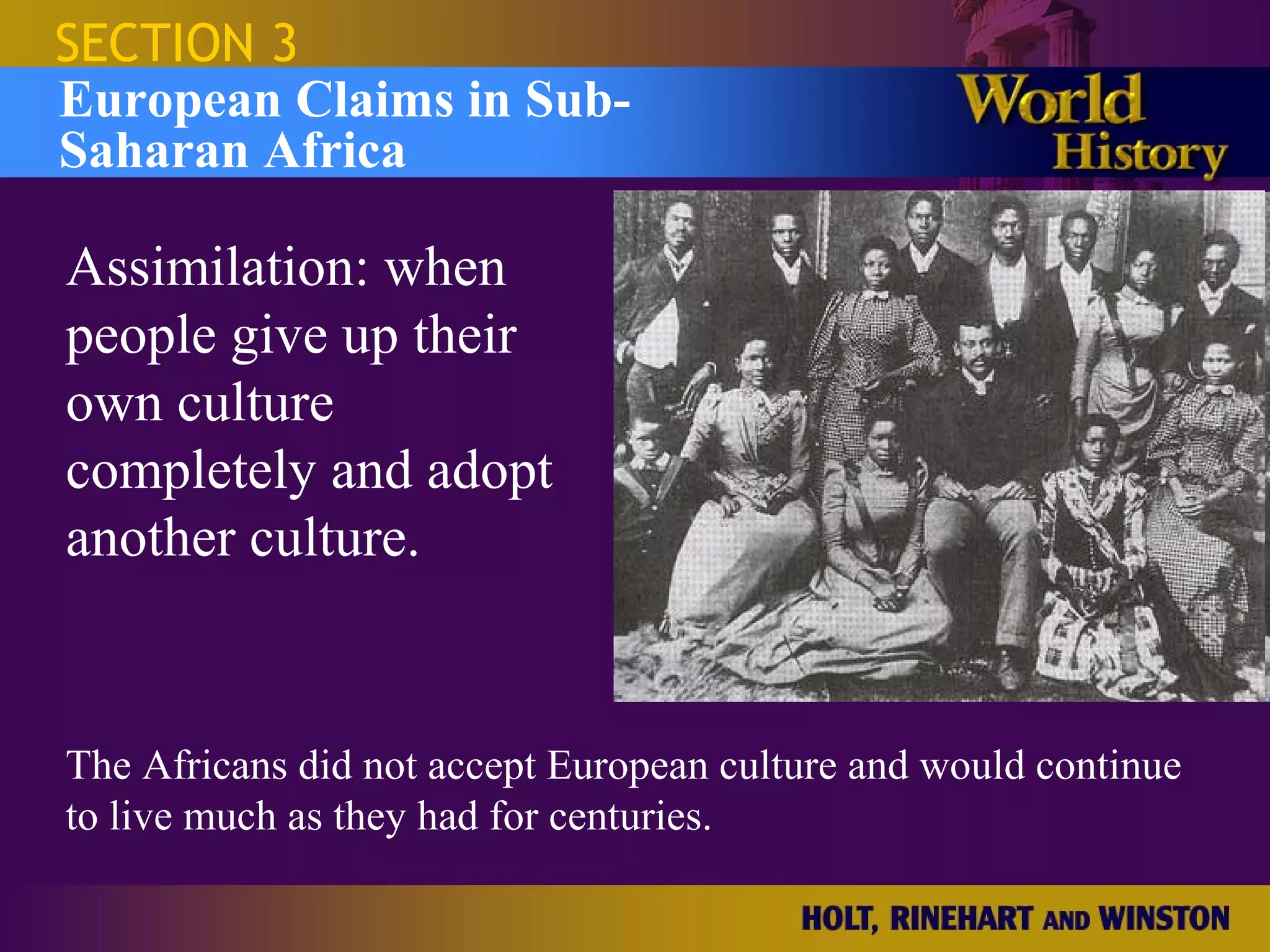
Assimilation: when
people give up their
own culture
completely and adopt
another culture.


The Africans did not accept European culture and would continue
to live much as they had for centuries.

Lesson three - Imperialism in East, West, and South Africa

  • 1.
    CHAPTER 17 The Ageof Imperialism Section 3: European Claims in Sub-Saharan Africa Objectives: List the features of West Africa that made the region particularly appealing to French and British imperialists. Describe European claims made in Central and East Africa. Explain why South Africa was so valuable. Explain how European imperialism affected Africa.
  • 2.
    SECTION 3 European Claimsin Sub- Saharan Africa West Africa • Formerly dealt primarily in slaves • Late 19th century turned to trading palm oil, feathers, ivory, and rubber.
  • 3.
    SECTION 3 European Claims in Sub- Saharan Africa France would fight the rebel Samory Toure for 18 years for control of West Africa. Britain would fight the Ashanti kingdom for the territory they would name the Gold Coast (Ghana). Liberia would be the only state to remain independent.
  • 4.
    SECTION 3 EuropeanClaims in Sub- Saharan Africa Stanley & Livingston 1869 reporter Henry Stanley began his search for missing missionary Dr. David Livingston. He found him in 1871. Livingston had been in Africa for years looking for the source of the Nile River. “Dr. Livingston, I presume?”
  • 5.
    SECTION 3 European Claimsin Sub- Saharan Africa King Leopold II of Belgium would carve a personal colony of over 900,000 square miles.
  • 6.
    SECTION 3 European Claimsin Sub- Saharan Africa East Africa …also divided into colonies. … Famine and rinderpest (a very infectious cattle/buffalo disease) weakened any African resistance to colonization.
  • 7.
    SECTION 3 European Claimsin Sub- Saharan Africa South Africa European settlement began in 1652 with Dutch settlement of Cape Town… which would grow into Cape Colony. …which the British will take over in the early 1800s.
  • 8.
    SECTION 3 European Claimsin Sub- Saharan Africa The Great Trek
  • 9.
    SECTION 3 European Claimsin Sub- Saharan Africa The Boers (Dutch for “farmer”) carved out three colonies: • Natal • Orange Free State •Transvaal
  • 10.
    SECTION 3 European Claimsin Sub- Saharan Africa Shaka ~ the most influential leader of the Zulu Kingdom. The British would defeat the Zulu in 1879.
  • 11.
    SECTION 3 European Claimsin Sub- Saharan Africa The story of diamonds in South Africa begins between December 1866 and February 1867, when 15- year-old Erasmus Jacobs found a transparent stone on his father's farm, on the south bank of the Orange River. Over the next 15 years, Cecil Rhodes South Africa yielded more would arrive in diamonds than India had in South Africa over 2,000 years. in 1870.
  • 12.
    SECTION 3 European Claimsin Sub- Saharan Africa Cecil Rhodes Within twenty years, Rhodes completely controlled South African diamond production through his company, De Beers. De Beers held a near-total monopoly (90%!) on worldwide diamond production until the year 2000. He would later organize a colony to the north in Rhodesia (now Zimbabwe).
  • 13.
    Political Cartoon European Claimsin Sub- Saharan Africa "I contend that we "To think of these are the first race in stars that you see the world, and that overhead at night, the more of the these vast worlds world we inhabit which we can the better it is for never reach. I the human race...If would annexe the there be a God, I planets if I could; think that what he I often think of would like me to that. It makes me do is paint as much sad to see them so of the map of clear and yet so Africa British Red far." as possible..."
  • 14.
    SECTION 3 European Claimsin Sub- Saharan Africa The Boer War • 1895 ~ Rhodes tried to overthrow the Transvaal gov’t because the Boers had kept the British from opening mines. • 1899 ~ The Boer War broke out. • After three horrible years, the British defeated the Boers. • 1910 ~ united Cape Colony and the three Boer colonies into the Union of South Africa. – The new constitution made it almost impossible for non-whites to vote. – The beginning of apartheid.
  • 15.
    SECTION 3 European Claimsin Sub- Saharan Africa Effects of Imperialism on Africa • Paternalism – limiting a group’s liberty “for their own good.” • New crops & ways of farming • Western medicine • Roads and railroads were built. • Improved communications
  • 16.
    SECTION 3 European Claims in Sub- Saharan Africa Emperor Menelik II Some African leaders attempted to work with the Europeans. 1899 negotiated a treaty with Italy. Italy claimed this made Ethiopia a protectorate, while Ethiopia claimed otherwise. Italy would later try to invade Ethiopia, but would not be successful, as Menelik had spent his reign modernizing his army. Ethiopia would be the only African nation to remain independent.
  • 17.
    SECTION 3 European Claimsin Sub- Saharan Africa Assimilation: when people give up their own culture completely and adopt another culture. The Africans did not accept European culture and would continue to live much as they had for centuries.

Editor's Notes

  • #5 The humor of this statement is obvious; Stanley asked his famous question of the ONLY other white person for hundreds of miles!
  • #6 Belgium itself covers a little over 30,000 square miles!
  • #7 … outbreak in the 1890s killed 80 to 90 percent of all cattle in Southern Africa, as well as the Horn of Africa . Sir Arnold Theiler was instrumental in developing a vaccine that curbed the epidemic.
  • #9 Northern and eastern migration of European settlers from Cape Colony in Africa.