The
        Scramble
       for Africa


© Student Handouts, Inc.
  www.studenthandouts.com
THE “DARK” CONTINENT
 • “Dark Continent” – racist terminology
   referred to both the peoples of Africa
   and their alleged ignorance
 • In reality, Africa has always had
   diverse groups of people with their
   own unique cultures and histories
   – Civilizations
   – Languages
   – Religions
GEOGRAPHY OF AFRICA
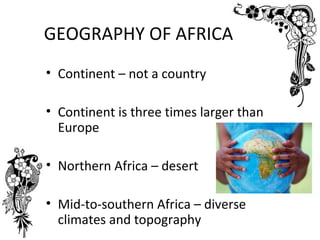
• Continent – not a country

• Continent is three times larger than
  Europe

• Northern Africa – desert

• Mid-to-southern Africa – diverse
  climates and topography
FOREIGN HISTORY IN AFRICA
    • Greeks controlled Egypt after conquest
      by Alexander the Great
       – Ptolemaic dynasty
    • Romans ruled all areas along the
      Mediterranean coastline, including
      northern Africa
       – Mediterranean – “Roman lake”
    • Arab traders converted many Africans to
      Islam from the 7th century
    • Source of slaves for the Americas from
      the 17th century
    • But little foreign interest in the interior of
      sub-Saharan Africa
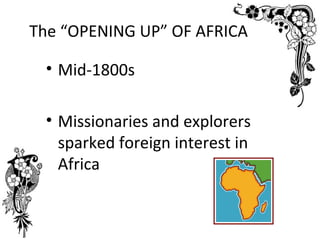
The “OPENING UP” OF AFRICA

 • Mid-1800s

 • Missionaries and explorers
   sparked foreign interest in
   Africa
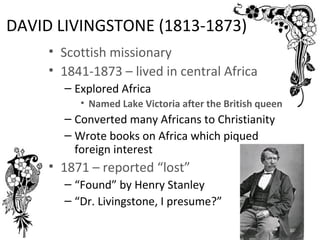
DAVID LIVINGSTONE (1813-1873)
     • Scottish missionary
     • 1841-1873 – lived in central Africa
       – Explored Africa
          • Named Lake Victoria after the British queen
       – Converted many Africans to Christianity
       – Wrote books on Africa which piqued
         foreign interest
     • 1871 – reported “lost”
       – “Found” by Henry Stanley
       – “Dr. Livingstone, I presume?”
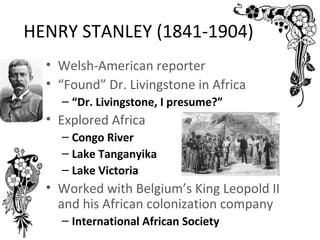
HENRY STANLEY (1841-1904)
  • Welsh-American reporter
  • “Found” Dr. Livingstone in Africa
    – “Dr. Livingstone, I presume?”
  • Explored Africa
    – Congo River
    – Lake Tanganyika
    – Lake Victoria
  • Worked with Belgium’s King Leopold II
    and his African colonization company
    – International African Society
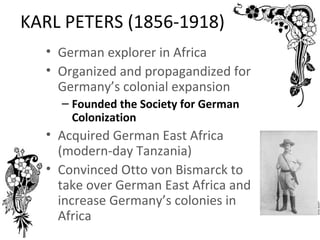
KARL PETERS (1856-1918)
  • German explorer in Africa
  • Organized and propagandized for
    Germany’s colonial expansion
    – Founded the Society for German
      Colonization
  • Acquired German East Africa
    (modern-day Tanzania)
  • Convinced Otto von Bismarck to
    take over German East Africa and
    increase Germany’s colonies in
    Africa
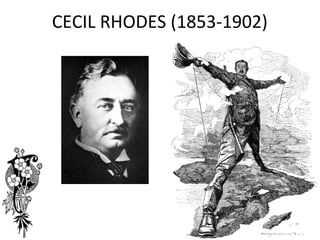
CECIL RHODES (1853-1902)
   • British businessman and politician in
     southern Africa
   • Made a fortune from African diamond
     mines
   • Established South African Company
      – Land later became Rhodesia (Zimbabwe)
   • Prime minister of Cape Colony (1890-1896)
      – Wanted British control over South Africa
      – Wanted Cape-to-Cairo Railroad
   • Architect of British imperialism in southern
     Africa
      – Great Britain became leading colonial power
        in southern Africa
CECIL RHODES (1853-1902)
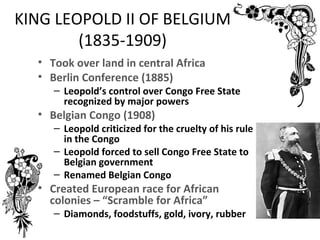
KING LEOPOLD II OF BELGIUM
        (1835-1909)
  • Took over land in central Africa
  • Berlin Conference (1885)
     – Leopold’s control over Congo Free State
       recognized by major powers
  • Belgian Congo (1908)
     – Leopold criticized for the cruelty of his rule
       in the Congo
     – Leopold forced to sell Congo Free State to
       Belgian government
     – Renamed Belgian Congo
  • Created European race for African
    colonies – “Scramble for Africa”
     – Diamonds, foodstuffs, gold, ivory, rubber
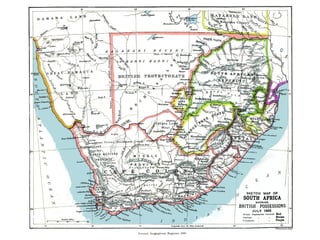
BRITISH IN SOUTHERN AFRICA
   • 1815 – British took Cape Colony from
     the Dutch
     – Boers moved north
        • Transvaal
           – 1886 – gold discovered and British moved in
           – 1881 and 1895 – British attempted to take
             Transvaal from the Boers
        • Orange Free State
   • Boer War (1899-1892)
     – Dutch led by President Paul Kruger
     – British won
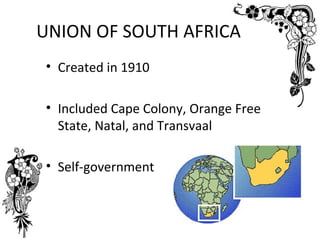
UNION OF SOUTH AFRICA
• Created in 1910

• Included Cape Colony, Orange Free
  State, Natal, and Transvaal

• Self-government
BRITISH COLONIES IN SOUTHERN AFRICA

    • Rhodesia (now Zimbabwe)
      – Named for Cecil Rhodes
      – North of Union of South Africa


    • Bechuanaland (now Botswana)
      – 1885 – became a British protectorate


    • Kenya
      – 1888 – became a British protectorate
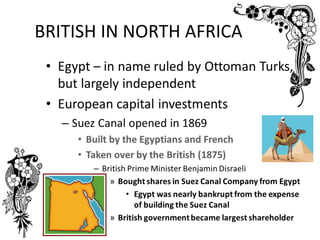
BRITISH IN NORTH AFRICA
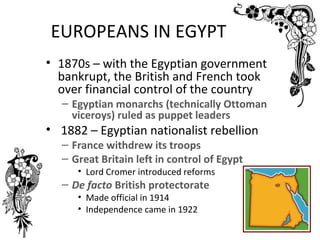
EUROPEANS IN EGYPT
• 1870s – with the Egyptian government
  bankrupt, the British and French took
  over financial control of the country
  – Egyptian monarchs (technically Ottoman
    viceroys) ruled as puppet leaders
• 1882 – Egyptian nationalist rebellion
  – France withdrew its troops
  – Great Britain left in control of Egypt
     • Lord Cromer introduced reforms
  – De facto British protectorate
     • Made official in 1914
     • Independence came in 1922
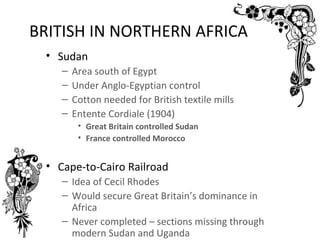
BRITISH IN NORTHERN AFRICA
 • Sudan
    –   Area south of Egypt
    –   Under Anglo-Egyptian control
    –   Cotton needed for British textile mills
    –   Entente Cordiale (1904)
         • Great Britain controlled Sudan
         • France controlled Morocco


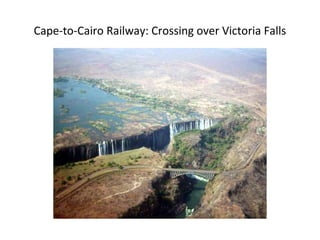
 • Cape-to-Cairo Railroad
    – Idea of Cecil Rhodes
    – Would secure Great Britain’s dominance in
      Africa
    – Never completed – sections missing through
      modern Sudan and Uganda
Cape-to-Cairo Railway: Crossing over Victoria Falls
FRENCH IN AFRICA
• Algeria
   – 1830 – invasion
   – 1831 – annexation
• Tunis
   – 1881 – controlled by France
      • Led Italy to join the Triple Alliance with Austria-Hungary and
        Germany
• Morocco
   – 1881 – large part under French control
   – 1905 and 1911 – nearly sparked a European war
     between France and Germany
      • 1906 – Algeciras Conference – Germany recognized French
        rights in Morocco
      • 1911 – Agadir Crisis – Germany recognized French protectorate
        over Morocco in exchange for part of France’s territory in the
        Congo
FRENCH IN AFRICA
• Madagascar
  – 1896 – controlled by France
• Somaliland
  – 1880s – partly under French control
• West Africa
  – Late 1800s – largely under French control
• Sudan
  – 1898 – met Britain’s area of control and
    nearly went to war
  – Entente Cordiale settled British-French
    disputes in Africa
FRENCH IN AFRICA
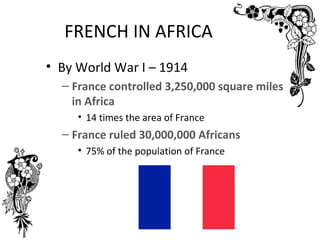
• By World War I – 1914
  – France controlled 3,250,000 square miles
    in Africa
     • 14 times the area of France
  – France ruled 30,000,000 Africans
     • 75% of the population of France
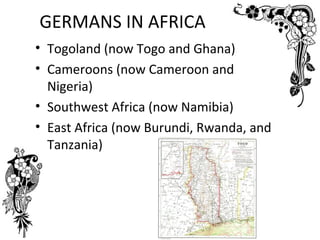
GERMANS IN AFRICA
• Togoland (now Togo and Ghana)
• Cameroons (now Cameroon and
  Nigeria)
• Southwest Africa (now Namibia)
• East Africa (now Burundi, Rwanda, and
  Tanzania)
ITALIANS IN AFRICA
• 1882-1896
  – Eritrea (along the Red Sea)
  – Somaliland (along the Indian Ocean, part
    of today’s Somalia)
• 1896
  – Defeated in attempt to conquer Abyssinia
    (Ethiopia)
• 1912
  – Won Tripoli from Ottoman Turks
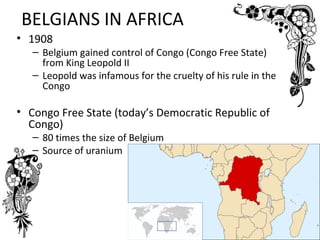
BELGIANS IN AFRICA
• 1908
   – Belgium gained control of Congo (Congo Free State)
     from King Leopold II
   – Leopold was infamous for the cruelty of his rule in the
     Congo

• Congo Free State (today’s Democratic Republic of
  Congo)
   – 80 times the size of Belgium
   – Source of uranium
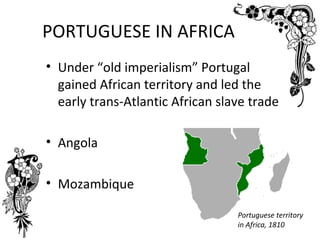
PORTUGUESE IN AFRICA
• Under “old imperialism” Portugal
  gained African territory and led the
  early trans-Atlantic African slave trade

• Angola

• Mozambique

                                  Portuguese territory
                                  in Africa, 1810
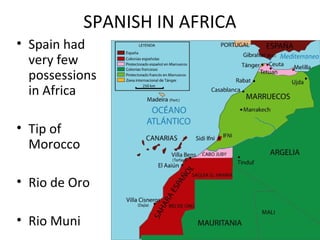
SPANISH IN AFRICA
• Spain had
  very few
  possessions
  in Africa

• Tip of
  Morocco

• Rio de Oro

• Rio Muni
AFRICANS IN AFRICA
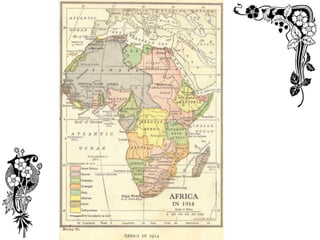
• By the time of the First World War
  (1914)
  – Only 2 independent African countries
     • Abyssinia (Ethiopia)
        – Ruled by dynasty stretching back to at least the
          13th century
        – Last emperor was Haile Selassie, deposed in 1974
        – Home to Ethiopian Orthodox Christian Church
          (strongly tied to Egyptian Coptic Church)
     • Liberia
        – Formed by freed slaves under auspices of the
          United States government
REVIEW QUESTIONS
1. What led to the “Scramble for
   Africa”?
2. Which European nations controlled
   the most land in Africa?
3. Who led British imperialism in Africa?
4. Which African nations were left
   independent at the time of World
   War I?

Scramble for Africa

  • 1.
    The Scramble for Africa © Student Handouts, Inc. www.studenthandouts.com
  • 2.
    THE “DARK” CONTINENT • “Dark Continent” – racist terminology referred to both the peoples of Africa and their alleged ignorance • In reality, Africa has always had diverse groups of people with their own unique cultures and histories – Civilizations – Languages – Religions
  • 3.
    GEOGRAPHY OF AFRICA •Continent – not a country • Continent is three times larger than Europe • Northern Africa – desert • Mid-to-southern Africa – diverse climates and topography
  • 4.
    FOREIGN HISTORY INAFRICA • Greeks controlled Egypt after conquest by Alexander the Great – Ptolemaic dynasty • Romans ruled all areas along the Mediterranean coastline, including northern Africa – Mediterranean – “Roman lake” • Arab traders converted many Africans to Islam from the 7th century • Source of slaves for the Americas from the 17th century • But little foreign interest in the interior of sub-Saharan Africa
  • 5.
    The “OPENING UP”OF AFRICA • Mid-1800s • Missionaries and explorers sparked foreign interest in Africa
  • 6.
    DAVID LIVINGSTONE (1813-1873) • Scottish missionary • 1841-1873 – lived in central Africa – Explored Africa • Named Lake Victoria after the British queen – Converted many Africans to Christianity – Wrote books on Africa which piqued foreign interest • 1871 – reported “lost” – “Found” by Henry Stanley – “Dr. Livingstone, I presume?”
  • 7.
    HENRY STANLEY (1841-1904) • Welsh-American reporter • “Found” Dr. Livingstone in Africa – “Dr. Livingstone, I presume?” • Explored Africa – Congo River – Lake Tanganyika – Lake Victoria • Worked with Belgium’s King Leopold II and his African colonization company – International African Society
  • 8.
    KARL PETERS (1856-1918) • German explorer in Africa • Organized and propagandized for Germany’s colonial expansion – Founded the Society for German Colonization • Acquired German East Africa (modern-day Tanzania) • Convinced Otto von Bismarck to take over German East Africa and increase Germany’s colonies in Africa
  • 9.
    CECIL RHODES (1853-1902) • British businessman and politician in southern Africa • Made a fortune from African diamond mines • Established South African Company – Land later became Rhodesia (Zimbabwe) • Prime minister of Cape Colony (1890-1896) – Wanted British control over South Africa – Wanted Cape-to-Cairo Railroad • Architect of British imperialism in southern Africa – Great Britain became leading colonial power in southern Africa
  • 10.
  • 11.
    KING LEOPOLD IIOF BELGIUM (1835-1909) • Took over land in central Africa • Berlin Conference (1885) – Leopold’s control over Congo Free State recognized by major powers • Belgian Congo (1908) – Leopold criticized for the cruelty of his rule in the Congo – Leopold forced to sell Congo Free State to Belgian government – Renamed Belgian Congo • Created European race for African colonies – “Scramble for Africa” – Diamonds, foodstuffs, gold, ivory, rubber
  • 12.
    BRITISH IN SOUTHERNAFRICA • 1815 – British took Cape Colony from the Dutch – Boers moved north • Transvaal – 1886 – gold discovered and British moved in – 1881 and 1895 – British attempted to take Transvaal from the Boers • Orange Free State • Boer War (1899-1892) – Dutch led by President Paul Kruger – British won
  • 13.
    UNION OF SOUTHAFRICA • Created in 1910 • Included Cape Colony, Orange Free State, Natal, and Transvaal • Self-government
  • 14.
    BRITISH COLONIES INSOUTHERN AFRICA • Rhodesia (now Zimbabwe) – Named for Cecil Rhodes – North of Union of South Africa • Bechuanaland (now Botswana) – 1885 – became a British protectorate • Kenya – 1888 – became a British protectorate
  • 16.
  • 17.
    EUROPEANS IN EGYPT •1870s – with the Egyptian government bankrupt, the British and French took over financial control of the country – Egyptian monarchs (technically Ottoman viceroys) ruled as puppet leaders • 1882 – Egyptian nationalist rebellion – France withdrew its troops – Great Britain left in control of Egypt • Lord Cromer introduced reforms – De facto British protectorate • Made official in 1914 • Independence came in 1922
  • 18.
    BRITISH IN NORTHERNAFRICA • Sudan – Area south of Egypt – Under Anglo-Egyptian control – Cotton needed for British textile mills – Entente Cordiale (1904) • Great Britain controlled Sudan • France controlled Morocco • Cape-to-Cairo Railroad – Idea of Cecil Rhodes – Would secure Great Britain’s dominance in Africa – Never completed – sections missing through modern Sudan and Uganda
  • 19.
  • 20.
    FRENCH IN AFRICA •Algeria – 1830 – invasion – 1831 – annexation • Tunis – 1881 – controlled by France • Led Italy to join the Triple Alliance with Austria-Hungary and Germany • Morocco – 1881 – large part under French control – 1905 and 1911 – nearly sparked a European war between France and Germany • 1906 – Algeciras Conference – Germany recognized French rights in Morocco • 1911 – Agadir Crisis – Germany recognized French protectorate over Morocco in exchange for part of France’s territory in the Congo
  • 21.
    FRENCH IN AFRICA •Madagascar – 1896 – controlled by France • Somaliland – 1880s – partly under French control • West Africa – Late 1800s – largely under French control • Sudan – 1898 – met Britain’s area of control and nearly went to war – Entente Cordiale settled British-French disputes in Africa
  • 22.
    FRENCH IN AFRICA •By World War I – 1914 – France controlled 3,250,000 square miles in Africa • 14 times the area of France – France ruled 30,000,000 Africans • 75% of the population of France
  • 23.
    GERMANS IN AFRICA •Togoland (now Togo and Ghana) • Cameroons (now Cameroon and Nigeria) • Southwest Africa (now Namibia) • East Africa (now Burundi, Rwanda, and Tanzania)
  • 24.
    ITALIANS IN AFRICA •1882-1896 – Eritrea (along the Red Sea) – Somaliland (along the Indian Ocean, part of today’s Somalia) • 1896 – Defeated in attempt to conquer Abyssinia (Ethiopia) • 1912 – Won Tripoli from Ottoman Turks
  • 25.
    BELGIANS IN AFRICA •1908 – Belgium gained control of Congo (Congo Free State) from King Leopold II – Leopold was infamous for the cruelty of his rule in the Congo • Congo Free State (today’s Democratic Republic of Congo) – 80 times the size of Belgium – Source of uranium
  • 26.
    PORTUGUESE IN AFRICA •Under “old imperialism” Portugal gained African territory and led the early trans-Atlantic African slave trade • Angola • Mozambique Portuguese territory in Africa, 1810
  • 27.
    SPANISH IN AFRICA •Spain had very few possessions in Africa • Tip of Morocco • Rio de Oro • Rio Muni
  • 28.
    AFRICANS IN AFRICA •By the time of the First World War (1914) – Only 2 independent African countries • Abyssinia (Ethiopia) – Ruled by dynasty stretching back to at least the 13th century – Last emperor was Haile Selassie, deposed in 1974 – Home to Ethiopian Orthodox Christian Church (strongly tied to Egyptian Coptic Church) • Liberia – Formed by freed slaves under auspices of the United States government
  • 30.
    REVIEW QUESTIONS 1. Whatled to the “Scramble for Africa”? 2. Which European nations controlled the most land in Africa? 3. Who led British imperialism in Africa? 4. Which African nations were left independent at the time of World War I?

Editor's Notes

  • #3 Possible anecdote: Review of African cultures and civilizations, such as Mansa Musa and Great Zimbabwe.