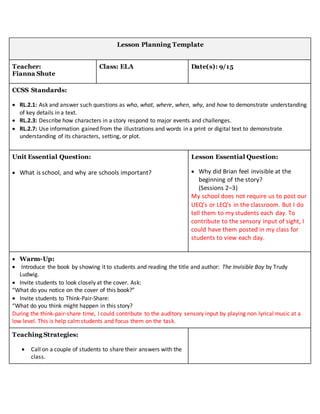
Lesson Planning Template
Teacher:
Fianna Shute
Class: ELA Date(s): 9/15
CCSS Standards:
 RL.2.1: Ask and answer such questions as who, what, where, when, why, and how to demonstrate understanding
of key details in a text.
 RL.2.3: Describe how characters in a story respond to major events and challenges.
 RL.2.7: Use information gained from the illustrations and words in a print or digital text to demonstrate
understanding of its characters, setting, or plot.
Unit Essential Question:
 What is school, and why are schools important?
Lesson Essential Question:
 Why did Brian feel invisible at the
beginning of the story?
(Sessions 2–3)
My school does not require us to post our
UEQ’s or LEQ’s in the classroom. But I do
tell them to my students each day. To
contribute to the sensory input of sight, I
could have them posted in my class for
students to view each day.
 Warm-Up:
 Introduce the book by showing it to students and reading the title and author: The Invisible Boy by Trudy
Ludwig.
 Invite students to look closely at the cover. Ask:
“What do you notice on the cover of this book?”
 Invite students to Think-Pair-Share:
“What do you think might happen in this story?
During the think-pair-share time, I could contribute to the auditory sensory input by playing non lyrical music at a
low level. This is help calmstudents and focus them on the task.
Teaching Strategies:
 Call on a couple of students to share their answers with the
class.
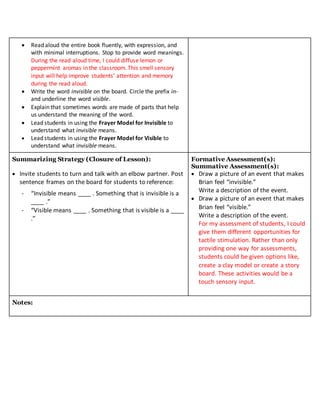
 Read aloud the entire book fluently, with expression, and
with minimal interruptions. Stop to provide word meanings.
During the read aloud time, I could diffuse lemon or
peppermint aromas in the classroom. This smell sensory
input will help improve students’ attention and memory
during the read aloud.
 Write the word invisible on the board. Circle the prefix in-
and underline the word visible.
 Explain that sometimes words are made of parts that help
us understand the meaning of the word.
 Lead students in using the Frayer Model for Invisible to
understand what invisible means.
 Lead students in using the Frayer Model for Visible to
understand what invisible means.
Summarizing Strategy (Closure of Lesson):
 Invite students to turn and talk with an elbow partner. Post
sentence frames on the board for students to reference:
- “Invisible means _____ . Something that is invisible is a
_____ .”
- “Visible means _____ . Something that is visible is a _____
.”
Formative Assessment(s):
Summative Assessment(s):
 Draw a picture of an event that makes
Brian feel “invisible.”
Write a description of the event.
 Draw a picture of an event that makes
Brian feel “visible.”
Write a description of the event.
For my assessment of students, I could
give them different opportunities for
tactile stimulation. Rather than only
providing one way for assessments,
students could be given options like,
create a clay model or create a story
board. These activities would be a
touch sensory input.
Notes:

Lesson planning evaluation

  • 1.
    Lesson Planning Template Teacher: FiannaShute Class: ELA Date(s): 9/15 CCSS Standards:  RL.2.1: Ask and answer such questions as who, what, where, when, why, and how to demonstrate understanding of key details in a text.  RL.2.3: Describe how characters in a story respond to major events and challenges.  RL.2.7: Use information gained from the illustrations and words in a print or digital text to demonstrate understanding of its characters, setting, or plot. Unit Essential Question:  What is school, and why are schools important? Lesson Essential Question:  Why did Brian feel invisible at the beginning of the story? (Sessions 2–3) My school does not require us to post our UEQ’s or LEQ’s in the classroom. But I do tell them to my students each day. To contribute to the sensory input of sight, I could have them posted in my class for students to view each day.  Warm-Up:  Introduce the book by showing it to students and reading the title and author: The Invisible Boy by Trudy Ludwig.  Invite students to look closely at the cover. Ask: “What do you notice on the cover of this book?”  Invite students to Think-Pair-Share: “What do you think might happen in this story? During the think-pair-share time, I could contribute to the auditory sensory input by playing non lyrical music at a low level. This is help calmstudents and focus them on the task. Teaching Strategies:  Call on a couple of students to share their answers with the class.
  • 2.
     Read aloudthe entire book fluently, with expression, and with minimal interruptions. Stop to provide word meanings. During the read aloud time, I could diffuse lemon or peppermint aromas in the classroom. This smell sensory input will help improve students’ attention and memory during the read aloud.  Write the word invisible on the board. Circle the prefix in- and underline the word visible.  Explain that sometimes words are made of parts that help us understand the meaning of the word.  Lead students in using the Frayer Model for Invisible to understand what invisible means.  Lead students in using the Frayer Model for Visible to understand what invisible means. Summarizing Strategy (Closure of Lesson):  Invite students to turn and talk with an elbow partner. Post sentence frames on the board for students to reference: - “Invisible means _____ . Something that is invisible is a _____ .” - “Visible means _____ . Something that is visible is a _____ .” Formative Assessment(s): Summative Assessment(s):  Draw a picture of an event that makes Brian feel “invisible.” Write a description of the event.  Draw a picture of an event that makes Brian feel “visible.” Write a description of the event. For my assessment of students, I could give them different opportunities for tactile stimulation. Rather than only providing one way for assessments, students could be given options like, create a clay model or create a story board. These activities would be a touch sensory input. Notes: