I.F.D.C. LENGUAS VIVAS
TALLER DE PRÁCTICA DOCENTE
Tutora: Aurelia Velázquez
ALUMNO RESIDENTE: Yanina Servetto
Período de Práctica: Nivel Primario
Institución Educativa: Instituto Manuel Belgrano
Dirección: Sarmiento 490, Macachín, La Pampa
Sala / Grado / Año - sección: 1° año de Secundaria
Cantidad de alumnos: 32
Nivel lingüístico del curso: Principiante
Tipo de Planificación: Clase
Unidad Temática: Partes del cuerpo/descripción física
Clase Nº: 4
Fecha: 03/07/2018
Hora: 16.40 a 18.00 horas
Duración de la clase: 80 minutos
Fecha de primera entrega: 29/06/2018
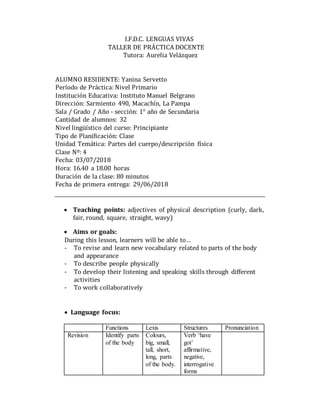
 Teaching points: adjectives of physical description (curly, dark,
fair, round, square, straight, wavy)

 Aims or goals: 
During this lesson, learners will be able to…
- To revise and learn new vocabulary related to parts of the body
and appearance
- To describe people physically
- To develop their listening and speaking skills through different
activities
- To work collaboratively
 Language focus:
Functions Lexis Structures Pronunciation
Revision Identify parts
of the body
Colours,
big, small,
tall, short,
long, parts
of the body.
Verb ‘have
got’
affirmative,
negative,
interrogative
forms
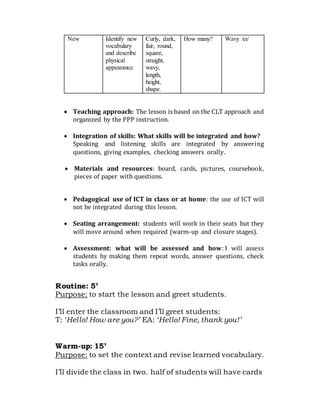
New Identify new
vocabulary
and describe
physical
appearance
Curly, dark,
fair, round,
square,
straight,
wavy,
length,
height,
shape.
How many? Wavy /eɪ/
 Teaching approach: The lesson is based on the CLT approach and
organized by the PPP instruction. 

 Integration of skills: What skills will be integrated and how? 
Speaking and listening skills are integrated by answering
questions, giving examples, checking answers orally.

 Materials and resources: board, cards, pictures, coursebook,
pieces of paper with questions.
 Pedagogical use of ICT in class or at home: the use of ICT will
not be integrated during this lesson.

 Seating arrangement: students will work in their seats but they
will move around when required (warm-up and closure stages).

 Assessment: what will be assessed and howI will assess
students by making them repeat words, answer questions, check
tasks orally. 
Routine: 5’
Purpose: to start the lesson and greet students.
I’ll enter the classroom and I’ll greet students:
T: ‘Hello! How are you?’ EA: ‘Hello! Fine, thank you!’
Warm-up: 15’
Purpose: to set the context and revise learned vocabulary.
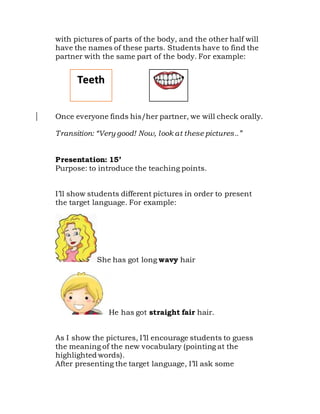
I’ll divide the class in two. half of students will have cards
with pictures of parts of the body, and the other half will
have the names of these parts. Students have to find the
partner with the same part of the body. For example:
Once everyone finds his/her partner, we will check orally.
Transition: “Very good! Now, look at these pictures..”
Presentation: 15’
Purpose: to introduce the teaching points.
I’ll show students different pictures in order to present
the target language. For example:
She has got long wavy hair
He has got straight fair hair.
As I show the pictures, I’ll encourage students to guess
the meaning of the new vocabulary (pointing at the
highlighted words).
After presenting the target language, I’ll ask some
Teeth
volunteers to give examples about themselves or their
peers using the new words.
Transition: “Great students! Now, let’s do some activities..”
Development: 30’
Purpose: to practise the target language using the
coursebook.
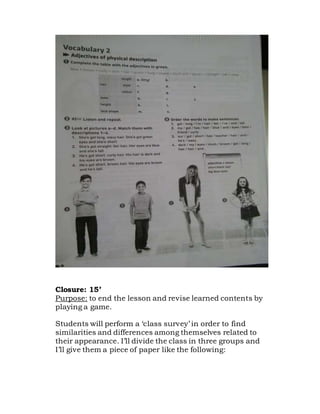
Students will work with their coursebooks in order to
practise the teaching points.
I’ll ask students to do activities 1, 3 and 4:
Students will work individually but they will be able to
discuss answers or doubts with their peers (as they are
already arranged in desks of two students). I’ll walk
around as well in case they need help.
Students’ answers will be checked orally but I’ll invite
some volunteers to write them on the board, too.
Closure: 15’
Purpose: to end the lesson and revise learned contents by
playing a game.
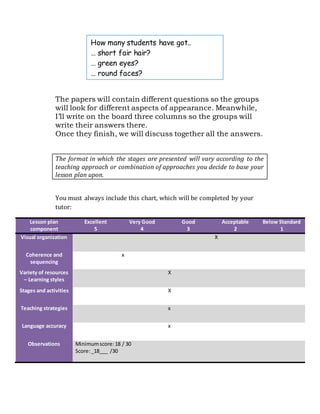
Students will perform a ‘class survey’ in order to find
similarities and differences among themselves related to
their appearance. I’ll divide the class in three groups and
I’ll give them a piece of paper like the following:
The papers will contain different questions so the groups
will look for different aspects of appearance. Meanwhile,
I’ll write on the board three columns so the groups will
write their answers there.
Once they finish, we will discuss together all the answers.
The format in which the stages are presented will vary according to the
teaching approach or combination of approaches you decide to base your
lesson plan upon.
You must always include this chart, which will be completed by your
tutor:
Lesson plan
component
Excellent
5
Very Good
4
Good
3
Acceptable
2
Below Standard
1
Visual organization X
Coherence and
sequencing
x
Variety of resources
– Learning styles
X
Stages and activities X
Teaching strategies x
Language accuracy x
Observations Minimumscore:18 / 30
Score:_18___ /30
How many students have got..
… short fair hair?
… green eyes?
… round faces?
Please,take commentsintoaccount. Youshouldfindseveral visualaidstoconveymeaning.Do
use picturesof real people.
Make the necessarychangestoimprove the lessonplan.
Have a greattime! 

lesson plan 4- primary level

  • 1.
    I.F.D.C. LENGUAS VIVAS TALLERDE PRÁCTICA DOCENTE Tutora: Aurelia Velázquez ALUMNO RESIDENTE: Yanina Servetto Período de Práctica: Nivel Primario Institución Educativa: Instituto Manuel Belgrano Dirección: Sarmiento 490, Macachín, La Pampa Sala / Grado / Año - sección: 1° año de Secundaria Cantidad de alumnos: 32 Nivel lingüístico del curso: Principiante Tipo de Planificación: Clase Unidad Temática: Partes del cuerpo/descripción física Clase Nº: 4 Fecha: 03/07/2018 Hora: 16.40 a 18.00 horas Duración de la clase: 80 minutos Fecha de primera entrega: 29/06/2018  Teaching points: adjectives of physical description (curly, dark, fair, round, square, straight, wavy)   Aims or goals:  During this lesson, learners will be able to… - To revise and learn new vocabulary related to parts of the body and appearance - To describe people physically - To develop their listening and speaking skills through different activities - To work collaboratively  Language focus: Functions Lexis Structures Pronunciation Revision Identify parts of the body Colours, big, small, tall, short, long, parts of the body. Verb ‘have got’ affirmative, negative, interrogative forms
  • 2.
    New Identify new vocabulary anddescribe physical appearance Curly, dark, fair, round, square, straight, wavy, length, height, shape. How many? Wavy /eɪ/  Teaching approach: The lesson is based on the CLT approach and organized by the PPP instruction.    Integration of skills: What skills will be integrated and how?  Speaking and listening skills are integrated by answering questions, giving examples, checking answers orally.   Materials and resources: board, cards, pictures, coursebook, pieces of paper with questions.  Pedagogical use of ICT in class or at home: the use of ICT will not be integrated during this lesson.   Seating arrangement: students will work in their seats but they will move around when required (warm-up and closure stages).   Assessment: what will be assessed and howI will assess students by making them repeat words, answer questions, check tasks orally.  Routine: 5’ Purpose: to start the lesson and greet students. I’ll enter the classroom and I’ll greet students: T: ‘Hello! How are you?’ EA: ‘Hello! Fine, thank you!’ Warm-up: 15’ Purpose: to set the context and revise learned vocabulary. I’ll divide the class in two. half of students will have cards
  • 3.
    with pictures ofparts of the body, and the other half will have the names of these parts. Students have to find the partner with the same part of the body. For example: Once everyone finds his/her partner, we will check orally. Transition: “Very good! Now, look at these pictures..” Presentation: 15’ Purpose: to introduce the teaching points. I’ll show students different pictures in order to present the target language. For example: She has got long wavy hair He has got straight fair hair. As I show the pictures, I’ll encourage students to guess the meaning of the new vocabulary (pointing at the highlighted words). After presenting the target language, I’ll ask some Teeth
  • 4.
    volunteers to giveexamples about themselves or their peers using the new words. Transition: “Great students! Now, let’s do some activities..” Development: 30’ Purpose: to practise the target language using the coursebook. Students will work with their coursebooks in order to practise the teaching points. I’ll ask students to do activities 1, 3 and 4: Students will work individually but they will be able to discuss answers or doubts with their peers (as they are already arranged in desks of two students). I’ll walk around as well in case they need help. Students’ answers will be checked orally but I’ll invite some volunteers to write them on the board, too.
  • 5.
    Closure: 15’ Purpose: toend the lesson and revise learned contents by playing a game. Students will perform a ‘class survey’ in order to find similarities and differences among themselves related to their appearance. I’ll divide the class in three groups and I’ll give them a piece of paper like the following:
  • 6.
    The papers willcontain different questions so the groups will look for different aspects of appearance. Meanwhile, I’ll write on the board three columns so the groups will write their answers there. Once they finish, we will discuss together all the answers. The format in which the stages are presented will vary according to the teaching approach or combination of approaches you decide to base your lesson plan upon. You must always include this chart, which will be completed by your tutor: Lesson plan component Excellent 5 Very Good 4 Good 3 Acceptable 2 Below Standard 1 Visual organization X Coherence and sequencing x Variety of resources – Learning styles X Stages and activities X Teaching strategies x Language accuracy x Observations Minimumscore:18 / 30 Score:_18___ /30 How many students have got.. … short fair hair? … green eyes? … round faces?
  • 7.
    Please,take commentsintoaccount. Youshouldfindseveralvisualaidstoconveymeaning.Do use picturesof real people. Make the necessarychangestoimprove the lessonplan. Have a greattime! 